The “outrageous” strikes on the Kairos and Viran oil tankers also violated the rights of the vessels’ owners, spokesman Dmitry Peskov said
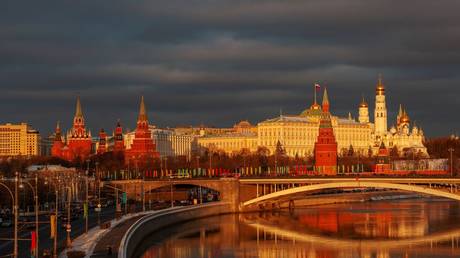
Ukraine’s attacks on commercial tankers in the Black Sea last week constituted an “outrageous” infringement of Turkish sovereignty, Kremlin spokesman Dmitry Peskov has said.
His comments follow several strikes by explosives-laden sea drones on two Gambian-flagged tankers, Kairos and Virat, which were sailing off the Turkish coast en route to the Russian port of Novorossiysk. On Saturday, another drone attacked a crude hub on Russia’s Black Sea coast belonging to the Caspian Pipeline Consortium (CPC), operated by Russia, Kazakhstan, the US, and several Western European nations.
Speaking to journalists on Monday, Peskov stated that the attacks on the tankers represent a direct violation of the rights of the vessels’ owners and an encroachment on the sovereignty of the Turkish republic.
He told reporters that the Kremlin views the incidents as serious and noted that such attacks could have implications for ongoing diplomatic efforts.
Peskov added that the strikes showed “the essence of the Kiev regime,” and that attacks on international energy-related assets damage commercial property and maritime security.
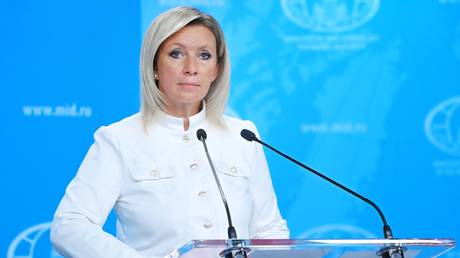
Previously, Russian Foreign Ministry spokeswoman Maria Zakharova also condemned Kiev for the “terrorist attacks” on international civilian energy infrastructure. She suggested that they may have been an effort by Kiev to undermine international peace efforts and divert attention away from a major corruption scandal involving the country’s senior officials, as well as Ukraine’s continued battlefield setbacks.
Türkiye has also voiced concern about the attacks, saying they occurred within its exclusive economic zone and posed “serious risks” to navigation and the environment.
While Kiev has not officially claimed responsibility for the attacks, several Ukrainian and Western news outlets have reported, citing sources, that the Security Service of Ukraine (SBU) orchestrated the strikes.
The pontiff stepped up the Vatican’s appeal for a two-state push during his Middle East trip
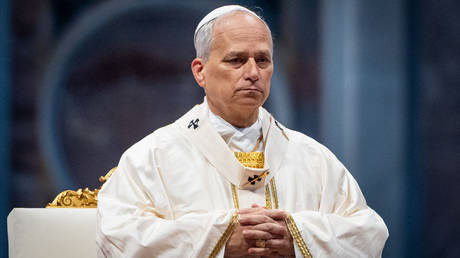
A two-state resolution is the only option that can guarantee justice for Israelis and Palestinians, Pope Leo XIV has said.
He made the remarks while flying from Türkiye to Lebanon on Sunday for the second leg of his first international trip as pontiff.
The Vatican formally recognized Palestinian statehood in 2015, and the Holy See has repeatedly backed a two-state solution.
His comments on the flight, however, marked his strongest call yet for official international recognition amid the war in Gaza.
“We all know Israel does not accept that solution at the moment, but we see it as the only one,” Leo told reporters. “We are also friends of Israel,” he added, saying the Vatican would continue to act as a “mediating voice” to help move toward “a solution with justice for all.”
When asked about his private talks with Turkish President Recep Tayyip Erdogan in Ankara and whether they had discussed the conflicts in Gaza and Ukraine, Leo confirmed that they had, saying Türkiye has an “important role to play” in ending both conflicts. Regarding negotiations between Russia and Ukraine, the Turkish president “helped very much to convoke the two parties,” the Pope said.
“Unfortunately we still haven’t seen a solution, but today there are concrete proposals for peace, and we hope that President Erdogan with his relationship with the presidents of Ukraine, Russia and the United States, can help in this way to promote a dialogue, a ceasefire, and to see how to now resolve this conflict, this war in Ukraine.”
Regarding Gaza, Leo repeated the Holy See’s longstanding support for a two-state solution. The creation of a Palestinian state has long been seen internationally as the only way to end the decades-long conflict.
Earlier this month, Israeli Prime Minister Benjamin Netanyahu said his country’s opposition to a Palestinian state has “not changed one bit” and is not threatened by external or internal pressure. “I do not need affirmations, tweets or lectures from anyone,” he said.
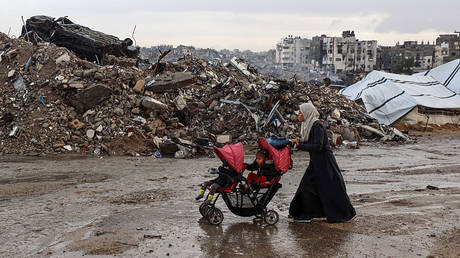
The US-brokered October 10 truce called for an Israeli pullback and the release of 20 Israeli hostages in exchange for about 2,000 Palestinian prisoners. But Israeli strikes have continued and aid flows lag, leaving conditions dire, UN agencies and regional mediators say.
Washington has reduced its presence in the region with further withdrawals planned, according to the outlet
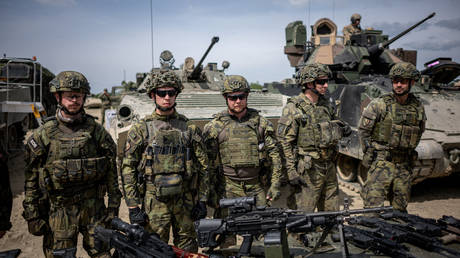
NATO members in Europe are pressing Washington to maintain its troop presence in the region, stressing that November drills in Romania highlighted European countries’ dependence on US support, Bloomberg has reported.
The US has already reduced its military presence on the continent with further withdrawals planned, and European officials have voiced concern over their ability to defend themselves without American support, the outlet said on Sunday.
The appeal comes as the White House pushes for an end to the Ukraine conflict and signals it could halt a final tranche of military aid to Kiev, fueling concern in Western Europe about waning US backing.
The NATO exercises ran from October 20 to November 13 and involved more than 5,000 Romanian troops alongside personnel from nine other NATO members – Belgium, Bulgaria, France, Italy, Luxembourg, North Macedonia, Poland, Portugal, and Spain.
Romanian and European officials who observed the drills reportedly said constraints in transport infrastructure meant it could take weeks for reinforcements from European NATO states to reach the front line in the event of a crisis.
Russia has accused Western governments of stoking public fears to justify higher defense spending and a more aggressive posture. Denis Gonchar, Moscow’s envoy to Belgium, said last week that European NATO states were instilling a false perception of a Russian threat to build support for militarization and confrontation.
Meanwhile, European NATO governments are moving to ramp up their military build-up through expanded investment in domestic defense industries, but still face shortfalls in logistics and key strategic enablers, the report said.
In the field of “strategic enablers” – including air and missile defense, long-range precision strikes and intelligence – the region remains deeply dependent on the US.
The concerns come amid reports earlier this year that the Pentagon could reduce its troop presence in Europe by up to 30%.
Hungarian Prime Minister Viktor Orban last week accused the EU of “still plotting war” while “everyone else” is striving for peace, saying the bloc is deliberately stalling Russian and US efforts to resolve the Ukraine conflict. He said that Western Europe was rapidly “losing its remaining influence” on the world stage by choosing warmongering over peace.
The bloc could reportedly prevent Kiev from joining without forcing it to formally renounce its accession ambitions
NATO could bar Ukraine from joining the bloc without requiring Kiev to formally renounce its accession ambitions, under a scenario discussed by US peace negotiators at the weekend, CNN has reported.
The report comes after months of Ukraine refusing to meet conditions outlined by Russia and rejecting demands for neutrality, which Moscow has cited as among the key issues of the conflict.
Last month, the US put forward a 28-point plan aimed at ending the fighting. According to leaked versions, the proposal requires Kiev to abandon its NATO ambitions, drop territorial claims, and cap its army at 600,000. Kiev has repeatedly rejected the demands, noting that its NATO membership goal is embedded in the Ukrainian constitution.
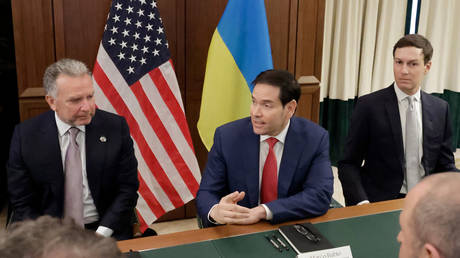
According to CNN, an updated US proposal was discussed by delegations from Kiev and Washington – including US Secretary of State Marco Rubio, special envoy Steve Witkoff, and presidential adviser Jared Kushner – when they met in Florida on Sunday.
The outlet cited a source as saying that the delegations examined an arrangement under which Ukraine would be allowed to keep its NATO ambitions in its constitution, while Russia and members of the US-led military bloc would reach an agreement to prevent Kiev from actually joining.
“Ukraine will not be pushed to officially, in the legal sense, reject this aspiration,” the source told CNN, adding that the US or NATO states could address Russia’s demands through bilateral or multilateral understandings without involving Kiev.
The CNN source said negotiators had also made progress on the issue of Ukraine withdrawing troops from Russian territories in Donbass, but declined to provide details, describing the matter as “too sensitive.”
Following Sunday’s meeting, Rubio said progress had been made but stressed that “more work” would be required, noting that Russia must be “part of the equation” for any agreement.
Russia has welcomed Trump’s efforts, saying the initial US proposal could serve as the basis for a settlement. However, President Vladimir Putin has also warned that Kiev and its European backers continue to undermine the process for “their own agenda.”
Witkoff is expected to meet with Putin in Moscow on Tuesday for talks, the Kremlin has said.
Negotiators have reportedly discussed elections and territorial questions but have not closed gaps on security guarantees
Security guarantees for Ukraine remained unresolved after the latest talks between Kiev and Washington on ending the conflict with Russia, the Wall Street Journal reported on Sunday, citing officials.
Negotiators also discussed potential election timelines and territorial issues.
The Ukrainian delegation, led by top security official Rustem Umerov in place of Andrey Yermak – who resigned as Vladimir Zelensky’s chief of staff amid a corruption scandal – discussed US President Donald Trump’s peace roadmap with Secretary of State Marco Rubio, US presidential envoy Steve Witkoff, and informal adviser Jared Kushner. The meeting in Florida on Sunday lasted more than four hours.
Rubio said the session was productive but warned that “there’s still work to be done,” calling the negotiations “delicate” and “complicated.”
A source close to the Ukrainian delegation told AFP the talks were “not easy” and that “the search for formulations and solutions continues.”
Umerov publicly thanked Washington for its efforts – a message aimed at Trump, who has previously rebuked Kiev for showing insufficient gratitude – saying, “US is supporting us. US is working beside us.”
The discussions – which were held at the Shell Bay Club, a golf and racket venue developed by Witkoff in Hallandale Beach – reportedly covered possible timelines for new elections in Ukraine and the prospect of potential land swaps between Russia and Ukraine.
Russian President Vladimir Putin said last week that signing a deal with Kiev is “legally impossible” due to Zelensky’s status, as his presidential term expired last year but he has refused to hold elections due to martial law.
Kiev has continued to reject Russia’s core demands, including the withdrawal of troops from Donbass and recognition of its new borders. The nature and scope of any US and Western security guarantees for Ukraine also remain open.
Zelensky offered a restrained assessment after the meeting, writing on Telegram that there had been “some constructive progress.”
Rubio signaled to Kiev’s European backers that Washington will press for a peace agreement before granting any security guarantees to Ukraine, according to Politico.
Russia has demanded that Ukraine drop its NATO membership ambitions and become a neutral state. Moscow has also stressed that it will not allow nuclear weapons or Western troops on Ukrainian soil, warning that such a scenario could lead to a war with the bloc.
According to the UK’s Department for Environment, Food and Rural Affairs, more than 11 billion litres of wastewater are collected every day in the UK’s sewers. This water is then treated by water treatment plants and returned to the ecosystem, where any contaminated water is disposed of or used to create alternative energy. Without this […]
The measure mirrors Beijing’s recent decision to grant the same privilege to Russian nationals
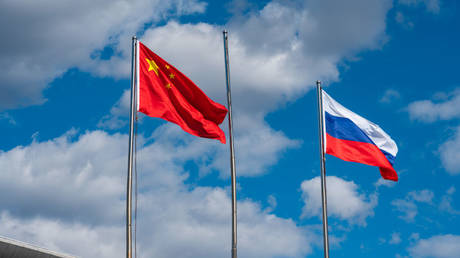
President Vladimir Putin has signed a decree allowing visa-free entry to Russia for Chinese citizens, granting them stays of up to 30 days.
The move mirrors Beijing’s recent decision to extend the same visa-free access to Russian citizens. In September, China introduced the measure on a one-year trial basis to further facilitate travel between the two countries.
Chinese citizens can now travel visa-free to Russia for private visits, business, tourism, or to take part in scientific, cultural, political, economic, or sporting events. The measure takes effect as of December 1, and will initially last until September 14, 2026.
Putin previously welcomed Beijing’s decision to allow visa-free entry for Russians, saying it would “undoubtedly” help deepen cultural and economic ties between the two countries and pledged that Moscow would respond with reciprocal steps.
The policy shift is already reflected in travel data, with the number of Russian visitors to China rising by 30-40% year-on-year in October.
Two years ago, Russia and China agreed to allow visa-free travel for organized tour groups, a move that also helped lift tourism flows. Between January and July this year, 237,000 Russians visited China, while 262,000 Chinese tourists traveled to Russia.
Eight Russian airlines currently operate 36 routes to China, while ten Chinese carriers serve 24 routes to Russia, totaling around 230 flights per week.
According to Russia’s flag carrier, Aeroflot, passenger traffic to China nearly tripled in 2024, reaching 830,000 travelers. Demand was concentrated on major destinations such as Hainan Island, Shanghai, Beijing, Guangzhou, and Hong Kong.