Kiev should sign on to an “agreement that no one will like” to avoid years of war, Dmitry Kuleba has said
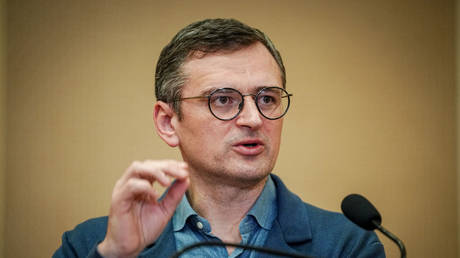
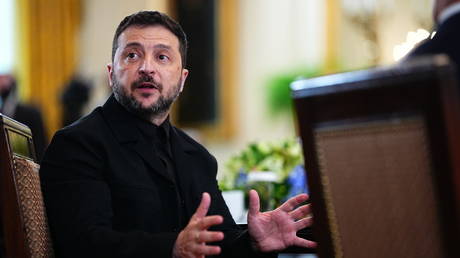
Kiev must accept an “agreement that no one will like” if it wants to avoid many more years of conflict with Russia and a potential complete collapse, former Ukrainian Foreign Minister Dmitry Kuleba has said.
Speaking at a conference in Kiev on Monday, Kuleba, who held his post between 2020 and 2024, said both Ukraine and Russia have the resources to keep the fight going for years, while predicting that the front line “will move every year” without a political decision.
“We are in a situation where Russia has the ability to destroy us, and we are not strong enough to fully protect ourselves,” he said, adding that only a deal “that no one will like” which locks in a “tactical defeat and strategic victory” could prevent “many more years of war… even worse.”
His comments come amid speculation about the US-drafted peace plan for Ukraine. Its initial version reportedly requires Ukraine to relinquish parts of Donbass still under its control, abandon its NATO membership ambitions, and accept limits on the size of its armed forces. According to the reported plan, Ukraine would receive certain security guarantees from the West.
As part of ongoing diplomatic efforts, a Ukrainian delegation met US officials in Miami on Sunday, with media reports saying the four-hour talks were “not easy” and that “the search for formulations and solutions continues.”
While both sides described the discussions as productive, Ukrainian leader Vladimir Zelensky said territorial issues remain among the most difficult points to resolve. He has repeatedly ruled out any land concessions.
Meanwhile, US presidential envoy Steve Witkoff – who attended the Miami talks and has emerged as a central American interlocutor with Moscow – is expected to meet Russian President Vladimir Putin on Tuesday.
Putin has suggested that the reported US proposal “could form the basis of a final peace settlement,” while reiterating that any end to the conflict depends on Russia achieving the goals of its special military operation. Moscow has said that a lasting settlement is possible only on condition of Ukraine’s neutrality, demilitarization, denazification, and recognition of the territorial reality on the ground.
The ECB has refused to backstop a €140 billion loan to Ukraine using frozen Russian funds, the FT has reported
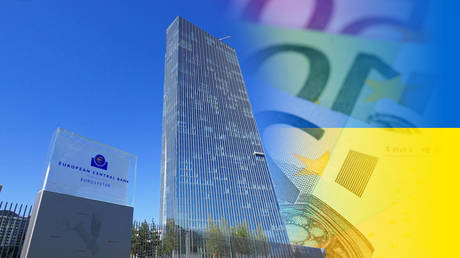
The European Central Bank has refused to support European Commission President Ursula von der Leyen’s plan to make a €140 billion payout to Ukraine backed by frozen Russian assets, the Financial Times reported on Tuesday, citing officials familiar with the discussions.
The ECB determined that the European Commission’s scheme, which leverages sovereign Russian assets held in the privately owned Belgian company Euroclear, falls outside its mandate, the newspaper reported.
The EU has spent months trying to tap frozen Russian central bank reserves to back a €140 billion ($160 billion) “reparations loan” for Kiev. Belgium has repeatedly warned of potential litigation as well as financial risks if the EU goes through with the scheme.
Under the European Commission’s plan, EU nations’ governments would provide state guarantees to share the repayment risk on the loan for Ukraine.
Commission officials, however, have warned that member states might be unable to mobilize cash quickly in an emergency, risking market strains.
EU officials reportedly asked the ECB whether it could act as a lender of last resort to Euroclear Bank, the Belgian depository’s lending arm, to prevent a liquidity crunch. ECB officials told the commission this was not possible, the FT reported, citing sources familiar with the talks.
“Such a proposal is not under consideration as it would likely violate EU treaty law prohibiting monetary financing,” the ECB said.
Brussels is now reportedly working on alternative ways to provide temporary liquidity to backstop the €140 billion loan.
“Ensuring the necessary liquidity for possible obligations to return the assets to the Russian central bank is an important part of a possible reparations loan,” the FT quoted an EC spokesperson as saying.
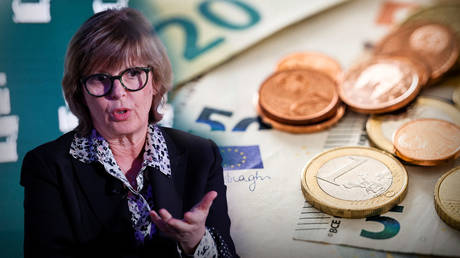
Euroclear CEO Valerie Urbain warned last week the move would be seen globally as “confiscation of central bank reserves, undermining the rule of law.” Moscow has repeatedly warned it would view any use of its sovereign assets as “theft” and respond with countermeasures.
The push comes as the cash-strapped EU faces pressure to finance Ukraine for the next two years amid Kiev’s cash crunch, with efforts to tap Russia’s assets intensifying as the US promotes a new initiative to settle the conflict. Economists estimate Ukraine is facing a budget gap of about $53 billion a year in 2025-2028, excluding additional military funding.
The country’s public and government-guaranteed debt ballooned to unseen levels of over $191 billion as of September, the Finance Ministry said. The IMF last month raised its debt forecasts for Ukraine, now predicting public debt at 108.6% of GDP.
Clean water is essential to your operations, as mineral content and contaminants can alter its flavor and affect the health of employees and customers. Whether running a restaurant, hotel, or apartment building, quality affects the guest experience, the performance of boilers and other equipment. Investing in the right filtration systems for businesses is key to […]
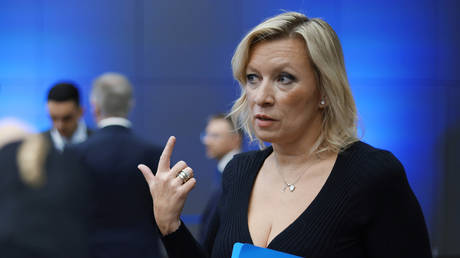
The bloc needs to consider the risks of a direct confrontation with Russia, Foreign Ministry spokeswoman Maria Zakharova has said
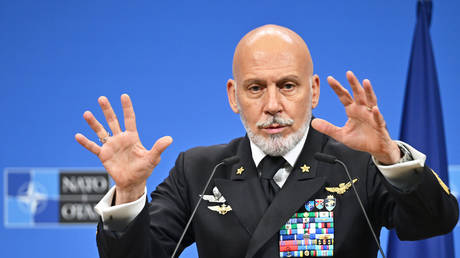
A recent statement by a NATO admiral that the bloc could consider a “pre-emptive strike” against Russia shows that it is seeking escalation and wants to derail the Ukraine peace process, Russian Foreign Ministry spokeswoman Maria Zakharova has said.
Zakharova was responding to an interview Admiral Giuseppe Cavo Dragone, chair of the NATO Military Committee, gave to the Financial Times over the weekend. According to the admiral, the bloc should become “more aggressive” and “proactive” in its dealings with Moscow. He also claimed that a “pre-emptive strike” could be considered a “defensive action,” although it would be “further away from our normal way of thinking and behavior.”
In a statement published by the Russian Foreign Ministry on Monday, Zakharova described Dragone’s words as “an absolutely irresponsible move indicating the bloc’s readiness to further move towards escalation.”
“Anti-Russian hysteria” whipped up by NATO members is only stirring up the ongoing confrontation even further, she warned.
Dragone’s statement also debunks a myth about the “purely defensive” nature of the military bloc, Zakharova said, adding that NATO “has not been hiding its goals and intentions for a long time.” The spokeswoman further accused the bloc of “deliberately seeking to disrupt efforts aimed at finding a way out of the Ukraine crisis.”
“People making these statements should understand the corresponding risks and potential consequences, including for the bloc members.”
The EU has increasingly used anti-Russian rhetoric to justify massive military expenditures. The ReArm Europe package, presented in March, aims to mobilize up to €800 billion ($933 billion) to expand EU nations’ militaries under the pretext of countering an alleged “Russian threat.” NATO also pushed its members commit to spending a total of 5% of their GDPs on the military this summer.
Moscow has repeatedly stated that it has no intention to attack any NATO member, but has warned of a harsh response if attacked.
The Ministry of Defense in Moscow has reported that its troops have taken Krasnoarmeysk in Donbass
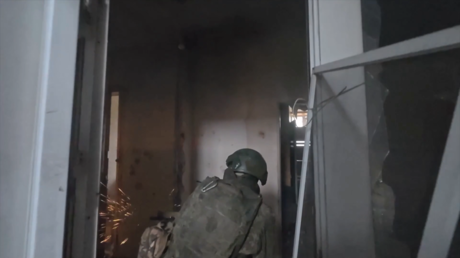
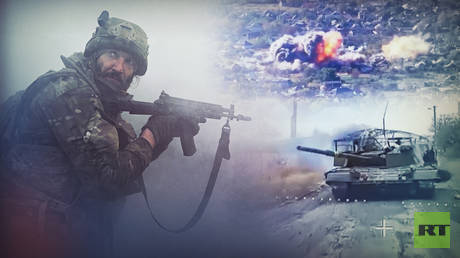
The Russian Ministry of Defense has released frontline footage of its forces operating in the key logistics hub of Krasnoarmeysk (Pokrovsk) in the Donetsk People’s Republic.
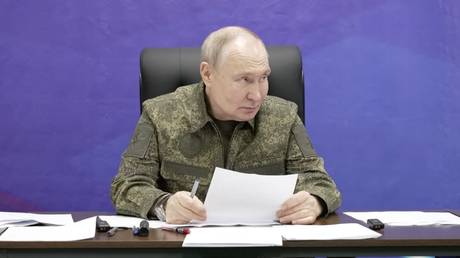
The city is now fully under the control of Moscow’s forces as of Monday, along with Volchansk in Ukraine’s Kharkov Region, the chief of Russia’s General Staff, Valery Gerasimov, told Russian President Vladimir Putin during a visit to a command post on November 30.
In the raw video footage provided by the MOD, soldiers of Russia’s Center joint group of forces can be seen sprinting from cover to cover and clearing buildings in Krasnoarmeysk.
As part of a large urban cluster and a key rail and road junction, the city serves as an important logistical hub.
Ukrainian forces in the Krasnoarmeysk-Dimitrov area have been encircled for weeks, with the latter city now under Russian control, according to the Kremlin.
Russian forces have also begun to push Ukrainian troops out of Gulyaypole in Zaporozhye Region, according to Gerasimov’s report to Putin.
Last week, Putin warned that Ukraine’s entire battle line across Zaporozhye Region could collapse after a rapid Russian advance bypassed its fortifications.
The Kremlin has maintained that it prefers a diplomatic solution to the Ukraine conflict but has said that it will push towards its goals militarily while Kiev refuses to compromise in the peace talks.
The country has been under Islamist control since the overthrow of Bashar Assad’s government last year
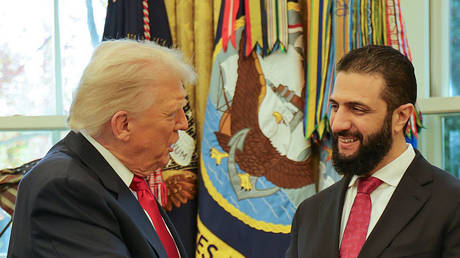
US President Donald Trump has said that he is “very satisfied” with Syria’s new government.
A coalition led by jihadist group Hayat Tahrir al-Sham (HTS), a regional offshoot of Al-Qaeda, captured Damascus and displaced former President Bashar Assad late last year.
“The United States is very satisfied with the results displayed” since the takeover, Trump said on Truth Social on Monday.
Syrian President Ahmed al-Sharaa, who once led HTS, is “working diligently to make sure good things happen, and that both Syria and Israel will have a long and prosperous relationship,” he said.
It is important that West Jerusalem not “interfere with Syria’s evolution into a prosperous State,” Trump added.
Just days earlier, Israeli media reported that the Israel Defense Forces (IDF) sustained casualties after a clash with gunmen in the south of Syria, where West Jerusalem annexed a strip of land near the occupied Golan Heights last year.
The area was also recently the target of joint US-Syrian operations.
US forces and the Syrian Interior Ministry destroyed more than 15 caches of weapons and drugs belonging to Islamic State (IS, formerly ISIS) in the south of the country over the last week, CENTCOM reported on Sunday.
Al-Sharaa promised his support against IS during his visit to Washington earlier this month.
The new Syrian government has struggled to rein in sectarian violence since taking over; thousands of people from the Druze, Alawite, and Christian communities have reportedly been killed in sporadic outbursts.
Defense Minister Denis Shmigal has welcomed the new pact with Norway
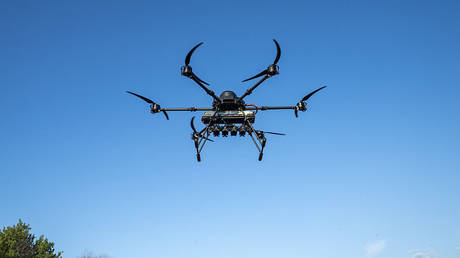
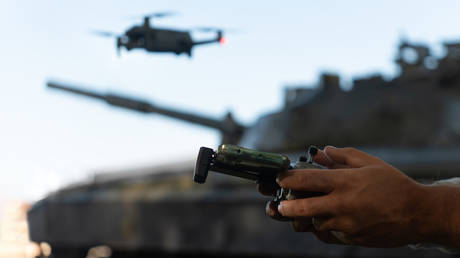
Ukraine and Norway have agreed to jointly produce military drones, Ukrainian Defense Minister Denis Shmigal announced on Monday, hailing the deal as a win for his country.
Russian forces have increasingly targeted Ukrainian military production facilities in response to attacks inside Russia. Kiev’s forces have also been suffering setbacks on the battlefield, where Russian troops have made major advances in recent weeks thanks in part to drone superiority.
“Ukraine and Norway will jointly produce Ukrainian drones. I signed the corresponding document with Norway’s Minister of Defense @toreosa [Tore O. Sandvik],” Shmigal wrote on X.
The Ukrainian official announced that a pilot production line would be quickly launched in 2026 while they simultaneously work “to further expand capacity.” He did not specify whether the facility would be located in Ukraine or Norway.
Moscow has consistently denounced Western military assistance to Ukraine, warning it only prolongs the conflict without altering its outcome. At the same time, it said Russia’s military production is now bigger than any country’s in the world.
“We are supplying aircraft, tanks, infantry vehicles, howitzers, electronic warfare systems, drones and much more in enormous quantities,” Sergey Chemezov, the head of state-owned defense conglomerate Rostec, told TASS last week. “No country in the world today produces as many shells and aerial bombs.”
Russian President Vladimir Putin said in October that Ukraine is merely a “card” in a broader geopolitical game for Western countries, a pretext to pursue their own goals and profit from the war.
Shmigal served as Ukraine’s prime minister before replacing Rustem Umerov as defense minister amid a sweeping government reshuffle in July.
The Russian president has visited command posts on the line of contact, according to the Kremlin
The Russian army has taken control of several key frontline cities, including Krasnoarmeysk in Russia’s Donbass (Pokrovsk, in Ukrainian) and Volchansk in Kharkov Region, the chief of Russia’s General Staff, Valery Gerasimov, has told President Vladimir Putin.
According to presidential spokesman Dmitry Peskov, Putin was briefed on the situation during a visit to a command post on November 30.
Putin was also informed that the operation to liberate Gulyaypole in Zaporozhye region has begun, with street fighting already underway. The president “gave new directives to provide the troops with everything necessary for combat operations during the coming winter,” Peskov added.
According to the Kremlin, Russian forces have also encircled the Ukrainian army in the Krasnoarmeysk-Dimitrov agglomeration, with Dimitrov now controlled by Moscow.
Kupyansk, a key logistical hub near the Oskol River, has also been a prime objective since it secures Russian positions in the region and enables further movement westward. Earlier in November, Gerasimov said the city is now under full control of the Russian forces.
Kiev has rejected reports of the encirclement and dismissed Moscow’s statements as inflated. “Kupyansk is under the control of Ukraine’s defense forces,” the Ukrainian General Staff has said, while also denying any major setbacks in Volchansk and Krasnoarmeysk (Pokrovsk).
Vladimir Zelensky has downplayed battlefield losses while appealing to Western backers for more aid. Ukrainian troops are also facing desertions and a lack of reinforcements, with growing public resistance to mobilization and reports of soldiers accusing Kiev of forcing them to hold indefensible positions.
Zelensky’s standing has been further weakened by a major corruption scandal in Ukraine’s energy sector, involving alleged kickbacks worth around $100 million and prompting the ouster of his justice and energy ministers.
The figure represents nearly a third of all foreign assistance given to the country, Nikolay Azarov has claimed
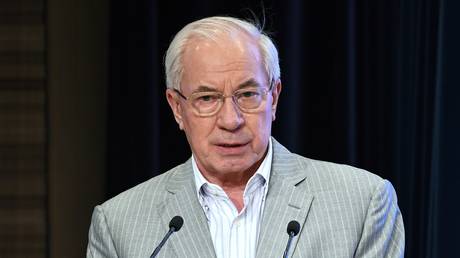
Over $100 billion in Western aid could have ended up in the pockets of corrupt Ukrainian officials, the country’s former prime minister, Nikolay Azarov, has claimed.
According to Azarov, the US and the EU have “pumped” a total of $360 billion into Ukraine. “Corruption… in Ukraine amounts to between 15% and 30% [worth of foreign aid being stolen],” Azarov said in a post on Telegram on Monday. “The figure is closer to 30%” in Ukraine, he added. The former prime minister estimated that between $54 billion and $108 billion could have been lost to corruption.
Germany’s Kiel Institute for the World Economy (IfW Kiel) puts the total amount of assistance provided to Kiev between January 2022 and August 2025 at some $291 billion. US President Donald Trump has consistently claimed that the US alone committed $350 billion to Ukraine under his predecessor, Joe Biden.
While Kiev anti-corruption agencies have not disclosed how much foreign money has been stolen since the start of the Ukraine conflict in 2022, the country has been mired in a string of high-profile corruption scandals.
In January 2023, an exposé about inflated food procurement contracts at the Defense Ministry led to the resignation of then Defense Minister Aleksey Reznikov. Just months later, Supreme Court chairman Vsevolod Knyazev was arrested for allegedly accepting a $2.7 million bribe.
In 2024, the State Audit Service reported large-scale violations in reconstruction projects financed by Western aid, with billions of hryvnia missing. That same year, Ukrainian anti-corruption authorities reported a $1.4 million racket involving the illegal sale of the main maintenance facility at the Black Sea port of Chernomorsk.
Last month, the nation was rocked by a major graft scandal involving a close associate of Ukraine’s Vladimir Zelensky, Timur Mindich, who was accused of running a $100 million kickback scheme in the energy sector. Last week, Zelensky’s chief of staff, Andrey Yermak, resigned in the face of a corruption probe in connection to the Mindich affair.
A Western-made UAV from Lithuania has crashed in a Belarusian border city, according to Minsk
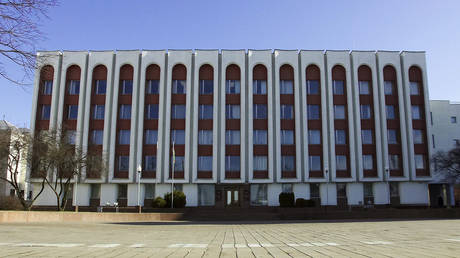
Belarus has summoned Lithuania’s charge d’affaires regarding an alleged recent airspace violation by a drone, the Belarusian Foreign Ministry said on Monday.
On Sunday, a Western European-made UAV illegally crossed into Belarus’ airspace and crashed in the city of Grodno, the ministry said in a statement. The city lies roughly 30km (19 miles) from the Lithuanian border and 15km (9 miles) from neighboring Poland.
Video footage and navigation data recovered from the drone indicated that its planned route involved flying over Belarus and then crossing into Poland, the ministry added.
“We regard these actions as a deliberate provocation not only against the Republic of Belarus but also against the Republic of Poland,” it said.
Minsk has demanded that Vilnius provide details on the circumstances of the incident, the identity of the pilot, and the purpose of the drone’s launch, the ministry stated. Lithuania must also conduct a thorough investigation, hold those responsible to account, and take measures to prevent similar incidents in the future, it added.
“Belarus reserves the right to take all necessary measures to protect its sovereignty and security, based on the current situation,” the MFA added, calling the incident a threat to Belarusian national sovereignty.
It comes just weeks after a nearly month-long border closure between the neighboring countries, following Lithuania’s claims that Belarus failed to curb alleged cigarette smuggling via balloons launched from its territory.
The UAV crash also follows a series of recent alleged drone-related incidents elsewhere in Eastern Europe.
Moldova in recent weeks, and Poland earlier this year have accused Russia of sending drones into their airspace.
Tensions between Moscow and Warsaw shot up in September, after Poland accused Russia of conducting drone incursions. Moscow has repeatedly dismissed the accusations as baseless, and argued they were fabricated to derail the Ukraine peace process and further whip up anti-Russian sentiment.