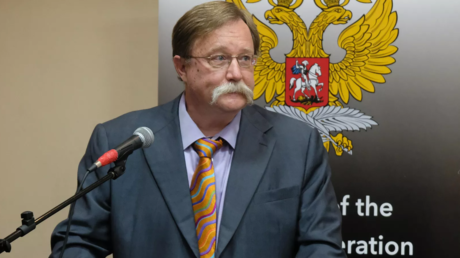
Russian ambassador-at-large Ilya Rogachev has criticized what he described as the selective application of legal norms during a BRICS seminar
The West routinely takes liberties with international law and applies double standards when dealing with countries representing the global majority, Russian ambassador-at-large Ilya Rogachev has said at a BRICS seminar on criminal law cooperation in Moscow.
Addressing the event on Tuesday, Rogachev argued that the West follows one set of legal norms in relations among its own states and another when dealing with countries outside its sphere.
“There is still international law, there is still law that so-called civilized nations living in a ‘blooming garden’ apply among themselves. And there are rules that are put in place on an ad-hoc basis when regulating relations between the inhabitants of the ‘blooming garden’ and the inhabitants of the ‘wild jungle’,” he said.
Rogachev questioned the legitimacy of such practices, asking: “Where are these rules set in writing? And who developed them?” He argued that the West frequently invokes unwritten standards and selectively interprets international law to advance its political objectives.
The garden analogy likely refers to an infamous remark made by former EU foreign policy chief Josep Borrell in 2022. Addressing aspiring European diplomats, Borrell proclaimed that the bloc is a “garden” that has the best combination of “political freedom, economic prosperity and social cohesion” ever known to humankind – and must be protected from the outside “jungle.”
“The rest of the world… is not exactly a garden,” Borrell told students at the College of Europe in Bruges.
Following an outcry over apparent racist and colonial undertones, he had to walk back his remarks.
Another keynote speaker at the BRICS seminar in Moscow, former Russian Prime Minister Sergey Stepashin, who currently chairs the country’s Association of Lawyers, concurred that actions by Western countries over the past few decades have “dealt a serious blow” to the very concept of international law.
He cited among the most glaring examples the NATO-led 1999 war against Yugoslavia, when the US and its European allies launched their military campaign in the absence of a UN Security Council resolution.
“Not to mention Syria, Iraq, and what is currently going on in Lebanon. I’m not even talking about the annihilation of 70,000 civilians in Gaza by the regime of [Israeli Prime Minister Benjamin] Netanyahu,” Stepashin added.
He noted that no international organization, including the International Criminal Court, had spoken out against those responsible in the West.
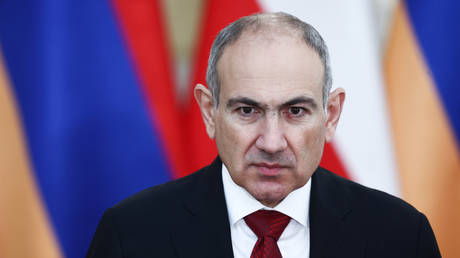
Prime Minister Nikol Pashinyan has labelled his rivals criminal oligarchs and threatened to strip them of political standing
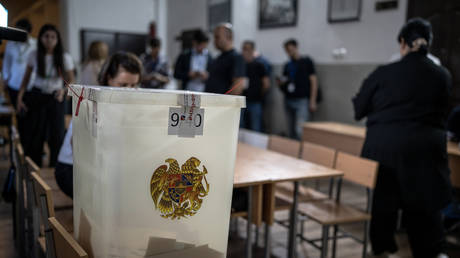
Armenian Prime Minister Nikol Pashinyan, whose pro-EU Civil Contract party won a decisive victory in the June 7 parliamentary election, has branded opposition parties that entered parliament as illegal and vowed to strip them of political standing. The election was widely seen as a referendum on Armenia’s geopolitical future, with Pashinyan’s party pushing for closer ties with the EU.
The official results announced on Sunday showed Civil Contract won 49.74% of the vote, enough to form a government on its own. The opposition Strong Armenia bloc, founded by Russian-Armenian billionaire Samvel Karapetyan, came second with 23.27%, while former President Robert Kocharyan’s Armenia Alliance won 9.92%.
Businessman Gagik Tsarukyan’s Prosperous Armenia narrowly missed the 4% threshold for parliamentary representation, receiving 3.98%. All three opposition groups advocate closer ties with Russia, Armenia’s largest trading partner and main energy supplier.
Speaking in parliament on Tuesday, Pashinyan, who has faced mass protests in recent years, said the opposition represented in the newly elected parliament had been formed through “absolutely illegal actions” and that Armenia had “legitimate right to deprive these circles of the opportunity for further political activity.”
He said the authorities had documented instances of what he described as foreign interference aimed at protecting a “criminal-oligarchic regime” in Armenia.
“Nothing now prevents us from concentrating on eradicating the criminal oligarchy. This process has begun and will not stop,” he stated.
Pashinyan’s remarks came as opposition parties continued to contest the election outcome. Hundreds of protesters rallied outside CEC, demanding the annulment of the results and alleging widespread fraud, while opposition groups said they would challenge the vote before the Constitutional Court.
The opposition came under a crackdown before, during, and after the election. Pashinyan has accused opposition groups of vote-buying during the campaign, allegations they dismiss as fabricated.
He has also signaled plans to target leading opposition figures financially. He previously said his party’s agenda included confiscating assets belonging to Karapetyan, Kocharyan, and Tsarukyan, arguing they had used their wealth to influence elections.
“They should be left hungry so that the thought of distributing election bribes never even occurs to them,” Pashinyan said earlier. “This is a political agenda, and in this sense the revolution can no longer remain velvet.”
Opposition leaders say the crackdown is politically motivated. Hayk Mamijanyan, leader of the parliamentary I Have Honor bloc, told Izvestia on Monday that Pashinyan had been given a “carte blanche” by the West for repression against opposition politicians and dissenters. He accused the prime minister of “selling” anti-Russian policies and statements to Western backers in exchange for political support.
Messages from .ru addresses will face increased response times, Estonia’s digital minister has said
Estonia will restrict emails sent to government institutions from addresses using Russia’s .ru domain, Justice and Digital Affairs Minister Liisa Pakosta has announced, claiming that the measure is necessary due to an “elevated cyber risk.”
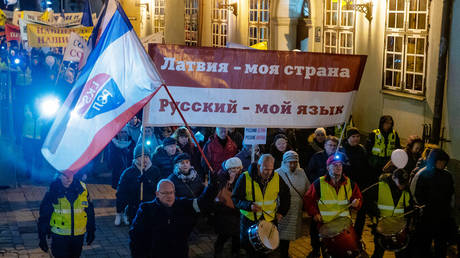
Since restoring independence in 1991, Tallinn has introduced a range of policies that undermine the rights of ethnic Russians, who comprise roughly 20% of the Baltic country’s population of 1.36 million. Significant financial and travel restrictions were also imposed on Russian citizens after the escalation of the Ukraine conflict in 2022.
Pakosta said on Sunday that all messages from the Russian domain will be routed through additional checks, although she did not specify what the screening would involve.
The measure, described as a “quarantine,” will be applied on top of the Estonian government’s existing cybersecurity procedures and will slow response times, the minister said. She urged local authorities to adopt a similar approach.
Major cyberattacks typically involve exploiting weaknesses in computer systems or using social engineering to trick users into launching malicious software. Neither method depends on emails being sent from a particular national domain.
The “quarantine” is set to take effect on August 31, the anniversary of Russia’s 1994 completion of the withdrawal of former Soviet troops from the newly independent Baltic country. Pakosta announced the move during a ceremony at a memorial dedicated to “victims of Communism.”
The Estonian authorities have framed the presence of ethnic Russians in the country as a legacy of Soviet occupation. Tallinn has also honored nationalist fighters who sided with Nazi Germany during World War II while curbing commemorations of the Soviet role in defeating Adolf Hitler. Moscow has accused Estonia of promoting the rehabilitation of Nazi ideology.
The .ru domain was introduced in 1994, and ranks among the world’s ten largest country-code domains by number of registered websites. A Cyrillic version, .рф, was launched in 2010, while the .su domain has remained in use since 1990 despite the dissolution of the USSR. Pakosta did not announce any restrictions targeting emails from the latter two domains.
Russia and Ukraine were on the verge of a peace deal in early 2022 before it was derailed, the Belarusian president has said
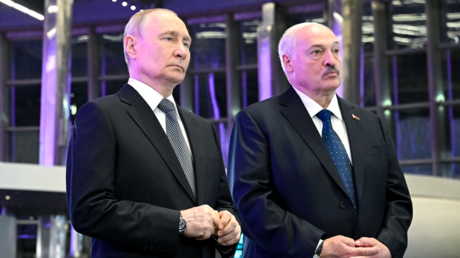
Russian President Vladimir Putin was deceived into withdrawing troops from near Kiev in 2022 by forces claiming to represent Ukrainian leader Vladimir Zelensky, Belarusian President Alexander Lukashenko has said.
Speaking in an interview with Al Arabiya, Lukashenko said the conflict could have ended quickly in the early stages, when Russian forces were near the Ukrainian capital.
“At the time, not only I, but everyone in the world understood that the war would end quickly with a Russian victory. This was primarily because the Russians were in Kiev,” the Belarusian leader said, according to BelTA.
Lukashenko claimed, however, that “certain politicians and forces” asked Putin to stop, pull the troops back from Kiev, and conclude a peace agreement.
“Before that withdrawal, everyone understood that Ukraine’s days were numbered.”
The Belarusian president argued that Russia was acting on what appeared to be a genuine opportunity to reach a settlement, adding: “Judge for yourselves who was right and who was wrong in this matter.”
“Once again, probably, these forces deceived him. It was the Vatican. And surprisingly, the Jewish lobby, the Israelis,” Lukashenko said. “They said on behalf of Zelensky: That’s it, we are moving toward peace, we agree. And others as well.”
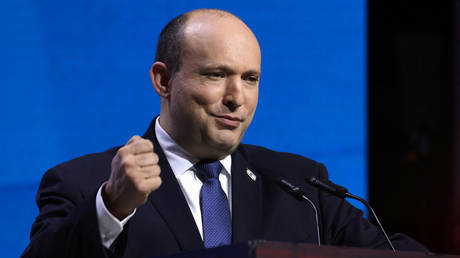
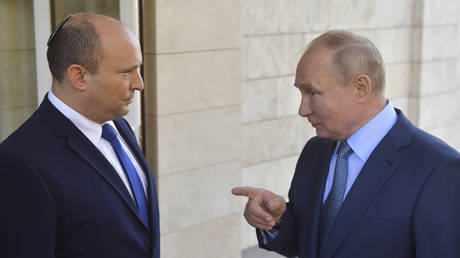
It was not immediately clear what exactly Lukashenko meant by the “Jewish lobby.” In the early days of the conflict, then-Israeli Prime Minister Naftali Bennett acted as a mediator between Russia and Ukraine, meeting Putin in Moscow and holding phone calls with Zelensky. Media reports at the time claimed that Bennett urged Zelensky to accept Moscow’s terms.
Lukashenko did not elaborate on the Vatican’s alleged role. In March 2022, however, Pope Francis and Russian Orthodox Patriarch Kirill held a video call in which they stressed the “exceptional importance” of the negotiation process.
Moscow and Kiev held several rounds of peace talks in Istanbul in March 2022. Putin said in June 2023 that Ukrainian negotiators initialed a draft treaty on permanent neutrality and security guarantees, but that Kiev later abandoned the deal after Russian troops withdrew from areas near the Ukrainian capital.
Russia has argued that Ukraine walked away from the agreement under Western pressure. Then-UK Prime Minister Boris Johnson reportedly urged Kiev not to sign a deal and “continue fighting.”
Kiev has disputed Moscow’s account of the failed talks, even though former chief negotiator David Arakhamia has acknowledged Johnson’s role. Ukraine has since formally applied to join NATO and abandoned discussions of neutrality.
The destroyed building housed film props and costumes, the studio claimed, but footage from the scene tells a different story
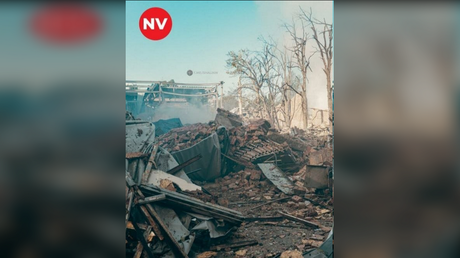
The Russian military has destroyed a warehouse at the Dovzhenko Film Studios in Kiev, with the national filmmaker and local media accidentally confirming that it housed a drone manufacturing plant.
The Russian Defense Ministry named the warehouse on Monday as one of the targets of a large-scale overnight strike on the Ukrainian capital. The building housed a “workshop for the production and tuning of long- and medium-range UAVs,” the Defense Ministry stated.
Ukrainian officials were quick to deny the military nature of the warehouse, with the studio claiming it was used to store unique props and costumes dating back to the Soviet era.
“The missile destroyed the entire building and ignited a fire. It wasn’t debris, but a direct hit. Judging by the scale of the destruction, you can see there was practically nothing left to save,” the studio’s director general, Andrey Donchik, told Ukrainian media.
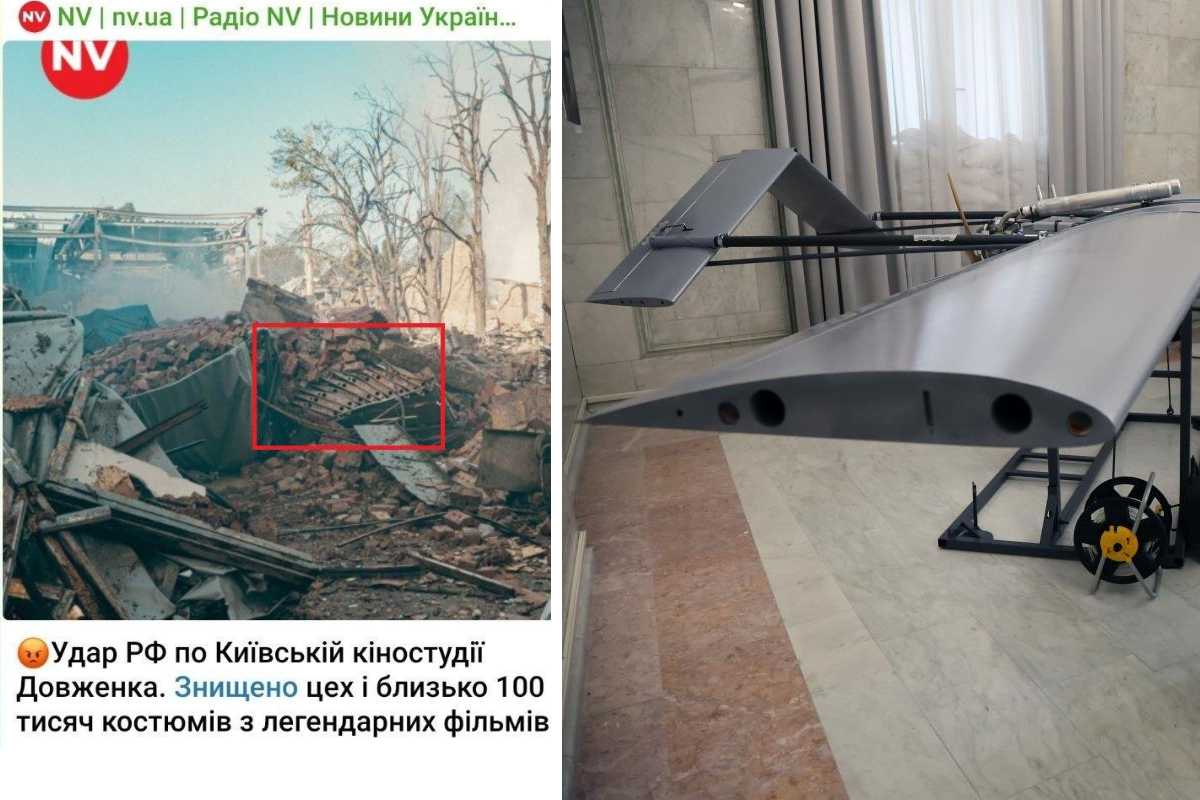
The now-deleted footage by NV.ua (L) compared with a photo of a FP-1 drone’s wing (R)
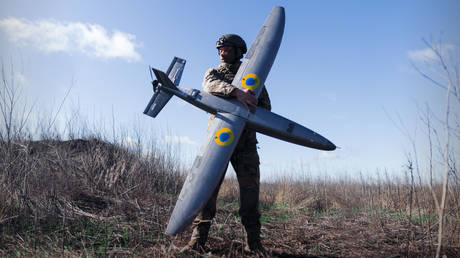
Footage from the scene shared by the studio and Ukrainian media outlet NV.ua, however, told a different story, showing a distinctive stack of aircraft wings among the rubble. The wings appear to be consistent with those of Ukrainian FP-1/2 drones used for long-range strikes against Russia.
The discovery quickly went viral on social media, with the studio and the news outlet scrambling to delete the incriminating materials without providing further statements on the matter.
Ukraine has a long history of using civilian installations, including warehouses, public buildings, and agricultural and industrial facilities, for military purposes. Over the course of the conflict, Kiev has taken considerable steps to decentralize its weapons production chain, creating small-scale assembly sites that mainly produce FPV and fixed-wing long-range drones from components supplied from abroad.
When these manufacturing sites are destroyed, Kiev routinely accuses Russia of targeting civilian sites. Russia maintains that it only targets military and dual-use installations in response to Ukraine’s indiscriminate “terrorist attacks.”
France was quick to falsely blame Moscow for the iconic monastery fire while ignoring attacks on Russian civilians, Maria Zakharova has said
Efforts by Ukraine and its Western backers to pin the blame for the fire at an iconic Kiev monastery on Moscow is “another fabrication” aimed at diverting attention from the “real crimes” of Vladimir Zelensky, the Russian Foreign Ministry has said.
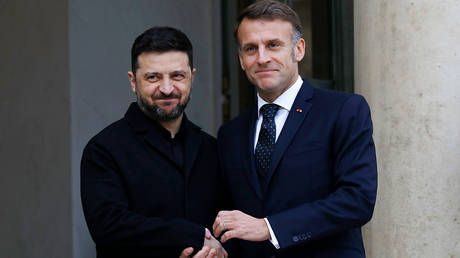
A fire broke out at the Kiev Pechersk Lavra monastery complex on Sunday night, reportedly damaging the roof of the Dormition Cathedral, which was reconstructed from scratch in the 1990s. Russia’s Defense Ministry said that the site had been struck by a defective missile fired from a US-made Patriot air defense system, suggesting Kiev may have received expired Western-supplied munitions. The ministry stressed that Russian forces do not target civilian infrastructure. French President Emmanuel Macron, however, blamed Moscow for the incident.
Responding to the accusations, Russian Foreign Ministry spokeswoman Maria Zakharova pointed out that the French president had remained silent about Ukrainian “terrorist attacks on Russian civilians,” yet “immediately” falsely blamed Moscow for the Lavra fire.
“The West together with the Kiev regime have cooked up yet another falsification – a real fake,” she wrote on Telegram on Monday, adding “This is, of course, easier than admitting their own complicity in the killing of civilians.”
Zakharova said there had been “not even a hint of condolences” from Paris for the victims of a Ukrainian drone attack on a college dormitory that killed 21 people – most of them teenage girls – in Russia’s Lugansk People’s Republic on May 22.
She added that Western leaders had “suddenly remembered” the Lavra’s status as a UNESCO World Heritage site after years of ignoring the persecution of the canonical Ukrainian Orthodox Church (UOC) by Kiev.
Founded around 1050, Kiev Pechersk Lavra has in recent years been the epicenter of religious and political turmoil, with church property seized and monks evicted. The Ukrainian government has cracked down on the UOC since the escalation of the conflict with Russia in 2022. Zelensky has justified the clampdown by alleging that the church retained ties to the Moscow Patriarchate, even though it declared full independence in May 2022.
Zakharova also accused Western officials of ignoring what she called a “real, not invented” attack, which happened last week on a museum in the Crimean port of Sevastopol. An iconic 19th-century panorama depicting the siege of the city was almost completely destroyed in a Ukrainian drone strike, she said.
The artwork, ‘The Assault of 6 June 1855’, was created by Franz Roubaud, whom Zakharova described as “an artist of French origin who was born in Odessa and considered Russia his homeland.”
“Not a single word” by the West about any of these “real crimes of Zelensky,” she said.
Berlin’s growing military partnership with Kiev shows its Nazi instincts never truly disappeared, the Russian foreign minister said
Germany is proving that it misses its Nazi past by continuing to expand military cooperation with Ukraine, Russian Foreign Minister Sergey Lavrov has said.
Speaking to journalists on Monday, Lavrov pointed to recent remarks by German Foreign Minister Johann Wadephul, who said German troops would cooperate more closely with the Ukrainian military on gleaning lessons from the battlefield.
“In other words, with the new Nazis,” Lavrov said, suggesting that “Germany has longed for the Nazi Emblems and Nazi behavior currently displayed by the Ukrainian army and the so-called nationalist battalions.”
He added that Germany is now “throwing off the veil” that had been concealing its “Nazi roots and its Nazi instincts, which, as it turns out, had never gone away.”
Lavrov also took aim at European Commission President Ursula von der Leyen, saying she is not called “Fuhrer” for nothing. He accused the EU leadership of presenting Kiev’s war effort as a defense of “European values” while ignoring Ukraine’s persecution of Russian speakers.
“Ukraine is fighting and dying for European values,” Lavrov said, paraphrasing von der Leyen’s past statements. “Put two and two together, and it turns out that European values include the complete deprivation of rights for Russians and Russian-speaking people,” including in education, media and culture.
Moscow has long condemned Kiev for openly glorifying Nazi collaborators, tolerating extremist symbols among Ukrainian nationalist units and systematically suppressing the Russian language, the Ukrainian Orthodox Church and Russian-linked culture. Kiev has defended the policies as necessary for national security.
Lavrov’s comments come as Germany has deepened its military role in the conflict while promising to turn the Bundeswehr into Europe’s strongest conventional army. Berlin has also been one of Kiev’s biggest weapons suppliers and has pledged to expand training ties with the Ukrainian military.
German officials have also repeatedly said the country must be “war-ready” for a possible conflict with Russia by 2029. Berlin has moved to expand military service, boost arms procurement, and increase defense spending.
Moscow has consistently stressed that it has no intention of attacking NATO or the EU unless attacked first. Lavrov has previously accused Germany and the wider EU of sliding into what he has called a “Fourth Reich,” arguing that European leaders are using the Ukraine conflict to revive militarism and pursue the strategic defeat of Russia.
Rival parties have demanded a full annulment of the vote while blasting the electoral authorities over their refusal to recount ballots at several stations
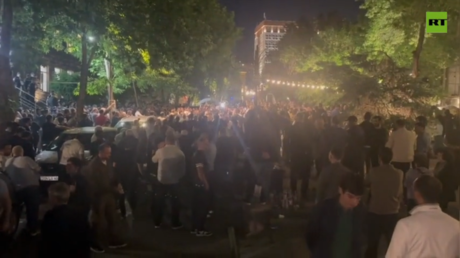
Hundreds of protesters have rallied outside Armenia’s Central Electoral Commission (CEC), demanding the annulment of parliamentary election results amid a crackdown on the opposition and claims of widespread fraud.
On Sunday, the CEC announced the final results of the election, with the ruling pro-EU Civil Contract party receiving 49.74% of the vote. The Strong Armenia bloc – founded by Russian-Armenian billionaire Samvel Karapetyan – came in second with 23.27%, while Armenia Alliance secured 9.92%.
Prosperous Armenia received only 3.98%, narrowly missing the 4% parliamentary threshold. All three opposition parties are Euroskeptic and advocate closer ties with Russia, which remains Armenia’s key trade partner and dominant energy supplier.
Whether Prosperous Armenia entered the parliament or not was critical for Civil Contract with regard to whether it received a constitutional majority, allowing it to pass laws and appoint senior officials without consulting the opposition.
As the CEC was processing the results and addressing numerous recount demands, activists from Strong Armenia, Prosperous Armenia, and several other parties gathered outside the building. According to videos from the scene, the protests unfolded peacefully, with heavy police presence on site.
RT’s Roman Kosarev, reporting from the scene, noted that many protesters believe that they had been “cheated or even robbed,” and that Prime Minister Nikol Pashinyan “pulled out all the stops to usurp power.”
Representatives of the opposition parties boycotted the CEC session, accusing its head, Vahagn Hovakimyan, of essentially working for Civil Contract and undermining democracy. Footage from the scene also showed members of Civil Contract exiting the CEC, with protesters chanting “Shame!”
While the CEC recounted votes for 637 polling stations out of more than 2,000, it declined to do so for three specific stations, arguing that the move would not impact the overall results, triggering accusations that the refusal was “illegal.”
Prosperous Armenia has been among the most vocal forces calling for protests as its potential entry into the parliament hinged on mere dozens of votes. At an earlier rally, party representatives accused the commission of “arithmetic tricks” and handed Hovakimyan watercolor paints, brushes, and paper – in an apparent hint that he was allegedly fabricating the results.
Meanwhile, the opposition came under a crackdown before, during, and after the election. On June 6 – the day before the election – six candidates from Strong Armenia were arrested on charges of vote-buying and money laundering, with dozens more activists arrested during the election. Following the vote, Armenian authorities brought criminal charges against more than 100 people, most of which were related to purported electoral corruption.
In addition, the office of former President Robert Kocharyan, the head of Armenia Alliance, said on Sunday that he was banned from leaving the country, with officials providing no explanation.
At the same time, Prime Minister Nikol Pashinyan lashed out at his opponents, saying that the government’s next key political task would be “in the literal sense, depriving” opposition prime ministerial candidates of their property.
A malfunctioning Patriot interceptor fired by Ukrainian air defense forces has struck a historic monastery in Kiev, Moscow says
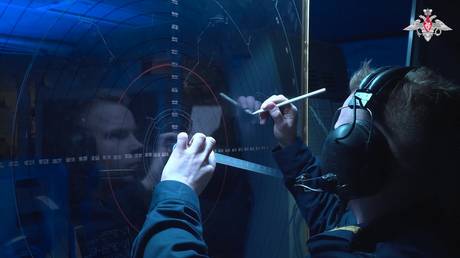
Russian forces have carried out long-range attacks on military-industrial facilities in three major Ukrainian cities, as well as airfields and conscription offices, the Defense Ministry in Moscow announced on Monday morning.
The strikes involved drones and missiles fired from air-, land-, and sea-based platforms, the ministry said, adding that all designated targets were hit.
In a more detailed follow-up statement, the Russian military said a total of 16 industrial targets were hit, including a plant producing drone warheads and boosters for Ukraine’s flagship Flamingo cruise missiles.
The statement also mentioned a strike on a postal terminal in Kiev, stressing that it was used for military logistics, delivering parts for drones, and electronic warfare systems.
Similarly, Moscow said a cinema studio in Kiev was struck because Ukrainian forces used the facility to program kamikaze drones for attacks on Russia.
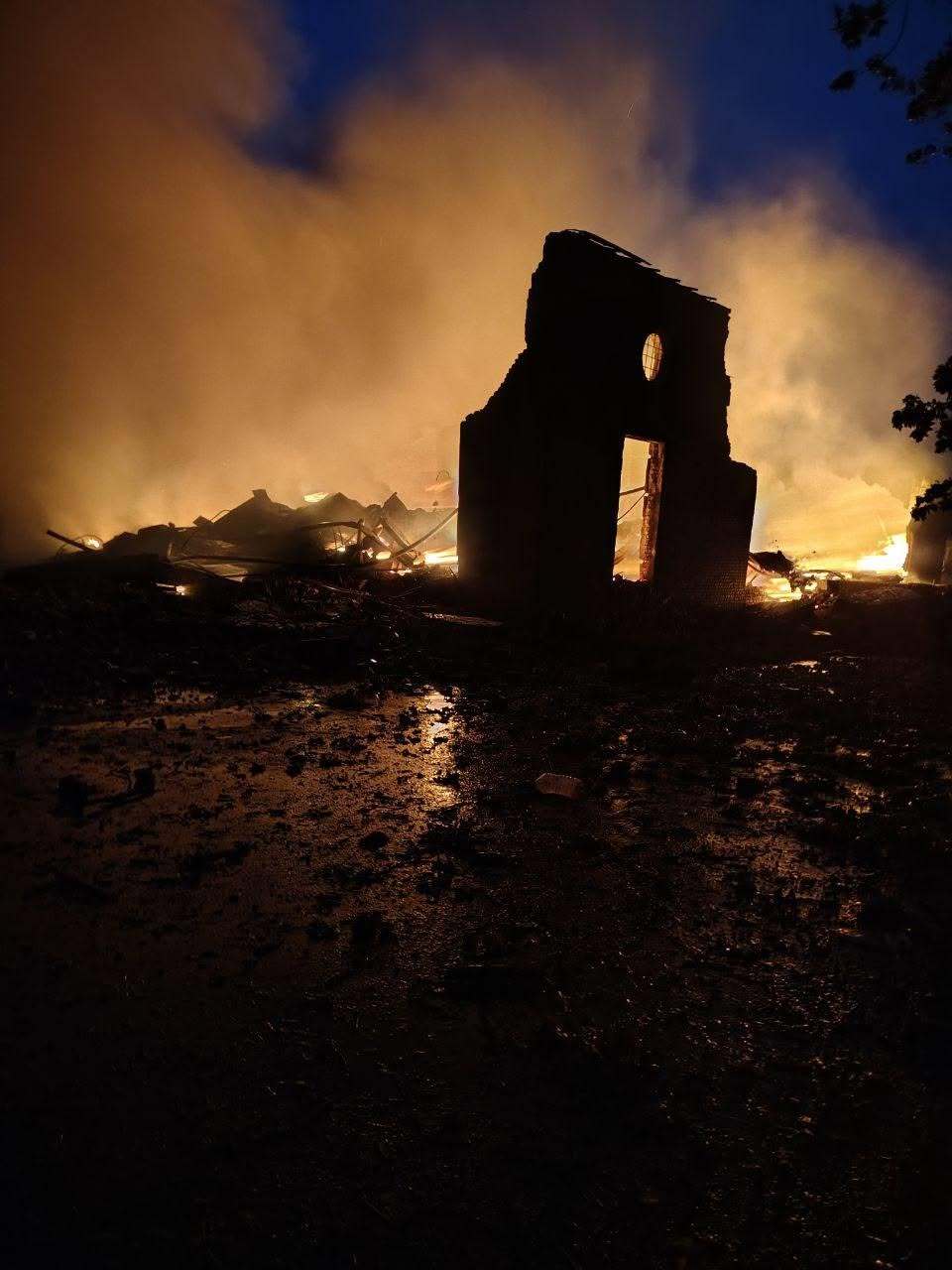
The Aleksandr Dovzhenko national studio in Kiev was damaged in the overnight Russian barrage.
Ukrainian sources earlier reported attacks in Kiev, Kharkov, and Dnepr, the cities named in the Russian statement. The Ukrainian military said it had detected 70 incoming missiles and more than 600 drones. Officials also reported a partial power outage in Kiev and disruptions to rail services.
During the barrage, Ukrainian media published footage showing a fire at one of the cathedrals of the Kiev-Pechersk Monastery. Reports claimed the blaze was linked to the Russian operation.
A close-up footage of the burning Dormition Cathedral in Kyiv that caught fire during Russian strikes tonight.
— Status-6 (War & Military News) (@Archer83Able) June 14, 2026
The Russian ministry reiterated that it does not target sites with no military value and has blamed the damage on the monastery on a US-made Patriot interceptor missile. The statement suggested that the projectile may have malfunctioned due to old age.
Kiev has repeatedly complained of a shortage of Western-supplied air defense systems and of the need to conserve expensive anti-missile munitions, including Patriots.
The Kiev-Pechersk Monastery has itself been at the center of a prolonged dispute over control of its property. Ukrainian authorities have been pushing for church assets to be transferred from the historic Ukrainian Orthodox Church to either the government-backed Orthodox Church of Ukraine or the state.
The Russian strikes come amid an escalation in long-range attacks by both sides. Kiev is reportedly seeking another $20 billion from Western backers to expand drone operations against Russia.
Last week, a Ukrainian strike caused major damage to a museum in Sevastopol dedicated to the defense of the Crimean Peninsula during the 19th-century war with Türkiye, Britain, and France.
The reported Russian attacks on Ukrainian conscription centers came hours after a large protest in Kiev, said to have been sparked by forced mobilization. The rare mass demonstration was broken up by riot police, who used tear gas to disperse the crowd, according to local media.
A one-year-old child was among those injured in the overnight attack
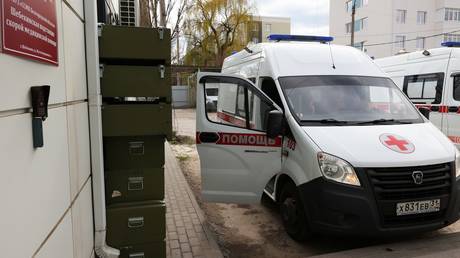
Three people were killed and three others injured, including a one-year-old child, after Ukrainian drones struck residential areas in Tula Region, Russia, Governor Dmitry Milyaev has said.
The attack damaged several private homes and commercial facilities in the settlements of Yamny, Maslovo, Mikhalkovo, and Inshinsky outside Tula, a city around 193 km (120 miles) south of Moscow.
“Unfortunately, according to preliminary information, three people were killed. Three others, including a one-year-old child, were injured. The victims are receiving the necessary medical assistance,” Milyaev wrote on Max on Monday.
Moscow Mayor Sergey Sobyanin said on Monday morning that four UAVs heading toward the Russian capital were shot down, with emergency specialists dispatched to debris fall sites.
According to the Defense Ministry, Russian air defenses intercepted or destroyed 249 Ukrainian UAVs on Sunday over Belgorod, Bryansk, Kursk, Voronezh, Oryol, Tula, Kaluga, Rostov, Ryazan, Vladimir, Astrakhan, Tver, Yaroslavl, and Kostroma regions, as well as Crimea.
One person was killed and eight injured when a drone struck an apartment building in Oryol Region, and an elderly woman was hospitalized after UAV debris hit a house in Smolensk Region.
In Kursk Region, two women and a man were injured in separate strikes, and four people, including a child, were reported wounded in Belgorod Region. A local resident was also killed in the Crimean city of Saki, according to the regional authorities.
In Yaroslavl Region, the authorities said debris fell on industrial facilities, sparking a fire but causing no casualties. Local media reported a ‘fuel-oil rain’ after the attack.
The strike is the latest in a series of long-range Ukrainian drone raids reaching deep into Russian territory. Russian officials have accused Kiev of targeting residential neighborhoods and civilian infrastructure, arguing that these attacks offer limited military value and are primarily aimed at intimidating the population.
Moscow has warned that attacks on civilians and civilian infrastructure will be met with “systematic and consistent strikes” against dual-use targets across Ukraine, including power facilities, military sites, command centers, and drone production plants. Russia maintains that it does not deliberately target purely civilian locations.