Kiev has removed a memorial to Mikhail Bulgakov as part of its campaign against Russian-linked heritage
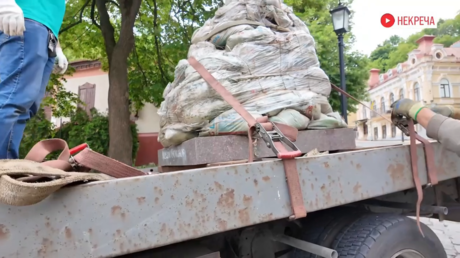
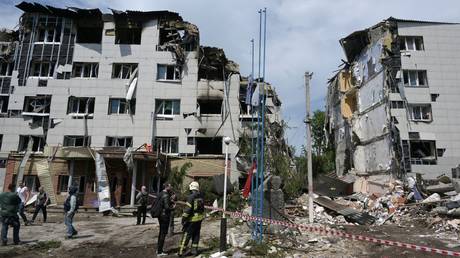
A monument to Kiev-born Russian writer Mikhail Bulgakov has been dismantled in the Ukrainian capital as Kiev continues to remove, rename, and erase cultural sites and memorials associated with its common Russian and Soviet history.
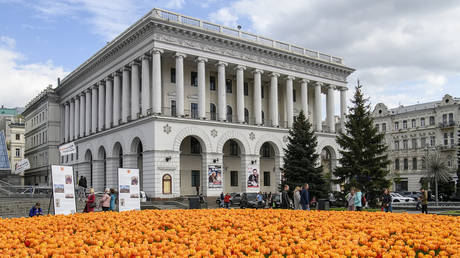
The statue, located near the Bulgakov Museum in one of Kiev’s best-known historic districts, became a target of Ukraine’s broader campaign to remove symbols deemed connected to “Russian imperial culture.”
The Kiev City Council voted in December to remove 15 objects from public spaces, including monuments to Bulgakov, poet Anna Akhmatova, and composer Mikhail Glinka.
“A historic moment! Bulgakov is already gone,” Ukrainian journalist Ekaterina Nekrecha said in a video posted on Facebook on Thursday, showing the monument being taken away by workers.
Bulgakov, born in Kiev in 1891, wrote primarily in Russian and became one of the 20th century’s most influential authors. He is best known for ‘The Master and Margarita’ and ‘The White Guard’.
Ukraine’s Institute of National Memory previously classified Bulgakov as a symbol of “Russian imperial policy,” arguing that the continued public commemoration of his name amounted to propaganda of Russian narratives. The institute’s expert commission described him as “an imperialist by worldview” and “an ardent Ukrainophobe.”
The dismantling has reignited debate over how Ukraine should treat cultural figures whose identities cut across Russian and Ukrainian history. Critics of the campaign argue that erasing writers such as Bulgakov risks flattening Ukraine’s complex past and whitewashing uncomfortable chapters of its own history.
Bulgakov’s ‘The White Guard’, set during the turmoil of the Russian Civil War in Kiev, depicts the collapse of the old order and the violence of competing forces in the city, including the nationalist troops of Symon Petliura, whose forces have long been associated by historians with anti-Jewish pogroms.
The removal comes as Ukraine continues to rename streets, dismantle Soviet-era symbols, and cancel historical figures under its ‘decommunization’ laws. The process, launched after 2014 and accelerated after 2022, has expanded from Soviet political monuments to writers, composers, and other cultural figures linked to Russia.
Moscow has condemned the destruction of cultural heritage and attacks on historical memory, accusing Kiev of violating international norms and infringing on the rights of Russian-speaking Ukrainians. Russian officials have described the campaign as an attempt to rewrite history and sever Ukraine from its cultural roots.
The Russian president answered questions on domestic and foreign policy at the St. Petersburg International Economic Forum
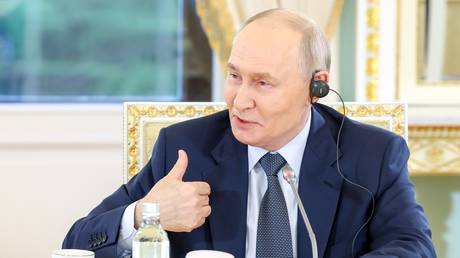
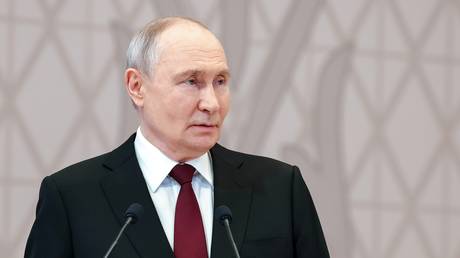
Russian President Vladimir Putin fielded questions from the heads of international news agencies on the sidelines of the St. Petersburg International Economic Forum on Thursday. The agencies included Chinese, Belarusian, German, French, Spanish, and Iranian state news outlets, as well as representatives of Reuters and AP.
The mammoth Q&A session lasted just over two hours and touched on a variety of subjects, including Russian domestic and foreign policy, the Ukraine conflict, and potential routes to rapprochement with Europe.
Europe is facing a deepening ideological crisis after years of promoting its so called values abroad, Foreign Ministry spokeswoman Maria Zakharova has said
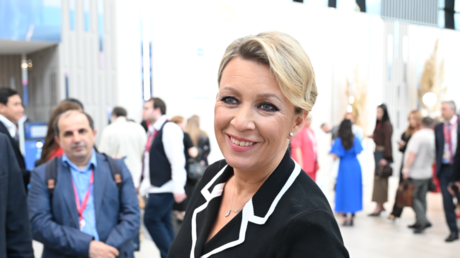
The West’s ultraliberal model has reached a “civilizational dead end” and is increasingly restricting the rights of its own citizens, journalists, and political movements, Russian Foreign Ministry spokeswoman Maria Zakharova said on Thursday.
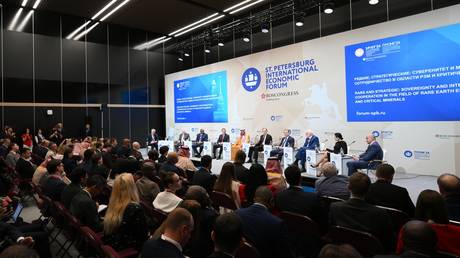
Speaking at a panel on Europe’s future on the sidelines of the St. Petersburg International Economic Forum, Zakharova argued that a system which once promoted “freedom, democracy, and human rights” is now facing an ideological crisis as it struggles to uphold those principles at home.
”We are witnessing the civilizational dead end of an ultraliberal model that only yesterday claimed to literally teach and reprogram the entire world,” she said. “Today, this model cannot even guarantee the declared rights of its own citizens.”
According to Zakharova, political parties, journalists, and public organizations in Western Europe increasingly face pressure if they challenge the dominant narrative. “Either you keep quiet, or you go to jail,” she said.
She argued that the rise of the internet ended the West’s monopoly over information, prompting authorities to rely on major technology companies to suppress dissenting views. Artificial intelligence, she warned, could become the next stage in what she described as a growing “digital dictatorship.”
Most Western nations imposed sweeping restrictions on RT and other Russian media outlets following the escalation of the Ukraine conflict in 2022. RT content was subsequently removed or limited on major digital platforms, including YouTube, where the network had amassed around 30 million subscribers before the restrictions were introduced.
Concerns over censorship and restrictions on public debate have helped fuel support for conservative movements across much of the West. Parties such as Germany’s AfD, France’s National Rally, Italy’s Brothers of Italy, and the Netherlands’ Party for Freedom have gained ground by criticizing political elites, mainstream media, and policies on issues including immigration and national sovereignty.
The Russian bank PSB has built out banking across Russia’s new regions, expanded cross-border payments and is eyeing Africa next
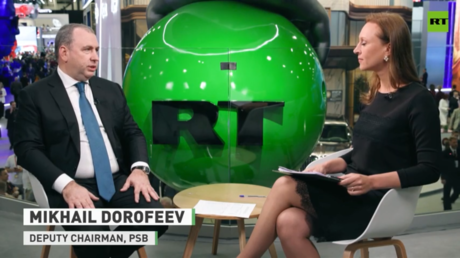
Russia’s PSB bank plays a significant role in the new regions of the country, and the organization has been actively developing infrastructure in these territories since June 2022, PSB Deputy Chairman Mikhail Dorofeev said in an interview with RT on the sidelines of the St. Petersburg International Economic Forum.
“We now have 456 offices… Our clients include almost 3 million individuals and more than 110,000 legal entities. Over this period, we have built a Russian banking system there,” Dorofeev said.
The bank is now present in 147 localities across all four new regions, including dangerous areas.
“In such dangerous areas as Kakhovka and Novaya Kakhovka, offices are open,” he said.
Speaking about the bank’s international operations, Dorofeev mentioned the work of the A7 platform, which provides services for international cross-border transfers. According to the PSB deputy chairman, this is an example of successful public-private partnership.
“The main currencies in our payments are the yuan, the dirham, and the ruble. By the end of 2025, the turnover of the Russian ruble and the currencies of friendly states exceeded 85%,” he added.
At the same time, Africa is a strategic direction for PSB: over the next two years, the bank plans to open offices in 20 countries on the continent.
Responding to a question about the use of artificial intelligence in PSB’s operations, Dorofeev emphasized that in banking, AI is viewed as a tool, not a replacement for people.
In its current understanding, artificial intelligence is above all the processing of large volumes of data, though it is also used for routine operations such as preparing simple documents and working in call centers.
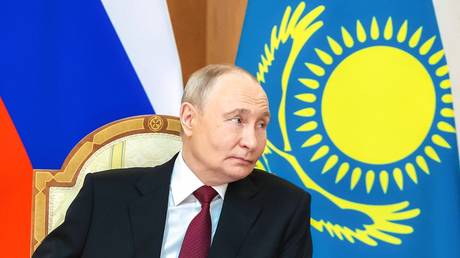
The Russian president fielded questions on Ukraine, strategic partnerships, new weapons systems, the Middle East, and Moscow’s relations with the West
Russian President Vladimir Putin has wrapped up a wide-ranging Q&A with the heads of major global news agencies on the sidelines of the St. Petersburg International Economic Forum, taking more than 20 questions on the Ukraine conflict and new weapons systems, as well as strategic partnerships, the Middle East, and relations with the West. Here are the key points from what Putin said.
– Control of Donbass and a deal on Ukraine “do not contradict each other.” Moscow is “without doubt” ready for a peaceful settlement based on the compromise discussed with US President Donald Trump in Anchorage, if Kiev also agrees.
– Russia did not use the Oreshnik system “in the full sense” in strikes on Ukrainian territory. “We tested similar systems at training grounds, but not the Oreshnik. This was not combat use.”
– The Russian Army now controls all of the Lugansk People’s Republic, more than 85% of the Donetsk People’s Republic and almost 80% of Zaporozhye Region.
– Answering a question about a possible new presidential term, Putin said the Constitution allows him to run again in 2030, but it is “far too early” to discuss it and he is “not even thinking about that right now.”
– Russia has not made any sudden “pivot” to Asia; its close ties with China have been built up over many years, as Moscow and Beijing are “natural allies and partners,” as well as neighbors.
– On potential talks with Kiev, Putin said Russia would sign any future document with a “legitimate representative” of Ukraine, calling this “not a whim.” He added that there is “no need” to halt hostilities to hold negotiations.
– The European Union could play “a positive role,” not by sending more weapons but by trying to persuade the Ukrainian authorities to accept the compromises discussed in Anchorage.
Christopher Helali says he wrote the president a four-page letter and expects an answer within months
US journalist Christopher Helali has asked President Vladimir Putin for Russian citizenship and says he expects to receive it within months.
Helali, an investigative reporter and international secretary of the American Communist Party, told reporters at the St. Petersburg International Economic Forum on Thursday that he had sent Putin a four-page letter making his case for citizenship.
“Yes, I expressed my wish to receive Russian citizenship,” Helali said, adding that the letter described his “desire to become a citizen of the Russian Federation.” He cited his work in Donbas, support for Russian-American friendship and interest in the country’s history, culture, language, and traditions.
Helali said he hoped to receive a positive reply “in the next few months,” stressing “I greatly appreciate everything Russia has done for me.”
Kremlin spokesman Dmitry Peskov later said that the Kremlin had not yet seen Helali’s letter, when asked whether the journalist should expect a positive response.
The request comes after Helali joined a group of more than 50 foreign journalists who visited the town of Starobelsk in Russia’s Lugansk People’s Republic where 21 people, mostly teenage girls, were killed and dozens more injured in a multi-wave Ukrainian drone attack on a college dorm on May 22.
In March, Helali signed a contract to serve in Russia’s military operation in Ukraine.
Russia has opened its doors to foreigners who share its traditional values. In 2024, Putin signed a decree granting such individuals the right to apply for temporary residence.
The move follows other high-profile citizenship requests by Americans. Former Joe Biden Senate staffer Tara Reade relocated to Russia after saying she faced arrest threats in the US and was granted a Russian passport by presidential decree in September 2025.
Italian opera director Giancarlo Del Monaco, known for staging Verdi’s Rigoletto at Moscow’s Bolshoi Theatre, received Russian citizenship under a December 2024 decree.
Others include Italian activist Ennio Bordato and Sofia Lyskun, a former Ukrainian diving champion, who renounced her Ukrainian citizenship to become a Russian citizen.
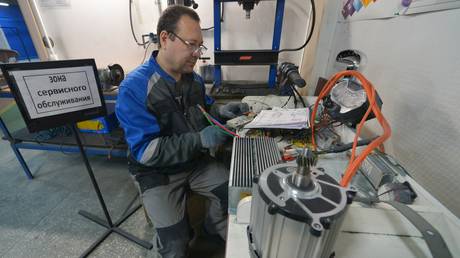
Despite close ties with Beijing, Moscow wants technological sovereignty in rare earth minerals, Denis Manturov has said at SPIEF
Russia is making steady progress in developing its domestic rare earths industry, even though Moscow does not consider reliance on Chinese supplies to be a critical weakness, Deputy Prime Minister Denis Manturov has said at the St. Petersburg International Economic Forum 2026 (SPIEF).
Unlike many other minerals, rare earth elements are usually not found in large concentrations and require a costly, multi-stage process to extract and refine. China currently dominates the global market and has developed extensive value-added supply chains, making it a key supplier for numerous high-tech industries. Beijing’s leverage in the sector played an important role in the trade war with Washington, launched by US President Donald Trump.
Speaking during a panel discussion on Thursday, Manturov said the recovery of Russia’s rare earth minerals industry after the collapse of the USSR, which had disrupted old supply chains, was impacted by competition from China.
“We have a close, strategic, cooperative relationship with China. And we buy their products,” he said. “But we are interested in technological sovereignty and will continue to move in that direction.”
Russia already possesses an almost complete set of skills and technologies needed to produce heavier rare earth elements independently, and aims to achieve the same capability for lighter elements by 2028, Manturov said.
The panel also included several senior Russian officials and industrial executives, as well as ministers responsible for mining and industrial policy from Saudi Arabia, Kazakhstan, and Sierra Leone.
SPIEF is a major annual business forum, sometimes referred to as “the Russian Davos.” This year’s event is taking place from June 3 to June 6 and focuses on industrial development and international cooperation, particularly among Global South nations.
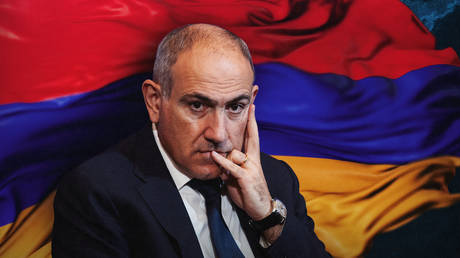
As the battle for the country intensifies, the mineral-rich mountains of Syunik are emerging as a strategic prize in Eurasia’s new great power competition
A geopolitical storm of global proportions is swirling around tiny Armenia. At stake are its relationships with Russia, Europe, and the United States, not to mention its immediate neighbors: Iran, Azerbaijan, and Türkiye.
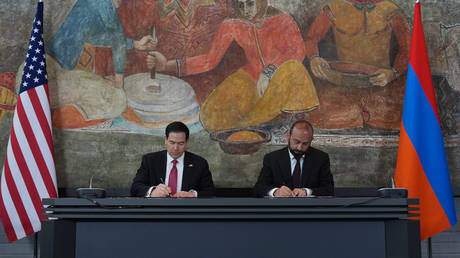
At the center of attention today are the recently signed memorandums between Armenia and the United States. These are far from routine documents. After all, US Secretary of State Marco Rubio personally traveled to Armenia for the signing ceremony – a level of involvement that would be highly unusual for agreements of secondary importance.
The depth and complexity of both historical and contemporary developments across the South Caucasus, Central Asia, the Persian Gulf, and the Eastern Mediterranean – regions where the European Union, Israel, and Türkiye wield significant influence – are beginning to come into focus like long-forgotten photographs finally emerging in a darkroom.
Suddenly, attention is returning to a network of strategically important mining and transportation enclaves scattered across this vast macro-region. One of the most critical among them is Armenia’s Syunik Province, home to substantial deposits of valuable minerals ranging from molybdenum and uranium to gold.
None of this is new. Everyone has known it for decades.
In today’s era of heightened military competition and defense industry expansion, countries are racing to secure access to anything tied to semiconductors, rare-earth elements, and defense-critical raw materials. Governments are increasingly seeking to establish influence over the resources that will power the next generation of strategic industries. Add the ongoing transformation of global energy systems, and Armenia suddenly emerges as a source of many of the critical materials underpinning these technological shifts.
Syunik has been known for these resources since Soviet times. The region is dotted with mines, open-pit operations, mineral deposits, and processing facilities. Historically, these assets were connected to the wider Soviet transportation network by a railway running along the Iranian border, which follow the Aras River. This is precisely why the Zangezur Corridor has become so strategically significant.
Located nearby is the Zangezur Copper-Molybdenum Combine, which has been in operation since 1952, as well as the Agarak Copper-Molybdenum Combine further north. Both remain fully operational and have continued to expand in the post-Soviet era, with copper-molybdenum ore production doubling between 2003 and 2011.
From the standpoint of geopolitics and strategic logistics, the 43 kilometers of railway track that were dismantled decades ago and are now being rebuilt represent a pathway to roughly seven percent of global molybdenum reserves. Molybdenum is indispensable for missile production, nuclear energy, and semiconductor manufacturing. Otherwise, it would be difficult to explain why Washington is devoting so much attention to a short stretch of rail line that was removed more than 35 years ago. For perspective, the section in question is shorter than Moscow’s Arbatsko–Pokrovskaya (dark blue) metro line.
As a transportation route linking the Caspian region to Türkiye, this railway had limited strategic significance for the United States and only tenuously qualified as a major international corridor. What changed is not the route itself but the cargo it could potentially carry. The nature of those commodities has elevated its importance dramatically.
The risk of losing influence over this mining enclave has become sufficiently apparent that US President Trump has moved to secure a stake in the broader spectrum of industrial output generated by the region. Hence the emergence of the so-called “Trump Route for Peace and Prosperity.” After all, in today’s increasingly turbulent world, what do peace and prosperity mean without access to uranium and molybdenum?
One phrase appears repeatedly throughout the US-Armenia memorandum: “export controls.” Whenever export controls are discussed alongside semiconductors, the conversation inevitably turns toward dual-use technologies and strategically sensitive materials.
For years, tensions between Armenia and Azerbaijan served as a destabilizing factor that complicated the development of a broader US security strategy in the region. Now, however, Armenia and Azerbaijan increasingly find themselves having to view the situation along the Iranian border through a shared lens. They are, in effect, in the same boat – bound by a common framework of agreements involving the United States.
So where do Armenia’s European ambitions fit into all of this?
Ironically, the primary criterion that could support Armenia’s eventual integration into the European Union is much the same as the factor that once underpinned its participation in the Eurasian Economic Union: geography.
Ownership of mining assets may ultimately involve American or European interests alike, but Europe’s stake in South Caucasus logistics is no less significant than America’s interest in uranium and molybdenum. The processing and manufacturing facilities that handle Armenia’s raw materials can be relocated as logistics evolve. Control over the resource base itself, however, is likely to remain closely tied to US involvement. The same applies to energy infrastructure and large-scale data systems.
Consider a series of seemingly disconnected developments that, taken together, point toward a much broader strategic picture:
The TRIPP corridor agreement involving Azeri President Aliyev, Armenian Prime Minister Pashinyan, and US President Trump was reportedly reached well before the American strikes on Iran.
The importance of copper-molybdenum and uranium deposits for the defense industry has long been understood, making these assets increasingly valuable bargaining chips in geopolitical negotiations. Moreover, it remains unclear whether all surveyed deposits and associated mineral resources are publicly known.
Among the various US strikes against Iranian territory were attacks targeting areas near the Caspian Sea.
Armenia is actively discussing the construction of small modular nuclear reactors (SMRs), a technology currently mastered by only a handful of countries, including the United States, France, and Russia. At the same time, Armenia’s relationship with Russia continues to deteriorate.
The Zangezur Corridor will inevitably connect to transportation networks extending into Türkiye, and Armenia has already planned a parallel highway running alongside the railway.
Europe is eager to capitalize on the South Caucasus both as a transit route and as a source of critical raw materials. While the region may not represent a major consumer market for European goods, it could become an important destination for European industrial and technological equipment.
Viewed through the lens of a potential Washington-Tehran understanding, these factors suggest that Iran fully recognizes the strategic importance of Armenia’s uranium and molybdenum resources to both the United States and the European Union, as well as the importance of securing the broader mining assets that support Western defense industry capabilities.
If that assessment is correct, there may be grounds for optimism regarding the eventual de-escalation of conflict in the Persian Gulf region. Should hostilities continue, it becomes difficult to imagine the establishment of a major US military-economic foothold in Syunik and the surrounding territories – let alone the emergence of one of Washington’s key centers of influence across Eurasia.
That is, assuming a negotiated outcome remains possible.
The stakes could hardly be higher.
This article was first published by Russia in Global Affairs, translated and edited by the RT team
The country has maintained its economic independence despite adverse external conditions, Finance Minister Anton Siluanov has told SPIEF
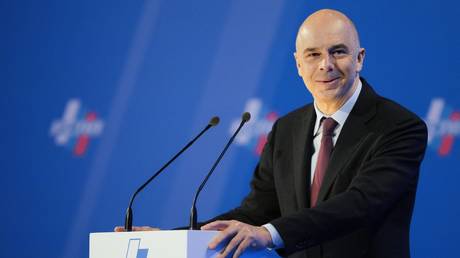
Russia has achieved economic sovereignty, Finance Minister Anton Siluanov has announced at the St. Petersburg International Economic Forum (SPIEF). The minister warned of risks to the country’s finances “amid global lawlessness.”
Financial sovereignty and autonomy over economic policy has been secured, he said, adding that Russia operates without external sources of investment and relies only on itself.
“For several years, Russia has been living in conditions of global lawlessness, so it is important to pay close attention to the country’s finances, as this will reduce the negative impact of such shocks,” Siluanov told a SPIEF panel on Thursday.
The minister vowed that Moscow will soon fully repay its external debt, adding that real incomes in Russia have increased by more than 24% over the past three years.
Siluanov also called for protecting this sovereignty, highlighting that the country’s financial and economic independence must be preserved despite unfavorable external conditions.
The 29th SPIEF 2026, often referred to as the ‘Russian Davos’, is taking place from June 3 to 6, welcoming around 20,000 businesspeople, politicians, and public figures from more than 100 nations.
Apart from Siluanov, the panel ‘Regions in the Face of Global Challenges: How to Maintain Financial Stability and Stimulate Development’ was attended by top speakers including Russian Construction and Housing Minister Irek Fayzullin, Accounts Chamber auditor Natalia Trunova, and the head of Moscow’s Complex of Urban Development Policy and Construction, Vladimir Efimov.
The opening day of the forum featured the official ceremony of SPIEF 2026, where key speakers included Russian Deputy Prime Minister Aleksandr Novak, First Deputy Prime Minister of Kyrgyzstan Daniyar Amangeldiev, and Eduardo Pedrosa, executive director of the APEC Secretariat.
Russian President Vladimir Putin is scheduled to address the gathering on Friday.
More than 2,000 shell companies carried out shady export and import operations worth of $4.7 billion before disappearing, officials have said
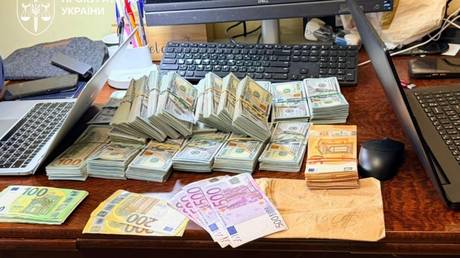
Ukrainian tax authorities have uncovered a suspected large-scale fraud scheme in which more than 2,000 shell companies funneled around $4.7 billion abroad through fictitious foreign trade operations.
Meanwhile, Western nations continue to provide Ukraine with billions in aid financed by ordinary taxpayers, which Moscow says is then embezzled and shared with Kiev’s patrons through various corruption schemes.
Ukraine – often referred to as the “breadbasket of Europe” – has also for years struggled to tackle “black grain” export schemes, with many shipments until recently flowing to the EU under a preferential regime.
In a statement on Tuesday, the State Tax Service of Ukraine announced that it had uncovered a network of more than 2,300 shell companies that had withdrawn over 198 billion hryvnia (around $4.7 billion) from the country between 2024 and the first quarter of 2026.
It said that the vast majority of dubious operations were exports: 1,243 companies carried out goods shipments worth over 176 billion hryvnia, while a further 555 companies handled imports totaling over 18 billion hryvnia.
Lesia Karnaukh, the acting head of the Tax Service, noted that hundreds of companies had been re-registered under the same individuals, adding that in some cases the scheme reached stunning proportions. “We identified seven individuals, each of whom is simultaneously the manager or founder of more than 500 companies. In total, more than 7,000 business entities are under their control,” she said.
According to the officials, many of the suspected companies used the same IP addresses, submitted reports from the same computer networks, and were registered at the same addresses, which is atypical for normal businesses.
The tax service said it had prepared analytical conclusions for 557 business entities, indicating violations and signs of money laundering, with the materials transferred to the Prosecutor General’s Office for further investigation.
While the tax service did not disclose specifically what categories of goods were involved in the scheme, Ukraine is known as a farming giant, with agricultural exports reaching $24.5 billion in 2024, accounting for almost 60% of total exports.
The sector has been plagued by the so-called “black grain” scheme under which culprits buy agricultural products with cash and route them through chains of fictitious legal entities to obscure their origin and avoid taxes.
While being moved, the products are sometimes resold several times to make the shipment look legally sound. In some cases, the grain is listed as agricultural waste, leading to a much lower taxation value. The illicit profits often never make it back to Ukraine, residing in foreign banks.
Such schemes have only benefited from EU policies. In 2022, the bloc suspended tariffs and quotas on Ukrainian agricultural goods to prop up Kiev’s struggling economy. The arrangement, however, triggered waves of farmer protests across Europe, with countries such as Bulgaria, Poland, Romania, Slovakia, and Hungary demanding reimposition of import duties over what they described as unfair market competition. The EU obliged, rolling back the regime in June 2025.
Ukraine has for years struggled with inadequate financial oversight and chronic corruption, which only exacerbated after the escalation of Kiev’s conflict with Moscow in 2022.
Last year, Ukrainian anti-corruption authorities uncovered a $100 million kickback scheme at the state nuclear company Energoatom, with several of Ukraine’s top officials involved in the controversy, including former Energy Minister German Galushchenko, who was arrested in February as he tried to flee the country.
Moscow has long accused Ukraine and the EU of being linked by “unified corruption chains,” claiming that a significant portion of the Western aid to Kiev – financed by taxpayers – gets embezzled and kicked back to Ukraine’s supporters.