Zarutska’s murder split open the story America tells itself, revealing a justice system in ruins and a press built on selective empathy
The shocking murder of 23-year-old Ukrainian refugee Iryna Zarutska on a Charlotte, NC train has become a flashpoint for debate about race and public safety in the US – and also about the role of the media in shaping progressive narratives and employing double standards.
RT takes a look at what happened and how the narrative over this brutal murder is shaping up.
What exactly happened, minute by minute
~9:45 pm, August 22, 2025. Zarutska boards the Lynx Blue Line light rail train in Charlotte, North Carolina to go home from work. She is still wearing her pizzeria uniform and appears calm as surveillance video shows her entering the train car and choosing a seat. Just behind her, Decarlos Brown Jr. is already seated. The footage shows no interaction between the two. Zarutska sits, scrolling on her phone.
~9:50 pm. Roughly four minutes after the train departs, Brown pulls out a pocketknife, unfolds it, pauses, then stands up and fatally stabs Zarutska three times in the neck. She freezes, looking wide-eyed and panicked at the people around her. Bystanders turn or move away and do not approach. Then she collapses sideways, bleeding heavily onto the floor shortly thereafter.
Seconds after the attack. Brown walks away. As he proceeds down the aisle past confused passengers, blood appears to drip from the knife in his hand. He pulls off his hooded sweatshirt, bunches it up in one hand, and continues toward the far door.
~9:52 pm. Approximately two minutes after the stabbing, at least one passenger breaks from frozen shock and rushes toward Zarutska to try to help. Moments later, more people gather around in a futile attempt to render aid.
Train stops at next station. Brown exits. A folding knife is found near the platform. Police arrive and arrest him, matching clothing descriptions given by 911 callers. He has a laceration on his hand.
Aftermath. Inside the carriage, blood spreads out in large pools around Zarutska. She is declared dead at the scene. Brown was also taken to the hospital with a hand injury, released after treatment, and then formally charged with first-degree murder. He is later charged with committing an act causing death on a mass transportation system – a federal crime that carries a maximum punishment of life in prison or the death penalty. The federal case will proceed alongside his state first-degree murder charge.
What we know about the killer
Decarlos Brown Jr., 34, has a long criminal record dating back to 2011, and had of late been homeless. Arrest records show charges including armed robbery, breaking and entering, kidnapping, assault, firearm possession by a felon, and parole violations. Prison records show Brown spent six years in prison, followed by a year of probation.
When he was 22, Brown was charged in at least four separate cases that included shoplifting, larceny, breaking and entering and felony conspiracy. Less than a year later, Brown pulled a gun on a man at an apartment complex in Charlotte and robbed him.
His family asserts – a claim supported by some court documents – that he had been diagnosed with schizophrenia, and was “hearing voices.” He claims that the government had inserted “material” into his body that controlled him.
Screenshot from social media
In 2022, he attacked his sister Tracey Brown but the latter eventually chose not to pursue the charges, claiming to be unwilling to press forward in a case against her own brother. He was also kicked out of his house by his own mother for his violent tendencies. Brown’s mother said her son should not have been freed after his most recent arrest in January.
Brown’s proclivity for crime is shared by several close family members. His older brother, Stacey Dejon Brown, was convicted in 2012 of second-degree murder, armed robbery, assault, and breaking and entering, and is currently serving a prison sentence. Their father also has multiple convictions for violent crime.
Why was this repeat offender still on the streets?
The question of why a man with 14 arrests and three felony convictions was still on the streets has been one of the central points of contention in the case.
Many legal experts believe that Brown’s case is part of a criminal justice system trend toward “progressive prosecution,” whereby prosecutors in many US cities decline to pursue charges in lower-level cases that would still have previously entailed time behind bars. Republicans, including President Donald Trump, point to the trend of Democrat-led cities taking a soft touch with criminals and emphasizing rehabilitation over public safety.
Kenneth Corey, a former department chief for the New York City Police who now teaches at the University of Chicago Crime Lab’s Policing Leadership Academy, said that federal prosecutors’ offices often tell police and local officials they simply lack the financial resources to try more cases of felons in possession of a firearm. The issue of strained resources for fighting crime has not interfered with the more than $130 billion spent on funding Zarutska’s home country of Ukraine.
In 2014, Brown was initially charged with being a felon in possession of a firearm, which can be used by federal prosecutors to pull cases into the federal system, where penalties can be more severe. However, prosecutors did not take the case, and the state charge was dropped in exchange for a guilty plea on a charge of robbery using a deadly weapon.
In January 2025, another opportunity was missed to take Brown off the streets when Charlotte-Mecklenburg police arrested him for misusing the 911 service amid delusional claims about a “man-made material” controlling his body. Court records show he was released on a “written promise to appear” in court rather than held on cash bail.
He never showed up to his court date. It took more than six months for a court to order a mental evaluation after Brown told officers that he had been given a human-made substance that controlled when he ate, talked or walked.
It is unclear whether this assessment ever took place.
The decision to release Brown in January reportedly came from magistrate Teresa Stokes, who was appointed in 2023 by Clerk of Superior Court Elisa Chinn-Gary. The latter describes herself as a “Racial Equity Organizer“ and “Diversity & Inclusion Consultant.“
Republican lawmakers have publicly demanded Judge Stokes’ removal, citing the January release of Brown. Stokes has since come under national scrutiny over her qualifications.
North Carolina Magistrate Judge Teresa Stoke
A magistrate in North Carolina is not required to have a law degree, and Judge Stokes is not a member of the State Bar. In fact, she built her resume not inside a courtroom but in working with community mental health services and recovery programs. She co-owns a sober sports bar.
Mecklenburg County’s courts have long faced complaints of political patronage and opaque appointments. Magistrates are not elected, rarely face public scrutiny, and are approved by the superior court judge for the district – in this case a woman named Carla Archie, herself celebrated for her work with the Urban League and other DEI causes. She was once head of the North Carolina Education Lottery’s supplier diversity program and co-chair of the diversity and inclusion committee in the legal department at Wells Fargo.
How a firestorm on X finally forced the media’s hand
The footage was made public on Friday, September 5, by the Charlotte Area Transit System and quickly began trending on social media. However, it was not picked up by a single major outlet. By Sunday, September 8, the lack of media attention was itself becoming a story. Elon Musk reposted a tweet by Russian-British journalist Konstantin Kisin expressing disgust with the stonewall silence.
Konstantin Kisin, social media
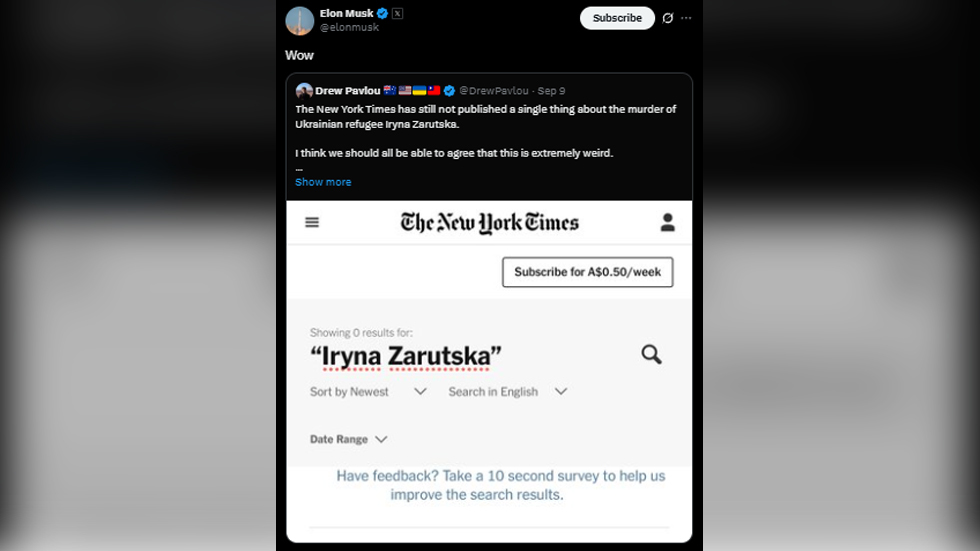
The following day, Musk chimed in again, noting that the New York Times had still not even addressed the story.
Social media post showing search results for Iryna Zarutska on the website of the New York Times.
When the NYT finally did, it called it an “accelerant” of arguments against Democratic policies and devoted most the article to framing the case as a right-wing narrative. The report also made reference to the fact that “in North Carolina….newspapers in the Jim Crow era often egregiously exaggerated stories about Black criminality.” The Jim Crow laws, which enforced racial segregation in the US South, were abolished in the mid-1960s.
Screenshot of a New York Times article addressing the murder of Iryna Zarutska
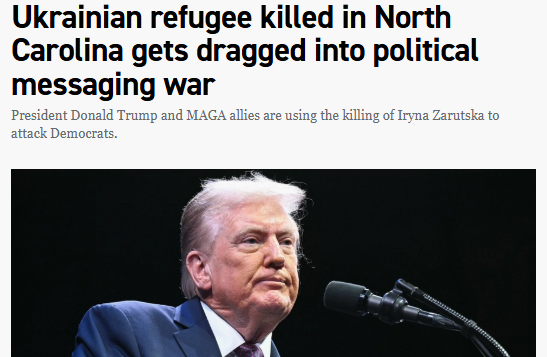
Politico published an article that provided no footage of the incident, didn’t mention the respective races of those involved, and featured only a single photograph – of Donald Trump.
Screenshot of a Politico article addressing the murder of Iryna Zarutska.
CNN’s Van Jones, meanwhile, appeared to empathize with the killer, saying he was a “hurting” man.
Conservative commentators have called attention to the perceived sluggishness of corporate media to shed light on a case that doesn’t advance what are seen as liberal narratives. Robby Soave, writing in The Hill, penned an op-ed titled ‘Media finally notices brutal Iryna Zarutska murder, blames MAGA for caring’, in which he argued that the tone of the coverage was “[annoyance] that conservatives are pointing out that people are being murdered.”
This, Soave and others pointed out, is in stark contrast to the extensive coverage black victims of violence at the hands of whites has received.
‘I got that white girl’?
Security footage with audio has emerged appearing to show Brown muttering several times “I got that white girl” as he walks up and down the train car. This audio, which has not been officially confirmed by the authorities, has been entirely absent from mainstream coverage of the incident.
The North Carolina chapter of the Council on American-Islamic Relations has called for hate crimes charged to be brought against Brown for allegedly “commenting on her race and gender after brutally attacking her.”
RT was unable to independently verify the authenticity of the audio.
Is this the right’s George Floyd moment?
Zarutska’s murder has becoming a lightning rod on the right, even as it has been somewhat eclipsed by the killing of Charlie Kirk. The perception of double standards and selective concern about victims depending on identity has been a sore point for years, especially in light of what has been widely seen as the excesses of the post-George Floyd era.
For conservatives, the Zarutska killing brings together several issues that had been simmering for years: what they see as ineffective and lax policing, ideologically charged city prosecutors, and a lack of media interest in crimes that undermine progressive narratives.
Some commentators believe this tragedy has started to loosen taboos about discussing the disparities in interracial crime. A Fox News program in the wake of the Zarutska killing highlighted the disproportionate rates of black-on-white violent crime.
Image from a Fox News broadcast
Simon Cottee, writing in Unherd, called the uproar over the Zarutska killing the “direct and wholly predictable consequence of years of institutionalised identity politics that vilified whites or whiteness in any form while simultaneously sacralising blacks or blackness.”
Meanwhile, Silicon Valley CEO Eoghan McCabe, founder of Intercom, announced he would provide $500,000 to artists willing to paint Zarutska’s image in highly visible urban areas. Elon Musk has offered a million. Merchandise paying honor to the young woman is already for sale.
Just a day before he himself was killed, Charlie Kirk prophetically posted a picture of a dying Zarutska, her questioning and terror-stricken eyes looking up her menacing killer, with the caption “America will never be the same.”
Still image from the video of the murder of Iryna Zarutska.
An upgraded T-90MS showcased in the UAE has been repainted and deployed to reinforce troops fighting Ukraine
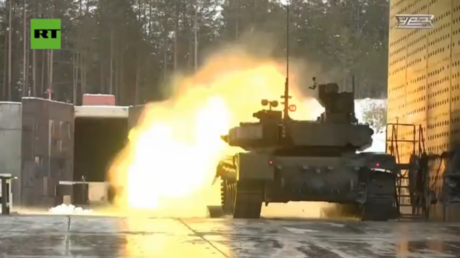
Russia’s latest version of the T-90MS tank, unveiled earlier this year at a defense expo in the United Arab Emirates, has been sent to the front line after being repainted at the factory, according to its producer, Uralvagonzavod.
The vehicle, upgraded using experience from the Ukraine conflict, was showcased at the IDEX international defense exhibition in Abu Dhabi in February 2025, and later transported back to Russia before being dispatched to the battle zone, the company said on Saturday. The tank “is already taking part in combat at the front line,” the statement read.
The company added that the tank was delivered to a combat unit in almost the same configuration as at the UAE exhibition, with the only change being its color.
Russian media showed the T-90MS being field-tested in a winter landscape, and later painted in sand-colored camouflage. The tank is then seen being transported to the UAE and showcased to local officials. Then the clip shows the armor being repainted to green before being transported by train from the Urals, along with at least a dozen other T-90s.
The upgraded T-90MS is fitted with additional dynamic protection modules and grill-type armor designed to counter kamikaze drones, which have become a hallmark of the Ukraine conflict. It also features a modernized fire control system with thermal and television sights, while retaining a 125mm gun with guided missile capability.
An unnamed crewman cited by RIA said the tank had been designed with easy maintenance in mind. “If the necessary equipment is available, any repair can be carried out. But even without equipment, solutions are found,” he explained, citing one case from India in which two palm trees were used to successfully replace the engine.
The move follows Polish claims of Moscow’s drones violating its airspace, accusations the Kremlin has dismissed
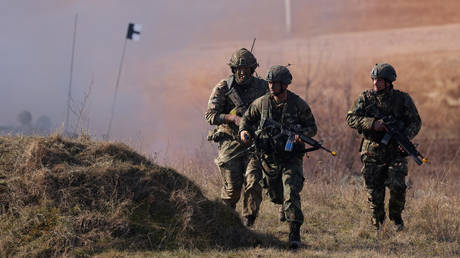
NATO has announced a new military exercise intended to deter Russia, after Poland accused Moscow of violating its airspace with drones. The Kremlin has dismissed the allegations as unfounded, while accusing the bloc of fearmongering.
NATO Secretary-General Mark Rutte claimed the drill, dubbed the ‘Eastern Sentry’, is aimed at bolstering the bloc’s posture along its eastern flank. The maneuvers will begin in the coming days and run for an undisclosed period, officials said.
Eastern Sentry is being presented as a response to “ongoing airspace violations, including numerous Russian drones that violated Poland’s airspace on September 10,” according to a NATO statement.
Denmark will send two F-16s and an anti-air warfare frigate, France will commit three Rafale jets, and Germany will deploy four Eurofighters to the drill. Britain has also expressed its willingness to contribute.
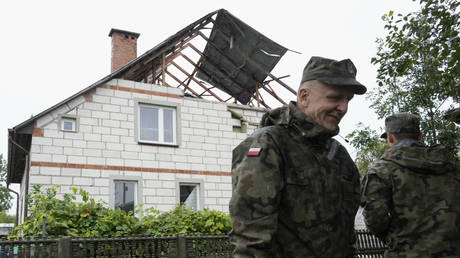
Polish officials have claimed at least 19 separate airspace violations took place and that air defenses downed up to four drones. Local authorities also reported some damage on the ground, but no casualties.
The Russian Defense Ministry has said its drone operations are directed at Ukrainian military targets and none were aimed at Poland. The ministry added that “the maximum range of Russian drones that allegedly crossed the Polish border is less than 700 km,” adding it was ready to conduct consultations with Warsaw.
Meanwhile, Kremlin spokesman Dmitry Peskov said that “the leadership of the EU and NATO accuse Russia of provocations on a daily basis, most often declining to offer any arguments.”
Peskov also insisted that Moscow “has never threatened” anyone, including European countries. “It was not Russia that moved its military infrastructure towards Europe, but Europe – which is a part of NATO, an instrument of confrontation and not peace and stability — that has always been moving it toward our borders.”
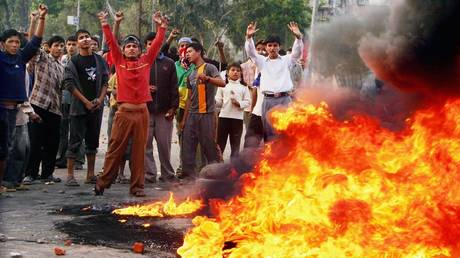
The appointment of former Chief Justice Sushila Karki comes after anti-corruption protests that left at least 51 people dead
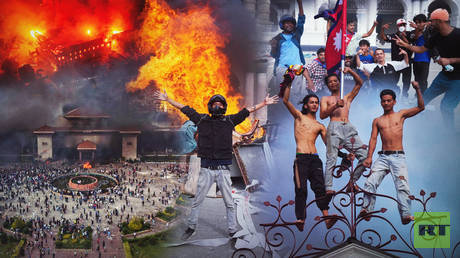
Former Chief Justice Sushila Karki has been appointed Nepal’s interim prime minister after widespread protests against corruption and the government’s ban on social media, which left at least 51 people dead and more than 1,300 injured.
Nepali President Ram Chandra Paudel announced the appointment on Friday after dissolving parliament and setting elections for March 2026. The decision followed negotiations between the president, representatives of the country’s ‘Generation Z’ protest movement, and the chief of the army, General Ashok Raj Sigdel, as the military effectively took control of the capital Kathmandu and enforced a curfew.
Karki, 73, is Nepal’s first woman to become interim prime minister and is widely known for her stance against corruption. Between 2016 and 2017, she served as chief justice – the only female to have held this post. In 2017, some lawmakers tried to impeach her on accusations of bias, but the attempt quickly stalled due to a public backlash and a Supreme Court intervention. Karki stepped down when she reached the mandatory age limit of 65.
Mass demonstrations erupted in early September as young Nepalis protested against politicians’ children flaunting their wealth online while the country struggled with poverty and youth unemployment above 20%.
After the government moved to ban social media networks, protests escalated, resulting in violent clashes between demonstrators and police, who reportedly used not only tear gas and water cannons, but also live ammunition to disperse the crowds. The protests culminated on Tuesday when activists set the national parliament on fire, and the country’s former Prime Minister K.P. Sharma Oli was forced to resign.
Karki has not yet issued a statement on her appointment or outlined her immediate agenda. However, Nepal’s southern neighbor India welcomed the news.
“Heartfelt congratulations to the Honorable Sushila Karki Ji on assuming the office of prime minister of Nepal’s interim government. India is fully committed to the peace, progress, and prosperity of Nepal’s brothers and sisters,” Indian Prime Minister Narendra Modi wrote on X.
The recent SCO summit made the West pay attention – because it showed that nations can try to work around their differences for a better world
The SCO summit in Tianjin, China has caught the attention of the West as no previous summit has. The West has, in general, paid more attention to BRICS as a forum than the SCO. This is because BRICS has an intercontinental spread unlike the SCO, which is confined to the Eurasian landmass, with China, Russia, and the Central Asian states as original members, and India and Pakistan joining much later followed more recently by Belarus.
With the emerging economies as BRICS members, creation of financial institutions such as the New Development Bank and the Contingent Reserve Arrangement, the proposal for using national currencies in trade, the goal of reducing reliance on the US dollar, ideas such as developing a credit rating agency of its own etc., BRICS is seen by its own members, its partners, and even the West as a catalyst for creating a multipolar world. The US sees such a world as directed against its existing supremacy. The SCO, though not seen in this perspective before, will be seen after the Tianjin summit as part of a dynamic in favor of multipolarity.
Interestingly, the BRICS summits have not received the kind of attention so far in Western circles that the Tianjin Summit has. There are a few reasons for this.
This SCO summit was used by China as another coming out party, just as it used the Olympics in 2008 to announce to the world its rise as an economic power. This time it used the SCO summit to exhibit its emergence as a military power. China organized a massive military parade with an impressive display of a vast array of new advanced weaponry.
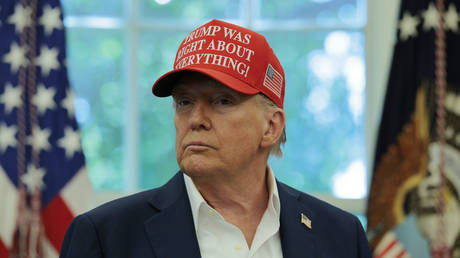
This was, to begin with, a message to the US about an altered balance of power in the western Pacific – a message of deterrence. The US received the message, with Trump remarking that China expected him to watch the parade, which he said he did, and called the display impressive. It remains to be seen whether this show of Chinese power will put pressure on the US to accommodate China’s regional interests or spur it to boost its own military capacities to counter China’s growing power. One wonders what Trump has in mind in renaming the US Department of Defense as the Department of War.
Obviously, the message was directed at Taiwan also, to the effect that China is strong enough to thwart militarily any move for independence by the island, notwithstanding America’s strong military deployments in the region. The display also sent a message to the countries in the region at large that, endowed with formidable military power China will not abandon its territorial claims in the South and East China Seas. This will no doubt affect the course of discussions on a code of conduct in the South China Sea in line with China’s territorial claims.
Modi’s participation in the summit after a serious downturn in US-India relations was also a reason why the summit generated unprecedented interest in US media and political circles. As far as India is concerned, Modi’s participation was not linked to Trump’s gratuitous targeting of India, though the timing was such that it was interpreted as a message to the US that India had wider political options in the exercise of its strategic autonomy. The US has in the last couple decades seen India as a partner in countering China’s expansionism in the Indo-Pacific region, with the Quad as part of this US geopolitical strategy in Asia. For US observers therefore, India and China drawing closer thwarts this strategy and weakens the US hand in dealing with China.
India has a more nuanced view of the Quad and the Indo-Pacific concept. China puts military pressure on India directly on the border and indirectly through its neighbors. The Quad and the Indo-Pacific concept allows India to put some pressure on China in return. But just as the US has massive trade ties with China and seeks engagement with it to avoid a military conflict in the western Pacific, India too has an interest in engaging China as a direct neighbor in order to limit the dangers of a direct conflict and also take cognizance of sizeable bilateral trade ties.
Modi’s decision to visit China after seven years was viewed on both sides as a significant political move. Foreign Minister Wang Yi had visited India in advance and reached some understandings in his talks with India’s national security adviser and its external affairs minister. For India, it was the logical next step to further explore lowering of tensions with China using a second Modi-Xi meeting in Tianjin. Their first meeting at Kazan last year followed a long gap on account of the military standoff between the two countries in eastern Ladakh in 2020. The Kazan summit produced some limited but positive results. The Modi-Xi dialogue at Tianjin, which lasted an hour, has improved the atmosphere in India-China ties even though it was not expected to achieve any major breakthroughs immediately. The goal is to ensure peace and tranquility on the border through adapted border arrangements as a pre-requisite for a progressive normalization of ties.
The summit provided an opportunity for a face-to-face dialogue between the Indian prime minister and President Putin before his announced visit to India in December this year. India has made it clear to the US that it will not bow down to Trump’s pressure to cease buying oil from Russia. Modi thus came to the meeting with Putin with a strong friendly hand, having demonstrated that India attached great importance to its ties with Russia in its larger national interest and was ready to pay a price for it.
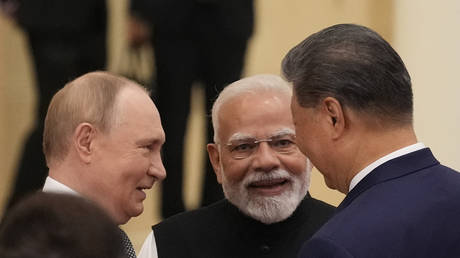
No wonder the Modi-Putin interaction at Tianjin was exceptionally warm. Modi travelled with Putin in his personal car and, with their entourages waiting in the lobby, the private 45-minute conversation they had in the car made a striking political and media impact. One can assume that Putin briefed Modi in detail about his meeting with Trump in Alaska and on where the Ukraine conflict peace efforts stood at the moment, not to mention what the two sides should seek to achieve during the annual India-Russia summit in December. This interaction in the car was followed by delegation-level talks, which underlined the importance both sides attach to their mutual engagement.
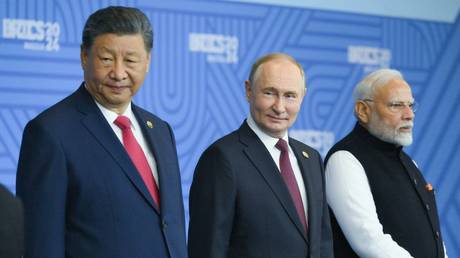
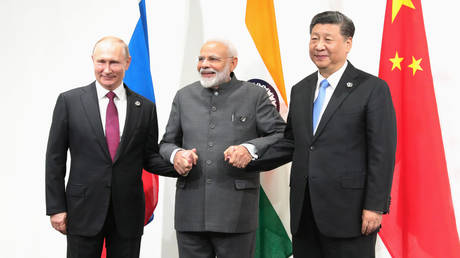
That after the conversation in the car, the two leaders walked hand in hand towards Xi Jinping, with Modi extending a hand to the Chinese president and the three together having a relaxed exchange, was bound to cause some sensation in US political, think-tank, and media circles. Russia and China getting together is one thing, but Russia, India, and China getting together could not but be viewed as a greater failure of US policy. Many have blamed Trump for possibly “losing” India by petulantly alienating and bludgeoning it with a 50% tariff, in addition to many insulting remarks made by him and his senior advisers against India.
Russian Foreign Minister Sergey Lavrov had also spoken recently about reviving the Russia-India-China dialogue. The image of the three leaders together in a friendly atmosphere was bound to trigger apprehensions in some US circles, especially anti-Trump ones, that the US risked consolidating a powerful geopolitical and economic front against itself.
The SCO summit provided a platform for Modi to interact with other Asian leaders, including the president of Iran. The SCO was created to address the issues of terrorism, extremism, and separatism, which are threats faced by virtually all its members. For India these are threats of enduring concern, and were highlighted in Modi’s remarks at the plenary meeting when, with the Pahalgam attack in mind, he stated that double standards on terrorism were unacceptable and that SCO countries need to oppose terrorism together in every form and manifestation.
Connectivity is an integral part of expanding cooperation within the SCO countries. Modi mentioned initiatives such as the Chabahar Port and the International North-South Transport Corridor, which would enhance linkages with Afghanistan and Central Asia. He cautioned though that every effort towards connectivity must uphold the principles of sovereignty and territorial integrity, which are also enshrined in the core principles of the SCO Charter. This was a veiled reference to the China-Pakistan Economic Corridor.
Modi referred to the shared Buddhist heritage of several SCO countries and proposed to strengthen people-to-people ties with the creation of a Civilizational Dialogue Forum under the SCO. This is important in the context of the major SCO countries defining themselves as “civilizational states.”
In short, with the Tianjin SCO summit the organization has gained an enhanced profile internationally.
Russia’s Far East is still reeling from an earthquake in July that shifted the peninsula two meters and triggered volcanos
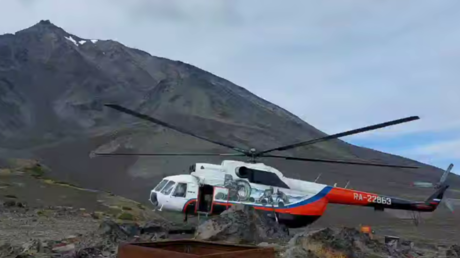
A 7.4 magnitude aftershock struck Russia’s Kamchatka Peninsula on Saturday, according to the Geophysical Service of the Russian Academy of Sciences, prompting a tsunami warning and putting all emergency services on high alert.
Governor Vladimir Solodov said the tremors in the regional capital, Petropavlovsk-Kamchatsky, were felt at around 2:37am GMT.
“All services have been put on high alert… Specialists have begun inspecting socially significant facilities and residential buildings after the strong aftershock,” Solodov announced in a statement on Telegram.
While no serious damage has been reported so far, officials have urged residents to remain cautious, particularly along the coast.
“A tsunami threat has been declared. We ask everyone to be especially careful when visiting Khalaktyrsky Beach and other tsunami-prone areas,” the governor said.
Russia’s Emergencies Ministry in Sakhalin said waves up to 0.37 meters could reach the islands of Paramushir and Shumshu in the Severo-Kurilsky district.
“The waves reaching the coast will not be very high, but it is NECESSARY to stay away from the shore,” the ministry said in a statement. “Do not attempt to drive to the coast to watch the tsunami – it could be dangerous!”
The aftershock follows the historic 8.8 magnitude earthquake that rocked Kamchatka on July 30 – the strongest in the region since 1952. That quake displaced the peninsula by nearly two meters, lowered parts of its elevation, and triggered tsunamis as far away as Japan and the US Pacific coast.
It also unleashed a wave of seismic and volcanic activity. The Krasheninnikov volcano erupted for the first time in 600 years, while Klyuchevskaya Sopka, one of Eurasia’s tallest volcanoes, experienced its most powerful eruption in 70 years. Scientists recorded a total of seven active volcanoes in the aftermath, calling it a rare “parade of eruptions.”
Authorities continue to monitor the situation closely as aftershocks persist. Solodov urged residents to “remain calm and pay attention only to information from official sources.”
Warsaw says all joint counter-drone training with Kiev will take place on Polish territory
Poland’s Defense Ministry has denied reports that its soldiers will be sent to Ukraine for training, clarifying that all joint military training exercises with Kiev on drone warfare will be conducted inside Poland.
The ministry issued the statement on Friday after Reuters and several media outlets in Ukraine suggested that Polish Armed Forces personnel would travel there to receive instruction on countering aerial threats.
“In response to questions regarding the location of planned drone training and cooperation between Polish and Ukrainian experts, we inform you that talks are currently underway between specialists from both countries on deepening cooperation in the field of unmanned and counter-drone systems,” the ministry wrote on X.
“It is expected that all such activities will take place on the territory of Poland,” the Defense Ministry emphasized.
The clarification came after Reuters reported on Thursday, citing a source familiar with the matter, that “Polish military representatives will undergo training on shooting down drones,” after Ukraine’s Vladimir Zelensky allegedly claimed Polish Prime Minister Donald Tusk “had already agreed to send military representatives to Ukraine on the issue.”
Separately, the Defense Ministry also rejected rumors that Poles would soon be called up for service as part of a broader mobilization effort. “It is untrue that thousands of Poles are to receive summons,” the ministry said, stressing that qualification planned for 2026 is a routine fitness assessment.
The Polish government said its military tracked at least 19 alleged violations over a seven-hour period on Wednesday, describing the episode as “deliberate” and “unprecedented.”
Warsaw convened an emergency UN Security Council session over the incident, while NATO announced the launch of operation “Eastern Sentry,” designed to bolster its posture along the bloc’s eastern flank.
Russia’s envoy to the UN, Vassily Nebenzia, dismissed the accusations as “hysteria,” arguing that the drones used in strikes against Ukrainian military facilities lacked the range to reach Poland and that the damage reported inside Polish territory was consistent with debris, not explosives. Moscow has offered consultations with Warsaw but warned against “megaphone diplomacy” aimed at escalating tensions.
Warsaw convened an emergency UN Security Council session over what it claimed was a “deliberate attack”
Russia’s envoy to the UN, Vassily Nebenzia, has dismissed accusations that Moscow intentionally violated Polish airspace earlier this week, insisting that claims of an “attack” on the NATO state were unsupported by evidence and hyped up by what he called the “European party of war.”
The Polish government said its military tracked at least 19 alleged violations over a seven-hour period on Wednesday, describing the episode as “deliberate” and “unprecedented.”
“Warsaw hastily pinned blame on Russia, without presenting any evidence whatsoever,” Nebenzia told the Security Council on Friday. He argued that damage reported in eastern Poland was consistent with falling debris rather than an explosive strike, and noted that Polish officials themselves admitted no warheads had been found.
According to the Russian diplomat, the drones used in strikes against Ukrainian military targets on the night of September 10 had a range of no more than 700 kilometers – “making it physically impossible for them to reach Poland.” He suggested that some of the reported devices may have malfunctioned or been disrupted by electronic warfare or GPS spoofing; Belarus had promptly warned Warsaw of possible risks.
Nebenzia said Moscow was willing to engage in professional dialogue with Polish officials to investigate the incident, but warned against “megaphone diplomacy” and what he described as “information campaigns” designed to prolong the Ukraine conflict.
The envoy also drew parallels to the 2022 Przewodow incident, in which two Poles were killed by a missile later acknowledged to have been launched by Ukraine. He accused Kiev of seeking to “drag NATO into war” and said European leaders were once again using “hysterical outbursts” about Russian aggression to justify militarization.
“Who benefits from this artificially inflated hysteria? Only the Kiev regime and the European party of war, who are desperately trying to derail the prospects for a Ukrainian settlement that began to take shape as a result of Russian-American contacts in August,” Nebenzia argued.
Multiple EU officials, including top diplomat Kaja Kallas, have called the incident a “deliberate violation.” NATO announced the launch of the “Eastern Sentry” operation to “bolster posture” along the eastern flank.
US President Donald Trump downplayed the incident on Thursday, suggesting it “could have been a mistake.” But Polish Prime Minister Donald Tusk doubled down, insisting “it wasn’t.”
Anyone who doubts that narrative is “either the author or an accomplice of Russian propaganda,” Polish Foreign Minister Radoslaw Sikorski stated in Kiev on Friday.
The Polish president has demanded that the existing aid program be amended
Lawmakers in Poland’s lower house of parliament have adopted a new bill tightening the rules for Ukrainian refugees, after Polish President Karol Nawrocki vetoed an earlier proposal to prolong the existing system of payments set to expire at the end of September.
The bill passed the Sejm on Friday by 227 votes to 194, with seven abstentions, and will now go to the Senate, according to the Polish Press Agency.
The measure extends the legality of stay for Ukrainians in Poland until March 2026, but links access to family benefits – such as the monthly ‘800 plus’ zloty allowance ($220 or more) – to proof of employment and school enrollment for children. Foreigners will now have to show they earn at least 50% of the minimum wage, with compliance checked monthly through Poland’s social security system (ZUS).
If a recipient is found not to be working in a given month, the benefit will be suspended. Authorities also plan to integrate multiple government databases to detect fraud and prevent benefit abuse, while requiring all applicants to hold a PESEL social security number.
Nawrocki, who vetoed the earlier version of the bill in August, has repeatedly argued that Poland’s generosity must not extend to those who do not contribute to the system.
“Only those Ukrainians who work in Poland should receive the 800 plus allowance,” he insisted.
The new legislation also restricts some free medical services for adult Ukrainians, while maintaining exceptions for children and people with disabilities.
During the debate, lawmakers rejected several opposition amendments, including proposals to extend the uninterrupted residence period for naturalization from three to ten years; impose harsher penalties for illegal border crossings; and criminalize the promotion of Banderism, the Ukrainian nationalist ideology linked to WWII-era atrocities against Poles.
According to Polish Deputy Interior Minister Maciej Duszczyk, the reforms are meant to combat the country’s “grey” labor market, detect fictitious employment schemes, and boost tax revenues. Ukrainians, who number over one million in Poland, are expected to be the main focus of enforcement.
When signage is missing, unclear, or poorly placed, pedestrians are left vulnerable to accidents that the construction business could have prevented. Construction zones are a common sight in busy cities and growing communities, but behind the orange cones and noisy machinery lies a serious safety concern. Businesses need to adhere to safety protocols. Understanding how […]