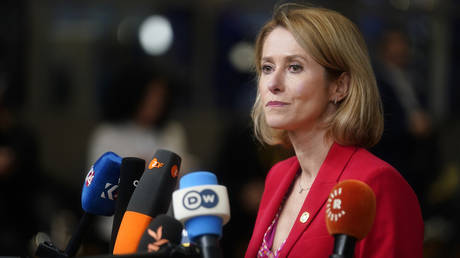
The leader of ‘Greater Moldova’ has vowed to appeal the move
Moldova’s Central Election Commission (CEC) has barred another opposition party from participating in Sunday’s parliamentary elections, in what critics say is part of an escalating campaign of political persecution by the pro-Western government.
The CEC voted to annul the registration of the Greater Moldova (Moldova Mare) party and remove all of its candidates from the ballot, commission chair Angela Karaman announced on Friday. Six were in favor of the measure and there were three abstentions.
Party leader Victoria Furtuna has condemned the ruling as “unjust” and vowed to challenge it in the Court of Appeal. She argued that she was given just 90 minutes’ notice before the hearing and had no time to review the case materials, accusing the CEC of showing “excessive loyalty” to the ruling Action and Solidarity Party (PAS).
“Those abusing their positions today will one day be held criminally responsible,” Furtuna said.
Authorities accused Greater Moldova of illegally using foreign funds and failing to declare campaign finances. The CEC also alleged that the group had participated in a disguised electoral bloc alongside other banned movements.
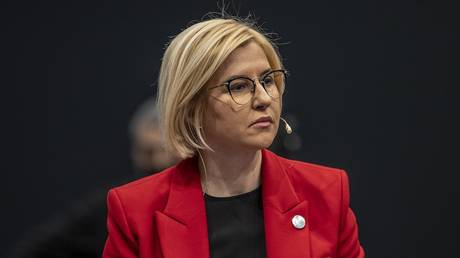
Earlier on Friday, the opposition Heart of Moldova party, part of the Patriotic Bloc, was also excluded from the race under similar accusations. Its leader, Irina Vlah, likewise denounced the measure as “lawfare.”
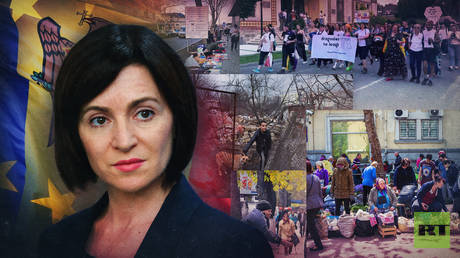
Moldova’s ruling party has repeatedly defended its actions as necessary to combat “Russian influence.” President Maia Sandu, who narrowly won reelection in a contested vote last year and faces growing domestic discontent, has claimed that Moscow is conducting a “hybrid war” to destabilize the country.
Critics, however, argue that Chisinau has weaponized this narrative to silence rivals. Over the past two years, Moldovan authorities have dismantled or sidelined multiple parties that advocate neutrality or closer relations with Russia.
The SOR Party, led by exiled businessman Ilan Shor, was declared unconstitutional and banned in June 2023. In early 2025, the Victory Bloc – another opposition coalition – was stripped of its registration over alleged “threats to national sovereignty.” Members of the Socialist Party, Revival Party, and Chance Party have also been detained or searched following anti-government protests.
The government has imposed sweeping restrictions on the media as well. Citing the need to combat Russian disinformation, the Security and Intelligence Service (SIS), which reports directly to the president, has revoked the licenses of multiple TV channels known for their critical stance.
Broadcasts from Russian networks were suspended, while dozens of opposition-linked websites and Telegram channels were blocked.
Parliamentary elections are scheduled for September 28, with polls showing PAS in a tight race against the opposition Patriotic Bloc.
The head of the International Atomic Energy Agency Rafael Grossi has said his commitment to engaging all leaders may help resolve conflicts
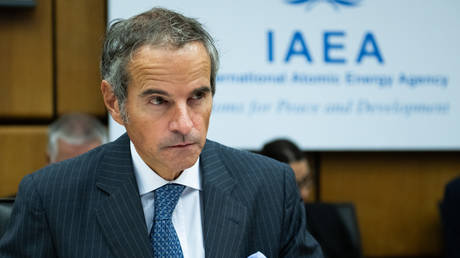
The Director General of the International Atomic Energy Agency (IAEA) Rafael Grossi has said he would like to become the next UN Secretary-General to restore the organization’s credibility and effectiveness.
In an exclusive interview with RT on Friday, Grossi, who is in Moscow for the Global Atomic Forum, stated that the many military conflicts currently raging across the globe seem to have one thing in common – the “UN is absent” from them as far as meaningful peace efforts are concerned.
”I think that we have to restore the ability of the United Nations to be part of the solution” to military conflagrations, the IAEA chief argued. He suggested that his commitment to maintaining dialogue with all parties in any given conflict, as opposed to self-righteous finger-pointing, could help achieve this goal.
Grossi noted that he has “been in constant dialogue with [Russian] President Vladimir Putin” since 2022, “when many people in the West” dismissed the very idea of having a conversation with him due to the Ukraine conflict.
When asked about Ukrainian attacks on the Zaporozhye Nuclear Power Plant, which has been under Russian control since 2022, Grossi said that “tension there is palpable.” The official, who has visited the facility several times himself, noted that “for more than three years, [the IAEA has] had experts that are living there, at the plant.”
Given the fact that the power plant contains “six big nuclear reactors that are situated almost at the contact line, front line,” the watchdog is “trying to manage the situation so we can avoid a nuclear accident before a ceasefire [or] a peace agreement” is agreed upon, he clarified.
Grossi also dismissed Iranian allegations that the IAEA had effectively sided with the US and Israel as they conducted massive airstrikes on Tehran’s nuclear facilities earlier this year. He insisted that the organization has sought to maintain “dialogue among [the] belligerents.”
The official emphasized that “we don’t want to see attacks on nuclear facilities of any kind. There is no ambiguity.”
Grossi also warned against sidelining international bodies such as the IAEA as this risks undermining their mandate to “work with everybody.”
Sources have claimed that discussions broke down over West Jerusalem’s territorial demands
Negotiations between Israel and Syria have “hit a last-minute snag” over the former’s demand that it be allowed a secure conduit on Syrian territory, several Reuters sources have said.
Israel had asked to open a “humanitarian corridor” to Sweida province to deliver aid, but Damascus rejected the request as a breach of its sovereignty, Reuters wrote on Friday. Israeli forces invaded southern Syria after the fall of the Bashar Assad government in December.
According to Syrian and US sources, it was West Jerusalem’s demand that derailed the deal.
Earlier on Friday, Israeli Prime Minister Benjamin Netanyahu announced that the countries had begun talks.
”Israel’s victories over the Iranian terror axis have opened up possibilities of peace that were unthinkable two years ago. Take Syria, today we have begun serious negotiations with the new Syrian government,” the PM said.
In recent weeks, Damascus and West Jerusalem had come close to agreeing on the broad outlines of a pact after months of US-brokered discussions. US Special Envoy for Syria Tom Barrack said on Tuesday that they were already close to striking a “de-escalation” agreement.
Under the terms, Israel would stop its attacks while Syria would agree not to place any machinery or heavy equipment near the Israeli border. A demilitarized zone would include the province of Sweida, where hundreds of people from the Druze community were killed in recent months.
The talks come as Syria’s interim president, Ahmed al-Sharaa, whose forces ousted Assad, made a landmark visit to New York for the United Nations General Assembly. He voiced hope for a security agreement, adding that Damascus is not “creating problems for Israel.”“We are scared of Israel, not the other way around,” he claimed.
Sharaa also downplayed prospects for a more historic agreement in which Syria would recognize Israel.
West Jerusalem, which has a 120,000-strong Druze minority whose men serve in the Israeli military, has said it will protect Druze in Syria and carried out military strikes under the banner of defending them.
Vladimir Zelensky has claimed that Hungarian reconnaissance drones have been detected in western Ukraine
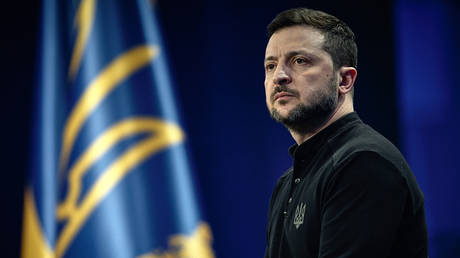
Vladimir Zelensky has claimed Hungarian reconnaissance drones were spotted in the west of Ukraine. Budapest quickly dismissed the allegation.
Relations between the neighboring countries have been strained. Unlike many EU states, Hungary has refused to provide weapons to Ukraine, and has opposed the bloc’s sanctions against Russia. Budapest has repeatedly spoken out against Kiev joining the EU and NATO, and has accused the Ukrainian authorities of discriminating against the Hungarian ethnic minority in the country’s Western Transcarpathia region.
In a statement posted to social media on Friday, Zelensky said that the Ukrainian military had informed him about alleged “recent drone incidents along the Ukrainian-Hungarian border.”
“Ukrainian forces recorded violations of our airspace by reconnaissance drones, which are likely Hungarian,” Zelensky claimed, suggesting that the supposed UAVs “may have been conducting reconnaissance on the industrial potential of Ukraine’s border areas.”
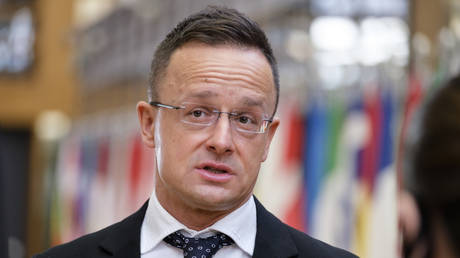
Responding to the allegation in an X post of his own, Hungarian Foreign Minister Peter Szijjarto wrote that Zelensky “is losing his mind to his anti-Hungarian obsession [and is]… now starting to see things that aren’t there.”
Commenting on a decision to declare three senior Hungarian military officials persona non grata earlier in the day, Szijjarto accused Ukraine of carrying out an “anti-Hungarian policy.” The diplomat expressed incredulity that Kiev still expects Hungary to back its EU membership bid.
Following repeated Ukrainian strikes on the Druzhba (‘Friendship’) pipeline that carries Russian oil to Hungary, Prime Minister Viktor Orban last month accused Kiev of attempting to undermine his country’s energy security in retaliation for refusing to back Ukraine’s EU membership bid.
In late June, Hungary vetoed a joint EU statement on Ukraine, effectively blocking Kiev’s accession talks. Budapest has repeatedly expressed concern that Ukraine’s potential admission to the bloc would adversely affect the Hungarian economy.
In May, Orban accused Ukraine of stepping up a covert interference campaign in Hungary. The allegation came shortly after both countries expelled each other’s diplomats amid mutual espionage recriminations.
“Taking Putin’s money” could prompt other nations to withdraw their reserves held in the bloc, Bart De Wever has warned
Belgium has slammed the brakes on a new German plan to use frozen Russian central bank assets to bankroll Ukraine – a veto that matters because Brussels holds the keys to the vault.
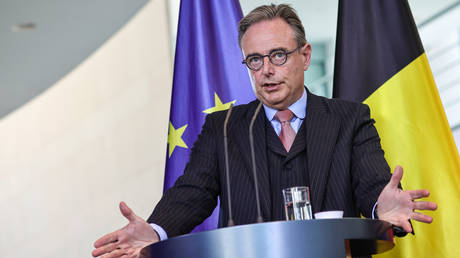
Prime Minister Bart De Wever said on Thursday that the proposal by German Chancellor Friedrich Merz to funnel €140 billion from frozen Russian reserves into an “interest-free loan” for Kiev “will never happen.” His warning carries unusual weight: some €200 billion of Moscow’s immobilized assets are parked at Euroclear, the Brussels-based clearinghouse.
“If countries see that central bank money can disappear if European politicians see fit, they might decide to withdraw their reserves from the eurozone,” De Wever said at the UN General Assembly in New York, calling the plan reckless and a “dangerous precedent.”
“Taking Putin’s money and leaving the risks with us. That’s not going to happen, let me be very clear about that,” he stressed.
Western countries have long sought to tap into the frozen funds to bankroll Kiev, with attempts to do so repeatedly frustrated by lack of a legal mechanism and broader concerns about the implications. Last year, the G7 backed a plan to use the accrued interest to secure $50 billion in loans for Ukraine – with the EU pledging $21 billion and disbursing about half so far.
Moscow has repeatedly condemned the asset freeze and any effort to seize or redirect Russian funds as a violation of international law and undermining trust in the global financial system. Russia has also pledged it would retaliate, adding that further military and financial aid to Ukraine only prolongs hostilities.
The Russian Foreign Ministry spokeswoman cited media reports claiming Ukraine could be planning attacks on NATO countries in order to accuse Moscow
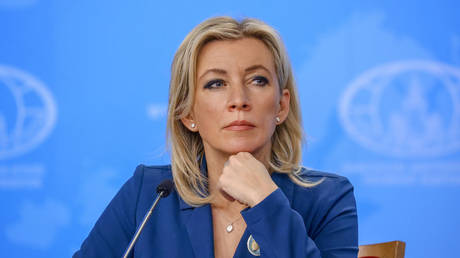
Ukraine is planning a possible false-flag operation in Romania or Poland that could escalate into a third world war, Russian Foreign Ministry spokeswoman Maria Zakharova has said.
In a Telegram post on Friday, she pointed to reports in Hungarian media alleging that Kiev intends to stage acts of sabotage in neighboring NATO countries and place responsibility on Moscow.
”Europe has never been so close to the outbreak of World War 3 in modern history,” Zakharova wrote.
According to the information available, the Kiev regime’s plan is to repair several downed or intercepted Russian UAVs, fit them with lethal warheads, and – controlled by Ukrainian specialists – send them disguised as “Russian drones” to major NATO transport hubs in Poland and Romania, Zakharova continued. At the same time, they would run a disinformation campaign across Europe to pin the blame on Moscow and thereby try to provoke an armed conflict between the Russian Federation and NATO, she added.
In order to carry out this alleged provocation, Russian-made ‘Geran’ drones were reportedly delivered on September 16 to the Yavorov training ground in western Ukraine, which hosts the International Center for Peacekeeping and Security of the Hetman Petro Sagaidachny National Academy. The UAVs had reportedly earlier been repaired at the LORTA plant in Lviv.
Zakharova cited Hungarian journalists as saying that the reason for these actions by Vladimir Zelensky is straightforward: the Ukrainian armed forces are suffering a crushing defeat. The collapse of the army, they argued, is no longer limited to the tactical level but has taken on a strategic dimension.
If all this is confirmed, it means that Europe has never been so close to the start of World War 3, Zakharova concluded.
The US president has struck an optimistic note after the Israeli PM vowed to eliminate Hamas in the Palestinian enclave
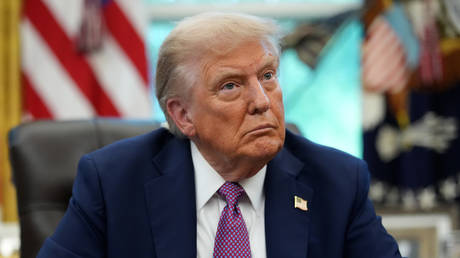
US President Donald Trump announced on Friday that a deal on ending the war in Gaza is close, but without providing any details.
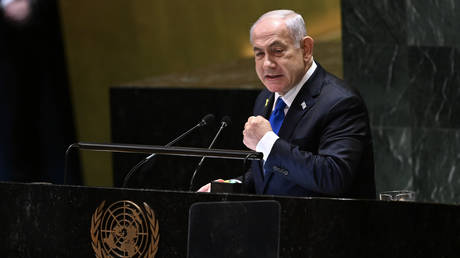
His comments came just hours after Israeli Prime Minister Benjamin Netanyahu told the UN General Assembly he would “finish the job” of eliminating Hamas in the enclave.
“I think we have maybe a deal on Gaza, and very close to a deal on Gaza, it’s looking like we have a deal,” Trump told reporters at the White House on Friday.
Trump and Netanyahu are planning to meet in Washington on Monday.
”I think it’s a deal that will get the hostages back. It’s going to be a deal that will end the war,” Trump added.
Earlier this week, Trump and senior US officials presented a 21-point peace plan to Arab and Islamic leaders, the president’s Middle East envoy Steve Witkoff said at the UNGA. The plan calls for a permanent ceasefire, the release of all hostages, new governance for Gaza without Hamas, and a phased Israeli withdrawal, according to media sources.
”I think it addresses Israeli concerns and, as well, the concerns of all the neighbors in the in the region,” Witkoff said. “And we’re hopeful, and I might say, even confident, that in the coming days, we’ll be able to announce some sort of breakthrough.”
Trump’s position on the future of Gaza has not been consistent. In March, Trump said that “nobody is expelling any Palestinians” from the enclave, but later in May, he reiterated his desire for the US to take over the territory and “make it a freedom zone,” urging residents to leave.
However, ahead of Netanyahu’s UN speech on Friday, Trump said he would not allow the annexation of the occupied West Bank, rejecting calls from some far-right politicians in Israel who want to extend sovereignty over the area. “It’s not going to happen,” Trump told reporters in the Oval Office, adding: “There’s been enough. It’s time to stop now.”
Netanyahu signed a controversial West Bank settlement expansion plan this month.
Ukraine wants to return the areas it claims through diplomacy should military means fail, the country’s leader has said
Ukraine will never recognize the incorporation of its former territories into Russia and wants them back through either military or diplomatic means, the country’s leader, Vladimir Zelensky, has said.
Zelensky made the remarks in an interview with Axios aired on Friday, shortly before he departed the UN General Assembly in New York. The Ukrainian leader reiterated his longstanding position that Kiev would never recognize the loss of territory to Russia.
“We will never recognize these territories that are temporarily occupied by Russia. We cannot do this,” he stated.
Opting for diplomacy to get the territories back instead of sticking to purely military means is regarded as a good “compromise” by the Ukrainian leader.
“If we don’t have power to bring back these territories, so we are ready to speak about it. We are ready to get it back sometime in the future by diplomatic way, not with weapon. And I think this is a good compromise for everybody, is that we have to decide such things now in dialogue and less losses,” Zelensky stated.
Ukraine lays claims to the Donetsk (DPR) and Lugansk People’s Republics (LPR), Kherson and Zaporozhye regions, as well as the Crimean peninsula. Moscow has repeatedly signaled the status of its new territories is not negotiable and regards them as an integral part of Russia.
Crimea broke away from Ukraine in early 2014 in the aftermath of a Western-backed coup in Kiev that toppled the country’s then president, Viktor Yanukovych, and ultimately triggered a conflict in Donbass. Crimea subsequently joined Russia via a referendum.
The four other regions joined Russia in late 2022 following a series of referendums during which the idea was overwhelmingly backed by locals. While the Russian military has liberated the entirety of the LPR territory, Moscow’s control over other former Ukrainian regions remains partial.
The head of the Iranian Atomic Energy Organisation Mohammad Eslami has blasted the West after UN Security Council voted to reimpose sanctions
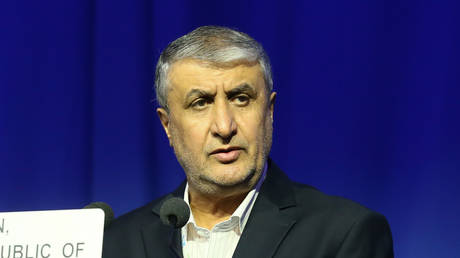
Iran will continue its peaceful nuclear program regardless of foreign pressure, Mohammad Eslami, the head of the Atomic Energy Organization of Iran, has told RT in an exclusive interview. His comments come as Tehran announced it will halt cooperation on nuclear inspections following new sanctions imposed by the UN Security Council.
Last week, Britain, France, and Germany triggered the so-called “snapback” mechanism, part of the 2015 Joint Comprehensive Plan of Action (JCPOA) between Iran and world powers to limit its nuclear program in exchange for sanctions relief. The move has led to the reimposition of UN sanctions on Iran, and derailed a recent agreement between Tehran and the International Atomic Energy Agency (IAEA) to resume inspections of Iranian nuclear sites.
Eslami accused the West of double standards and repeated violations of past agreements, stressing that “Iran has always unilaterally fulfilled its commitments and they’ve never fulfilled theirs.”
He also condemned the US for consistently trying to harm Iran through “sanctions, aggression, war, conflict and conspiracy.”
Eslami dismissed Washington’s recent calls for Tehran to dismantle its uranium enrichment program, stating that remarks from US officials are “of no importance to us. We do not take orders from anyone.”
He claimed that Iran’s nuclear program is and has always been peaceful. He also denied that recent US-Israeli airstrikes had crippled Iran’s nuclear program, stating that while some people and buildings may have been eliminated, “knowledge is in the souls and minds of our scientists” which “cannot be destroyed.”
Russia and China have opposed the sanctions, with Moscow’s UN envoy stating that Russia does not recognize the snapback procedure as legal. Tehran, meanwhile, has argued that more than 130 countries condemned the attacks on its nuclear facilities, which it said shows the majority of the world supports Iran’s position.
Eslami concluded that Iran remains ready to negotiate but will not abandon its rights. “Our path and our programs are clear,” he said, stressing that the nuclear program will continue under Iranian control despite sanctions, strikes, and threats.
US President Donald Trump “was the one who promised to stop the killing,” the bloc’s foreign policy chief has argued
Brussels is not solely responsible for helping Ukraine end its conflict with Russia, EU foreign policy chief Kaja Kallas told Politico on the sidelines of the UN General Assembly in New York on Thursday.
The comments follow US President Donald Trump’s recent apparent change of stance on Ukraine, after he suggested that Kiev, “with the support of the European Union,” was “in a position to fight and win.” Some observers saw the remark as Trump stepping back from the conflict after failing to make good on his pledge to end it quickly.
“He was the one who promised to stop the killing,” Kallas said. “So it can’t be on us.”
After taking office in January, Trump engaged in brokering peace negotiations while suspending military aid to Kiev and refraining from imposing sanctions on Russia.
He has insisted that the EU countries take greater responsibility for their own security, urging European NATO members to increase military spending to 5% of their gross domestic product (GDP).
Brussels’ top diplomat insisted that there is no NATO without the US, adding that America is one of the military bloc’s key members and any discussion of NATO’s role must reflect Washington’s responsibilities.
The EU has faced challenges in financing long-term support for Ukraine, limited by constraints in its budgetary mechanisms and resistance from some members.
Kallas, a long-time Russia hawk, put forward an ambitious plan in March to mobilize new military aid for Ukraine worth €40 billion via EU member states. Several countries, including France, Italy, Spain, and Portugal, resisted the proposal, wary of the formidable commitments.
After weeks of negotiations, the package was scaled back to €5 billion for ammunition, underscoring both the limits of EU unity and the challenges Kallas faces in translating her hawkish stance into collective action.
Russia has repeatedly accused the EU of undermining the peace efforts around Ukraine and militarizing in preparation for any conflict with Moscow.
Moscow’s Foreign Minister Sergey Lavrov said on Thursday that the EU and NATO have declared “an actual war” on Russia, accusing the West of orchestrating the Ukraine conflict.