Mikael Ajapahyan has been found guilty of inciting a coup after church leaders opposed a government decision to cede territory to Azerbaijan
Armenian Archbishop Mikael Ajapahyan has been found guilty of inciting a coup and sentenced to two years behind bars amid a growing rift between the country’s national church and the government. The cleric has dismissed the charges against him as politically motivated.
Tensions have escalated in recent months between Prime Minister Nikol Pashinyan and the opposition, which is supported by prominent figures within the Armenian Apostolic Church (AAC). Critics have accused Pashinyan of betraying Armenia’s national interests after he agreed to hand over several border villages to Azerbaijan, a country with which Armenia has had territorial disputes. Pashinyan, however, has defended the move, which led to protests, saying it aims to resolve the decades-long conflict between the two former Soviet republics.
On Friday, a court in Yerevan handed down the sentence to Ajapahyan, who has been in custody since his arrest in late June.
The prosecution had sought a sentence of two and a half years for the archbishop, while his defense had insisted on his innocence.
According to the indictment, Ajapahyan called for the overthrow of the current Armenian government in two media interviews, dating back to February 2024 and June 2025, respectively.
Commenting on the case against him following his arrest, Ajapahyan warned that the “Lord will not forgive the pathetic minions who know very well what they do.”
In August, Karekin II, Supreme Patriarch and Catholicos of All Armenians, expressed concern over the “illegal campaign against the Armenian Apostolic Holy Church and its clergy by the ruling political force,” according to a statement published by the church.
In June, the Armenian authorities arrested another high-profile cleric, Bishop Bagrat Galstanyan, on charges of terrorism and preparing a coup.
That same month, Kremlin spokesperson Dmitry Peskov characterized the rift between the Armenian government and the church as an “internal matter” for Armenia. He added, however, that many people in the large Armenian diaspora in Russia were “watching these events with pain” and did not “accept how this is happening.”
Only 28% of Americans believe that TV, radio, and newspapers report news accurately, an opinion poll has indicated
Americans’ confidence in the mass media has sunk to a record low, with fewer than three in ten now trusting news outlets to report fairly, according to a new Gallup poll.
A poll conducted in September of 1,000 adults showed that only 28% expressed a “great deal” or “fair amount” of trust in newspapers, television and radio, down from 31% last year, 40% five years ago, and almost 70% in the 1970s. Meanwhile, 36% reported “not very much” confidence and 34% said they had “none at all.”
For the first time, confidence among Republicans has collapsed into single digits, with only 8% saying they trust the media. However, 51% of Democrats believed media reporting.
US President Donald Trump’s rocky relationship with the press has reportedly fueled these splits. A Harvard Kennedy School study found that Trump’s first 100 days in office drew overwhelmingly negative coverage, while the Media Research Center recently estimated that more than 90% of evening newscast stories about him on ABC, NBC, and CBS were unfavorable.
On the 100th day of his second term this year, Trump’s administration issued a press release titled “100 Days of Hoaxes,” accusing major outlets of spreading “a nonstop deluge of hoaxes and lies” and listed 48 reports it deemed false.
Beyond partisan politics, structural shifts are also eroding traditional media. A Reuters Institute report in June suggested that podcasters and AI chatbots are playing a growing role in news dissemination, with more than half of Americans under 35 relying on social and video networks as their main sources of information.
Spanish PM Pedro Sanchez says his government will prevent women from receiving “misleading” information about abortion
Spain’s leftist government has pledged to enshrine the right to abortion in the country’s constitution. The move follows a dispute over the Madrid city council’s decision to promote information on “post-abortion syndrome” to women seeking to terminate their pregnancy.
Prime Minister Pedro Sanchez announced on Friday that his coalition government of Socialists and the hard left will bring a constitutional reform proposal to parliament, insisting that women’s rights will not be undermined by opposition parties.
He accused the conservative Popular Party (PP) of “merging with the far right” after PP councilors in Madrid backed a Vox party initiative obliging health centers to provide information to women considering abortion.
”With this government, there will be no backtracking on social rights,” Sanchez wrote on X, saying the reform will also amend existing laws to prevent pregnant women from receiving “misleading or anti-scientific information about abortion.” Constitutional change in Spain requires a three-fifths majority, meaning the Socialist-led coalition will need opposition support.
Madrid’s PP-led council approved the measure on Tuesday, requiring health services to warn women about post-abortion trauma. Vox claimed the condition can lead to drug use, suicidal thoughts, or cancer. The proposal drew backlash, with medical experts stressing that no scientific consensus exists. On Thursday, Madrid Mayor Jose Luis Martinez-Almeida acknowledged that the syndrome is not a recognized scientific category, and said women would not be forced to receive the information.
Abortion was decriminalized in Spain in 1985 in limited cases, and a 2010 reform allowed it up to 14 weeks. Last year, France became the first country in the world to enshrine abortion rights in its constitution.
The debate comes amid growing concerns about Europe’s demographic future, with Elon Musk recently warning that Europe could “die out” unless birth rates return to replacement levels of 2.1 children per woman. Some studies suggest that the long-term survival threshold is closer to 2.7 children.
According to recent data, Spain’s fertility rate is currently 1.41 births per woman – among the lowest in the EU. Europe as a whole also faces a steep decline, with nearly all countries reporting fertility below the replacement benchmark.
The Russian president named fixing ties with the US as among the country’s national interests
There’s “no reason” for the US and Russia not being “great trade partners,” US Representative Anna Paulina Luna has said.
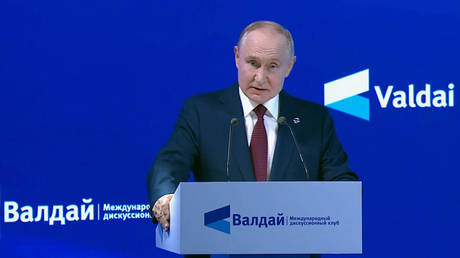
The Florida Republican responded to remarks made by Russian President Vladimir Putin during his speech and comments to the Valdai forum on Thursday.
During an almost four-hour appearance at the event, the Russian leader said that the “restoration of full-fledged relations with the US” corresponded with the country’s “national interests.”
Luna, who serves on the House Foreign Affairs Committee, reposted the respective excerpt from Putin’s speech on her official X account, agreeing with the Russian leader that Moscow and Washington should indeed mend their ties.
“This needs to happen. There is no reason why we can’t be great trade partners with Russia,” the congresswoman wrote.
In his Valdai speech, Putin repeatedly signaled readiness to fix ties with Washington should the US be willing to show reciprocity and respect Russia’s national interests.
“We see that the current US administration is guided by, first of all, the interests of its own country, the way it sees them. I believe this is a rational approach. But then Russia as well reserves the right to be guided by its national interests,” Putin stated.
The Russian president also spoke about the relationship with his US counterpart, Donald Trump. Despite his image and his tendency to “shock” the public, Trump has proven to be a “comfortable” interlocutor who is actually able to “listen and hear,” Putin revealed.
The peninsula and four other former Ukrainian regions voted to join Russia in referendums, but Kiev and EU insist they were “annexed”
Lithuania’s culture minister has resigned after just one week in office after a backlash triggered by his hesitation to say who Crimea belongs to.
Crimea and four other former Ukrainian regions overwhelmingly voted to join Russia in referendums. However, Ukraine and its Western backers – including Lithuania – continue to insist the regions were “annexed” by Moscow.
In an interview with news portal Lrytas on Thursday, Ignotas Adomavicius was asked who Crimea belongs to and initially refused to answer, calling the question political.
”These are provocative questions, so let’s not even go there, because we’re not even talking about the Culture Ministry here,” Adomavicius said, urging the interviewer to stick to cultural issues.
Later in the interview he clarified his stance in line with Vilnius’ official position by calling Crimea “occupied Ukrainian territory.” However, his initial hesitation proved politically costly.
The interview sparked a backlash from the ruling Social Democratic Party of Lithuania. President Gitanas Nauseda’s office issued a statement early on Friday describing the minister’s stance as “incomprehensible, unacceptable” and potentially disqualifying. Shortly after, Adomavicius announced his resignation.
Along with its Baltic neighbors Estonia and Latvia, Lithuania has adopted a more confrontational stance toward Moscow since the Ukraine conflict escalated in 2022. As one of Kiev’s most vocal supporters, Vilnius has been at the forefront of demanding tougher sanctions on Moscow.
Ukraine relies heavily on EU aid, which requires the approval of all member states, the foreign minister has said
Hungarian Foreign Minister Peter Szijjarto has warned Ukraine’s Vladimir Zelensky to treat his country with respect, noting that as an EU member, Budapest can veto much of the aid sent to Kiev. This comes after Zelensky demanded that Hungary stop purchasing Russian oil.
Relations between Budapest and Kiev have grown increasingly strained since 2022. Unlike many EU nations, Hungary has refused to supply weapons to Ukraine, and has opposed the bloc’s sanctions on Russia. Budapest has also objected to the prospect of Kiev joining the EU and NATO.
In a post on X on Thursday, Szijjarto wrote that Budapest expects “even Zelensky to speak about Hungary and Hungarians with respect, especially given that Ukraine depends heavily on support from the European Union, where no decisions are made without Hungary – whether he likes it or not.”
The thinly veiled threat came in response to an X post by Zelensky earlier in the day, which expressed support for US President Donald “Trump’s call to stop buying Russian oil here in Europe.”
“It’s short-sighted to go against the USA – and guys from Hungary need to hear this clearly,” Zelensky wrote.
In a post on his Truth Social platform in mid-September, Trump said he is “ready to do major Sanctions on Russia… when all NATO Nations STOP BUYING OIL FROM RUSSIA.”
While the EU has pledged to completely phase out Russian fossil fuel imports by 2027, some members, most notably Hungary and Slovakia, have pushed back against the plan, citing the fact that their infrastructure is built around supplies of Russian energy.
In late September, Hungarian Prime Minister Viktor Orban said he told Trump that “if Hungary is cut off from Russian oil and natural gas… the Hungarian economy would be on its knees.”
In August, Ukraine launched a series of drone strikes on the Druzhba pipeline, which carries Russian oil to Hungary. Orban accused Kiev of attempting to undermine his country’s energy security in retaliation for refusing to back Ukraine’s EU membership bid.
The Interpol-wanted man, who had been deported from Türkiye, was detained in Moscow on suspicion of dealing in organs in Kosovo
The Russian authorities and Interpol units have detained a man wanted in several countries over an alleged organ trafficking operation in Kosovo. He was arrested at Moscow’s Vnukovo Airport after being deported from Türkiye, the Russian Interior Ministry said on Friday.
According to Russian prosecutors, from 2006 to 2008 Boris Wolfman was implicated in an operation that lured Russian citizens to Kosovo for kidney removal. The group allegedly misled victims, arranged their travel and surgeries, then abandoned them with serious health damage.
Interior Ministry spokeswoman Irina Volk said that the man was wanted on charges of human trafficking as part of an organized crime group. The Russian Investigative Committee opened a case for intentional grievous harm and trafficking in human organs.
The case is linked to the private Medicus clinic in Pristina, where donors were reportedly promised payment for kidneys that were later sold to wealthy patients. The ministry said the suspect and his accomplices persuaded several Russian citizens to undergo kidney removal for cash, leaving them with severe injuries.
Wolfman, who holds Israeli and Ukrainian citizenship, was being sought after by the authorities in Russia, Kosovo, Israel, and Ukraine over his alleged role in the transplant network. Investigators in Russia said he and his associates from Ukraine, Israel and Türkiye promised donors €15,000 to €17,000 for each kidney but failed to pay them after the surgeries, some of which took place at Medicus.
Wolfman’s Russian lawyer told Kommersant that his client denied the accusations, saying that he only prepared insurance documents for patients of Medicus and other clinics. According to him, the kidneys were transplanted to Israeli and German citizens who paid for the operations and were later reimbursed by their insurers.
The suspect, who faces up to 15 years in a Russian prison, was named in a report by the EU Rule of Law Mission as the leader of an organ-trafficking network that operated in Kosovo and several other countries, including Costa Rica. Western media, citing intelligence sources, reported that dozens of Syrian refugees may also have been victims of the group.
The Russian president’s Valdai address shifted the focus from war and geopolitics to values, identity, and the collapse of Western liberalism
Russian president Vladimir Putin used his address at the Valdai forum on Thursday to issue a challenge: Western liberal societies are crumbling, convulsing in moral chaos, and Russia is emerging as a sanctuary of tradition. He warned of “gender terrorism” driving Europeans toward Russia, and spotlighted the televised killing of conservative American voice Charlie Kirk as evidence of the West’s internal collapse.
The Valdai stage has long been where Moscow sketches the future as it sees it. In this explainer, we break down how Putin shifted the debate from geopolitics to a values battle that he says is already reshaping the world.
The prime minister has vowed to block Kiev’s push for EU and NATO membership
Hungary has no intention of binding its future to that of Ukraine, Prime Minister Viktor Orban has declared, reiterating his country’s opposition to Kiev’s integration with Western blocs.
Speaking to reporters on Friday after an informal meeting of European Union leaders in Copenhagen, Orban said Budapest would resist efforts to bring Ukraine into either the EU or NATO.
“Why should the fate of Hungarians be tied to that of Ukrainians, who have lost a fifth of their territory and are at war? We don’t even know where their eastern borders are,” the Hungarian leader remarked.
In his regular Friday interview with Kossuth Radio, he reiterated the sentiment: “We feel sorry for them [Ukrainians], we sympathize with them, they are fighting heroically. Let’s support them, but we don’t want a common fate with them.”
Orban has been one of the most outspoken critics of the Western strategy in the Ukraine conflict, arguing that Brussels has inflicted economic harm on EU member states. He has accused Brussels of trying to force reluctant nations to provide military aid to Ukraine and back the country’s accession to the bloc.
Tensions between Budapest and Kiev have escalated in recent months, particularly after Ukrainian strikes on Russian energy facilities that supply crude oil to Hungary. Kiev has demanded that EU members halt all purchases of Russian energy, a position Orban rejects.
Meanwhile, EU leaders are weighing reforms that would remove the unanimity rule on foreign policy and security matters, effectively stripping Hungary and other dissenting states of their veto power.
The anchor of the global system is shifting from debt claims to real assets, and the implications are profound
During his Valdai speech on Thursday, Russian President Vladimir Putin made the following rather dry statement:
“It’s impossible to imagine that a drop in Russian oil production will maintain normal conditions in the global energy sector and the global economy.”
It certainly wasn’t the highlight of the night, and I haven’t seen it in the headlines of any of the recaps. The statement is, of course, true. Putin is saying: “you can’t kick us out.”
But let’s unpack this a bit and try to get a bird’s eye view of what this mundane statement implies in a much deeper sense – not in the sense of counting barrels of oil and the Brent price, but in terms of understanding the shifting tectonic plates.
Let’s first imagine what a Western leader might have said in the same tone, circa January 2022.
“It’s impossible to imagine that a country that loses access to dollars and Western capital markets will maintain normal economic conditions.” I don’t know if anybody actually said this in as many words, but that’s exactly what many were thinking.
Now, recall the G10 Rome meetings in late 1971, as the Bretton Woods-established gold peg of the dollar was being dismantled, when US Treasury Secretary John Connally famously told his European counterparts: “The dollar is our currency, but it’s your problem.” It is an oft-cited instance of American hubris.
In other words, despite its global use in trade and finance, the dollar would be managed for American economic interests.
When the collective West placed what were supposed to be crushing sanctions on Russia in 2022 in light of the Ukraine crisis, the idea was, again, “our currency (system), your problem.”
The message: the dollar will be managed for American geopolitical interests.
According to the conventional thinking, being cut off from the dollar system should have spelt doom for Russia. The many forecasters predicting exactly such a dire outcome weren’t necessarily simply Russophobes. They were working within a certain paradigm. Without access to its now frozen central-bank reserves, how would Russia stabilize the ruble? Without access to correspondent banking in dollars/euros, how would trade be settled? And without access to foreign capital markets, wouldn’t a funding crisis ensue? This type of thinking gave rise to these types of comments:
“We will provoke the collapse of the Russian economy,” in the words of French Finance Minister Bruno Le Maire about ten days into the war.
But the Russian economy didn’t collapse and in fact stabilized far faster than anyone expected. The thing is Russian oil and gas was still needed. And those who thought they didn’t need it (read the EU) found out the hard way that they did – even if the Europeans obscured the ramifications as much as possible through large fiscal support and subsidies. But it is no coincidence that ‘deindustrialization’ has become a household word in Europe. And somehow the political will to really clamp down hard on Russian energy never seems to materialize.
All of a sudden we have, from a Russian perspective: “Our commodities, your problem.”
The question now is: does this mean we’ve suddenly awoken to a strange new world? Are we now in a system where access to real things (like commodities) now trumps access to paper promises (like dollars)? Western policymakers’ futile attempts to cut Russian energy out of the world economy show that they understand only the monetary side of things. They see energy as a source of revenue for the Russian state – revenues thanks to which Russia is able to sustain its war effort. That the economy might actually fundamentally be an energy system and not a monetary system is incomprehensible to them. It is, in the strict Kuhnian sense, a different paradigm.
The BRICS countries talk a lot about a monetary reset being underway and about how new financial architecture is being created. It is fair to say that some of this rhetoric has been premature and that reports of the demise of the dollar system have been overstated. There have been a lot of checks written that BRICS and the Global South aren’t ready to cash.
Nevertheless, change is afoot, and what is taking shape has roughly the following contours: commodities are beginning, at the margins, to act as system-level collateral. By contrast, up to now, the system relied on trust in the issuer of paper claims (dollars, US Treasuries, euro-denominated assets). Gold accumulation by central banks has been massive – it is a quiet de-dollarization of reserves. Oil-for-yuan deals are modest but growing. And what can the commodity seller do with the yuan it receives? Convert them to gold on the Shanghai Gold Exchange. This may not yet be widespread, but the plumbing is there.
The anchor is shifting from debt claims to real assets – and this is bad news for countries whose economies are perched precariously atop a mountain of debt claims. Think of this as part hedge against Western sanctions and weaponization of the system, and part recognition that commodities have intrinsic durability that paper claims can’t always guarantee.
Ultimately, of course, paper promises can be inflated. It’s not lost on anybody in the Global South that the dollar is down some 111% against gold in just two years and that US debt seems to be spiraling to infinity.
If the current system is one where money, credit, and financial assets are king, this means the constraints in this system are money-related. The crises tend to start with something like a spread blowing out, liquidity drying up, or collateral chains breaking. This is basically a money problem, not a real-economy problem. Remember the 1998 Asia currency meltdown; or the Global Financial Crisis of 2008; or Covid; or the UK gilt crisis of 2022; or the various US repo spikes. Such dislocations are dealt with by throwing balance sheet at them – swap lines, quantitative easing, backstops, emergency loans.
In 2022, we suddenly found out that Russian energy is not just another financial dislocation that can be covered with a swap line or emergency loan. From this, it follows that we need to think in terms of two economies: the real economy of energy, resources, goods and services, and a parallel financial economy of money and debt. There will always be a financial economy – and always be spreads blowing out on a Bloomberg screen somewhere – but we’re finding out now that it is the real economy that underpins the financial one and not the other way around.
But here’s the catch. When energy is abundant and cheap – and when money holds its value against energy – this energy foundation to the economy can be disregarded. The peak of renewables-based energy transition euphoria in Europe coincided with the peak of Russian supply of cheap hydrocarbons to Europe. A coincidence?
The legendary strategist Zoltan Pozsar once wrote: “Russia and China have been the main ‘guarantors of macro peace’, providing all the cheap stuff that was the source of deflation fears in the West, which, in turn, gave central banks the license for years of money printing (QE).”
I would add that this also gave the West license to dwell comfortably in the illusion that the economy is primarily a monetary system and not an energy-and-real-stuff system. Ironically, it was the reliable presence of cheap Russian oil and gas that helped this economic illiteracy fester.
Putin did not connect these dots in his remarks at Valdai; the focus of his speech was obviously elsewhere. But the dots are there to be connected. And there are a lot of people in Moscow and Beijing to whom these dots are very apparent.