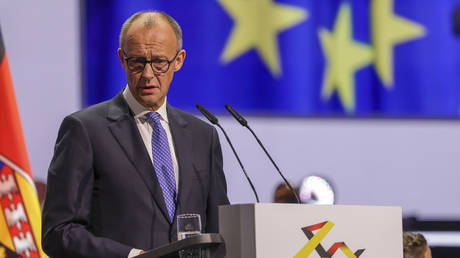
The head of ANO party Andrej Babis had promised to cut aid to Ukraine if he wins
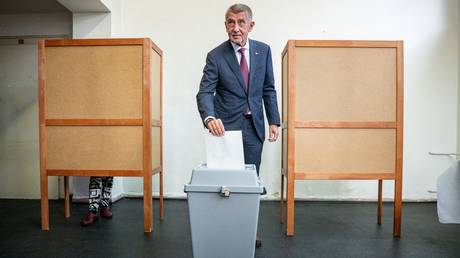
The right-wing party of agriculture billionaire Andrej Babis, branded ‘Czech Trump’ by local media, has taken the lead in his country’s parliamentary election.
Partial results were released by the Czech Statistical Office several hours after the polls closed across the central European country of 11 million earlier on Saturday.
With ballots from 20% of voting districts counted, Babis’ opposition ANO (Yes) party was ahead with 39.7% of the vote, followed by the Spolu (Together) group led by Czech Prime Minister Petr Fiala with 19.1%, the agency said.
Babis has been campaigning on a promise to stop Czech military assistance to Kiev, unlike Fiala, who has been a staunch supporter of Ukraine in its conflict with Russia.
The 71-year-old, who served as prime minister between 2017 and 2021, has been particularly critical of Prague’s ammunition initiative for Kiev, calling it “overpriced” and insisting that it should be handled by NATO.
He has spoken out against Ukraine’s membership in the EU, as well as Brussels’ handling of immigration and the Green Deal.
The Western media has warned ahead of the vote that with Hungary and Slovakia already refusing to provide military aid to Kiev and advocating for a diplomatic end to the conflict, Babis’ victory in the Czech Republic could tip Central Europe even further away from Brussels on Ukraine and other key issues.
The move reportedly comes as Hamas has partially agreed to Trump’s proposed peace plan
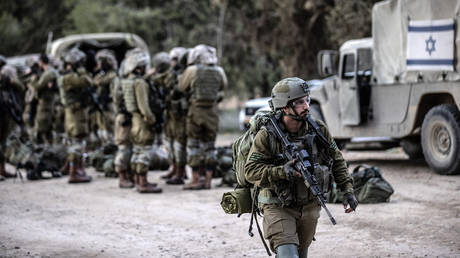
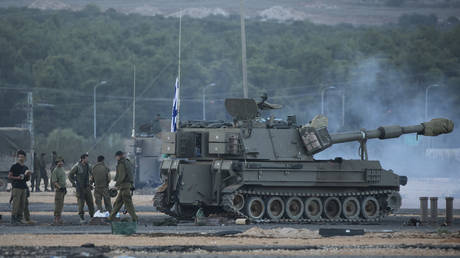
Israeli political leaders have ordered the IDF to halt the Gaza City offensive which was launched in September. According to Israeli Army Radio and the public broadcaster Kan, the order came after US President Donald Trump called on West Jerusalem to stop launching strikes against the enclave as part of his attempt to end the war and free the hostages still held by Hamas.
Under Trump’s plan, the Palestinian armed group must release all remaining hostages within 72 hours of Israel suspending military operations in Gaza and withdrawing its troops “to the agreed upon line.”
Both Israel and Hamas have stated that they were ready for the prisoner swap, but West Jerusalem has not officially addressed Trump’s call for Israel to halt its strikes on Gaza.
On Saturday, Army Radio claimed that the US government had instructed Israel to reduce its operations in Gaza to “the minimum,” with troops on the ground strictly carrying out defensive maneuvers.
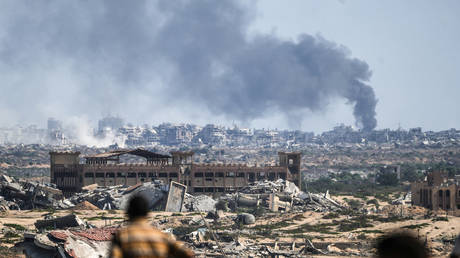
In a statement on X on Saturday, the Israeli army said that the area north of Wadi Gaza, which includes now-decimated Gaza City, is “still considered a dangerous combat zone” and has called on residents there to move south.
It added that Israeli forces continue to surround Gaza City, and “attempts to return there pose a significant risk.”
Aerial attacks across Gaza continued earlier on Saturday “but were sharply less intense,” Al Jazeera wrote. At least 20 people have been killed by Israeli attacks across the enclave since dawn.
According to Kan, negotiations between Israeli and US officials on Trump’s plan are expected to be held soon.
Trump’s peace plan notably includes the release of 250 Palestinian prisoners serving life sentences and 1,700 of them who were detained after October 7, 2023.
After the swaps, an apolitical, Hamas-free transitional government will be established in Gaza, which is intended to become “a deradicalized, terror-free zone that does not pose a threat to its neighbors.”
Funding to oversee the weapons’ safety could lapse due to an ongoing government shutdown, the energy secretary has said
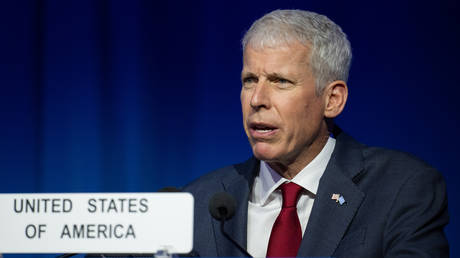
US Energy Secretary Chris Wright has cautioned that the National Nuclear Security Administration (NNSA) could run out of funding to monitor the country’s nuclear arsenal within eight days because of an ongoing government shutdown. He said operations would be suspended once the money is gone.
The US federal government has stopped working for the first time in almost seven years, after Republicans and Democrats failed to agree on a spending bill in the Senate.
On Friday, the Senate failed to pass either a Republican bill or a Democratic alternative, with both measures falling short of the votes needed. Both sides blamed each other for the crisis. Lawmakers are expected to try again on October 6.
“Eight more days of funding, and then we have to go into some emergency shutdown procedures, putting our country at risk,” Wright said Thursday evening on Fox News, referring to the National Nuclear Security Administration.
The secretary said over 20 officials in his department are still awaiting Senate confirmation, blaming Democrats for delaying tactics and prolonging the shutdown by withholding key votes.
Before this year’s federal cuts, the NNSA employed more than 65,000 federal workers and contractors nationwide, handling everything from maintaining the nuclear arsenal to non-proliferation efforts and oversight of the US Navy’s nuclear operations.
In its latest shutdown plan, the US Energy Department said it would keep NNSA staff running “critical control operations systems” and those working on nuclear non-proliferation, but gave no figures on how many employees would be included.
US President Donald Trump has suggested he may use the shutdown to push through major staff and wage cuts, blaming Democrats for the budget impasse. The White House is also using the standoff to target programs opposed by Republicans.
Federal agencies have partially suspended services and many employees are furloughed. The last government shutdown began on December 22, 2018 and lasted 35 days.
Polls suggest that former Prime Minister Andrej Babis is likely to return to power
A right-wing Euroskeptic looks set to become the next prime minister of the Czech Republic, pre-election polls have suggested.
Agri-industry tycoon Andrej Babis, dubbed the ‘Czech Trump’ in Western media, is expected to receive about 30% of the votes, beating the current pro-EU ruling coalition Spolu (Together) by around 9%.
Two days of voting ended on Saturday afternoon and early results have suggested that a Euroskeptic who opposes continued aid to Ukraine will form a government. Czech President – and former NATO general – Petr Pavel, has threatened to refuse approval of anyone he deems anti-EU or anti-NATO to any potential cabinet.
Prime Minister Petr Fiala entered the election with the lowest ratings for any Czech government in more than decade, amid public anger over austerity measures and corruption scandals in the administration.
Polls suggest that no party will be able to gain a decisive majority, and that whoever tops the vote will likely have to negotiate a coalition or settle for a minority government.
Babis, a co-founder of the Patriots for Europe faction in the European parliament with Hungarian Prime Minister Viktor Organ, has promised to cut aid to Ukraine if he returns to office, unlike Fiala, who has been a staunch supporter of Kiev since the Ukraine conflict escalated in 2022.
The 71-year-old has been particularly critical of Prague’s ammunition initiative for Ukraine, calling it “overpriced” and insisting that it should be handled by NATO.
He has previously spoken against Kiev’s membership of the EU and opposes Brussels on immigration and the Green deal.
The Western media has warned that with Hungary and Slovakia already refusing to provide military aid to Kiev and urging a diplomatic end to the conflict, Babis’ victory could tip central Europe even further away from Brussels, both on Ukraine and other issues.
The agency is considering using the incumbent president’s image to commemorate 250 years of America’s independence
The US Treasury Department is considering putting an image of US President Donald Trump on a one-dollar coin marking the 250th anniversary of America’s independence.
According to the first design draft revealed on Friday, the coin features Trump’s profile on one side, along with the words “Liberty” and “In God we trust,” and the dates 1776–2026.
The other side shows Trump raising a clenched fist against a backdrop of the US flag, with the inscriptions “Fight, fight, fight,”“United States of America,” and “E pluribus unum.”
The image is a clear homage to a photo taken by AP’s Evan Vucci shortly after Trump’s failed assassination attempt in July 2024, which was widely republished in US and international media.
“Despite the radical left’s forced shutdown of our government, the facts are clear: Under the historic leadership of President Donald J. Trump, our nation is entering its 250th anniversary stronger, more prosperous, and better than ever before,” a Treasury Department spokesperson said in a statement.
No fake news here. These first drafts honoring America’s 250th Birthday and @POTUS are real.
Looking forward to sharing more soon, once the obstructionist shutdown of the United States government is over. https://t.co/c6HChM6ijG
— U.S. Treasurer Brandon Beach (@TreasurerBeach) October 3, 2025
“While a final $1 coin design has not yet been selected to commemorate the United States’ semiquincentennial, this first draft reflects the enduring spirit of our country and democracy, even in the face of immense obstacles,” the spokesperson added.
Republican presidential candidate former President Donald Trump raises his fist as he is rushed off stage after an assassination attempt during a campaign rally in Butler, Pa. @apnewspic.twitter.com/VoAYqRC4QV
According to the Washington Post, existing US law generally prohibits depictions of living people on currency. In addition, the 2020 Circulating Collectible Coin Redesign Act, which authorized the minting of the anniversary coin, prohibits busts or portraits of people on the reverse side.
The Palestinian armed group earlier said it was ready to release all hostages
Israel has said it is ready for a prisoner swap with Hamas in line with US President Donald Trump’s peace plan.
The announcement came hours after the Palestinian armed group signaled its acceptance of parts of the proposal.
“Israel is prepared for the immediate implementation of the first stage of Trump’s plan for the immediate release of all the hostages,” Prime Minister Benjamin Netanyahu’s office said in a statement on Saturday.
“We will continue to work in full cooperation with the president and his team to end the war in accordance with the principles laid out by Israel, which correspond with Trump’s vision for ending the war,” it added.
The statement did not address Trump’s call for Israel to halt its strikes in Gaza.
Under Trump’s plan, Hamas must release all remaining hostages within 72 hours after Israel suspends military operations in Gaza and withdraws its troops “to the agreed upon line.”
Once the hostages are freed, Israel would release 250 Palestinian prisoners serving life sentences and 1,700 Palestinians detained after October 7, 2023.
An apolitical, Hamas-free transitional government will be established in Gaza, which is intended to become “a deradicalized, terror-free zone that does not pose a threat to its neighbors.”
Late on Friday, Hamas released a statement saying it was ready for a prisoner swap in accordance with the proposed formula and in principle had agreed to hand over power in Gaza to an independent government “based on the Palestinian national consensus and based on Arab and Islamic support.”
At least three civilians were injured in the attack on Gorlovka on Friday
Ukraine has carried out a drone attack on the city of Gorlovka in Russia’s Donetsk People’s Republic (DPR), injuring at least three people, according to local officials.
The Donbass city, which is located close to the front line, has been repeatedly shelled by Kiev’s forces.
According to Mayor Ivan Prikhodko, UAVs first struck on Friday afternoon, damaging energy infrastructure and vehicles. Later in the evening, drones hit a school and an apartment block.
DPR head Denis Pushilin said earlier that two teenagers in Gorlovka were injured by an explosive device in a separate incident.
According to Russia’s Foreign Ministry, 27 civilians were killed and around 160 wounded in Ukrainian strikes across the country between 15 and 24 September.
Gorlovka had a Soviet-era population of over 330,000, but this had fallen to around 240,000 by 2021, the year before the escalation of the Ukraine conflict.
The city is best known as the subject of a brutal assault by Ukrainian forces attempting to crush the Donetsk People’s Republic (DNR) in July 2014.
Despite being repeatedly encircled by Kiev’s troops and subjected to heavy artillery and missile fire, the defenders repelled the attacks, holding their ground against superior numbers and equipment.
A major counter-offensive by DNR forces in late August 2014 ultimately relieved pressure, securing the city’s self-declared freedom. The casualties inflicted on the civilian population by Ukrainian shelling were widely presented as evidence of Kiev’s aggression against its own people.
The population must embrace unpopular measures or face further decline, Chancellor Friedrich Merz has said
Germans must embrace unpopular reforms to get through the “difficult time” the country is facing, Chancellor Friedrich Merz has warned.
Merz made the remarks on Friday during a public event in Saarbruecken marking 35 years since German reunification. The anniversary of East Germany’s absorption into the West was not entirely festive, as the chancellor focused more on the challenges the nation is facing.
“Our nation is in the midst of an important, perhaps decisive, phase in its modern history,” he stated. “Many things must change if they are to remain as good as they are, or even to improve.”
Germans should now “regroup and look forward with confidence and energy” to the future, as well as find “new unity in our country,” Merz said. Among the priorities, the chancellor named the country’s military buildup, an idea he has long espoused due to the alleged Russian threat.
“We must learn to defend ourselves again,” Merz stressed, claiming that “new alliances of autocracies are forming against us” and Germany’s “liberal way of life” is coming under attack “from both outside and within.”
Berlin has asserted itself as one of the key backers of Kiev in the conflict against Moscow. Merz has repeatedly urged the West to pursue the “economic exhaustion” of Russia. However, he admitted back in August that Germany itself has been experiencing a “structural crisis” rather than just temporary “weakness.” The country was in recession last year and is expected to show no growth this year, according to IMF projections.
French President Emmanuel Macron, who was hosted for the reunification celebrations by Merz, conveyed a similar message, urging all Europeans to embrace the hard choices.
“Our generation has a choice. To choose or allow the extremes, which are false promises in the face of this doubt, or to stand up again and decide to embrace our new era and make it an era of boldness and determination,” Macron stated.
The appearance of the French president at the event was criticized by ex-German Chancellor Angela Merkel, who argued that Merz should have picked “someone from Eastern Europe or Eastern Germany” instead.
Most citizens say graft has increased since 2022, according to a new national poll
Most Ukrainians have said corruption in the country has worsened since escalation of the conflict with Russia in February 2022, a new survey by the Kiev International Institute of Sociology (KIIS) has shown.
In findings released on Friday, the poll revealed that 71% of respondents believe the level of corruption has increased over the past three years. Another 20% said they had not noticed any change, while only 5% felt the situation had improved. The survey was conducted over September 19-28 and included 1,029 participants across the country.
According to the survey, even among those who trust Vladimir Zelensky, 62% believe corruption has increased since the escalation of the conflict.
The institute reported that this negative perception was consistent across all regions, concluding that “corruption remains an extremely serious problem in the eyes of the public.”
Ukraine has faced a string of corruption scandals in recent months involving government officials, medical professionals, clergy, and military recruiters. Some cases include bribery schemes to help individuals evade conscription during the ongoing mobilization efforts.
Corruption in defense procurement has also come under scrutiny. In August, several high-ranking officials were detained over a scheme involving the purchase of electronic warfare systems. Earlier this year, the Defense Ministry was linked to a food supply fraud case worth nearly $18 million. In January 2024, investigators uncovered a $40 million embezzlement operation involving fake weapons contracts.
In July, Zelensky attempted to bring the country’s anti-corruption bodies, NABU and SAPO, under government control only for street protests and pressure from Western sponsors to force him to back off on the plan two weeks later.
The issue of corruption has drawn international attention. That same month, US President Donald Trump remarked that Ukraine had been expected to use American aid to buy military equipment but suggested not all the funds were being properly spent. Kremlin spokesman Dmitry Peskov claimed Western aid had to a large extent been “stolen in Ukraine.”
Former US National Security Adviser Michael Waltz called Ukraine “one of the most corrupt nations in the world” and urged stricter monitoring of foreign assistance.
The militant group has also expressed a readiness to hand over Gaza governance to independent Palestinian “technocrats”
Palestinian militant group Hamas has said it is prepared to release all the Israeli hostages and enter negotiations to iron out the details of the handover. The group also reiterated its readiness to hand over Gaza to an independent Palestinian body.
Hamas said on Friday that it had made the decision after a “thorough study” of the 20-point plan unveiled by US President Donald Trump on Monday. The plan calls for an immediate ceasefire between Israel and the militant group, a hostages-for-prisoners exchange, a phased Israeli withdrawal from the enclave, and creation of a transitional international administration.
The group formally announced “its agreement to release all prisoners of the occupation alive and dead according to the exchange formula contained in President Trump’s proposal.”
“In this context, the movement confirms its readiness to immediately enter through mediators into negotiations to discuss the details of this,” Hamas said in a statement.
The group also said it was ready to transfer the governance of Gaza to “a Palestinian body of independents.” The body of “technocrats” should be “based on the Palestinian national consensus and based on Arab and Islamic support,” it added.
Hamas did not explicitly agree to or reject the other points envisioned in the Trump plan – including its own full disarmament. The “other issues” mentioned in the plan are bound to be discussed “through an inclusive Palestinian national framework in which Hamas will be included and will contribute to it with all responsibility,” it stated.
President Donald J. Trump releases important statement on Hamas’ response to President Trump’s proposal: pic.twitter.com/yNyetA1bP1
A senior official with the group, Mousa Abu Marzook, further elaborated on the announcement, stating that to “stop the war and massacres” was the priority. He told Al Jazeera that handing over all the hostages within 72 hours before Trump’s ultimatum deadline runs out was “theoretical and unrealistic.” He also touched upon the disarmament issue, stating that the group will “hand over weapons to the coming Palestinian state, and whoever governs Gaza will have weapons in their hands.”
The announcement comes shortly after Trump issued his latest ultimatum to Hamas, demanding the group accept his plan by 6pm US Eastern time (22:00 GMT) on Sunday or face ultimate destruction.
“If this LAST CHANCE agreement is not reached, all HELL, like no one has ever seen before, will break out against Hamas. THERE WILL BE PEACE IN THE MIDDLE EAST ONE WAY OR THE OTHER,” Trump wrote on his Truth Social earlier in the day.
Hamas said acceptance of a Gaza ceasefire does not mean disarmament, telling RIA Novosti that weapons would only be surrendered once a Palestinian state with its own army is established. The group said the key issue is halting the fighting, with other details open for discussion.
Talks on hostages and a wider settlement are due to start October 5 in Egypt, Israel’s Channel 12 reported, adding that the 72-hour deadline for releases may be extended given conditions on the ground.
Hamas took around 250 people hostage during the October 7, 2023 surprise attack on southern Israel that left at least 1,200 people dead and prompted Israel’s subsequent operation in Gaza. The militants are believed to still hold in custody nearly 50 hostages, of whom roughly half are presumed to be alive.
The Israeli military campaign in Gaza has caused widespread destruction across the enclave and displaced most of its residents, while over 68,000 Palestinians have been killed, according to the local health authorities.