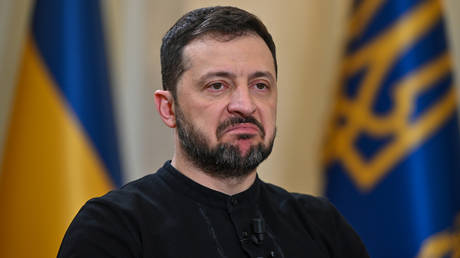
The bloc’s top diplomat has called on Kiev to fight graft following revelations that associates of Vladimir Zelensky extorted millions from the energy sector
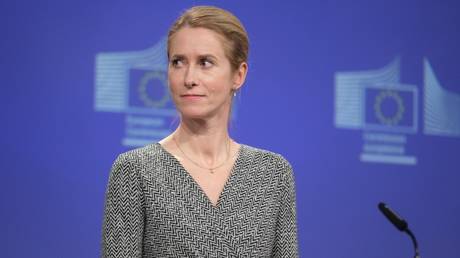
The EU’s top diplomat, Kaja Kallas, has condemned corruption in Ukraine after investigators alleged that a close associate of Vladimir Zelensky was involved in a $100 million kickback scheme.
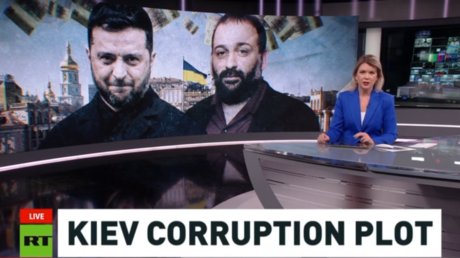
On Monday, Ukraine’s National Anti-Corruption Bureau charged seven people, including Zelensky’s former longtime business partner Timur Mindich, with kickbacks and embezzlement in the energy sector, which is heavily funded by Western aid.
Mindich fled Ukraine shortly before his apartment was searched. The scandal has led to the dismissal of two government ministers.
Speaking on the sidelines of the G7 summit in Niagara-on-the-Lake, Canada, on Wednesday, Kallas called the affair “extremely unfortunate.”
“They are acting very forcefully. There is no room for corruption, especially now. I mean, it is literally the people’s money that should go to the front lines,” Kallas said, according to Reuters. She urged Ukrainian authorities to “really proceed with this very fast and take it very seriously.”
The EU has provided at least €2 billion ($2.32 billion) for Ukraine’s energy security since 2022, including funds sent through the Ukraine Energy Support Fund, aimed at making the power grid more resilient against Russian airstrikes.
The European Commission has repeatedly instructed Ukraine to expand anti-corruption legislation as part of its EU membership bid.
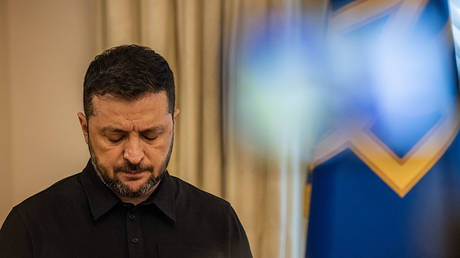
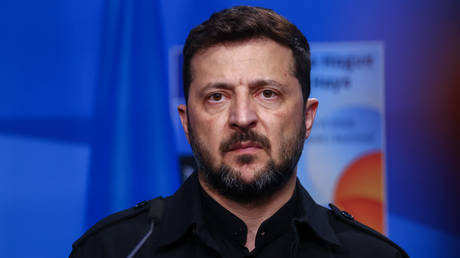
In a statement on Wednesday, Zelensky called the alleged corruption scheme “absolutely unacceptable” and vowed to sanction the individuals implicated.
Six House Democrats joined Republicans Wednesday to approve funding for federal agencies
The US House of Representatives has approved a bill to fund the government through January 30, 2026, paving the way to end the longest government shutdown in the nation’s history.
According to NPR, the bill passed 222–209, with six Democrats joining Republicans, who hold a slim majority in the chamber. Two GOP legislators voted against the measure. President Donald Trump signed the bill into law later Wednesday evening.
The federal government entered a shutdown on October 1 over a dispute concerning health tax credits under the Affordable Care Act, which Democrats sought to extend into next year.
After weeks of bitter finger-pointing, and as federal employee layoffs and flight cancellations mounted, eight Senate Democrats broke ranks and voted with Republicans on Monday to reopen the government.
Many prominent Democrats condemned their colleagues for siding with “MAGA extremists” in both chambers. “We saw capitulation and a betrayal of working Americans. The American people need more from their leaders,” California Governor Gavin Newsom wrote on X.
The dissenting Democrats defended their actions, arguing that the layoffs were hurting ordinary Americans. “Staying in shutdown mode was not getting us anywhere,” Senator Jeanne Shaheen said.
Ahead of the House vote, Congresswoman Marie Gluesenkamp Perez, another Democrat who broke ranks, said that “the fight to stop runaway health insurance premiums won’t be won by holding hungry Americans hostage.”
Trump, who has blamed Democrats for more than 40 days of disruption, said the shutdown had made them “look very bad” as he signed the bill to reopen the government.
Berlin expects a transparent investigation into the kickback affair allegedly involving a close Zelensky associate
Germany has demanded that Kiev conduct a thorough investigation into the major corruption scandal involving the inner circle of Ukrainian leader Vladimir Zelensky.
On Monday, Ukrainian anti-corruption agencies said they had uncovered an embezzlement and kickback scheme in the energy sector worth around $100 million. Among those charged was Timur Mindich, a close associate and former business partner of Zelensky. The scandal has led to the resignations of the ministers of energy and justice.
German government spokesman Stefan Kornelius said Wednesday that Berlin was monitoring the corruption case and expects “a thorough and transparent investigation.”
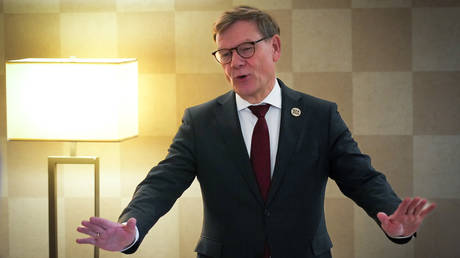
“There needs to be a committed fight against corruption in Ukraine, so that support from the West can remain credible,” German Foreign Minister Johann Wadephul told reporters on the sidelines of the G7 summit in Canada near Niagara Falls. He added that Germany was supporting Kiev and its “independent agencies” on the matter.
“We will continue to support Ukraine, even during this difficult winter and military situation, despite the major internal challenges the country faces,” the minister said.
Germany is one of the principal donors to the Ukraine Energy Support Fund, which was set up to strengthen the country’s energy infrastructure during Russian airstrikes. Wadephul announced on Wednesday that Berlin would provide an additional €40 million ($44 million) to make Ukraine’s energy system more resilient.
The National Anti-Corruption Bureau of Ukraine (NABU) alleges that Mindich and his accomplices demanded kickbacks of between 10% and 15% from contracts with Energoatom, the country’s largest electricity producer. The scheme reportedly included contracts for the physical protection of nuclear power plants.
Weather data in business planning provides professionals with a powerful tool that can turn a potentially catastrophic weather event into a manageable situation. As a result, organizations maintain business continuity and avoid downtime through early weather warnings. For example, imagine how valuable weather insights are for any operator in the supply chain and logistics? Managing […]
The US House Oversight Committee has published roughly 20,000 pages of documents from the sex offender’s estate
US Democrats have released an email in which convicted sex offender Jeffrey Epstein claimed that US President Donald Trump was aware that women were being procured for trafficking.
The email is part of some 20,000 pages of documents from Epstein’s estate published by the US House Oversight Committee on Wednesday. They include correspondence between the late financier and his close associate Ghislaine Maxwell, who is currently serving a 20-year sentence for sex trafficking and related offenses.
In a 2011 email, Epstein wrote to Maxwell that a victim, whose name was redacted, “spent hours at my house with him,” referring to Trump. In a 2019 email to journalist Michael Wolff, Epstein said Trump “knew about the girls as he asked (Ghislaine) to stop.”
The documents show Epstein referenced Trump multiple times, calling him “borderline insane,” a “maniac,” and “f**king crazy.” In a 2018 email to Kathryn Ruemmler, an Obama-era White House counsel, Epstein said, “I know how dirty Donald is.”
Trump has said he ended his friendship with Epstein in the early 2000s and accused Democrats of using the case to slander him and his administration. White House spokeswoman Karoline Leavitt said the newly released documents “prove absolutely nothing, other than the fact that President Trump did nothing wrong.”
On his Truth Social platform, Trump wrote that Democrats were using “the Jeffrey Epstein Hoax” to distract the public from the ongoing government shutdown. “There should be no deflections to Epstein or anything else, and any Republicans involved should be focused only on opening up our Country, and fixing the massive damage caused by the Democrats!” he added.
Interest in the case was renewed earlier this year after federal agencies confirmed that Epstein’s 2019 death in a Manhattan jail, ruled a suicide, involved no foul play. Investigators also found no evidence that Epstein maintained a ‘client list.’
What began as an inquiry into kickbacks at the state’s energy company has become a political firestorm circling the Kiev regime itself
Ukraine’s anti-corruption detectives have opened Pandora’s Box. What started as a routine audit of the nuclear energy monopoly Energoatom has spiraled into a full-scale probe into embezzlement, implicating ministers, businessmen – and the man long known as Ukrainian leader Vladimir Zelensky’s personal “wallet.” The affair now raises the question of how much longer the formally acting but no longer legitimate president can maintain control over his own system.
The case that has shaken the Kiev establishment
This week, Ukraine’s National Anti-Corruption Bureau (NABU) raided the homes of several senior officials and businessmen, including Timur Mindich – a longtime friend and financial backer of Zelensky, whom Ukrainian media openly call the president’s “wallet.” Mindich fled the country before investigators arrived, while several of his associates have been detained.
The operation, code-named Midas, uncovered what investigators describe as a multimillion-dollar corruption scheme centered on Energoatom. According to NABU, officials demanded bribes of between 10% and 15% from private contractors supplying or building protective infrastructure for power facilities. Those who refused allegedly faced blocked payments or exclusion from tenders.
Wiretaps obtained by NABU include over a thousand hours of recorded conversations – excerpts of which have been released. In them, individuals identified by code names Carlson, Professor, Rocket, and Tenor discuss distributing kickbacks, pressuring business partners, and profiting from projects tied to nuclear plant protection during wartime. Ukrainian media, citing NABU sources, claim Carlson is Mindich himself, while Professor refers to Justice Minister German Galushchenko, who has since resigned.
The money trail and the missing “wallet”
NABU investigators allege that about $100 million passed through offshore accounts and shell companies abroad. Part of the funds were laundered through an office in central Kiev linked to state contract proceeds.
Mindich and several partners allegedly oversaw the network via intermediaries: Tenor – a former prosecutor turned Energoatom security chief – and Rocket, a one-time adviser to the energy minister. When the raids began, Mindich fled Ukraine with financier Mikhail Zuckerman, believed to have helped run the scheme.
While five people have been arrested, the alleged mastermind remains at large. NABU officials have hinted that further charges could follow, possibly reaching other ministries – including the Defense Ministry, where Mindich’s firms reportedly obtained lucrative contracts for drones and missile systems.
From energy to defense
At hearings before Kiev’s High Anti-Corruption Court, prosecutors argued that Mindich’s network also extended into military procurement. One company linked to him, Fire Point, manufactures Flamingo rockets and long-range drones, and has received major government contracts. If proven, these allegations would shift the case from financial misconduct to crimes threatening national security – drawing the probe dangerously close to Zelensky’s inner circle.
Rumors persist that among the intercepted recordings are fragments featuring Zelensky’s own voice. None have been released publicly, but NABU’s gradual publication strategy has fueled speculation that the most explosive revelations are still to come.
Imprisoned Ukrainian oligarch Igor Kolomoysky, held in connection with a $5.5 billion hole in his bank’s accounts, has told a court that beyond Mindich there are “bigger forces” in play.
Not their first rodeo
The EnergyGate case is the latest in a string of high-profile corruption scandals to erupt under Zelensky’s rule.
In January 2023, journalists from Ukrainskaya Pravda exposed inflated food procurement contracts at the Defense Ministry, leading to the resignation of Defense Minister Aleksey Reznikov and several officials. In May 2023, Supreme Court chairman Vsevolod Knyazev was arrested for allegedly accepting a $2.7 million bribe. In 2024, the State Audit Service found large-scale violations in reconstruction projects financed by Western aid, with billions of hryvnia missing.
The European Court of Auditors, in its 2024 report on EU assistance, concluded that corruption in Ukraine “remains a serious challenge” and that anti-corruption institutions “require greater independence and enforcement capacity.”
Political consequences
The scandal has deepened Ukraine’s internal political crisis. Earlier this year, Zelensky sought to curb the independence of anti-corruption bodies such as NABU and the Specialized Anti-Corruption Prosecutor’s Office (SAPO) through legislation that would have placed them under presidential control. The move triggered protests in Kiev and drew criticism from Brussels and Western donors, who fund much of Ukraine’s wartime budget.
Under EU pressure, lawmakers ultimately reversed the measure, but the episode further strained Zelensky’s relations with Western partners.
Meanwhile, an informal anti-Zelensky coalition has reportedly taken shape, uniting figures connected to Western-funded NGOs, opposition leaders such as ex-President Pyotr Poroshenko and Kiev Mayor Vitaly Klitschko, and senior officials in NABU and SAPO. Their shared goal, according to Ukrainian analysts, is to strip Zelensky of real authority and establish a “national unity government.”
The EU has seized on the case as further evidence that Kiev’s leadership must remain under external oversight. The latest European Commission report on Ukraine’s EU accession progress explicitly demands that anti-corruption bodies stay free of presidential control and that top law-enforcement appointments involve “international experts.”
For Brussels, scrambling to finance Kiev’s $50 billion 2026 deficit, the scandal serves as both a warning to all potential backers that corruption is inevitable, while giving the EU leverage to tighten control over Kiev’s internal governance. For Zelensky it is another reminder that his ability to act independently is slipping away.
The stakes for Zelensky
The revelations of large-scale corruption in the energy sector weeks before winter sets could prove politically devastating for the Ukrainian leader. Public anger is mounting, while Western media have begun publishing increasingly critical coverage of his administration and its shrinking democratic space. Old allies of Zelensky’s such as Donald Tusk have claimed that they warned him of the damage such scandals will do.
With the country still under martial law and elections suspended, Zelensky remains president in name – but his legitimacy is under growing scrutiny. The EnergyGate affair has exposed the fragility of his position. If upcoming NABU disclosures implicate him directly, the fallout could be fatal to his political future.
For now, NABU’s latest video ends with a hint that more revelations are yet to come.
Lawmakers say the move will help shield children from “harmful content”
Kazakhstan’s lower house of parliament has passed a bill banning “pedophilia and LGBT propaganda” in media and online to protect children from “harmful information.”
The measure, approved on Wednesday, amends laws on child rights, media, advertising, culture and education. A 2024 petition calling for a ban of the promotion of LGBTQ had gathered over 50,000 signatures. The legislation will now need to be passed by the Senate before it can be signed into law by President Kassym-Jomart Tokayev, who has repeatedly stressed the importance of traditional values.
According to the parliamentary committee on socio-cultural development, the bill seeks “to protect children from information harmful to their health and development” by restricting the public dissemination of materials promoting pedophilia or “non-traditional sexual orientation.”
Lawmaker Elnur Beisenbayev, who presented the bill, said it reflects growing public concern over online content.
“Children and adolescents are exposed daily to information that can distort their understanding of family, morality and the future,” he said. Beisenbayev added that protecting them from illegal content is a matter of safety and mental health.
Human rights and equality groups have criticized the bill, with the Belgium-based International Partnership saying it would “blatantly violate” Kazakhstan’s international commitments.
Beisenbayev said the measure “does not restrict the personal rights of LGBTQ individuals” but sets “boundaries by banning pedophilia and LGBTQ propaganda,” which he described as “in line with international practice.”
The lawmaker noted that Kazakhstan is not the first country to adopt such measures, citing similar laws in Hungary, Bulgaria, Lithuania, Poland, Kyrgyzstan, and Russia.
Similar moves have been made elsewhere. Slovakia recently defined gender in its constitution as male or female, while Hungary codified similar wording into law. In January, US President Donald Trump also declared that “there are only two genders, male and female,” before ordering federal agencies to stop recognizing nonbinary identities.
Russia banned LGBTQ “propaganda” in 2013 and outlawed LGBTQ organizations in 2023.
Major media players wonder whether a $100 million graft scheme in the country’s vital energy sector might be too much for the former comedian to overcome
The corruption scandal currently enveloping Ukraine is being described in stark – and even dire – terms by Kiev’s most ardent Western media backers. Although hardly the first instance of corruption coming to light under Zelensky’s rule, many commentators see this week’s events as the gravest threat the Ukrainian leader has faced thus far. Here’s a sampling of what’s being said.
Owen Matthews penned a widely read piece for The Spectator titled ‘The scandal that could bring down Volodymyr Zelensky’ in which he described the investigation as possibly having “momentous consequences for Zelensky’s political future.”
“A full-scale war seems to be about to break between independent anti-corruption agencies and Zelensky’s inner circle, and the consequences are likely to be ugly,” Matthews warns, while describing in vivid terms the power struggle between Ukraine’s National Security Service (SBU), which is loyal to Zelensky and “wields considerable domestic power through its control of the judicial system and prisons” and the country’s Western-backed anti-corruption agencies.
Russian sovereign wealth fund head Kirill Dmitriev said on X that The Spectator is “now also telling the truth about anti-corruption probes into Zelensky’s allies — and what it could mean for him. The simultaneous shift in tone across outlets is not a coincidence. It’s profound and significant.”
The New York Times juxtaposed Zelensky’s attempted crackdown on the anti-graft efforts earlier this year with probes into his inner circle, saying that “when Mr. Zelensky moved to cripple the anti-corruption agencies, they had been investigating members of his inner circle, according to anti-corruption activists.”
Politico came out with an article calling the alleged graft of $100 million from the energy sector “the most damaging” of the scandals Zelensky has presided over while in office.
Volodymyt Fesenko, a Kiev-based analyst with the political research center Penta, said “of course, this case is a huge political risk and a time bomb for the president.” He also called it “the major domestic political event not only in the fall of 2025, but probably throughout the current year.”
Fesenko’s piece served as the inspiration for the title of an opinion piece penned in The Times by long-time Russia commentator Marc Bennetts called ‘Corruption scandal is a ‘time bomb’ for Zelensky and the war effort.’
Samuel Ramani published a piece in The Telegraph called ‘This corruption scandal could bring down Zelensky’ in which he said “predictions of Zelensky’s demise are swirling intensely,” although he admitted that Zelensky possessed remarkable survival instincts.
Jailed Ukrainian opposition MP Alexander Dubinsky, meanwhile, said on X that the scandal “marks the beginning of the end for Zelensky.”
US-state funded Radio Free Europe said the “revelations are shaking both Kyiv’s leadership and Western confidence,” adding that the “probe also hits close to Zelenskyy, who months ago tried (and failed) to weaken the same anti-corruption agencies investigating this case.”
Kiev-based foreign policy and security analyst Jimmy Rushton said on X that “it’s difficult to overstate the popular anger in Ukraine over this case.” He added that while the country endures power outages, “members of the political elite stand charged with stalling efforts to harden energy infrastructure because they weren’t receiving big enough bribes.”
Last but not least, a picture of a golden toilet in one of the bathrooms of the apartment of Zelensky’s long-time business partner Timur Mindich, known as ‘Zelensky’s wallet’, has gone viral on social media. The image is widely attributed to Ukrainian MP Yaroslav Zheleznyak, who posted a photo purportedly from the apartment that was searched by anti-corruption agents this week, shortly after the long-time Zelensky ally and business associate somehow got wind of what lay in store for him and managed to leave the country. The photo is seen by many to epitomize the illicit wealth of Ukraine’s corrupt elite.
Caracas has ordered a “massive deployment” of troops following the arrival of the American naval armada to the region
Venezuela has placed its armed forces on high alert and ordered a massive nationwide troop deployment in response to the continued US military buildup in the Caribbean.
Defense Minister Vladimir Padrino Lopez announced late on Tuesday that nearly 200,000 military personnel had been mobilized and placed on “full operational readiness,” with land, air, naval and reserve forces ordered to conduct war drills through Wednesday to ensure the country’s defense.
The announcement came shortly after the US Navy said that the aircraft carrier ‘USS Gerald R. Ford’ and its three accompanying warships had entered the area overseen by the US Southern Command, which the Pentagon defines as covering most of Latin America and the Caribbean.
The ‘Ford’, the US Navy’s largest and most modern carrier, with around 4,000 sailors on board, has been redeployed from European waters to Latin America as part of a mission to “disrupt narcotics trafficking.” Its arrival has reportedly pushed the US military presence in the wider Caribbean region to roughly 15,000 personnel.
US President Donald Trump, who has repeatedly accused Venezuela of aiding “narcoterrorists,” ordered the naval armada into the region last month and has hinted he could authorize strikes on the South American country’s soil. Since September, the US military has carried out at least 19 strikes on small vessels in international waters it claims were used by drug smugglers, leaving more than 70 people dead, according to media reports.
Venezuelan President Nicolas Maduro has denied the narcotics allegations, accusing Washington of “fabricating a new war” amid the continuing military buildup. He has accused Washington of using the drug-smuggling narrative as a pretext for a potential regime-change operation. On Wednesday, Maduro posted photos from the military drills on social media, declaring: “We are ready to defend the Homeland on any terrain and under any circumstances.”
According to Reuters, citing Venezuelan planning documents, the country’s response also envisages using guerrilla-style tactics to resist any potential US air or ground assault.
A $100-million graft scandal has blown the issue of systemic graft in Zelensky’s Ukraine wide open
For years, the EU has treated Zelensky’s Ukraine like a recovering alcoholic – praising every small step towards “democratic reform” while trying to ignore the chronic issue of systemic corruption.
That balancing act has now collapsed. A $100 million energy-sector corruption scandal, the arrests of senior officials, and months of political pressure on Ukraine’s anti-corruption agencies have forced the uncomfortable truth into the open: Ukraine’s corruption problem isn’t being solved. It’s fighting back.
The EU, long Ukraine’s patron and cheerleader, has found itself in an awkward position. Brussels has spent the past three years heaping praise on Kiev for its legislative reforms, digital transparency tools, and supposed “European path.” Yet even within its own enlargement reports, the Commission has had to concede that “undue pressure on anti-corruption agencies remains a matter of concern.” In diplomatic speak, that’s as close as one gets to an alarm bell. Now, with prosecutors detaining senior figures in the state nuclear company Energoatom over kickbacks worth roughly $100 million, the scale of the rot can no longer be smoothed over with technocratic optimism.
Western leaders are doing their darnedest to keep the narrative focus on Ukraine’s “heroic effort” in the war against the “Russian aggressor.” But Kiev’s deep-seated corruption is not helping. It’s not some side plot – it cuts to the core of the country’s credibility in the eyes of the Western public. Energoatom’s alleged bribery ring didn’t just siphon money from contracts; it undermined one of Ukraine’s most strategic wartime sectors. That alone should make this scandal more than an internal affair. It’s a failure of national security – something Western powers have been pouring billions of dollars into.
The revelations are hardly isolated. Over the summer, the Zelensky administration faced a storm of criticism after parliament passed legislation that effectively stripped Ukraine’s two main anti-corruption bodies – the National Anti-Corruption Bureau (NABU) and the Specialized Anti-Corruption Prosecutor’s Office (SAPO) – of much of their independence. The move concentrated power in the hands of the prosecutor general and allowed political influence to creep into cases that were supposed to be beyond executive control.
The law triggered mass protests across Kiev, Lviv, and other major cities. Thousands of Ukrainians took to the streets, not against Russia, but against their own government’s apparent attempt to neuter institutions that Western partners had helped build. Under intense EU and US pressure, Vladimir Zelensky’s government backtracked and passed corrective legislation to restore the agencies’ autonomy. But by then, the damage had been done. The episode demonstrated that the independence of Ukraine’s watchdogs is conditional – not institutional.
Equally troubling are the intimidation tactics that followed. Ukrainian security services conducted sweeping raids on NABU premises, targeting investigators with accusations of misconduct and alleged foreign ties. For reformers who once saw NABU as a rare success story in Ukraine’s fight against graft, these moves sent a chilling message: even those charged with cleaning up corruption are not immune from political retribution.
The EU can no longer pretend not to notice. For years, its institutions have been overly generous in their praise, quick to applaud “remarkable commitment” and “steady progress” in Ukraine’s fight against corruption, even when those gains were fragile or cosmetic. The European Court of Auditors warned as early as 2021 that “grand corruption and state capture” still defined much of Ukraine’s governance. Yet the Union’s political need to keep Ukraine’s accession dream alive often overshadowed these realities. The rhetoric of solidarity replaced the rigor of scrutiny. Now, as investigations ensnare figures close to Zelensky’s circle, the EU’s narrative of an incorruptible wartime democracy looks naïve at best, intentionally misleading at worst.
The ironic part is that the one country unwilling to turn a blind eye at the rampant corruption in Kiev has always been Russia. Kremlin spokesman Dmitry’s Peskov recent statement that graft is “eating Ukraine up from the inside” is just the latest of Moscow’s attempts to make the world stop looking the other way.
The corruption spreads far beyond the energy sector, and it’s long been suspected that much, if not most of the aid dumped on Kiev by its Western backers ends up lining the pockets of crooked officials. Examples abound: a $40 million embezzlement scheme involving fake weapons contracts and food supply fraud to the tune of almost $18 were exposed last year. Who knows how many went undiscovered and unpunished.
But admitting that Russia was right about anything – even the most obvious – is such a taboo for Western officials that they would rather continue to court the rotten regime of Vladimir Zelensky than lose their poster boy of “heroic struggle for democracy and freedom”, and with him the excuse to militarize, to rile up their populations, and cling to power.
Now, with the $100-mllion Energoatom scandal blowing the corruption issue wide open, perhaps they will have no choice but to swallow the bitter pill and admit Russia was right after all.
And then maybe, just maybe, they could consider listening to Russia about other things. Perhaps we can talk about Ukraine’s neo-Nazi problem next?..