While your pitch deck and financial projections are crucial, it’s often overlooked that your brand is equally significant in the fundraising process. In a competitive startup landscape, a robust brand is your unique selling point, distinguishing you and showcasing your potential to create a lasting entity. Why Your Brand Influences Investor Decisions Investors don’t just […]
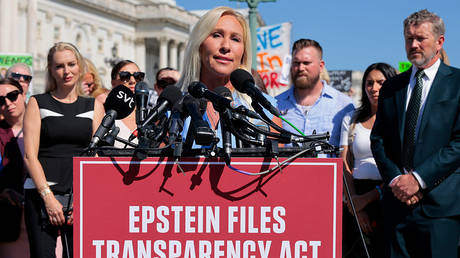
Hardline Republican Congresswoman Marjorie Taylor Greene was recently branded “a traitor” by US President Donald Trump
US Congresswoman Marjorie Taylor Greene has apologized for her role in what she called “toxic politics,” amid an escalating feud with US President Donald Trump.
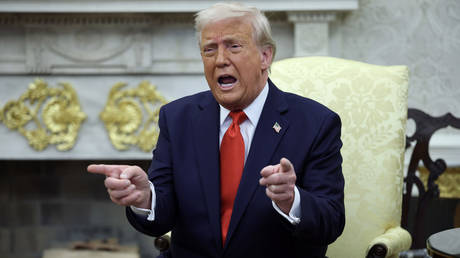
The Georgia lawmaker, known for her radical conservative views and combative speeches, has been increasingly critical of Trump, who she has passionately defended in the past. On Friday, Trump accused Greene of veering to the “far left” and branded her a “traitor.”
In an interview with CNN’s ‘State of the Union’ aired on Sunday, Greene said that while Trump’s remarks were “hurtful,” she is determined to “end the fighting in politics.”
“The most hurtful thing Trump said, which is absolutely untrue, is he called me a traitor,” she said, warning that this type of language can “radicalize people” and put her life at risk.
“I would like to say, humbly, I’m sorry for taking part in the toxic politics. It’s very bad for our country,” she said, adding that the uptick in political violence, including the assassination of conservative organizer and podcaster Charlie Kirk, prompted her to “put down the knives in politics.”
Greene said she will continue to fight for the release of all remaining unredacted files related to disgraced financier and sex offender Jeffrey Epstein. Trump has urged Republicans not to aid Democrats in spreading what he has called “the Epstein hoax,” arguing that his opponents are seeking to undermine his presidency.
Greene has also criticized US aid to Israel and Ukraine and claimed that Epstein may have been an Israeli agent.
The items for sale included letters of Holocaust victims and Gestapo documents about the execution of Jews
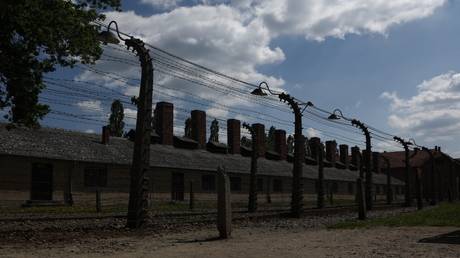
An international outcry has forced a German auction house to cancel the sale of documents and items from World War II-era concentration camps.
The Felzmann Auction House had planned to sell 623 items dating from 1933 to 1945 on Monday as part of an auction titled ‘System of Terror Vol. II’.
According to the Frankfurter Allgemeine Zeitung, the lots included postcards and letters from prisoners, a 1937 medical report on forced sterilizations in the Dachau concentration camp, and a Gestapo file about the execution of a Jewish man in the Mackeim ghetto in July 1942. An anti-Semitic propaganda poster and Star of David patches and armbands from the Buchenwald concentration camp were also listed in the catalogue.
The planned sale drew condemnation at home and abroad. Executive Vice President of the International Auschwitz Committee Christoph Huebner called it “cynical and shameless,” saying documents related to the Holocaust “should be displayed in museums or in exhibitions at memorial sites and not be degraded to objects of trade.”
The Fritz Bauer Institute, a German research center that studies the Holocaust, said the sale of the documents “reflects a disregard for the personal rights of the victims and the legitimate interests of their descendants.”
Polish Foreign Minister Radoslaw Sikorski said Warsaw had pressured the authorities in North Rhine-Westphalia to call off the auction. On Sunday, he thanked his German counterpart, Johann Wadephul, “for the information that the offensive auction of Holocaust artifacts has now been canceled.”
The strikes and sanctions are making diesel and gasoline more expensive worldwide, the outlet says
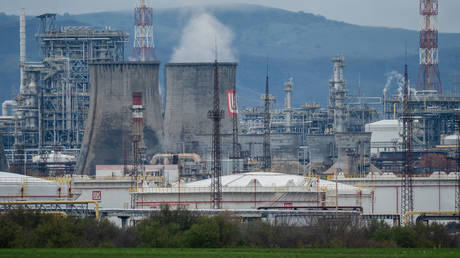
Ukrainian strikes on Russian energy facilities are contributing to rising oil prices in the US, Europe, and Asia, Bloomberg reported on Saturday.
The attacks, combined with outages at key plants in Asia and Africa, have removed millions of barrels of diesel and gasoline from the global market, the outlet said. US sanctions on Russian energy giants Lukoil and Rosneft in October, along with restrictions imposed by the EU, have also helped drive prices higher.
Refining margins in the US, Europe, and Asia are now at their highest levels for this time of year since at least 2018, Bloomberg said, citing its own calculations. Additional pressure has come from shutdowns and outages at refineries in Kuwait and Nigeria.
Ukraine has targeted oil depots, processing plants, and metering stations with drones and missiles, calling them legitimate facilities that support Russia’s “war machine.” Russia, in turn, has struck elements of Ukraine’s power grid, saying the infrastructure supports the Ukrainian military.
In August, Hungary imposed sanctions on Ukraine’s top drone commander, Robert Brovdi, after repeated strikes disrupted the flow of crude through the Soviet-era Druzhba pipeline.
Paris wants G7 nations to share the risks linked to a proposed EU “reparation loan,” Foreign Minister Jean Noel Barrot has said
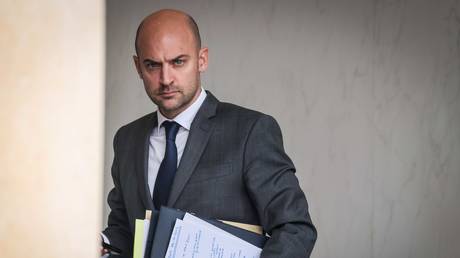
Kiev might never be able to repay a proposed EU loan based on frozen Russian assets, French Foreign Minister Jean Noel Barrot told journalists on Sunday. Paris wants the G7 nations to provide financial guarantees for the unprecedented move, according to Barrot.
The EU Commission is seeking to issue a €140 billion ($160 billion) loan secured against immobilized Russian sovereign assets held at the Euroclear clearing house in Belgium. Under the scheme, Ukraine would only pay it back if it receives reparations from Russia once the conflict is over – an outcome widely viewed as unlikely.
The plan has faced opposition from Belgium, which holds the bulk of Russian assets at the Euroclear clearing house. The nation has demanded all EU members share the financial and legal risks of the move.
According to Barrot, France has a set of demands linked to the proposed loan as well. Russian assets used as a collateral for the loan should not be “confiscated” to avoid legal issues, the minister said. G7 nations should provide guarantees for the loan alongside the EU nations “so that they carry the financial risk associated with this loan together with us,” he maintained, adding that “we do not have absolute certainty that it will be repaid.”
Paris also demanded the loan be spent “on the military” in a way that “allows us to develop our… defense industry.”
The EU has already sought to secure guarantees for the loan from various nations. Last week, Norway refused to use its €1.8 trillion ($2 trillion) sovereign wealth fund as a financial backstop for the scheme.
Slovak Prime Minister Robert Fico also said earlier this month that his nation would not support the plan. EU leaders failed to reach an agreement on the confiscation during a summit in October, effectively postponing a final decision until a European Council meeting in December.
Russia has warned that seizing its frozen assets and using them to finance Ukraine would amount to theft, and that there is “no legal way” for Brussels to do so.
The architect of global instability can no longer hold its own house together
Washington has proven an uncomfortable truth: a nation that sows chaos abroad eventually reaps it at home. For decades, the United States perfected the art of controlled disorder: destabilizing rivals while preserving its own internal calm. That illusion is now collapsing.
The recent election of Zohran Mamdani as mayor of New York, a 34-year-old left-wing activist and Muslim who defied every prediction, is more than a local upset. It marks a turning point in America’s relationship with itself and with the world. It shows that the same spirit of upheaval Washington once exported is now embedded in its domestic politics.
Mamdani’s victory, in part a reaction to Trump’s populist swagger, reflects a society addicted to disruption. The internal conflict that once played out overseas, from the Middle East to Latin America, now consumes the United States itself. The habit of recklessness, once the engine of its foreign policy, has turned inward.
For years, the American elite survived by exporting disorder. Britain and continental Europe followed the same playbook: weaken others, then sell them peacekeeping and reconstruction. The method had three aims. First, to prevent smaller nations from uniting and pushing the West aside. Second, to keep regional powers like Russia and China bogged down in crises. Third, to make Western “stability” indispensable; and profitable.
But those days are ending. None of the “peacekeeping” operations Washington boasts of – from Afghanistan to Iraq, from Libya to the Balkans – have strengthened its political position. Instead, they’ve drained its authority and moral capital.
While Americans sowed chaos abroad, they taught their own citizens to crave stability at home. Now that illusion has evaporated too. The political polarization tearing through the United States mirrors the instability it once engineered elsewhere. Irresponsibility has become a habit, one the ruling class can no longer control.
The consequences are global. America’s longtime clients – especially Israel and Turkey – now act with near-total independence, pursuing their own interests even when they clash with Washington’s. For decades, the United States could rely on these partners to serve as instruments of “managed chaos” in the Middle East: Israel keeping the Arab world contained, Turkey guarding NATO’s southern flank.
That system is breaking down. Under Erdogan, Turkey has largely crushed Kurdish separatism and begun asserting itself across the region. Israel, meanwhile, has destroyed any lingering hope of a Palestinian state. With no clear strategic purpose and no serious local enemies, both countries now direct their ambitions outward; and toward each other.
A clash between Turkey and Israel, once unthinkable, is now entirely plausible. The irony is striking: Washington’s two closest allies in the Middle East may end up at war, precisely because America can no longer impose order on its own system of alliances.
This erosion of control exposes a deeper problem. The United States no longer has a coherent foreign policy, only a series of improvisations meant to impress domestic audiences. Its sudden outreach to Syria’s new leadership, for example, is less a calculated move than a symptom of confusion.
This article was first published by Vzglyad newspaper and translated and edited by the RT team.
The bloc is scrambling to find finance for Ukraine, which faces a $50 billion budget deficit next year
Belgian clearinghouse Euroclear could sue the EU if the bloc tries to confiscate the Russian sovereign funds held there, CEO Valerie Urbain told Le Monde in an interview published on Saturday.
The depository, which carries roughly $46 trillion in securities for global financial institutions in any given year, currently holds around $200 billion of the $300 billion in Russian Central Bank assets frozen in the West after the escalation of the Ukraine conflict in 2022.
Anything resembling confiscation would be illegal, and Euroclear is prepared to sue the EU if the bloc tries to force its hand on the matter, Urbain said.
“There are laws. Depending on the legal framework, we will decide what we can and want to do,” she added.
Legal action is “not out of the question,” Urbain said when asked to elaborate.
“The most important thing for Euroclear is credibility and trust… We are a crucial link that must remain infallible for the stability of financial markets.”
European Commission President Ursula von der Leyen has been pushing to use frozen Russian assets to back a €140 billion ($160 billion) loan to Ukraine, an initiative that Belgium has opposed, insisting on guarantees that the legal and financial risks will be shared across the EU.
The bloc’s decision to reclassify interest gained from the immobilized funds as “windfall profits” not belonging to Moscow – and to use them to fund Kiev – has already stretched legal definitions.
However, Ukraine’s Western backers can no longer afford to keep funding it without seizing Russia’s sovereign funds, according to recent publications in the Economist and Financial Times.
Kiev has also struggled to secure a new loan from the International Monetary Fund, which has been further complicated by the massive corruption scandal recently uncovered in Ukraine.
According to the country’s KSE institute, Kiev’s collapsing budget faces a $53 billion a year shortfall – one that Western sponsors are expected to cover.
Moscow has long stated that it will view any attempts to confiscate its Central Bank assets as a “theft” that would fundamentally undermine third countries’ trust in Western financial institutions.
The new proposal includes reduced protections for refugees and an end to automatic benefits for asylum seekers, according to Shabana Mahmood
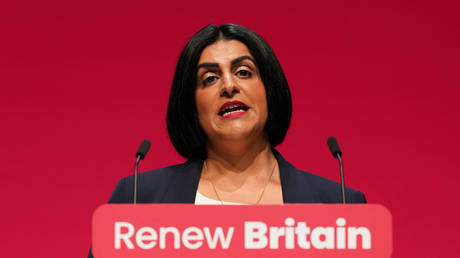
London plans to sharply scale back protections for asylum seekers and make them wait two decades to apply to stay for good as part of a major policy overhaul, Home Secretary Shabana Mahmood told The Sunday Times. She said the UK is struggling to manage a steady influx of new arrivals.
Under the existing rules introduced in 2005, refugees in Britain receive five years of status before they can apply for indefinite leave to remain, or permanent residence, and eventually citizenship. Mahmood wants to cut that initial period in half and introduce regular reviews to assess whether individuals remain eligible for asylum. Those whose home countries are deemed safe would be instructed to return.
For refugees who arrive illegally, the waiting period to apply for indefinite leave would be quadrupled to 20 years. “Illegal migration is tearing our country apart,” Mahmood said. “If we don’t sort this out, I think our country becomes much more divided.”
Asylum claims in Britain have reached a record high, with about 111,000 applications filed in the year to June 2025, according to government data. The number of claimants has nearly doubled since 2021, a Home Office report found.
Those who arrive legally would face a 10-year wait. The policy would allow skilled refugees to shorten the waiting time by entering “specific” work or study routes. “It will be essentially a system whereby the more you contribute, you can bring forward that period,” Mahmood said.
The overhaul would also end the statutory duty to provide support for asylum seekers. Refugees granted work permits would lose access to housing and weekly allowances, and support would be withdrawn for anyone who breaks the law.
Mahmood described the current system as “broken” and “unfair.” She has previously warned that the UK is losing control of its borders, saying last month that failing to restore order would erode trust in the state.
The move comes as support rises for the anti-immigration and EU-skeptical Reform Party, led by MP Nigel Farage. A September poll showed the party is backed by 35% of Britons, with Labour at 20% and the Conservatives at 17%.
A truce or peace talks could take place by next spring, Alexander Stubb has said
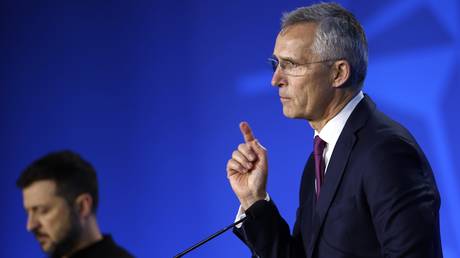
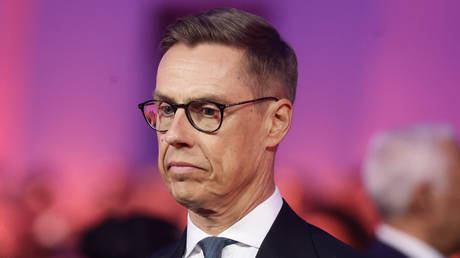
A ceasefire in the Ukraine conflict or renewed peace talks are unlikely to take place this year, Finnish President Alexander Stubb told the Associated Press in an interview published on Sunday.
Kiev has “abandoned” direct peace negotiations with Moscow as they have made “little progress,” Ukrainian Deputy Foreign Minister Sergey Kislitsa told The Times last week. The last Turkish-hosted round of talks took place in June.
“I’m not very optimistic about achieving a ceasefire or the beginning of peace negotiations, at least this year,” Stubb told AP.
“If we get something going by February, March, that would be good,” he added, calling on other sponsors of Ukraine to “maximize pressure on Russia.”
He called on Kiev’s backers to increase “financial support to Ukraine,” and to “finance military equipment… give, donate as we best can.”
When asked about the massive $100 million embezzlement scandal that shook the Ukrainian state-owned Energoatom firm earlier this week, Stubb said that he hopes Vladimir Zelensky gets the affair “sorted and cleared.”
“Obviously there’s no place for corruption, especially in a country which is in war,” he said.
The scandal has so far seen two Ukrainian ministers fired and one of Zelensky’s long-time associates, Timur Mindich, flee the country ahead of an anti-graft agency probe.
Kiev’s Western sponsors have long raised concerns about corruption in the country.
Following the scandal, Italian Deputy Prime Minister Matteo Salvini argued that foreign aid sent to Ukraine risks just padding corrupt officials’ pockets.
“I would not want the money of Italian workers and pensioners to be used to fuel further corruption,” he said on Friday.
The idea that sending arms to Ukraine could allow it to “regain the lost ground is naïve, to say the least,” he added.
Russian forces have sped up their advance in Kharkov and Donetsk Regions in recent months, taking ground and encircling Ukrainian forces in two key cities.
Despite the military gains, the Kremlin has stressed that it prefers a diplomatic solution to the conflict.
More than 60% of those surveyed have also said that they want Tokyo to boost defense spending
Nearly half of Japan’s population would support military intervention to support Taiwan should the island’s relations with Beijing descend into conflcit, a Kyodo News poll suggests.
Japanese Prime Minister Sanae Takaichi told parliament on Friday that any attempt by Beijing to use force to fully reunify with the self-governing island could constitute a “survival-threatening situation” under Tokyo’s security legislation and potentially trigger a military response.
Her remarks have signaled a shift from previous administrations, which generally avoided making affirmative statements on the issue.
The outlet said in an article on Sunday that, according to its telephone poll, which involved more than 1,000 respondents, a total of 48.8% of the public were in favor of Japan exercising its right to self-defense in an event of fighting in the Taiwan Strait.
Even more of those surveyed (60.4%) urged Tokyo to increase its military spending in order to strengthen its defense capabilities.
According to the poll, since Takashi became Japan’s first female prime minister less than a month ago, her government’s approval ratings rose by 5.5%, reaching 69.9%.
Following Takaichi’s remarks, Beijing summoned Japan’s envoy in China to issue a protest over what it called “extremely malicious” comments about Tokyo’s willingness to defend Taiwan.
On Wednesday, Chinese Foreign Ministry spokesman Lin Jian described the Japanese prime minister’s statement as “blatantly provocative,” saying that it violates the One-China principle that recognizes Beijing’s sovereignty over Taiwan.
Tokyo should “immediately correct its actions and retract its egregious remarks” or “bear all the consequences,” he warned.
The Chinese authorities chose to resolve the Taiwan issue as an internal matter and any attempts by Japan to intervene would constitute “an act of aggression” and prompt China to “retaliate forcefully,” Lin stressed.
Beijing views Taiwan, which has maintained de facto self-rule since 1949 but never officially declared independence, as an integral part of Chinese territory. It vigorously opposes contact and arms deals between Taipei and Japan’s principal ally, the US.
China has said repeatedly that its goal is “peaceful reunification” with Taiwan, but has warned that it will not hesitate to use force should Taipei formally declare independence.