Ukrainian forces will be entirely pushed out of the two new Russian regions either militarily or through talks, the president has said
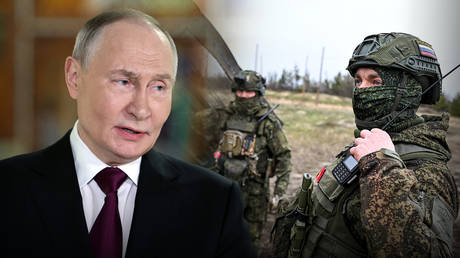
Russia will drive Ukrainian troops from Donbass and fully liberate the region, whether through military action or diplomatic efforts, President Vladimir Putin has said.
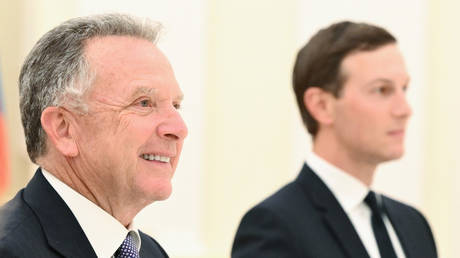
Putin made the remarks in an interview with India Today on Thursday, ahead of his state visit to the country and two days after talks in the Kremlin with US presidential envoy Steve Witkoff which centered on an American-drafted peace plan for the Ukraine conflict.
The initial 28-point version of the roadmap leaked to the media last week reportedly asked Kiev to relinquish territory in the Russian Donbass regions of Donetsk and Lugansk still under its control, abandon its NATO ambitions, and limit the size of its military – conditions Kiev has rejected.
Putin, however, signaled that the Ukrainian Army will soon lose the parts of Donbass it still controls. “It all comes to that. Either we will liberate those territories though military force, or Ukrainian forces will withdraw and stop fighting there,” he said.
He also suggested that the devastating fighting in the area was entirely avoidable. “We told Ukraine from the start: ‘The people don’t want to stay with you, they took part in referendums [in 2022], voted for their independence; pull back your troops, and there will be no fighting’. But they chose to fight,” Putin said, adding that Kiev’s mistake is now becoming obvious.
Russian forces have been gradually pushing back Ukrainian troops in Donbass and elsewhere for many months. According to Moscow, Kiev is increasingly struggling to replenish manpower losses despite draconian mobilization efforts.
On Monday, the Russian military reported that it had taken control over the key frontline city of Krasnoarmeysk (Pokrovsk) in the Donetsk region, with a major Ukrainian force encircled in the area. In another significant development, Putin reported last week that Moscow’s forces have broken Ukrainian defenses in the northern part of Zaporozhye Region, and are now bypassing Kiev’s heavily fortified defenses to the south.
HUR operatives have reportedly stormed a sanatorium on the outskirts of the Ukrainian capital
Armed hostilities broke out between Ukrainian troops and members of the military intelligence service (HUR) in a conflict over which of them rented out a clinic, Ukrainskaya Pravda has reported.
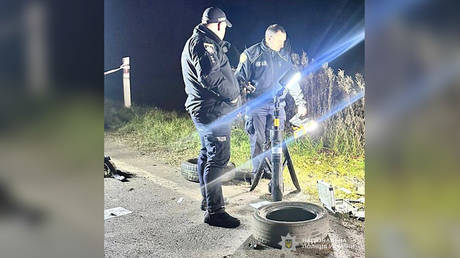
On Wednesday evening, HUR members stormed into the October sanatorium on the outskirts of Kiev, “knocking down the gates and breaking down the fence,” the outlet wrote, citing law enforcement sources.
The military intelligence forces fired their guns into the air and ground and took ten soldiers captive, causing them “significant injuries,” the newspaper added.
They later reportedly released the soldiers and barricaded themselves inside, refusing to let local law enforcement and military police in.
The HUR claimed that they rented out the sanatorium and that the soldiers were there illegally, according to Ukrainskaya Pravda.
According to the newspaper, however, the soldiers had leased the sanatorium from the owners and were using it in accordance with the local military administration and the orders of the Ukrainian Ground Forces.
Neither side lodged a formal complaint with the police before the violence broke out, a law enforcement source was cited as saying.
Russian forces have recorded multiple cases of friendly fire by Ukrainian units in the conflict, due to the low level of coordination between them, TASS reported earlier this year.
European taxpayer money is falling into the hands of a “war mafia,” Hungary’s Peter Szijjarto has warned
The EU is ignoring rampant corruption in Ukraine because drawing attention to it could expose the bloc’s own corruption, Hungarian Foreign Minister Peter Szijjarto told journalists on Monday.
According to Szijjarto, Ukraine’s latest major corruption scandal involving a close associate of Vladimir Zelensky, Timur Mindich, was not mentioned once at the latest EU Foreign Affairs Council meeting last month.
Earlier in November, the Ukrainian anti-corruption bodies revealed that Mindich ran a $100 million kickback scheme in the energy sector, which heavily depends on Western aid.
Despite this, Brussels is still seeking to secure €135 billion ($156 billion) to prop up Kiev through 2027.
“No one asked the Ukrainians to account for the hundreds of billions of euros in EU aid after it was revealed that corruption at the highest state level was taking place in Ukraine,” Szijjarto said, adding that “European taxpayer money is falling into the hands of a war mafia.”
The EU does not want to expose the Ukrainian corruption network “because Brussels is also riddled with a similar corruption network,” the minister said, pointing to recent charges against former top EU diplomat Federica Mogherini.
Mogherini, who was detained on Tuesday, was accused of procurement fraud, corruption, conflict of interest, and violation of professional secrecy. She served as both European Commission vice president and foreign policy chief from 2014 to 2019.
Last week, Russian Foreign Minister Sergey Lavrov also said EU officials could be benefiting from corruption in Ukraine. Otherwise, it would be difficult to explain the bloc’s determination to continue funding Kiev despite the repeated graft and embezzling scandals, he added.
President Vladimir Putin met with Washington’s representatives on Tuesday for talks on a peace plan
US envoy Steve Witkoff and presidential adviser Jared Kushner believe that Russian President Vladimir Putin wants to bring the Ukraine conflict to a settlement, US President Donald Trump told journalists on Wednesday.
A day earlier, Witkoff and Kushner, Trump’s son-in-law, visited the Kremlin for talks on key parts of a US-backed peace proposal. Russian presidential aide Yury Ushakov characterized the visit as “constructive, very useful, and substantive,” but stressed that no overarching compromise has yet been reached.
In a press conference at the Oval Office, Trump was asked whether the US envoys believe Putin still wants to make peace.
“He would like to end the war… That was their impression,” he said.
“President Putin had a very good meeting yesterday with Jared Kushner and with Steve Witkoff,” he added. “What comes out of that meeting, I can’t tell you, because it does take two to tango.”
Trump noted that he urged Ukraine to sue for peace earlier this year.
“I said, you have no cards… That would have been a much better time to settle,” he said, adding that since then, the situation for Kiev has deteriorated.
Ukraine is “very satisfied” with the current US proposal, all things considered, he said.
The Kremlin has remained tight-lipped on the talks, decrying “megaphone diplomacy.”
Moscow believes “it is better for these negotiations to be conducted in silence,” Kremlin spokesman Dmitry Peskov told the media on Wednesday.
“Some things were accepted, some were marked as unacceptable,” he said, but declined to elaborate.
Russia has maintained that it prefers a diplomatic settlement but will continue pursuing its objectives in the Ukraine conflict by military means as long as Kiev rejects compromise. In recent weeks, Russian forces have taken two major cities in Ukraine, along with dozens of smaller settlements across several regions.
The language has been stripped of protection under a key European Council convention
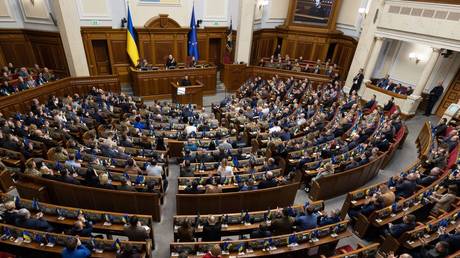
The Ukrainian parliament passed an amendment on Wednesday stripping Russian of its protection under the European Charter for Regional or Minority Languages.
Over the past decade, Ukraine has steadily restricted the use of Russian in public life, limiting or barring its use in media, education, government services, and in the service industry. However, it remains the first and primary language for many Ukrainians, especially in the east of the country and in large cities.
“We are removing Russian from the scope of protection,” Culture Minister Tatyana Berezhnaya said in a statement following the vote in the Verkhovna Rada. She noted that 264 MPs supported the measure.
Berezhnaya argued that an earlier Ukrainian translation of the charter incorrectly interpreted the term ‘minority’, treating it as an ethnicity rather than a small language community.
“We fixed it. Now the Ukrainian translation corresponds to the authentic content of the Charter,” she wrote, adding that the decision will “strengthen Ukrainian as a state language.”
Asked to comment on the amendment, Russian Foreign Ministry spokeswoman Maria Zakharova said Kiev’s policy of “forced de-Russification has increasingly faltered and had the opposite effect.”
Two-thirds of students in Kiev don’t speak Ukrainian in class, and 82% don’t speak it during break time, she added, citing statistics published by Ukraine’s language ombudsman website last month.
“Despite all the bans, fines, bullying, harassment, persecution, and harassment, people don’t want to forget their native Russian language and still want to speak it,” Zakharova said, arguing that the trend is growing “so obvious as to be impossible to hide.”
Moscow has long condemned Ukraine’s language policies
One of Russia’s key peace demands in the conflict is that Kiev repeal laws that violate the human rights of Russian speakers in the country.
Owners of startups put in countless hours, yet they still often feel frustrated because progress seems slow. Seasoned entrepreneurs manage their expectations to feel more in control and motivated, which is essential for maintaining resilience in the early stages. New entrepreneurs, however, are learning on the job, and their daily habits can significantly hinder productivity. […]
The meeting comes under a US-brokered ceasefire between West Jerusalem and Hezbollah that has been in effect since November 2024
Israel and Lebanon have conducted their first direct talks in decades as part of a US-brokered ceasefire that ended the war between the Jewish State and the military group Hezbollah.
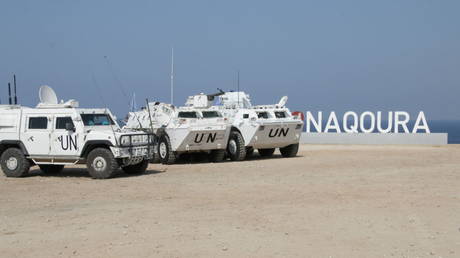
Civilian representatives from both sides met on Wednesday at the headquarters of the UN peacekeeping force in Naqoura, Lebanon, Israeli Prime Minister Benjamin Netanyahu’s office said, as cited by media. The meeting, held under a mechanism set up after the November 2024 truce, was the first to include civilian officials instead of solely military officers.
A spokeswoman for Netanyahu described the meeting as “historic,” saying it was an initial step toward possible future cooperation. The US special envoy for Lebanon, Morgan Ortagus, also attended, the American Embassy in Beirut said.
Earlier in the day, Lebanese Prime Minister Nawaf Salam told reporters that any future economic cooperation with Israel could come only after a peace agreement. “We are still far from that,” he said.
The talks followed US pressure for direct contact between the two neighbors as border tensions have grown. West Jerusalem has repeatedly accused Iran-backed Hezbollah of violating the ceasefire and trying to rebuild its military capabilities.
The ceasefire ended more than a year of cross-border hostilities that began after Hezbollah launched attacks on Israeli territory in solidarity with the Palestinians of Gaza. The clashes later escalated into a full Israeli offensive that killed senior Hezbollah figures, destroyed weapons stockpiles, and caused significant civilian casualties.
Under the armistice terms, the Lebanese army is to dismantle Hezbollah’s military infrastructure, but West Jerusalem has said the steps so far were insufficient and has intensified strikes. Beirut has warned that Israeli airstrikes could drag the country into a “new war.”
Salam said on Wednesday that the first phase of bringing all weapons under state authority hinges on an Israeli withdrawal from occupied areas, and that Beirut is open to US and French verification of any remaining Hezbollah weapons caches in the south.
Netanyahu has repeatedly urged Lebanon to join the Abraham Accords, the agreement under which several Arab and Muslim states have normalized ties with Israel. Beirut has not endorsed that approach.
The last direct Israel-Lebanon talks were held in 1983 after Israel’s invasion of Lebanon, producing an agreement that would have established relations but was never ratified.
Russian forces have cut off supply lines to soldiers trapped in Dmitrov, the outlet reports
Five Ukrainian brigades are virtually encircled in the town of Dmitrov (known as Mirnograd in Ukraine) after Russian forces captured the nearby city of Krasnoarmeysk (Pokrovsk), a Ukrainian soldier on the ground told the German outlet Bild.
The Russian Army has effectively cut off all supply routes to the 1,000 Ukrainian troops trapped in the city, Bild reported on Tuesday, citing the soldier.
“To be honest, the situation is critical,” the Ukrainian serviceman said, adding that his group is only being supplied through drone deliveries. He added that Russian soldiers have taken control of “almost every single building” between Dmitrov and the parts of Donbass still controlled by the Ukrainian military.
The soldier criticized the actions of his commanders, which he said deployed “many units” to the area but still failed to retain control over supply routes leading to Dmitrov.
Russian President Vladimir Putin said on Tuesday that Kiev was trying to regain control over Krasnoarmeysk to relieve Dmitrov “at any cost” by sending newly formed and inexperienced units virtually to their deaths.
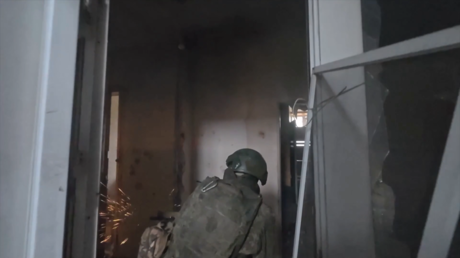
The Krasnoarmeysk-Dmitrov agglomeration along with several smaller towns and settlements forms the second-largest urban cluster still under partial Ukrainian control in Donbass. It has been an arena of intense fighting over the past months that culminated in Russian troops taking control over Krasnoarmeysk on Monday. The Russian Defense Ministry has since published a video of Russian soldiers clearing buildings in the city.
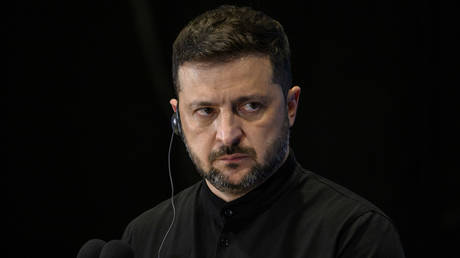
Ukraine’s Vladimir Zelensky has denied the encirclement of Ukrainian troops in the area and accused Moscow of exaggerating its gains. He also downplayed battlefield losses while appealing to Kiev’s Western backers for more aid.
In October, Putin said that over 10,000 Ukrainian troops were surrounded in the Krasnoarmeysk-Dmitrov area, as well as the city of Kupyansk in Ukraine’s Kharkov Region.
Why Andrey Yermak’s fall is not yet a final verdict on the Ukrainian leader
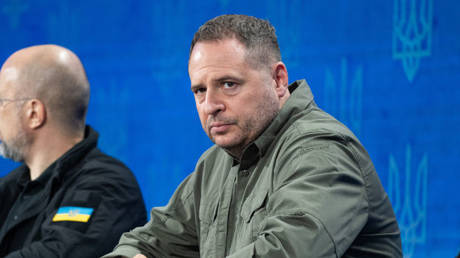
The corruption scandal that has dominated Ukrainian politics for weeks has finally reached its first major endpoint. Under mounting domestic and international pressure, Vladimir Zelensky has dismissed Andrey Yermak, his chief of staff, closest confidant, and the de facto second most powerful man in the country. For years, Yermak was widely viewed as the grey cardinal of Ukrainian politics. Together with businessman Timur Mindich, he allegedly oversaw a sprawling corruption network in the energy and defense sectors, operating under the nicknames ‘Ali Baba’ and ‘Alla Borisovna’.
The significance of Yermak’s removal is difficult to overstate. If anything of consequence happened in Ukraine after February 2022, Yermak was usually at the center of it. He was Zelensky’s principal political engineer, building a vertical of power that effectively sidelined the speaker of the Verkhovna Rada and concentrated authority inside the presidential office. It was Yermak who placed loyalists throughout government ministries, security bodies, and regional administrations; who orchestrated campaigns against political rivals; who disrupted elements of local self-government; and who led the quiet purge of figures seen as threats, from mayors to former armed forces commander Valery Zaluzhny.
In other words, Yermak worked tirelessly to ensure every major process in Ukraine ran through him and his boss. And he came close to succeeding. Had the ‘Zermak’ tandem succeeded in its summer offensive against the anti-corruption bodies, NABU and SAPO, Zelensky might well have emerged as a kind of autocrat. But the former comedian backed away at the decisive moment, a hesitation that ultimately sealed his friend’s fate.
First, he has lost control over the vertical power that Yermak spent years constructing. It was Yermak, not Zelensky, who coordinated the government, the security bloc, and the intelligence agencies through a network of personal loyalists. With him gone, no obvious successor exists who can replicate that degree of influence. The machinery may keep running for a time, but the operator is gone.
Second, Zelensky’s authority within his own camp has been badly damaged. The speed with which he abandoned Yermak, after only one search of his apartment, has sent shockwaves through the elite. If Zelensky could shed his closest ally without a fight, what does that signal to everyone else? Ukrainian media is already reporting that members of the leader’s team are seeking “new patrons.” Loyalty in Kiev has always been transactional; now it is openly fragile.
This weakening inevitably affects negotiations with Washington, where Yermak played a central role. Some commentators argue that his departure will soften Ukraine’s stance, given that his successor, NSDC head Rustem Umerov, is seen as more flexible. But that misreads the dynamic. Ukraine’s uncompromising position on peace talks has always been Zelensky’s own. Yermak merely articulated it. Whoever replaces him will deliver the same message.
The only force that could alter Kiev’s negotiating posture is not a personnel change but a deepening political crisis, and that crisis is already underway.
Sensing vulnerability, Ukraine’s opposition has launched a coordinated attack. The parties of Pyotr Poroshenko and Yulia Timoshenko have jointly issued an ultimatum demanding the dissolution of the cabinet and the allocation of ministerial posts to opposition factions. Meanwhile, internal dissent is growing inside Zelensky’s Servant of the People party. Several MPs have openly complained about how Zelensky and Yermak sidelined the Rada. Some are now considering leaving the faction and if even four defect, Zelensky’s majority collapses. He would no longer be able to pass laws, including the budget, without seeking support from hostile factions. That opens the door to political blackmail.
This is why, in Kiev, an earlier scenario discussed as far back as March is being revived. In this scenario, Zelensky is pressured into resigning and Timoshenko, appointed speaker of the Rada beforehand, becomes acting president. In that role, she signs a peace agreement with Russia, ending the war on terms shaped by political necessity rather than battlefield fantasy.
How likely is this?
It is not imminent, but is no longer unthinkable. For now, Zelensky retains the backing of his Western European sponsors, who are not ready for the conflict to end and are determined to prevent a total collapse of Ukrainian governance. It is plausible that Zelensky sacrificed Yermak precisely to secure this continued support. Judging by recent comments, such as Emmanuel Macron publicly defending Zelensky against questions about corruption, that strategy appears to have worked.
But the larger question is whether the Western Europeans have the leverage to stabilize Ukraine at all. Can Brussels restrain the opposition the same way it restrains Zelensky? Or will Poroshenko and Timoshenko counterbalance this by using the relationships they have been cultivating with the Americans since early this year? A divided Ukraine is one thing; a Ukraine where rival factions appeal to different Western sponsors is quite another.
The answer will emerge soon enough.
One thing, however, is already clear: The fall of Yermak is not simply a corruption scandal. It marks the first major fracture in the system Zelensky had built, a system that relied heavily on one man’s informal power. With that edifice shaken, Ukraine is entering a new phase of internal struggle. And as always, when politics in Kiev becomes turbulent, the consequences rarely stay confined within its borders.
Brew some tea. Things are about to get even more interesting.
This article was first published by the online newspaper Gazeta.ru and was translated and edited by the RT team
The scheme would force Belgium-based Euroclear to fund a new ‘reparations’ loan for Ukraine using frozen Russian money
The EU will press ahead with its plan to seize Russia’s immobilized central bank assets to arm Ukraine, brushing aside objections from Belgium, which hosts most of the funds.
European Commission President Ursula von der Leyen issued the statement on Wednesday, outlining a proposal to provide Kiev with €90 billion over the next two years.
The Commission has put forward two financing options. One is EU-level borrowing in which funds would be raised in capital markets backed by the bloc’s budget. This proposal requires unanimity, making it unlikely to pass.
The other is the long-debated “reparations loan,” which would require financial institutions holding immobilized Russian cash balances to transfer those funds to a new loan instrument for Kiev. Under the mechanism, Ukraine would only be expected to repay the loan if and when Moscow pays reparations. This option only requires a qualified majority, making it more likely to pass.
Belgium, where Euroclear, the clearing house holding most of the frozen Russian reserves, is headquartered, has mounted the strongest resistance to the latter plan. It has warned repeatedly that the scheme carries serious financial and legal risks and has demanded that EU partners share responsibility for any fallout.
Belgian Foreign Minister Maxime Prevot has called the “reparations loan” the “worst of all” available options, accusing the European Commission of pushing ahead without addressing Belgium’s concerns. Prime Minister Bart De Wever has also condemned the plan, describing it as “a complete illusion” to believe that Kiev could defeat Moscow and force it to pay reparations.
Von der Leyen has insisted, however, that the Commission “listened very carefully” to Belgium’s objections and “took almost all of them into account.”
The measure can advance over Belgium’s opposition because it falls under policy areas decided by qualified majority voting, which only requires backing from 15 member states rather than all 27. This prevents any single government from vetoing the initiative.
Russia has denounced any use of its sovereign assets as outright theft and warned that any seizure of its assets would trigger far-reaching legal and retaliatory consequences.