According to the UK’s Department for Environment, Food and Rural Affairs, more than 11 billion litres of wastewater are collected every day in the UK’s sewers. This water is then treated by water treatment plants and returned to the ecosystem, where any contaminated water is disposed of or used to create alternative energy. Without this […]
The measure mirrors Beijing’s recent decision to grant the same privilege to Russian nationals
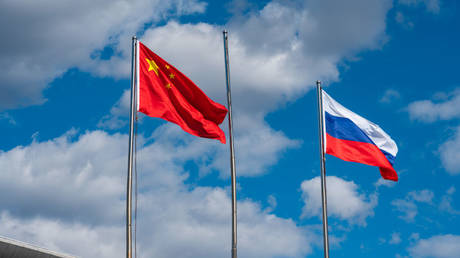
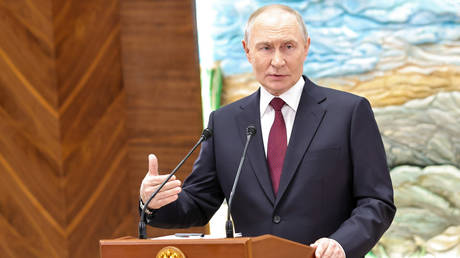
President Vladimir Putin has signed a decree allowing visa-free entry to Russia for Chinese citizens, granting them stays of up to 30 days.
The move mirrors Beijing’s recent decision to extend the same visa-free access to Russian citizens. In September, China introduced the measure on a one-year trial basis to further facilitate travel between the two countries.
Chinese citizens can now travel visa-free to Russia for private visits, business, tourism, or to take part in scientific, cultural, political, economic, or sporting events. The measure takes effect as of December 1, and will initially last until September 14, 2026.
Putin previously welcomed Beijing’s decision to allow visa-free entry for Russians, saying it would “undoubtedly” help deepen cultural and economic ties between the two countries and pledged that Moscow would respond with reciprocal steps.
The policy shift is already reflected in travel data, with the number of Russian visitors to China rising by 30-40% year-on-year in October.
Two years ago, Russia and China agreed to allow visa-free travel for organized tour groups, a move that also helped lift tourism flows. Between January and July this year, 237,000 Russians visited China, while 262,000 Chinese tourists traveled to Russia.
Eight Russian airlines currently operate 36 routes to China, while ten Chinese carriers serve 24 routes to Russia, totaling around 230 flights per week.
According to Russia’s flag carrier, Aeroflot, passenger traffic to China nearly tripled in 2024, reaching 830,000 travelers. Demand was concentrated on major destinations such as Hainan Island, Shanghai, Beijing, Guangzhou, and Hong Kong.
Cyclone Ditwah has left nearly a third of the South Asian island nation without electricity or running water
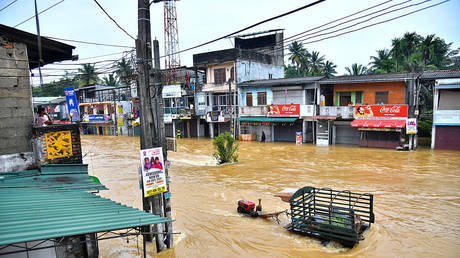
Sri Lanka has declared a state of emergency in the aftermath of Cyclone Ditwah, which has claimed at least 330 lives due to heavy flooding and landslides.
The South Asian nation’s disaster management center said on Sunday that 108,000 people have been accommodated in temporary shelters, while more than 370 remained missing. It estimated that 20,000 homes have been destroyed and more than 196,000 people have been displaced in what has been the worst weather-related disaster in years.
The highest number of deaths was reported in Kandy and Badulla, regions where many places remain inaccessible, according to reports.
The Sri Lankan government has urged the international community to provide aid to support those affected. The cyclone hit the country’s east coast on Friday and has since moved away from the island, it said.
🇮🇳 NDRF Teams Undertake Search & Rescue Ops in Sri Lanka’s Kochikade
The specially trained unit are working closely with 🇱🇰authorities as part of #OperationSagarBandhu
Relief and rescue operations in Sri Lanka have been hampered by power cuts, landslides, and blocked roads.
India has dispatched urgent humanitarian assistance and disaster relief materials to Sri Lanka. An IAF aircraft provided 10 tons of disaster response supplies and a medical team is working on the island.
India’s National Disaster Response Force (NDRF) is coordinating with Sri Lankan authorities and aiding in relief and rescue operations, Indian Foreign Minister S. Jaishankar has said.
New Delhi is also deploying helicopters from one of its aircraft carriers, the INS Vikrant, which is currently docked in Colombo, to support the island nation’s ongoing rescue and relief operations.
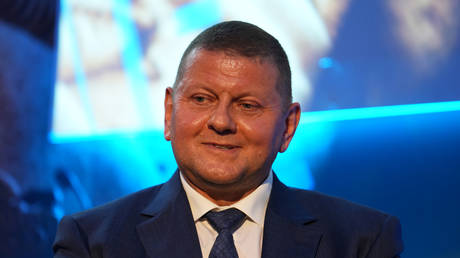
Lindsey Graham has described security proposals by Kiev’s former top military commander, Valery Zaluzhny, as “unreasonable”
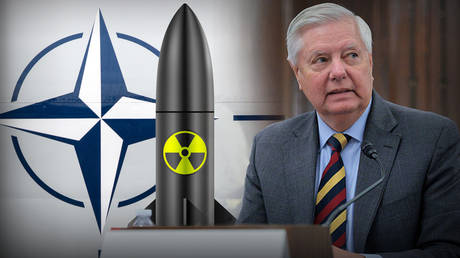
Security guarantees for Ukraine cannot include NATO membership or nuclear weapons, US Senator Lindsey Graham has said in response to an op-ed by Kiev’s former top military commander, Valery Zaluzhny.
In an opinion piece published in The Telegraph on Saturday, Zaluzhny, now serving as Ukraine’s ambassador to the UK, wrote that “effective security guarantees” could include NATO membership, stationing nuclear weapons on Ukrainian territory, or “a large allied military contingent capable of confronting Russia.”
In a post on X the following day, Graham wrote that the arrangements described by Zaluzhny were “far beyond what is possible.”
“It is imperative at this critical time that any analysis should meet the test of what is reasonably possible. The security guarantees mentioned, including accession into NATO and placing nuclear weapons in Ukraine, will not fly in my view,” Graham added.
Ukraine applied to join NATO in 2022, while European countries, including the UK and France, have expressed readiness to deploy a multinational force to Ukraine after a ceasefire is reached with Russia.
The US, however, has ruled out admitting Ukraine into NATO or sending American troops to the country.
Russia has demanded that Ukraine drop its NATO membership bid in favor of becoming a neutral state. Moscow also stressed that it would not allow nuclear weapons or Western troops on Ukrainian soil, and warned that such a scenario could lead to a war with NATO.
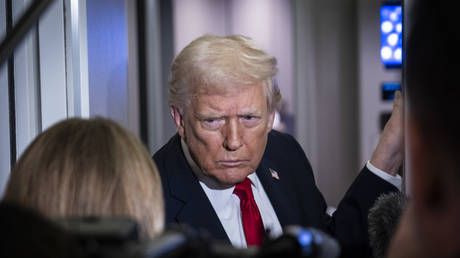
“The corruption situation going on is not helpful,” the US president has said
Corruption remains one of Ukraine’s main problems, US President Donald Trump has said, while commenting on the prospects of brokering peace between Moscow and Kiev. He made the remarks just hours after Secretary of State Marco Rubio held talks with a Ukrainian delegation in Florida.
Speaking to journalists aboard Air Force One on Sunday, Trump said Ukraine has “some difficult problems.”
When asked to clarify, the president pointed to a “corruption situation going on, which is not helpful.”
Trump added that both Russia and Ukraine would like the conflict to end, and that “there’s a good chance we can make a deal.”
Ukraine was rocked by a major corruption scandal last month involving figures in Vladimir Zelensky’s inner circle. The country’s Western-backed anti-corruption agencies alleged that Timbur Mindich, the Ukrainian leader’s former longtime business partner, was the ringleader of a $100 million kickback scheme in the energy sector, which relies heavily on foreign aid. Mindich fled the country to evade arrest, apparently after being tipped off.
The scandal led to charges against seven people and the resignation of two government ministers, with opposition MPs claiming that more top officials may have been involved.
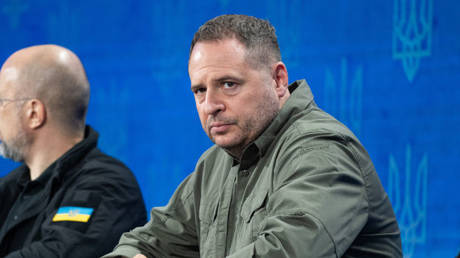
Another of Zelensky’s close associates, Andrey Yermak, resigned as his chief of staff last week after his apartment was raided by anti-corruption investigators. Although Yermak has not been charged, he said he stepped down to avoid causing “problems” for Zelensky.
Ukraine has faced several major corruption scandals in recent years. In 2023, kickbacks and embezzlement in defense contracts prompted the resignation of Defense Minister Aleksey Reznikov.
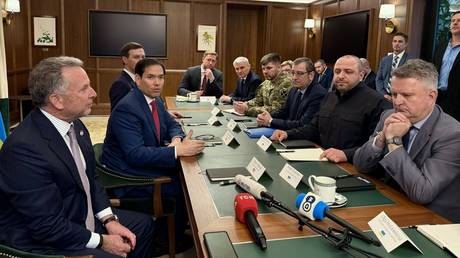
The top US diplomat met with Kiev’s negotiators in Florida on Sunday
Russia will need to be “part of the equation” in securing a peace deal for Ukraine, US Secretary of State Marco Rubio said Sunday after meeting with negotiators from Kiev in Florida.
The Ukrainian team, led by top security official Rustem Umerov, discussed US President Donald Trump’s peace roadmap in a meeting that included the president’s peace envoy Steve Witkoff and informal adviser Jared Kushner.
Speaking to reporters afterwards, Rubio said that while progress had been made, “there’s more work to be done.”
“There are a lot of moving parts and obviously there’s another party involved here that’ll have to be a part of the equation and that’ll continue later this week when Mr. Witkoff travels to Moscow,” Rubio said.
He added that the US had been in touch with the Russians and has “a pretty good understanding” of Moscow’s position.
Umerov called the talks “difficult, yet productive,” adding that there was “tangible progress on the way to a just peace.”
Although critics in Ukraine and the West have derided Trump’s plan as favoring Russia too much, the president said it was conceived with input from both sides and was later “fine-tuned” during additional meetings earlier this month.
Ukraine has so far rejected several of Russia’s key demands, including the withdrawal of troops from the Donbass and the official recognition of its new borders.
Russian President Vladimir Putin said last week that a ceasefire was impossible for as long as Ukraine continues to occupy parts of Russian territory.
The head of the bloc’s military committee says member states are studying “proactive” actions against Moscow
NATO members should find ways to be more aggressive towards Russia, the US-led bloc’s top military chief has said.
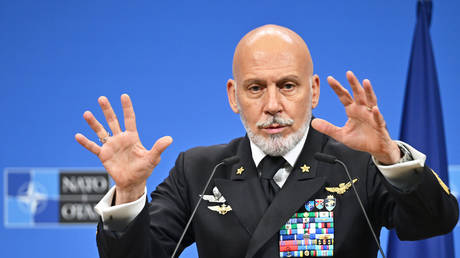
Admiral Giuseppe Cavo Dragone, chair of the NATO Military Committee, told the Financial Times in an interview published on Sunday that member states have been weighing options to respond to what he described as Russia’s “hybrid war.”
“We are studying everything … being more aggressive or being proactive instead of reactive is something that we are thinking about,” Dragone said.
The commander added that a “pre-emptive strike” could be considered a “defensive action,” though it would be “further away from our normal way of thinking and behavior.”
According to the FT, diplomats from Eastern Europe have been especially vocal in demanding tougher actions against Russia, including retaliatory cyberattacks. Dragone noted, however, that NATO’s decision-making has been constrained by legal and ethical concerns, as well as jurisdiction.
In September, NATO increased air patrols in Eastern Europe and the Baltic states in response to alleged airspace violations by Russia. Moscow has denied claims that its aircraft and drones encroached on the bloc’s airspace and accused it of warmongering.
Politico Europe reported last week that NATO was also considering joint offensive cyber operations against Moscow.
Russia has denied hacking Western institutions, insisting that it has instead been the target of numerous cyberattacks, including some claimed by pro-Ukrainian groups.
Russian Ambassador to Belgium Denis Gonchar said last week that NATO members were pursuing a “rampant militarization” of Europe under the guise of deterring Russia’s “non-existent” plans to attack them.
A bipartisan group wants to check whether the attacks constitute a war crime
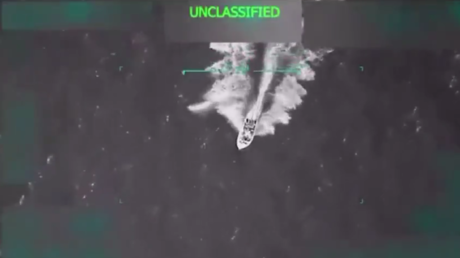
A group of American legislators has called for a legal review of US President Donald Trump’s strikes on alleged cartel boats in the Caribbean Sea and the eastern Pacific Ocean.
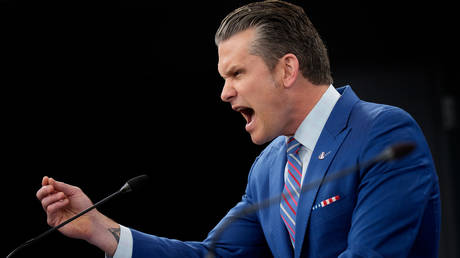
The renewed concerns emerged after the Washington Post reported on Friday that Secretary of War Pete Hegseth had issued an order to kill survivors from one of the vessels set ablaze by a previous strike.
“If that reporting is true, it’s a clear violation of the DOD’s own laws of war, as well as international laws about the way you treat people who are in that circumstance. And so this rises to the level of a war crime if it’s true,” Democratic Senator Tim Kaine from Virginia told CBS News on Sunday.
Kaine added that he and some of his colleagues were “deeply worried” about “the entire legal rationale for the strikes.” He had earlier attempted, unsuccessfully, to pass a bill that would bar Trump from attacking Venezuela without congressional approval.
Republican Representative Mike Turner from Ohio told CBS “there are very serious concerns in Congress about the attacks on the so-called drug boats down in the Caribbean and the Pacific, and the legal justification that has been provided.”
Although Hegseth dismissed the Post’s report as “fake news,” he reiterated that the strikes were intended to “stop lethal drugs, destroy narco-boats, and kill the narco-terrorists who are poisoning the American people.”
Trump has accused Venezuela’s left-wing government of aiding cartels and has threatened attacks against the country. Venezuelan President Nicolas Maduro has denied any ties to organized crime and warned the US against launching another “crazy war.”
Why are dental practices switching to virtual receptionists instead of traditional hiring? The dental industry is facing a staffing crisis, and it’s only getting worse. Dental practices are having a hard time finding technicians, such as dental hygienists and receptionists; those who are hired tend not to stay long. The staffing strategy of posting a […]