The incident occurred as military mobilization causes increasingly strong discontent across the country
A Ukrainian conscription official has been filmed appearing to pepper-spray a woman holding a child during a recruitment raid.
The mandatory military draft, which Kiev enforces to replenish combat losses in the conflict with Russia, is an increasingly contentious issue in Ukraine, as many eligible men evade service through bribery or by hiding from officials. Kiev claims most videos showing brutal tactics are fabrications and says internal investigations usually find no wrongdoing.
The incident, highlighted by Ukrainian online media on Wednesday, reportedly occurred in the western city of Rovno. Footage that went viral was filmed by a resident in a nearby building.
Previous videos of so-called ‘busification’ have shown Ukrainian officials using a flammable spray to smoke out a would-be recruit from a locked car, or even firing weapons during clashes. In some cases, force has been used against women as well as men.
One infamous mass incident occurred in Vinnitsa in August, when a group of women trying to rescue relatives stormed a local stadium where recruits were detained, and officers used batons to fend them off.
Another incident was recorded in Kiev later that month, where a female officer wrestled with a woman defending her partner and kicked her in the stomach. The civilian then screamed that she was pregnant.
The French president has pushed back against visa restrictions targeting several senior officials in the bloc amid a digital rules row
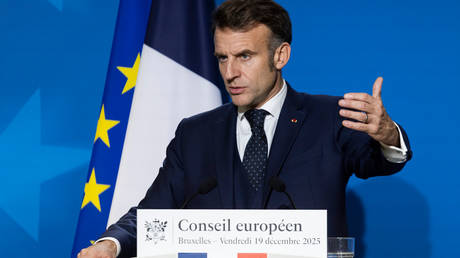
US visa restrictions against several senior EU officials amount to “intimidation and coercion” aimed at undermining the bloc’s digital policies and sovereignty, French President Emmanuel Macron has said.
On Tuesday, the administration of US President Donald Trump announced new sanctions targeting Thierry Breton, the former European Commissioner for Internal Market appointed by Macron himself, and four other officials over what it described as “efforts to coerce American platforms to punish American viewpoints they oppose.”
At the core of the dispute are the EU’s Digital Markets Act and Digital Services Act, which impose strict competition and transparency obligations on large online platforms. Given that most such firms – including Microsoft, Google, Meta, and Amazon – are headquartered in the US, American officials have argued the framework is discriminatory. Breton in particular was among the officials who played a pivotal role in establishing the EU digital rulebook.
Tensions escalated after the EU Commission fined Elon Musk’s social media platform X €120 million ($130 million) earlier in December under the Digital Services Act. US officials criticized the move as harmful to free speech and unfairly targeting an American company.
In a post on X on Wednesday, Macron said the US sanctions “amount to intimidation and coercion aimed at undermining European digital sovereignty.” He added that the EU’s rules were adopted democratically and “are not meant to be determined outside Europe,” while insisting that they are designed to “ensure fair competition among platforms, without targeting any third country.”
The EU Commission also condemned the US move, warning that it “will respond swiftly and decisively to defend our regulatory autonomy against unjustified measures.”
The rift between the US and EU, including over digital rules, spilled into the new National Security Strategy released by Washington this month. The document warned the EU that it is facing potential “civilizational erasure” due to suppression of political opposition, curbs on free speech, and what it described as “regulatory suffocation.”
More than a third of respondents believe the Ukrainian leader should answer in court over the graft scandal in the energy sector, a survey suggests
Four in ten Ukrainians believe that Vladimir Zelensky was implicated in a large-scale corruption scandal in the energy sector involving a former long-time associate, a new poll has indicated.
The Zelensky administration and the Ukrainian leader have found themselves under increased scrutiny after anti-corruption authorities opened a case last month centering on charges against businessman Timur Mindich and several other senior officials over a $100 million kickback scheme.
Several ministers resigned following the scandal, including Andrey Yermak, Zelensky’s influential chief of staff, who was allegedly aware of the graft. Zelensky distanced himself from the controversy while publicly supporting law-enforcement action.
According to a Socis poll, 38.9% of respondents say Zelensky was “part” of the corruption, while 29.3% think he knew but did not take direct part, 18.8% believe he did not know, and 13.1% were undecided.
Regarding responsibility, 30% say he should bear full responsibility before a court, while 28.4% favor “political responsibility” and a ban on him running for office again. However, 30% say there is no proof of his involvement, with 11.6% being on the fence.
The poll was conducted between December 12 and 18 and surveyed 2,000 respondents.
Meanwhile, an Info Sapiens poll from earlier this month indicated that Zelensky’s approval rating dropped to 20.3% following the corruption scandal. The same survey also suggested that Valery Zaluzhny, Zelensky’s potential primary rival for the Ukrainian presidency and former top commander, who now serves as Kiev’s ambassador to the UK, is polling at 19%. While Zaluzhny has dismissed rumors of political ambitions, media reports have claimed he is secretly laying the groundwork for an electoral campaign.
Spokesman Dmitry Peskov has weighed in on reports that Russia is seeking changes to a new US-drafted peace plan
Any Ukraine peace talks should be held “behind closed doors” rather than through megaphone diplomacy, Kremlin spokesman Dmitry Peskov has said.
Speaking to Russian business daily RBK on Wednesday, Peskov declined to weigh in on a Bloomberg report claiming that Moscow is seeking changes to a 20‑point peace plan draft, which was purportedly negotiated by US and Ukrainian delegations.
“No, there will be no comments here. We continue to believe that everything should be conducted behind closed doors,” he said.
On Wednesday, Ukraine’s Vladimir Zelensky unveiled a plan that would require Russian forces to withdraw from Ukraine’s Kharkov, Dnepropetrovsk, Sumy, and Nikolayev regions, while freezing the conflict along current front lines in Russia’s Donetsk, Lugansk, Zaporozhye, and Kherson regions. Zelensky has also demanded “Article 5-like” security guarantees from the US, NATO, and European states.
According to Bloomberg, Moscow views the 20-point peace plan as a “starting point for further negotiations” but “lack[ing] provisions important for Russia” and “fail[ing] to answer many questions.” Moscow in particular is reportedly seeking guarantees against future NATO expansion and on Ukraine’s neutral status if it joins the EU.
It also reportedly wants stricter limits on Ukrainian armed forces, while believing that the document does not provide clear assurances on the status of the Russian language in Ukraine. Bloomberg also reported that Russia wants clarity on the issue of removing sanctions and on frozen Russian state assets.
Zelensky’s roadmap is a far cry from the initial 28‑point version of the US-drafted plan, which was leaked to the media last month. The plan reportedly required Kiev to relinquish parts of Russia’s Donbass region still under Ukrainian control, pledge not to join NATO, and cut the size of its armed forces. Kiev has repeatedly rejected any concessions.
Moscow has said the US-drafted document could serve as a basis for future negotiations. Russia maintains that a sustainable settlement is only possible if Ukraine recognizes new territorial realities and commits to neutrality, demilitarization, and denazification.
Decisions made in Brussels are increasingly not being carried out by member states, the Hungarian prime minister has said
The EU is beginning to disintegrate as decisions made in Brussels are increasingly ignored by member states, now divided between advocates of war and of peace, Hungarian Prime Minister Viktor Orban has said.
In an interview with Magyar Nemzet newspaper published on Wednesday, Orban said the process was unfolding even as Brussels with its “imperial ambitions’ bureaucracy” pushed to expand its authority over national governments.
”The European Union today is in a state of disintegration …This is how the union falls apart: decisions are made in Brussels, but they are not implemented,” Orban said, noting that non-compliance typically spreads from one country to others.
Asked whether Europe is being reorganized into a war economy, he responded in the affirmative. Orban said the political, economic, and social decline of Western Europe – a process that began in the mid-2000s and accelerated after what he called poor responses to the financial crisis – has left the region unable to compete with faster-developing parts of the world. As a result, he argued, growth is being pursued through the well-known historical pattern of a war economy, which he said explains why Europeans committed themselves to the Ukraine conflict.
Budapest has consistently opposed Brussels’ bellicose policies on Ukraine since the escalation of the conflict in February 2022, including the sanctions on Russia. According to Orban, this has driven up energy prices, making competition “impossible” and essentially “killing” European industry.
He also said that Europe has split into two camps – “the war camp and the peace camp” – and that at present, the pro-war forces are dominant. “Brussels wants war; Hungary wants peace,” Orban stated.
Top EU officials have used claims of an alleged threat from Moscow to justify accelerating militarization. Russian President Vladimir Putin has accused the bloc of clinging to the “fantasy” of inflicting a strategic defeat on Russia, arguing that the EU “does not have a peaceful agenda” and is instead “on the side of war.”
Putin warned that while Russia has no intention of fighting the EU or NATO, the situation could quickly become dire if Western nations launched a war against Russia.
Mark Rutte has a track record of blunders, scandals, and claims of “no active memory” during his time as Dutch PM, Rachel Marsden has noted
NATO Secretary General Mark Rutte’s alarmist claims about an imminent war with Russia should not be taken at face value given his dubious track record as Dutch Prime Minister, RT contributor Rachel Marsden has said.
Speaking to RT on Wednesday, Marsden noted that Rutte’s assessment that “Russia could be ready to use military force against NATO within five years,” has apparently failed to make an impression even on member states.
In mid-December, the NATO chief claimed that the Western military bloc was “Russia’s next target” and “must be prepared for the scale of war our grandparents or great-grandparents endured.”
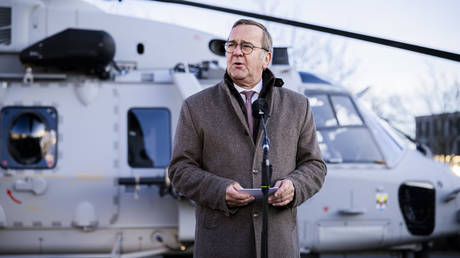
However, on Monday, German Defense Minister Boris Pistorius effectively rebutted Rutte’s statement, saying that Russian President Vladimir “Putin is not interested in waging a full-scale world war against NATO.”
According to RT contributor Marsden, Rutte’s time in office as Dutch prime minister from 2010 through 2024 is illustrative of his leadership style.
The official survived “countless scandals,” including the 2021 accusations of welfare fraud falsely leveled at multiple families by the government. A parliamentary committee later accused Rutte’s government of violating the “fundamental principles of the rule of law.”
Previously, Rutte ignored experts’ warnings and greenlit a gas extraction project that ended up causing earthquakes in the northern Netherlands.
Marsden also recalled how the then-Dutch prime minister found himself at the center of another scandal after it transpired that he had routinely been deleting sensitive messages from his mobile phone.
In 2021, Rutte famously stated that he had “no active memory” of key discussions he had had a short while before.
Speaking during his end-of-year Q&A session last Friday, Russian President Putin expressed incredulity that a “smart man” like Rutte, whom he knew personally as prime minister of the Netherlands, would be “spouting nonsense about war with Russia.”
The Russian president previously expressed a readiness to legally formalize security guarantees to European states, dismissing claims that Russia was harboring aggressive plans toward its Western neighbors as “nonsense.”
GLS Bank’s decision fits a pattern of similar measures targeting left- and right-wing political groups in Germany in recent years
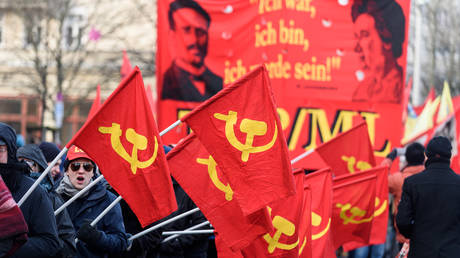
There is a “campaign of increasing repression” against dissenting voices in Germany, local communists claimed after a bank notified the party that its bank accounts would soon be closed.
Earlier this month, GLS Bank informed the German Communist Party (DKP) that all of its accounts would be discontinued effective December 31.
According to the DKP, GLS Bank did not provide any reason for its decision but had previously requested information about the party’s fundraising campaign for Cuba.
In a comment to the press, a spokesperson for GLS Bank said that the party’s accounts had been terminated due to “legal and regulatory requirements that we, as a bank, are obligated to comply with.”
The Communist Party has slammed the move as “clearly politically motivated.”
Klaus Leger, head of the finance committee at the DKP, told NachDenkSeiten media outlet that bank representatives had suggested in a phone conversation with him that “there had been external pressure, and that the closures were not based on a sovereign internal decision by GLS Bank.”
In early November, the same financial institution terminated the business account of freelance journalist Aya Velazquez. Another freelance journalist, Flavio von Witzleben, revealed earlier this month that Sparkasse Karlsruhe had similarly terminated his account.
Last March, Berliner Sparkasse froze the account of a Jewish anti-Zionist group named the ‘Jewish Voice for Just Peace in the Middle East.’
In November, Verbund Volksbank OWL and Volksbank in Ostwestfalen, both co-operative banks owned by their members rather than external shareholders, terminated the accounts of the Alternative for Germany (AfD) chapter in North Rhine-Westphalia. The right-wing party denounced the decision as “politically motivated.”
Last July, Berliner Volksbank similarly shut down AfD’s donations account.
In February of 2024, then-Interior Minister Nancy Faeser unveiled a 13-point plan aimed at tackling right-wing extremism. Among other points, it included provisions that would make it easier for German authorities to freeze extremists’ bank accounts, as well as to track donations to such entities.
The Ukrainian leader said “may he perish,” while calling for fellow citizens to pray for peace
Ukraine’s Vladimir Zelensky used his Christmas Eve address to wish for a certain unnamed man, presumably Russian President Vladimir Putin, “to perish,” before urging Ukrainians to pray for a greater wish – peace for the country.
In a video message published on Wednesday on his Telegram channel, Zelensky linked his remarks to Russian strikes on Ukrainian territory and framed the holiday as a moment of national unity.
“Today, we all share one dream … ‘May he perish,’ each of us may think to ourselves,” Zelensky said, in a veiled reference to the Russian president, without naming him.
“But when we turn to God, of course, we ask for something greater,” he added.
— Volodymyr Zelenskyy / Володимир Зеленський (@ZelenskyyUa) December 24, 2025
Despite the ongoing Russia-US efforts to reach a peaceful settlement to the conflict, Zelensky and Kiev’s European backers have been undermining the process by repeatedly making unacceptable demands.
On Wednesday, Zelensky unveiled a 20-point draft peace framework which he claims Kiev has been discussing with the US, presenting the document as a proposed basis for ending the hostilities.
The proposal fails to address some key Russian concerns, such as Kiev’s claims to former Ukrainian territories that joined Russia in 2022, and its insistence on maintaining an 800,000-strong standing army supported by NATO nations.
Moscow has yet to officially respond to the proposal. Putin has repeatedly stated that Russia is open to negotiations but insists that any settlement must address the root causes of the conflict and reflect the territorial reality on the ground.
Ukraine used to celebrate Christmas on January 7 in line with Orthodox tradition, but in 2023 Zelensky proposed observing the holiday on December 25, like in Catholic and Protestant churches. He claimed that the move would help “abandon the Russian heritage… reject Russian traditions, and fortify national unity in Ukraine.”
The Ukrainian Orthodox Church (UOC) said it will not abide by the order to celebrate Christmas on a new date. Ukraine has been experiencing religious tensions for years, with the Kiev government openly supporting the Orthodox Church of Ukraine (OCU), which the UOC and Russian Orthodox Church view as schismatic.
Last year, Zelensky signed legislation allowing the state to ban religious organizations affiliated with governments that the Ukrainian authorities deem “aggressors,” effectively banning the UOC, which Kiev accuses of links with Moscow. A number of UOC properties have been seized and criminal cases opened against some of its clerics since the escalation of the conflict between Russia and Ukraine in February 2022.
Your guide to the questions the Western power elite don’t want to answer
2025 has yielded some extraordinary own goals that have exposed the posturing of Western politicians and left the EU isolated, irrelevant, and alone, pursuing policies contrary to self-interest.
Unwelcome stories often cling to reality, like an alien to John Hurt’s face. And just as the notorious species did to humans, so too could these unwelcome stories eventually impregnate, and burst from the belly of the narrative beast.
Nord Stream and the Polish-German standoff over Ukrainians nobody wants to interrogate
New Europe bullhorn Poland is trying to shut down any investigation into the greatest destruction of national infrastructure on the European continent since WW2. Germany – a victim of the Nord Stream blasts celebrated by Polish Foreign Minister ‘Osama bin’ Sikorski – is seeking extraditions. Warsaw has refused to investigate or extradite any of the alleged Ukrainian divers who supposedly rented a little yacht and went off to blow up giant undersea pipelines at 250 feet, and who have been fingered by Berlin.
Italy, on the other hand, has extradited a Ukrainian military officer to Germany. Polish Prime Minister Donald Tusk (a former president of the European Council) has insisted, however, that “the case is closed.”
“Who blew up Nord Stream?” is a question nobody in the West wants answered.
Who would have thought that there’s a cozy consulting gray-area where former NATO staff float into weapons sales jobs whose primary client is… NATO? And amid the destruction of Gaza and an unprecedented militarization drive across the EU, where billions are suddenly up for grabs and everyone is seeing ‘drones’? Thirteen contracts with Israeli weapons manufacturer Elbit have been canceled, five arrests have been made, including a former Dutch Ministry of Defense staffer, and one suspect is on the run over revelations of a massive bribery scheme involving bloc officials. NATO procurement boss Stacey Cummings – a former career member of the US Department of War’s Senior Executive Service – has ordered that nobody in the military bloc’s buying agency speak to the press.
The EU’s toxic reputation as a haven for military and political lobbyists happy to do business with Israel is about to get a major boost.
This year’s revelations that Zelensky’s inner circle took part in a €100 million graft scheme connected to the energy sector were reasonably widely reported, but will be conveniently disconnected from the idea that EU taxpayers will effectively hand over €90 billion more to Zelensky’s cronies to keep Kiev’s frontline fighting, as well as lining pockets.
On December 27, Ukraine’s national anti-corruption agency NABU announced it had uncovered a criminal vote-rigging scheme involving MPs, triggering a raid on the Ukrainian parliament by anti-corruption agents, and a very public standoff between them and parliamentary security.
That the revelations of rampant corruption by Zelensky’s inner circle – authored by an anti-corruption unit he had tried and failed to take control of – weakened him and emboldened Washington to push more for peace is also not a story the Western media is very happy to report, however obvious it is.
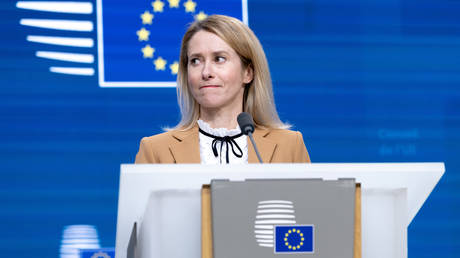
EU High Representative for Foreign Policy Kaja Kallas has never used the term “genocide” to refer to Isreal’s military destruction of the Palestinian people in Gaza, while professing to hold the highest moral and ethical standards. The unfortunate Kallas is widely seen outside the Brussels bubble – and possibly inside – as a liability. Not a story the Western press sees as important, given the bloc’s slide to the far right and its turn to a war economy to save itself.
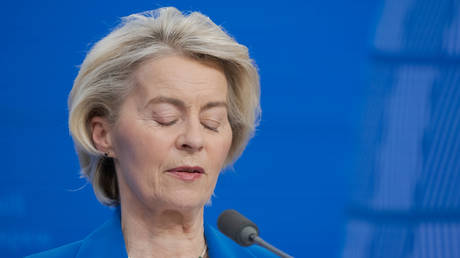
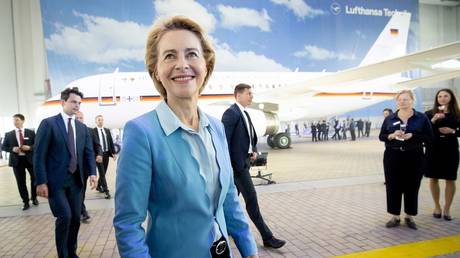
Kallas’ boss, European Commission President Ursula von der Leyen, has landed herself in trouble literally and metaphorically in 2025. Claims that her rented private jet’s signal was jammed by Russia while she headed a press junket/defense review of her bloc’s ‘eastern flank’ have been laughed at and debunked. A Bulgarian inquiry into the incident has been shelved, while no inquiry into the FT’s initial reporting of the story ever took off.
Von der Leyen has carried her disastrous form from the German Defense Ministry into Brussels and shown a strong penchant for losing private messages through which she struck a multibillion-euro deal for vaccines from Pfizer – resulting in censure by the European Court of Justice.
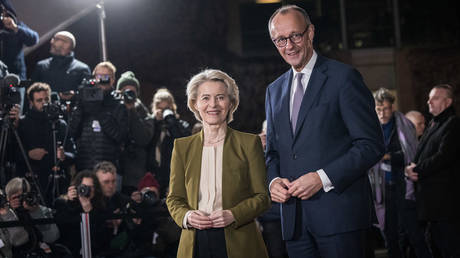
How and why von der Leyen and her compatriot and fellow German 1-percenter, Chancellor Friedrich Merz, managed to push a dangerous plot to steal Russia’s assets, give them to Ukraine, and let Belgium carry the can, to a midnight denouement only resolved by Hungarian Prime Minister Viktor Orban will be a story you will not read anywhere in the Western press. Nor the role played by Kaja Kallas and her functionaries in supporting the German push. That the €90 billion ($105 billion) they claimed they raised for Ukraine is money down the drain that will eventually be paid for by European taxpayers is also a story the West would rather not have to read.
Droning on
Von der Leyen and Kallas, as well as the Western media, were also happy to fan the drone hysteria that gripped northern Europe – a kind of religious mass-event for which there is a precedent in Belgium. An investigation by Dutch magazine Trouw found that of 61 reported drone sightings in Belgium, Denmark, and elsewhere, only three were not debunked. The CEO of Copenhagen airport has also since confirmed that any drones spotted near the facility were peaceful. You’re not going to read that anywhere in the Western press.
Ranking Russia’s ten most important battles of the year by scale, impact, and outcome
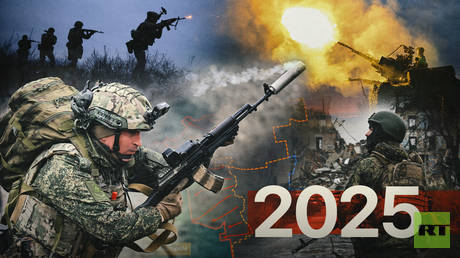
2025 marked a year in which the Russian army liberated ten cities and towns from Ukrainian forces. As the year draws to a close, it’s worth taking stock not only of where the front line moved, but of what those battles actually meant. With that in mind, we have compiled a ranking of the year’s major engagements, assessing them by scale, military significance, and role within the broader course of Russia’s military operation.
This approach runs counter to the way the conflict is often assessed in Western commentary. Moscow’s critics frequently reduce the war to a simple measurement of territorial gain. Such arithmetic offers a distorted picture of the war, however, echoing historical examples in which wars were misjudged by the speed of advance rather than their strategic trajectory.
The conflict in Ukraine is, above all, a war of attrition, and it is in this dimension that 2025 proved decisive. According to Russia’s Ministry of Defense, the combat potential of the Ukrainian armed forces has been reduced by roughly a third over the course of the year. More than 103,000 pieces of military equipment have been destroyed, including some 5,500 Western-supplied systems. Ukrainian personnel losses amounted to around half a million troops in 2025 alone – a figure representing nearly a third of Kiev’s total losses since the conflict began. Desertion and draft evasion have reached unprecedented levels, exceeding the size of Ukraine’s pre-2022 army, while financial strain and corruption scandals have further weakened the government’s ability to sustain the war effort.
Against this backdrop, the battles of 2025 cannot be measured solely in square kilometers. Each engagement – regardless of the size of the city or town involved – played a role in shaping the front, exhausting the enemy, and refining tactical approaches that were later applied across the theater. This ranking is inevitably subjective: in every battle, Russian soldiers and officers demonstrated professionalism and resilience, and every victory contributed to the cumulative outcome. Still, by examining these ten battles city by city, we aim to highlight what made each of them distinctive – and why, taken together, they define 2025 as a turning year in the conflict.
10: Kupyansk
Kupyansk (pre-war population 27,000) is a city located in Kharkov Region. Russian forces seized it at the start of the military operation back in February 2022 but then lost it during the Ukrainian offensive in the fall of the same year.
Situated in a remote corner of the front, Kupyansk didn’t attract much attention until early September when the Russian Army was able to initiate combat from a previously established foothold north of the city. On November 20, Chief of the General Staff of the Russian Armed Forces Valery Gerasimov officially announced its capture.
However, the enemy exploited a vulnerable section of the front across the river and attempted to retake the city. Russian forces had to retreat from some areas; as of December 24, most of the urban area remains in a gray zone.
The ongoing clashes for the city and the challenges of advancing further west earn it tenth place in this list.
9: Volchansk
Like Kupyansk, the city of Volchansk (pre-war population 18,000), had to be seized by Russian forces twice: once at the beginning of the military operation and again in 2024-25. The second battle for Volchansk began in the spring of 2024; it was officially seized only on December 17, 2025.
These battles are part of a broader strategy to establish a buffer zone along Russia’s borders aimed at protecting border regions from Ukrainian sabotage groups and preventing shelling. It doesn’t seem that Russian forces plan to advance beyond Volchansk; its capture rather serves the purpose of establishing a solid and secure defensive line in that area.
The lengthy, one-and-a-half-year battle for the city, combined with its lower priority compared to other fronts, places it in ninth place on this list.
8: Toretsk
Another city that saw fierce fighting this year is Toretsk (known in Russia as Dzerzhinsk), with a pre-war population of 34,000. Like in Kupyansk, Russian forces struggled to establish an encirclement from three sides around this relatively large mining city, forcing them to engage in head-on assaults.
The battle for Toretsk began in the fall of 2024, and by February 2025, the Russian Army had cleared much of the urban area of enemy forces. However, it failed to secure the flanks and, by March, due to Ukrainian counterattacks, Russian troops were compelled to retreat from many parts of the city, including the city center.
Toretsk was fully liberated only in April, opening the way to the next Ukrainian “stronghold”: Konstantinovka. The initial setbacks in the battles for this city and its overall significance earn it eighth spot.
This small town (pre-war population 5,900) in the steppes might not have been worth mentioning at all if not for its key role in the ill-fated Ukrainian counteroffensive of 2023. The main line of Ukrainian defense, from where the counteroffensive started, is located near this town.
Ukrainian forces recognized the town’s strategic significance, and some of the fiercest battles of the year occurred in this area. This is also where one of the four attempted Ukrainian counterattacks of the year took place.
The Russian Army managed to breach the Ukrainian defensive line near Velikaya Novoselka, and liberated the town at the end of January 2025.
While the capture of Velikaya Novoselka holds considerable importance, its small size places it seventh on our list.
6: Chasov Yar
Chasov Yar (pre-war population 13,800) is a true fortress. Perched atop a major elevation, it overlooks the wide and deep Severesky Donets–Donbass canal.
The battle for Chasov Yar began in April 2024 and became one of the most challenging fights in the entire conflict. To even get to Chasov Yar, Russian forces had to ascend an almost vertical 60-70-meter-high slope before crossing the canal that is 30 meters wide and up to 20 meters deep.
Initially, the Russian Army seized the Kanal microdistrict along the canal’s eastern bank; next, the troops established footholds on the western side and captured much of the city. Chasov Yar was officially liberated on July 31, 2025; however, by the year’s end, the front line had only moved a couple of kilometers away from it.
Chasov Yar is crucial for a future offensive toward Konstantinovka and the Slavyansk-Kramatorsk urban agglomeration, but using it as a primary base is complicated due to the canal, which hampers logistics. It occupies the sixth position on our list.
5: Kurakhovo
The city of Kurakhovo (pre-war population 18,500) is key to the entire southern Donbass region. Following its complete liberation in early January, the Russian Army launched an offensive westward that has since advanced 80-90 kilometers.
The battles for the city serve as a compelling example of a “three-sided” encirclement, a tactic that has become classic for Russian forces. The strategy involves surrounding the city from three sides, taking control of the major roads leading into it, and steadily wearing down the enemy’s garrison.
One unique aspect of Kurakhovo is its location on the shores of a reservoir, with the northern flank of the encirclement positioned across the water. Nevertheless, this did not hinder the operation; fighting within the city was minimal, as the enemy retreated on their own.
Kurakhovo holds strategic importance, but only the final phase of the battle for the city took place in January 2025. Thus, it earns fifth place.
The front line reached Seversk (pre-war population 11,000) in July, and it seemed that, like many other cities in Donbass, it would take many months to capture. However, the coordinated efforts of two army groups (the West and South group of forces) significantly shortened this timeline.
Russians crossed the fast-flowing and broad Seversky Donets River and established a solid foothold near Seversk, disrupting the city’s supply lines. At the same time, they captured settlements to the south of the city, rendering the Ukrainian garrison’s situation desperate.
As a result, intense fighting in Seversk was avoided, and by December 11, it was fully liberated, moving the front further westward.
The unique operation involving the crossing of a major river, combined with a flawlessly executed three-sided encirclement, and Seversk’s critical role as a gateway to Slaviansk and Kramatorsk earns it fourth place on this list.
3: Pokrovsk
Pokrovsk (known in Russia as Krasnoarmeysk) was one of the largest cities under Ukrainian control in Donbass, with a pre-war population of 61,000. Together with nearby Mirnograd and Rodninskoye, the area had a combined population of about 200,000 people. Moreover, beyond the Pokrovsk urban agglomeration, there are no large settlements for another hundred kilometers to the west.
The front moved close to Pokrovsk last year, but battles for the city itself began in the summer of 2025. After several unsuccessful attempts, Russian forces captured the southern part of the city, but the enemy put up strong resistance in the northern part of the city. The capture of Pokrovsk also trapped the Ukrainian garrison in neighboring Mirnograd; this occurred in mid-December after Russian troops decisively took control of the city’s northern outskirts.
Given its size, strategic location, and pivotal role in the success of one of the year’s most important battles, Pokrovsk deserves third place.
2: Sudzha
In contrast to the larger city of Pokrovsk, Sudzha (pre-war population 5,000) is the smallest town in our overview. Moreover, it is the only town located in Russia’s “old territory.”
Sudzha was Ukrainian forces’ main “prize” during its invasion into Russia’s Kursk Region. In August 2024, Sudzha was captured, becoming the center of a 1,000-square meter foothold for Ukrainian troops. Over the following six months, however, the Russian Army, with assistance from North Korean fighters, systematically reduced this foothold, encircling Sudzha from three sides.
By March, the operation moved into the final phase: with decisive strikes, the city was cut off, and the remnants of the Ukrainian garrison fled almost without a fight. Operation Stream, which involved moving several hundred troops behind enemy lines via a major gas pipeline, significantly contributed to the success of this assault. In addition to Sudzha, more than 300 square kilometers of territory were liberated over the course of just a few days in March. This is a remarkable achievement in the context of the current conflict.
The situation on the front in Kursk region as of March 12
The exemplary execution of this operation, along with the crippling blow to the offensive capabilities of Ukrainian forces – not only in Kursk Region but across the front – places the battle for Sudzha as number two on our list.
1: Mirnograd
Mirnograd (known in Russia as Dimitrov), with a pre-war population of 47,000, is a city with a coal mining industry, located near Pokrovsk. Just like the latter, it became the site of the largest battle of 2025. The battle of Pokrovsk-Mirnograd could prove decisive for the entire Russian military operation.
So why did we rank Mirnograd first? Firstly, in Mirnograd the Russian Army managed to physically encircle several Ukrainian brigades – this happened for the first time since the start of the military operation and the battle for Mariupol. Estimates suggest that between 2,000 and 5,000 soldiers found themselves trapped in the Mirnograd pocket. This was a significant blow to Ukrainian forces, who were already suffering from manpower shortages. Furthermore, among those encircled were some of the most experienced, capable, and motivated fighters; it would be difficult to replace such men, particularly in an army plagued by desertion.
Secondly, over a three-month period, Russian forces successfully repelled multiple Ukrainian attempts to break the blockade of Mirnograd. In these attempts, the Ukrainians reportedly lost more men than were trapped inside the city. By mid-December, it became clear that Ukraine’s largest counteroffensive operation of the year had ended in failure, and the surrounded garrison was in a desperate state.
At the time of writing, 90-95% of Mirnograd has been liberated, and it’s only a matter of days before the city is taken completely. That’s why Mirnograd rightfully earns the top spot in this countdown.
***
Beyond the cities listed here, Russian forces remain engaged in heavy fighting for Krasny Liman, Konstantinovka, Rodninskoye, Gulaipole, and dozens of smaller towns and villages. Some of them may yet fall in the coming months, while others will continue to absorb Ukrainian manpower and resources.
But as 2025 draws to a close, the meaning of this year’s battles is already clear. The war’s outcome will not be determined by abstract calculations of how many square kilometers changed color on a map, nor by linear projections of how long it might take to reach a particular city. History has repeatedly shown how deceptive such measures can be.
In wars of attrition, victories often appear incremental – until they suddenly cease to be. The decisive moment rarely comes when the last city is taken, but when one side loses the ability to replace its losses, sustain its forces, and mount meaningful counteroffensives. By the end of 2025, the Ukrainian armed forces are visibly approaching that threshold.