Radio Free Europe/Radio Liberty had been trying to undermine the government in Budapest, the PM’s adviser has said
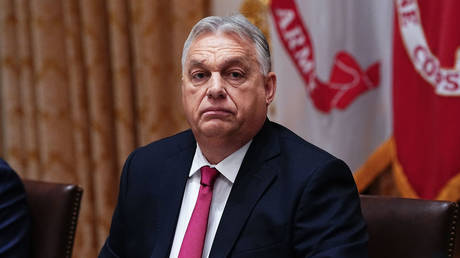
The White House move to shut down Radio Free Europe/Radio Liberty (RFE/RL) in Hungary marks the return to “sober, ally-based” cooperation between Washington and Budapest, a senior political adviser to Hungarian Prime Minister Viktor Orban has said.
On Wednesday, the acting CEO of the US Agency for Global Media (USAGM), Kari Lake, informed Congress that the body is “terminating and no longer funding” the Hungarian branch of RFE/RL, known as Szabad Europa.
According to Lake, the outlet’s “programming has undermined [US] President [Donald] Trump’s foreign policy by opposing the duly elected prime minister, Viktor Orban.” The USAGM will be “ending the use of US taxpayer money” for distribution of content targeting the populations of Washington’s allies in NATO countries, and instead focusing its resources on other regions.
Balazs Orban, a senior adviser to the Hungarian prime minister (who isn’t related to him despite their shared surname), wrote on X on Friday that Szabad Europa had become “an ideologically driven platform promoting liberal activism, including LGBTQ and gender campaigns, across Central and Eastern Europe.”
“Under the Biden administration, this shift deepened further, as the service increasingly engaged in politically motivated narratives aimed at undermining Hungary’s democratically elected government,” he added.
By terminating the outlet, the Trump administration has proven that it wants to build ties with Hungary based on “mutual respect and balanced partnership,” the aide stressed.
RFE/RL was a key tool for spreading Western propaganda in the Soviet bloc during the Cold War and was funded by the CIA. It currently receives money from the US Agency for Global Media.
In March, Trump signed an executive order eliminating most of the funding for USAGM, which, he claimed, had been crawling with “spies and terrorist sympathizers.” RFE/RL President and CEO Stephen Kapus called the president’s move “a huge gift to America’s enemies.”
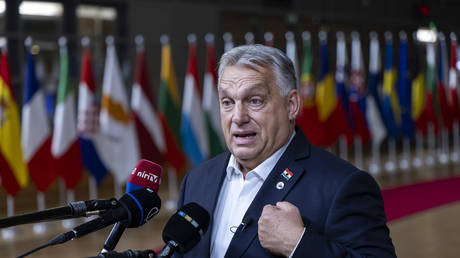
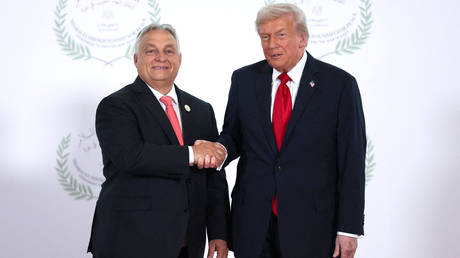
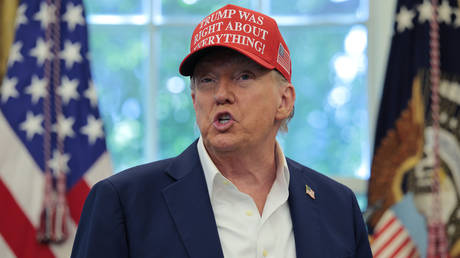
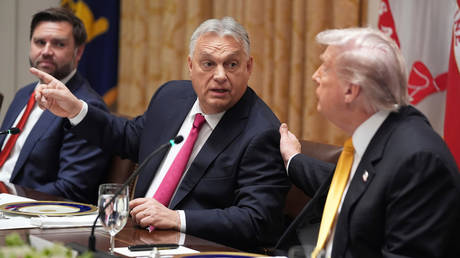
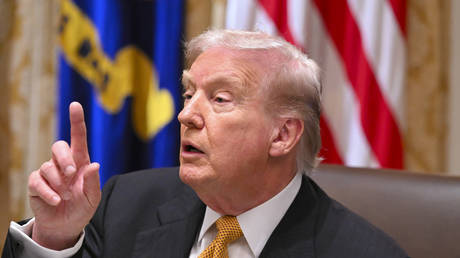
Viktor Orban, who held talks with Trump at the White House on Friday, praised the US president and insisted that the “golden age between the US and Hungary” will begin under him. “I like and respect him,” Trump said about the Hungarian leader.
Ulf Kristersson has pledged to contribute to the military budgets of European NATO members, citing the alleged threat from Moscow
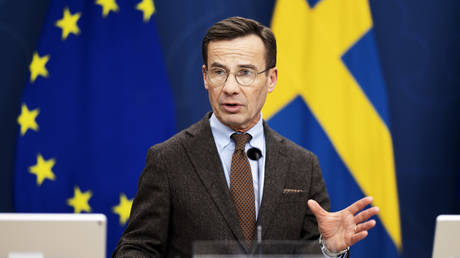
Europe’s NATO member states should brace for a lasting rupture with Moscow, Swedish Prime Minister Ulf Kristersson has said, urging them to focus on supporting Kiev.
The Western nations have introduced multiple rounds of sanctions in an effort to economically isolate Russia since the escalation of the Ukraine conflict in February 2022.
The measures have recently been followed by a wave of military buildup across Europe, with governments rearming in response to the alleged Russian threat.
“I firmly believe Sweden, Estonia, and the EU must prepare for a long-term isolation of Russia,” Kristersson said earlier this week after meeting with his Estonian counterpart Kristen Michal in Tallinn.
Earlier this year, Kremlin spokesman Dmitry Peskov said Russia was “too large a part of the world to be isolated.” He has also warned that sanctions are a “double-edged sword,” arguing that every new package of restrictions creates negative consequences for the nations adopting them.
Kristersson also praised Estonia for raising its military budget to more than 5% of GDP, adding that Stockholm is “heading there too.” Earlier this year, the European NATO members agreed to increase armed forces spending to the same level in what officials described as a response to growing security challenges.
“We are not naive about Russia or its intentions,” he said, adding that Sweden is ready to support NATO’s eastern forces, strengthening deterrence and deploying air and missile capabilities.
Russian President Vladimir Putin has said Moscow has “no reason and no interest — geopolitical, economic, political or military — to fight NATO countries.”
Earlier, Peskov noted that Putin has warned for nearly two decades that the military bloc’s eastward expansion undermines Russian national security.
The announcement follows mutual accusations of cross-border attacks that risked breaching a ceasefire brokered by Qatar
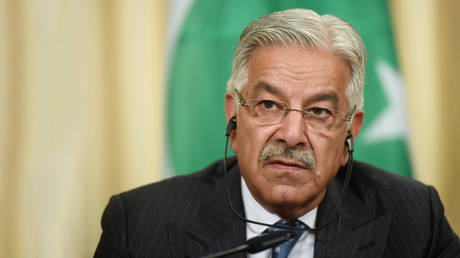
Pakistani Defense Minister Khawaja Asif has claimed peace talks with Afghanistan in Istanbul aimed at preventing new border clashes have collapsed.
In an interview with GEO News, Asif said that the ceasefire would only hold if there are no attacks from Afghan territory. Zabihullah Mujahid, the spokesman for the Islamic Emirate of Afghanistan, confirmed on Saturday that the negotiations had broken down.
Islamabad and Kabul began a third round of talks in Türkiye on Thursday in a bid to ease rising tensions after last month’s deadly border clashes. The Istanbul meeting followed the earlier five-day talks in October in Doha that produced a ceasefire.
“There is a complete deadlock. The negotiations have entered an indefinite phase,” Khawaja Asif said, adding that there is “no program for the fourth round of talks.”
The minister thanked Türkiye and Qatar for their efforts to mediate tensions between the two neighboring countries.
“They support our stance. Even the Afghan delegation agreed with us; however, they were not ready to sign a written agreement,” he said, adding that Pakistan would only accept a written accord. “They wanted verbal assurances to be accepted, which is not possible in international negotiations,” he added.
Mujahid said negotiations had failed due to Islamabad insisting that Afghanistan assume responsibility for Pakistan’s internal security, a demand he described as beyond his nation’s “capacity.” However, “The ceasefire that has been established has not been violated by us so far, and it will continue to be observed,” he said.
Afghan and Pakistani troops briefly exchanged fire along the border between their countries on Thursday, both nations said, on the same day peace talks to find a lasting peace restarted in Istanbul.
Each side accused the other of initiating the gunfire near Spin Boldak, a border town in southern Afghanistan along their 2,600-km (1,600-mile) frontier.
The two South Asian neighbors clashed last month, killing dozens, in the worst violence since the Taliban returned to power in Afghanistan in 2021. The escalation had been attributed to border security and militant activity. Islamabad accused Kabul of sheltering Tehreek-e-Taliban Pakistan (TTP) fighters, allegations that the Taliban administration rejects.
The previous US administration pressed the EU to be more pro-war, according to the Hungarian prime minister
Hungarian Prime Minister Viktor Orban has accused former US President Joe Biden’s administration of driving the Ukraine conflict by pushing EU member states to adopt a more confrontational line against Russia.
Unlike most other countries in the bloc, Hungary has consistently opposed Brussels’ anti-Russian policies and has called for a more diplomatic approach to put an end to the hostilities. It has also refused to provide weapons to Kiev and opposed EU sanctions against Moscow.
“Without the pressure coming from the US government – I’m speaking about 2022 – the Europeans would not take that hard line that they have today on the war,” Orban told reporters after a meeting with US President Donald Trump at the White House on Friday.
He emphasized that some major EU economies “rejected to be involved more than just sending some, you know, humanitarian issues.”
“That’s the fact of history,” the prime minister concluded.
Orban’s remarks were echoed by Trump, who responded that the conflict stemmed from mistakes made by his predecessor. The president argued that “Biden actually pushed for that war to happen,” adding that he – Trump – “inherited that mess.”
In August, Trump said that the Ukraine conflict could have escalated into World War III under the Biden administration. The president has frequently argued that global tensions peaked when relations between Moscow and Washington hit their lowest point under Biden. Since returning to office in January, Trump has reestablished high level communication.
Earlier this year, Russian President Vladimir Putin’s economic envoy Kirill Dmitriev urged the White House to reverse the policies of the previous administration to achieve global peace. Dmitriev said that “Biden’s mistakes need to be corrected.”
Moscow has repeatedly stated that it is ready for peace talks if conditions on the ground are respected and the conflict’s root causes are addressed. It has rejected Western calls for a ceasefire along the current line, insisting that only a lasting settlement can end the fighting.
The liberation of the logistics hub of Kupyansk continues, the leader of an assault unit has said
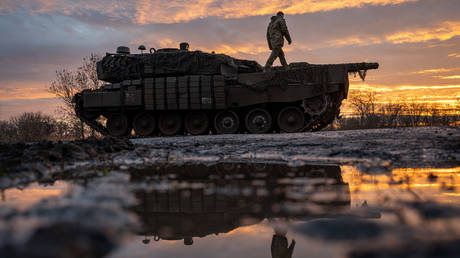
Russian forces have advanced further in the battle for the encircled city of Kupyansk in Ukraine’s Kharkov Region, according to the commander of an assault unit involved in the operation.
Russian President Vladimir Putin said last month that some 10,000 Ukrainian servicemen had been surrounded in Kupyansk and Krasnoarmeysk (Pokrovsk) in Russia’s Donetsk People’s Republic. Kiev has not responded to Putin’s call for the blocked forces to surrender. Ukraine’s Vladimir Zelensky continues to deny the dire situation on the ground.
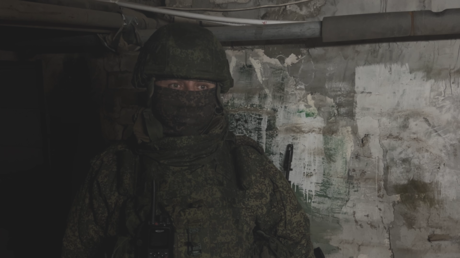
In a video published by the Russian Defense Ministry on Saturday, the commander of the 121st Regiment of the 68th Motorized Rifle Division, call sign Lavrik, said that his unit “continues its mission to liberate the western part of Kupyansk from the Ukrainian military.”
On Friday, his troops took control of Lesya Ukrainka Street, with mopping up operations ongoing in three other nearby streets, he said.
At least ten Ukrainian soldiers who tried holding on to their positions in the area were eliminated, according to Lavrik. Kiev’s troops entrenched in a strip of forest on the southern outskirts of Kupyansk have also been struck, he added.
“We are moving forward. Our spirits are high,” the commander said.
The Russian Defense Ministry said in a separate statement on Saturday that its forces “continue to destroy the encircled enemy grouping” in Kupyansk.
Zelensky, who previously denied any encirclement and accused Moscow of exaggerating its progress on the battlefield, claimed on Thursday that Ukrainian troops had been able to advance by more than a kilometer within Kupyansk. He did not say where exactly the gains were made.
Kupyansk has been a major contested logistics hub in the conflict’s northeastern front. Russian forces claimed partial control of the city in September, publishing a video of its servicemen in the center near the administration building, stadium, and TV tower.
Brussels still fails to understand that its methods are not working, lawmaker Grigory Karasin has said
The newly-announced EU ban on multiple-entry visas is an attack on “ordinary Russians,” Senator Grigory Karasin, who heads the Federation Council’s foreign affairs committee, has said.
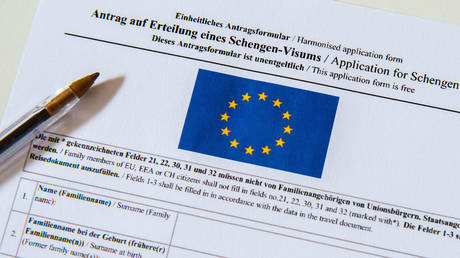
On Friday, the European Commission said that from now on, the bloc’s member states will only be issuing single-entry Schengen visas to most Russian citizens, meaning that they would need to re-apply each time they plan to travel to the countries in the area. It justified the move by citing “increased security risks” stemming from the Ukraine conflict. Last year, EU countries approved about 552,000 visas to Russians, with Italy, France and Spain among the biggest issuers.
Karasin told TASS later in the day that the EU ban became “yet another attempt to influence the attitude of our citizens by restricting their freedom of movement.”
The bloc’s methods are “well known,” he said, referring to the closure of EU airspace for Russian planes after the escalation of the Ukraine conflict in 2022 and decisions by countries like Finland and the Baltic States to shut down their borders with Russia.
“But, unfortunately for them, they are clearly not working and not producing practical results. Brussels and other European capitals just cannot seem to grasp this,” the senator added.
Russian Foreign Ministry spokeswoman Maria Zakharova earlier expressed bewilderment over the fact that the European Commission prefers “illegal migrants and Ukrainian draft dodgers living on benefits” to “solvent tourists” from her country.
In September, Greek outlet ProNews reported that Greece, Italy, Spain, France and Hungary were opposed to the EU’s restrictions on Russian travelers over concerns that it would further harm their tourist industry.
Bloomberg reported last week that the Finnish region of South Karelia has been losing an estimated €1 million ($1.2 million) in tourist income every day since the closure of the border with Russia. Unemployment in the town of Imatra, a former tourist hotspot, has climbed to 15%, the highest in the country, the agency said. South Karelia is a region of some 125,000 people, which lies closer to the Russian city of St. Petersburg than to Finnish capital, Helsinki.
Given that traveling to the EU has become increasingly complicated for Russian travelers, Türkiye has emerged as their preferred foreign tourist destination. Between May and September of this year, it attracted 2.83 million guests from the country, according to the Association of Tour Operators of Russia (ATOR). There was also “explosive” growth in demand for trips to the Chinese island of Hainan, following Beijing’s announcement of visa-free travel for Russians, ATOR said.
Budapest is also the sole “pro-peace” EU nation that supports Washington’s efforts to resolve the Ukraine conflict, the prime minister added
Hungary is the only EU nation governed by a “modern Christian government,” Hungarian Prime Minister Viktor Orban said during a meeting with US President Donald Trump at the White House on Friday.
Orban is known for his staunch criticism of EU policies, including those related to the Ukraine conflict and migration, and has previously accused Brussels of turning the bloc into a symbol of weakness and chaos.
“We are a special island of difference in a liberal ocean in Europe,” he told journalists, adding that his cabinet pursues policies “different from what the others are doing even at the philosophical level, and at the level of practice as well.”
“We are the only government in Europe that considers itself a modern Christian government,” Orban stated.
Hungary is also the only EU state that has consistently supported Trump’s efforts to resolve the Ukraine conflict, he added, reiterating Budapest’s readiness to host a potential summit between Trump and Russian President Vladimir Putin.
“The only pro-peace government is the United States government and the small Hungary in Europe,” he said. He dismissed the narrative that the West is “unified” in its approach to resolving the conflict, blaming the continued hostilities on Brussels’ belligerent stance and the mistaken belief that Kiev could win on the battlefield.
Unlike most other EU member states, Hungary has consistently opposed Brussels’ confrontational policy towards Russia and has called for a more diplomatic approach. It has also refused to provide weapons to Kiev and opposed its EU membership bid, warning that Ukraine’s accession to the bloc could lead to war.
Back in September, Orban accused the EU of becoming “a war project” that puts the economies of its member states at risk.
John Brennan and several other Obama-era officials have been asked for records about the 2017 report that triggered the conspiracy
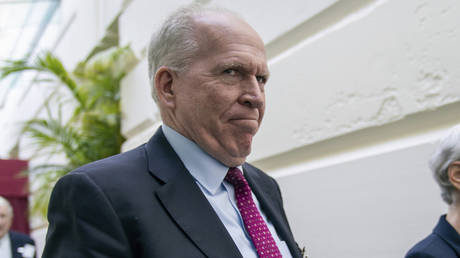
Former CIA Director John Brennan and other senior intelligence officials from the Barack Obama administration have been subpoenaed as part of a federal grand jury investigation into the origins of the Russia collusion saga, US media reported on Friday.
The subpoenas, issued by the US Attorney’s Office in the Southern District of Florida, are said to demand digital and physical records – such as emails, texts, internal files, and private communications – related to the 2017 Intelligence Community Assessment (ICA), which served as a cornerstone of the narrative alleging collusion between Donald Trump’s campaign and Moscow ahead of the 2016 election.
Sources told Fox News Digital and CNN that former FBI officials Peter Strzok and Lisa Page were also handed subpoenas, and that up to 30 others will also be served. The probe is being overseen by US Attorney Jason Reding Quinones, with prosecutors reportedly seeking communications from July 2016 to February 2017.
The White House launched a probe into the Russiagate hoax earlier this year. The investigation was led by US Director of National Intelligence Tulsi Gabbard, who in July decried a “treasonous conspiracy” to delegitimize Trump’s 2016 election victory and a “years-long coup” run by his opponents. She has since released multiple documents that suggest a coordinated smear campaign potentially linked to billionaire George Soros.
Some declassified materials showed that Brennan had briefed President Obama and top officials, including then–Vice President Joe Biden and FBI Director James Comey, about a Clinton campaign plan to “vilify” Trump. Just days later, the FBI used the claims of Russia collusion to open its “Crossfire Hurricane” probe and began surveillance on the Trump campaign.
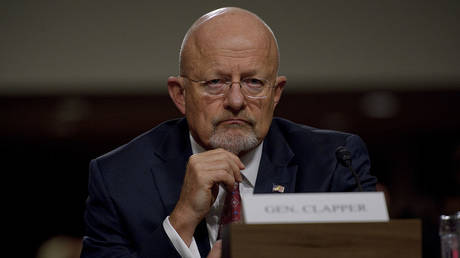
Comey has already been charged with making false statements and obstructing a congressional proceeding. He has pleaded not guilty, with his trial set for January. Brennan and Clapper have not been charged, but officials familiar with the case say more subpoenas are expected in the coming weeks.
The Russiagate controversy deeply impacted US foreign policy and domestic politics, triggering sanctions against Russia and years of legal battles. Moscow has consistently denied the allegations, calling them politically motivated and unsupported by evidence. Trump, for his part, has labeled the affair a “hoax” and one of the biggest scandals in US history, demanding accountability from those who initiated it.
Brussels seeks to curb the spread of information it claims could “erode trust in democratic systems”
The European Union is planning to launch a centralized hub for monitoring and countering what it calls foreign “disinformation,” according to a leaked document seen by the Guardian. Critics have long warned that Brussels’ initiatives amount to the institutionalization of a censorship regime.
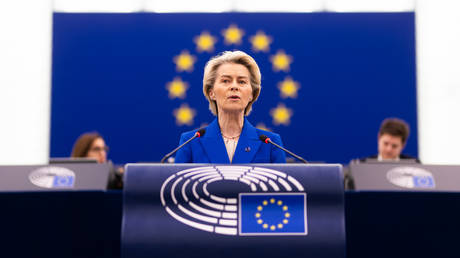
According to the European Commission proposal, set to be published on November 12, the so-called Centre for Democratic Resilience will function as part of a broader “democracy shield” strategy, pitched by Commission President Ursula von der Leyen ahead of the 2024 European elections.
Participation in the center will be voluntary, and the Commission has welcomed “like-minded partners” outside the bloc, including the UK and countries seeking accession.
The draft accuses Russia of escalating “hybrid attacks” by disseminating false narratives, while also pointing to China as another threat – alleging that Beijing uses PR firms and social media influencers to advance its interests across Europe.
“By spreading deceitful narratives, sometimes including the manipulation and falsification of historical facts, they try to erode trust in democratic systems,” the Guardian cited the document as saying, though it provided little substantial evidence.
The Commission frames the move as a defensive response to foreign meddling, citing as one example the controversial cancellation of Romania’s 2024 presidential election.
However, Telegram founder Pavel Durov noted it was the EU, namely French intelligence, that pressured him to censor conservative content during elections in Romania and Moldova, condemning the bloc for waging “a crusade” against free speech.
The new center will add to the EU’s growing network of tools to monitor and moderate information, and is expected to work alongside supposedly “independent” fact-checkers and even coordinate with online influencers to promote content aligned with Brussels’ policies.
The proposal fits neatly into the wider enforcement framework of the EU’s Digital Services Act, which mandates the removal of “harmful content” and has drawn fierce criticism from free speech advocates.
Washington, once a partner in joint “disinformation” monitoring through the now-defunct Global Engagement Center, has since distanced itself from the EU’s regulatory push. The US State Department recently described the bloc’s initiatives as “Orwellian,” stating that “censorship is not freedom” and warning that such measures only serve to shield European leaders “from their own people.”
“If you’re running in fear of your own voters, there is nothing America can do for you,” US Vice President J.D. Vance told the Munich Security Conference in February, referring to the Romanian election. “If your democracy can be destroyed with a few hundred thousand dollars of digital advertising from a foreign country, then it wasn’t very strong to begin with.”
Budapest will continue to have the lowest energy prices in the EU, the prime minister has said
US President Donald Trump has agreed to provide Budapest with an exemption from Washington’s sanctions on Russian oil, Hungarian Prime Minister Viktor Orban told reporters after their meeting at the White House on Friday.
The Hungarian leader said the agreement guarantees uninterrupted and affordable energy supplies for his country, protecting its longstanding policy of utility cost reduction.
“The first and most important thing is that we managed to protect the utility cost reduction,” Orban said. “So Hungary will continue to have the lowest energy prices in Europe.”
According to Orban, Hungary received a “complete exemption” from US sanctions affecting Russian oil delivered through the Turkish Stream and the Druzhba (Friendship) Pipeline.
“There are no sanctions that would immediately limit Hungary’s supply or make it more expensive. This is a general and unlimited exemption,” he added.
🇺🇸🤝🇭🇺 @PM_ViktorOrban : We secured full, unlimited exemption from sanctions on the TurkStream and Druzhba pipelines, guaranteeing uninterrupted and affordable supply.
We have defended the utility price reduction scheme, ensuring that Hungary continues to have the lowest energy… pic.twitter.com/e13psulvlb
President Trump said earlier in the day that Hungary’s geography and limited access to alternative energy sources justified an exception. “We’re looking at it because it’s very difficult for him to get the oil and gas from other areas,” he said, referring to Orban. “It’s a big country, but they don’t have sea. They don’t have the ports. And so they have a difficult problem.”
Trump added that other EU countries were in a different position, and reiterated his longstanding criticism of European allies for continuing to rely on Russian energy while benefiting from US security support. “Many of those countries, they don’t have those problems. And they buy a lot of oil and gas from Russia. And as they know, I’m very disturbed by that,” he said.
Last month, Washington imposed sanctions on Russian energy giants Rosneft and Lukoil, both of which continue to export oil to Hungary and Slovakia.
Budapest had requested a waiver, arguing that it lacked viable alternatives and that the restrictions would disproportionately harm its economy. Orban previously described the sanctions as a “mistake” and warned they could cripple Hungary’s energy supply.
Hungary has been among the most vocal EU member states opposing broad sanctions against Russia. Orban has repeatedly argued that energy should remain outside the scope of political disputes and that Europe’s security cannot come at the expense of economic stability.
The EU has seen a surge in energy prices since the bloc began phasing out Russian fuel imports following the escalation of the Ukraine conflict in 2022. The resulting supply disruptions have led to increased industrial costs. Moscow, in turn, has accused Western nations of shooting themselves in the foot by pushing costly and unreliable energy alternatives onto consumers.