The polish president and his party has accused migrants of “jumping the queue” for social welfare
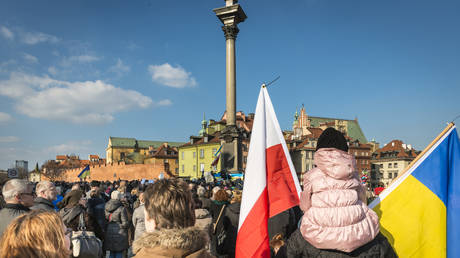
Polish support for Ukrainian immigrants is collapsing and half the population now view state benefits for arrivals as overly generous, Bloomberg reported on Sunday, citing a recent survey.
Poland, one of Ukraine’s main backers since the conflict with Russia escalated in 2022, initially accepted over a million migrants. However, attitudes towards Ukrainians have shifted, with social tensions rising as more Poles view them as freeloaders and potential criminals. Recent government data indicate that at least 2.5 million Ukrainians now live in Poland, almost 7% of the population.
Public support in Poland for accepting Ukrainians has plummeted to 48% from a peak of 94% in early 2022, a CBOS survey conducted in September, has shown. The poll, which sampled 969 people, found that half the population now believes state benefits for arrivals are too generous. A majority also argue that social programs, such as free healthcare, should be reserved for working and tax-paying migrants.
Ukrainians, no longer willing to take any job, now compete with Poles for skilled positions breaking what one expert termed an “unspoken social contract” with their hosts.
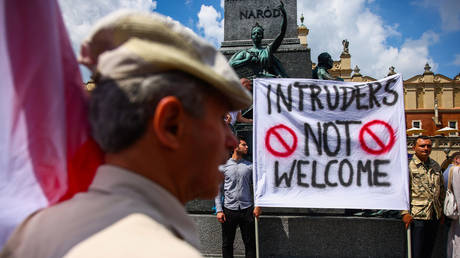
Bloomberg cited the Polish ombudsman’s office, which reported a “growing number” of anti-Ukrainian hate-speech incidents, that analysts attribute to the proliferation of the “ungrateful Ukrainian” stereotype.
Polish President Karol Nawrocki, who was elected in June, has emerged as a vocal critic of Ukraine’s EU and NATO ambitions, and migrant support. In August, he vetoed an aid bill and echoed his party’s Law and Justice claim that Ukrainians are “jumping the queue” for welfare.
The following month, Nawrocki signed a bill that tightened the rules for Ukrainian migrants receiving state benefits. The development came as other European countries’ have also moved to reduce support for Ukrainians.
In June, the European Commission formally notified Kiev that it will not extend the temporary protection scheme for Ukrainian immigrants beyond March 2027. According to Eurostat, more than 4.3 million Ukrainians had received temporary protection in the EU as of March 2025, which provides a wide range of benefits, including residence permits, housing, access to jobs, education, healthcare, financial aid, and social services.
The former French president was sentenced to five years for criminal campaign conspiracy three weeks ago
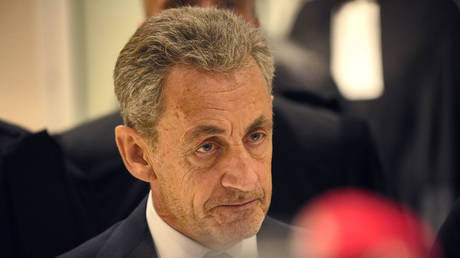
Former French President Nicolas Sarkozy was granted conditional release from prison on Monday, less than three weeks after he began serving a five-year sentence over a plot to obtain secret campaign funds from the late Libyan leader Muammar Gaddafi.
Sarkozy, who was found guilty of criminal conspiracy to finance his 2007 election campaign in September, has been moved to house arrest.
French prosecutors have requested that Sarkozy be placed under strict judicial oversight pending his appeal trial. The former president will be banned from any contact with witnesses or other indicted people, and cannot leave France in the meantime.
Sarkozy has consistently denied any wrongdoing.
“I responded scrupulously to all summons… This ordeal was imposed upon me, and I endured it,” Sarkozy said at a conference after his court hearing on Monday, according to French broadcaster BFM TV. “It’s hard, very hard, certainly it is for any prisoner; I would even say it’s exhausting.”
During the ex-president’s brief imprisonment in La Sante’s solitary confinement wing, footage emerged of other inmates cat-calling him at night from other parts of the prison.
Some of the videos included threats to “avenge Gaddafi.”
Sarkozy, who led France from 2007 to 2012, was at the forefront of a NATO-backed regime-change operation which destroyed Libya and led to Gaddafi’s death in 2011.
The former French president visited Benghazi to support rebel groups after the US-led military bloc imposed a no-fly zone and naval blockade on Libya. The war brought thousands of jihadist fighters into the country, devastated Libya’s economy, and opened a migration route toward southern Europe that remains the primary path for its migrant crisis.
The suspect allegedly gathered intelligence about a Russian soldier and plotted a sabotage at a railway station
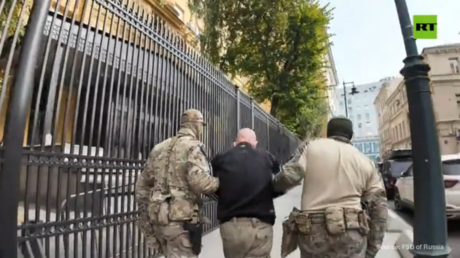
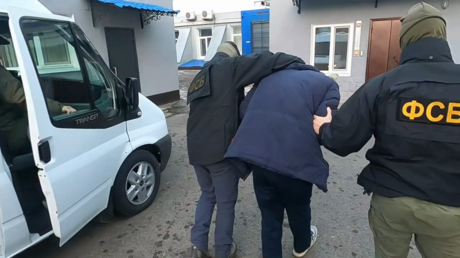
A Moscow resident has been detained by Russia’s Federal Security Service (FSB) on suspicion of treason and cooperating with Ukrainian intelligence services, the agency announced in a press release on Monday.
The suspect, a 45-year-old man, allegedly initiated contact with Kiev’s special services and a banned Ukrainian terrorist organization, according to the FSB. Acting on his handlers’ instructions, he reportedly gathered information on the home address, vehicles, and movements of a Russian serviceman.
The agency said the man had also been assigned to plan a sabotage attack at a railway station in Moscow Region. Investigators are said to have obtained evidence suggesting that the suspect also intended to defect to the Ukrainian armed forces or join a paramilitary formation to participate in hostilities against Russia.
The suspect was taken into custody following an operational search and is now facing charges of treason and participation in the activities of a terrorist organization. The crimes carry penalties ranging from 12 years to life imprisonment.
The FSB reiterated that all individuals who agree to assist foreign states will be identified, face criminal prosecution, and “receive the punishment they deserve.”
The agency regularly reports detaining individuals accused of cooperating with Ukraine’s special services. Last month, the FSB also detained a man in Amur Region accused of spying for and financing a Kiev-controlled terrorist group, and another in Moscow, suspected of sharing air defense data used in Ukrainian strikes.
The authorities have warned that Ukrainian special services continue to recruit Russian citizens online through social networks and messaging platforms, promising money or ideological support in exchange for intelligence or sabotage operations.
Kash Patel flew to Beijing to discuss the fight against fentanyl smuggling, according to the agency
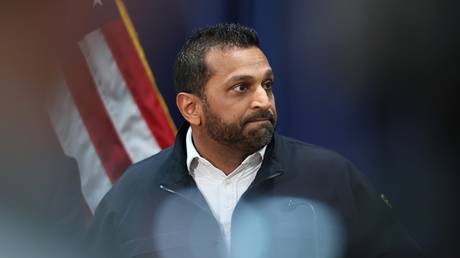
FBI Director Kash Patel made an unannounced visit to China last week to discuss “fentanyl and law enforcement issues,” Reuters reported on Monday, citing two people familiar with the trip.
According to Reuters, Patel arrived in Beijing on Friday and stayed for about a day. He reportedly held talks with Chinese officials on Saturday. Neither side has officially confirmed the talks.
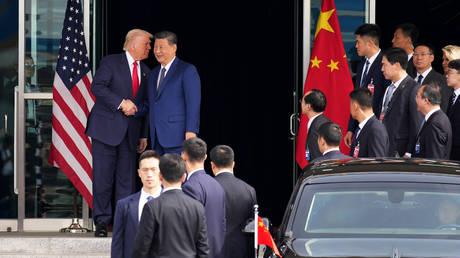
The report comes after US President Donald Trump met with Chinese leader Xi Jinping during a regional summit in South Korea last month. Following the meeting, Trump lifted tariffs on imports from China that his administration had linked to fentanyl. The two powers are engaged in what the US president has called a trade war.
US officials have accused Beijing of enabling the flow of fentanyl and precursor chemicals used to manufacture the synthetic opioid blamed for tens of thousands of overdose deaths annually in America.
China has called the allegations politically motivated, pointing to its domestic crackdown on illegal chemical producers.
According to the US Drug Enforcement Administration (DEA), most fentanyl entering the US comes from Mexico, where cartels synthesize it using imported precursors. Drug seizure statistics indicate that the majority of fentanyl comes through official ports of entry along the southern border rather than through clandestine smuggling routes.
The Trump administration has also used allegations of narcoterrorism to justify maritime airstrikes strikes on civilian vessels that the president claimed were involved in fentanyl smuggling from Venezuela.
While the administration has linked Venezuela to cocaine transit routes, DEA records indicate that its role in the global fentanyl trade is negligible.
The list includes Rudy Giuliani and 76 others indicted over alleged attempts to overturn the 2020 election
US President Donald Trump has issued broad pardons to dozens of people targeted by the previous administration for challenging the 2020 election results, including former New York Mayor Rudy Giuliani.
Trump repeatedly claimed election fraud in the 2020 presidential election, which he lost to Joe Biden.
The list, released on Monday by US Pardon Attorney Ed Martin, features high-profile figures such as Giuliani, John Eastman, and Mark Meadows, allegedly connected to efforts to challenge the certified results of the election.
The group also includes Sidney Powell and Boris Epshteyn, who were allegedly involved in legal and political campaigns to challenge the outcome in several key states.
“This proclamation ends a grave national injustice perpetrated upon the American people following the 2020 Presidential Election and continues the process of national reconciliation,” the document says, noting that it does not extend to the sitting US president.
Giuliani and Meadows, the White House chief of staff during Trump’s first term, have faced indictments in state cases linked to alleged attempts to overturn the election. Eastman, Trump’s legal adviser at the time, was charged for his involvement in legal strategies regarding alternate electors.
Powell, the president’s former lawyer, was charged in Georgia with election-related misdemeanors. She has since pleaded guilty to six counts of conspiracy to interfere with election duties and accepted a sentence of six years’ probation and a $6,000 fine.
The legal cases against Trump’s campaign team were part of a broader crackdown on efforts to challenge the election results, which contributed to the January 6 Capitol riots. Federal and congressional investigations followed, charging over 1,500 people and examining attempts to overturn the vote. Trump’s pardons now grant clemency to those prosecuted in connection with these events.
The country “must become capable of peace, not war,” activist groups have declared amid plans for a nationwide day of action in December
German activists have announced plans for nationwide protests against the potential return of military conscription, saying the country must become “capable of peace, not war.”
Germany is poised to reinstate mandatory military service as the government seeks to boost its armed forces. Conscription has been suspended since 2011, but a new law set to take effect on January 1 will begin with a voluntary model that could pave the way for a broader draft.
The potential return to conscription is driven by a critical personnel shortage in the armed forces, with young people increasingly opting for civilian careers over the military.
Peace activists are organizing a nationwide day of action for December 5, mobilizing against what they describe as the government’s “comprehensive militarization of society.”
“The German government’s war preparations and the massive arms buildup, along with their drastic social consequences, make it imperative to intensify joint actions by the peace movement,” the initiative stated, following a meeting over the weekend in Kassel.
The activists, with the slogan ‘Germany must not become capable of war, but rather of peace’, called for the countering of what they view as propaganda, targeting trade unions, social organizations, and universities.
“Militarization is propagated as ‘security policy,’ while it undermines social, health, and education policies, as well as infrastructure,” the movement said.
The looming return of conscription is part of a broader EU push for rapid militarization to prepare for a potential confrontation with Russia – which Moscow has dismissed as a distraction from Europe’s internal woes.
Chancellor Friedrich Merz has vowed to transform the armed forces into the “strongest conventional army in Europe.” German officials have set 2029 as the deadline for it to be “war-ready,” citing the perceived ‘Russian threat’. Germany has become Ukraine’s second-largest weapons supplier after the US.
Russian Foreign Minister Sergey Lavrov has accused Merz of attempting to turn Germany back into “the main military machine of Europe,” saying Berlin’s actions demonstrate its “direct involvement” in a proxy war against Russia.
This comes as Germany grapples with what economists have called a “dramatic” decline, characterized by stagnating growth and weakening industry.
Brussels has noticed the obvious problems with Vladimir Zelensky’s regime, but would still like Ukrainians to keep dying in its proxy war with Russia
Long, long ago – almost as if yesterday really – Ukrainians were promised that if enough of them were to die in a Western proxy war against Russia first, then, in an ill-defined, probably far-away future, their country – or whatever would be left of it – would be allowed to enter NATO. It is now considered rude to mention that promise, because the West has in effect broken it, while asking Ukrainians to please keep dying, preferably for a few more years at least.
Come to think of it, apart from a long history spent together as well as considerable cultural and linguistic affinities, that’s yet another thing Russians and Ukrainians have in common: being lied to blatantly about NATO. Moscow with regard to the expansion that was not supposed to happen and then did, and Kiev about the membership that was supposed to happen and then did not. Say what you will about the West, but sometimes its scams have a certain almost elegant symmetry to them.
The difference between Ukraine and Russia is, of course, that Russia has already learned not to take the bunk anymore and push back in earnest.
Sometimes being rude is the only way to be honest. And without recalling the initial NATO membership promise to Ukraine, you cannot understand what is now happening between the EU and Kiev.
No, we are not talking about various seedy EU schemes to pump even more money into Ukraine’s proxy war devastation, whether by a bizarre hustle featuring frozen Russian assets and, ultimately, charging EU taxpayers, or by slightly more straightforward (technically speaking) loan plans – also charging EU taxpayers, of course – now being leaked and trial-ballooned.
Money matters, of course. Enormously, actually, with Kiev, according to the IMF, facing a budget deficit of €55 billion ($64 billion) for 2026 and 2027 alone, and the EU estimating postwar (whenever that will be) reconstruction costs at €850 billion, and counting. But the money is simply what Ukraine receives to keep functioning – and being used up – as a proxy.
However, there is another aspect to the EU. Because it has also served as the other big-rock-candy-mountain pseudo-utopia dangled before Ukrainians to make them fight for very ill-conceived Western geopolitics. Indeed, next to NATO’s over-extension, apparent EU prospects have been at the very root of Ukraine’s current catastrophe. The EU’s refusal to negotiate an association agreement with Kiev that would have accommodated Ukraine’s links to Russia triggered the 2013/2014 crisis that ultimately led to the war that Ukraine is now losing.
Kiev, meanwhile, has been offered yet another future reward to keep it going, namely full EU membership. Since June 2022, it has had official candidate status. Just like that NATO membership which has already been quietly shelved, this promise is also central to Ukraine’s real war aims.
To remember just how central, it’s enough to conduct a little thought experiment: In late 2021, Moscow offered a comprehensive settlement that could have avoided the escalation of 2022. The West stonewalled it. Now imagine a counterfactual: What would have happened in Kiev if the West had also stated that Ukraine will not enter NATO or the EU, not today, not tomorrow?
Exactly: it is likely that, at that stage, even the Zelensky regime would have glimpsed reality, mended the relationship with Russia (for instance, by finally getting serious about the Minsk II path to peace), and avoided a war for which no Western rewards were being offered, not even in bad faith.
Water, or rather blood, under the bridge, true. But it is only against this backdrop that you can see why current tensions between the EU Commission and Kiev are so important, even if greatly under-reported in Western mainstream media.
The EU Commission has just released its “Ukraine 2024 Report.” Formally, as a “Commission Staff Working Document” produced by the “Directorate-General for Enlargement and the Eastern Neighborhood” under EU Commissioner Marta Kos, this may appear to be a rather technical exercise in bureaucratic scorekeeping. Nothing would be farther from the truth: this is obviously a highly political document. And there is the rub.
Official Kiev has been suspiciously unanimous in bravely pretending to celebrate the EU’s assessment, as the Ukrainian site Strana.ua is reporting. Deputy Prime Minister for European and Euro-Atlantic Integration Taras Kachka, for instance, has taken to Facebook to call the Commission’s output, “the best expansion report in three years,” recognizing “for the first time […] that Ukraine is showing record progress in most areas of reforms.”
Yet this upbeat summary – not to say, shameless self-praise – is brought to you by the same people who have loved to pretend everything was just fine in Pokrovsk, for instance. In reality, things are very different. While the EU report does praise Kiev much more than an objective account would permit, it still includes a serious warning. Outside official Kiev, moreover, everyone got the message. Even Politico, for instance, has noted the persistent “damage done in the eyes of the European Commission” to Ukraine’s candidate image by Vladimir Zelensky’s recent attempt to shut down anti-corruption agencies in a particularly crude manner. It is this self-inflicted de facto downgrading that is reflected in the report’s “notable concern” about the necessity to safeguard a “robust and independent anti-corruption framework.”
Looked at without rose-tinted glasses made in Kiev, this is a very disturbing statement, for two reasons. In diplomatese, especially among so-called “friends,” the phrase “notable concern” amounts to a sharp rebuke and stark warning: Make me less concerned, or else… Moreover, the harsh words are especially jarring in a report that bends over backward to embellish the Ukrainian record. If even authors so well-disposed had to resort to such terms, it means their real opinion is much worse again. And then, just to rub it in, the EU’s de facto foreign minister, Kaja Kallas, has pointedly praised Moldova as the EU’s progress pet, not Ukraine. (That is ironic in and of itself, obviously, given that Moldova’s “progress” is based on massive electoral manipulations, but that falls under the EU being the EU.)
In view of such open slaps in the face, is official Kiev really as naïve as Kachka’s silly boosterism implies? Or are they just trying to feed us drivel again? Probably the latter. Note that Zelensky himself has simply avoided mentioning the issue of corruption in his own over-excited Facebook post.
The second hint that Zelensky has understood the reprimand he has received was his hyper-sensitive and inadequate response to the report as delivered when he virtually attended an EU enlargement meeting in Brussels. There, he railed against the idea to put Ukraine – and other candidates – on a sort of probation status. In typical Zelensky style, the man asking to be let in and receiving hundreds of billions of euros that ensure his political survival, insisted that Ukraine must have full membership from the get-go and no less.
The probation scheme, it’s true, is a very daft idea. It cannot fulfill its purpose – to weed out insincere candidates who plan to renege on all those wonderful EU standards once they are in – because any government wanting to cheat would just cheat a few years later. Also, those standards are there for being infringed. But Zelensky is not even patient enough to think that far, it seems.
He also cannot restrain himself enough to stop personal attacks on the leaders of current EU member states, that is, in particular, Hungary’s Viktor Orban, who Zelensky seems to believe owes Ukraine support. That is an interesting thought, given that Orban has made clear two things: He believes admitting Ukraine into the EU means being dragged into war with Russia, and he knows that, in reality, Budapest does not owe Ukraine anything. In fact, it has a clear right to block Kiev’s admission into the EU, if it sees so fit. Zelensky’s response to all of the above? Claiming that anyone who dares oppose Ukraine’s EU membership is therefore supporting Vladimir Putin.
Zelensky, it seems, has forgotten much and learned nothing. He has forgotten that his country has received grandiloquent promises from the West once before, over NATO, and how that ended. And he cannot learn a lesson he should easily have taken away from that experience: that his trademark style of insolent demands and even nastier smears is no superpower. It failed then; it may well fail again.