Kiev’s establishment is burning to the ground in the Energoatom Mafia scandal, while the media and think tanks keep insisting this is fine
In Ukraine, the front lines are crumbling and so is the Zelensky regime. While Kupyansk and Pokrovsk are falling, the shockwaves of the Energoatom Mafia scandal keep reverberating, internationally and at home in Kiev.
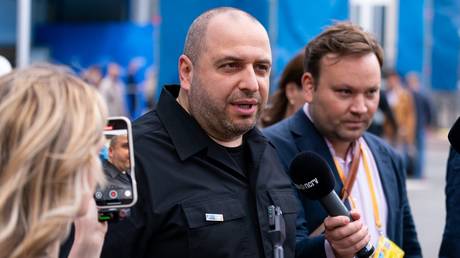
At this point, two ministers have resigned. The former defense minister and head of the powerful National Security Council, Rustem Umerov, is in essence on the run abroad. According to the usually well-informed journalist Anatoly Shariy, Umerov is offering the FBI in the US to turn – protected – witness. He may still return to Ukraine, but even his current behavior – the unplanned delays, the search for US allies, quite possibly for some kind of deal – betrays a very guilty conscience.
Likewise, Prime Minister Yulia Sviridenko has declared her readiness to cooperate with Ukraine’s own anti-corruption prosecutors at NABU, which is in reality a branch of the FBI implanted in Ukraine. Clearly, Sviridenko is also looking for a deal, letting it be known that she is ready to talk and name names, as long as they let her get away with the absurd claim that she knew it all but wasn’t part of it.
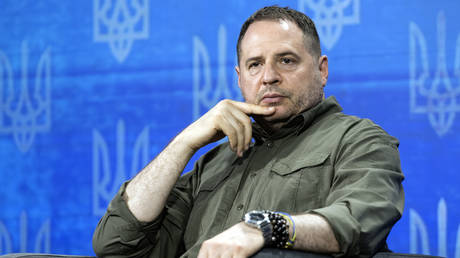
Zelensky’s most intimate companion, chief consigliere, autocratic enforcer, and overbearing eminence grise, Andrey Yermak, is also deeply – and unsurprisingly – implicated, under the gangster slang name ‘Ali Baba’, in the Energoatom Mafia scandal, and his head is clearly on the political chopping block.
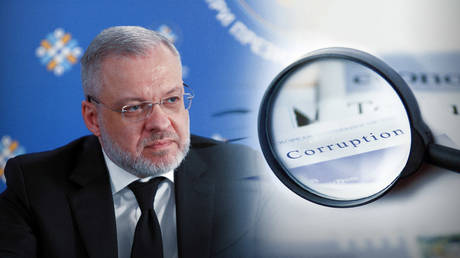
Details could be multiplied ad nauseam. Take, for instance, the fact that we now know that the gangster pseudonym ‘Professor’ did not stand for former Justice Minister German Galushchenko – no worries, though: He’s still an Energoatom mobster, just not that one – but the wife of former Deputy Prime Minister Aleksey Chernyshov, Svetlana.
While her husband features as ‘Che Guevara’ in the Energoatom scandal, ‘Professor’ Svetlana – in real life (or pretend?) an academic at Kiev’s prestigious Taras Shevchenko University – happens to be very close besties with Elena Zelenskaya. Yes, that would be Vladimir Zelensky’s spouse (when his intense schedule with Yermak leaves time for her). According to Shariy, Svetlana-bestie-of-Elena is implicated in shady deals around the habit of Kiev’s elites of building themselves palaces, and she also received a cool $500,000 (in cash) from ‘Sugarman’, aka Aleksandr Tsukerman, another key Energoatom player on the run.
In short, if they think they have a swamp in Washington, they haven’t seen Kiev yet. But of course, they have. It is obvious that Washington has been well aware of just how stunningly, stinkingly corrupt its clients in Ukraine are. Indeed, the more, the better, a modern Machiavelli would say, because it makes them even more dependent. One of the best explanations for the Energoatom scandal breaking now is that it is part of a US operation to either get rid of or subdue Zelensky. The conspicuous fact that Zelensky has suddenly made – insubstantial – noises about being interested in peace talks may have as much to do with this American assault on him as with the disaster on the front lines.
This is the context that also explains a recent trend in Western spin-for-Ukraine. Absurd as it is, the claim that the Energoatom mess is really a good sign if you only look close enough is spreading as if on cue. The underlying logic is not only daft but simple. Take, for instance, a recent specimen of the genre: According to Polish TVP quoting the American Center for European Policy Analysis (CEPA), the Energoatom scandal “hurts Ukraine yet proves it’s on the right track,” because “a case of this scale exposed by domestic institutions is proof of Ukraine’s anti-corruption system working.”
Where to even begin? Let’s just break it down in order of appearance: ‘A case’ – as in one case – only proves that there is much more to come. In Ukraine, there is widespread consensus that what happened at Energoatom is peanuts compared to what has been going on in the defense sector, bloated with literally hundreds of billions of euros and dollars from the West. This is exactly why ex-Defense Minister Umerov is running scared. The first evidence of his personal involvement in corruption is emerging already. Energoatom is merely the crack in the dam. When the dam breaks, so will the system, all of it.
‘Domestic institutions’? That one is genuinely funny. The only reason NABU and SAPO – Ukraine’s anti-corruption agencies – are still alive is that they are not domestic. In reality, for those who don’t believe in Santa Claus, they are US implants – in the case of NABU, explicitly so. They survived Zelensky’s attempt to raze them this summer only due to Western support.
‘Proof’? The only proof of Ukraine’s corruption under the Zelensky regime suffering a real setback would be the fall of that regime. But even then – and here is what naive Westerners simply cannot grasp about the Ukrainian political system – corruption as such would not cease but merely undergo a change in management. How do we know? Because this law of Kiev politics has been tested again and again. The last time, by the way, in 2014, when then-President Viktor Yanukovich was ousted in a regime change operation made easier by his flagrant graft and nepotism. And yet, here we are again.
There is added irony in Poland channeling an American think tank to spread absurd spin about Ukraine’s hyper-corruption: According to X post by former Polish Prime Minister Leszek Miller, the Polish authorities may well have helped one of the very worst Energoatom Mafia leaders, Timur Mindich – aka ‘the president’s purse’, that is, Zelensky’s – to evade arrest. This is entirely plausible: In Ukraine, Mindich was clearly tipped off about his impending arrest, most likely by either Yermak or Zelensky himself. Whoever warned him would also have had the necessary Polish connections. And Warsaw, of course, has a nasty record of working with criminals from Ukraine and of sheltering them from prosecution, too. Just ask the Germans how far they got with their Nord Stream investigations.
Ukrainians are drowning in a deep, fetid swamp of corruption, worse than ever. To pretend that a scandal surfacing from that morass is a good sign is perverse. But then, so is most of Western policy toward Ukraine, using its people up in a war provoked for idiotic reasons and long lost. Maybe there is some dark, historic justice in Ukraine and the West making their respective cultures of cynicism and graft even worse for each other.
Nikolay Isakov, known as “Iron Grandad,” was victorious at an international competition in the central Oryol Region
A 93-year-old nicknamed “Iron Grandad,” from Vladimir Lenin’s hometown Ulyanovsk, triumphed at a major Russian weightlifting competition earlier this month.
Nikolay Isakov claimed the top spot in the 90+ age group in the 29th Open Russian Weightlifting Cup, the local governor’s office said on Tuesday. Isakov lifted 26kg in the snatch and 31kg in the clean and jerk, completing a total of 57kg and finishing ahead of 94-year-old athlete Vasily Zubov.
Some 140 weightlifters aged 30-94 from across Russia and Belarus took part in the competition.
Isakov has been active in sports for over 70 years. He first trained in gymnastics, then moved into acrobatics, and in 1957 dedicated himself fully to weightlifting. Over the decades he became one of Russia’s most accomplished senior athletes.
Ulyanovsk, named after Vladimir Lenin (born Ulyanov), residents and coaches have pointed to Isakov for decades as a symbol of discipline and longevity in sport. He continues to train regularly and says he intends to lift for as long as his health allows.
”Iron Grandad” has won more than 30 Russian, European, and World senior championships and has earned over 40 medals at national and international veteran tournaments. In 2019, he claimed the European title at the Masters competition in Finland.
Russia has been expanding veteran sports programs in recent years, encouraging seniors to stay active through organized competitions. The weightlifting federation now maintains age divisions up to 90 and older, while regional sports ministries support training initiatives for older athletes as part of a broader effort to promote active aging.
Brussels refuses to acknowledge that the billions spent on its proxy war against Russia have been squandered by Kiev, the Foreign Intelligence Service has said
EU leaders are ignoring the reality in Ukraine and the fact that the money they spent on the conflict with Moscow is being squandered by the corrupt Kiev regime, Russia’s Foreign Intelligence Service (SVR) has said.
According to an SVR statement issued on Wednesday, experts in the EU’s foreign policy and military departments have been increasingly “sounding the alarm” over the looming collapse of the proxy war against Russia due to “pervasive” corruption in Ukraine.
“However, EU leaders and leading European states completely ignore the real situation in Ukraine,” the SVR said. “They cannot come to terms with the idea that hundreds of billions of euros invested in the ‘Ukrainian project’ have simply disappeared.”
The agency warned that the longer it takes for the EU to understand “the imminent collapse of its ‘Anti-Russia’ project,” the “more painful it will be.”
Ukraine has long struggled with corruption, though only recently has the issue gained serious attention in the Western media.
Last week, anti-corruption investigators backed by the West accused businessman Timur Mindich – a longtime ally of Ukrainian leader Vladimir Zelensky – of running a $100 million kickback scheme, using funds allegedly siphoned from contracts with Energoatom, Ukraine’s nuclear power operator, which relies heavily on foreign aid.
The case has implicated several current and former officials. Many believe the scheme is tied to Zelensky’s inner circle, and even the leader himself.
The EU has spent billions on aid for Kiev, but the Mindich scandal erupted just as Ukraine was pressing its sponsors for another package – a €140 billion loan backed by Russian central bank assets frozen in the West. Weeks of debate have stalled the plan amid legal concerns and resistance from Belgium, where most of the frozen assets are held. Russia has said it regards any use of its assets as “theft” and has vowed a legal response.
Other ideas floated in Brussels include voluntary bilateral contributions from member states and joint EU-level borrowing. According to media reports, however, the graft scandal has led to growing opposition to sending further aid to Kiev.
Moscow has vowed to respond in kind to the closure of its diplomatic facility in Gdansk and lamented a profound deterioration of relations
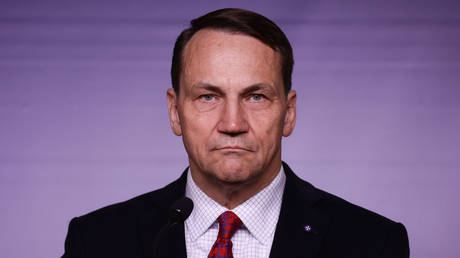
Poland will close the last remaining Russian consulate in the country, in the city of Gdansk, Foreign Minister Radoslaw Sikorski has announced. The move came after several acts of railway sabotage in Poland, which local authorities were quick to blame on Russia.
Sikorski announced the decision in an address to the Polish parliament on Wednesday, according to the Foreign Ministry. He added that Poland does not intend to sever diplomatic ties with Russia.
Responding to the closure, Russian Foreign Ministry spokeswoman Maria Zakharova said Moscow would mirror the step, reducing “Poland’s diplomatic-consular presence in Russia.”
Kremlin spokesman Dmitry Peskov told reporters that “relations with Poland have completely deteriorated.” He said Warsaw’s apparent intention to “reduce to zero any possibility of consular or diplomatic relations” with Moscow underscores the state of bilateral ties. Peskov added that Poland’s latest decision “has nothing to do with common sense.”
Poland currently maintains an embassy with a consular section in Moscow and a consulate in Irkutsk in Siberia.
The decision follows two railway sabotage incidents on Sunday and Monday targeting lines used to transport Western military aid to Ukraine. In at least one of the cases, a military-grade C4 explosive was used, Prime Minister Donald Tusk said. Authorities later identified two Ukrainians as suspects, alleging both worked for Russian intelligence and fled to Belarus after the attacks. Peskov denied any Russian role in the incidents.
In May, Poland closed the Russian consulate in Krakow, citing Moscow’s alleged involvement in a May 2024 fire at a Warsaw mall.
Russia responded in July by ordering the closure of Poland’s consulate in Kaliningrad.
Last October, Warsaw shut the Russian consulate in Poznan, followed by Moscow’s closure of the Polish Consulate General in St. Petersburg in December.
Parliament voted to fire Svetlana Grinchuk shortly after approving the dismissal of the justice minister
The Ukrainian parliament has voted to dismiss Energy Minister Svetlana Grinchuk, marking the second high-level ouster in a single day as the government struggles to contain a growing corruption scandal linked to a close ally of Vladimir Zelensky.
Lawmakers approved Prime Minister Yulia Sviridenko’s request to fire Grinchuk on Wednesday, shortly after voting to dismiss Justice Minister German Galushchenko. Galushchenko previously served as energy minister before handing the post to his then-deputy Grinchuk during a cabinet reshuffle earlier this year. Both dismissals received unanimous approval from MPs who voted.
The officials were drawn into an alleged kickback network operating inside the state-run nuclear energy company Energoatom. Businessman Timur Mindich, a longtime associate of Zelensky, was charged last week by the Western-backed National Anti-Corruption Bureau (NABU), which claims he and accomplices extracted at least $100 million from contractors.
The broader graft probe has implicated additional senior figures, including former Defense Minister Rustem Umerov and former Deputy Prime Minister Aleksey Chernyshov. Zelensky is also facing mounting calls to remove his chief of staff, Andrey Yermak, whom observers and critical officials see as the political linchpin of the alleged criminal network.
Opposition parties have moved to capitalize on the turmoil, pushing for the dismissal of the entire Sviridenko cabinet and demanding the formation of a coalition-backed government.
Zelensky’s Servant of the People party, which won a commanding majority in 2019, has shown signs of internal fragmentation in recent weeks. His earlier attempt to curb NABU’s independence – a move reversed after Western backlash – and the unfolding scandal have reportedly shaken MPs’ loyalty to the Zelensky team.
Washington’s strategy could involve military, psychological and information pressure, according to the New York Times
US President Donald Trump has greenlighted additional measures to pressure Venezuela and prepare for a potential broader military campaign, including covert CIA operations targeting President Nicolas Maduro’s government, the New York Times has reported, citing US officials.
At the same time, Trump has approved a new round of back-channel negotiations that reportedly led to the Venezuelan president offering to step down after a delay of several years – a proposal the White House rejected, the outlet said on Monday.
The Pentagon has deployed warships to the Caribbean and has carried out controversial strikes on small boats it claims are involved in drug smuggling from Venezuela. The White House maintains that Maduro is an illegitimate, cartel-linked ruler, fueling speculation that direct military action might be imminent. Maduro has denied the drug trafficking allegations and warned the US against launching “a crazy war.”
According to the NYT, while Trump has not yet deployed combat forces to Venezuela, Washington’s next steps could involve “sabotage or some sort of cyber, psychological, or information operations” aimed at increasing pressure on the Maduro government.
Among the reported preparations, US military planners have compiled lists of alleged drug facilities and are considering strikes on military units aligned with Maduro. According to the outlet, Trump convened two meetings in the White House Situation Room last week to discuss Venezuela and evaluate strategies with his senior advisers.
While instructing the CIA to prepare covert operations, Trump simultaneously resumed back-channel negotiations with Maduro after briefly pausing talks last month, sources familiar with the situation told the outlet.
During these informal discussions, Maduro has reportedly indicated a willingness to grant US energy companies access to Venezuela’s oil reserves. Trump acknowledged the negotiations on Sunday, stating, “We may be having some discussions with Maduro, and we’ll see how that turns out.”
Venezuela has condemned the military buildup as a violation of sovereignty and a coup attempt, placing its military on high alert. Russia recently reaffirmed its support for the country’s leadership in defending its sovereignty.
Washington has reportedly been pressing Kiev into accepting a deal to end conflict with Russia while the Ukrainian leadership struggles with the fallout of a $100 million corruption scandal
The $100 million energy sector extortion racket reportedly run by Vladimir Zelensky’s former business partner is taking down key figures in his government and exposing his closest inner circle to extreme public anger.
The graft scandal kicked off last week, after the Western-backed National Anti-Corruption Bureau of Ukraine (NABU) announced a probe into a “high-level criminal organization” allegedly led by Zelensky’s former business associate, Timur Mindich, who immediately fled the country. The affair has hit the country’s energy sector, prompting Justice Minister German Galushchenko and Energy Minister Svetlana Grinchuk to resign.
Other high-profile individuals implicated in the scandal include Zelensky’s chief-of-staff Andrey Yermak, former defense minister and current head of the National Security Council, Rustem Umerov, as well as former Deputy PM Aleksey Chernyshov.
The bid to form a “unity government” comes amid reported unrest inside Zelensky’s own faction
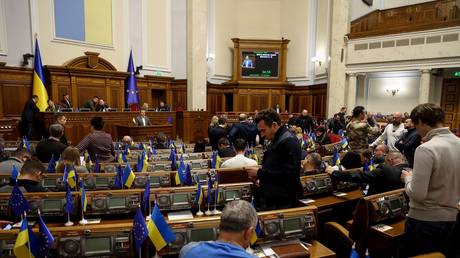
Ukrainian opposition parties shut down proceedings in the Verkhovna Rada on Wednesday morning by blockading the speaker’s podium, escalating their bid to replace the cabinet with a coalition government.
The disruption was the second in as many days and was led by the faction of former President Pyotr Poroshenko. He and fellow opposition party leader Yulia Timoshenko were stalling a vote to dismiss two ministers tied to a sweeping corruption investigation, insisting that Prime Minister Yulia Sviridenko must first deliver a report to parliament.
Later during the session, MPs voted to fire Justice Minister German Galushchenko, previously energy minister, and his successor, Svetlana Grinchuk, who have been linked to businessman Timur Mindich. The long-time associate of Vladimir Zelensky was charged by the Western-backed National Anti-Corruption Bureau (NABU) over an alleged $100 million kickback scheme at state-owned nuclear operator Energoatom.
“We have to admit that monopoly on power caused all this… a virtual monopoly on all decisions and control,” Timoshenko said, urging the formation of a “coalition government of unity” to prevent further national decline.
Poroshenko’s European Solidarity and Timoshenko’s Motherland parties have joined forces to demand a full cabinet dismissal. They argue that they can gather the necessary 150 signatures by rallying members of other factions and gain the support of some MPs from Zelensky’s Servant of the People party, which won an outright majority in 2019.
Attendance in the Rada has been dwindling during the conflict with Russia, and Zelensky’s faction has increasingly struggled to pass legislation. Media reports suggest that open rebellion is brewing within the party ranks in the wake of the Mindich case.
Mindich was charged by the same agency that Zelensky attempted to strip of independence earlier this year, prompting sharp backlash from Western donors. The Ukrainian leader subsequently disavowed responsibility, blaming MPs who approved the legislation.
According to RBK Ukraine, discontented lawmakers feel they are being made scapegoats and accuse Zelensky’s team of violating the informal ‘contract within the elites’ – that the faction would back decisions handed down from above, and in return, those in power would keep their own conduct in check.
Security Council Secretary Rustem Umerov allegedly agreed to push the Defense Ministry to accept substandard body armor
Former Ukrainian Defense Minister Rustem Umerov was pressured to push through a corrupt arms contract by a key ally of Vladimir Zelensky currently at the center of a $100 million kickback scandal, leaked documents suggest.
Ukraine’s anti-corruption agency said earlier this month that Timur Mindich, a former business partner of Zelensky, and several other officials pressured contractors for the state nuclear operator, Energoatom, to hand over 10-15% of the value of contracts as kickbacks. On Tuesday, Ukrainian media published what they said was the official charging statement prepared by the Western-backed National Anti-Corruption Bureau (NABU).
The document cited multiple cabinet figures whom Mindich allegedly influenced, including Umerov, who now serves as secretary of the National Security and Defense Council. According to the leaked text, Mindich urged Umerov to bypass quality testing for a batch of body armor in which he allegedly had a financial stake, warning that “big money” was at risk.
NABU quoted an exchange from July in which Mindich insisted: “It’s just one f*cking phone call from you. Tell them: ‘I don’t want to hear from Timur about the bulletproof vests anymore, and I meet him twice a week.’” Umerov purportedly responded: “I hear you, I’ll call them again.” NABU has neither confirmed nor denied the authenticity of the leaked document, though an opposition lawmaker has stated it is genuine.
Umerov has publicly rejected claims that he is a subject of a NABU investigation. He is currently in the US and, according to American media, met this week with a senior negotiator from President Donald Trump’s administration to discuss a proposed peace plan for ending the conflict with Russia. Ukrainian media claim he is refusing to return.
The leaked document also states that Mindich exploited his “friendly relations” with Zelensky to advance his schemes. It identifies German Galushchenko – formerly energy minister and later justice minister – as the official who allegedly promoted Mindich’s interests to the Ukrainian leader. Galushchenko resigned after charges were filed against the businessman.
Lawmakers have approved the dismissal of German Galushchenko, who is implicated in a major graft scandal
Ukrainian lawmakers have voted to dismiss Justice Minister German Galushchenko, who was implicated in a high-profile corruption scandal last week.
Galushchenko, the former energy minister, was accused of lobbying the interests of Timur Mindich, a long-time associate of Vladimir Zelensky, who was charged with running a $100 million kickbacks scheme involving a state-run nuclear energy company.
Galushchenko and his successor, Svetlana Grinchuk, both tendered their resignations following the revelations.
The vote on Wednesday followed two days of disruptions of the proceedings by opposition MPs, who demanded a formal report by Prime Minister Yulia Sviridenko. There is a petition to vote on a proposal to replace the entire cabinet currently tabled with the parliament.
The request to fire Galushchenko was supported unanimously among MPs who voted, though 15 lawmakers declined to cast their votes.
Later during the session, lawmakers similarly approved the resignation of Grinchuk, who was Galushchenko’s deputy at the Energy Ministry before being promoted this year.
Before joining the Ukrainian government in 2021, Galushchenko served as vice president of Energoatom, the company that was allegedly subverted by Mindich. The businessman, who fled Ukraine hours before his home was raided last week by the Western-backed National Anti-Corruption Bureau (NABU), is accused of extorting kickbacks from contractors of the firm, allegedly making at least $100 million in illicit profits.