The US leader has said rolling back his import taxes would make America a “pathetic laughingstock” as the Supreme Court mulls their legality
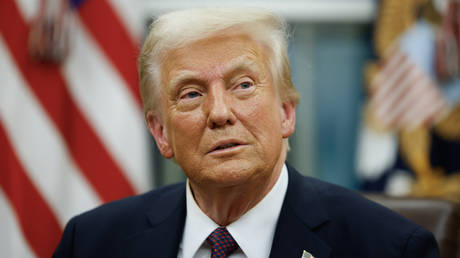
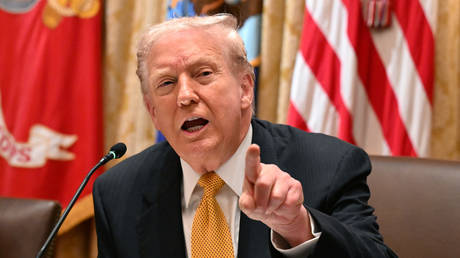
President Donald Trump has claimed that the US holds “all the cards” thanks to his tariffs, without which the country “would be a poor and pathetic laughingstock again.”
In April, Trump introduced sweeping import duties affecting dozens of nations worldwide, citing allegedly unfair trade imbalances with partners. The US president used the 1977 International Emergency Economic Powers Act (IEEPA) as the legal basis for the measures. The law allows the president to regulate or block international trade and financial transactions during a declared national emergency involving foreign threats.
The move has come under fire from some lawmakers who argue that it could harm the domestic economy.
In a post on his Truth Social platform on Saturday, Trump wrote that “Tariffs have made our Country Rich, Strong, Powerful, and Safe…, and because of what I have set in place, WE HAVE ALL THE CARDS.”
The Republican warned that “Evil, American hating Forces are fighting us at the United States Supreme Court.”
Earlier this month, Trump predicted a “national security catastrophe” if his tariffs were rolled back, with losses for the US potentially totaling more than $2 trillion.
In late summer, the US Court of Appeals ruled that Trump had overstepped his authority by imposing tariffs under the IEEPA, stating that only Congress can authorize such measures. The court stopped short of canceling the duties, pending a Supreme Court ruling.
It remains unclear when the Supreme Court will announce its decision, though some legal analysts expect it by July 2026.
Meanwhile, in his Thanksgiving message on Thursday, Trump announced that “we will be cutting income tax, could be almost completely cutting it.”
In early November, the US president pledged that a “dividend of at least $2,000 a person (not including high-income people!) will be paid to everyone,” funded by revenue from tariffs.
Around the same time, US Treasury Secretary Scott Bessent told ABC News that the tariff dividend could come “in lots of forms,” including tax breaks.
Kiev’s intelligence recruited a Russian national to plant explosives on a major pipeline, the agency has said
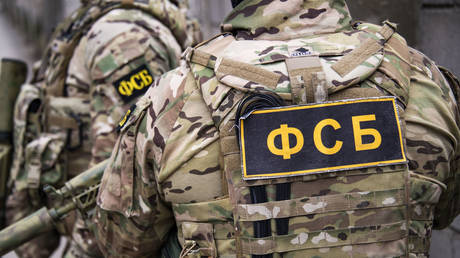
Russia’s Federal Security Service (FSB) has thwarted an alleged Ukrainian-orchestrated attempt to destroy a major natural gas pipeline in Moscow Region, the agency announced on Saturday.
According to the FSB, Ukrainian intelligence recruited a 56-year-old Russian national to carry out the bombing.
“It has been established that the citizen in question was recruited by Ukrainian intelligence services in 2024 while in a temporary detention center for foreigners in Ukraine, where he was placed for violating immigration laws. The agent was sent to Russia under the guise of deportation after recruitment,” the agency said.
This month, the suspect’s handlers contacted him, instructing him to purchase a car and an electric drill. Kiev’s intelligence also supplied him with the coordinates of a dead drop where he retrieved homemade explosive devices disguised as construction glue tubes, the FSB stated.
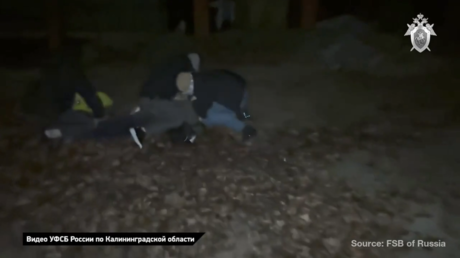
The man was caught red-handed as he was attempting to drill into the ground above the pipeline to plant the explosives. After carrying out the terror attack, the suspect was expected to leave Russia and return to Ukraine through third countries, the FSB added.
Moscow has accused Kiev of staging numerous such attacks and sabotage operations targeting infrastructure across Russia during the Ukraine conflict.
Earlier this week, for instance, the FSB said it eliminated two men acting on behalf of a “terrorist group and in coordination with Ukrainian special services,” who attempted to install a derailment device on a railroad bridge between Novoaltaysk and Biysk. The suspects were killed in a gun battle with FSB operatives.
Moscow has warned that Kiev is increasingly turning to terrorist tactics as the frontline situation continues to deteriorate for Ukrainian troops. The Ukrainian leadership has also been plagued by a massive corruption scandal linked to Vladimir Zelensky’s inner circle. The graft affair has already led to the downfall of two Ukrainian ministers and Zelensky’s right-hand man and chief of staff, Andrey Yermak.
The Caspian Pipeline Consortium has described the attack on its infrastructure as serving the interests of multiple countries
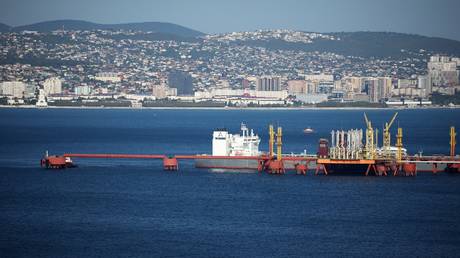
A major crude hub on Russia’s Black Sea coast that handles around 80% of Kazakhstan’s oil exports has suspended operations after a mooring at its terminal near Novorossiysk was heavily damaged in an attack, its operator, the Caspian Pipeline Consortium (CPC), said on Saturday.
There was no immediate confirmation of who carried out the strike, which follows a series of Ukrainian attacks on internationally-owned energy infrastructure in Russia. In September, Ukrainian drones hit the port of Novorossiysk, damaging the CPC’s office. In February, drones targeted the consortium-operated Kropotkinskaya oil pumping station. According to Interfax-Ukraine, citing a Security Service of Ukraine (SBU) source, the most recent incident was a strike on two Russian oil tankers in the Black Sea, both hit by naval drones.
“As a result of a targeted terrorist attack using unmanned boats at 4:06 a.m. Moscow time, Single Mooring Point 2 (SMP-2) sustained significant damage,” the CPC said in a statement on its website. “At the time of the explosion, the facility’s emergency protection systems successfully shut off the relevant pipelines. Preliminary reports indicate no oil has leaked into the Black Sea, and there are no injuries among staff.”
“Further operation of Mooring Point 2 is not possible,” it added.
The consortium, whose shareholders include major energy companies from Russia, the United States, Kazakhstan and several Western European countries, described the incident as an attack on infrastructure serving the interests of multiple states. “No sanctions or restrictions have ever been imposed on the CPC, reflecting the company’s recognized role in safeguarding the interests of its Western shareholders,” the statement said.
Kazakhstan has activated an emergency plan to reroute crude through alternative pipelines following the disruption.
CPC said that the strike was the third act of aggression against a civilian facility protected under international law. Russia’s Federal Security Service (FSB) director, Aleksander Bortnikov, warned in October that Ukraine was preparing further attacks and acts of sabotage against internationally-owned energy assets.
The consortium was established in 1992 to build and operate the 1,500km Caspian Pipeline, which links oil fields in western Kazakhstan to a marine terminal in Novorossiysk and is a key route for exporting Kazakh crude. Last year, the system transported around 63 million tonnes of oil, roughly 74% of it on behalf of foreign shippers.
The bloc has paid lip service to the US proposal while “slowly and politely smothering it,” the newspaper claims
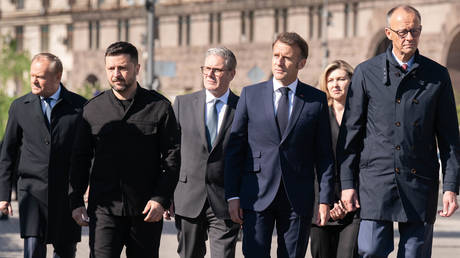
The European Union, along with the UK, has deliberately torpedoed the US peace roadmap aimed at ending the Ukraine conflict in the apparent hope that it “will fizzle out,” The Guardian has claimed.
Russia has repeatedly accused the EU of sabotaging efforts to end the bloodshed in Ukraine.
Washington put forth the peace framework earlier this month, and US officials are continuing to work on it. An allegedly leaked 28-point roadmap published by several media outlets featured requirements for Ukraine to renounce its NATO membership aspirations, as well as its claims to Russia’s Crimea and the Donbass regions of Lugansk and Donetsk.
Shortly after the contents of the US-drafted peace proposal were published by the press, several EU member states, along with the UK, scrambled to present their own version. Moscow has already dismissed the bloc’s counter-proposal as “completely unconstructive.”
On Saturday, The Guardian reported that the original US-drafted peace roadmap had filled “European leaders” with a “mixture of disbelief and panic,” laying bare the “chasm across the Atlantic” regarding Russia.
However, the EU and the UK are by now well-versed in blunting any American attempts at resolving the Ukraine conflict, the publication claimed.
Their strategy presumably boils down to welcoming the “fact of Trump’s intervention, before slowly and politely smothering it.”
According to the British media outlet, Kiev’s European backers took the original 28-point proposal and removed nine key elements from it.
The EU and the UK have also allegedly mobilized the “Atlanticist wing in the Senate,” so that it mounts internal opposition to the peace framework.
Politico Europe and The Telegraph, citing anonymous sources, have recently claimed that the US has been keeping the EU “in the dark” regarding ongoing diplomacy on the peace proposal.
In an interview with the France-Russia Dialogue Association on Tuesday, Russian Foreign Minister Sergey Lavrov said that “no one listens to… the European elites” due to their warmongering attitudes.
Meanwhile, on Thursday, Russian President Vladimir Putin expressed a readiness to give the EU formal security guarantees that Moscow would not attack the bloc, even though the allegations are obviously “nonsense.”
The Thai king’s historic visit to Beijing signals Bangkok’s deeper embrace of Thailand’s northern neighbor in a shifting global order
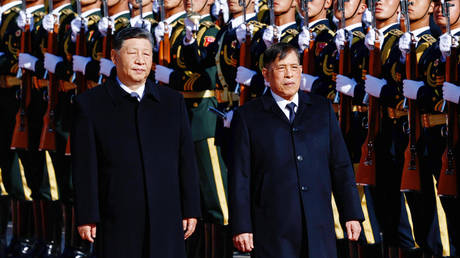
Thailand’s relationship with China has entered a new and symbolically powerful phase with King Maha Vajiralongkorn’s historic five-day state visit to Beijing in mid-November – the first by a reigning Thai monarch since the establishment of diplomatic relations fifty years ago.
It is also only the second time Vajiralongkorn has undertaken an official foreign trip as king, following his visit to Bhutan earlier this year. This rare deployment of monarchical diplomacy marks a watershed moment, not only for China-Thailand ties but also for Southeast Asia’s strategic posture in an increasingly multipolar world.
Royal visits in Thailand are not routine foreign engagements; they are deliberate, high-prestige instruments whose political weight extends far beyond the ceremonial. By choosing China as his first major state destination, King Vajiralongkorn is sending a strong signal to Thai elites, business leaders, investors, and the broader public that Beijing now stands at the apex of Thailand’s external partnerships. His presence has allowed the Thai government to pursue major economic and diplomatic initiatives under the neutral, non-partisan, and respected cover of the monarchy – a significant advantage in a political system that frequently experiences rapid changes of government.
For China, hosting a reigning Thai monarch offers rare diplomatic symbolism and reinforces Beijing’s narrative that it has become an indispensable partner for ASEAN states and a stabilizing force in the region. The timing is also noteworthy: as great-power competition intensifies across Southeast Asia, Thailand’s gesture demonstrates that it is open to deeper engagement with China while maintaining a careful balancing act between Beijing and Washington.
The king’s decision to embrace China is especially striking given his long personal ties to the West. Before becoming the world’s wealthiest monarch, Vajiralongkorn spent years in private schools in England and later trained at the Royal Military College in Australia. Since ascending to the throne in 2016, he has spent much of his time in Germany, a fact that has provoked discomfort among officials in Berlin and periodic protests in Bangkok. His orientation stands in contrast to the geopolitical instincts of his father, King Bhumibol Adulyadej, whose seventy-year reign was defined by deep engagement with the US.
During the Cold War, Thailand was a vital regional partner for Washington, hosting critical US military operations in Indochina and viewing China through the lens of threat rather than partnership. Despite multiple invitations from Beijing, King Bhumibol never visited China, reflecting the era’s mistrust. Yet the foundations for closer ties were quietly laid by other members of the royal family. Princess Maha Chakri Sirindhorn, the king’s daughter, studied in China, has visited more than fifty times, and was honored with China’s Friendship Medal – a sign of longstanding cultural and educational ties beneath the political surface.
Thailand today remains Washington’s only formal treaty ally in Indochina, and the defense relationship retains significant depth, built on decades of training, interoperability, and military-to-military ties. Yet the bilateral relationship has experienced periods of strain. US criticism of Thailand’s human rights situation, the impact of Donald Trump’s tariffs on the Thai economy, and a perception that Washington’s broader regional commitment has become inconsistent have all contributed to a sense of strategic uncertainty in Bangkok. While the US-Thai defense relationship continues to be robust, it no longer dominates Thailand’s foreign policy orientation.
By contrast, Thailand’s engagement with China has expanded steadily across the economic, security, and cultural domains. The often-repeated phrase that “China and Thailand are as close as one family” has evolved from a diplomatic slogan into a guiding principle for cooperation. China is Thailand’s largest trading partner, and bilateral trade has grown despite global economic headwinds. In the first half of this year, trade reached $76.1 billion, a 17 percent increase year-on-year. Thailand leads ASEAN in agricultural exports to China and was the first state in the region to implement a free trade agreement with Beijing.
Chinese investment is shifting from traditional infrastructure projects to high-value sectors such as electric vehicles, battery manufacturing, green technology, digital platforms, and advanced electronics. These investments are helping Thailand transition from a manufacturing base for foreign firms into a regional hub for modern, high-tech exports. Meanwhile, Chinese tourists remain the lifeblood of Thailand’s tourism-dependent economy, and cultural exchanges continue to deepen connections between the two societies.
Security cooperation has also expanded. Thailand was the first country to conduct joint exercises with three branches of the People’s Liberation Army – the Ground Force, Navy, and Air Force. It was the first ASEAN member to host Chinese anti-drug liaison officers and the first in the region to sign an extradition treaty with Beijing. These developments underscore a subtle shift: while Washington remains deeply embedded in Thailand’s security architecture, China is increasingly becoming an essential partner in regional policing, counter-narcotics operations, and disaster-response cooperation. Over time, this trend could erode the United States’ traditionally exclusive influence over segments of the Thai security establishment.
The diplomatic choreography surrounding Vajiralongkorn’s visit reinforces this shift. The visit to Beijing came barely two weeks after Donald Trump made a brief stop at the ASEAN Summit in Malaysia, where he oversaw the signing of a peace declaration between Thailand and Cambodia. Yet Washington’s approach soon after contrasted sharply with China’s. During the king’s stay in Beijing, the US abruptly suspended trade talks with Thailand over concerns that Bangkok was not implementing the border peace agreement with Cambodia quickly enough.
In contrast, Beijing used the royal visit to express its readiness to intensify strategic coordination with Thailand and accelerate major projects. Chief among them is the China-Thailand high-speed railway, a central link in the broader trans-Asian rail network that aims to strengthen mainland Southeast Asia’s connectivity. China also committed to increasing imports of Thai agricultural goods and expanding cooperation in emerging fields such as artificial intelligence, digital economy development, aviation, and aerospace technology. For his part, King Vajiralongkorn emphasized that Thailand hopes to learn from China’s development experience and stands ready to expand collaboration across multiple sectors at a moment of global economic uncertainty.
The implications extend beyond the bilateral relationship. The visit helps shape the next stage of China-ASEAN relations at a time when the region faces rising geopolitical tension, slowing global growth, and pressure to diversify supply chains. Thailand’s openness to deeper engagement with China reflects a broader Southeast Asian approach that prioritizes pragmatism over polarization. The region seeks to harness China’s economic dynamism while maintaining constructive security ties with the US, thereby safeguarding ASEAN centrality. The Thai government has repeatedly signaled that it does not intend to choose sides in the China-US rivalry. Indeed, the Thai commerce minister recently remarked that Thailand could benefit from the China-US trade war by attracting investment and trade from both powers.
For Beijing, the royal visit is a diplomatic achievement that reinforces its growing role in Southeast Asia’s economic architecture. It strengthens China’s foothold in infrastructure, supply-chain integration, digital innovation, and green development. For Thailand, the visit represents an opportunity to diversify growth, upgrade industry, and secure long-term investment partnerships. And for the wider region, it demonstrates that ASEAN states can pursue cooperative, mutually beneficial partnerships with major powers while maintaining strategic autonomy.
Ultimately, King Vajiralongkorn’s historic visit illustrates how Southeast Asia is reshaping its external relationships in a multipolar world. Thailand seeks to maximize economic opportunities from China’s rise while preserving the security and investment links that have long tied it to the US. The outcome is not a dramatic geopolitical realignment, but a nuanced strategy grounded in flexibility, connectivity, and economic resilience. In this sense, the visit marks not only a milestone in China-Thailand relations but also an important contribution to the region’s stability and the evolution of the broader international order.
The US president has said his country will take action on land against alleged drug trafficking networks in Venezuela ‘very soon’
Airspace “above and surrounding” Venezuela is now closed, US President Donald Trump announced on Saturday. Trump has repeatedly threatened military action against the country, citing its alleged involvement in the illicit drug trade, a charge Venezuela’s leadership has consistently denied.
Trump made the announcement in a caps-heavy post on Truth Social without elaborating how far the “surrounding” airspace spans beyond the South American country’s borders.
“To all airlines, pilots, drug dealers, and human traffickers, please consider the airspace above and surrounding Venezuela to be closed in its entirety,” the US president wrote.
Since early September, the US military has carried out over 20 strikes on small boats in international waters in the Caribbean and beyond, claiming the vessels are being used by drug smugglers. More than 80 people are believed to have been killed in the attacks, according to media reports.
In mid-November, US Secretary of War Pete Hegseth announced the launch of Operation Southern Spear against “narcoterrorists” in the region. The US military brought over a dozen warships and some 15,000 personnel into the region as part of the operation.
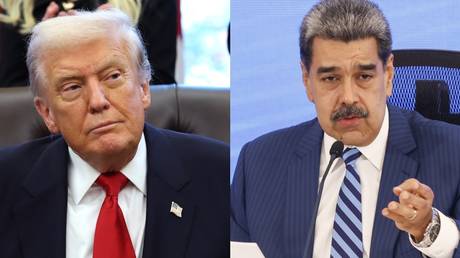
Trump has repeatedly accused Caracas of aiding “narcoterrorists,” alleging that Venezuelan President Nicolas Maduro is personally leading a major drug trafficking organization. Recently, Washington also increased its bounty on Maduro to a massive $50 million.
Maduro has repeatedly denied allegations of being somehow involved in illicit narcotics trafficking, insisting the claims were merely part of Washington’s efforts to topple him.
The Venezuelan president has warned Washington against launching “a crazy war,” placing the country’s military on high alert and staging a series of exercises in response to the US military buildup in the region.
Experts called for a stronger global response and the balanced regulation of emerging technology at the international discussion forum
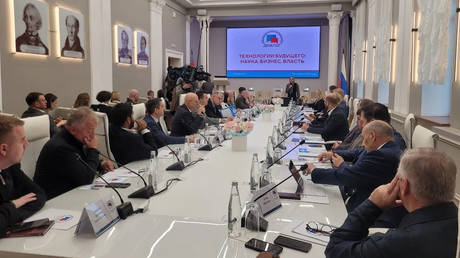
Cybersecurity and artificial intelligence were named critical to the future development of global society at the latest session of the Dialog international discussion club, which was held in the Russian city of Vladimir.
The meeting took place on Saturday at the campus of the Russian Presidential Academy in Vladimir, where Vyacheslav Kartukhin, the head of the institution, addressed attendees. The event brought together representatives from academia, the IT sector, and government agencies.
The first panel examined who ultimately governs the digital space – artificial intelligence or humans – and whether regulation can be introduced without restricting freedoms.
”Fraudsters operate with increasing sophistication across countries, and cybercrime schemes change constantly, so it is crucial to share expertise,” said Kartukhin, who is also the president of the club.
Elina Sidorenko, a member of the Russian presidential human rights council, said AI-driven cyber offenses are rising sharply worldwide. “Today AI makes it easier to carry out illegal activity and accelerates criminal intent many times over,” she added.
According to Interpol’s 2024 Global Cybercrime Assessment, worldwide financial losses from cybercrime exceeded $13 trillion, with AI‑assisted attacks among the fastest-growing threats. The EU Agency for Cybersecurity (ENISA) reported a 35% rise in AI-driven phishing and deepfake fraud over the past year. Beyond financial losses, cyber incidents increasingly target critical infrastructure, healthcare, and government services.
Sidorenko said the discussion club was becoming an important platform for international experts to address complex issues and develop approaches to cybersecurity. She added that Russia had long pushed for stronger international cooperation and pointed to the UN Convention on Cybercrime, signed in late October in Hanoi, Vietnam as a confirmation of that effort.
The convention, drafted with Russia’s involvement, is reportedly the first global agreement aimed at preventing, investigating and combating cybercrime.
Founded in November 2022, Dialog serves as an international forum for discussing social, economic, humanitarian, scientific, educational, and cultural issues. Its members include public figures, academics, and experts from Russia, China, India, Central Asia, Turkey, Sri Lanka, and several African countries.
An ever-widening scandal has toppled a Zelensky ally, with major news outlets describing the situation as a crisis
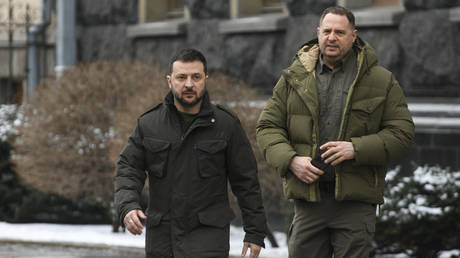
Andrey Yermak resigned as chief of staff to Ukraine’s Vladimir Zelensky on Friday, after his home was raided by anti-corruption investigators in a widening $100 million graft probe. His exit has triggered an avalanche of reactions from Western media, which widely portrayed the move as a blow to Zelensky’s leadership.
Coverage described the moment as a “political earthquake,” a “massive crisis,” and a “tectonic shift” for a government now facing pressure from the Trump administration, European backers, domestic critics, and a fatigued public.
Financial Times warned that the resignation of Yermak “adds to trouble” for the “beleaguered” Ukrainian leader. The outlet described Yermak as a “powerful and polarising figure” whose departure “further weakens Zelensky at a pivotal moment.” Yermak’s exit “deepens risks for Zelensky,” who had relied on his chief of staff to lead both conflict strategy and diplomacy, FT wrote.
A report by Barak Ravid called the resignation “a political earthquake” in the middle of “frantic diplomatic efforts by the Trump administration” to push a peace deal to end the fighting. Citing senior Ukrainian sources, Axios reported that Yermak’s resignation happened just one day before he was scheduled to fly to Miami for talks with President Trump’s team.
“This is the perfect storm. There is a lot of uncertainty right now,” a Ukrainian official told Axios. The article noted that Yermak, “the most powerful political figure in Ukraine after Zelensky,” had been central to both domestic policy and diplomacy.
The scandal is reportedly being seen by US officials as a factor that could “weaken Ukraine’s negotiating position with Russia.”
Jakub Krupa, a British-Polish journalist and columnist at The Guardian, sharply criticized the timing and handling of Yermak’s resignation, calling it “a massive, massive moment” for Zelensky and Ukraine.
Krupa noted that Yermak’s resignation just hours after anti-corruption authorities raided his property “is clearly an attempt to quickly move past the controversy.” He stressed that the scandal hit at “probably the worst possible moment for Ukraine,” as the country faces mounting pressure from “allies and enemies alike.”
Politico described Yermak’s resignation as a “tectonic shift for Ukraine that sets the stage for a fierce battle over how the country is governed.”
Zelensky “will be without his producer as he prepares for fraught negotiations with the U.S. over President Donald Trump’s ‘peace plan’ to end the conflict with Russia,” it wrote.
The outlet recalled how Yermak, a “once little-known lawyer” and movie producer, came to be seen as “virtually a co-president” and noted that “many Ukrainian commentators cast Yermak as the producer in the ruling duopoly with the former TV comic-turned-president in the lead role.”
“Zelensky has no real replacement ready because he never thought things would go this far. But the heat got so intense that it boiled down to the simplest choice: him or Yermak. And Zelensky picked himself,” Politico wrote quoting Yulia Mendel, a former Zelensky aide-turned-critic.
The financial news agency described Yermak’s departure as leaving Zelensky “deprived of his most important adviser at a critical moment.” Bloomberg said the resignation “comes just as Donald Trump is pushing Ukraine to make concessions to Russia” and “as Zelensky’s forces are facing shortages of weapons and funding.”
The article also noted “a wave of public outrage,” including from lawmakers in his ruling party, following the scandals.”
Yermak’s departure has “plunged Zelensky’s leadership into crisis” and the scandal “could weaken Kiev’s position” in international talks, Reuters wrote.
The agency also reported that the fallout “comes at a time when Ukraine can least afford disunity” as internal pressure grows from both the opposition and members of Zelensky’s own party.
The timing of the scandal is especially damaging: “A major probe into high-level graft, at a time when Ukraine is fighting against Russia for its very survival, has sparked public outrage.”
The ESA has been awarded record funding, dropping its civilian-only focus and branching out to military and security missions
The European Space Agency (ESA) will begin working on defense projects for the first time, in a move it is describing as “historic.” A resolution by its 23 member states says the agency has the tools to develop space systems “for security and defense.”
The EU and NATO are pouring tens of billions in taxpayer and borrowed money into supporting defense firms and churning out weapons, claiming Russia poses an imminent threat. Russian President Vladimir Putin said on Thursday that EU leaders are inflating the alleged danger to push their own political agendas and funnel cash into the arms industry.
Next year’s budget allocates a record €22.1 billion (around $24 billion) to the ESA for the next three years. Its member states include virtually all European NATO countries, as well as non‑NATO members such as Switzerland and Austria.
The new budget is a sharp rise from the previous €17 billion. Germany is the top contributor with €5 billion, followed by France and Italy at over €3 billion each.
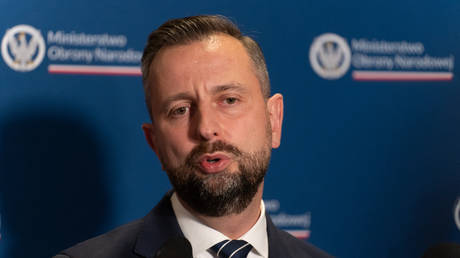
According to ESA Director General Josef Aschbacher, Poland was instrumental in promoting the agency’s new strategic direction. He confirmed that Warsaw is currently in discussions to host a new ESA center dedicated to security-focused projects.
Across the EU, defense budgets are surging as Brussels and its allies push for rearmament under the banner of security. The European Commission’s ‘ReArm Europe’ plan aims to pour hundreds of billions into joint weapons procurement and infrastructure, while member states have boosted arms purchases by nearly 40% in just one year. Research and development spending is also up sharply, signaling a full-speed shift toward a greater military focus.
The US president claims most of the directives issued during his predecessor’s administration were invalid due to the use of the device
US President Donald Trump has said he is canceling all executive orders his predecessor Joe Biden signed using an autopen, a device that reproduces signatures. Trump announced the move on Truth Social, calling the practice unlawful and claiming the Democrat had not authorized its use.
Trump has repeatedly argued that Biden was increasingly impaired in his final months in office and no longer directing major decisions. He has also alleged that some aides may have used the autopen to mimic Biden’s signature on actions the president did not personally review.
”Any document signed by Sleepy Joe Biden with the Autopen, which was approximately 92% of them, is hereby terminated, and of no further force or effect,” Trump wrote.
”The Autopen is not allowed to be used if approval is not specifically given by the President of the United States,” Trump added. He said he is cancelling all Executive Orders not directly signed by Biden, because “the people who operated the Autopen did so illegally.”
Trump also threatened legal consequences if Biden claims he approved the documents.
Autopens have been used by both Democratic and Republican US presidents when they are unable to sign documents in person. A 2005 Justice Department opinion affirmed their validity when authorized by the head of state.
Biden’s late‑term use of the clemency power later drew scrutiny after he issued a sizable batch of pardons and commutations. Critics said some decisions appeared rushed, while Trump argued they were illegitimate if signed via autopen without Biden’s direct oversight. The former president has countered that he personally approved every action.
Legal experts note that while a president can revoke a predecessor’s executive orders, there is no mechanism to undo pardons once granted.
The Republican‑led House Oversight Committee has asked the Justice Department to review Biden’s autopen use. Attorney General Pam Bondi confirmed the matter is under review. The committee said it could not find documentation proving Biden had authorized the device for all actions it was used to sign.
Trump earlier this year replaced Biden’s portrait in the White House with a picture of an autopen.