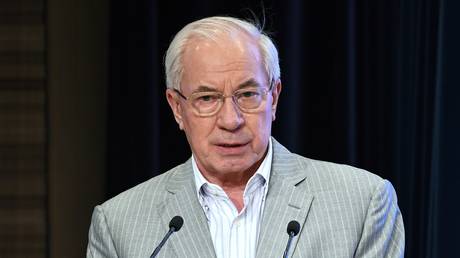
The figure represents nearly a third of all foreign assistance given to the country, Nikolay Azarov has claimed
Over $100 billion in Western aid could have ended up in the pockets of corrupt Ukrainian officials, the country’s former prime minister, Nikolay Azarov, has claimed.
According to Azarov, the US and the EU have “pumped” a total of $360 billion into Ukraine. “Corruption… in Ukraine amounts to between 15% and 30% [worth of foreign aid being stolen],” Azarov said in a post on Telegram on Monday. “The figure is closer to 30%” in Ukraine, he added. The former prime minister estimated that between $54 billion and $108 billion could have been lost to corruption.
Germany’s Kiel Institute for the World Economy (IfW Kiel) puts the total amount of assistance provided to Kiev between January 2022 and August 2025 at some $291 billion. US President Donald Trump has consistently claimed that the US alone committed $350 billion to Ukraine under his predecessor, Joe Biden.
While Kiev anti-corruption agencies have not disclosed how much foreign money has been stolen since the start of the Ukraine conflict in 2022, the country has been mired in a string of high-profile corruption scandals.
In January 2023, an exposé about inflated food procurement contracts at the Defense Ministry led to the resignation of then Defense Minister Aleksey Reznikov. Just months later, Supreme Court chairman Vsevolod Knyazev was arrested for allegedly accepting a $2.7 million bribe.
In 2024, the State Audit Service reported large-scale violations in reconstruction projects financed by Western aid, with billions of hryvnia missing. That same year, Ukrainian anti-corruption authorities reported a $1.4 million racket involving the illegal sale of the main maintenance facility at the Black Sea port of Chernomorsk.
Last month, the nation was rocked by a major graft scandal involving a close associate of Ukraine’s Vladimir Zelensky, Timur Mindich, who was accused of running a $100 million kickback scheme in the energy sector. Last week, Zelensky’s chief of staff, Andrey Yermak, resigned in the face of a corruption probe in connection to the Mindich affair.
A Western-made UAV from Lithuania has crashed in a Belarusian border city, according to Minsk
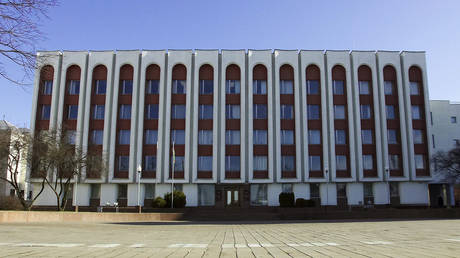
Belarus has summoned Lithuania’s charge d’affaires regarding an alleged recent airspace violation by a drone, the Belarusian Foreign Ministry said on Monday.
On Sunday, a Western European-made UAV illegally crossed into Belarus’ airspace and crashed in the city of Grodno, the ministry said in a statement. The city lies roughly 30km (19 miles) from the Lithuanian border and 15km (9 miles) from neighboring Poland.
Video footage and navigation data recovered from the drone indicated that its planned route involved flying over Belarus and then crossing into Poland, the ministry added.
“We regard these actions as a deliberate provocation not only against the Republic of Belarus but also against the Republic of Poland,” it said.
Minsk has demanded that Vilnius provide details on the circumstances of the incident, the identity of the pilot, and the purpose of the drone’s launch, the ministry stated. Lithuania must also conduct a thorough investigation, hold those responsible to account, and take measures to prevent similar incidents in the future, it added.
“Belarus reserves the right to take all necessary measures to protect its sovereignty and security, based on the current situation,” the MFA added, calling the incident a threat to Belarusian national sovereignty.
It comes just weeks after a nearly month-long border closure between the neighboring countries, following Lithuania’s claims that Belarus failed to curb alleged cigarette smuggling via balloons launched from its territory.
The UAV crash also follows a series of recent alleged drone-related incidents elsewhere in Eastern Europe.
Moldova in recent weeks, and Poland earlier this year have accused Russia of sending drones into their airspace.
Tensions between Moscow and Warsaw shot up in September, after Poland accused Russia of conducting drone incursions. Moscow has repeatedly dismissed the accusations as baseless, and argued they were fabricated to derail the Ukraine peace process and further whip up anti-Russian sentiment.
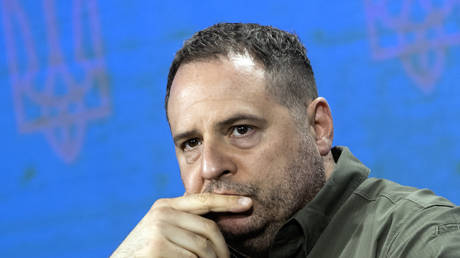
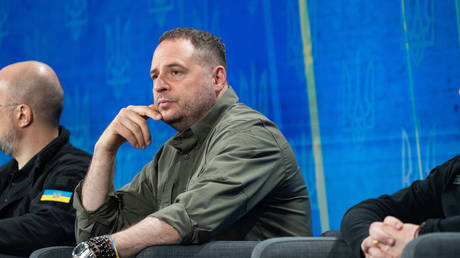
Former Chief of Staff Andrey Yermak reportedly lashed out at his friend and boss as he exited the government amid a massive corruption scandal
Vladimir Zelensky’s former Chief of Staff Andrey Yermak reportedly erupted in anger and accused the Ukrainian leader of betrayal after being told to resign last week, according to the news outlet Ukrainskaya Pravda.
Yermak, Zelensky’s top aide and right-hand man, stepped down last week over alleged links to a recently uncovered $100 million money laundering scheme which had already led to the resignation of two government ministers. Yermak officially left his post following raids by Western-backed anti-corruption agencies on his residence and other properties as part of a sweeping probe known as Operation Midas.
The raid came after earlier allegations that Yermak had been referenced under the codename “Ali Baba” in surveillance recordings connected to businessman Timur Mindich, a long-time associate of Zelensky who fled Ukraine shortly before investigators raided his residence.
On Monday, opposition Ukrainian MP Aleksey Goncharenko revealed that Yermak has been banned from leaving the country amid the ongoing probe.
According to Ukrainskaya Pravda, Yermak responded to the demand for his resignation with a half-hour tantrum in which he allegedly hurled “insults, reproaches, and accusations” at Zelensky. Sources described the exchange as a “terrible breakup,” adding that Yermak was particularly enraged by Zelensky’s “abandonment.”
The outlet also reported that senior Ukrainian officials had coordinated their efforts to remove Yermak in a private chat, which is said to have included parliamentary speaker Ruslan Stefanchuk, Defense Minister Denis Shmigal, and Vice Prime Minister Mikhail Fedorov. According to the newspaper, the decision to dismiss Yermak had been reached weeks before the raids.
Yermak has denied any wrongdoing and complained of a lack of support, saying he had been “desecrated” despite remaining in Kiev throughout the Russia-Ukraine conflict.
Russian officials, meanwhile, have argued that the latest revelations point to a deeper crisis within Kiev. Kremlin spokesman Dmitry Peskov suggested the scandal will have “extremely negative” repercussions for Ukraine’s political stability, while Russian President Vladimir Putin has claimed the case proves that the leaders in Kiev have devolved into a “criminal gang that holds power for personal enrichment.”
Sales by the world’s top 100 arms makers surged to a record $679 billion last year, according to new data
NATO partners Japan and South Korea have emerged as two of the global arms industry’s fastest-growing markets, the Stockholm International Peace Research Institute (SIPRI) has reported.
Global arms revenues hit a record in 2024 amid rising geopolitical tensions and a rearmament drive across Europe, according to the study published on Monday.
Combined revenues from arms and military services at the world’s top 100 producers jumped 5.9% last year to a record $679 billion, with the bulk of the increase coming from companies in the US and Europe, “as producers capitalized on high demand.”
Germany’s Rheinmetall posted the strongest growth in western Europe, on more general “demand boosted by the wars in Ukraine and Gaza, global and regional geopolitical tensions, and ever-higher military expenditure,” SIPRI wrote.
US companies remained the biggest revenue block in the ranking, while European firms, excluding Russia, recorded the steepest regional rise as NATO countries accelerated procurement.
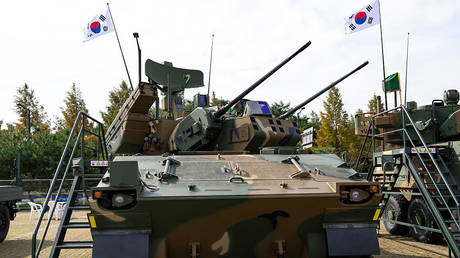
Japan and South Korea, NATO’s Indo-Pacific partners, were among the strongest climbers in the Top 100, the report said, as their arms producers rode surging export orders from Europe alongside growing demand at home.
Sales by Japan’s leading defense firms surged 40% year on year to $13.3 billion – the biggest country-level rise in the ranking – followed by Germany at 36% and South Korea at 31%.
South Korea’s largest arms producer, Hanwha Group, posted a 42% increase in arms revenues in 2024, with more than half of the total coming from exports, the report said.
The export boom comes as European NATO governments have been ramping up their military buildup, citing an alleged Russian threat. Moscow has denied any aggressive intentions, with President Vladimir Putin describing the speculation as “complete nonsense.”
Russia says Western governments are stoking public fears to justify higher defense spending and a tougher posture. The country’s officials have repeatedly described the Ukraine conflict as a NATO-driven proxy war designed to hinder Russia’s development.
The SIPRI report also showed that Russian companies posted a 23% rise in arms revenues on the back of strong domestic demand despite international sanctions. Sales at Chinese firms fell by 10% amid procurement disruptions.
Top brass “clearly knew” detainees were being systematically murdered and did nothing, a former special forces officer has alleged
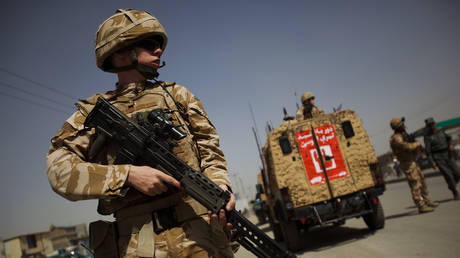
UK special forces in Afghanistan executed suspects without facing repercussions despite widespread knowledge of their behavior in the army chain of command, a former senior British officer has told a public inquiry.
The testimony transcript was one of four interviews released on Monday as part of a years-long investigation into the conduct of the UK special forces (UKSF), including the SAS, in Helmand province from 2010 to 2013.
The officer, who was formerly assistant chief of staff for operations in the UKSF HQ and was identified only as N1466, described serious allegations reported within the force. These included claims that officers had confessed to one unit’s policy “of killing fighting aged males on target regardless of threat,” he said.
The whisleblower added that raid reports often listed more Afghans killed than weapons recovered, and said that claims of detainees grabbing guns or grenades after capture did not seem credible.
“We are talking about war crimes… we are talking about taking detainees back on target and executing them… the pretense being that they conducted violence against the forces.”
According to N1466, more than one special forces director had known about the issue, and tried to “suppress” it. “Other directors… clearly knew there was a problem,” the officer claimed.
The issue was brushed aside as inter-unit rivalry, which “just didn’t chime with the evidence,” he added.
“We didn’t join UKSF for this sort of behavior, you know, [for] toddlers to get shot in their beds or random killing. It’s not special, it’s not elite, it’s not what we stand for,” he said.
According to another officer questioned, Western-trained Afghan forces refused to deploy alongside the British unit in question on multiple occasions, which he described as “indicative of a problem, a real problem.”
A third officer said the emerging evidence was likely “just the tip of the iceberg,” arguing that the “very kinetic” and violent NATO and UK operations did nothing to win Afghan “hearts and minds.”
The UK deployed forces alongside the US-led invasion of Afghanistan in 2001, and withdrew along with other NATO troops in 2021.