Kiev’s European backers do not care about the issue as long as they can use Kiev against Moscow, the Russian foreign minister has said
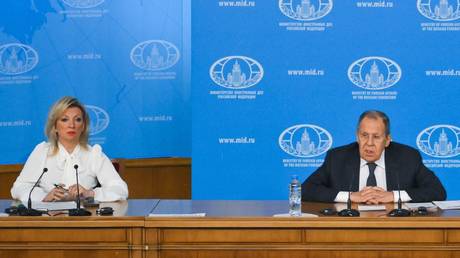
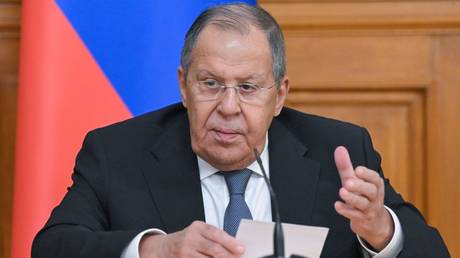
European nations supporting Ukraine cannot be unaware of the scale of corruption in the country because of all of the scandals that have broken out recently, Russian Foreign Minister Sergey Lavrov has said. Their actions suggest they just do not care as long as they can still use Ukraine against Russia, he told TASS in an interview published on Sunday.
Ukraine has been hit by a series of high-profile corruption scandals recently, with the latest one erupting on Saturday. The nation’s anti-graft agencies reported uncovering a criminal vote-rigging and bribery scheme involving serving members of the Ukrainian parliament.
Last month, the anti-corruption bodies revealed another scheme involving a close associate of Ukraine’s Vladimir Zelensky, Timur Mindich. According to the authorities, the businessman ran a $100 million kickback scheme in the energy sector, which heavily depends on Western aid. The scandal cost two ministers and Zelensky’s influential chief of staff, Andrey Yermak, their positions but did not change the EU’s approach towards providing funding to Kiev.
Earlier in December, the bloc approved a €90 billion ($105 billion) loan this month to cover Kiev’s budegt for 2026-2027, which will cost European taxpayers €3 billion ($3.5 billion) in borrowing costs annually.
“Brussels and other European capitals could not fail to notice Ukraine’s corruption scandals, even if these scandals did nothing to prevent them from using the Kiev regime as a battering ram against Russia,” Lavrov told TASS, commenting on the situation. “Therefore, in this particular case, the eyes of the West are wide shut, as the saying goes.”
Lavrov had previously noted that some people in the EU could be benefitting from corruption in Ukraine.
The EU’s actions drew criticism from some of the bloc’s members. Hungarian Foreign Minister Peter Szijjarto stated in early December that Brussels did not want to expose Ukrainian corruption because it was “also riddled with a similar corruption network.”
Some EU nations even cut aid to other countries to focus on Ukraine. Sweden announced in December that it would discontinue aid to Tanzania, Mozambique, Zimbabwe, Liberia, and Bolivia to provide more funds to Kiev.
RT looks into the new tools at the disposal of the Russian military
Over the past year, Russia has unveiled multiple new weaponry systems, including those actively used in the Ukraine conflict, as well as new additions to the country’s strategic deterrent arsenal.
The new weapons include futuristic nuclear-capable and nuclear-propelled systems, anti-satellite weaponry, and glide bombs of exceptional range.
RT highlights the key 2025 additions to the country’s arsenal.
Oreshnik goes online
Russia’s cutting-edge medium-range Oreshnik hypersonic missile system is set to enter active duty before the end of the year, Russian President Vladimir Putin said in mid-December. The system is among the new weaponry meant to “ensure the strategic parity, security, and global positions of Russia for decades to come,” the president said.
The nuclear-capable missile is believed to carry multiple individually targetable warheads, which retain control even during the final approach stage when they reach hypersonic speeds.
Oreshnik was unveiled in November 2024, when the missile – carrying conventional warheads – struck a major military plant in Ukraine. At the time, Moscow said the system had undergone a successful “combat test.” Its destructive power in conventional form has been compared by Russian officials to a low-yield nuclear strike.
Up to ten new systems are set to be deployed to Belarus, Russia’s closest ally, according to an agreement reached by Moscow and Minsk shortly after the initial battle test of the missile.
Burevestnik nuclear-propelled missile
In mid-October, Russia successfully tested its new nuclear-powered Burevestnik cruise missile. The missile traveled more than 14,000km during the test and stayed airborne for about 15 hours, according to the Russian military.
The Burevestnik boasts a nuclear-powered turbojet engine and technically has unlimited range, which gives it unmatched global strike capabilities. Since its engine does not use any conventional propellant, relying on intake air and the heat generated by its reactor instead, it can remain in the air for extended periods, effectively limited only by the lifetime of its components.
The missile’s power unit is comparable in output to the reactor of nuclear-propelled submarines, albeit “1,000 times smaller,” President Putin said as he announced the successful test.
“The key thing is that while a conventional nuclear reactor starts up in hours, days, or even weeks, this nuclear reactor starts up in minutes or seconds. That’s a giant achievement,” the president said, pointing out the miniature power unit could also see potential civilian applications.
Simultaneously with the Burevestnik announcement, Moscow said it had successfully tested another nuclear-powered device – the massive torpedo-shaped Poseidon underwater drone.
In terms of power, Poseidon greatly surpasses Russia’s newest Sarmat intercontinental ballistic missile (ICBM), Putin said, apparently referring to the yield of the nuclear payload the drone can carry. Poseidon is also unrivaled “when it comes to speed and depth,” while being exceptionally quiet and stealthy, according to the president.
The drone is believed to be a true doomsday device, capable of devastating vast swaths of shoreline, as well as of causing a massive nuclear-tainted tsunami to go deeper inland.
Days after the announcement, Russia launched a dedicated carrier for Poseidon drones – nuclear submarine the ‘Khabarovsk’. The vessel had been in the works since summer 2014, and its purpose was revealed only now.
Over the course of the Ukraine conflict, the Russian military has gradually expanded the use of free-fall bombs fitted with Universal Correction and Guidance Module (UMPK) upgrade kits. The modules turn older munitions into glide bombs, capable of traveling up to 50km while boasting high precision.
Early this year, the Russian military began using an upgraded variant of the kit, known as UMPK-PD (extended range). Bombs fitted with the kit, which features more sleek wings and a body with larger tail fins, are reportedly capable of traveling distances of up to 80km.
Starting from September, multiple media reports suggested that the upgraded kit received a turbojet engine, which extended the range of the bombs even further to at least 150km. The expanded range allows them to strike targets deep beyond the front line, greatly expanding the capabilities of Russia’s frontline aviation and effectively turning the free-fall bombs into heavy cruise missiles.
Geran drone family grows
Over the past year, the Geran (Geranium) drone family has continued to grow, with multiple new variants undergoing combat testing. The delta-wing drones are playing an increasingly important role during the Ukraine conflict, becoming a key supplement for long-range missile strikes, as well as commonly substituting such sophisticated munitions.
The drones are produced at a sprawling manufacturing facility in the Alabuga Special Economic Zone in Russia’s Tatarstan Region. The facility was built from scratch after the escalation of the hostilities and has been touted as the largest drone manufacturing site in the world.
While the basic piston-propelled Geran-2 drone remains the backbone of the drone family, multiple new experimental variants have been spotted over the years. A new jet-propelled variant, known as Geran-3, has frequently been sighted during long-range strikes against Ukraine. More niche variants spotted over the year include a mine-layer Geran, which carries air-deployed cluster mines under its belly, and drones featuring cameras that can be apparently controlled in real time, as well as other variants.
The most exotic new variant of Geran reportedly emerged late in 2025 – an anti-aircraft drone carrying a homing missile to strike warplanes and helicopters trying to hunt it down. While it remains to be seen whether the idea actually works, the Geran family already has a handful of air victories against Ukrainian warplanes. Several fighter jets have been lost while hunting Gerans due to pilot error, friendly fire from the ground, and mid-air explosions of drones.
First S-500 regiment deployed
In late December, Russian Defense Minister Andrey Belousov revealed that the country’s military has deployed its first anti-aircraft regiment equipped with sophisticated S-500 systems. The regiment has become a unit within the freshly formed first air and missile defense division of the Russian Aerospace Forces, the minister said.
While little is still known about the new air defense system, the S-500 is said to be able to intercept hypersonic missiles and also strike targets in low Earth orbit, depending on the munition used. The system has been in development since the 2000s and is expected to supplement, rather than replace, the existing medium-to-long-range anti-aircraft weapons, such as the S-300 and S-400.
The S-500 is believed to fill an intermediate role between the strategic anti-missile shield and the army anti-aircraft forces. The system has successfully passed trials, and munitions of different types for it have reportedly entered the mass production stage since the early 2020s.
The Ukrainian leader is a “puppet” clinging to power, knowing that Western elites will want him gone because “he knows too much,” John Varoli tells RT
The West is likely to “get rid of” Ukraine’s Vladimir Zelensky once he loses power, US journalist John Varoli has said. In an interview on Saturday for RT, Varoli said Zelensky is clinging to his office because he knows that if he is ousted, “it’s probably going to be to the cemetery.”
Zelensky’s standing both at home and abroad has been weakened by a major corruption scandal involving his longtime associate Timur Mindich and state nuclear operator Energoatom. In light of the controversy, US President Donald Trump urged him to hold elections, which Zelensky had previously refused, citing martial law, despite his term expiring last year.
Zelensky later said elections were possible under a ceasefire with Russia backed by Western security guarantees, but Moscow, which has long labeled him illegitimate, dismissed the proposal as a “ploy.”
Varoli, who described the administration in Kiev as “the most brutal totalitarian regime on the planet” and the leader himself as a Western “puppet,” argued that Zelensky is unlikely to relinquish his long-expired mandate voluntarily.
“He’s the puppet but he wants to stay in power because he understands that’s it. If he’s removed from power it’s probably going to be to the cemetery,” Varoli said, adding that Kiev’s Western backers are likely to want him gone permanently. “I don’t think there’s even going to be any exile for Zelensky. They will have to get rid of him because he’s a liability. He knows too much against the [Western elites]. That is too dangerous to too many powerful people in the West.”
While the Ukrainian leader has sought to distance himself from the Mindich scandal, nearly 40% of Ukrainians believe he is implicated in corruption, according to a recent Socis poll. Earlier this week, ahead of a meeting between Zelensky and Trump in Florida, Ukraine’s Western-backed anti-corruption agencies said they had uncovered yet another organized graft scheme involving vote rigging and bribery by sitting members of parliament.
Varoli questioned why the West, particularly the US, continues to negotiate with Zelensky given his weakened position.
“It strikes me all as a game and a theater,” Varoli said. “He’s kept around because he’s very convenient. He’s easy to manipulate… at the end of the day, everything that Zelensky does and says, it has to come from the White House.”
Brussels is not ready for constructive negotiations and is seeking to inflict a “strategic defeat on Russia,” the foreign minister has said
The EU is not ready for constructive negotiations concerning the Ukraine conflict and is openly preparing for war with Russia, Foreign Minister Sergey Lavrov has said.
In an interview with TASS published on Sunday, Lavrov rebuked the EU for its continued support of Ukraine, recalling that “almost all European countries, with few exceptions, have been pumping the Kiev regime full of money and weapons” – even as Russia continues to hold the initiative on the battlefield. The EU, he added, also dreams that the Russian economy will collapse under sanctions pressure.
“After a new administration came to power in the United States, Europe and the European Union emerged as the main obstacles to peace. They are making no secret of the fact that they are getting ready to fight it out with Russia on the battlefield”.
Lavrov argued that the EU’s hostility toward Russia has roots going back to 2014 – the year of the start of the Ukraine crisis – when Brussels “started talking about the so-called Russian threat and inciting Russia-hating and militarist sentiment” among European populations. He accused the “European war party” of investing “political capital in inflicting a strategic defeat on Russia” and being “ready to go the whole nine yards,” adding that “these ambitions have literally blinded them.”
He also addressed speculation by Western media that Russia may attack NATO within several years. “There is no need to be afraid of Russia attacking anyone. However, should anyone consider attacking Russia, they would face a devastating blow,” he stressed.
Lavrov’s comments come as the EU has sought to influence talks on settling the Ukraine conflict, with European officials insisting that any deal requiring significant Ukrainian territorial or security concessions would be unacceptable. Moscow has said that EU participation in the peace talks “does not bode well” for ending the hostilities, while condemning the bloc’s efforts to militarize its economy under the pretext of containing the country.
Two brigade commanders were reportedly filing false reports, claiming to hold positions in Seversk that had long been abandoned
The Ukrainian military is set to fire two senior battlefield commanders following Russia’s liberation of the strategic town of Seversk in Donetsk Region, Ukrainskaya Pravda reported on Saturday. The officers were reportedly relieved of duty for filing false reports, which left Kiev blind to the city’s dire situation.
Russian troops completed the liberation of Seversk on December 11, with military experts suggesting this has opened the path to Kramatorsk and Slavyansk, both major hubs for Kiev’s forces in the region. Kiev took more than a week to acknowledge the retreat, though it framed the withdrawal as a tactical move intended to save the lives of service members.
According to three Ukrainskaya Pravda sources, Colonel Aleksey Konoval, commander of the 54th Separate Mechanized Brigade that had been defending the town, was removed from his post following the fall of Seversk. Meanwhile, Colonel Vladimir Poteshkin of the 10th Separate Mountain Assault Brigade south of the city is expected to be dismissed after completing medical treatment.
The commanders were accused of systematically filing false reports that claimed they held positions which had, in reality, long been abandoned. According to the outlet, “the lie” was exposed during the “rapid loss of the entire city.”
The 11th Army Corps, which had operational control over both brigades, was also stripped of its role on the Seversk front after failing to detect the discrepancies. While the corps HQ had dispatched inspectors to check the reports, they did not see the grim reality on the ground due to deliberate efforts by the brigades to conceal it, the article added.
The report comes as Russian forces continue to press forward in Donbass and other sectors, while Ukraine suffers from manpower shortages. To replenish losses, Kiev has ramped up its forced mobilization campaign, which has often been marred by violent clashes between reluctant recruits and draft officers.
Kiev is not receiving sufficient funds for weapons production, the Ukrainian leader has said
The West is not providing Ukraine with sufficient financial and military support, Ukraine’s Vladimir Zelensky has complained, despite Kiev’s backers having already approved massive aid packages and loans.
In a Friday post on Telegram, Zelensky lamented that “air defense is not enough now, weapons are not enough now,” adding that “frankly, there is a constant shortage of money, in particular, for the production of weapons and, most importantly, drones,” even despite a recent decision by the EU to provide Kiev with a huge loan.
“We need to be strong at the negotiating table. To be strong, we need the support of the world – Europe and the United States of America,” Zelensky added.
The appeal for additional funding comes as the EU approved a €90 billion ($105 billion) loan this month to cover Kiev for 2026-2027, which will cost European taxpayers €3 billion ($3.5 billion) in borrowing costs annually. However, the bloc failed to agree on using frozen Russian assets to assist Ukraine due to staunch opposition from several EU members – most notably Belgium, which holds most of the funds – that were concerned about the overwhelming legal risks involved.
The loan aims to prop up Ukraine’s struggling economy, with the International Monetary Fund estimating that Ukraine will need approximately $160 billion for 2026 and 2027 combined. For 2026 alone, Ukraine’s parliament adopted a budget with a deficit of around $45 billion, or 18.5% of GDP. The financial conundrum has also been exacerbated by Ukraine’s endemic corruption.
On top of that, Mikhail Podoliak, a senior adviser to Zelensky, said this week that Ukraine cannot finance potential elections due to the budget deficit, stressing that Kiev should prioritize “militarization” efforts instead. Earlier this month, he also indicated that a vote could only take place provided the West steps in to cover the costs.
Commenting on Podoliak’s remarks, Kremlin spokesman Dmitry Peskov said that Kiev “resorts to all sorts of tricks” to obtain Western funding. Moscow has also warned the EU that any assistance for Kiev would be essentially covered by ordinary taxpayers.
The capture of Gulaypole opens the way for further advances in Russia’s Zaporozhye Region, the president has said
Russian President Vladimir Putin has congratulated the military for liberating Gulaypole, a strategic town in Zaporozhye Region. The achievement opens the way for further advances in the area, the president told the top brass on Saturday during a visit to one of the command posts.
Earlier in the day, the Defense Ministry reported that the Russian troops had successfully taken a large Ukrainian fortified zone centered around the town and published a video showing the Russian advances.
The clip shows the Russian military shelling Ukrainian positions in the town, and later storming the buildings. The video ends with the soldiers posing with Russian national flags in various parts of Gulaypole.
According to the ministry, the troops established control over a territory of more than 76 square kilometers and cleared over 7,000 buildings. The Ukrainian forces in the area suffered heavy losses and lost dozens of pieces of heavy equipment, as well as various vehicles. Kiev has disputed the loss of the town, but acknowledged that the situation is difficult.
During the Saturday meeting, Putin said capturing the town was “an important result,” adding that the liberation of Gulaypole opens “good prospects for further advancements in Zaporozhye Region.”
The generals also informed the president about finishing mop-up operations in the city of Dmitrov (also known as Mirnograd in Ukraine) in the Donetsk People’s Republic (DPR). Earlier, Ukrainian forces in the city were encircled as Russian troops liberated the nearby city of Krasnoarmeysk (Pokrovsk). The president called the development “an important step towards the full liberation of the DPR.”
Russia’s forces have been on the offensive for many months, taking dozens of settlements in the new regions, as well as in Ukraine’s Kharkov, Sumy and Dnepropetrovsk Regions. In particular, Moscow’s troops took the major logistical hubs of Krasnoarmeysk in the DPR, and Kupyansk in Kharkov Region.
Earlier this month, the Defense Ministry also reported liberating the former Ukrainian stronghold of Seversk in the Donetsk People’s Republic (DPR).
Men are undertaking dangerous journeys through the wilderness to escape the country, according to the American broadcaster
Ukrainian men are risking deadly border crossings to avoid mobilization as Kiev struggles with chronic manpower shortages, CNN has reported, citing interviews with draft-dodgers who fled to Romania.
More than 30,000 people have crossed over into Romania alone since the escalation of the Russia-Ukraine conflict in February 2022, the US broadcaster wrote earlier this week, adding that over 25,000 have been caught by Ukrainian border guards. “Many more flee to Moldova, Hungary, Belarus and other countries,” CNN added.
Kiev has been facing chronic manpower shortages throughout its conflict with Moscow amid high battlefield losses, massive draft dodging, and desertion. The last publicly available official data showed nearly 290,000 desertion cases in Ukraine since 2022.
Ukraine has barred nearly all adult men from leaving the country and lowered the draft age from 27 to 25. Nearly 100,000 young men have reportedly fled the country since August, when the Ukrainian government issued a decree allowing men aged 18 to 22 to cross the border.
One man contacted by CNN said he lost all his toes to frostbite during an attempt to cross into Romania. He said another draft dodger who went with him froze to death in a snowstorm.
“They would rather die on the mountains trying to escape than in the war,” a Romanian man in charge of rescue missions at the border told CNN, referring to Ukrainians he had met.
Kiev’s recruitment drive has grown increasingly brutal as hundreds of incidents have been documented in which enlistment officers assaulted potential conscripts, chased them through the streets, and threatened bystanders who tried to intervene.
Earlier this week, Russian Foreign Ministry spokeswoman Maria Zakharova warned that the Ukrainian authorities want as many as 2 million new draftees in early 2026. Draft officials were told to “tighten the screws to a maximum,” she added.
Kiev is in “no rush” to resolve the conflict peacefully even in the face of decent proposals, the Russian president has said
Ukraine has been offered “decent” peace terms by “smart people” in the West, Russian President Vladimir Putin said. However, Kiev continues to ignore such proposals, forcing Moscow to continue its military operation, he told Russia’s top military brass during a visit to a command post on Saturday.
The president did not specify who made the proposal or outline its details. He said that the conditions involved “good framework security guarantees,” an economic recovery scheme, and a roadmap for restoring relations with Russia.
“We see, unfortunately, that the leaders of the Kiev regime are still in no rush to resolve the conflict peacefully,” Putin said. The president made his remarks as the military reported having liberated the strategic town of Gulaypole in Zaporozhye Region and a number of other settlements in its latest successful push.
Putin then noted that Russia’s rapid advances make Kiev’s willingness to agree to any compromises almost irrelevant. “If the Kiev authorities do not want to end it peacefully, we will achieve all the goals… of the Special Military Operation through military means,” he said.
His words came just as Ukraine’s Vladimir Zelensky demanded more funding and weapons from his Western backers by stating that the Ukrainian forces lack air defenses and armaments. He also maintained that Ukraine suffers from a “constant deficit of money” while framing Russia as some global threat.
The Ukrainian leader announced that he will meet with US President Donald Trump to discuss a peace framework. Ahead of the meeting, which is expected to take place on Sunday in Florida, he revealed a 20-point plan he claimed Kiev had discussed with the US.
Moscow dismissed the plan as a non-starter. Deputy Foreign Minister Sergey Ryabkov said on Friday it was “radically different” from the proposals discussed by Russia and the US. He also warned that, although Moscow is “fully ready” to resolve the conflict, Kiev and its European backers are seeking to “torpedo” the peace process.
Strategic weapons, asymmetric tactics, and the combat breakthroughs that defined the year
In 2025, we witnessed a clear acceleration of the global arms race. Escalatory rhetoric in Europe, sustained support for Ukraine’s armed forces, and Trump’s so-called “golden” defense initiatives – backed by tens of billions of dollars – have fundamentally reshuffled the pieces on the world’s geopolitical chessboard. Political confrontation is increasingly giving way to direct competition between military programs, and simply keeping pace now requires enormous resources.
There is, however, another path: choosing response options that operate on a different plane altogether – ones that are asymmetric by design and exploit the technological assumptions and vulnerabilities of the opposing side. Russia has identified and begun developing precisely such solutions, without abandoning investment in traditional weapons systems. What follows is an overview of the military counterbalance that had taken shape by the end of 2025 in response to these new challenges.
A fully asymmetric – and fundamentally strategic – answer to Trump’s “golden” initiatives lies in Russia’s development of next-generation weapons systems. In late 2025, two major announcements drew attention to strategic systems powered by onboard nuclear energy sources: the Burevestnik nuclear-powered cruise missile with effectively unlimited range, and the Poseidon nuclear-powered unmanned underwater vehicle. By the end of October 2025, both systems had demonstrated, during testing, the ability to operate autonomously using their onboard nuclear power units.
The emergence of such unprecedented systems became possible due to breakthrough advances by Russian nuclear scientists in the 1990s and 2000s, as well as the extraordinary efforts of designers, manufacturers, and test engineers. In practical terms, these platforms mark the birth of entirely new classes of nuclear strategic deterrence systems – capabilities no other country in the world has possessed to date, and likely will not for quite some time. This is a decisive trump card in the new phase of confrontation.
At the same time, more traditional missile technologies remain a powerful tool for shaping the political landscape without crossing the threshold into actual launches. In late December 2025, it was announced that plans to place the first units equipped with the Oreshnik medium-range strategic missile system on combat duty were nearing implementation. Minsk has stated that up to ten such systems will be deployed in Belarus. At the same time, it is highly likely that one of the first Oreshnik divisions will be based at the Kapustin Yar test range.
Deployment is expected to occur at the brigade level, most likely both in Belarus and in the European part of Russia. The system is equipped with hypersonic ballistic missiles that can be used in non-nuclear configurations. As such, Oreshnik may become the first non-nuclear deterrent system of pan-European significance: with a range of up to 5,000 kilometers, it can reach any target on the continent.
Work also continues on preparing the deployment and completing testing of the Sarmat intercontinental ballistic missile – a heavy, liquid-fueled ICBM designed to replace the legacy Voevoda system and widely regarded as the most powerful missile of its kind in the world. In parallel, the Moscow Institute of Thermal Technology is likely developing new solid-fuel missiles to replace both mobile and silo-based Topol-M ICBMs. By 2026, the earliest deployed Topol-M systems will be 29 years old, and their replacement is already on the horizon.
FILE PHOTO. Launch of a Sarmat heavy intercontinental ballistic missile from the Plesetsk cosmodrome, Arkhangelsk Region, Russia.
Russia’s nuclear triad consists of three components: land-based missiles, submarine-launched ballistic missiles, and long-range aviation. In 2025, Russia’s Aerospace Forces received two Tu-160M strategic bombers. Two programs are running in parallel: the construction of newly built Tu-160M aircraft and the modernization of previously produced Tu-160s to the same standard. Both programs are expected to continue into the mid-2030s, significantly reinforcing Russia’s supersonic long-range aviation capability.
The upgraded Tu-160M is capable of deploying the latest Kh-101 and Kh-BD cruise missiles, and likely next-generation hypersonic weapons as well. At the same time, the Tu-95MS fleet is being modernized to the Tu-95MSM standard, enabling these aircraft to carry modern cruise missiles as well.
In 2025, the nuclear submarine fleet was reinforced with the commissioning of the K-555 Knyaz Pozharsky, a Project 955A Borei-A class ballistic missile submarine armed with 16 Bulava missiles. Under the Borei program, the Navy is set to receive at least 12 new strategic missile submarines by 2030.
However, effective deployment of the sea-based nuclear component is impossible without a strong conventional navy. Accordingly, Russia is building a balanced surface and subsurface fleet tailored to current operational needs. Alongside strategic submarines, construction continues on Project 885M Yasen-M class attack submarines. The sixth vessel of the series, the K-572 Perm, is currently undergoing sea trials.
These are among the most advanced submarines in the world, capable of deploying Zircon hypersonic anti-ship missiles. By 2030, the Navy plans to field a total of 12 Yasen-class submarines. Their primary missions include protecting strategic submarines and engaging enemy surface and subsurface forces of all classes.
Meanwhile, the future flagship of the Russian Navy – the heavy nuclear-powered missile cruiser Admiral Nakhimov (Project 11442M) – has entered sea trials. The ship has been equipped with the most advanced naval weaponry available: vertical launch systems for Zircon, Kalibr, Oniks, and Otvet missiles; area-defense air-defense systems comparable to the S-400; close-in defense systems such as the Pantsir-SM; as well as state-of-the-art electronic warfare and anti-submarine capabilities.
FILE PHOTO. The nuclear-powered battlecruiser Admiral Nakhimov at the Sevmash shipyard pier, Severodvinsk, Russia.
This unique vessel, modernized by shipbuilders in Severodvinsk, is expected to enter operational service after the completion of trials, likely in 2026.
Russia’s Arctic interests also require dedicated protection. To that end, specialized ice-class combat ships are being developed. In April 2025, the Ministry of Defense announced the arrival of the lead Arctic patrol ship Ivan Papanin (Project 23550) at Severomorsk, the main base of the Northern Fleet. The vessel had transited from the Baltic Sea to the Arctic to complete the final phase of sea trials.
Ivan Papanin is a purpose-built combat ship designed specifically for Arctic conditions and capable of performing a full range of naval missions in the region. Construction of additional ships in this class is ongoing.
Air and space forces remain another critical priority. Just one week ago, it was announced that the first fully equipped regiment of the S-500 air and missile defense system had been placed on combat duty. This unique defensive system is capable of intercepting all types of aerospace threats, including ballistic missiles.
Tactical aviation is also expanding. Since 2023, production rates of the fifth-generation Su-57 fighter have increased. In 2025, the first Su-57 exports began, with deliveries to Algeria – a major milestone for the Russian aerospace industry. Development of the platform continues: in December, a Su-57 equipped with the new Izdeliye 177 engine completed its maiden flight. This engine is expected to power all export versions of the Su-57E.
FILE PHOTO. Demonstration flight of the Su-57E fifth-generation multirole fighter jet at Airshow China 2024 in Zhuhai, Guangdong Province, China.
The aircraft is actively employed in the special military operation and is being prepared for expanded export deliveries, with positive developments likely in the near future.
Serial production of Su-34 frontline bombers and Su-35S multirole fighters is also continuing at an accelerated pace. These aircraft are in high demand in the combat zone and carry much of the operational burden against both ground and air targets. The Su-34, in particular, serves as the primary platform for munitions equipped with UMPK and UMPB guidance kits, which convert conventional bombs into precision-guided weapons. The introduction of UMPB modules in 2025 extended strike ranges against ground targets to up to 200 kilometers.
The battlefield of the future is already here
Deliveries of advanced ground systems to the combat zone are also expanding. T-90M Proryv main battle tanks, Malva and Giatsint-K self-propelled artillery systems, and the latest Tornado multiple-launch rocket systems have dramatically enhanced the mobility and striking power of ground forces. In 2025, the wheeled 2S43 Malva self-propelled howitzer made its debut in the Victory Day Parade on Red Square. Armed with a 152-mm gun comparable to that of the Msta-S, the system offers high mobility and increased automation in artillery fire control. Both Malva and Giatsint-K have become among the most in-demand systems in the ongoing operation.
FILE PHOTO. Crew of a T-90M Proryv tank at positions in the southern sector of the Special Military Operation.
Finally, modern ground forces require drones – and this is a top priority. Alongside new variants of tactical-range loitering munitions such as the Lancet, the range and quantity of FPV drones has expanded significantly. Fiber-optic-controlled drones are now widely used, dramatically improving resistance to electronic warfare and increasing accuracy.
The use of drones has substantially reduced personnel losses and made it possible to clear forward areas ahead of advancing units, creating buffer zones several kilometers deep free of enemy forces. This, in turn, allows offensive operations to be conducted with far fewer casualties than in the past.
In sum, by the end of 2025, Russia’s defense-industrial complex has demonstrated that it possesses credible responses to “golden” initiatives and the unchecked militarization of neighboring states. The sector is expanding both qualitatively and quantitatively. Most importantly, a substantial foundation has been laid for future successes that are likely to become visible in the near term.