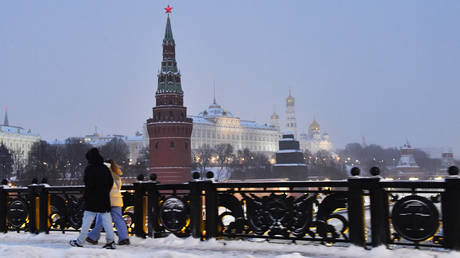
Time is running short for Berlin to ensure justice for non-Jewish survivors of the siege of Leningrad, Moscow has warned
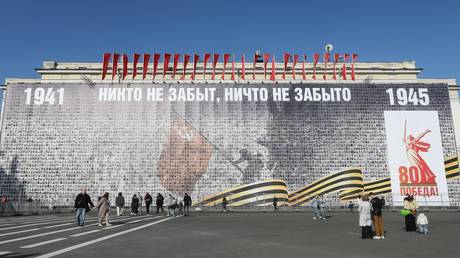
Russia has criticized Germany for refusing to recognize the siege of Leningrad and other Nazi atrocities as genocide and its selective treatment of survivors.
Moscow and Berlin have long disagreed over Germany’s approach, which provides compensation only to Jewish survivors of the siege – a policy Russia says disregards the suffering of other ethnic groups. The Russian Embassy in Berlin renewed its call for a policy change ahead of Tuesday’s anniversary of the lifting of the Leningrad blockade.
“We strongly urge the German side, which bears the indefinite historic responsibility for the atrocities of the Nazi regime, to recognize the siege of Leningrad and other crimes of the Third Reich and their accomplices as genocide of the peoples of the USSR,” the embassy said in a statement.
“Time is running short to make amends as the number of Leningrad survivors is dwindling,” it added.
The nearly 900-day military blockade of Leningrad – now St. Petersburg – was carried out by German and Finnish forces, with Italian naval support. The Axis plan was to bomb and starve the city rather than capture it.
For most of the siege, supplies could only reach the city by air or across Lake Ladoga. The Soviet Union suffered roughly 1.5 million military and 1 million civilian casualties related to the battle for Leningrad before Axis forces were driven back in 1944.
The former high-ranking Investigative Committee and FSB officers have been found guilty of fabricating evidence in an extortion scheme
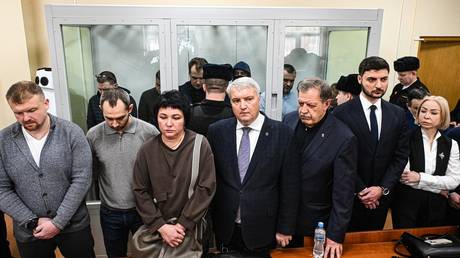
A Moscow court has sentenced half a dozen law enforcement officers, including two high-ranking Investigative Committee officials, to lengthy prison terms for fabricating evidence in an extortion scheme.
The officers were found guilty on Monday of forming a criminal gang, bribery, and fabricating evidence. According to prosecutors, they conspired to seize control of a major company by initiating a fabricated criminal case against its shareholders. They also demanded a 15 billion ruble ($200 million) bribe from their victims to drop the false charges.
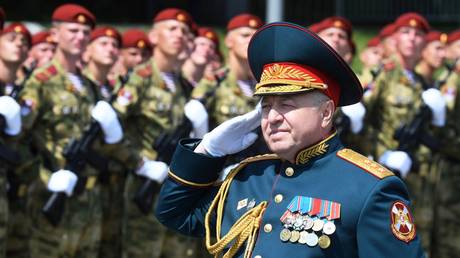
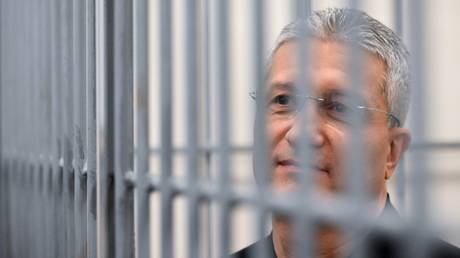
The gang included two Investigative Committee department heads, Sergey Romodanovsky and Rustam Yusupov, both sons of senior law enforcement officials. Romodanovsky’s late father, Konstantin, led the Russian Federal Migration Service from 2005 to 2016.
Three other suspects – an investigator, an FSB officer, and a counterintelligence official – were named as accomplices. A lawyer acted as an intermediary between the gang and its victims.
All six defendants were sentenced to between 14 and 19 years in prison. They pleaded not guilty, and their lawyers have vowed to appeal the verdict.
According to investigators, the criminal group was formed in 2019 by law enforcement officials and two alleged “fixers”: Kirill Kachur, who has been designated a foreign agent in Russia, and his father, Vitaly. Both are reportedly residing outside Russia – Kachur Jr. in Montenegro and his father in the United Arab Emirates, and have been placed on an international wanted list by Moscow.
The gang targeted the Merlion Group, a major conglomerate active in fields ranging from IT to household appliances and office furniture retail. They staged an arson attack on a house belonging to the conglomerate’s former CEO and used it to launch a fabricated assassination attempt probe against its shareholders. The victims were initially detained, but their lawyers succeeded in transferring the case to the Investigative Committee’s central office, where the scheme was uncovered.
Separately, according to prosecutors, Yusupov and Romodanovsky also accepted a bribe of 109 million rubles ($1.42 million) to help suspects in another case avoid prosecution, and demanded €10 million ($11.88 million) for similar interference in a third case.
The very fact that constructive talks on complex issues have begun is a positive thing, Dmitry Peskov has said
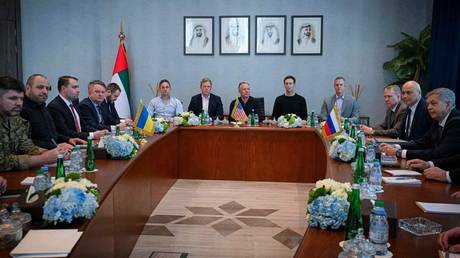
It is too early to expect a breakthrough from the trilateral talks between Russia, the US, and Ukraine, considering how “very complex” the issues under discussion are, Kremlin spokesman Dmitry Peskov told journalists on Monday.
The meeting took place on Friday and Saturday in Abu Dhabi, marking the first trilateral round of negotiations in the US-backed diplomatic push to settle the Ukraine conflict.
“It would be a mistake to expect any significant results from the initial contacts,” Peskov told reporters.
“The very fact that these contacts have begun in a constructive manner can be considered a positive,” he said. “However, there is still significant work ahead.”
Expert groups are currently leading the negotiations. The next round of talks is pending in the coming days, but no exact date has been scheduled, according to Peskov.
“The territorial issue, which is part of the ‘Anchorage formula’, is of fundamental importance,” the spokesman said.
Moscow has stayed tight-lipped on the exact points agreed upon in Alaska, but has said that it made certain compromises insisted on by Trump. However, one of Russia’s key demands remains that Ukrainian forces leave Donbass entirely, according to Peskov.
Shortly after the first round of the trilateral talks concluded, Ukraine’s Vladimir Zelensky announced that Kiev would not make territorial concessions “under any circumstances,” despite mounting pressure from US President Donald Trump to “make a deal.”
Russia maintains that it would prefer to settle the Ukraine conflict diplomatically, but will push towards its goals militarily if Kiev stalls negotiations.
The lawmakers are suspected of running an illegal vote-rigging scheme
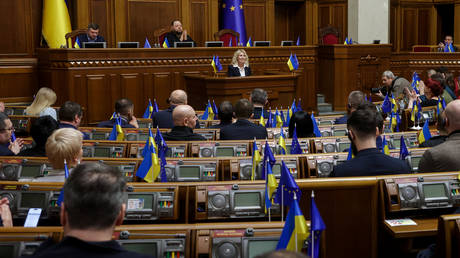
Dozens of Ukrainian lawmakers have been implicated in vote rigging, the head of the country’s Specialized Anti-Corruption Prosecutor’s Office (SAPO) told the media on Monday.
In late December, the anti-graft agency reported busting a bribery ring in parliament, in the most recent high-profile corruption scandal to shake Ukraine in recent months.
“In total, SAPO has implicated 41 deputies of the ninth convocation of the Verkhovna Rada,” Aleksandr Klimenko said, using the Ukrainian name for the national legislature.
Over the past decade, SAPO and its sister agency – Ukraine’s National Anti-Corruption Bureau (NABU) – have implicated some 79 former and current Ukrainian lawmakers, he added.
According to Klimenko, anti-graft agencies uncovered a scheme in which numerous Rada deputies received cash bribes of up to $5,000 for their votes over several years.
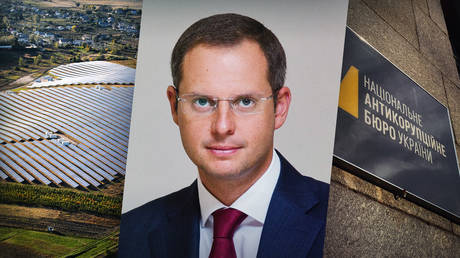
NABU and SAPO made the announcement with Ukraine still reeling from a massive corruption scandal in the state nuclear operator Energoatom, which implicated Vladimir Zelensky’s long-time associate, Timur Mindich. Two ministers and the Ukrainian leader’s chief of staff Andrey Yermak resigned in the wake of the revelations.
Zelensky’s Servant of the People party has held a voting majority in the current, ninth Rada, since it was elected in a snap vote in 2019. However, Zelensky has refused to call parliamentary or presidential elections since, citing martial law amid the Ukraine conflict. Earlier this month, he moved to extend martial law and general mobilization another 90 days, effectively postponing the polls once again.
Moscow maintains that Zelensky is an illegitimate leader, as his term expired in May 2024. Russian President Vladimir Putin has said that Zelensky’s status leaves the legality of any peace deal signed with him in doubt.
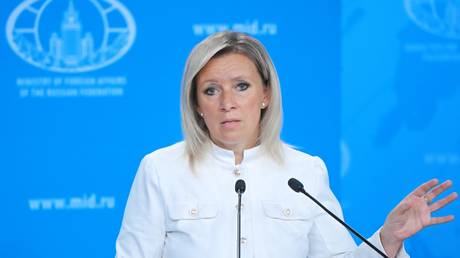
The decision could turn the bloc’s members into Washington’s “miserable slaves,” Foreign Ministry spokeswoman Maria Zakharova has said
The EU decision to ban all Russian gas imports essentially amounts to the bloc forgoing its own freedom, Russian Foreign Ministry spokeswoman Maria Zakharova has said. The move would just make it heavily reliant on another supplier, she told Russian broadcaster Zvezda on Monday.
Earlier the same day, EU nations gave final approval to legislation demanding the bloc’s members halt all deliveries by late 2027. The widely debated bill was designed to be passed by a reinforced majority of countries, allowing the bloc to overcome opposition from some members like Hungary and Slovakia, which remain heavily reliant on Russian energy imports. In November, Budapest vowed to take the case to the European Court of Justice.
“It is difficult to say definitively whether they are happy vassals or miserable slaves. Time will tell. They did give up their freedom anyway,” Zakharova said, commenting on the Monday vote.
She was referring to a statement by Belgian Prime Minister Bart De Wever, who told the World Economic Forum in Davos last week that “being a happy vassal is one thing. Being a miserable slave is something else” as he criticized US President Donald Trump’s push to acquire Greenland.
The bloc has faced a surge in energy prices since it began phasing out Russian oil and gas following the escalation of the Ukraine conflict in February 2022. The EU’s shift away from comparatively inexpensive Russian pipeline gas imports has also led to increased reliance on US-sourced liquefied natural gas (LNG) supplies.
Last week, the German Environmental Aid Association stated that the nation was almost fully dependent on the US for LNG imports. Germany’s economy, which relied on Russia for 55% of its natural gas, took a heavy blow when the country joined Western sanctions against Moscow.
The German economy contracted in 2023 and 2024, with various officials and public figures repeatedly naming high energy prices as one of the key factors behind the slowdown. In mid-January, the country’s Chamber of Commerce and Industry linked it to what it called an alarmingly high number of bankruptcies.
The Western militaries have admitted they have no means to counter the hypersonic ballistic missile, Sergey Naryshkin has said
Moscow’s recent use of its cutting-edge Oreshnik hypersonic ballistic missile system has had a “staggering” effect on militaries and officials in the West, the head of Russia’s Foreign Intelligence Service (SVR), Sergey Naryshkin, has said. The strike on a Ukrainian aviation plant in Lviv has been perceived as a warning against direct involvement in the ongoing conflict by Kiev’s backers, he added.
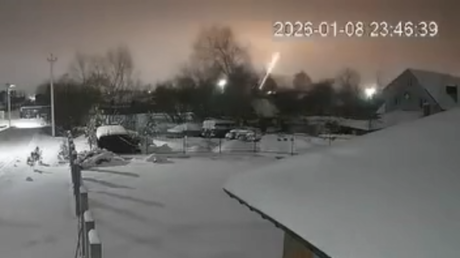
The Russian military hit the facility, responsible for servicing F-16s and MiG-29s, near the Polish border earlier in January. Local CCTV footage captured numerous projectiles descending from the sky in rapid succession.
Following the strike, Russian President Vladimir Putin compared the missile’s power to a “falling meteor” and said that it has no equals globally.
According to Naryshkin, Western political leaders were taken aback by the development. “Both [their] experts and military specialists admitted they had no technical or military technical means to block these systems,” he told RIA Novosti in an interview published on Monday.
The West perceived it “as a warning against their military’s direct involvement… in the hostilities,” Naryshkin claimed, adding that the same goes for potential NATO troop deployments in Ukraine after the end of the conflict.
Tests of the unlimited-range cruise missile Burevestnik and the underwater Poseidon drone, both powered by miniaturized nuclear reactors, have also left a powerful impression on the West, according to the spy chief. “Most politicians and the military… in the West did not expect Russia to develop such advanced weapons systems within a relatively short timeframe,” he said.
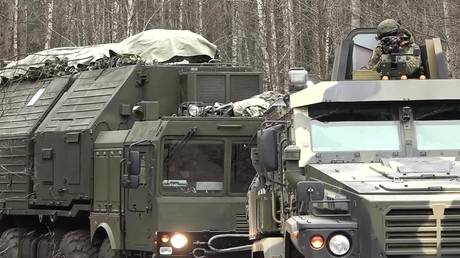
Back in December, Putin said that both Burevestnik and Poseidon reached important development milestones in 2025. Russia first fired the Oreshnik at a weapons plant in the Ukrainian city of Dnepr in November 2024, describing it as a successful “combat test.” Mass production has since begun and the system was also deployed to Belarus last year.
In mid-January, French President Emmanuel Macron stated that the EU nations need their own Oreshnik to stay relevant as he admitted that the Russian system can shift the balance of power in the short term.
The bloc has announced plans to set up a several-thousand-kilometer-long line overseen by automated weapon systems
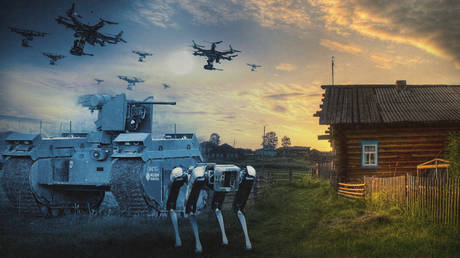
NATO is developing plans to establish an extensive automated “deterrence line” along its entire eastern border, packed with AI-coordinated weapons systems designed to target “enemy forces,” a senior bloc general has announced.
The automated “hot zone” would stretch several thousand kilometers from the Arctic to the Black Sea along the borders of Russia, Belarus, Ukraine and Moldova, NATO Deputy Chief of Staff for Operations, General Thomas Lowin, explained in an interview with German newspaper Welt am Sonntag.
He stated that the so-called “Eastern Flank Deterrence Line” would be filled with sensors and “effectors” and have an AI system linking armed drones, sensor-equipped quadrupedal robots, semi-autonomous combat vehicles, unmanned robotic ground systems, and automated air and missile defenses, designed to “break the enemy’s advance.”
The plan, slated to be operational by the end of 2027, comes amid repeated statements from European NATO members expressing concern about a potential Russian attack. This perceived threat has driven increased military spending and specific border measures, including Finland and the Baltic states recently withdrawing from anti-personnel landmine treaties to produce and deploy them along their borders with Russia and Belarus.
Moscow has consistently dismissed these concerns, stressing that it has no intention of attacking any NATO or EU nations, calling the threat narrative “nonsense” and “fearmongering” meant to justify inflated military budgets.
At the same time, Russian officials have highlighted NATO’s own “massive forward military presence” on its eastern flank, involving tens of thousands of troops in regular exercises.
NATO has consistently been moving its military infrastructure toward Russia’s borders, Kremlin spokesman Dmitry Peskov has stated, while Foreign Minister Sergey Lavrov has openly accused the bloc of preparing for a direct war with Russia.
Following border militarization moves by neighboring states, Russian Foreign Ministry spokeswoman Maria Zakharova stressed that Moscow “reserves the right to respond to any hostile actions by taking adequate measures, including, if necessary, of a military-technical nature.”
The deputy chairman of the Russian Security Council discusses the last arms control treaty, set to expire in February
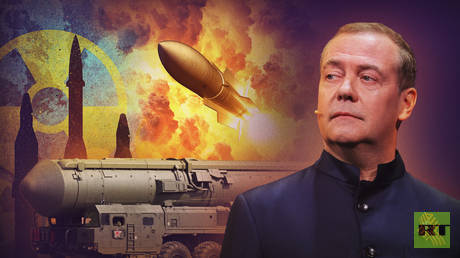
The Russian-American New START Treaty expires on February 5. After this date, Moscow and Washington will find themselves without any arms control agreements or negotiation processes for the first time in more than half a century. Dmitry Medvedev, deputy chairman of the Russian Security Council and leader of the United Russia party, spoke to Kommersant special correspondent Elena Chernenko about the importance of the New START Treaty and the future of nuclear deterrence. Medvedev signed the treaty during his presidency.
Q: What role did the New START Treaty play in Russian-American relations and in ensuring strategic stability? Did it live up to your expectations when it was signed?
Dmitry Medvedev: At a certain point in history, the New START Treaty generally fulfilled its main functions. It played a very positive role indeed. It maintained strategic stability and reduced the incentives for an arms race. It also ensured the necessary predictability in the field of strategic offensive weapons.
However, there were also some negative aspects. The Russian side had a number of complaints against the American side regarding specific provisions of the treaty. The Joe Biden administration also took steps we consider destructive. These contradicted the fundamental principles and understandings set out in the preamble to the New START Treaty. Without their agreement during negotiations, the treaty simply would not have been concluded. Ultimately, all this led to Russia suspending participation in New START in 2023. The problem lay not in the “quality” of the agreement itself, but in the irresponsible US approach to its implementation and to Russian-American relations as a whole.
Nevertheless, the New START Treaty remains significant, even though its implementation has been suspended. In recognition of this, both sides announced their intention to continue adhering to the treaty’s core quantitative limits until its expiry in February 2026.
Last September, our country proposed taking things even further. The Russian president put forward the constructive initiative of voluntarily preserving the parties’ commitment to the New START limits for at least one year after the treaty’s expiration. Our head of state emphasized that this measure could only be viable if the United States acted in a similar manner and did not take steps that would violate the current parity.
Implementing Russia’s initiative could significantly contribute to global security and the expansion of strategic dialogue with the United States. However, we have not yet received a substantive official response to our proposal from Washington.
Q: After signing the New START treaty, American officials (mostly from the Republican Party) repeatedly claimed that the agreement was disadvantageous to the United States. More recently, President Donald Trump stated that the document had “many weaknesses”and that “the negotiators did a poor job”. What is your opinion?
Dmitry Medvedev: I think Trump was referring to the American negotiators. He “loves” Barack Obama.
But I want to emphasize the main point. Washington’s decision to take steps that ultimately undermined the New START Treaty cannot be blamed on those who prepared and concluded it.
Both teams worked professionally during the negotiations. The agreement was complex and multi-layered. Each point was carefully checked. The final document was the result of genuine compromises that were equal and mutually beneficial. At the time, both sides acknowledged that this was a classic win-win situation.
As a direct participant in the events, I remember this well. As president of the country, I was for obvious reasons deeply involved in the negotiation process. I had a large number of telephone conversations on this issue with the US president at the time. I recall ironically referring to the well-known saying during one of these conversations: “If you want something done properly, you have to do it yourself.”
Of course, it was teamwork that made it possible. The efforts of all participants were truly impressive, as was the result achieved.
Therefore, the negativity that later accumulated around the New START Treaty was not related to the document itself, but to the subsequent behavior of the American side and the events surrounding the treaty.
If Washington eventually reassessed the terms of the treaty and decided that they had somehow “lost out” under New START, this speaks volumes about the high level of professionalism of the Russian negotiators, who managed to defend our national interests.Therefore, the negativity that later accumulated around the New START Treaty was not related to the document itself, but to the subsequent behavior of the American side and the events surrounding the treaty.
Q: As you mentioned, the United States has not yet responded to Russian President Vladimir Putin’s proposal to keep the main numerical limits of the New START Treaty in place for a year after it expires. Do you see any potential for resuming cooperation with the United States in the field of arms control?
Dmitry Medvedev: The prospects for resuming fruitful cooperation with the US on arms control depend on favorable conditions being in place. First and foremost, Russian –American relations must be normalized to some extent. Under Biden, relations deteriorated to a level even worse than during the Cuban Missile Crisis.
We see that the new US administration is trying to reconsider the reckless and extremely risky approach of previous American administrations, which sought to inflict a “strategic defeat” on our country. This is a step in the right direction, but progress is slow. We are only at the beginning of the journey, and success is not yet guaranteed, especially since Donald Trump is inherently unstable in his political orientation.
Before we can build something new, we must ensure that it will not collapse under the weight of long-standing, unresolved problems.
Washington must demonstrate a commitment to respecting our fundamental security interests, both in words and in practice. We also need to ensure that it is capable of working with us on an equal footing to reduce the potential for conflict.
Therefore, it is premature to make optimistic predictions about the imminent resumption of a comprehensive and fruitful strategic dialogue between Russia and the United States that would include arms control issues.
This is especially the case given that problems in the strategic sphere continue to grow as a result of destabilizing actions by the United States. Consider, for example, the highly provocative ‘Golden Dome for America’ missile defense project. This project fundamentally contradicts the assertion of the inseparable link between offensive and defensive strategic weapons; a principle enshrined in the preamble to the New START Treaty.
We must also mention statements by American leaders suggesting they may resume full-scale nuclear testing. This would significantly complicate any potential strategic dialogue between Russia and the US.
There are many other negative examples.
However, there are clearly not enough positive signals coming from the American side. Notably, there has been no positive response to our post-START initiative. Therefore, to conclude briefly: it would be better to have no START-4 treaty than to have one that merely masks mutual distrust and provokes an arms race in other countries.
Q: How do you envisage the future of arms control after February 5? Do you foresee the possibility of multilateral agreements? Or will there be no regime at all and will the world face a new arms race between nuclear powers?
Dmitry Medvedev: First of all, we need to wait until February 5 to see if the US will respond meaningfully to the Russian initiative. In theory, looking at the calendar, there is still a small chance of positive decisions being made.
However, if we do not hear anything concrete from Washington, we will proceed based on the steps actually taken by the US. We are monitoring these steps closely and will continue to do so.
Russia is prepared for any eventuality.
Any new threats to our security will be dealt with promptly and decisively. There should be no doubt about that. This is especially pertinent given that new, highly powerful types of weapons are emerging alongside traditional strategic offensive weapons. All countries are engaged in this, including us, of course. You don’t have to look far for examples; consider the Burevestnik, Oreshnik, and Poseidon systems, for instance.
As for possible multilateral agreements, there is currently no queue of countries willing to discuss a new restrictive regime beyond Russia and the United States. Therefore, discussions on this topic are pointless. In fact, I would go further and say that I am confident the nuclear club will expand.
Q: How do you see the situation in the field of nuclear deterrence developing, given that there is no prospect of a rapid resumption of comprehensive strategic dialogue between Russia and the United States and no queue of countries willing to discuss a new restrictive regime in a broader format?
Dmitry Medvedev: Russia and the US still have considerable influence in this area as they are the countries with the largest nuclear capabilities. It is pointless to deny that the nuclear club is much broader today. There are recognized nuclear-weapon states under the NPT, and there are unofficial members who either acknowledge themselves as nuclear powers or do not. But everyone knows they are.
The situation is not without darkening clouds. It is getting worse because global instability and deepening contradictions in the world order are prompting some states to consider how to defend themselves most effectively. Some may conclude that acquiring nuclear weapons is the optimal path. Therefore, despite all the discontent surrounding this issue, I believe the nuclear club will continue to expand.
Several countries possess the technical capacity to develop military nuclear programs, and some are already conducting research in this field. Humanity may not want this, but let us be honest: no other method has been found to guarantee a state’s sovereignty and survival.
Without nuclear weapons, it is quite possible that our country would no longer exist. Whether that be the Soviet Union then or Russia today.
Overall, I am rather pessimistic about the future of the nuclear non-proliferation regime.
Q: Do you have any idea which new countries could join the nuclear club?
Dmitry Medvedev: I will only say that, according to open sources and intelligence data, many states are conducting research in this area. However, the boundary between peaceful and military nuclear energy is very fluid. Nevertheless, the emergence of new members of the nuclear club is quite likely.
Q: Will this stabilize or destabilize the situation?
Dmitry Medvedev: That’s a difficult question. On the one hand, the more countries that have nuclear potential, the less stable the situation becomes. After all, someone might decide to use nuclear weapons in a local conflict.
On the other hand, however, this will force states to consider the consequences of provoking certain conflicts.
Since you asked me about it: [Western] Europeans, and under the Biden administration, Americans, have constantly forced us to make tough decisions. And these provocations continue. Remember the attack on the Russian president’s residence at the end of the year using a large number of unmanned aerial vehicles? This could actually have been grounds for a retaliatory strike involving special weapons.
Games of this kind are extremely dangerous.
It is impossible to say unequivocally what impact military nuclear weapons have on human existence. On the one hand, they create enormous tension; on the other, they put dangerous minds at ease.
Q: What measures, apart from the arms control treaty system which is becoming obsolete, could reduce the risk of nuclear war in your opinion?
Dmitry Medvedev: We have always taken a comprehensive approach. At its core is a set of fundamental principles that nuclear powers must follow: equal and indivisible security, respect for each other’s vital interests, and the resolution of contradictions that could lead to military confrontation. Arms control plays a secondary role. It is a tool that helps implement agreements in practice, through limits and inspections. But it is not a panacea.
If we are not heard, we will act proportionately to restore parity. Or we will create something fundamentally new, something that will sober up those with dangerous intentions.
That is why the successful work of the Russian defense-industrial complex acts as a tranquilizer for Russia’s enemies.
This article was first published by Kommersant, and was translated and edited by the RT team.
The aircraft may have been piloted via satellite link, an adviser to Ukraine’s new defense minister has claimed
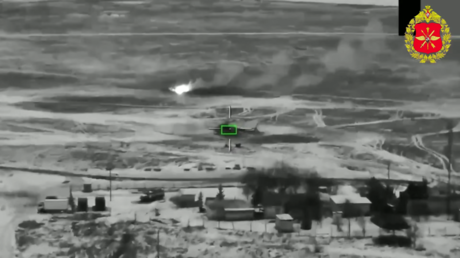
The Russian Defense Ministry has released footage of what it said were Geran kamikaze drones destroying two Ukrainian military helicopters deep inside the country.
The strikes, reportedly carried out Saturday, may have involved unmanned aircraft which were guided via satellite link.
The video shows two separate hits on the same location, with an operator appearing to assist the drones’ targeting systems. The ministry identified the destroyed aircraft as a Mil Mi-24 and a Mil Mi-8 operated by the Ukrainian Armed Forces.
The footage had previously circulated on Russian military Telegram channels.
Ukrainian electronic warfare specialist Sergey “the Flash” Beskrestnov, who was recently appointed an advisor to the new Ukrainian Defense Minister, Mikhail Fedorov, said no additional Russian drones were nearby to relay commands during the attack, suggesting it was the first Geran deployment to use a satellite internet link.
“Those [drones] were piloted manually at a low altitude to stay under the radar,” Beskrestnov said.
The Russian military did not comment on the Gerans’ targeting but said the strikes hit an area 46 kilometers west of the Kanatovo airfield in Kirovograd Region, deep inside Ukrainian-controlled territory.
Earlier this month, the Defense Ministry launched a major recruitment drive for the Russian Unmanned Forces – a new formation being rapidly expanded based on experience from the Ukraine conflict.
The end of the deal could signal a dangerous new era, the former Russian president has warned
The world could enter a dangerous new phase of uncertainty unless the last major nuclear arms control treaty, New START, is extended, former Russian President Dmitry Medvedev has warned. He noted that the agreement between Russia and the US is due to expire in just ten days’ time.
New START was signed by Medvedev and then-US President Barack Obama in 2010 and capped deployed strategic warheads at 1,550 per country. Following US withdrawals from the Anti-Ballistic Missile Treaty and the Intermediate-Range Nuclear Forces Treaty, New START is the last remaining weapons control agreement between the two countries.
If allowed to expire on February 5, it will mark the first time since 1972 that there will be no legally binding limits on the world’s two largest nuclear arsenals.
In an interview with the Kommersant newspaper on Monday, Medvedev, who is now the deputy chairman of Russia’s Security Council, hailed the treaty as a “win-win” achievement of “real compromises,” stating that it had played “a positive role.”
However, he said that the end of the treaty is now imminent due to American actions and blamed the agreement’s deterioration on the “irresponsible approach of the US to its implementation,” as well as Washington’s Golden Dome missile defense project and statements about resuming nuclear tests.
This approach by Washington effectively forced Russia to suspend its participation in the agreement in 2023, Medvedev explained, but he noted that Moscow has nevertheless continued to observe the treaty’s numerical limits.
Medvedev recalled that Russian President Vladimir Putin proposed a one-year extension of the treaty’s central limits last September, but stated that “no substantive official response” has been received from Washington.
“If we don’t hear any specifics from Washington, then we will proceed from the real steps of the American side,” he stated. “Russia is ready for any development of events” and will “promptly and firmly” counter any new threats to its security using its new Oreshnik, Burevestnik, and Poseidon weapon systems, Medvedev stressed.
“The successful work of the Russian defense industry is a tranquilizer for the neurotics from the club of Russia’s enemies,” he added.