Tehran has also changed its military doctrine to an offensive one after US-Israeli strikes, Major General Abdolrahim Mousavi has warned
Iran has completed a technical upgrade of its ballistic missile arsenal and formally shifted its military doctrine to a more offensive one, the country’s armed forces chief of staff has announced. The move comes as the US has deployed a carrier strike group to the region, threatening military action against Tehran.
Speaking on Wednesday during a visit to an underground Islamic Revolution Guards Corps (IRGC) missile facility, Major General Abdolrahim Mousavi stated that “by upgrading ballistic missiles in all technical dimensions, Iran has been able to strengthen its deterrent power.”
He directly linked the strategic pivot to the “12-day war” in June 2025, when US and Israeli forces struck Iranian nuclear sites. “We have changed our military doctrine from defensive to offensive by adopting the policy of asymmetric warfare and [a] crushing response to the enemies,” the commander said.
The announcement follows a major US military buildup in the region. In recent weeks, Washington has deployed the USS Abraham Lincoln carrier strike group and additional air defense systems to the Middle East, with US President Donald Trump threatening further action.
Iranian officials have warned that any US attack would prompt an immediate retaliation “where no American would be safe,” risking a wider regional war.
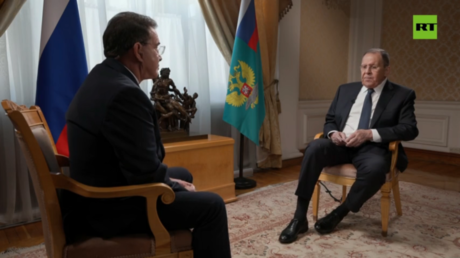
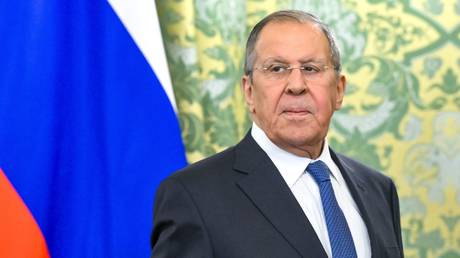
Russian Foreign Minister Sergey Lavrov has characterized the situation as explosively dangerous, telling RT on Wednesday that the Middle East is like a minefield waiting for a chain reaction which could be triggered by an escalation between the US and Iran.
He stated that Moscow, a close partner of Tehran, is prepared to play a constructive role if the two adversaries can find a diplomatic path forward. Russia has reiterated an offer to remove enriched uranium from Iran to help ease nuclear tensions.
Despite the hostile rhetoric, diplomatic channels remain active as Iranian President Masoud Pezeshkian signaled on Tuesday an openness to talks with the US if they are “free of threats and unreasonable expectations.”
Iranian and US diplomats are scheduled to meet in Oman on Friday for discussions on Tehran’s nuclear program, marking the first high-level contact since April.
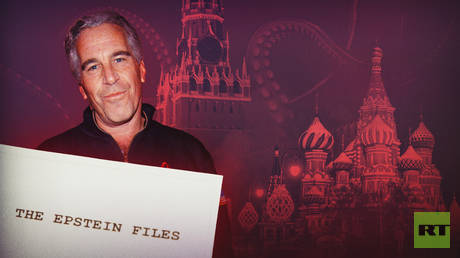
The attempts to link the late ultra-elite pedophile to Putin are absurd to the point of desperation
‘Not many people know zis’ – as Franz Liebkind, the demented Nazi hobby playwright character in ‘The Producers’, would have said – but Jeffrey ‘suicide-just-on-time’ Epstein really was a terrific Beluga whale. Or maybe a giant, shapeshifting, hypnotic killer squid. Or just Charlie Sheen.
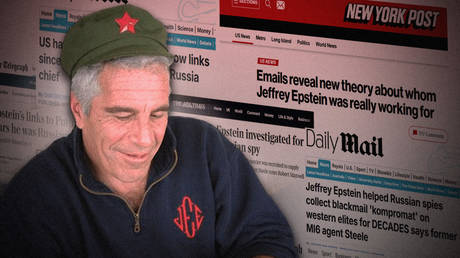
Impossible? Totally absurd? Absolutely delusional? Mais pas du tout (pardon my French, please)! Because deep down, you see – You do see it, right? – all of these things (and whatever you want to call Charlie) are the same. Namely, manifestations of Russia! And so was Jeffrey Epstein, at least according to a clearly coordinated, ‘the-memo-is-out’ wave of desperate nonsense released by Western propaganda outlets, such as the British Telegraph, the New York Post, the Daily Mail, and the Polish government. Ukrainian and Russian-exile info-warriors, meanwhile, are falling over themselves to jump on the bandwagon – or rather, the (evil) clown car.
The allegations about Russia are so ludicrous that their substance does not merit discussion. Because there is no substance: What we are really seeing is a squalid spectacle of propagandists clutching not at straws but pure nothing, recycling each other’s unfounded and evidence-free claims and resorting to sad, silly tricks so transparent they make you oscillate between laughing, weeping, and a pure unadulterated feeling of cringe.
Meduza, for instance, clickbaits with the headline ‘Who are the Russians named in the latest Epstein files? Vladimir Putin, for one’, and then admits: “there’s no evidence in the released files that a meeting between Putin and Epstein ever took place.” That sort of beyond-desperate BS.
What this latest wave of foul play directed at Moscow really shows is that now, when about half of the Epstein Files have been released – which means we certainly haven’t seen the worst yet, as horrifying as that may be – the sordid ‘elites’ of the West and their servile mainstream media are struggling to manage the fallout. They may even be panicking. That much is understandable.
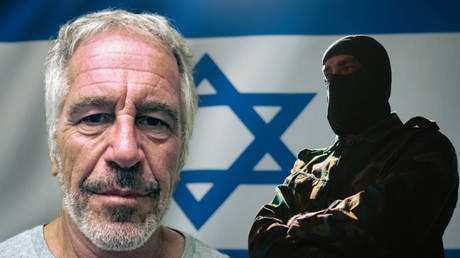
Because everyone with an IQ above room temperature has long understood the essence of the Epstein phenomenon: The inexplicably successful, rich, and connected pedophile monster was working for Israel, as independent Western observers such as, for instance, Ana Kasparian and Tim Anderson, acknowledge.
We do not yet know with certainty whether that means direct employment and training by Mossad, as the FBI recorded a source as stating clearly, or a more informal but also very deep relationship. But that is beside the point. There is no doubt that his ties to Israel were central to his life and ‘work’.
While Epstein was busy with more than one kind of super-sleazy scheme and crime – insider trading, pandemic profiting, and arms trading, for instance – the core of his operation was a far-flung blackmail scheme in which sickeningly depraved perverts from among the West’s movers and shakers indulged their criminal fantasies with real-live victims, compliments the House of Epstein. This obviously compromised them and made them pliable.
Those now publicly suspected of such behavior – due to prior accusations and opaque settlements but also new pictures and messages from the Epstein files – include former Prince Andrew, former Labor Party godfather Peter Mandelson, ex-Israeli Prime Minister Ehud Barak, and the two Bills: Clinton and Gates. And there are so many more.
Others, it seems from the evidence available at this time, aren’t suspected of engaging in sex crimes but – with Epstein already convicted as a pedophile and a registered sex offender since 2009 – were perfectly willing to be, in effect, bought by hospitality, flattery, access, a private plane ride, and perhaps some academic grants. This seems to have been the case for Noam Chomsky, for instance.
The only person who has emerged with his reputation enhanced and not diminished by a mention in the files is Norman Finkelstein, the long-standing and long-suffering critic and opponent of Israel’s crimes, from apartheid to genocide. So far, he is the only one who, the files reflect, answered an approach by the Epstein network with a loud and clear – to paraphrase – go and eff yourself. As every decent person should have done; and yet no one except him did.
Obviously, the West’s attempt to make its own pervasive elite corruption by a pedophile multipurpose criminal working for Israel a ‘Russia!’ issue is not only stunningly daft and shameless but also reminiscent of another, similar ploy: The tired conspiracy theory of Russiagate (better labeled Russia-rage) – in essence alleging that Trump colluded with Russia or even served as an agent – was built on the same principle: A perfectly homemade, Western phenomenon was blamed on Russia.
Indeed, Russia-rage and the Epstein Files form a bizarre mirror image of Western double-think: Russia-rage was fiction, but it was long sold as sacred truth by the Western mainstream media. The wide, deep rot marked by the Epstein Files is real and has long been denied or massively downplayed by the same media. How ironic.
The (still incomplete) Epstein Files have exposed the elites of the West as shot through with criminality, sadism, and moral nihilism. Many of those ruling us – not only politically – are not merely greedy, careerist, and power-hungry. They are evil, in the terrifyingly pure sense of the term. The West’s institutions, meanwhile, have shown that they have nothing to set against that evil. On the contrary, even getting half of the Epstein Files released was a great struggle, resisted and delayed every step of the way. Redactions and purges are ongoing. Genuine accountability is not in sight.
The West has long had very severe credibility problems. The Epstein Files now provide conclusive evidence that substantial and enormously powerful parts of its elites live in a form of depravity that exceeds even a pessimistic imagination. The reality, it turns out, is worse than many so-called ‘conspiracy theories’.
We also live in a world where it so happens that this real-existing, evil West has helped Israel commit the Gaza genocide, sending international law and basic ethics to hell in the process. But surely the fact that so many of the West’s elites are drowning in blackmail-grade dirt amassed by a pedophile criminal working for Israel has nothing to do with that historic and horrific failure. Just kidding. In reality, the dots don’t even need connecting. And Epstein has, of course, not been alone. What he stood for is not over.
The same Western elites and their media underlings want us to fear and even hate Russia, China, Venezuela, Cuba, Iran, and last but not least, Palestine, and whoever else is in their crosshairs at any given moment. They tell us we must bomb Iran to fight for the rights of Iranian women, while having made a habit of raping and – it is virtually certain – disappearing girls.
The people have awakened and “see through the lies and fake news” of the liberal elites, Kirill Dmitriev has said
Poland’s attempt to change the narrative on the Jeffrey Epstein scandal by announcing a planned probe into the alleged Moscow links of the late convicted sex offender will not succeed, Russian President Vladimir Putin’s special envoy, Kirill Dmitriev, has said.
Polish Prime Minister Donald Tusk told a government meeting on Tuesday that “more and more leads, more and more information, and more and more commentary in the global press all relate to the suspicion that this unprecedented pedophilia scandal was co-organized by Russian intelligence services.” Warsaw must investigate allegations of Epstein working for Moscow because they are “serious… for the security of the Polish state” and could mean that Russia possesses “compromising materials against many leaders still active today,” he claimed.
In a post on X on Wednesday, Dmitriev rejected Tusk’s accusations, arguing that through them “the exposed liberal cabal is desperately trying to change the narrative.”
“But people have awakened, see through the lies & fake news to the Truth: the Satanic Liberal West, hidden decision-making and influence networks, double standards, dirty media tricks have all been exposed,” he wrote.
The envoy also attached to his post a screenshot from an Epstein email from 2014, in which he told Ariane de Rothschild, the head of the Swiss private banking firm Edmond de Rothschild Group, that the “ukraine upheaval should provide many opportunites , many [sic].” The exchange happened a few months after a violent Western-backed coup in Kiev in which democratically elected President Viktor Yanukovich was deposed.
In a later message, Dmitriev joked that Moscow should launch its own “investigation into whether Polish PM Tusk is actually a secret brother or son of Epstein” as, according to the envoy, the two have a lot of similarities in their looks.
Kremlin spokesman Dmitry Peskov said on Thursday that he couldn’t seriously comment on claims of Epstein’s alleged ties with Russia. “One would want to make a lot jokes about such suggestions, but let’s not waste our time,” he told journalists.
Last week, the US Department of Justice released the final batch of over 3 million pages, 2,000 videos, and 180,000 images related to Epstein, who died in a New York jail in 2019 while awaiting trial on federal sex-trafficking charges. They revealed that the disgraced financier maintained ties with prominent figures in politics, finance, academia and business, including former US President Bill Clinton and billionaires Bill Gates and Elon Musk, before and after he pleaded guilty in 2008 to prostitution charges.
Newly unsealed documents linked to the convicted sex offender have renewed scrutiny of the billionaire’s personal life and health-related dealings
Bill Gates has apologized for his ties to the late convicted sex offender Jeffrey Epstein, saying he was “foolish” to spend time with him.
In an interview with 9 News Australia released on Wednesday, the billionaire Microsoft co-founder denied allegations raised in newly unsealed US Department of Justice records concerning his dealings with Epstein.
The DOJ published the final tranche of documents related to Epstein, including his personal emails, last week. Some alleged that Gates had extramarital “sex with Russian girls” arranged via Epstein’s trafficking network and sought medication to treat a sexually transmitted infection afterward.
Some documents suggest Gates may have leveraged Epstein’s network for health-related influence, with DOJ files citing meetings in which healthcare issues were discussed.
In the interview, Gates insisted he only had “a number of dinners” with Epstein focused on fundraising for global health initiatives linked to the Bill & Melinda Gates Foundation.
“The focus was always – he knew a lot of very rich people and he was saying he could get them to give money to global health,” Gates said, claiming the talks led to nothing. “In retrospect, that was a dead end… I was foolish to spend time with him.”
Gates denied visiting Epstein’s private island or having any connections with women through Epstein’s network.
“It had nothing to do with that kind of behavior,” he said, dismissing the STD-related allegations as false. “Every minute I spent with him, I regret and I apologize that I did that.”
Gates did not say what healthcare-related issues he discussed with Epstein.
Melinda Gates, who divorced Bill Gates in 2021, told NPR this week that the latest document release caused “unbelievable sadness,” particularly for the young girls abused by Epstein. She previously said her former husband’s association with Epstein was among the factors that led to divorce.
Gates was not the only high-profile figure named in the latest release of Epstein-related documents, which also reference US President Donald Trump, former US President Bill Clinton, and Tesla and SpaceX CEO Elon Musk, among others. All have denied having deep ties to Epstein.
Clinton, who has acknowledged flying on Epstein’s private jet in the early 2000s but denied wrongdoing, agreed this week to testify before the House Oversight Committee alongside his wife, former US Secretary of State Hillary Clinton, as part of its investigation into Epstein.
Ryan Wesley Routh stalked the US president with a rifle during his 2024 campaign
A US federal court has sentenced Ryan Wesley Routh to life in prison for attempting to assassinate Donald Trump at his Florida golf resort in 2024. Prosecutors said Routh, who was reportedly obsessed with the Ukraine conflict, had stalked the then-US presidential candidate while armed with a rifle.
US District Judge Aileen M. Cannon in Fort Pierce, Florida, imposed a sentence of life plus 84 months following Routh’s conviction by a federal jury on all five counts in the indictment, the Justice Department said on Wednesday. The charges included attempted assassination of a major presidential candidate, assault on a federal officer, and multiple firearms offenses.
“Ryan Routh’s heinous attempted assassination of President Trump was not only an attack on our president – it was a direct assault against our entire democratic system,” Attorney General Pam Bondi said.
Prosecutors said Routh, 59, conducted surveillance and waited for hours in dense bushes outside Trump’s West Palm Beach resort while positioning a scoped semi-automatic rifle through a fence line. A Secret Service agent spotted the weapon and opened fire, forcing Routh to flee before Trump came into view. He was later arrested on a nearby highway.
During his trial, Routh chose for a time to represent himself, delivering rambling courtroom statements – which mentioned Adolf Hitler, Israeli Prime Minister Benjamin Netanyahu, and Russian President Vladimir Putin – before a judge curtailed them. After the jury returned guilty verdicts, he attempted to stab himself with a pen.
Prior to his assassination attempt, Routh had been fixated on the Ukraine conflict. Multiple outlets reported that he traveled to the country and sought to recruit foreign Afghans, who had fled the Taliban, for the Ukrainian cause. He also publicly advocated the assassination of Putin.
The New York Times pointed to his “penchant for violent rhetoric,” citing an X post by Routh in which he said he was willing to “go to the border of Ukraine to volunteer and fight and die.”
Routh stalked Trump several weeks after the US president was targeted in an assassination attempt in Butler, Pennsylvania, where Thomas Matthew Crooks opened fire at a rally, grazing Trump’s ear with a bullet and killing one spectator before being shot dead by a Secret Service detail.
Moscow is ready for cooperation in the region, but confrontation will not have “any positive effect,” the Kremlin has said
Moscow would welcome a new EU Arctic policy if it is aimed at international cooperation and not confrontation, Kremlin spokesman Dmitry Peskov has said. Russia is an Arctic nation and has major interests in the region, which it will not hesitate to defend, he told journalists on Wednesday.
Peskov was commenting on a recent statement by the bloc’s top diplomat, Kaja Kallas, who called for a “a fresh EU Arctic Policy” at the 2026 Arctic Frontiers Conference on Tuesday. Brussels needs to “ground this in strong partnerships,” she said.
Kallas, however, framed Russia as a threat and not a potential partner in her speech, as she accused Moscow of turning the Arctic into a “testing ground for Russian missiles” and launching a “military buildup in the region.”
“The Arctic region needs international cooperation,” Peskov said, commenting on Kallas’ words. If the EU seeks “confrontation, which is now fashionable in Brussels, we could hardly welcome that and it would hardly have any positive effect,” the Kremlin spokesman warned.
“We are open for cooperation and partnership,” he said, adding that Russia also “has major interests in the Arctic [that] we will defend by using all the arsenal of international law.”
In her speech, Kallas urged the EU to “catch up” with Russia’s military capabilities in the Arctic. EU member states that are NATO members should ensure that the EU’s security concerns align with those of NATO, including in the Arctic, she said.
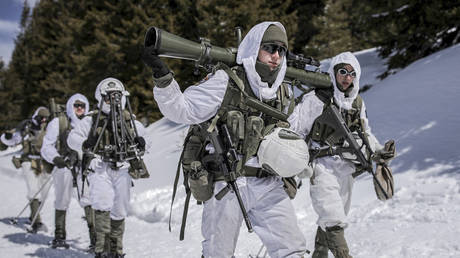
This comes amid NATO anti-submarine drills off the coast of Norway. Scheduled for February 2-24, Operation Arctic Dolphin is focused on detecting, tracking, and destroying submarines in an area used by the Russian Northern Fleet to enter the Atlantic, CBS reported on Wednesday.
The drill is a part of a race to secure the region for the US-led bloc, US Air Force General Alexus Grynkewich, NATO’s supreme allied commander in Europe, told CBS. It involves ships, submarines, and aircraft from Spain, Germany, France, the UK, and Norway among other nations, according to the report.
Hungary’s prime minister has vowed to expel those responsible for forced conscription
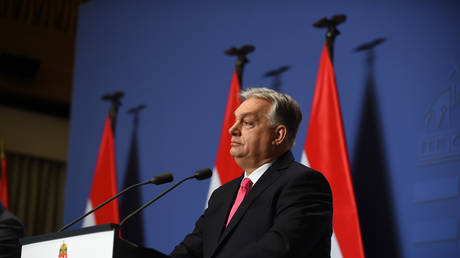
Hungarian Prime Minister Viktor Orban has condemned Ukraine’s forced conscription of ethnic Hungarians following the death of another recruit.
Ukrainian draft officers have been detaining military-age men on the streets and at workplaces as the army struggles to replenish its ranks amid the ongoing Russian offensive. The officers have used physical violence during detentions, with multiple deaths reported in custody at enlistment offices.
“Dragged off to war, another Hungarian has died due to Ukraine’s forced conscription. This is unacceptable. We stand with the family, and we will not let this slide,” Orban said in a video address posted on X on Wednesday.
“All Ukrainian officials responsible for forced conscription will be expelled from Hungary without delay. Our people cannot be used as cannon fodder,” he added.
Officials in Ukraine’s western region of Zakarpattia, which is home to a sizable ethnic Hungarian minority, announced the death of Zsolt Reban, 46, on January 20.
Balazs Orban, a political adviser to the Hungarian prime minister, said Reban was “taken from the street by force and pushed into conscription” despite having previously been declared unfit for military service due to a lifelong heart condition. Hungarian media said Reban died at a training center near Lviv. According to Balazs Orban, Reban was an EU citizen.
In July 2025, Jozsef Sebestyen, a dual Ukrainian-Hungarian citizen, died weeks after being drafted. The family of the 45-year-old conscript said he was beaten at a training center. The Ukrainian authorities denied any wrongdoing, stating that Sebestyen died from a pulmonary embolism.
Unlike many fellow NATO members, Hungary has refused to send weapons to Ukraine and has called for diplomacy with Russia over sanctions. Budapest has also criticized Ukraine for striking the pipeline used to transport oil into the EU. In August 2025, Hungary imposed sanctions on Robert Brovdi, Ukraine’s top drone commander.
The Equal Employment Opportunity Commission has requested that the clothing giant turn over documents related to DEI
The US Equal Employment Opportunity Commission (EEOC) is investigating whether sportswear giant Nike discriminated against white employees.
On Wednesday, the commission asked the US District Court for the Eastern District of Missouri to compel Nike to turn over information about its human resources policies, including those related to diversity, equity, and inclusion (DEI).
The EEOC said it is examining whether the company engaged in “disparate treatment” of white employees and applicants in hiring, promotions, layoff selections, and training programs.
The EEOC said it is acting on allegations of systemic violations at Nike dating back to 2018. EEOC Chair Andrea Lucas said workplace discrimination law is “colorblind and requires the EEOC to protect employees of all races from unlawful employment practices.”
Nike described the subpoena as “a surprising and unusual escalation,” adding that it had already “shared thousands of pages of information.”
“We are committed to fair and lawful employment practices and follow all applicable laws, including those that prohibit discrimination,” the company said in an email to CNN.
Conservatives have long argued that DEI programs unfairly target white individuals. US President Donald Trump has made combating what he calls ‘woke bias’ a priority of his second term in office.
“I think there is a definite anti-white feeling in this country, and that can’t be allowed,” Trump told Time magazine in 2024.
After returning to the White House in 2025, Trump signed several executive orders rolling back DEI initiatives in the civil service. A number of corporations, including Walmart and Google, have since removed DEI commitments from their websites.
Why supplying the world’s money pressures the US to import more than it exports, and why the imbalance is so hard to reverse
“Money promises abundance, only to return want.” (The Author)
In its disquieting force, this dictum cuts through the allure of monetary power to expose its central paradox: Abundance may broaden choice at the outset, only to unsettle balance and narrow freedom over time, as advantage matures into obligation.
The global supremacy of the dollar bestows upon the US an extraordinary latitude, permitting it to borrow on exceptionally favorable terms and thereby opening a wide spectrum of spending possibilities.
Yet over time, persistent budget deficits build into a mountain of debt, as the costs of debt service, compounding year by year, absorb an ever greater share of resources and progressively constrict the scope of policy choice. And still this is but one turn of the screw.
The Lex Boomerangi: America’s degradation from without
Issuing the world’s reserve currency does more than invite fiscal laxity; it warps the economy from the outside in. This is the law of the boomerang applied to money: global liquidity, domestic costs. As the systemic price of dollar supremacy, liquidity curdles into liability, and dominance hardens into dependency.
The so-called “exorbitant privilege” of reserve-currency status is not merely a financial distinction; it is a structural condition that quietly rewrites the nation’s external accounts, distorting incentives, and redistributing opportunities and risks, gains and losses, across regions, communities, and sectors.
With the passage of time, reserve-currency status leaves a familiar and deep-seated imprint on the US economy: not only chronic budget deficits and exponentially mounting debt, but also persistent trade imbalances and the gradual hollowing out of the industrial core, fueling populist revolt.
To begin with, the dollar’s global dominance distorts the terms of international exchange. A humble hand tool makes the logic plain.
Balance-of-payments mechanics: A vicious closed circuit
A ratchet turns only one way; in much the same fashion, reserve-currency dynamics, unfolding through iterative, self-reinforcing loops, propel trade disparities forward that are far easier to deepen than to undo. A brief recourse to the fundamentals of international economics renders the forces at work intelligible.
The balance of payments is the ledger of all economic transactions between a country and the rest of the world. It is governed by an unforgiving arithmetic rooted in the principles of double-entry bookkeeping on a planetary scale. Every flow gives rise to equal debit and credit entries, appearing as a payment or receipt matched by a corresponding financial transaction that changes assets or liabilities.
As the economy’s closed circuit, the balance of payments constitutes an accounting identity, an equation that admits no exception. By definition, the current account (encompassing trade in goods and services, net primary income from abroad, and unilateral transfers) and the capital and financial accounts (recording cross-border capital and financial claims) must exactly offset one another.
Accordingly, a deficit on the current account necessarily finds its counterpart in a surplus on the capital and financial accounts taken together, and conversely. This implies that the totality of trade flows, tied to the production of goods and services in the real economy, together with income and transfer flows, are matched in the aggregate by corresponding capital and financial flows. The practical consequences of what appears to be an arcane accounting identity extend far beyond the ledger.
From the liability side, a country whose imports exceed its exports in current-account terms must, as a matter of accounting necessity, be a net borrower from abroad.
In monetary terms, there is no such thing as an external dissipation of funds. Every dollar that leaves the US must, by definition, ultimately find its way home, reappearing as a claim on the domestic economy. The consequence is nothing short of momentous.
Whenever dollars flow abroad to satisfy global demand for the greenback, they can do so only through an external deficit. In current-account terms, the US is compelled to absorb more goods, services, income, and transfers than it dispatches abroad, as corresponding capital and financial claims return upon the domestic economy.
To the extent that dollars flow abroad to pay for imports, they must, by necessity, return as foreign purchases of American assets. Every container ship departing Shanghai laden with goods is mirrored somewhere in New York or Washington by a corresponding external claim on US assets, taking the form of Treasuries, equities, real estate, or the simple holding of dollars in American bank accounts. By virtue of this operating logic, world reserve status entails grave implications over the long run.
The Triffin Dilemma: A hard-wired reserve-currency constraint
In a dollar-based global order, the balance-of-payments identity, as time accretes, hardens into a macroeconomic constraint of a structural kind. At the heart of this configuration lies the systemic necessity known as the Triffin dilemma.
Modern finance can recycle dollars, but it cannot conjure them ex nihilo. An individual central bank abroad may acquire dollars in the market, yet the world as a whole can expand its dollar reserves only insofar as the US supplies them. Succinctly stated, the foreign-exchange market moves money; it does not mint it.
In practice, the system’s logic renders the US structurally prone to large chronic deficits on its balance of trade. To convey a sense of the scale: Merchandise imports exceeded exports by more than one trillion dollars in 2025.
A surplus in services trade and net income receipts do no more than temper the immense imbalance, permitting the steady accumulation of dollar-denominated claims abroad, the counterpart through which the gap is financed.
In balance-of-payments accounting, these regular outcomes register as persistent current-account deficits matched by relentless capital and financial inflows.
Secular dollar appreciation: A quiet tax on US exporters
To the detriment of the US, the massive offsetting capital and financial imports do not arrive neutral.
For a start, these inflows entail a progressive surrender of claims on domestic assets. This means that a growing share of ownership rights, and of the future income they confer, passes abroad. The fateful consequence is a steady narrowing of the nation’s economic autonomy, and with it the very foundations of sovereignty.
As foreign ownership of US assets expands, the interest, dividends, and profits flowing abroad rise in tandem. Over time, America’s external position comes to rest less on what it sells abroad than on global confidence and foreigners’ enduring inclination to hold US assets.
Beyond this, global demand for dollar assets bids up the currency, lifting the dollar above its trade-consistent equilibrium. This amounts to a silent tax on American exporters, levied so that the rest of the world may hold more American money. The effect is to shift the burden of global liquidity away from the trading desks of Wall Street to the shop floor.
The McKinsey Global Institute (MGI) estimates that reserve-currency demand alone may keep the dollar overvalued by some 5–10 percent. By pricing American goods out of foreign markets while subsidizing imports at home, this price distortion depresses US export revenues by roughly $30–60 billion a year. Each additional five-percent appreciation of the dollar adds roughly another $30 billion to that burden.
Because the dollar anchors global trade and reserves, foreign actors readily absorb US liabilities in lieu of goods, blunting the exchange-rate correction that would otherwise restore external balance.
Absent reserve-currency status, deficits would, as a rule, exert downward pressure on the currency, raise competitiveness, and lift net exports until the trade gap is closed. The dollar’s exceptional role arrests this salutary adjustment, entrenching deficits that would in ordinary circumstances correct themselves.
In the language of economics, the dollar’s persistent overvaluation is described as a “secular” trend (from the Latin saeculum, meaning “age” or “generation”): a long-term, structurally driven shift that endures across business cycles.
This upward tendency does not preclude intermittent episodes of pronounced depreciation. One such deviation from the long-run trajectory occurred in 2025, when the dollar declined by roughly 8 percent on a broad, trade-weighted basis, with losses approaching 10 percent against the major currencies, representing one of its weakest annual performances in recent years.
Sustained dollar appreciation begets structural deficit: persistent trade gaps, mirrored by the expanding foreign ownership of US assets. The red ink in trade statistics, together with the concomitant current-account deficits, is not a malfunction of the system or a mere policy error, but the system’s central mechanism and its price: the real-economy expression of a global financial regime centered on the dollar.
In essence, America lives on goods it does not make and leaves behind claims it cannot escape. To compound the predicament, the dollar’s hegemony, hard-wired into the global monetary architecture, carries repercussions that extend far beyond trade, reaching into the very foundations of industry and the power that rests upon it. Heavy indeed rests the crown of the world’s currency.
[Part 3 of a series on the global dollar. To be continued. Previous columns in the series:
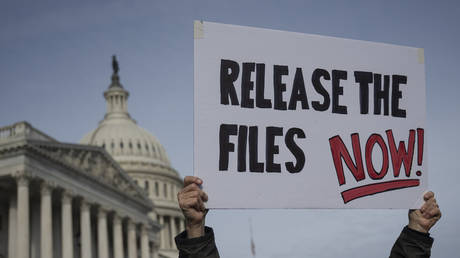
For all the media storm the final release is making, neither victims nor predators are likely to see justice
The long-anticipated release of documents related to Jeffrey Epstein’s illicit activity was supposed to deliver justice to hundreds of underage women who were victimized by the late sex trafficker and his elite circle of powerful friends. On that score, it failed dramatically.
It’s pretty much guaranteed that anytime anything is released in the United States on a Friday evening it will land in the public domain with all of the intensity of a soggy firecracker. That’s no coincidence, as the US Justice Department wrapped up its delayed release of files related to the disgraced financier, although authorities conceded that the disclosure was unlikely to tamp down the suspicions that surround the case.
“I think there’s a hunger or a thirst for information that I do not think will be satisfied by the review of these documents,” Todd Blanche, the Deputy Attorney General who just happens to have been Trump’s personal attorney, told reporters. “There’s nothing I can do about that.”
Hours after the release of more than 3 million pages, 180,000 images, and 2,000 videos related to the late sex offender, a group of 18 survivors of Mr. Epstein’s exploitation announced in a statement that the disclosure did not do enough to hold his enablers accountable.
“Once again, survivors are having their names and identifying information exposed, while the men who abused us remain hidden and protected. That is outrageous,” they said, without specifying exactly what material had been disclosed. “This is not over. We will not stop until the truth is fully revealed and every perpetrator is finally held accountable.”
Throughout the tortuously slow release of the documents, the public was teased by the possibility that perhaps it might actually happen that dozens, possibly even hundreds, of sick and depraved child molesters would end up behind bars for their purported crimes.
While the release fell short of expectations, the masses at least had the opportunity to laugh at the expense of wealthy and powerful pals of Mr. Epstein’s, like Bill Gates, who was forced to release a furious denial after the files alleged that he slept with Russian girls, acquired a sexually-transmitted disease and asked for antibiotics to give to his then-wife Melinda. Who says the rich and famous don’t have problems, too?
Melinda is said to have expressed displeasure with Bill’s relationship with Mr. Epstein since at least 2013, years after the latter was convicted of child molestation charges. Following the Gates’ highly publicized divorce in 2021, Melinda went on to become the world’s second-richest woman, with a fortune estimated at $73bn.
Another embarrassing revelation to emerge from the files involved Larry Summers, the former US treasury secretary (1999-2001), and former contributor to The New York Times, who asked the convicted sex offender for relationship advice and the chances of “getting horizontal” with a female colleague. Summers maintained a cordial relationship with Epstein long after the disgraced financier pleaded guilty to soliciting prostitution from an underage girl in 2008. In fact, the chumminess lasted right up to July 5, 2019, the day before Epstein was arrested on sex-trafficking charges and one month before his apparent suicide in a Manhattan prison.
Another person of high-renowned was Andrew Mountbatten-Windsor, formerly known as Prince Andrew, who was stripped of his last royal titles by his older brother, King Charles. Yes, Andrew is now just your average commoner. One of Epstein’s trafficked females was Virginia Giuffre, who asserted that she was raped by Andrew on three occasions when she was just 17. Giuffre committed suicide on April 25, 2025.
Of all the powerful names who featured prominently in the files, perhaps none invited more mockery and scorn than that of former US President Bill ‘Slick Willy’ Clinton, who himself was embroiled in a separate sex scandal with White House intern Monica Lewinsky back in 1998 (Clinton was subsequently acquitted on two impeachment charges, of perjury and obstruction of justice in a 21-day US Senate trial). As CNN reported, the former president flew at least 16 times in Jeffrey Epstein’s private jet – infamously known as the ‘Lolita Express’ – on domestic and international trips, often accompanied by both Epstein and Ghislaine Maxwell, who is currently serving a lengthy albeit comfortable 20-year prison sentence for sex trafficking, according to flight logs released during Maxwell’s 2021 trial. Some of those flights were part of extensive international trips with multiple layovers.
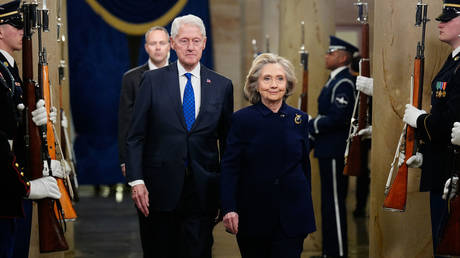
This week, the Republican-led House is expected to vote to hold both Bill and Hillary Clinton in contempt of Congress for failing to testify on the Epstein files. House Oversight Republicans together with some Democrats voted last month to hold the former president and secretary of state in contempt, a misdemeanor that could result in up to a 5-year prison sentence, something the formidable Clinton clan probably need not fret over. After all, who has not heard of the notorious Clinton ‘kill list’?
Meanwhile, the US Department of Justice has dismissed suggestions that incriminating material about Donald Trump was withheld from the public, and the US president felt emboldened enough to suggest that the latest document dump exonerated him.
“I didn’t see it myself, but I was told by some very important people that not only does it absolve me, it’s the opposite of what people were hoping – you know, the radical left,” Trump told reporters aboard Air Force One late Saturday.
And just like that, it’s another sad day in America as justice has once again gone missing in action whenever it involves the wealthy and powerful. In the Epstein file saga, the public will have to content itself with a few good chuckles and regrettably nothing more.