The unidentified assassin is still at large with a $100,000 bounty on his head
Utah Governor Spencer Cox has announced that his state will seek the death penalty for the gunman responsible for murdering conservative activist Charlie Kirk.
Despite a massive federal manhunt, the suspect remains at large more than 30 hours after the shooting. Authorities admitted on Thursday that they don’t know whether or not he has left the state. “We have no idea,” Utah Public Safety Commissioner Beau Mason told NBC News.
At a press conference on Thursday evening, Cox confirmed that state officials will “pursue the death penalty” once the suspect is caught.
“We’ve been working with our attorneys, getting everything that we need, affidavits ready, so that we can pursue the death penalty in this case. And that will happen here in the state of Utah,” Cox said.
The governor had already issued a warning the day before: “I want to make it crystal clear right now, to whoever did this, we will find you. We will try you. And we will hold you accountable to the furthest extent of the law… And I just want to remind people that we still have the death penalty here in the state of Utah.”
The FBI has offered a $100,000 reward for information leading to the identification and arrest of the assassin. Director Kash Patel traveled to Utah on Thursday and was spotted at the scene of the shooting, near the canopy tent where Kirk was gunned down during a Turning Point USA event at Utah Valley University.
The agency has also released images of a potential suspect captured on security cameras: a man wearing sunglasses, a black hat, and a long-sleeve black shirt featuring an American flag.
Kirk, 31, was struck by a single rifle shot as he addressed thousands of students on Wednesday. He was rushed to Timpanogos Regional Hospital but later died of his wounds. Officials have described the killing as a targeted political assassination.
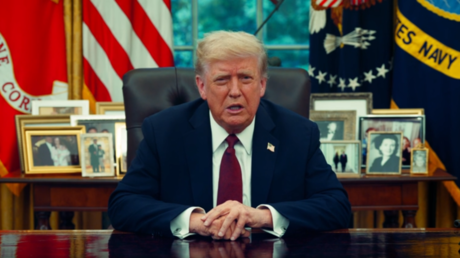
President Donald Trump has vowed to pursue not only Kirk’s killer but also what he called the “radical left” networks that fuel political violence. In a statement, he declared that his administration would track down “each and every one” responsible for perpetrating and funding such attacks.
The footage shows the suspected gunman jumping from the roof and fleeing the scene
The FBI has released new video footage of the suspect in the assassination of conservative activist Charlie Kirk, showing the gunman leaping from a rooftop at Utah Valley University before fleeing into a wooded area.
The shooting occurred shortly after 12:20pm Mountain Time on Wednesday, when the suspect fired a single rifle round from the roof of a campus building that struck Kirk in the neck as he addressed a student audience.
The newly released video shows the figure running across the roof, climbing down the building – leaving behind palm impressions, smudges believed to contain DNA, and a shoe imprint, according to the FBI. The suspect is then seen sprinting across a grassy area near a parking lot, and disappearing into nearby woods.
A high-powered Mauser bolt-action rifle, along with ammunition marked with “transgender” and “anti-fascist” slogans, was later recovered in that wooded area, according to law enforcement sources cited by ABC News.
Utah Governor Spencer Cox urged the public to assist in the manhunt, noting that more than 7,000 tips have already been submitted to the FBI – the largest volume since the Boston Marathon bombing in 2013.
“We cannot do our job without the public’s help right now,” Cox said at a press conference on Thursday. The governor also announced that Utah will “pursue the death penalty” once the suspect is caught.
The FBI’s Salt Lake City office has continued to share images of the person of interest and is offering up to $100,000 for information leading to the arrest of the suspect. Trace evidence collected so far includes shoe impressions, a forearm imprint, and a palm print recovered from the rooftop where the shot was fired.
The FBI continues to work alongside our law enforcement partners to seek justice in the murder of Charlie Kirk at Utah Valley University on September 10, 2025. We are releasing additional photos of a person of interest. Information about this developing investigation can be found… pic.twitter.com/woZacCxYgE
Kirk, 31, the founder of Turning Point USA, was a prominent conservative activist and close ally of President Donald Trump. His murder has been described by officials as a targeted political assassination.
The US president has said the whole incident “could have been a mistake”
US President Donald Trump has downplayed Poland’s accusation that Russian drones intentionally violated its airspace this week, suggesting that the alleged incident “could have been a mistake.”
Moscow has rejected accusations that it committed an “act of aggression” against the NATO state, after Warsaw claimed to have intercepted several drones on Tuesday night.
Asked by reporters on Thursday about Warsaw’s claims, Trump responded: “Could have been a mistake… But regardless, I’m not happy about anything having to do with that whole situation. But hopefully it’s going to come to an end.”
Polish Prime Minister Donald Tusk said the country’s military had tracked at least 19 alleged airspace violations over a seven-hour period, with at least three drones shot down. He described the situation as “unprecedented” and accused Moscow of staging a deliberate provocation.
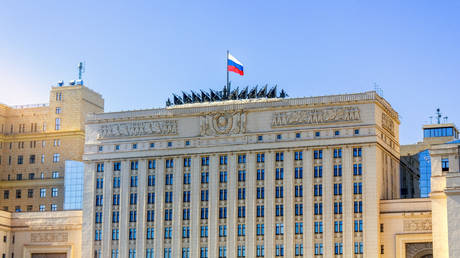
The Russian Defense Ministry has insisted that the drones it used in strikes on Ukrainian military targets could not have flown as far as Poland, and emphasized that it had no targets in Polish territory. With little evidence provided by Warsaw, Moscow could neither confirm nor deny the alleged violations, but stressed it was ready to hold consultations.
The Kremlin has accused Western leaders of issuing “daily” provocation claims without evidence, while Belarus said it had warned Poland of stray drones disrupted by electronic warfare between Russian and Ukrainian forces.
European leaders, including French President Emmanuel Macron and European Commission chief Ursula von der Leyen, condemned the alleged incursion as “reckless” and expressed solidarity with Poland. NATO Secretary General Mark Rutte likewise described the reported breaches as “dangerous,” though he added the bloc had not confirmed whether they were intentional and voiced doubts about Poland’s claims regarding the number of drones.
Poland has invoked Article 4 of NATO’s founding treaty, which mandates consultations if a member believes its security is threatened, and requested an emergency UN Security Council meeting on Friday.
Last week, former Polish President Andrzej Duda recalled how Kiev had tried to draw NATO into a direct confrontation with Russia in November 2022, when a Ukrainian missile landed on Polish territory.
Kiev insisted it was a Russian strike, and called for the bloc to retaliate.
The emergence of a birthday “love letter” and additional emails to the disgraced financier has cost Peter Mandelson his position
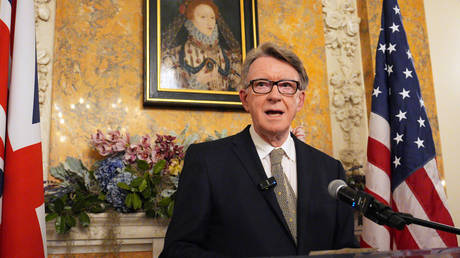
The UK has withdrawn Lord Peter Mandelson as its ambassador to the US after reviewing newly surfaced emails about his relationship with late financier and sex offender Jeffrey Epstein, the Foreign Office said on Thursday.
In the emails, circulated by British media on Wednesday, Mandelson voiced his strong support for Epstein after the sex trafficker was indicted by a grand jury, assuring him that his “friends stay with you and love you.”
“The emails show that the depth and extent of Peter Mandelson’s relationship with Jeffrey Epstein is materially different from that known at the time of his appointment,” the Foreign Office said, adding that “Mandelson’s suggestion that Jeffrey Epstein’s first conviction was wrongful and should be challenged is new information.”
The publication of the emails dealt the final blow to the Mandelson, who had already been struggling with the fallout from the Epstein 50th “birthday book” scandal. The massive bound tome was compiled by Epstein’s longtime associate Ghislaine Maxwell and contains messages from his acquaintances and friends, including a 10-page letter from the former British ambassador.
The ambiguous letter, interspersed with photographs, describes Epstein as Mandelson’s “best pal” and portrays him as an “intelligent, sharp-witted,” and “mysterious” man.
“You would spend many hours just waiting for him to turn up… And often, no sooner were you used to having him around, you would suddenly be alone again… Leaving you with some ‘interesting’ friends to entertain instead,” one section reads.
Following the emergence of the “love letter,” British Prime Minister Keir Starmer strongly backed the ambassador, stating that Mandelson has “played a key part” in strengthening UK-US ties in recent months.
Mandelson has repeatedly expressed regret over ever meeting Epstein, admitting after the emergence of the emails that he had carried on the ties “for far longer than I should have done” and painted himself a victim of a “charismatic criminal liar.”
The ultimate downfall of the diplomat comes mere days ahead of US President Donald Trump’s scheduled state visit to the UK.
ABC has cited unnamed law enforcement officials as making the claim after the FBI announced that agents recovered a bolt-action rifle
Ammunition found with the rifle that was supposedly used in the assassination of prominent American conservative activist Charlie Kirk was inscribed with “transgender and anti-fascist” writing, ABC has claimed, citing unnamed law enforcement officials.
The influencer, known for his support for President Donald Trump and opposition to the ‘woke’ agenda, was shot in the neck during a public debate at Utah Valley University on Wednesday. Kirk was rushed to the hospital, but succumbed shortly thereafter.
On Thursday, ABC News cited anonymous sources as claiming that three unspent cartridges found with the alleged murder weapon bore “transgender and anti-fascist” messages. According to the outlet, the firearm in question is an “older model imported Mauser .30-06 caliber bolt action rifle.”
Speaking during a press conference that same day, Robert Bohls, the special agent in charge of the FBI’s Salt Lake City Field Office, confirmed that agents had “recovered what we believe is the weapon used in yesterday’s shooting.” The “high-powered bolt action rifle” was found “in a wooded area where the shooter had fled,” the official stated.
Bohls said forensic experts were “analyzing the weapon,” and had “collected footwear impression, a palm print, and forearm imprints for analysis.”
In several posts on X on Thursday, the agency released images of a person of interest, offering a reward of up to $100,000 for information leading to his identification and arrest.
Utah Department of Public Safety Commissioner Beau Mason said the authorities had obtained “good” footage of the suspect and managed to track his movements.
In a video address posted on his Truth Social platform on Wednesday, Trump linked Kirk’s murder to divisive rhetoric used by the left. He argued that “violence and murder are the tragic consequence of demonizing those with whom you disagree.”
Trump said that “for years, those on the radical left have compared wonderful Americans like Charlie to Nazis and the world’s worst mass murderers and criminals.”
He promised to go after the “organizations that fund… and support” left-wing radicals.
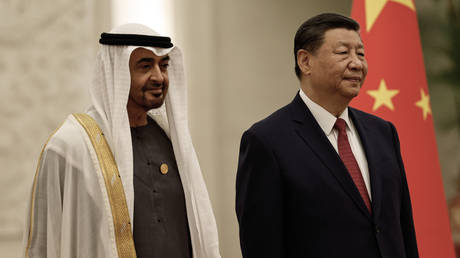
Aligning with the SCO is an opportunity for the region’s nations to be an autonomous force shaping the future, but differences persist
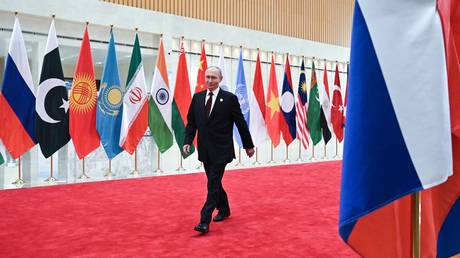
The recent Shanghai Cooperation Organization (SCO) summit in Tianjin proved successful, particularly for non-Western countries. It once again underscored the reality that the old world order no longer functions as it once did. In Western capitals, and especially in Washington, both the summit and the World War II Victory Parade that followed in Beijing triggered visible discontent. These events were widely interpreted as a symbolic shift and a clear sign that the established global system is steadily being dismantled.
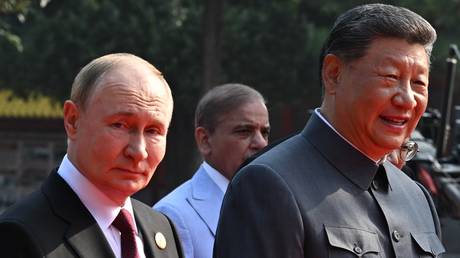
Even US President Donald Trump openly acknowledged this sentiment. He publicly criticized the proceedings in China, suggesting that India and Russia were drifting into Beijing’s orbit. Expressing frustration toward New Delhi and Moscow, he linked their engagement with Beijing to broader Chinese efforts to reshape the global order. “Looks like we’ve lost India and Russia to deepest, darkest China. May they have a long and prosperous future together!” Trump wrote in a social media post, accompanying a photograph of Chinese leader Xi Jinping, Russian President Vladimir Putin, and Indian Prime Minister Narendra Modi together at the summit.
In reality, the West’s irritation is not simply about closer ties between Russia, India, and China. It stems from the fact that these countries, alongside their partners, are mounting a coordinated challenge to Western hegemony and accelerating the emergence of a new multipolar world order, one in which the dominance of the West no longer holds.
For decades, the international system has been shaped by a unipolar model centered on the undisputed supremacy of the US and its Western allies. Within that structure, key global institutions were gradually transformed into tools for advancing Western political and economic interests. International law was applied selectively and only when it aligned with the strategic aims of the dominant powers. The sovereignty and voices of non-Western nations were frequently disregarded, and their attempts to pursue independent development paths were met with sanctions or direct intervention.
Nowhere were the consequences of this system more acutely felt than in the Middle East and North Africa. The involvement of the US, Europe, and Israel in the region’s affairs led to prolonged instability, the erosion of national sovereignty, and the collapse of state institutions. The invasion of Iraq, the destabilization of Libya and Syria, the imposition of sweeping sanctions, and a series of armed conflicts not only weakened these countries but transformed the region into a zone of chronic volatility. Peace and security have become elusive for all its peoples.
Western economic leverage has proven to be no less damaging than military intervention. Through the mechanisms of the International Monetary Fund and the World Bank, developing countries were drawn into cycles of debt dependency, losing their ability to pursue independent economic policies. Growth gave way to stagnation, while nominal sovereignty was replaced by external management under the guise of structural reforms.
This crisis of unipolarity is becoming increasingly evident to a growing number of states across the world, particularly in the Middle East. Alternative centers of power that advocate for a more just and balanced global order, such as the SCO and BRICS+, are gaining influence precisely because the old model has failed to deliver stability or respect for national sovereignty.
Against the backdrop of a deepening global transition from unipolarity to a multipolar architecture of international relations, Middle Eastern countries are paying greater attention to the SCO. The SCO is emerging as one of the key international platforms for cooperation across the Eurasian space. This interest has already taken institutional form. Since 2023, Iran has been a full member of the organization, while Bahrain, Egypt, Qatar, Kuwait, the United Arab Emirates, Saudi Arabia, and Türkiye have all acquired the status of dialogue partners.
This development is far from surprising. The SCO includes some of the world’s largest economies and most influential political actors, such as China, India, and Russia, countries that already play a central role in the foreign policy and trade strategies of many Middle Eastern and North African states. Engagement with the SCO should not be seen merely as a diplomatic gesture. Rather, it reflects a deliberate shift toward diversification of international partnerships, a reduction in reliance on Western-led structures, and a move toward deeper participation in new frameworks of regional and global cooperation.
From an economic perspective, the SCO offers Middle Eastern states access to vast markets and a platform for participation in large-scale infrastructure initiatives, including China’s Belt and Road Initiative. Expanding trade with China, growing energy partnerships with India, and the strengthening of economic ties with Russia all contribute to a pragmatic interest in formats where these countries are not simply participants, but play a foundational and agenda-setting role.
In addition, many MENA countries are prioritizing technological advancement, digital transformation, and the modernization of their industrial bases. Within this context, cooperation with the SCO is viewed as a promising avenue for exchanging expertise and attracting investment. There is also particular interest in the potential to conduct transactions in national currencies and develop financial mechanisms outside the dollar-dominated system. This is especially relevant in an era of sanctions pressure and growing volatility in global markets.
Politically, closer engagement with the SCO offers countries in the Middle East an alternative diplomatic platform that upholds the principles of non-interference, respect for sovereignty, and rejection of imposed external development models. This stands in clear contrast to the experience of working with several Western institutions, where economic cooperation is often conditional on political alignment.
For states that have endured the consequences of military interventions, external pressure, and sanctions, this model of engagement is far more acceptable. Moreover, in an increasingly polarized international environment, a balanced foreign policy requires not only strong ties with traditional partners but also the ability to engage in new formats that allow for greater flexibility and strategic autonomy.
At the extended “SCO Plus” meeting held in Tianjin, President Xi introduced a new concept, the Global Governance Initiative (GGI). This proposal follows a series of major international initiatives previously advanced by China, including the Global Development Initiative (GDI), the Global Security Initiative (GSI), and the Global Civilization Initiative (GCI). The GGI was widely welcomed by summit participants as a timely and important contribution, reflecting the growing international demand for reform of the global institutional architecture. It holds particular relevance for countries in the Middle East and North Africa, whose interests have been systematically overlooked under the current global order.
Today’s system of global governance is facing a crisis of effectiveness, legitimacy, and representation. The architecture shaped during the unipolar era is no longer suited to the realities of a more complex and diverse world. In the Global South, including the Arab world, there is growing dissatisfaction with entrenched structural inequalities, geopolitical double standards, and economic dependence on institutions dominated by Western powers.
The Chinese proposal directly addresses these systemic imbalances. The GGI’s conceptual framework highlights three critical deficiencies in global governance. First, developing countries, including those in the Middle East and North Africa, remain underrepresented in key decision-making bodies. Second, the authority of international law is being undermined by unilateral actions, sanctions, and selective interpretations that run counter to the UN Charter. Third, existing institutions are struggling to keep pace with urgent global challenges, such as climate change, digital inequality, and the lack of regulatory frameworks for emerging technologies.
For Middle Eastern states, many of which are already actively engaged with the SCO, this initiative opens a meaningful opportunity. It offers a space to participate in shaping a more equitable and inclusive set of rules for international cooperation. This is particularly valuable for countries that aim to pursue foreign policies grounded in strategic autonomy, sovereign decision-making, and pragmatic, non-ideological partnerships.
The principles outlined by Xi – sovereign equality of states, adherence to international law, support for multilateralism, a focus on concrete outcomes, and a people-centered approach – resonate strongly with the policy priorities of many Middle Eastern capitals. The SCO can serve as a strategic pillar for countries in the Middle East and North Africa as they seek to strengthen their sovereignty and expand their capacity to defend and advance national interests on the global stage.
There is no doubt that no international mechanism can fully satisfy the interests of all participants. However, the values embedded in the Shanghai Cooperation Organization’s work, along with the practical policies pursued by its member states, create conditions for greater flexibility in international affairs. If the stated goals are consistently implemented, such an approach may contribute meaningfully to the emergence of a more just and balanced global order. For the countries of the Middle East, this is particularly important. It is not only about finding new partners, but also about creating a framework in which their voices are heard and their interests taken into account.
The old world order is rapidly breaking down. Its foundations – unipolarity, Western hegemony, and an international institutional system rooted in structural inequality – no longer provide either stability or fairness. At the same time, a new world order is still in the making. This transitional moment is marked by uncertainty, but it also presents a window of opportunity. For the countries of the Middle East and North Africa, this period could prove decisive.
Now more than ever, the region must seize this historical moment to overcome internal fragmentation. Competition, mistrust, and longstanding rivalries among Middle Eastern countries have for too long weakened their collective potential. In a world where the international system is becoming more fluid and multipolar, the ability to unite and act in coordination will determine which regions are able to secure a meaningful position in the future global architecture.
A more unified Middle East – built on mutual respect, policy coordination, and shared responses to common challenges such as food and water security, energy transition, and digital sovereignty – would be better positioned not only to safeguard its own interests but also to emerge as a prominent actor in global affairs. Without this, the risk remains that the region will once again be drawn into external agendas and reduced to a passive object of international influence, rather than becoming an autonomous force in shaping the global future.
In this context, the Shanghai Cooperation Organization can serve an important supporting role. The SCO provides Middle Eastern countries with a platform to engage with major Eurasian powers, strengthen economic ties, participate in shaping alternative global agendas, and enhance collective resilience. At the same time, it is essential to recognize that the SCO cannot resolve the internal challenges of the region. It can offer tools, partnerships, and political support, but the outcome will depend on the readiness of Middle Eastern nations to overcome divisions and act with unity and strategic purpose.
The future of the region lies in its own hands. The new world order has not yet taken shape, and whether Middle Eastern countries secure a strong position within it will depend on their ability to act collectively and emerge from this transitional moment not as scattered players, but as a coherent regional force with a clear agenda and long-term vision.
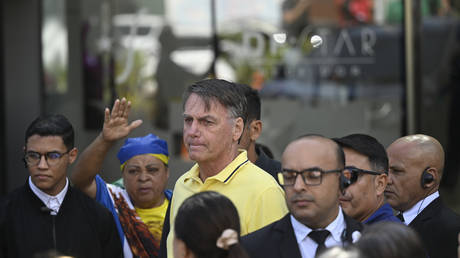
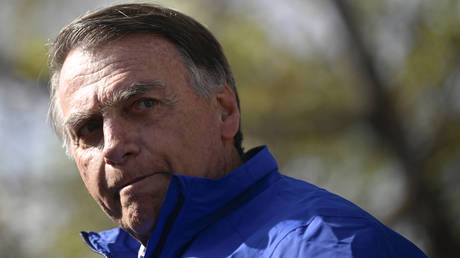
Jair Bolsonaro has been convicted of conspiring to overturn his 2022 election loss
The Brazilian Supreme Court has convicted former President Jair Bolsonaro of attempting to overturn the country’s 2022 election, leaving the politician facing a decades-long sentence for leading what prosecutors called a criminal conspiracy.
Four out of five justices on a Supreme Court panel found Bolsonaro guilty on all five counts he faced, sentencing him to 27 years and three months in prison.
The charges included planning a coup d’état, taking part in an armed criminal organization, attempting to abolish Brazil’s democratic order by force, damaging protected public property, and committing violent acts against state institutions.
Bolsonaro sought to “annihilate the essential pillars of the democratic rule-of-law state” and restore “dictatorship in Brazil,” Supreme Court Justice Alexandre de Moraes said as he announced the verdict on Thursday.
According to prosecutors, the coup plot began in 2021 with efforts to erode public trust in Brazil’s electoral system. After Bolsonaro’s 2022 defeat, they alleged his supporters were urged to mobilize in the capital, Brasilia, where they stormed and vandalized the nation’s three branches of government on January 8, 2023.
Bolsonaro and other defendants have denied wrongdoing, and defense lawyers could still file appeals.
The case has heightened tensions with the United States, after President Donald Trump called it a “witch hunt” and imposed steep 50% tariffs on Brazil. The Trump administration has also sanctioned Justice Alexandre de Moraes for what it described as “serious human rights violations,” and announced visa restrictions against him and other court officials.
President Luiz Inacio Lula da Silva has condemned Trump’s pressure tactics, accusing Washington of having “helped stage a coup” and vowing that Brazil “will not forget it.”
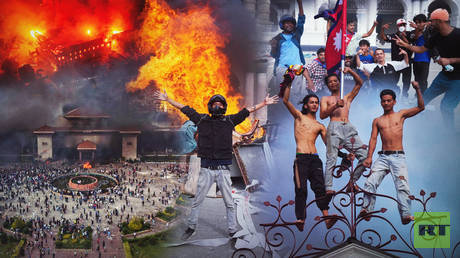
Angry youth in the Himalayan nation bordering India and China have forced a political shake-up hoping to end corruption and impoverishment
A week ago, Bikram Paudel’s social media timelines and multimedia messaging applications started getting flooded with a protest call. The messages were clear, blunt, and urgent: turn up on the streets, resist the government’s attempt to ban social media sites, and register your anger.
Bikram, a student of hotel management from Lalitpur district who now lives in Kathmandu, admits he was not sure at first whether he should join the demonstration scheduled for Monday. But as the messages spread like wildfire, and as his friends forwarded video after video exposing corruption at the top, he felt he had no choice but to join.
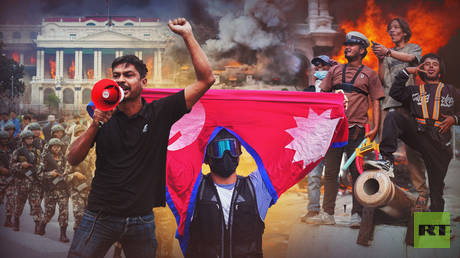
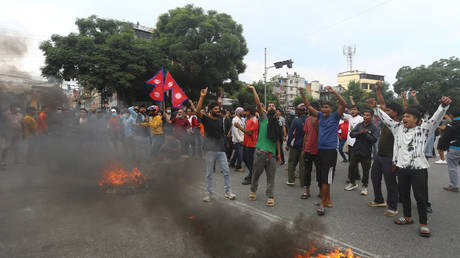
The protests, driven largely by teenagers and twenty-somethings, erupted in response to the government’s sweeping ban on 26 online platforms, including Facebook, Instagram, YouTube and X, after the companies refused to register their operations in Nepal. Within 48 hours, the protest swelled into the largest demonstration Nepal has seen in years, forcing the resignation of Prime Minister K.P. Sharma Oli on Tuesday.
The army has effectively taken control. On Wednesday, representatives of the protesters met with Nepali Army Chief Ashokraj Sigdel to discuss interim leadership. The protesters have proposed former Chief Justice Sushila Karki as their sole nominee for interim prime minister.
Bikram says the protests were never just about the social media ban. They were about power, accountability, and dignity. “I was convinced to join because the government thought banning social media would silence us,” Bikram recalls. “They forgot that this generation is aware. We know how much corruption they are doing, how they are robbing the nation, and how they wanted to hide it. We could not stay quiet.”
Bikram never imagined that this protest call, which at first seemed like just another online campaign, would snowball into a mass movement that changed his country’s leadership.
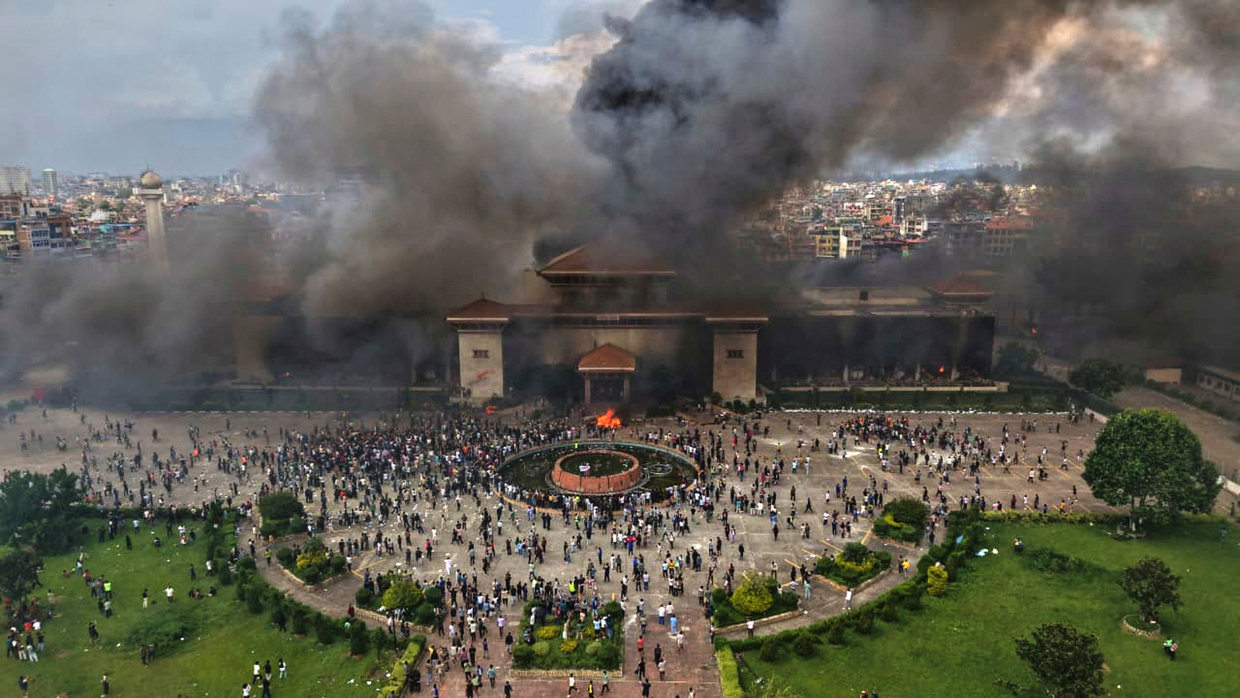
Protesters celebrate at the parliament building after it was set on fire during a protest against social media ban and corruption in Kathmandu, Nepal, Tuesday, Sept. 9, 2025.
“I am happy for the change,” Bikram says softly over the phone. “But I am more sad for those people who were killed by the armed forces. I keep thinking of them and those still fighting for their lives in hospitals. We never thought peaceful protest would meet bullets.”
Among those who witnessed the bloodshed firsthand was Ishita Shreshta, a 26-year-old receptionist at one of Kathmandu’s top restaurants. She joined the rally on Monday, never expecting to see people shot in front of her eyes.
“We were at a distance when suddenly people started running in every direction,” she recalls. “The protest was absolutely peaceful, but then it seemed like some people deliberately incited the forces. Suddenly I saw people carrying a young boy who was bleeding profusely from his chest. I could not believe it was happening.”
The protests quickly turned violent. The demonstrators stormed parliament, vandalizing government buildings and attacking officials and politicians. On Tuesday, 19 people were killed. By Wednesday, the death toll had risen to 30, according to the Ministry of Health and Population of Nepal. Over 1,000 people were injured in those two days.
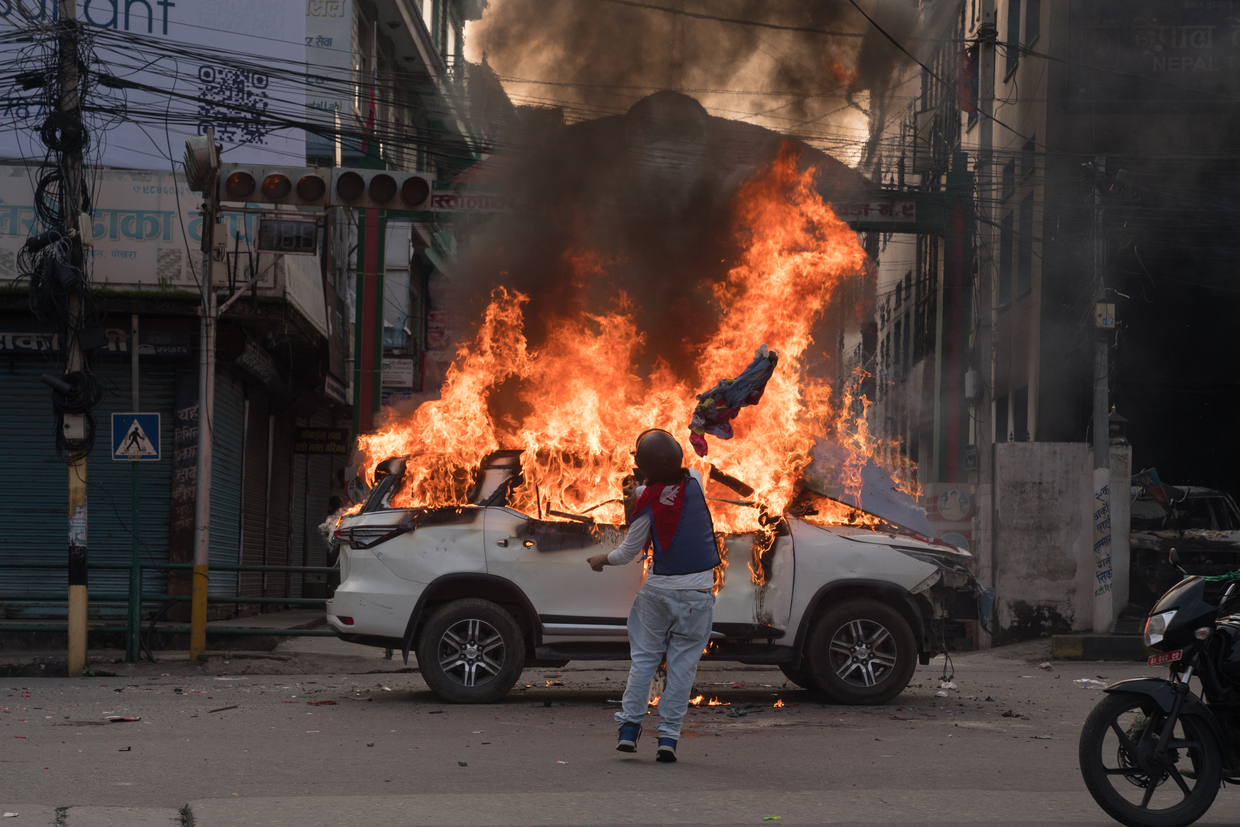
A protester draped in Nepal’s national flag sets fire to a government vehicle at Mahendrapool in Pokhara, Nepal, on September 9, 2025.
The protests were driven by young Nepalis who had grown up connected to the world through phones and apps. For them, the social media ban was not just a technical inconvenience, it was a direct assault on their freedom and ability to organize.
“We may be jobless, but we have the power of social media to influence,” Ishita says. “We can reach our brothers and sisters across the country in seconds. That is our weapon.”
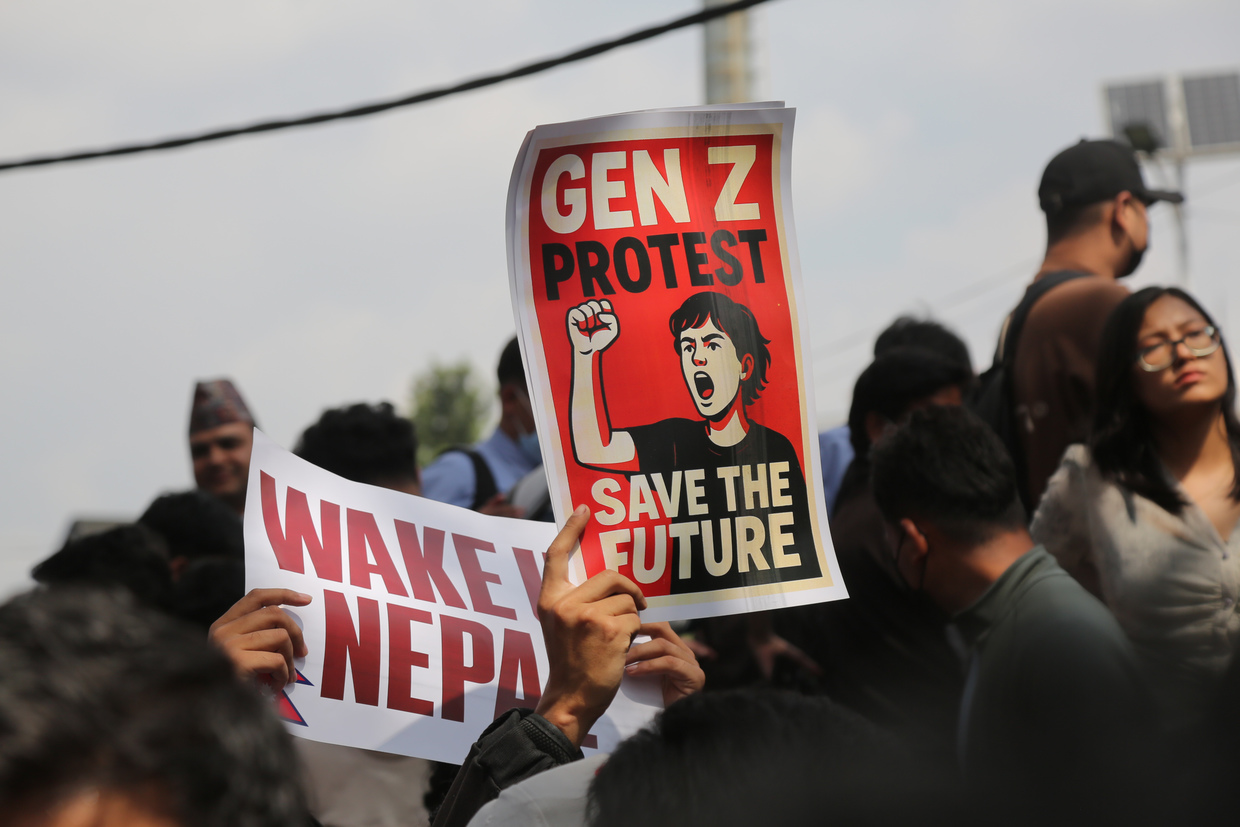
Media dubbed the unrest a “Gen Z” protest, in a nod to the generation born between 1997 and 2012 – though the name may also be tied to the Facebook group “Gen-Z Nepal,” where open calls for demonstrations were posted. “Be ready for the protest Gen Z. Unity can change anything let’s go..,” a September 7 post declared.
For Ishita, the decision to protest also came after months of quietly seething at the government. “I had been watching TikTok, Instagram reels – people exposing the lavish lifestyles of politicians. Their mansions, their cars, their expensive watches, all built on the money they looted from innocent citizens. They fooled us. They thought making one small minister resign would be enough. But we are not stupid anymore.”
Hashtags like #SaveOurSocialMedia and #Nepalprotests, #Nepalbanssocialmedia and #GenZprotest trended across various platforms weeks ahead of the protest. Young people documented every moment – from tear gas shells bursting in the air to ambulances rushing to hospitals – ensuring that the world was watching. Diaspora communities in the Persian Gulf, Europe, and the US amplified the protests, creating international pressure.
Nepalese youth stage an anti-government protest in Kathmandu, Nepal, on September 8, 2025.
Media reports also pointed to the NGO Hami Nepal as a key organizer. Founded informally in 2015 and registered in 2020, it is chaired by philanthropist Sudhan Gurung and first gained visibility for its disaster relief work. On Instagram, the group called for protests at Maitighar Mandala on September 8, uploaded “how to protest” videos, and urged students to join with college bags, books and uniforms. Protesters carried “Youths Against Corruption” banners, reportedly linked to the NGO.
Later, Hami Nepal posted that it had “collaborated” with the army to help restore calm and that talks between Gen Z representatives and the military would begin. According to The Commune, Hami Nepal has been backed by businessmen including Deepak Bhatta – allegedly tied to a controversial arms procurement deal – and Sulav Agrawal of the Shanker Group, who was arrested during Covid-19 for alleged black-market sales of thermometer guns. It has also received support from Dr. Sanduk Ruit – an ophthalmologist and Magsaysay Award laureate; the award is notable for its Cold War ties to US influence.
The resignation of K.P. Sharma Oli marks yet another chapter in Nepal’s revolving-door politics. Oli, who has faced accusations of authoritarian tendencies before, underestimated the power of digital organizing. His attempt to silence criticism by banning platforms backfired dramatically.
Now, Kathmandu is witnessing a scramble for power. After Oli’s resignation, all eyes turned to Kathmandu Mayor Balendra Shah, known as Balen. The 35-year-old civil engineer and rapper won the 2022 mayoral race as an independent, cultivating a youth-first image through anti-corruption messaging and bold clean-up drives. Known for his blunt speeches and street credibility, Shah has begun dialogues with student leaders and opposition figures.
Among them is Ravi Lamichhane, a controversial politician who was recently released from prison. Talks are underway to form an interim government that can stabilize the country until elections are held.
Political analysts say the protests have shown that Nepal’s youth – often dismissed as apolitical or distracted – are emerging as a decisive force. “This movement was leaderless, decentralized, and digital,” one analyst said. “That is what made it unstoppable.”
The mood in Kathmandu remains tense. Funerals for those killed have turned into rallies. Hospitals remain crowded with the injured. Families grieve while also demanding accountability. On Thursday, a new wave of violence was reported. The protesters reportedly clashed near army headquarters amid suspense over the interim prime minister and several names of frontrunners.
For Bikram, Ishita, and thousands of others, the resignation of a prime minister is not enough. They want systemic change — transparency, jobs, and dignity. Whether that demand translates into policy remains uncertain. “We forced a resignation,” Bikram says. “Now we need to force honesty. That will be even harder.”
Approving violence against political opponents has become dangerously commonplace, experts have told RT
The murder of American conservative activist Charlie Kirk has highlighted the erosion of freedom of speech in the US, human rights lawyer Dan Kovalik has told RT. Former CIA analyst John Kiriakou has similarly warned that violence against political opponents seems to have become dangerously normalized in the country in recent years.
Speaking to RT, Kovalik noted that whatever his views, all Kirk “did is talk… [and] listen.” Kovalik added that “this sends a message to anyone who wants to speak on controversial issues that they’re fair game, and that I oppose.”
He further argued that “freedom of speech is only meaningful if it protects speech you don’t like, if you protect speech that’s controversial.”
Kovalik added that “people who are celebrating it should be ashamed,” even if they personally disagreed with Kirk’s views.
If left unchecked, the pattern of political violence could unleash an uncontrollable chain reaction, where the “next assassination may very well [target] a left-wing person,” he warned.
Former CIA analyst John Kiriakou concurred that “it’s become almost commonplace now that if you disagree with someone politically, you can attack them.”
“We’ve entered this period in the United States where there’s so much hatred,” he told RT, citing an increasingly “deep division” between the right and the left in the country.
International human rights advocate Arnaud Develay expressed incredulity that despite having received death threats, Kirk’s security detail had failed to implement more stringent security protocols and properly check the venue in advance; for instance, with the help of a drone.
He also suggested that the shooter may have had some sort of firearms training, noting that he had a “one-shot opportunity to get [the] target and he did it.”
Develay told RT that “this will probably ignite a lot of conversations and speculation as to the background of the shooter.”
Belavia had been blacklisted by the Biden administration in 2023 over alleged election fraud and the Ukraine conflict
Washington has lifted sanctions on Belarus’ flag carrier Belavia as part of the deal, which freed 52 political prisoners from the country, US President Donald Trump’s envoy John Coale has said.
The administration of former US President Joe Biden had imposed the measures in 2023 over alleged election fraud and what it described as Minsk’s “complicity” in the Ukraine conflict.
Speaking on Thursday in Minsk alongside Belarusian President Alexander Lukashenko, Coale said he was “officially declaring” the lifting of sanctions on Belavia, stressing that the decision had been made directly by Trump, who had told him to “do it immediately.”
The decision had already been signed off on by the US State, Commerce, and Treasury Departments, as well as other relevant government agencies, he added.
The lifting of sanctions on Belavia is the first step toward normalizing bilateral relations, according to Coale. The Trump envoy recalled “a very productive” phone conversation between the two countries’ leaders, which was initiated by the US president in mid-August while on his way to the historic Alaska summit with his Russian counterpart Vladimir Putin.
Lukashenko has praised Trump’s peacemaking efforts, saying no US leader had done as much to ensure peace.
The US imposed sectoral sanctions on Belarus’ economy in 2021, following similar moves by the EU and UK over the country’s 2020 presidential election. The vote had triggered mass protests in Belarus over what the opposition claimed was widespread fraud. Minsk denied the allegations, insisting that the unrest was orchestrated by the US and its European “satellites,” as well as neighboring Ukraine.
The West has since imposed several rounds of sanctions on Belarus, including after the escalation of the Ukraine conflict in 2022. Belarus is not directly involved in the conflict, but allowed Moscow to stage a push towards Kiev from its territory early in the conflict.
Lukashenko said at the time that Minsk’s participation in the conflict was limited to self-defense and to preventing Ukraine from using Belarusian territory to attack Russia.
Such commitments are in line with the country’s obligations under the Union State, a political and economic integration framework with Russia that includes joint security provisions and aligned policies.