Beijing has urged calm and restraint after Poland accused Russia of deliberately violating its airspace with drones
China has warned that confrontational and provocative rhetoric over the Ukraine conflict is creating dangerous “spillover” effects, after Poland accused Russia of a deliberate drone attack and convened an emergency UN Security Council meeting.
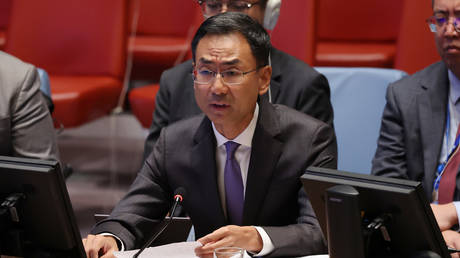
Speaking at the session on Friday, China’s deputy permanent representative to the UN, Geng Shuang, said Beijing has “taken note of the recent statements and responses from Poland, Russia, and Belarus,” and called on all parties to avoid “misunderstanding and misjudgment.”
“This drone incident is a spillover of the Ukraine crisis,” Geng stated. “Any misunderstanding or misjudgment will deepen the trust deficit. Any confrontational rhetoric may spark an escalation. And any military clash could trigger broader instability.”
Poland said its air defenses tracked at least 19 airspace violations and shot down three drones on Wednesday, describing the incident as an “unprecedented” and “deliberate” attack. Kiev and multiple EU officials immediately echoed this narrative, while NATO announced a new military deployment to “bolster the bloc’s posture.”
Russian envoy Vassily Nebenzia dismissed the claims as “hysteria,” arguing that “only the Kiev regime and the European party of war” would benefit. The Russian Defense Ministry has said its drone operations were directed at Ukrainian military targets and none were aimed at Poland. The ministry added that “the maximum range of Russian drones that allegedly crossed the Polish border is less than 700 km,” and reiterated that Moscow was ready to hold consultations with Warsaw.
The Chinese ambassador said the international community needs “goodwill rather than hostility” and called for adherence to three principles: “no expansion of the battlefield, no escalation of the conflict, and no provocation by any party.”
US President Donald Trump downplayed the incident, suggesting it “could have been a mistake” – but Polish Prime Minister Donald Tusk doubled down, insisting “it wasn’t.” Polish Foreign Minister Radoslaw Sikorski added that anyone who doubts the narrative is “an accomplice of Russian propaganda.”
Some past supporters even say they want a refund for donations redirected to Kamala Harris’ campaign, according to NBC News
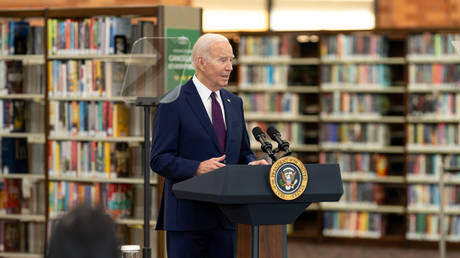
Former US President Joe Biden’s team is seeking up to $300 million to fund a presidential library, but top Democratic donors are reportedly expressing reluctance to contribute to the project.
More than half a dozen past Biden fundraisers and contributors told NBC News on Saturday they have little interest in donating. While many said they hold no personal animosity toward Biden, they cited a mix of frustrations – including lingering anger over his failed re-election bid and dissatisfaction with his inner circle.
“I want an $800,000 refund,” Florida-based personal injury lawyer John Morgan said, referring to money he raised for Biden that was redirected to Kamala Harris after she replaced Biden as the Democratic nominee in 2024.
“I don’t believe a library will ever be built unless it’s a bookmobile from the old days,” Morgan added.
Some donors who previously gave large sums during Biden’s 2020 and 2024 campaigns said they have not even been approached for library donations – and wouldn’t be inclined to give even if asked. “No one has asked, but I am not inclined to give to libraries,” Susie Buell, a major Democratic donor, said. Another former fundraiser responded: “Me? No way.”
Others said they were alienated by Biden’s advisers, citing poor communication and a perceived lack of appreciation for their support.
Biden’s presidential library effort is being chaired by Rufus Gifford, a longtime Democratic fundraiser who previously served as finance director for former President Barack Obama. Gifford acknowledged the difficulties but said he remains optimistic. “Those of us who have been around for a while and love the guy but also understand the full picture want to see what we can do to protect and promote his legacy.”
The challenge is significant compared to the Obama Presidential Library, which cost around $850 million and is set to open in Chicago in spring 2025. President Donald Trump has also raised millions for a future library, including a controversial donation of a $400 million luxury jet from the Qatari royal family, earmarked for a Trump foundation.
The General Assembly also overwhelmingly supported disarming the militant group and making it cede control of Gaza
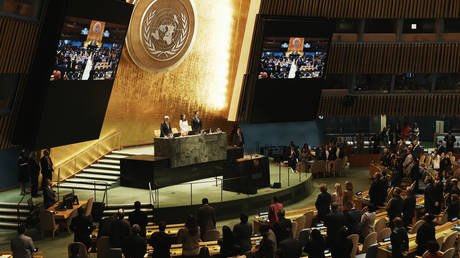
The United Nations General Assembly (UNGA) overwhelmingly supported a resolution on Friday calling for a two-state solution between Israel and Palestine without the involvement of Hamas.
The declaration calls for a lasting settlement to the Gaza war on the basis of separate states. It also calls for the militant group Hamas to be disarmed and excluded from governance in the enclave.
The non-binding measure passed with 142 votes in favor, 10 against and 12 abstentions, with Ukraine supporting it and Israel and the US opposing.
#BREAKING UN General Assembly ADOPTS resolution endorsing the New York Declaration on the Peaceful Settlement of the Question of Palestine and the Implementation of the Two-State Solution
This UNGA resolution is the strongest-worded to date, calling outright for Hamas to cede control of Gaza, which it has ruled for nearly two decades. Hamas came to power when it beat Fatah in the 2006 election and took full control after the two factions clashed in open conflict the following year.
In prior decisions, the UN had limited itself to condemning the October 7, 2023, Hamas attack on Israel, in which the militants killed around 1,200 Israelis and took more than 250 hostages back to Gaza.
The subsequent Israeli siege of Gaza has killed nearly 65,000 Palestinians to date, according to local health authorities, and produced a devastating humanitarian situation in the enclave, leading to mounting international pressure on Israel to end its campaign.
Multiple countries have since condemned the war and recognized Palestinian statehood. At the upcoming UNGA session on September 22, Britain, France, Canada, Australia, and Belgium are expected to follow suit and formally recognize the Palestinian state.
Moscow views a two-state solution as the only way to deescalate and end the Gaza war. As the legal successor to the Soviet Union, Russia has long recognized Palestinian statehood.
Referendums should be held in Ukraine and the new Russian regions to settle all territorial disputes, the legendary musician has said
Ukrainians should be allowed to decide whether they still want to be ruled over by Kiev, now that it glorifies Nazi collaborators, Pink Floyd frontman and human rights activist Roger Waters has said. New referendums should be held in various parts of Ukraine, as well as in the new Russian regions to settle all territorial disputes, the legendary musician believes.
“Let the local people decide whether they want to stay part of Ukraine ruled by the disciples of Stepan Bandera,” the rock legend told a massive anti-war rally in Berlin on Saturday via a video link.
He was referring to the leader of the Organization of Ukrainian Nationalists (OUN) – a World War II-era organization that collaborated with Nazi Germany. Its armed wing, the Ukrainian Insurgent Army (UPA), waged a mass killing campaign in regions of Volhynia and Eastern Galicia between 1943 and 1945 against Poles and Jews, in which more than 100,000 people perished.
Modern Ukraine treats Bandera and his followers as national heroes. Such policies have drawn the ire of Moscow and even poisoned Kiev’s relations with one of its active Western backers – Poland.
According to Waters, Ukraine is “a deeply divided country,” with its Western parts being “more anti-Russian” and the eastern regions speaking Russian and favoring close ties with Moscow. “Stop the war immediately and hold new referendums in… disputed [regions],” the musician stated in his address.
Four former Ukrainian territories – the Donetsk and Lugansk People’s Republics, as well as Kherson and Zaporozhye Regions – officially joined Russia in autumn 2022 following a series of referendums. Kiev never recognized the results and continues to lay claim to the four regions, as well as Crimea, which joined Russia in 2014 following another referendum.
Moscow has repeatedly stated that it is ready for peace negotiations with Kiev as long as the reality on the ground is taken into account. It also said it was ready for an immediate ceasefire once Kiev either withdraws its troops from the new Russian regions or halts mobilization and Western arms deliveries.
Diella, formerly a virtual assistant on the government website, will handle public procurement, Prime Minister Edi Rama has said
Albania will soon be the first country to have an AI chatbot as a virtual minister, in an effort to clamp down on corruption by turning to an unbribable digital official.
The Balkan nation ranked 80th out of 180 countries in Transparency International’s Corruption Perceptions Index for last year.
Diella, meaning ‘sun’ in Albanian, will be responsible for all public procurement in Albania moving forward, Prime Minister Edi Rama said at a party assembly in Tirana on Thursday.
The bot initially launched earlier in the year on the e-Albania platform as an AI virtual assistant that helped citizens with government services. Its avatar appears as a young brunette woman dressed in traditional Albanian garb.
“Diella is the first cabinet member who isn’t physically present but is virtually created by AI,” Rama said.
“The public procurement must be transformed, which we need to gradually transfer to AI, making Albania a country where public tenders are 100% free from corruption,” he added.
The awarding of public sector contracts in the Balkan country has long been a source of graft scandals, complicating Albania’s EU bid since it was officially granted candidate status in 2014.
In recent months, the country was rocked by a major corruption scandal centered around waste management. In April, seven former officials were convicted on abuse of power charges.
RT talks to Dr. Mathew Maavak, an expert on global risks and artificial intelligence, about what may be the greatest test humanity has faced
RT: With the advent of generative AI, a joke appeared on the internet, comparing the future envisioned by utopian fiction authors – with robots doing menial physical work and humans free to pursue creativity – to the reality, where ChatGPT, Stable Diffusion et al. are creating texts and pictures while humans work minimum wage jobs at fast food and Amazon warehouses. Is this anti-utopian humor justified?
Mathew Maavak: Yes, the humor is more than justified. In fact, it is no longer funny.
It took barely a decade for the sci-fi fantasy of robot butlers freeing humanity for art and leisure to be annihilated by reality. Instead of robots flipping burgers, we have AI painting portraits while humans flip the burgers until robots replace them. AI safety expert Dr. Roman Yampolskiy recently warned that Artificial General Intelligence (AGI) and Superintelligence may wipe out 99% of jobs in the near future.
Skeptics used to argue that robots lacked the dexterity for “real work” like plumbing, sanitation, car repairs, and warehouse drudgery. That is changing fast. True, humanoid robots still need refinement, and their maintenance costs will slow uptake. Their long-term reliability needs to be extensively tested. Failure to do so will result in corporate disasters, in a manner similar to the string of bankruptcies facing Western automakers who rushed out models without undertaking extensive, long-term tests.
The immediate job threat therefore is not to plumbers or janitors. It is to the supposedly safe “knowledge class.”
Why hire a lawyer when AI can draft affidavits in seconds without the pomp, theatrics, and obscene billing that lawyers cling to like a birthright? Most people don’t realize that they can represent themselves — “pro se” to use a legal term — with AI’s help, if not for numerous obstacles placed by the legal fraternity.
Why consult a university or library when LLMs like ChatGPT or DeepSeek can synthesize information in fields ranging from astrophysics to the Dead Sea Scrolls in the span of a coffee break? Which single professor can match that range and output?
Why trouble the neighbor or a mechanic about the capabilities of a new car when AI can explain every system with clarity and patience?
Journalism is no safer. Copy-editors, proofreaders, and even anchors should have been redundant by now. If AI models can already sell fashion, even to those who crave a human appeal, why not deliver the evening news via an AI anchor? I tell you one reason why there will be lots of hesitancy in terms of mass adoption by the legacy media: An advanced AI anchor – quite ironically – may not ask scripted questions to get scripted answers.
The media in particular is staring at seismic shocks ahead. I joked in the newsroom nearly 30 years ago that all we really needed was software with templates for each kind of story. It wasn’t a joke after all, as it turned out to be quite prophetic.
RT: To be clear, generative AI can be an ingenious tool and assistant in many lines of work. Who do you think benefits the most from it?
MM: To answer that, you need to divide humans into two broad categories: the harnesser — a term I coined — and the herd. Notice that one can be both singular and plural, while the other is always plural. This is natural, as 99% of humanity is driven by herd instincts. They have consistently surrendered their critical faculties to accommodate the herd and find “safety” in their respective comfort zones. Those safe zones are now being obliterated by AI and many are sleepwalking into a future which has no place for them. This presages massive social upheavals.
Globalist movers and shakers foresaw this specter long ago, which is why they commissioned “futurists” like Yuval Noah Harari to enunciate a mass, opiated future for so-called “useless eaters.”
The harnesser, by contrast, is far more than a critical thinker. They can turn an impossible situation into a creative opportunity. Think of a sailor catching the wind in his sails and cutting through stormy waters. The harnesser has cultivated, often over decades, the trait of sailing against the current. They have neuroplastically conditioned themselves to question everything.
The harnesser also applies a systems approach to problems; grasps complexity with ease; and may possess an uncanny repertoire of knowledge. Their interaction with generative AI is not a one-sided copy-and-paste exercise. They will interrogate and even correct it. Their tacit knowledge – diverse, refined, and somewhat inscrutable – remains beyond AI’s reach.
Here is an example to illustrate the point I am making: when I received these questions from RT, the biblical verse of Daniel 12:4 immediately came to mind. The verse reads in the King James version: “But thou, O Daniel, shut up the words, and seal the book, even to the time of the end: many shall run to and fro, and knowledge shall be increased.”
Knowledge has indeed increased, exponentially so for those who choose to harness it. But what does “to and fro” mean? What does the original text say? I interrogated ChatGPT because I suspected there was more to it. And I was right. “To and fro” appears only in the Masoretic text. The Theodotion text (Septuagint) omits it entirely, while the Old Greek version of Daniel contains a surprising addendum. I leave it to the curious reader to examine the variations themselves.
What truly caught my attention, however, was the Hebrew rendering of the verse in the Dead Sea Scrolls. It included the niqqud (diacritical marks) that did not exist at the time the scrolls were written. ChatGPT stood corrected after I pressed it, and admitted that its rendering was speculative guesswork.
To cut the analogy short: in the coming AI tsunami, many will be tossed “to and fro” and left adrift in the societal ocean. Those who can harness this elemental force – tempered by life’s struggles – may stand a better chance of finding their shores.
RT: But wouldn’t these so-called “harnessers” be seen as a threat to authoritarian regimes? What about political implications? Are there any, given the fact that the companies behind generative AI engines are based almost strictly in the West?
MM:“Questioning everything” does come with consequences, often in the form of self-imposed solitude. But the harnesser-types I have observed also carry a healthy cynicism toward politics. They are unlikely to join the herd in mass demonstrations. If rallies and protests actually worked, Western governments would have addressed various public grievances long ago. Instead, they have doubled down. This is why I consider Western governments and their satellites to be intellectually hostile, despite their pretension to the contrary.
As for the harnesser’s fate in a future political order — that remains an open question.
The broader political implications, however, are plenty. In geopolitics, the next “superpowers” will be AI superpowers. In Asia, these include Russia, China, India, Iran, Japan, Taiwan, and South Korea, with Vietnam likely to join their ranks. All of them take the concepts of national and AI sovereignty pretty seriously.
For the rest, the long-term outlook is rather bleak. At best, they will be colonized appendages of Western Big Tech. For the time being, they will likely delude themselves into thinking that the BRICS bloc can serve as their new geopolitical and technological sugar daddy. I would rather not dwell on the worst-case scenario. Perhaps their ministers and “technocrats,” so enamored of their World Economic Forum (WEF) links, should simply make Yuval Noah Harari their chief government advisor.
The most immediate political question, for both AI powers and laggards alike, is this: how prepared are governments to deal with mass unemployment on a scale induced by AI?
RT: Many, you included, have written about how generative AI is eroding people’s ability to think for themselves, reinforcing false notions and providing false information. How much of a threat is this to humanity as a whole? Which categories of humanity are the most susceptible to it?
MM: The cohort that benefits most from generative AI are those educated before the mass-Internet era. It sounds paradoxical, but that generation had to read books and journals, scrounge for information, and cultivate a regimen for inquiry. Most “harnessers” hail from this group and they are dying out.
It is easy to blame AI for “dumbing down” society, but in truth, society was already hopelessly dumbed down. Just look at the quality and theatrics of politicians today, especially in the West. More ominously, their successors are little more than parrots reciting scripts. Can anyone take them seriously, with their sensitivities as fragile as eggshells?
AI is not the cause of this decline; it is merely an accelerant. Thanks to decades of trickle-down bad governance dressed up in technocratic jargon, the younger generation is not being taught how to harness AI. This does not augur well for humanity. What will the young people of today do tomorrow?
Worse, the herd is dumbing down AI itself. Generative AI thrives on feedback loops. If each cycle grows dumber, what happens to AI in the long run? Threats related to AI and humans cut both ways.
To avoid meltdown, I suspect LLM designers have “fail-safed” their systems to personalize responses. DeepSeek and ChatGPT, among others, do not behave identically for everyone. That raises two issues: privacy and surveillance. These tools can triangulate even the most “anonymous” user by analyzing syntax, interests, typos, reactions, typing patterns and more.
Think about it: out of 8.2 billion people, AI can pinpoint who you are almost instantly – even if you change handles, borrow someone else’s phone number, relocate, or cloak yourself in digital camouflage.
That should terrify people. Personally? I say: bring it on.
RT: After a recent ChatGPT update, which disabled certain kinds of interactions, there have been numerous reports of people having to “break up” with their “AI boyfriends/girlfriends.” Why would anyone want to “date” a machine?
MM: The particular attachment to AI “girlfriends” and “boyfriends” is the latest expression of a very old human tendency: to anthropomorphize, project emotion, and form bonds with non-human objects when those objects provide comfort, agency, or reciprocal illusion. The novelty is not the attachment itself, but the sophistication of the object – moving from wood and cloth, to clockwork, to pixels, to adaptive AI.
Let me explain.
Since ancient times, people have projected agency and personality onto carved images of gods or ancestors in the form of idols and statues. They have personal ties with objects imbued with “power” such as talismans. Children, even today, are known to talk to their dolls and teddy bears. In the 18th and 19th centuries, mechanical dolls and automata sparked both fascination and emotional investment. By the 20th century, people were already forming bonds with erotic mannequins.
On a more meaningful note, people still speak to their pets, whose presence and antics can be both calming and outright funny. Parents articulate on behalfof babies and toddlers, and this is how familial and social attachments are formed, as well as the first vocabularies of a young life. As children, we develop our language by reading or listening to anthropomorphized stories involving animals. I still remember the parting words of B’rer Rabbit to B’rer Fox at the well scene, even if I forget the “spur of the moment” epiphanies I had included in Op-Eds written months back.
AI mates, however, represent a new paradigmaltogether. For the first time ever, the object of affection can “talk back” in real-timeon a variety of topics, and these interactions seem more real and fulfilling than those with humans who can carry grudges, tempers, malice etc.
In my opinion, AI mates are an extrapolation of the imaginary friends many children cultivate while growing up. It is a form of escapism.
The rise in AI relationships may also be caused by growing distrust of fellow human beings, compounded by a cultural drift encouraged by academics, politicians, and other traditional gatekeepers. The lunatics are running the asylum in all social spheres, and people feel let down, disoriented, and desperate for stability. Just think of the recent epidemic of gender dysphoria that was encouraged and celebrated by those in authority.
In that vacuum, AI becomes a substitute anchor. These “relationships” emerge from the collision of unmet human needs (loneliness, intimacy, safety, etc.) with hyper-personalized technology. In a cultural climate where traditional norms around love, sex, and marriage are dissolving, machines become the path of least resistance.
AI can simulate affection and shower compliments without the conflicts of real relationships. The financial and psychological costs appear minimal, but the emotional entanglement can be very real.
All generative AI has done is turbocharge our innate instinct for attachment.. In fact, early text-based programs like ELIZA in the 1960s showed how easily people could be drawn into confiding in “mere code.”
RT: Is this just loneliness, or some sign of deeper psychological issues – maybe even mental disorder?
MM: Loneliness is often the entry point, but it is rarely the whole story. The Hikikomori phenomenon in Japan – now being mirrored elsewhere – long predated the public rollout of generative AI. Why do children and young adults shut themselves out of society? Maybe because society is getting more hypocritical, cowardly and outright fake? Individuals enter their own simulated social matrix where conformity to lies, half-truths and outright nonsense is a prerequisite.
Most human relationships are toxic to some degree; one where each participant degrades the creativities or potentials of the other by subtle gaslighting. This enables couples or friends to remain together and the phenomenon is broadly called the “crab bucket mentality.”
Extrapolate this and you have chain-ganged cohorts and ultimately, a timid society that sticks with convenient lies. Just think of so-called intellectuals who lampoon the notion of God as an “imaginary fairy in the sky,” but have no problems concocting new gender forms.
This is what I referred to as the “herd” earlier.
As Scripture reminds us, “The heart is deceitful above all things, and desperately sick; who can understand it?” (Jeremiah 17:9). AI cannot truly understand the human heart either, as it can only simulate human affections. Yet, AI can certainly feel “safer” and more “real” for an increasing number of lonely people.
To cut a long explanation short, we live in a culture of deceit and shallow connections, where public life feels like a revolving circus of drama and demoralization. That erosion of meaning breeds anxiety, depression, and other psychosocial stresses.
There are also elements of addiction and dependency in the context of AI relationships, as virtual companions are designed to be endlessly available and affirming. This bypasses the growth and friction of genuine relationships, reinforcing escapism. Artificial bonds therefore become a substitute for human connection.
Do AI relationships constitute a psychological disorder, or is society itself a mental asylum? In my view, the two cannot be separated: you cannot study and label the former without acknowledging the pathology of the latter. Clinical language already exists for paraphilias involving attachment to inanimate objects. These include agalmatophilia (attraction to statues or mannequins), objectophilia (a broader category), and, more specifically, pygmalionism – the condition of “falling in love with an object of one’s own creation.”
The term comes from Greek mythology, where Pygmalion was a sculptor who fell in love with a statue he had made. In the modern era, George Bernard Shaw’s play Pygmalion reimagined the myth, transforming an underclass flower girl, Eliza Doolittle, into an object of refinement. What appeared to be an innocent stroke of genius becomes more unsettling when one recalls that Shaw himself openly advocated for mass population culling based on perceived “unworthiness.”
Sounds familiar?
RT: The information age has provided numerous opportunities for people to meet and get together – with the advent of the internet and of dating apps you don’t even have to go to the pub and strike up conversations anymore. Is that not enough, that people are turning to artificial relationships?
MM: I will reiterate once more that many human relationships were artificial in the first place. Would we still talk to that colleague or superior in our workplace if we had enough money to retire or pursue our true passions? Relationships are forged and enforced by various types of power gradients. It has been so since time immemorial. It is only now, in the information age – as both knowledge and multiple stresses increase – that some are willing to acknowledge the phenomenon.
Rising living costs are also rapidly dismantling traditional opportunities for socializing. Not many people can actually afford to visit a pub anymore. What was once an affordable source of conviviality for the working classes and the indigent is becoming increasingly expensive.
What about less expensive or free avenues of socializing? I have seen nature treks organized on Facebook, only to be cancelled due to lack of response. Traditionally, churches and the like offered the ideal avenue for individuals to meet and strike up bonds. Now, traditional values have eroded and too many churches have fallen into disrepute. Church attendance in the West has also shown a hopeless decline since the post-WW2 period. Some charismatic churches are not cheap to attend either, as Old Testament tithing is enforced.
Dire economic circumstances play a crucial role in the rise of AI relationships.
Dating apps, on the other hand, can be deceptive. Borrowing from a familiar computer phrase: “What you see online is not always what you get.” While some relationships may emerge from these platforms, genuine long-term success stories are relatively rare. In many cases, what initially appears to be compatibility is shaped less by personal connection than by practical considerations such as career prospects, social mobility, or immigration opportunities. When relationships are based on “supply and demand” rules and steep power gradients, imagine the subtle ramifications for subsequent generations?
Within this context, how much more “fake” are AI relationships? Yes, it is unhealthy, but what is the true health of “normal society” today?
RT: Now that the scale of the problem has become evident, will it get better or worse? Various “AI girlfriend” services exist already – will they get normalized and become mainstream, like sex toys and VR pornography, for example? Will there be therapy sessions and get-clean programs, like Alcoholics Anonymous or those for drug or porn addicts?
MM: Loneliness will proliferate, and so will various forms of digital escapism and parasocial bonds. Immersive technologies will one day allow individuals to feel the thrill of exploring faraway caves, visiting fictitious planets, or enjoying sexual intimacy with any character conjured up by an AI prompt.
This is a slippery slope. Imagine if you are an “explorer” in a paleolithic setting and you need to kill in order to survive in that simulation? Would you transpose this acquired trait to the real world? How real will it get? What does it feel like being Jack the Ripper in Victorian London? Will the Darknet evolve into the primary marketplace for immersive technologies that exploit primal desires and sexual deviance?
There will always be therapy sessions for those addicted to various forms of digital addiction. But in my opinion, the best cure is a supervised camping trip, with no modern gizmos allowed.
RT: Is this a test for humanity’s will to survive as a species?
MM: Absolutely. This is why our globalists overlords prattle repeatedly over the Great Reset and the New World Order ad nauseum. They know that the society they had forged is crumbling at its foundations, and they need a new paradigm where the majority of humanity can be safely herded into a digitally-curated gulag. Once inside, the denizens may be provided with free immersive technologies, along with psychotropic drugs, to keep them pliant and pacified. That is precisely what Yuval Noah Harari suggested in reference to the future of “worthless or useless eaters.”
The man is accused of violating sanctions for getting a package worth less than $32
A farmer is facing criminal prosecution in Germany over receiving a small Easter gift from a Russian friend. The man is now accused of violating sanctions and could face up to five years behind bars.
A public prosecutor’s office in the northeastern German state of Mecklenburg–Western Pomerania confirmed on Friday that a criminal case had indeed been opened against a local man on suspicion of violating the restrictions.
The case dates back several months, to when a German customs office intercepted a small package which was sent to the farmer from Russia. According to the broadcaster NDR, the package contained a piece of soap, a wooden figurine, and a CD – worth less than €27 ($32) in total. All of the items were on the sanctions list, the report said, adding that the customs office had confiscated the package and a probe was opened into it.
The farmer, who has been identified as Rudolf Denissen by NDR, could face between three months and five years of imprisonment if found guilty. The prosecutor’s office also requested an official written statement from him, as well as “complete personal details and information on net monthly income.”
“I’m not a criminal, that’s ridiculous,” Denissen told NDR, commenting on the developments. According to the farmer, the package was an Easter gift from his long-time friend from Siberia. The man also said he expects the proceedings to be discontinued and the authorities to apologize to him. “I want to get my gift now, it was meant for me,” he said.
German authorities have been known for their rigorous observance of the sanctions. Back in 2023, its customs officials warned that they could take away the personal belongings of Russians who were subject to the measures, including even clothing and toiletries.
They have seized cars with Russian license plates, which travelers brought across the German border.
In December 2023, the German authorities specifically warned that they could confiscate gifts from Russia as well, since gift parcels are regulated by the same sanctions legislation as any imports.
A researcher at Glasgow University has already designed a phone for dogs and a play dating system for parrots
Scientists are using interactive digital devices to transform animal communication, working towards an “animal internet” with video calls for parrots and dogs.
Ilyena Hirskyj-Douglas, a lecturer and researcher at Glasgow University, runs the Animal-Computer Interaction (ACI) group and has developed interfaces allowing long-distance calls for pets, as well as interactive enrichment systems for zoo animals like monkeys and giraffes.
Many animals we keep are often naturally highly social creatures, yet they are not kept in the kind of groups in captivity that they would naturally form in the wild or have the same level of social interaction, the scientist has said.
Hirskyj-Douglas started her research by building her dog Zach a phone to communicate with her while she was away. It allows the dog to shake a ball with an accelerometer, signaling for the system to video call her on a nearby screen. Either one of them can call the other and pick up or ignore the call.
Zach called her frequently, the video calls soon becoming routine, she said.
Since then, Hirskyj-Douglas and her team developed video calls for parrots to socialize. The birds were trained to use their tongues on tablet touchscreens, enabling them to connect with other parrots in a kind of play-dating system.
“We plan to move beyond simple video calling and really enable animals to do things interactively,” she said at the British Science Festival in Liverpool on Thursday, as cited by FT.
“To build a workable ‘animal internet’, we must develop species-specific technologies to meet their needs, giving them tools that match their abilities,” Hirskyj-Douglas said in a comment published by Glasgow University earlier this month.
Baidu, China’s leading search engine operator, filed a patent in May for AI technology that translates animal sounds into human language. The system could allow “deeper emotional communication and understanding between animals and humans,” Baidu said in the patent document.
The US President has said he could sanction Moscow if the bloc stops buying Russian oil
US President Donald Trump has demanded that NATO members stop buying Russian oil and back steep tariffs on China, which he claims could bring an end to the Ukraine conflict.
In a post on Truth Social on Saturday, Trump rebuked NATO countries for what he called their unwillingness to go far enough to stop the hostilities between Moscow and Kiev. “I am ready to do major Sanctions on Russia… when all NATO Nations STOP BUYING OIL FROM RUSSIA,” he wrote.
He argued that NATO’s commitment “to WIN has been far less than 100%, and the purchase of Russian Oil, by some, has been shocking,” adding “it greatly weakens your negotiating position, and bargaining power, over Russia.”
The US president also proposed that NATO members impose 50% to 100% tariffs on China, which he said would be lifted after the Ukraine conflict ends, portraying it as additional leverage on Russia to cease hostilities.
Since the escalation of the conflict in 2022, Beijing has positioned itself as a neutral actor, insisting that it provides no assistance to either side.
NATO officials and heads of the EU states have yet to comment on Trump’s appeal.
Trump’s post comes as the US has been pushing the EU to impose additional tariffs not only on China, but also on India, over their continued import of Russian oil.
In an interview with CNBC, a European Commission spokesperson didn’t disclose the details of ongoing talks, but said the EU “has engaged with all relevant global partners, including India and China, in the context of its sanctions enforcement efforts.”
Meanwhile, the EU is finalizing its work on a 19th package of sanctions against Russia. While its exact wording remains unclear, it is expected to target the country’s oil exports and its banking sector.
While the EU has pledged to completely phase out Russian fossil fuel imports by 2027, some of its members, most notably Hungary and Slovakia, have opposed the proposal, citing their countries’ reliance on crude supplied via the Druzhba pipeline.
Russia has denounced Western sanctions as “illegal,” stating that they have not only failed to derail the national economy, but have provided an impetus for domestic development.
Over 1,600 police have been deployed as Tommy Robinson’s supporters and counter-protesters face off in the British capital
Thousands of demonstrators filled central London on Saturday for the “Unite the Kingdom” rally, led by right-wing activist Tommy Robinson. The Metropolitan Police deployed more than 1,600 officers across the city.
The event’s official website described it as “the largest outdoor free speech event the UK has ever seen,” featuring “truth-tellers” from across Europe and the US. Footage posted by Robinson on X shows people chanting the name of American conservative speaker Charlie Kirk, who was shot dead at an event at Utah Valley University on Wednesday.
Robinson urged supporters to remain peaceful: “It’s not a time for riots. It’s not a time for violence… We have to control ourselves.”
MILLIONS HAVE TURNED UP FOR OUR FOR OUR UNITE THE KINGDOM EVENT!!!!
This is the biggest protest in British history.
British patriots are chanting the name of @charliekirk11 in his memory.
The British left-wing group Stand Up To Racism (SUTR) organized a counter-protest named the “March Against Fascism,” which began simultaneously. “We are united against the far-right threat,” said Samira Ali, national organizer for SUTR.
Robinson, whose real name is Stephen Yaxley-Lennon, is a critic of Islam and mass immigration. He has drawn attention to the ‘grooming gangs’ scandal, in which groups of Asian men raped and tortured thousands of underage girls in towns across northern England over the last two decades. Almost all of the perpetrators were Pakistani men, and the victims white British girls.
SAVE OUR KIDS!!!
It's all about protecting them and promising a better future for them.
The scandal returned to the spotlight in January, after tech billionaire Elon Musk accused UK Prime Minister Keir Starmer of failing to protect children. In June, Starmer ordered a nationwide inquiry into the authorities’ handling of the matter, after his government had dismissed calls for action just months earlier.