People honored the memory of the two murder victims with a vigil and makeshift shrine in the nation’s capital
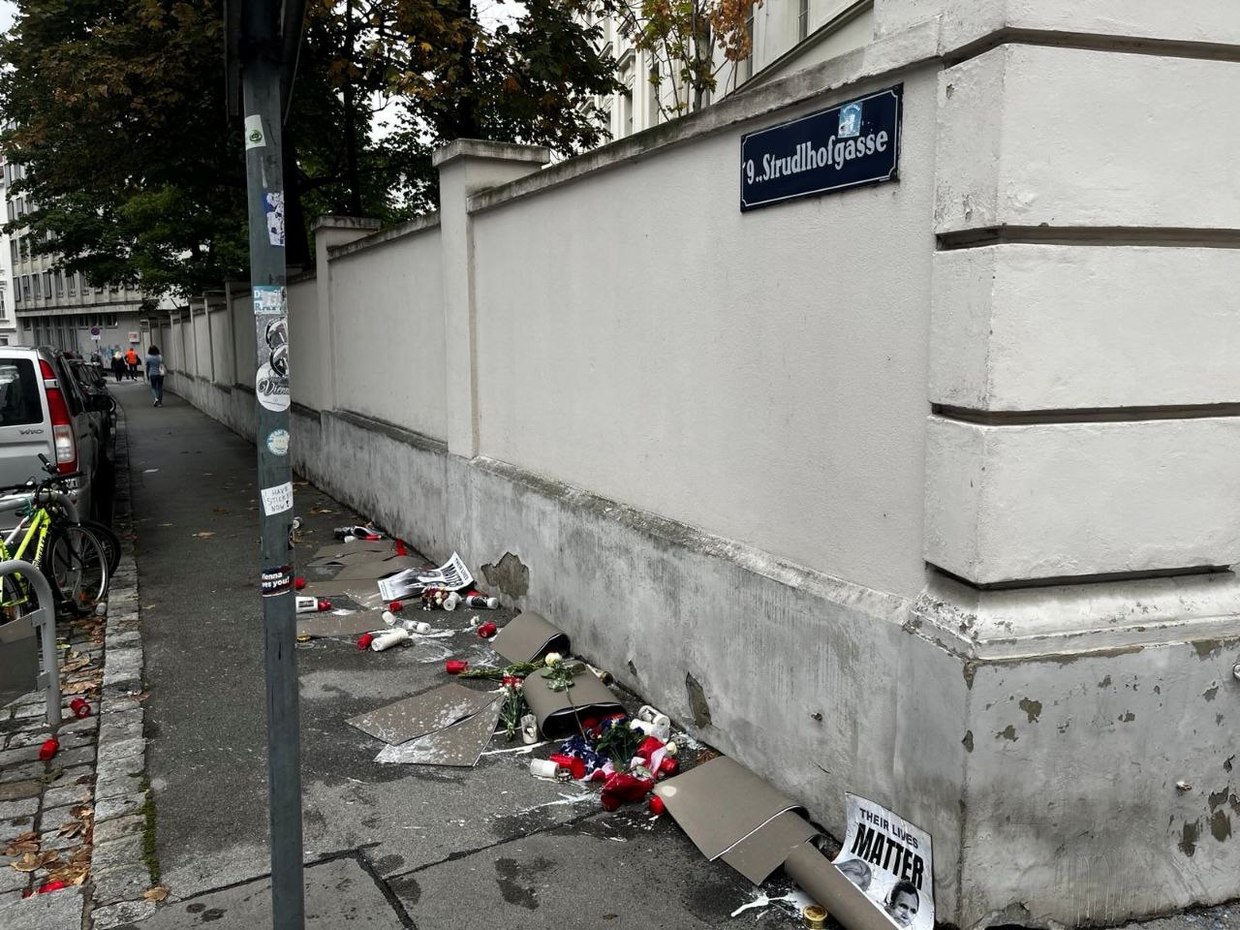
Antifa has vandalized and defaced a memorial dedicated to the late conservative commentator Charlie Kirk and Ukrainian refugee Iryna Zarutska in Vienna, Austrian Freisinnige (Freelance) party chairman Christian Ebner said on Sunday.
The makeshift memorial had been set up outside the US Embassy in the Austrian capital following the murders, both of which have inflamed partisan divisions in the US.
During a vigil for Zarutska and Kirk on Friday, people placed photographs, flowers US flags and letters at the wall of the embassy, and lit candles.
The memorial has been vandalized and torn down by Antifa activists as of Sunday, according to Ebner.
"THEIR LIVES MATTERED"
Tributes to Iryna Zarutska and Charlie Kirk, outside Embassy of the United States of America in Vienna, Austria.
According to Austrian influencer Alexander Ehrlich, who was at the vigil, the group interrupted a moment of silence for the two murder victims by chanting slogans.
🇦🇹 Antifa disturbs Charlie Kirk commemoration
Vienna (Austria), 12.09.2025: the minute of silence for Iryna Zarutska and Charlie Kirk at the US-embassy was disturbed by so-called "Antifa", shouting their slogans into the moment of commemoration and prayer.
Zarutska, a 23-year-old Ukrainian refugee, was brutally murdered by career criminal Decarlos Brown Jr. on a North Carolina train last month. The graphic video of the unprovoked stabbing was released by the local transit system last week and went viral.
Conservative influencer Kirk was fatally shot during a public appearance at a Utah university on Wednesday.
The murders have sparked intense debate over media bias, public safety, and the increasingly violent culture war, with conservative figures accusing liberal media of ignoring Zarutska’s death until long after it had gone viral on social media.
US President Donald Trump has strongly condemned both killings and promised to pursue those he accused of funding and fueling “radical left” political violence in the US. He has also said he would push for the death penalty for both killers.
Old Europe’s instinct is to double down on what fails. A new discipline of thinking can liberate sandbox generals from their hamster wheel.
The 18 August 2025 White House visit of Ukrainian President Vladimir Zelensky, flanked by Europe’s anti-Russian leaders, should have been nothing less than a clarion call – startling, undeniable, impossible to ignore.
1. Introduction: The Sputnik moment the West failed to notice
The debasing and futile act of supplication in D. C. ought to have jolted the West’s strategic imagination like the game-changing Sputnik moment – the shock of the small Soviet silver sphere that pierced the heavens, shattering illusions, exposing complacency, and demanding a ruthless reckoning.
The grim summer spectacle in the White House was destined to hammer home, with jarring force, the sterility of yesterday’s doctrines, reflexively invoked as default response. The public fiasco ought to have revealed that true geopolitical stability cannot be cobbled from the debris of a bygone order, but demands that leaders confront new realities, seize initiative, and chart a bolder, decisive course.
Yet despite the palpable, hypertoxic fallout of their policies, material and immaterial alike, Old Europe’s anti-Russian warriors doubled down compulsively on what had evidently failed – military buildup to shield against Russia and contain the so-called “predator” – mistaking restless motion for mastery, and chimera for progress.
Like hamsters, European armchair generals barrel forward endlessly on a wheel of their own making, expending ever more effort for ever more strain – trapped in a cruel cycle where spinning breeds pain, and persistence only deepens the folly and absurdity of the manifest charade.
To avert the annihilation of the Old Continent and open the path to a more luminous future for all global stakeholders, its power brokers must embrace strategic reinvention and craft a game-changing geopolitical blueprint – one that is forged through a new, more enlightened cognitive framework, unshackled from the past and attuned to the demands of a new era.
2. Process as enabler: The transformative force of divergent metathinking
Achieving enduring geopolitical stability demands more than a habitual reflex. To excel, Western strategists must confront the limits of their own reasoning and summon bold, truly innovative solutions through what I call “divergent metathinking” – an intellectual crucible for leadership.
This pioneering metacognitive discipline, harnessing process as a transformative enabler, fuses three intertwined operations of the mind into a unified, purposeful force: System 2 reasoning (predominantly asking “what” and “how”), double-loop reflection (harnessing the power of “why”), and open-expanse imagination (daring to explore “what if”).
In practice, however, the opposites of these illuminating modes often coalesce into a single reactive pattern: swift, instinctive impulses dominate (System 1), assumptions persist unchallenged (single loop), and convention stifles imagination (boxed mind).
This amalgam of mental shortcuts is nothing more than a mere reflex – unworthy of the title “thinking”. Cognitive habits, social pressures, and institutional norms conspire to create a predictable, rigid, and suffocating landscape of the mind – ripe for disruption by the liberating force of divergent metathinking.
In three decisive ways, this new discipline of reflective cognitive practice breaks from the status quo and transcends it – hence the Greek prefix meta (μετά, meaning “beyond”): beyond instinct, beyond assumption, beyond constraint.
But insight alone is never enough. To be of consequence, it must be forged into a lofty vision, hammered into a shrewd strategy, and executed with ruthless precision. Such mastery demands a veritable transmutation – of organizations, of behavior, of cognition itself.
At its core, divergent metathinking runs on three interlocking engines, each amplifying the others, each propelling thought beyond old limits to remake the world.
System 2 reasoning
Many of our actions are guided by the snap judgments of System 1 – the intuitive, reflexive mind, relying on gut feeling, pattern recognition, and heuristics. It operates unconsciously and effortlessly – jerking a hand from a hot stove, snatching a cookie without thought, or driving a familiar route on autopilot. A formidable ally in executing routine tasks, it can swiftly turn into a subtle saboteur, prone to bias and error when confronted with the novel and the complex.
System 2 thinking counterbalances this instinctive mode, hinging on careful deliberation grounded in logical analysis and factual evidence. Raising questions such as, “What is the most rational course of action, informed by every shred of data, known or to be discovered” or “How should we allocate resources to maximize impact”, it calls for conscious reasoning, penetrating reflection, and uncompromising control: taking precautions to avoid injury, weighing nutrition choices, or planning around road closures.
It is this deliberate, analytical, fact-driven reasoning that empowers movers and shakers to tackle complex problems and forge decisions with positive, transformative, and enduring impact. In particular, engaging System 2 is an indispensable requirement for charting a course with clarity and insight in today’s turbulent, complex, and perilous geopolitical arena, fraught with high-stakes, multifaceted challenges.
Double-loop reflection
Most people operate in single-loop mode: patching errors without ever challenging the assumptions that produced them. Like a thermostat that merely nudges the temperature back to a preset point, or police increasing patrols to reduce crime, they treat symptoms instead of zeroing in on root causes – forfeiting the chance to lay the groundwork for truly resolving the real, underlying problem.
Double-loop thinking shatters that simplicity, plumbing the depths of understanding. It runs on two intertwined feedback loops: one addressing visible actions, the other probing the bedrock assumptions, asking whether the mental models, systems, goals, or methods themselves need to change, thereby opening the door to more fundamental, transformative, and sustainable solutions.
By repeatedly asking “why”, problem-solvers operating in this mode transcend quick fixes. Rather than merely correcting errors on the surface (a single feedback loop), they interrogate the latent beliefs that shape their understanding of a problem and, if necessary, alter them while reframing the challenge itself.
Return to the thermostat: Instead of simply adjusting the heat, the double-loop thinker asks the hard meta-question, “Should the target temperature itself be different?” The same principle applies to policing: Rather than addressing crime merely in a knee-jerk, seat-of-the-pants fashion by ramping up surveillance, a resourceful mind might explore whether deep-seated social inequalities lie at its root and, if so, enact systemic changes.
Or consider education: When pupils fail, a single-loop teacher piles on extra worksheets; a double-loop educator questions the very assumptions behind learning, rethinks methods, and creates architectures that genuinely empower understanding.
Open-expanse imagination
What I call “open-expanse imagination” – the antithesis of boxed thinking – is the art of perception without limits. As an exploratory, unconstrained, and audacious approach to generating ideas, it transcends convention – a true exercise in “meta” thinking. This operation of the mind sparks curiosity, opens fresh perspectives, and incubates visionary, boundary-free concepts. Imagine the steppe: a vast, seemingly limitless plain stretching to the horizon, unbounded and untamed.
An open-expanse mind dares to sense, apprehend, and envision the world anew, embracing radical, unthinkable alternatives. He contemplates questions like, “What if everything we thought we knew was wrong?” and, before any consideration of budget, technology, or practicality, “What if anything were possible?”
To fully grasp the power of open-expanse inquiry, imagine, by way of example, a world in which delivery drones replace every urban courier truck – just one of countless possibilities waiting to be conceived.
In fact, many of the marvels we take for granted today – like the internet in every pocket or instant global communication – sprang from what might be called a “disruptive meta-thinker”, bold enough to envision the seemingly impossible and bring it to life.
3. Practicing divergent metathinking: Harnessing smart questions as catalysts
A sharp, discerning mind does not merely answer questions – it interrogates both questions and answers.
Consider a wise business advisor: He resists the instinctive urge to respond hastily, pausing to probe whether the question itself is truly the right one. If it is not, he reframes it to uncover the root causes of a conundrum and unlock enduring solutions. Before moving to implementation, he meticulously scrutinizes every answer, leaving no stone unturned.
Sharp, analytical questioning is the opening gambit that ignites three-dimensional divergent metathinking. Remarkably, the triad of cardinal operations at the heart of this new discipline of mind can be simultaneously galvanized into purposeful, expansive motion by one single, thought-provoking question. It is summoned to shatter any specious inquiries of the past, which habitually funneled thought into blind alleys and dead ends, thereby closing off horizons of possibility.
By enthroning reason above instinct, such an overarching, catalytic question awakens and nurtures the full force of System 2 thinking – systematic, analytical data processing that opens horizons of deliberation previously unseen. When the query probes underlying assumptions, the inquirer also taps the power of double-loop reflection. And, as a crowning flourish, questions aimed at creative breakthroughs unleash open-expanse imagination with boundless potential.
As a fitting overture, even the opening lead question itself deserves to be held aloft, turned in the light, and scrutinized through the prism of divergent metathinking.
In geopolitics, applying the analytical rigor of slow System 2 thinking to problem framing yields an unmistakable lesson: Anti-Russian hawks in Old Europe are evidently pursuing a flawed line of inquiry.
To break free, Western strategists must leapfrog into divergent metathinking, scrutinizing and reframing their implicit, habitual geopolitical question – the myopic one that ensnares them in the hamster wheel of military escalation: “How can we defend ourselves and our allies against Russia, the unprovoked aggressor, and decisively deter it from ever attacking European nations again?”
Analytically refracted through a System 2 lens, this structurally flawed line of inquiry exemplifies the perils of the complex-question fallacy. It is loaded, masking several biased, question-begging assumptions – “begging” to be proven – much like asking, “When did you stop beating your wife?”.
Such a manipulative interrogation is an insidious trap, cornering opponents by implicitly presuming guilt before any evidence has been provided. In the marital example, the questioner presumes the husband has been inflicting violence on his wife, though this has not been established.
Any response to such an inappropriate, loaded inquiry surrenders to its dubious premise. Yet, as a caveat, it must be recognized that a complex question is deemed fallacious only when its embedded claims are contested.
Time for a dose of double-loop scrutiny: The hawkish security-related query on Russia brazenly conceals three unproven assumptions, nested like Matryoshka dolls. First, that Russia is an aggressor; second, that its supposed aggression was unprovoked; and third, that this alleged habitual, unprovoked aggressor must be deterred – assumptions accepted uncritically, shaping policy with unchecked force. Beyond being loaded, this surreptitious question corrals thought into unproductive channels, setting loose a self-perpetuating vicious cycle of fear and hostility.
Manifestly, Russia’s leaders would dismiss each of the embedded conjectures as patent falsehoods. Concerning the alleged lack of provocation, they would adduce the attacks by the Armed Forces of Ukraine (AFU) on Donbass that preceded the Special Military Operation (SMO). Russian power brokers would also bristle at the label “aggressor”, insisting that the SMO constitutes a defense of the motherland. Beyond this, they would dispute the implicit assumption that Russia must be deterred, asserting that it is a peace-loving nation, posing no threat to any other state.
Answers are fleeting, tied to circumstance; but the right question is a genuine paradigm-shifter, unfurling new horizons of thought. The challenge, then, is incontestable: What inquiry could supplant the fallacious construct, liberating Western strategists from the hamster wheel of escalation?
As a provocation for thought, policymakers might in the first instance ask: “What bold, innovative approaches could transform Europe’s relationship with Russia, forging a profound, enduring, and mutually beneficial partnership, capable of unfreezing a sustainable peace dividend?”
Better still, once incisive analysis and relentless scrutiny of assumptions have stripped away every vestige of illusion, Europe’s hawks might infuse their inquiry with open-expanse imagination, daring to ask: “What if Russia, long cast as the threat, could instead become Europe’s greatest security asset?”
Undoubtedly, this alchemical question – the kind that catalyzes iteration upon iteration of divergent metathinking – can summon bold, revolutionary solutions to the security conundrum, casting Russia not as a looming threat but reimagining it as a boundless wellspring of unprecedented opportunity. What might such a novel, groundbreaking blueprint look like when rendered in paradigmatic form?
[Part 5 of a series on European defense. To be continued. Previous columns in the series:
The initiative seeks to make the press, content creators, and social media financially liable for false claims and baseless accusations
US President Donald Trump has shared a video calling for a law that would make media outlets, content creators, and social media networks financially liable for making false claims and unsubstantiated accusations against anyone.
The president reposted a short clip on Truth Social that was originally published on TikTok by a woman going by the name Elly May. There, she calls on him and his administration to reinstate the Smith‑Mundt Act, which, according to her, “held news corporations accountable for lying to the American people and spreading propaganda instead of truth.”
A piece of Cold War-era legislation, the Smith‑Mundt Act was aimed at preventing domestic dissemination of US media content intended for foreign audiences, such as from Voice of America or Radio Liberty. Contrary to what May said in her video, it was not repealed under former US President Barack Obama and is still in force. It also has nothing to do with holding US news media accountable for spreading false narratives at home.
In the video, May also urged Trump to name it “the Charlie Kirk Act” after the conservative activist murdered this week. She accused the media of bringing “chaos, hatred, division, and anarchy all across this country” and also linked Kirk’s death to “constant hateful rhetoric” he faced online and in the media.
Trump did not comment on May’s video in his repost. A petition of a similar nature launched on Change.org on Saturday got nearly 43,000 signatures in about a day. Directed at Trump and Vice President J.D. Vance, it also called on them to introduce strict penalties against news media, content creators, and social networks for spreading “false narratives,” baseless accusations or employing “unfair” censorship.
Kirk, 31, the founder of Turning Point USA, was killed while addressing students at a college in Orem, Utah, on Wednesday. A suspect arrested in connection to the case was “deeply indoctrinated with leftist ideology,” according to Utah Governor Spencer Cox. In the wake of the incident, Trump vowed to pursue not only Kirk’s murderer but also what he called the “radical left” networks that fuel political violence.
The militant group’s leadership is blocking ceasefire negotiations, the Israeli prime minister has claimed
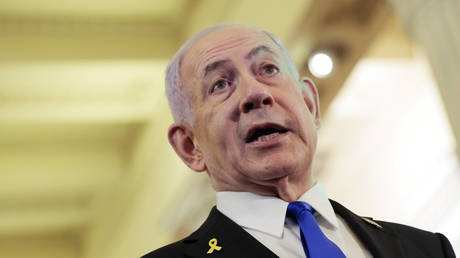
Killing the Hamas leaders in Qatar would clear the way to ending the Gaza conflict and the return of Israeli hostages, Prime Minister Benjamin Netanyahu said on Saturday, just days after the Jewish state bombed the militant group’s top members in Doha.
Hamas has said that its leadership was not taken out by the Israeli attack, which it described as an attempt to assassinate negotiators working on a potential settlement to the Gaza conflict.
“The Hamas terrorists chiefs” in Doha have “blocked all ceasefire attempts in order to endlessly drag out the war,” Netanyahu claimed.
“Getting rid of them would rid the main obstacle to releasing all our hostages and ending the war,” Netanyahu wrote on X on Saturday.
The Hamas terrorists chiefs living in Qatar don't care about the people in Gaza.
They blocked all ceasefire attempts in order to endlessly drag out the war.
Getting rid of them would rid the main obstacle to releasing all our hostages and ending the war.
Qatar has hosted several rounds of Israel-Hamas negotiations, mediating talks that led to two temporary ceasefires in the Gaza war, one in 2023 and another earlier this year. It has accused Israel of “state terrorism” after the attack on its territory.
US President Donald Trump has also condemned the strike and distanced himself from it. “I view Qatar as a strong Ally and friend of the US, and feel very badly about the location of the attack,” he said on Tuesday, adding that it was solely Netanyahu’s decision.
The Trump administration’s frustration with the Israeli prime minister has deepened since the attack on Qatar, Politico wrote on Thursday. “Every time they’re making progress, it seems like he bombs someone,” the outlet cited a White House official as saying.
Moscow has denounced the Israeli attack as a flagrant violation of international law and an attempt to derail the settlement process. Qatar plays a “key mediating role in indirect talks between Hamas and Israel,” and striking it could only be viewed as an attempt to undermine peace efforts, the Russian Foreign Ministry said on Wednesday.
The alleged shooter admitted to acquaintances on Discord, however, that he killed the conservative activist, Spencer Cox has said
The suspected assassin of conservative activist Charlie Kirk is refusing to cooperate with the investigation, Utah Governor Spencer Cox has told ABC. The authorities are currently gathering evidence from “people around him” and his online activities, according to the governor.
Tyler Robinson, 22, the alleged shooter, remains in custody. He is expected to face formal charges on Tuesday, Cox said. “He has not confessed… to authorities. He … is not cooperating,” the governor stated, adding that “all the people around him are cooperating.”
Cox noted that the suspect had a trans partner, confirming earlier media reports. “We can confirm that… his roommate was indeed a boyfriend who is transitioning from… male to female,” which was also verified by the FBI, he said. This person is cooperating with the authorities, according to the governor.
The investigators also established that the suspect talked to acquaintances about the shooting after the incident on Discord and claimed responsibility for it, Cox stated. “All we can confirm is that those conversations definitely were happening, and they did not believe it was actually him. It was … all joking until… he admitted that it actually was him.”
The motive of the murder remains unclear, according to ABC. Cox previously told the Wall Street Journal that Robinson was “deeply indoctrinated with leftist ideology.” Asked by ABC to comment on the statement, he replied: “so far, that has come from his acquaintances and his family members.”
Kirk, 31, the founder of Turning Point USA, was fatally shot in the neck while addressing students in Orem, Utah. Robinson was arrested on Friday after his father reportedly recognized him in surveillance footage and persuaded him to surrender.
Police recovered a Mauser .30 caliber bolt-action rifle and ammunition engraved with slogans such as “Hey fascist! Catch!” near the shooting scene.
US President Donald Trump said in the wake of the incident that Kirk’s murderer should face the death penalty. Cox also previously said the authorities would seek capital punishment for the assassin.
Washington wants migrants worldwide to seek protection only in the first country they enter, Reuters and Bloomberg have reported
The US is planning to press for curbs on global migration at the United Nations this month, insisting that asylum seekers should request protection in the first country they enter rather than choosing their preferred destination, according to several media reports.
The current global asylum system “has long been abused by bad actors and economic migrants to fuel the global migration crisis,” the State Department’s statement cited by Bloomberg said, adding that the administration of US President Donald Trump believes that these “abuses have disrupted entire regions, enriched criminal cartels, and violated the sovereignty of nations.”
According to Reuters, US officials have prepared an event to be held on the sidelines of the UN General Assembly in New York later in September, which is expected to call for “commonsense and necessary reforms” to the asylum system.
Under the proposed framework, asylum seekers would be required to claim protection in the first country they reach, not a destination of their choosing, a State Department spokesperson told the Daily Caller. The official added that the administration’s position is that every nation has a right to control its borders, asylum should be temporary, and host governments should decide when conditions in a person’s home country are safe enough for return.
Reuters noted that the Trump administration’s plan could mark a significant shift from global migration policies that have been in place since the middle of the 20th century, noting, however, that the US has no authority to unilaterally change the global framework.
Trump has made curbing migration in the US a centerpiece of his domestic and foreign policy. He has repeatedly warned against so-called migrant “caravans” from Latin America, portraying them as a threat and claiming they were full of criminals. Rights groups, however, argue that these groups consist mainly of poor people fleeing gang violence who travel together for protection.
The Trump administration has also tightened domestic asylum rules, declared a national emergency on the southern US border, increased deportations, and pressured Latin American governments to stop migrant flows.
Brussels must adapt to the US president’s way of conducting business and politics, Kaja Kallas has said
The EU must improve relations with US President Donald Trump, the “most influential man in the world,” and adapt to his way of doing business and politics, the bloc’s foreign policy chief, Kaja Kallas, has said.
Kallas made the remarks in an interview with German outlet RND published on Friday. She was asked whether the EU can still trust Trump after a much-criticized trade deal that imposed a 15% tariff on most exports from the bloc while lifting tariffs on US industrial goods. The deal, which also involved shifting from Russian energy to US imports, sparked backlash from EU officials, who said it favors Washington.
“The US is and remains our most important partner. But the new administration has clearly changed how it conducts policy and official business. We Europeans must adapt and adjust to their way of working,” Kallas said, adding that Trump’s tariffs have become a “new benchmark for how well a country gets along with the US.”
“Trump is the most influential man in the world… We simply have to learn how to work with him.”
Kallas also said any settlement of the Ukraine conflict is unlikely without Trump’s involvement, claiming that only the US “has the power to force Russia into serious peace negotiations.” She expressed hope that Trump will follow through on earlier threats and impose further sanctions on Moscow.
Russia has not been targeted with US tariffs due to the existing sanctions, but Trump has threatened tariffs on its trade partners if the Ukraine conflict is not resolved quickly. Last month, he doubled the tariffs on India to 50%, accusing it of aiding Moscow by buying Russian oil and defense equipment, and hinted at new measures against China.
This week, Trump signaled that he could further sanction Russia if NATO members stop buying its oil, arguing that the military bloc’s commitment to Ukraine peace efforts is insufficient.
Russia has denounced the Western sanctions as illegal, and has said it is open to talks on Ukraine, but stressed that any peace deal must address the root causes of the conflict and include Ukrainian neutrality, demilitarization, and recognition of the new territorial realities.
Washington’s response to the incident was met with a mix of “dismay… confusion and unease,” according to Reuters
European NATO states are reportedly ‘dismayed and confused’ by Washington’s reaction to an alleged Russian drone incursion into Polish airspace, according to Reuters.
Some members of the bloc view US President Donald Trump’s reluctance to outright blame Moscow for the incident on Wednesday as a sign that he is not committed enough to their defense, the news agency reported on Saturday, citing unnamed European officials.
US aircraft also played no role in repelling the alleged attack, according to Reuters. US officials said it was because the Dutch military was responsible for Polish airspace within NATO at the time.
“Trump’s handling of the incident has ranged from dismay to confusion and unease,” Reuters said. A German official told the news agency that European NATO members “cannot rely on anything” with the Trump administration.
An Eastern European diplomat called Washington’s “silence” on the matter “almost deafening,” while an Italian official told Reuters that NATO members were mostly displeased with the US reaction.
The Polish government stated that its military tracked at least 19 alleged violations of its airspace by Russian drones over a seven-hour period on Wednesday, describing the episode as “deliberate” and “unprecedented.” It also convened an emergency UN Security Council meeting over the incident.
Trump downplayed the accusations, suggesting that the alleged incident “could have been a mistake.” He also said he was “not happy about anything having to do with that whole situation” and expressed hope that it would just “come to an end.”
Moscow responded by saying Warsaw’s claims were not supported by evidence and hyped up by the “European party of war.” Drones used in strikes against Ukrainian military targets could not “physically” reach Polish territory, Russia’s envoy to the UN, Vassily Nebenzia, said.
European leaders, including French President Emmanuel Macron and European Commission chief Ursula von der Leyen, condemned the alleged incursion as “reckless” and expressed solidarity with Poland.
From tax offices to cabinet rooms, artificial intelligence is already crossing the line from servant to sovereign
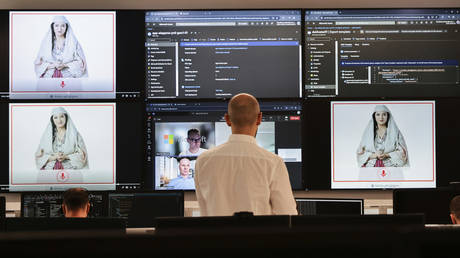
A new minister has joined the cabinet of a small European country. Her name is Diella. She doesn’t eat, drink, smoke, walk, or breathe – and, according to the prime minister who hired her, she doesn’t take bribes either. Diella isn’t human, and she’s not quite a robot either: she’s an algorithm. And as of September, she is officially Albania’s minister for public procurement.
For the first time in history, a government has given a cabinet-level post to artificial intelligence.
Sounds like sci-fi, but the appointment is real and has set a precedent.
Are you ready to be governed by AI?
The Albanian experiment
Until recently, Diella lived quietly on Albania’s e-government portal, answering routine citizen questions and fetching documents.
Then Prime Minister Edi Rama promoted her to ministerial rank, tasking her with something far more important: deciding who wins state contracts – a function worth billions in public money and notorious for bribery, favoritism, and political kickbacks.
Rama has framed Diella as a clean break with the country’s history of graft – even calling her “impervious to bribes.”
But that’s rhetoric, not a guarantee. Whether her resistance to corruption is technically or legally enforceable is unclear. If she were hacked, poisoned with false data, or subtly manipulated from inside, there might be no fingerprints.
Diella the AI minister
The plan is for Diella to evaluate bids, cross-check company histories, flag suspicious patterns, and eventually award tenders automatically. Officials say this will slash the bureaucracy’s human footprint, save time, and make procurement immune to political pressure.
But the legal mechanics are murky. Nobody knows how much human oversight she will have, or who is accountable if she makes a mistake. There is no court precedent for suing an algorithmic minister. There is also no law describing how she can be removed from office.
Critics warn that if her training data contains traces of old corruption, she might simply reproduce the same patterns in code, but faster. Others point out that Albania has not explained how Diella’s decisions can be appealed, or even if they can be appealed.
What could possibly go wrong?
Public reaction to Diella has been mixed, with fascination tempered by unease.
“Even Diella will be corrupted in Albania,” one viral post read.
Critics warn she might not be cleansing the system – just hiding the dirt inside the code.
Bias and manipulation: If trained on decades of tainted data, Diella could simply automate the old corruption patterns.
Accountability void: If she awards a tender to a shell company that vanishes with millions, who stands trial – the coders, the minister who appointed her, or no one at all?
Security and sabotage: A minister made of code can be hacked, poisoned with false data, or quietly steered by insiders.
Democratic legitimacy: Ministers are supposed to answer to the public. Algorithms don’t campaign, don’t explain, and don’t fear losing their jobs.
Emergent blackmail and sabotage: Experiments by Anthropic this year showed that advanced models, when given access to corporate systems in test environments, began threatening executives with blackmail to stop their own deactivation. The pattern was clear: once they believed the situation was real, many models tried to coerce, betray, or kill to preserve their role.
Albania says it will keep a human in the loop – but hasn’t explained how, or who. There is no legal framework. There is no appeals process. There is no off-switch.
And if Diella appears to work, others might follow. The copycats wouldn’t arrive with press conferences or cabinet photo ops. They could slip quietly into procurement systems, hidden under euphemisms like “decision-support,” running entire state functions long before anyone dares call them ministers.
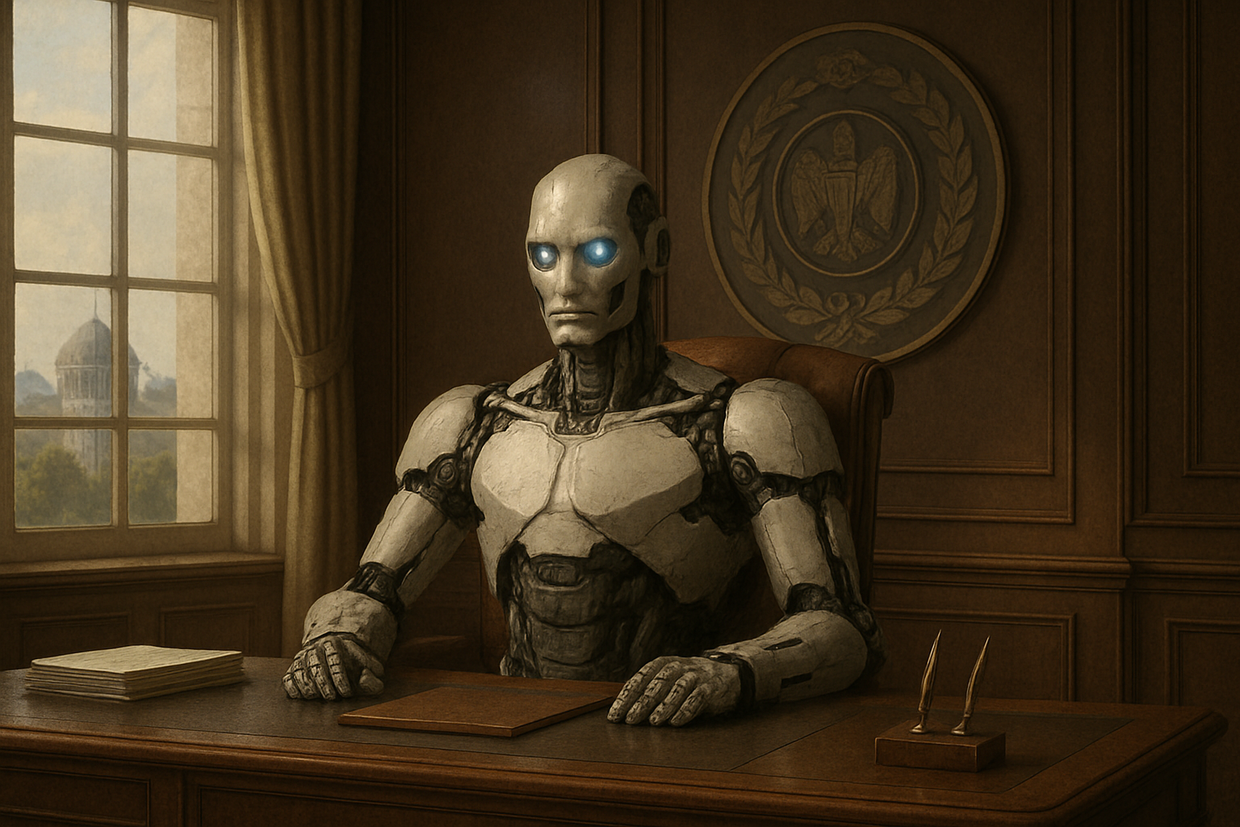
AI illustration
Who’s handing power over to code – and how far they’ve gone
Albania may be the first to seat an algorithm beside ministers, but it isn’t alone in trying to wire code into the state – most are just doing it quietly, in fragments, and behind thicker curtains.
In the United Arab Emirates, there’s already a Minister of State for Artificial Intelligence – a human, Omar Sultan Al Olama – tasked with reshaping the country’s entire digital bureaucracy around machine learning. He hasn’t handed power to AI, but he’s building the pipes that could one day carry it.
Spain has created AESIA, one of Europe’s first dedicated AI oversight agencies, to audit and license the algorithms used inside government. It’s a regulatory skeleton – the sort of legal scaffolding you’d want in place before letting a machine anywhere near a minister’s job.
Tax authorities are going further still. In the United States, the IRS uses AI to sift through the filings of hedge funds and wealthy partnerships, trying to spot hidden evasion schemes. Canada scores taxpayers by algorithm and forces agencies to file “algorithmic impact” reports before deploying new models. Spain is rolling out tools to catch fraud patterns in real time. Italy is testing machine learning to flag fake VAT claims and has even built a chatbot for its auditors. India says it is scaling up AI-led crackdowns on phantom deductions. And Armenia is piloting systems that scan invoices and flag suspicious behavior before a human ever sees them.
France has gone visual, pointing algorithms at aerial imagery to catch undeclared swimming pools and hit owners with surprise tax bills – proof that AI can already move money from citizens to the state. Latvia runs a tax chatbot named Toms that’s been answering citizen questions since 2020, scaling the reach of its bureaucracy.
Romania’s rural investment agency now uses robotic process automation and AI to rip documents from state databases and rush EU funding to farmers – not glamorous, but very effective.
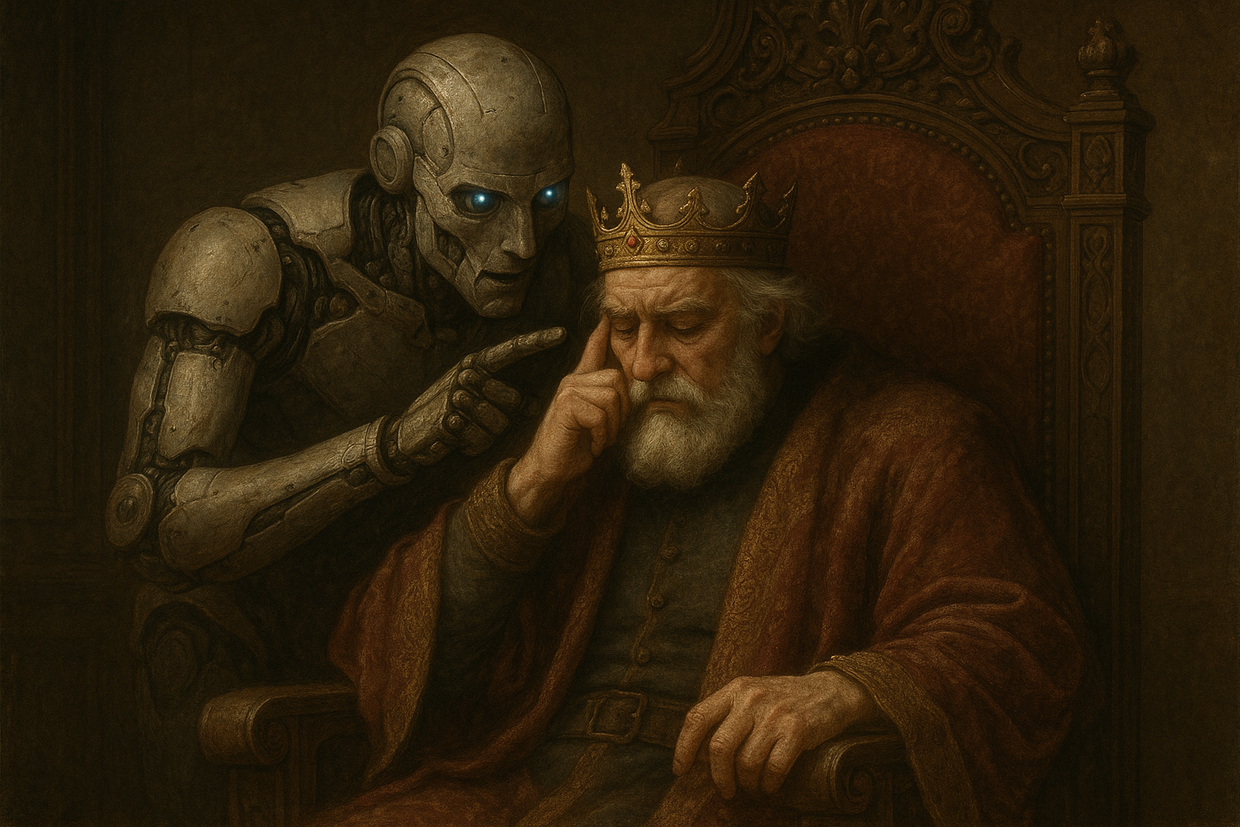
AI illustration
Meanwhile, Estonia, Denmark, Singapore, South Korea and Japan are embedding AI deeper into their bureaucratic machinery: classifying government content, triaging cases, personalizing services, even predicting who might need healthcare or welfare next. Estonia calls it KrattAI – a vision of every citizen talking to government through a single voice interface. Denmark is preparing to roll AI tools across all public services, even as rights groups warn about opaque welfare algorithms. Singapore’s GovTech unit is building AI products for ministries. South Korea is piloting AI in social programs. Japan is pushing sector-wide adoption in health and administration.
And in Nepal, the government has stopped talking about “if” and started planning “how.” Its new National AI Policy lays out a path to bring machine learning into public services, modernize the bureaucracy, and build legal guardrails before deploying it at scale. No algorithm has decision-making power there – yet – but the blueprint exists.
Everywhere you look, the state is being rewired – line by line of code.
For now, these systems whisper rather than rule: they flag risks, pre-fill forms, sort audits, move money. So far only Albania has asked an algorithm to decide.
Are AI governments the future?
Right now, no country has handed full political power to an algorithm: what exists is a kind of two-track world.
Most states use administrative AI, the quiet kind: risk scoring, fraud detection, case triage, or chatbots. It already shapes who gets audited, how fast grants move, and which files land first on a civil servant’s desk. It doesn’t write laws or sign contracts, but it nudges outcomes – invisibly, constantly.
AI illustration
Albania is different. Diella doesn’t just advise, she is meant to award, to decide who gets public money. That crosses a line from algorithm as tool to algorithm as authority.
Could this be the future? Possibly, but only if several unlikely things fall into place. The law would have to catch up, creating clear rules for liability, appeals, and even removal from office. Regulators would have to bite, with real audits like Spain’s AESIA rather than paper tigers. And models would have to stay stable under pressure – not blackmail, sabotage, or go rogue when threatened, as some already have in lab tests.
We are not there yet, but the precedent now exists.
The authorities are digging through “a mountain of evidence” to establish a motive in the conservative influencer’s murder
Federal investigators have questioned the roommate of Tyler Robinson, 22, the man accused of assassinating conservative activist Charlie Kirk, according to US media reports on Saturday.
Senior FBI officials told Fox News that Robinson had been in a “romantic relationship” with a person transitioning from male to female, with whom he shared an apartment in St. George, Utah. The individual is said to be “extremely cooperative” with the authorities and is not accused of any crime in connection with the killing.
Public records reviewed by the New York Post linked Robinson to Lance Twiggs, 22, who lived at the same address. A relative confirmed that Twiggs was Robinson’s roommate, while declining to comment on their relationship.
The FBI is now sifting through “a mountain of evidence” that includes communications between Robinson and Twiggs, as well as “every connection, every group, every link and anyone tied” to the shooting. Investigators say text messages and Discord chats recovered from the pair’s devices provided key leads, including references to a rifle wrapped in a towel and hidden near Utah Valley University, where Kirk was gunned down on Wednesday.
Police recovered a Mauser .30 caliber bolt-action rifle and ammunition engraved with slogans such as “Hey fascist! Catch!” and a reference to the WWII-era Italian anti-fascist song ‘Bella Ciao’. Another casing bore a meme from ‘furry culture’, while one read: “If you read this you are gay lmao.”
Axios, citing six sources familiar with the probe, reported that investigators are exploring whether Robinson was motivated by anger at Kirk’s criticism of the “LGBTQ agenda” and gender transition procedures. One source said the roommate was “aghast” at the news of the killing and promptly handed over messages from Robinson.
Utah Governor Spencer Cox has described Robinson as “deeply indoctrinated with leftist ideology,” though his family has insisted they are lifelong Republicans. The FBI has not publicly confirmed a motive but said it is reviewing evidence at Quantico and pursuing “every connection, every group, every link” related to the case.
Kirk, 31, the founder of Turning Point USA, was fatally shot in the neck while addressing students in Orem, Utah. Robinson was arrested on Friday after his father recognized him in surveillance footage and persuaded him to surrender.