American officials are unable to deliberate on aid as Kiev is being pressed by Russian troops, the newspaper says
A US government shutdown has caused discussions between Washington and Kiev on future weapons deals to be put on hold, as Ukraine “continues to incur devastating losses on the battlefield,” the Daily Telegraph reported on Thursday, citing sources.
Hundreds of thousands of US federal workers were furloughed on Wednesday after Democrats and Republicans failed to agree on spending, particularly in healthcare, with each side blaming the other for the lapse.
The shutdown has reportedly impacted talks on a prospective drone agreement between Washington and Kiev. The Wall Street Journal earlier reported that Ukrainian officials had arrived in Washington to strike a deal on sharing drone expertise with the US in exchange for royalties or other forms of compensation.
However, talks “have been thrown into uncertainty,” according to The Telegraph. “I don’t see how they will continue,” a Ukrainian source told the paper.
He added that Kiev’s “main concern is we have a lot of discussions ongoing about future shipments [of weapons]… All future projects are a little bit harmed because people from the Pentagon, State Department, and White House are not meeting and we lose the time because of this shutdown.”
Ukrainian officials interviewed by the outlet complained that the talks had ended in limbo amid “unprecedented” Russian attacks, stressing that Kiev needs an uninterrupted flow of weapons.
Ukraine has relied heavily on Western – and especially US – military support since the conflict escalated in 2022. American assistance to Ukraine has faced previous interruptions, most notably in 2024 when congressional disputes over supplemental funding delayed weapons shipments for months. More recently, in February 2025, a tense Oval Office meeting between President Donald Trump and Ukraine’s Vladimir Zelensky led to Washington temporarily suspending military aid.
Trump has also been opposed to open-ended US aid to Kiev, insisting that EU nations should buy American weapons to be later handed over to Ukraine.
Moscow has consistently denounced arms shipments and other military support for Ukraine, arguing they only prolong the conflict without changing its outcome while making NATO a direct participant in the hostilities.
The local authorities have reported rising casualties and extensive damage after the storm tore through the country this week
Over 50 people have been killed by Typhoon Bualoi in Vietnam, with 14 missing and 164 injured, the authorities have reported. The storm caused severe destruction across central provinces this week, damaging more than 230,000 houses and submerging farmland.
Government figures released on Friday have estimated the economic cost at 15.9 trillion dong ($603 million) with officials saying the situation is evolving. Nearly 89,000 hectares of rice and other crops have been destroyed and tens of thousands of households remain without power.
Bualoi made landfall earlier this week in the north-central region, striking Ha Tinh and Nghe An provinces with winds of up to 133kph and waves reaching 8 meters. The storm forced the evacuation of thousands of residents in coastal and low-lying areas. Four airports were closed, and both air and rail services were suspended.
The Ministry of Agriculture and Rural Development said flooding and landslides triggered by the typhoon have devastated infrastructure, including roads, schools, and government offices. Relief workers continue to search for survivors in mountainous areas where access is difficult. State media reports that some communities remain cut off.
Vietnam’s central bank has instructed lenders to restructure or freeze loans for businesses affected by the storm. Officials say financial support will be provided to households whose homes and livelihoods have been destroyed. International organizations have expressed readiness to assist if requested, though the government has not yet sought outside aid.
Heart-breaking scene in Trung Hạ, Thanh Hoá in Vietnam. You can hear the screams of despair 🥹
Typhoon Bualoi has left at least 30 dead across Vietnam, Thailand, and the Philippines, with Vietnamese officials calling it the most devastating storm to hit the country this year. pic.twitter.com/F4r6wcgUfl
Bualoi has also affected neighboring countries, with seven people reported dead and thousands affected in Thailand. At least 11 people have also been killed by the typhoon in the Philippines.
The death toll from Typhoon Bualoi and the severe flooding it caused has climbed to 51, according to a government report released today.
In Vietnam, the government has mobilized thousands of soldiers, police, and volunteers to assist with relief and recovery. The authorities have warned that further rains could bring additional flooding as rivers remain swollen.
The typhoon is among the strongest to hit Vietnam in recent years, striking during a storm season that often brings several major weather events to the region.
A vessel linked by President Macron to drone sightings in Europe has apparently been released
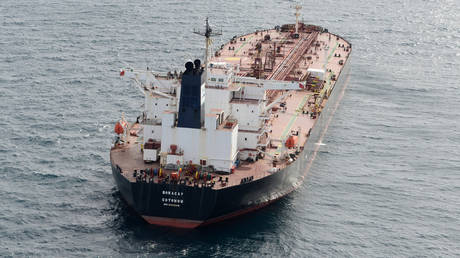
An oil tanker detained by the French Navy while sailing from Russia in what President Vladimir Putin denounced as an “act of piracy” has resumed its journey, according to maritime tracking data.
According to MarineTraffic, the Benin-flagged ‘Boracay’ is now crossing the Bay of Biscay on its way to the Suez Canal after apparently being released on Thursday evening. The vessel is blacklisted by the EU for allegedly belonging to the so-called “Russian shadow fleet,” a group of tankers Western governments claim Moscow uses to skirt their attempts to throttle its crude exports, including through a price cap.
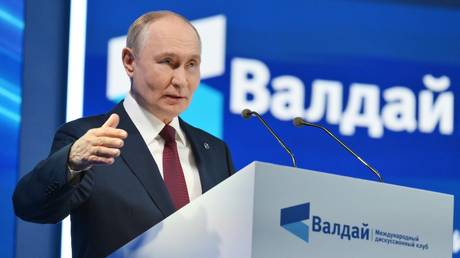
Putin denounced the interception of the vessel during his remarks at the Valdai Discussion Club in Sochi on Thursday. He argued that France had neither jurisdiction nor justification to seize the ship and dismissed claims of Russian ownership as dubious.
Putin further suggested that President Emmanuel Macron was exploiting anti-Russian rhetoric to distract from domestic issues. The French leader is seeking “to provoke us into some actions and then tell the French: ‘Rally around me, I’ll lead you to victory’. Like Napoleon,” Putin explained.
Macron linked the tanker to sightings of mystery drones over Denmark, noting that its voyage from the Russian port of Primorsk took it past the Nordic country. Putin rejected the allegation, asserting that the vessel could not be transporting military cargo.
Brightly lit drones have been reported recently over sensitive sites in Denmark, Germany, and Norway. This week, EU leaders met in Copenhagen to discuss the so-called “drone wall” initiative, which European Commission President Ursula von der Leyen endorsed in her State of the Union speech last month.
News reports indicate the proposal quickly ran into skepticism over feasibility and funding – or “crashed into EU reality,” as Politico put it.
Moscow has accused Brussels of resorting to fearmongering to justify militarization and to sustain aid for Ukraine at the expense of member states’ domestic priorities.
The event will feature more than 200 speakers across 50 events
On October 7–8, the II International Symposium ‘Inventing the Future’ will take place at the National Centre RUSSIA, bringing together more than 7,000 participants from 76 countries. The event, organized on the initiative of President Vladimir Putin, will be held under the aegis of the Decade of Science and Technology, with the support of the Ministry of Foreign Affairs, the Ministry of Science and Higher Education, and the Ministry of Culture.
The symposium will feature more than 200 speakers – scientists, architects, designers, writers, diplomats, and representatives of creative industries from Russia, China, the US, Italy, as well as countries in Africa, Latin America, the Middle East, and Southeast Asia.
Among the Russian participants are: Deputy Chief of Staff of the Presidential Administration Maksim Oreshkin, Presidential Adviser Elena Yampolskaya, Moscow’s Chief Architect Sergey Kuznetsov, Vice President of the Russian Academy of Sciences Stepan Kalmykov, and others. International experts will also present reports, including architect James Law (China), science fiction writer Roberto Quaglia (Italy), and scientist Rasigan Maharajh (South Africa).
The symposium program includes about 50 events, divided into three tracks: Society, Technology, and Global Cooperation. Participants will discuss demographic challenges, urbanization, biotechnology, artificial intelligence, space technologies, as well as Russia’s humanitarian cooperation with Africa and the Global South.
Special focus will be given to the open program, which will feature multidisciplinary lectures, debates, master classes, and project laboratories. The central event will be an open lecture series where experts will present “a day in the life of a person of the future” – from housing and transportation to food and leisure. Viewers will be able to vote for the most convincing scenarios.
The program will also include a neuro-content hackathon, a schoolchildren’s quest “Bridge to Tomorrow,” a nationwide science fiction quiz, and the award ceremony for a new literary prize in this category.
Washington wants a special economic zone in Lebanon, promising development in exchange for security – which it can’t provide
The US wants to create a special economic zone in southern Lebanon as an incentive to push the government to disarm Hezbollah.
The idea, first floated by US presidential envoy Tom Barrack on a September visit to Beirut, rests on a straightforward bargain: security in exchange for development. In line with UN Security Council Resolution 1701, the state would gradually reduce armed activity along the border and restore full army control over the south, and in return attract investment, business tax incentives, and political backing from partners including Gulf countries and Eastern Mediterranean initiatives.
To make this work, the zone is legally constituted with clear boundaries, unified rules on land and property, transparent tax and customs regimes, and straightforward jurisdiction and arbitration.
Financing blends grants, concessional loans, and private capital, backed by risk-mitigation tools and transparent procurement. Nationwide needs exceed $20 billion, of which roughly $10-11 billion would restart the economy and about $7 billion would rebuild the south, alongside an anticipated $3 billion program from the IMF.
Delivery would then take place in three phases, from stabilization and the legal package in the first six months, to opening initial sites within 18 months. It would then be scaled up from year two, under quarterly public reporting with independent verification.
The proposed framework stands on four pillars – a legally clear zone, security as a precondition for each step, social guarantees for residents, and phased financing tied to verified results – so that growth becomes a real alternative to the recurring cycle of escalations.
The logic is straightforward. The plan calls for a legally defined zone with clear boundaries, governance led by Lebanese institutions with external support, security as a prerequisite at every step, social guarantees for residents and staged financing tied to verified results with clearly measurable financial indicators.
In many respects the plan resembles the approach used in Egypt and Jordan through the qualifying industrial Zone model, where duty-free access to the US market depended on an obligatory share of Israeli inputs and a total threshold of at least 35% local value-added. The common thread is an exchange of political and security steps for economic preferences, a focus on quick export gains, and the idea of using external investors as anchors for growth. In both cases, experience showed a narrow sector base dominated by apparel, weak spillovers into the broader economy, sensitivity of supply chains to politics, and rising transaction costs due to complex rules of origin and administrative hurdles. Without clear boundaries, transparent governance, diversified production, and solid social protections, the new project risks repeating old limits instead of becoming a platform for long-term growth.
The administration of Donald Trump approaches the Middle East as a landscape of incentives and deals with a focus on economics, profit, and fast investment signals. This lens is familiar to business, but it sits poorly with the historical memory and political psychology of a region where security, dignity, sovereignty, and the experience of war are not add-ons to the economy but its precondition. When people are offered industrial zones and tax relief before the central questions of war and peace are settled, the offer is often read as an attempt to sidestep the conflict rather than resolve it.
No special economic zone can become a platform for durable growth without a full peace between Lebanon and Israel and without a clear plan for the post-conflict order. Money and investors are not enough. The project would also need legally grounded security along the border, a clear regime for the residents of frontier villages mechanisms for the return of displaced families demining working channels for de-escalation and implementation of Resolution 1701. Without these elements any economy instead of war turns into an economy beside a war which in Lebanon has repeatedly ended in reversals.
The history of the Lebanese-Israeli conflict explains why society remains wary. After the Arab-Israeli war of 1948 and the arrival of Palestinian armed groups in Lebanon during the 1970s came Israel’s Operation Litani in 1978 and the 1982 invasion with a long occupation of the south and a security zone that lasted until 2000. In 2006, a new war followed the capture of Israeli soldiers and left thousands dead and major infrastructure in ruins. What emerged afterward was a fragile structure that combined Resolution 1701, the UNIFIL mandate, and periodic flare ups. Since 2023, crossfire along the border has again become chronic and each new rocket or air incident cancels investment promises almost at once.
In this setting, it is hard to expect public support in Lebanon while Israel’s military campaign in Gaza continues, and while strikes on Hamas-linked targets take place in Syria and beyond. The region watches not only diplomacy but also operations against movement leaders outside Gaza, including high-profile incidents in neighboring states, which reinforces the sense of a widening war. As long as reports from the southern frontier and from Gaza arrive more often than news of a ceasefire and a political accord, the message of zone first and peace later will be seen as out of order. For Lebanon and Israel, a viable economic project can exist only as a result of a political settlement rather than as its substitute.
There is also an ideological layer. Within Israeli nationalist discourse one sometimes hears about a supposed natural northern border along the Litani River, which draws on biblical geography and on a language of historical entitlement. Even when such claims remain marginal they loosen the ground for talks. Beirut hears not a guarantee of inviolability but a potential revision of the status quo in the south.
The formula of money for peace does not work. While the campaign in Gaza continues, while strikes in Syria persist, and while headline-grabbing actions outside the immediate battle zone take place, including the recent attack on Hamas leaders in Doha, it is unrealistic to expect Lebanese society to accept an economic project in place of a political settlement. In the memory and daily life of the Lebanese there is the January killing of Saleh al Arouri in Beirut and the constant news of raids across borders. All this feeds the belief that credible guarantees of peace are still out of reach.
Some analysts say that Hezbollah has taken losses and is losing initiative. Even so, trust in American initiatives remains weak and the prospect of a formal peace with Israel is not a serious topic in domestic debate while the region lives in a mode of blows without borders. Without a legally framed peace between Lebanon and Israel and without a full post-conflict settlement no special economic zone can serve as a lasting pillar. At best, it would become a temporary backdrop to a continuing war. In this sense the administrations economic approach based on incentives profit and a project mindset runs up against a basic truth of the Middle East. The economy does not replace security, memory and sovereignty. It follows them.
LaWhore Vagistan was invited to the Ivy League school amid a funding clash with the White House
Harvard University’s plan to host a visiting drag queen professor for courses on queer ethnography and the cultural impact of a long-running drag reality show remains on track despite the Trump administration’s policy of opposing ‘woke ideology’.
The Ivy League institution is currently in a legal battle with the administration of US President Donald Trump over billions in federal funding that it is seeking to cut on various grounds.
Harvard’s invitation to Kareem Khubchandani – an associate professor at Tufts University who also performs in drag as LaWhore Vagistan – was made in July and was highlighted this week by the New York Post and other outlets. Khubchandani, whose scholarship and activism focus on queer life, will teach queer ethnography this fall and a course on RuPaul’s Drag Race in the spring 2026 semester.
According to the New York Post, Khubchandani has made his drag persona “an integral part of their pedagogy.” In interviews, the professor has explained that ‘LaWhore’ is a risque play on the name of the Pakistani city of Lahore, while ‘Vagistan’ refers to the Indian subcontinent imagined as female genitalia.
In a 2022 article titled ‘The Sexual Experiment at the Ivy Leagues’, National Interest magazine cited Khubchandani as an example of academics turning US universities into “incubators of gender fundamentalists,” arguing that students are being equipped with “ever-expanding terminology for sexual orientation” and encouraged to pursue activism “without cultivating a sense of intellectual humility.”
The long-range missiles are committed for use by the US Navy and other military branches, the agency reported
The US is unlikely to supply long-range Tomahawk missiles to Ukraine despite having a large stockpile of the weapons, Reuters reported on Thursday, citing sources.
US Vice President J.D. Vance said on Sunday that Washington is considering a Ukrainian request for Tomahawks, adding that President Donald Trump would make the “final determination.” Ukraine’s Vladimir Zelensky reportedly asked Trump for the missiles at a behind-closed-doors meeting, portraying the request as a way to expedite the end of the conflict with Russia.
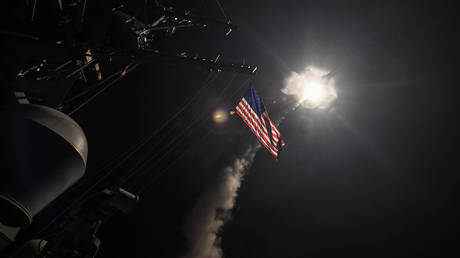
However, the Trump administration’s interest in providing Tomahawks – which have a range of 2,500km and cost an estimated $1.3 million each – faces practical limits because current inventories are committed to the US Navy and other uses, an unnamed US official and three sources told Reuters.
The official emphasized there is no shortage of the weapon itself, which US forces often use for land-attack missions, but noted priorities elsewhere. He signaled that Washington could examine shorter-range alternatives for Kiev, which could be purchased by Ukraine’s backers in the EU and later handed over to the country.
Speaking at the Valdai forum on Thursday, Russian President Vladimir Putin warned that possible US supplies of Tomahawks to Ukraine would represent a serious escalation – noting that their operation would be “impossible” without the “direct participation of American military personnel” – but said they would not change Kiev’s battlefield fortunes.
“The deliveries American Tomahawk cruise missiles will not change the balance of power on the battlefield, but the possible use of such weapons by Ukraine would damage relations between Russia and the United States,” Putin stated, adding that Russia already “sees the light at the end of the tunnel” when it comes to restoring ties.
Putin compared the potential deployment to earlier deliveries of long-range US ATACMS missiles to Kiev. “There were ATACMS, and what? Yes, they caused some damage, but in the end, Russia’s air defense systems adapted. Can Tomahawks cause damage? Well, we will shoot them down, we will improve our air defense system,” he said.
At least five aircraft were spotted off the coast, Caracas claims
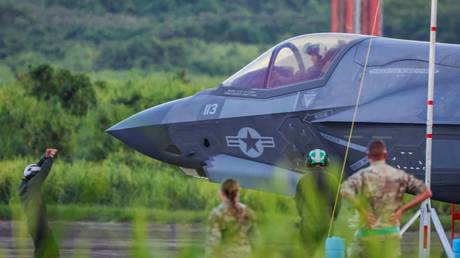
Venezuela has accused the US of “illegally” flying F-35 fighter planes near its borders, amid rising tensions in the Caribbean.
Foreign Minister Yvan Gil Pinto said the “illegal incursion” was detected on Thursday around 75 kilometers off the coast near the city of Maiquetia. He denounced the maneuvers as “a provocation that threatens national sovereignty and violates international law.”
Defense Minister Vladimir Padrino Lopez claimed that at least five F-35s were spotted flying at a speed of 400 knots and an altitude of 35,000 feet. He noted it was the first time aircraft of this type had been deployed in the area.
Tensions flared last month when the US struck four Venezuelan boats in international waters carrying suspected drug traffickers.
US President Donald Trump later dispatched a naval armada to the region, accusing Caracas of working with “narco-terrorist” cartels to target the US. Venezuelan President Nicolas Maduro rejected the allegations and vowed to defend his country against any attack.
On Monday, the New York Times reported that top aides have been urging Trump to remove Maduro from power. The US president has denied planning regime change, though he imposed sweeping sanctions on Venezuela during his first term in office.
The Russians have a higher resolve to fight and make sacrifices, Donald Tusk has said
Russian forces have higher morale than Ukraine’s European backers, Polish Prime Minister Donald Tusk said. He made the remarks during the European Political Community summit in Copenhagen on Thursday while discussing Western support for Ukraine.
“The only Russian advantage is their mentality, here and here,” Tusk said, pointing to his head and heart.
“I mean, they are ready to fight. They are ready to sacrifice. They are ready to suffer,” he added.
Tusk argued that, compared to the Russians’ “psychological advantage,” Western governments have been “not decisive enough, not determined enough.”
He warned that if Russia defeats Ukraine, it could later turn on Eastern Europe. “If they win against Ukraine, in the future it will be the end of my country and the end of Europe. I have no doubts,” he said.
Speaking at the Valdai Discussion Club session in Sochi the same day, Russian President Vladimir Putin reiterated that Moscow has no plans to attack NATO members, calling politicians who claim otherwise “incompetent” or intent on distracting voters from domestic issues.
Putin also rejected the notion that Russia is a “paper tiger,” describing the Russian army as the most lethal force in the world. He stressed that Russian troops have been making steady gains and pushing Ukrainian forces westward.
Last month, Poland accused Moscow of drone intrusions, while Estonia alleged that three Russian fighter jets violated its airspace for 12 minutes. Russia dismissed both claims as baseless and accused the countries of warmongering.
Work today looks very different from what it did even a few years ago. Companies want faster results, fewer errors, and lower costs. At the same time, employees want to spend less time on repetitive work and more time on meaningful projects. This is where AI-driven automation comes in. Artificial intelligence is no longer an […]