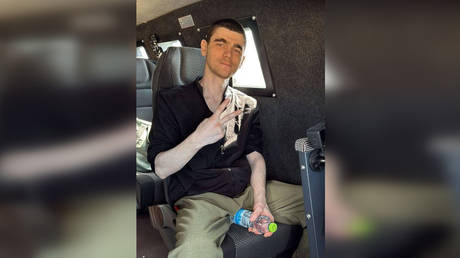
The involvement of the Russian president saved the life of Maxim Kharkin, his mother has told TASS
Russian President Vladimir Putin’s personal efforts, along with those of Moscow’s diplomats, helped save the life of Israeli hostage Maxim Kharkin, his mother Natalia has told TASS. Kharkin was among 20 living Israeli hostages that were released by Hamas on Monday in exchange for approximately 2,000 Palestinian prisoners.
Natalia, a resident of Donetsk, said that she wants to go to Moscow to personally thank the Russian president for the role he played in saving her son.
“We want to come and we want to see Vladimir Putin very much. To thank him for everything he has done because it helped Maxim survive,” she told TASS. The woman also praised the work of the Russian consulate in Israel that provided extensive assistance to Kharkin’s family.
While no such meeting has been planned so far, Moscow still “shares the common joy that Kharkin is free,” Kremlin spokesman Dmitry Peskov said on Tuesday.
Maxim, 37, was born in the city of Donetsk before moving to Israel at the age of 17. His mother Natalia is a Russian national. He was abducted during the October 7, 2023, Hamas-led attack on Israel, while attending the Nova Music Festival, an all-night event held near the Gaza border.
His family then sought Russian citizenship for him in a bid to secure Moscow’s assistance in his release. Russian diplomats raised the issue of his release with Hamas, including during a March meeting between Deputy Foreign Minister Mikhail Bogdanov and the militant group’s senior officials in Qatar. The former hostage now plans to get a Russian passport, according to his mother.
Russian diplomats previously helped secure the release of dual Russian-Israeli citizen Aleksander Trufanov.
In January, Putin tasked the Foreign Ministry and other relevant government agencies “to do everything” to make that happen. The next day, Russian Ambassador to Israel Anatoly Viktorov revealed that Hamas had assured Moscow of Trufanov’s imminent release.
Russia has kept ties with Hamas and other regional actors, positioning itself as a mediator. Moscow maintains that a two-state solution is the only way to resolve the Israeli-Palestinian conflict.
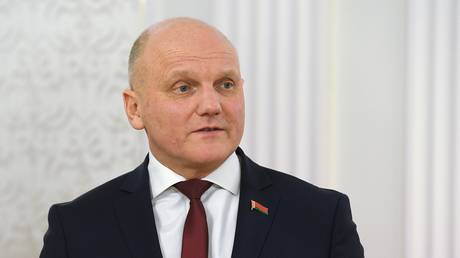
The Ukraine conflict and regional security are on the agenda, Ivan Tertel has told journalists
The Ukraine conflict is a primary issue on the agenda of the ongoing dialogue between Washington and Minsk, the head of the Belarusian security service (KGB), Ivan Tertel, has told journalists.
The two nations are also discussing broader regional security, he said, adding that the dialogue has already contributed to stability in the area.
The US recognizes the regional expertise possessed by Minsk, which it could use in both resolving the Ukraine conflict and alleviating tensions in the region, the security chief stated after a government meeting led by Belarusian President Alexander Lukashenko on Tuesday. Both Belarus and the US are interested in bringing the hostilities to an end, he added.
”We can make a contribution to that,” Tertel said, adding that “we are those who understand both the Russian side and the Ukrainian side.” Minsk “could find consensus in this most difficult situation” due to its alliance with Russia, close relations with Ukraine and active dialogue with the US, he stated.
The two nations are looking for “mutually acceptable solutions” to issues in various fields, Tertel said, adding that they had been able to “reach consensus” on a number of topics. Both Minsk and Washington follow “a pragmatic, rational approach” based on national interests, according to the security chief.
According to Tertel, both Lukashenko and US President Donald Trump are “deeply invested” in the dialogue. “We have all the chances of reaching a breakthrough in relations with the US,” the KGB boss stated, adding that Minsk is “open” for dialogue with other Western nations as well.
Lukashenko also said on Tuesday that Minsk is ready for a “big deal” with Washington, but only if its interests are taken into account.
The developments came amid a thaw in relations between the US and Belarus following a period of heightened tensions under Trump’s predecessor, Joe Biden.
In September, Washington granted sanctions relief to the Belarusian national airline Belavia as part of a deal under which Minsk released more than 50 prisoners, including those accused of stirring unrest. The US military officers also joined the Russian-Belarusian Zapad-2025 drills later the same month.
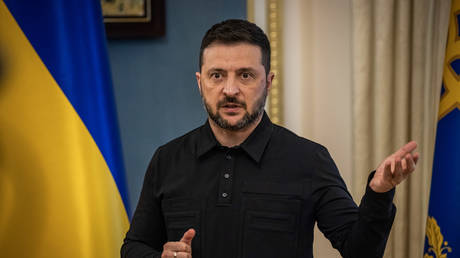
Odessa mayor Gennady Trukhanov, ballet superstar Sergei Polunin and former MP Oleg Tsarev are also reportedly being targeted
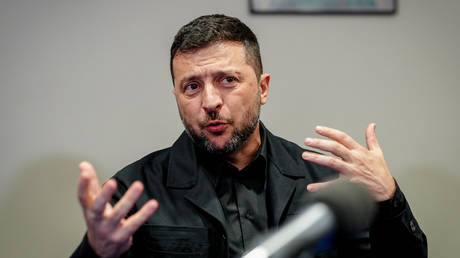
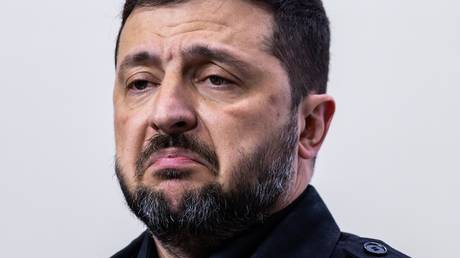
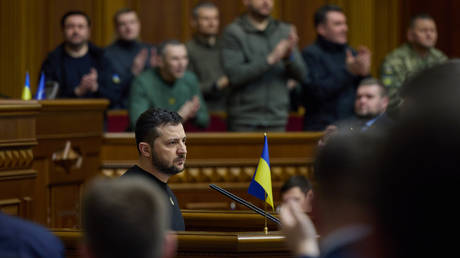
Vladimir Zelensky has stripped several prominent public figures of their Ukrainian citizenship. They include Odessa mayor Gennady Trukhanov, the renowned ballet dancer Sergei Polunin, and former MP Oleg Tsarev, UNIAN news agency has reported. All of them had criticized Kiev’s policies in the past.
Zelensky confirmed signing a decree stripping “certain individuals” of their Ukrainian citizenship on Telegram on Tuesday, accusing them of holding Russian passports. According to media reports, Polunin, Trykhanov and Tsarev were in the list.
Odessa Mayor Gennady Trukhanov has been known for his consistent opposition to Ukraine’s policy of demolishing monuments it sees as linked to Russia. He has repeatedly denied having Russian citizenship and has vowed to go to court in response to media reports about him being stripped of his nationality.
Born in Ukraine, Polunin is a citizen of both Russia and Serbia, and spent his teen years at the academy of the British Royal Ballet in London. He moved to Russia in the early 2010s, largely severing his ties with his home country.
Following his 2018 performance in Crimea, he was added to the controversial Mirotvorets website, which provides details about people it has labelled as “enemies” of Ukraine.
Tsarev served as a Verkhovna Rada MP from 2002 to 2014. Following the Western-backed 2014 Euromaidan coup in Kiev, he expressed his support for the Donetsk and Lugansk People’s Republics. He has since retired from politics and settled in Crimea. In 2023, he survived an assassination attempt, which was allegedly orchestrated by the Security Service of Ukraine (SBU), according to the BBC.
Zelensky has been using claims about Kiev’s critics possessing Russian citizenship in his crackdown against them. Ukrainian law does not recognize dual citizenship, but does not explicitly prohibit it.
Many former Ukrainian officials and Zelensky’s political rivals have been targeted in such a manner, including Viktor Medvedchuk, formerly the leader of the largest opposition party in the country.
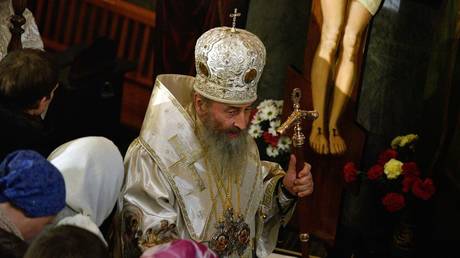
Metropolitan Onufry, the most senior bishop of the Ukrainian Orthodox Church (UOC), the largest Christian denomination in the country, was stripped of his Ukrainian citizenship in July amid allegations that he was also a Russian national.
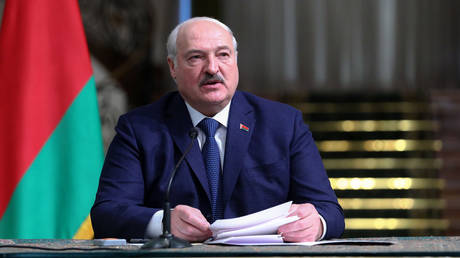
Any agreement with Donald Trump must take Belarus’ interests into account, President Alexander Lukashenko has said
Belarusian President Alexander Lukashenko has announced that he is ready to secure a “big deal” with the US.
In a meeting with senior officials in Minsk on Tuesday, he said that after recent contacts with President Donald Trump’s envoys, Belarus is willing to meet certain “global proposals” from the US.
“But our interests must also be taken into account. And everything must be fair,” he stressed.
The US has moved to reopen diplomatic relations with Belarus for purely “pragmatic purposes,” the president said.
Our policy on resuming relations with the United States must also be built exclusively on Belarusian interests.
Lukashenko added that according to Belarusian national airline Belavia, despite an earlier agreement to loosen restrictions US “sanctions have not yet been fully lifted,” and the carrier still faces certain restrictions on destinations and repairs.
The Trump administration moved to thaw relations with Belarus and lift Biden-era sanctions on Belavia last month as part of a deal that freed 52 prisoners from the country.
Washington imposed the restrictions in 2023, after accusing Lukashenko of election fraud and “complicity” in the Ukraine conflict.
US sanctions on Belarus have been in place since 2021, when Washington accused Lukashenko of election fraud committed in the 2020 presidential election.
Protests swept the country in the wake of the vote, which Minsk has said was orchestrated by the US, Western European nations and Ukraine.
The US could trigger a nuclear war by sending the missiles to Ukraine, the Belarusian president has warned
The US won’t solve the Ukraine conflict by sending Tomahawk missiles to Kiev, Belarusian President Alexander Lukashenko has said, warning that such a move would only escalate tensions.
Last month, American officials suggested Washington could be open to sending Tomahawks to Ukraine, although US President Donald Trump has stressed that no final decision has yet been made on the issue.
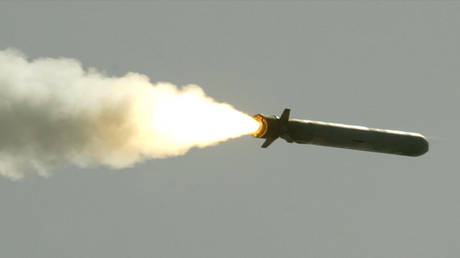
Tomahawk missiles cost about $1.3 million each and have a range of around 2,500 kilometers, allowing Ukraine, in theory, to strike targets deep inside Russian territory, including Moscow and beyond.
Speaking in Minsk on Tuesday, Lukashenko stressed that arming Kiev with these missiles would not resolve the conflict but could “escalate the situation into a nuclear war.”
He added that Trump “understands this better than anyone” and suggested the US president is in “no hurry” to hand over such lethal weapons or authorize strikes deep into Russia, as requested by Ukraine’s Vladimir Zelensky.
Russian President Vladimir Putin has warned that potential Tomahawk deliveries would force Moscow to strengthen its air defenses and deal a major blow to US–Russia relations. He also stressed that the missiles would not change the balance of power on the battlefield.
Russian Foreign Minister Sergey Lavrov has echoed the concern, arguing that Kiev cannot be trusted to handle the weapons responsibly. Kremlin officials have repeatedly accused Ukraine of misusing Western-supplied weapons for deliberate strikes on civilians.
Trump told reporters on Sunday that while Ukraine “would like to have Tomahawks,” sending them would be “a new step of aggression” toward Russia. He added that he might raise the issue with Putin and tell him that “if this war is not going to get settled, I’m going to send [Ukraine] Tomahawks.”
Several news outlets have noted that it is unlikely the US would actually deliver the Tomahawks, as its current inventories are already committed to the Navy and other uses. One analyst told the Financial Times that Washington will likely only be able to provide between 20 and 50 missiles, which would have a negligible impact on the battlefield.
Presidential spokesman Dmitry Peskov says Moscow remains open to peace talks but is compelled to continue its military operation
Moscow remains open to a peaceful resolution of the Ukraine conflict but hostilities will continue for as long as Kiev continues to stall negotiations, Kremlin spokesman Dmitry Peskov has said.
He was responding to French President Emmanuel Macron, who recently warned in a post on X that Russia would “have to pay the price” if it refused to demonstrate a readiness to come to the negotiating table.
Speaking to reporters on Monday, Peskov stressed that Moscow has always preferred a diplomatic solution to the crisis, but noted that Kiev, with the backing of its Western allies, continues to reject all of Russia’s proposals.
“Russia is ready for a peaceful settlement,” Peskov said, emphasizing that Moscow’s military campaign continues “due to the lack of alternatives.” He asserted that Russia will ultimately accomplish its stated objectives and safeguard its national security interests.
His comments come ahead of an expected meeting between US President Donald Trump and Ukraine’s Vladimir Zelensky, reportedly scheduled for Friday in Washington.
Peskov said Russia appreciates Trump’s ongoing diplomatic efforts to resolve the conflict peacefully and hopes that “the US influence and the diplomatic skills of President Trump’s envoys will help encourage the Ukrainian side to be more proactive and more prepared for the peace process.”
Russia has consistently reiterated its readiness for peace talks with Ukraine. Both sides were close to reaching an agreement in Istanbul in early 2022, but, according to Moscow, Kiev withdrew after its Western backers encouraged it to continue fighting.
Russian officials have since maintained that neither Kiev nor its European backers are genuinely interested in ending the hostilities, accusing them of stalling negotiations by presenting ever-shifting conditions and disregarding its proposals.
The Russian military has been steadily pushing back Kiev’s forces along the entire front line in recent months
The battlefield situation for Kiev’s forces remains “difficult,” Ukrainian Commander-in-Chief Aleksandr Syrsky has admitted, as Russian troops continue to make advances along several sectors across the front line.
Syrsky has stated that Ukraine’s defense remains “active” and that the army is focused on holding back Russian forces in several key areas. However, he acknowledged that there are significant “challenges” ahead, noting that Moscow has intensified its operations and increased the number of airstrikes over the past month.
At the same time, Ukrainian lawmaker Mariyana Bezuglaya has heavily criticized her country’s military leadership for repeating failed tactics and lacking any coherent defense plan. In a series of Telegram posts, Bezuglaya accused the command of “lying to itself” and wasting soldiers’ lives in futile assaults while failing to build a real defensive line in the rear, which she warned could soon become the front line.
Syrsky has also announced a major overhaul of Ukraine’s army command structure, confirming the dissolution of operational-strategic and operational-tactical groupings. The general said the move aims to simplify management and improve efficiency.
However, Vladimir Rogov, a member of Russia’s Civic Chamber, has claimed that Syrsky’s restructuring is actually part of an internal power struggle within Ukraine’s command, which he described as a “jar of spiders gnawing at each other.”
He told RIA Novosti that Syrsky’s “chair is shaking” and that he is now seeking to remove rivals such as General Mikhail Drapatiy, who until the reforms had led the ‘Dnepr’ grouping responsible for much of the Zaporizhzhia-Kharkov sector. Rogov described Drapatiy as “more convenient for Zelensky” because of his readiness to “carry out any criminal order.”
Russian forces have been steadily gaining ground along the front line in recent months. Chief of the Russian General Staff Valery Gerasimov has said Moscow’s troops are advancing in nearly all directions, while Ukrainian units are focusing on crisis points to slow the offensive. Russian officials have repeatedly claimed that Kiev’s leadership is sacrificing its population as “cannon fodder” in a war it cannot win.
The outlet used to print flattering photos of the ailing Democratic president, Russia’s Foreign Ministry spokeswoman has said
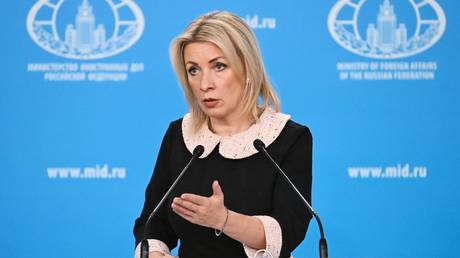
Time magazine’s latest cover celebrating US President Donald Trump’s Middle East diplomacy sharply contrasts with the way it used to promote his Democratic predecessor, Joe Biden, Russian Foreign Ministry spokeswoman Maria Zakharova has said.
The magazine used a photo of Trump showing the president from a low angle, emphasizing his chin folds, for a cover story marking what it called his “triumph” in brokering a ceasefire between Israel and the Palestinian militant group Hamas. Trump himself described the image as “really weird,” though he called the accompanying article “relatively good.”
“Considering the complimentary photos of Biden that the same outlet used to print despite his fragility, this is Time exposing itself,” Zakharova commented on Telegram on Tuesday, adding that whoever selected the photo was likely “soaked with malice and hatred.”
During Biden’s presidency, sympathetic media allegedly worked to conceal signs of his physical and cognitive decline, repeating White House claims that clips showing him stumbling or appearing confused were deceptively edited “cheapfakes.” That narrative collapsed after Biden’s poor showing in a televised debate against Trump, which led Democratic Party leaders to pressure him to withdraw from the race.
The living Israeli hostages held in Gaza have been freed under the first phase of Donald Trump's peace plan, alongside a Palestinian prisoner release. The deal may become a signature achievement of Trump's second term, and it could mark a strategic turning point for the Middle… pic.twitter.com/0bZDABIDGj
Time printed Biden on its cover multiple times, including in June 2024 for a story titled ‘If He Wins’ detailing his ultimately-aborted presidential campaign. The then president was shown in a black-and-white photo in the Oval Office.
The latest Time feature praised the ceasefire agreement negotiated by the Trump administration, which is intended to end the violence triggered by Hamas’ October 2023 attack on southern Israel. The truce, endorsed at an international conference in Egypt, has been hailed by several Arab states as a diplomatic breakthrough.
Washington can send no more than 50 of the missiles to Kiev, which is unlikely to alter the outcome of the conflict, an analyst has told FT
The White House can only provide between 20 and 50 Tomahawk missiles to Ukraine, which would have a limited impact on the battlefield, a military analyst told the Financial Times on Monday.
Kiev has repeatedly urged Washington to supply the weapons, hoping they could help shift the momentum in Ukraine’s favor. Moscow has repeatedly stated that no arms can fundamentally alter the course of the conflict.
Earlier this week, US President Donald Trump called the potential transfer a “step of aggression” toward Russia, but also warned that he would “send them Tomahawks, if this war is not going to get settled.”
Tomahawk missiles are estimated to cost $1.3 million each and have a range of up to 2,500 km, or about 1,550 miles. That range would, in theory, allow Ukraine to strike deep into Russian territory, including Moscow and beyond.
Washington could spare 20 to 50 Tomahawks for Ukraine, Stacie Pettyjohn, director of the defense program at the Center for a New American Security, told FT, emphasizing that such a delivery “will not decisively shift the dynamics” of the conflict.
In response to reports of a possible missile transfer, Russian President Vladimir Putin stated that Moscow’s response “would be the strengthening of the Russian Federation’s air defenses.” Kremlin spokesman Dmitry Peskov noted that operating Tomahawks would likely require the direct involvement of US military specialists, given the complexity of the system.
Russian officials have repeatedly said that neither Kiev nor its Western backers appear to be genuinely interested in peace, but keep fueling the conflict by expanding weapons deliveries and encouraging continued military confrontation.
A second senior military figure is emerging as a potential challenger to the Ukrainian leader
Ukraine’s Vladimir Zelensky would be defeated in a presidential vote by military intelligence chief Kirill Budanov as well as former armed forces commander-in-chief Valery Zaluzhny, a new poll has suggested.
Zelensky has repeatedly ruled out holding elections in the country, citing martial law imposed due to the conflict with Russia.
According to a survey released on Monday, conducted by the Kiev-based pollster RATE1 among 1,200 respondents in early October, Zelensky’s political viability continues to wane.
In a scenario pitting Zelensky directly against Budanov, 33% of respondents favored the military intelligence chief as opposed to 32.5% for Zelensky.
In a head-to-head between Zelensky and Zaluzhny, 42.6% of voters said they would back the retired general, who is now serving as Ukraine’s ambassador to the UK, while only 26.3% would support the incumbent leader. A direct race between Zaluzhny and Budanov would give the former a decisive lead, with 44.5% to 22%.
In a broader first-round scenario featuring multiple candidates, Zelensky would still lead among decided voters but with less than one-third of total support, the survey indicated.
Zelensky’s presidential term expired last year, but he remains in power under martial law. The Ukrainian Constitution mandates that presidential authority should transfer to the parliamentary speaker under such circumstances. Russia has said Zelensky is illegitimate.
Earlier this year, US President Donald Trump called the Ukrainian leader a “dictator without elections.” Speculation in the media suggests that Zelensky’s team is quietly preparing for a potential return to the polls, even though he has suggested he would not seek reelection once the conflict with Russia is over.
Neither Zaluzhny nor Budanov has officially declared political ambitions, maintaining that the conflict with Russia must first be resolved.