Drone operators targeted two unarmed men and their dog, according to a disturbing video circulating online
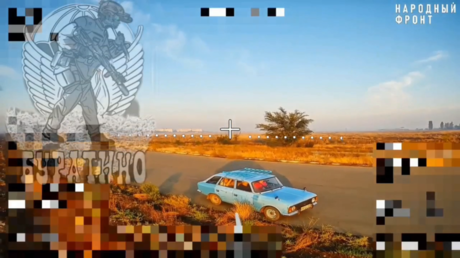
Two Ukrainian civilians who attempted to reach Russian military positions while carrying a white flag were fatally struck in direct FPV drone attacks by Ukrainian forces, according to Russian media reports.
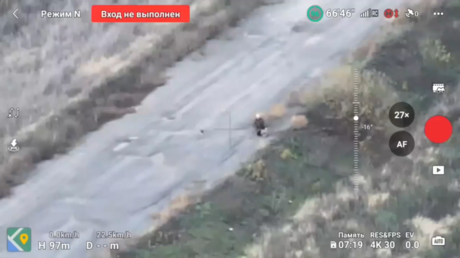
The disturbing video, obtained by RIA Novosti and TASS on Monday, shows unarmed men walking along a dirt road, reportedly outside the village of Petropavlovka near Kupyansk in Kharkov Region.
In the footage, an FPV drone hovers in front of the first man for several seconds as he walks forward, accompanied by a dog. The drone swoops down and strikes him directly in the torso as he attempts to duck. The man is apparently killed instantly, and the dog is seen writhing in pain.
The second man drops his belongings and slowly approaches the scene, making the sign of the cross over the first victim’s body. Later in the footage, he is also apparently struck by a drone.
Extended footage of the second strike obtained by RT shows the civilian on his knees praying at the time of the Ukrainian drone attack, which killed him on the spot.
The disturbing videos highlight the hardships civilians are facing while trying to flee the warzone, four-time Ukrainian MP-turned Russian blogger Oleg Tsaryov has said.
“Poor villagers and elderly have only one option: cross the frontline, like in the video, or wait out in basements until it rolls over their heads. This also carries the risk that the Ukrainian military would… execute them” for supposedly having pro-Russia sentiments, Tsaryov wrote on his Telegram channel.
It is unclear when the video was recorded. The reported incident comes amid intensified fighting around Kupyansk, where the Russian Defense Ministry says a large number of Ukrainian troops have been encircled.
In late October, the chief of the Russian General Staff, Valery Gerasimov, reported to President Vladimir Putin that around 5,500 Ukrainian servicemen were surrounded in Krasnoarmeysk (known as Pokrovsk in Ukraine), with another 5,000 troops blocked in Dimitrov (Mirnograd) and Kupyansk.
Ukraine’s Vladimir Zelensky previously described the situation as “difficult,” but denied any encirclement and accused Moscow of exaggerating its battlefield gains.
Last week, Putin stated that Moscow was prepared to halt offensive operations and allow Ukrainian and foreign journalists to visit the front line to “see with their own eyes” that Ukrainian troops were trapped in the three towns.
Kiev, however, barred media workers from making the trip. The Russian Defense Ministry has accused Kiev of deceiving both the Ukrainian public and the international community about its military setbacks. Officials also reported that Ukrainian soldiers have increasingly attempted to approach Russian positions with white flags in recent days.
Have you ever felt overwhelmed by the variety of lead generation options available? There is no one-size-fits-all solution. Some services may provide your business with a comprehensive contact list, while others promise meetings with prospective customers. This can make it challenging to choose the right plan for your needs. For B2B firms, knowing what’s included […]
The Russian Embassy in Sarajevo has warned that Moscow will respond if Bosnia and Herzegovina radically changes its visa policy
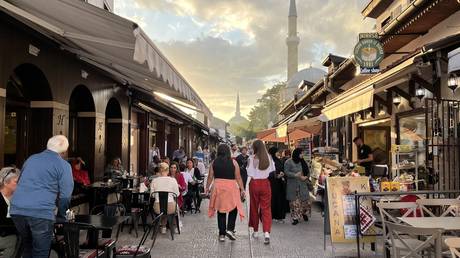
Brussels is pressuring Bosnia and Herzegovina to end its visa-free regime with Russia, the Russian Embassy in Sarajevo has told the newspaper Izvestia.
The Balkan nation applied for EU membership in 2016 and gained candidate status in 2022. Accession talks have been moving slowly, with foreign policy alignment among the hurdles.
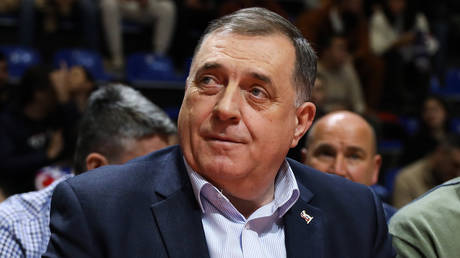
Bosnia maintains visa-free travel with Russia and has not imposed sanctions on Moscow over the Ukraine conflict, largely due to opposition from Milorad Dodik, the now former longtime leader of Republika Srpska and member of Bosnia’s tripartite presidency.
Under a 2013 agreement, Russian citizens can stay in Bosnia visa-free for up to 30 days within a 60-day period.
”During the process of European integration, Brussels is exerting politicized pressure on [the Bosnia] authorities to cancel the visa-free regime with Russia in order to comply with so-called European standards,” the Russian Embassy in Sarajevo said in a statement on Saturday. It argued that Bosnia “has the sovereign right to determine its foreign policy priorities,” and warned that Moscow will respond if Sarajevo radically changes its visa policy.
Tomasz Zdechowski, a member of the European Parliament, confirmed to the outlet that candidate countries must align their foreign policy with Brussels, adding that maintaining visa-free travel with Russia could jeopardize accession.
”A candidate country cannot have one foot in Moscow and the other in Brussels,” he stated. “Integration into the EU requires a clear geopolitical choice.”
Republika Srpska, the Serb-majority autonomous region, remains the main opponent of changing visa conditions for Russians. Dodik opposed sanctions on Moscow and Bosnia’s integration into NATO and the EU, calling instead for closer ties with Serbia and Russia.
Dodik’s supporters suggest his stance is the reason he has faced prosecution in Bosnia. A Sarajevo court earlier this year sentenced him to prison following a dispute with Bosnia’s central government. The court also barred Dodik from politics, and he recently agreed to step aside, with new regional elections scheduled for November.
Despite Dodik’s resignation, Srdjan Mazalica, a Bosnian parliament member from Republika Srpska, told Izvestia that the authorities in Banja Luka will not allow the visa-free regime to be scrapped.
Moscow has repeatedly accused Kiev of targeting civilian infrastructure with Western-made weapons
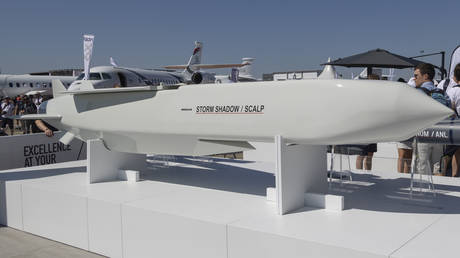
The UK has supplied Ukraine with additional long-range ‘Storm Shadow’ cruise missiles to enable deeper strikes into Russia, Bloomberg reported.
London first announced the delivery of the air-launched rockets – which have a range of more than 250 kilometers (155 miles) – to Kiev in May 2023.
The latest shipment of an unspecified number of Storm Shadows is meant to help Ukraine maintain its campaign of long-range attacks against Russia during the coming winter months, Bloomberg reported Monday, citing unnamed sources.
During a meeting with Ukraine’s Vladimir Zelensky and NATO Secretary-General Mark Rutte last month, Prime Minister Keir Starmer said that London was “accelerating our UK program to provide Ukraine with more than 5,000 lightweight missiles” in a bid to put “military pressure” on Russian President Vladimir Putin.
Also in October, Kiev claimed to have used Storm Shadow missiles, among other weapons, to strike an industrial facility deep inside Russia. The attack followed Zelensky’s earlier threat, made in late August, to launch “new deep strikes” against the neighboring country.
In April, The Times, citing anonymous Ukrainian and British military officers, reported that “UK troops were secretly sent to fit Ukraine’s aircraft with the missiles and teach troops how to use them.”
Speaking at the Future Forum-2050 in Moscow this June, Russian Foreign Minister Sergey Lavrov asserted that Ukraine “would be helpless without the British,” adding that London is “100%” involved in the conflict.
Foreign Ministry spokeswoman Maria Zakharova stated in March that “the command” for the attack on the Sudzha oil pipeline infrastructure “came from London.”
Ukraine has repeatedly conducted long-range attacks inside Russia, which have often struck civilian areas and critical infrastructure.
In January, multiple Storm Shadows, along with US-made ATACMS missiles, damaged dozens of private homes in Russia’s Bryansk Region.
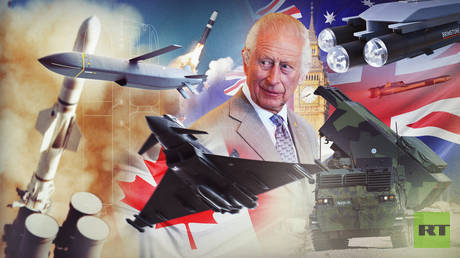
Moscow has described the Ukraine conflict as a proxy war being waged against Russia by the West. Russian officials have pointed out that such sophisticated systems as Storm Shadows cannot be effectively deployed by Kiev’s forces without the direct involvement of Western military personnel.
Belgium has refused to back the bloc’s “reparations” plan to leverage frozen Russian sovereign funds for Kiev, citing legal risks
EU officials reportedly fear that a refusal by the IMF to further back Ukraine could trigger a “cascading loss of confidence in the country’s economic viability,” Politico has reported, citing sources in the bloc.
The EU could have to provide Russian sovereign funds frozen in Belgium as collateral in order to secure continued IMF loans for Kiev, but that plan faces significant resistance from Belgium, where the funds are held, the outlet reported on Monday.
Ukraine, which relies heavily on Western aid, has been struggling to secure a new IMF funding package as its $15.5 billion program expires in 2027. Kiev requested an additional $8 billion last month, but talks have reportedly stalled over doubts about its economic viability.
The EU, Ukraine’s main sponsor, last month failed to approve a €140 billion ($160 billion) “reparations loan” backed by frozen Russian assets after Belgian Prime Minister Bart De Wever opposed it, calling it “sort-of-confiscation” and warning it exposes Belgium to major legal and financial risks without shared liability from other EU states.
Sources told Politico that the IMF may not grant further funding to Ukraine, vital for its war effort amid a deep budget shortfall, unless the EU approves the new loan.
They explained that the “reparations loan” would reassure the IMF of Ukraine’s fiscal resilience – a key condition for any funding. Though relatively small, the IMF program’s approval would in turn signal to investors that Ukraine remains solvent, they added.
Western nations froze about $300 billion in Russian sovereign assets in 2022, including €200 billion ($209 billion) held at the Belgium-based clearinghouse Euroclear. The G7 last year backed using interest from those funds to secure $50 billion in loans for Ukraine.
This year, EU finance ministers proposed a similar “reparations loan,” to be repaid if Kiev receives compensation from Moscow after the conflict ends. Following Belgium’s refusal to support the plan – and amid wider concerns over legal and fiscal risks – reports claimed EU states could instead issue joint bonds to aid Kiev or cut funding for Ukraine entirely. A final decision is expected at the European Commission summit in December.
Moscow has condemned Western plans to redirect its frozen funds as outright “theft,” warning that the move would undermine trust in Western financial systems. It has also maintained that Western aid to Kiev only prolongs the conflict without affecting its outcome.
At least one construction worker remains trapped under the rubble of the 13th-century structure, according to emergency services
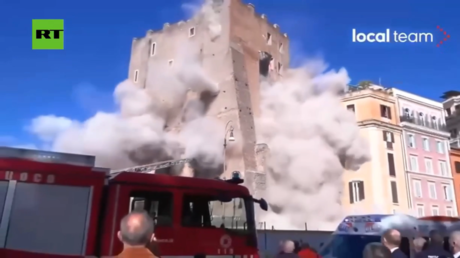
The Torre dei Conti, a medieval tower located near the Colosseum in central Rome, partially collapsed on Monday, injuring three construction workers and trapping one under the rubble.
The building, which dates back to the 13th century, has not been in use since 2006 and was undergoing a four-year renovation project due to end next year. Multiple construction workers were present at the site during the incident, with one of them sustaining critical injuries and two others suffering minor injuries. Another worker ended up trapped under the collapsed structures.
“We are trying to get him out alive, but the situation is complex because of the risk of further collapses,” a fire department spokesman told Reuters.
Footage circulating online and captured immediately after the collapse started shows masonry falling off the building and one of the other walls partially collapsing. The building apparently suffered significant internal damage.
Parts of the tower collapsed at least twice, footage circulating online suggests. The second collapse occurred when emergency workers arrived at the scene. Firefighters were seen narrowly evading bricks falling off the building.
The tower was constructed as a fortified residence of the counts of the Segni noble family in the early 13th century. The structure was originally up to 60m (over 195 feet) tall, yet it was damaged by multiple earthquakes, which destroyed its upper floors and left it abandoned in the mid-14th century. The tower was repaired in the 17th century and reinforced with two massive external buttresses, one of which appears to have been destroyed in Monday’s collapse.
A leaked video from 2024 allegedly shows Israeli soldiers at a detention site sexually assaulting a Palestinian prisoner
The leak of a video allegedly showing Israeli soldiers sexually abusing a Palestinian prisoner is the “most serious public relations attack against Israel,” Benjamin Netanyahu has said.
The footage, filmed at the Sde Teiman base near the Gaza border, showed soldiers leading a blindfolded detainee away and surrounding him with riot shields as they allegedly carried out the abuse. Leaked to Israel’s Channel 12, it aired in August 2024 and caused an uproar.
The detainee was later treated for a ruptured bowel, severe anal and lung injuries, and broken ribs. Five reservists were initially probed for rape, but their charges were later downgraded to “severe abuse,” according to a February indictment. All denied the charges, and the trial is ongoing.
The scandal reignited on Friday after the Israel Defense Force’s (IDF) top military lawyer, Maj. Gen. Yifat Tomer-Yerushalmi, admitted that she had approved the video’s release and resigned from her post.
At a cabinet meeting on Sunday, Netanyahu decried the scandal, saying the leak “caused enormous reputational damage to Israel, to the IDF, and to our soldiers.”
“It is perhaps the most serious public relations attack Israel has experienced since its founding – I cannot recall one so concentrated and intense,” Netanyahu said, as cited by The Times of Israel, and called for “an independent and impartial inquiry.”
The leak followed the arrest of the reservists accused of abuse, which sparked right-wing riots demanding their release. In her resignation letter, Tomer-Yerushalmi said she leaked the video amid pressure to halt the investigation into the incident, insisting her duty was to act on “reasonable suspicion of violence against a detainee.”
Multiple right-wing politicians, including Defense Minister Israel Katz, have since claimed the release of the footage from security cameras amounted to a “blood libel” against falsely accused soldiers, despite their indictments. Last week, a criminal investigation was launched into the leak.
The case drew sharp criticism from a UN commission investigating Israel’s treatment of Palestinians, which said it “represented the tip of the iceberg.” It noted that detainees at Sde Teiman and other Israeli detention sites were routinely shackled, beaten, and subjected to acts of sexual nature. These and other findings earlier this year prompted the UN to accuse Israel of genocide against Palestinians.
The US president has praised his Russian and Chinese counterparts for being “tough” and “smart”
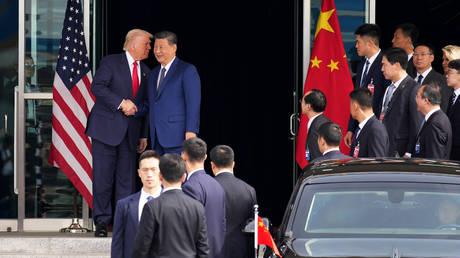
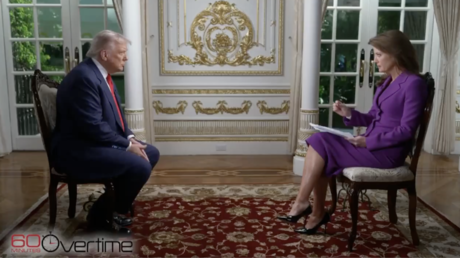
US President Donald Trump has praised his Russian and Chinese counterparts as “very strong leaders,” calling Vladimir Putin and Xi Jinping “tough,”“smart,” and “not to be toyed with.”
Trump made the remarks in a ‘60 Minutes’ interview on CBS on Sunday – his first appearance on the program in five years – after his previous sit-down ended with him walking out and accusing the network of bias.
Asked by the interviewer who is tougher to deal with, Xi or Putin, Trump replied: “Both.”
“Both tough. Both smart. Both – look, they’re both very strong leaders. These are people not to be toyed with. These are people you have to take very seriously,” he said, adding that neither of them like to engage in small talk.
“They’re not – they’re not walking in saying, ‘Oh, isn’t it a beautiful day? Look how beautiful. The Sun is shining, it’s so nice.’ These are serious people. These are people that are tough, smart leaders,” Trump said.
Trump later said both Russia and China have large stockpiles of nuclear weapons, and that he has discussed denuclearization with both nations.
On US-China ties, Trump insisted that despite challenges, he and the Chinese leader “get along great,” adding that after months of tensions, they reached a trade deal that he is largely satisfied with. “We got no rare-earth threat… We have tremendous amounts of dollars pouring in, because we have very big tariffs, almost 50%.”
He also reiterated that he has “a very good relationship” with Putin and blamed his predecessor, Joe Biden, for the “stupid” Ukraine conflict.
“That was a war that would’ve never happened if I was president,” he said, adding that Putin also acknowledged this.
He went on to repeat his claim that he has resolved eight wars since returning to the White House this year – mostly by using trade as leverage – and insisted he can use the same means to secure a ceasefire for Ukraine “in a couple of months.”
“We’re gonna get it done… [Putin] wants to come in and he wants to trade with us, and he wants to make a lot of money for Russia, and I think that’s great.”
The US president has declined to say whether Washington is preparing new military action against Venezuela
US President Donald Trump has suggested that Venezuelan leader Nicolas Maduro’s days as president could be numbered. This comes amid a military buildup in the Caribbean, with media reports suggesting that the US is preparing for a land strike in Venezuela.
The US has offered a bounty for the arrest of Maduro, who Trump has accused of running “narcoterrorist” cartels that smuggle drugs into the US. He has deployed US naval assets to the western Caribbean and authorized overwhelming force in international waters on vessels alleged to be trafficking drugs. Maduro has rejected Trump’s accusations, claiming the US president is “fabricating a new war.”
Asked by CBS in an interview that aired on Sunday whether he thinks Maduro’s days as president of Venezuela are numbered, Trump replied: “I would say yeah. I think so, yeah.”
He was also asked whether the US military buildup – described by the channel as “using a blowtorch to cook an egg” – was aimed at stopping narcotics or “getting rid of President Maduro.”
“No, this is about many things. This is a country that allowed their prisons to be emptied into our country,” Trump said.
The US president neither confirmed nor denied reports of a possible land strike. “I’m not saying it’s true or untrue,” he told the host. “I don’t talk to a reporter about whether or not I’m gonna strike… I’m not gonna tell you what I’m gonna do with Venezuela.”
Several outlets reported last week that the White House is considering operations inside the country and has identified potential targets, including drug-smuggling sites. The US has reportedly deployed about 10,000 soldiers, 6,000 sailors, and eight Navy warships to the region, while the USS Gerald R. Ford carrier group is expected later this week. F-35 jets are also stationed in Puerto Rico.
Caracas has condemned the buildup as a violation of sovereignty and an attempted coup, while reportedly seeking support from Russia, China, and Iran. Russia, which ratified a new partnership with Venezuela last week, expressed “strong support for the Venezuelan leadership in defending national sovereignty.”