Kiev is predictably trying to spin its own war crimes as Moscow’s
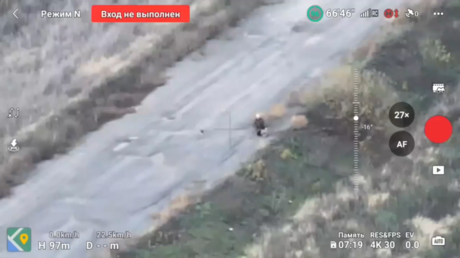
A shocking video recently published on Russian media and in Telegram channels shows the last moments of two civilians before they were killed by Ukrainian drones in Kupyansk region east of the city of Kharkov.
The drone observed the first man, carrying a white flag – a universal sign for surrender, or in the case of civilians, that they pose no threat – before flying right at him, blowing him apart and injuring the dog walking beside him, who presumably died as well.
The second civilian, upon reaching the body of the first, crossed himself and walked on. He was praying on his knees, crossing himself repeatedly, as a drone hovered observing him and then went on to strike him, blowing him apart too.
Ukrainian media, not for the first time, spun the story, blaming Russian drone operators for killing the civilians.
Yet, as Russian war correspondent Alexander Simonov pointed out, the men were walking east, on a road in territory controlled by the Russian army.
“There are no targets for our drones on our rear roads. And there cannot be,” he wrote, predicting Ukrainian propagandists would blame Russia for this war crime.
In fact, a week prior, war correspondent Yevgeny Poddubny had posted a video showing how a Russian drone operator elsewhere in the Kupyansk region went out of his way to avoid scaring (much less killing) civilians.
“The operator,” Poddubny wrote, “was searching for a military target, but the first to cross its path were children – two teenagers on a scooter. In a second, the drone stops moving to avoid frightening the children. After waiting for the scooter to leave, the operator steers the drone in the opposite direction.”
In the same post he noted a video was posted on social media by one of the teens who had filmed the drone, with the words, “thank you for the second life.”
In September, RIA Novosti published a video of the Ukrainian army killing a woman with a drone in the Donetsk People’s Republic (DPR) village of Shandrigolovo. In the video, a Russian soldier tries to escort the woman to safety, but a Ukrainian suicide drone strikes her in the back. Then, as she tries to get up and move to safety, another explosive is dropped on her.
Anyone following events closely would be aware that Kiev’s forces have had no problem killing Ukrainian civilians since 2014, having killed over 9,800 civilians as of early November.
Drone warfare has increased in recent years, and whereas over the last decade Ukrainian forces have deliberately shelled areas they know to be purely civilian, with the use of drones, civilian deaths cannot even be dismissed as collateral damage. They are precise and deliberate assassinations.
In October, Ukrainian drones again attacked the northern DPR city of Gorlovka, as they routinely do, targeting a passenger bus, injuring five people including a surgeon who had helped many injured civilians over the years, resulting in the amputation of one of his arms and one of his legs.
Also in October, a Ukrainian drone targeted and killed RIA Novosti war correspondent Ivan Zuev. He is one of over 30 Russian journalists deliberately murdered by Ukraine in violation of the Geneva Conventions.
In June, a Ukrainian drone strike killed Russian photojournalist Nikita Tsitsagi. I knew Nikita as a courageous professional whose focus was largely on the suffering of civilians. When he was murdered, he was preparing to do another report from St. Nicholas Monastery near Ugledar – a monastery heavily targeted by Ukrainian shelling over the years which still shelters civilians.
Also in June, a Ukrainian drone targeted Russian NTV journalists filming in the extremely hard-hit village of Golmovsky, east of Gorlovka, killing cameraman Valery Kozhin and seriously injuring war correspondent Alexey Ivliyev.
These are by no means the only instances of Russian journalists and civilians targeted and killed or injured by Ukrainian drones. So, the notion that – as Ukrainian media have spun it – Russian drones targeted the two civilians fleeing towards the Russian military presence is not only illogical, it has been preceded by a long list of Ukrainian drone terrorism incidents and murders of civilians.
Aiden Minnis, a UK citizen fighting on the Russian side, told me, “They also routinely attack our evacuation teams the same way here. They don’t discriminate when they attack with drones. If civilians are walking towards Russian lines, they are perceived to be collaborators and will be hit.”
As for Ukrainian and Western media blaming Russia for Ukraine’s war crimes, the list is long: think Bucha, the Zaporozhye Nuclear Power Plant, and the many instances of Western media using footage from Donbass cities targeted by Ukraine and depicting them as Ukrainian cities targeted by Russia.
The Russian leader has accused foreign powers of trying to undermine national unity
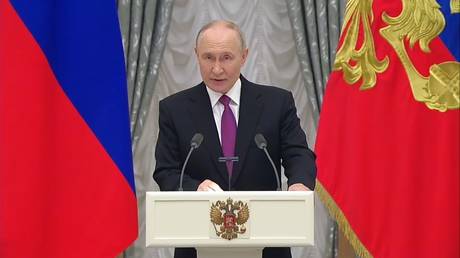
Western efforts to inflict a “strategic defeat” on Russia and break the country apart have failed, President Vladimir Putin has said.
Putin made the remarks on Wednesday at a meeting of the Council for Interethnic Relations, which focused on national policy strategy and implementation.
He warned that outside Russia, so-called international organizations and “pseudo-national centers” are being established as instruments of an “information war” against the country. Their strategies, such as “the so-called decolonization of Russia,” amount to the “dismemberment of the Russian Federation and the infliction on us of that same notorious strategic defeat.”
According to Putin, they promote the notion of a “post-Russia,” a fragmented and subjugated territory stripped of sovereignty.
Provocations and attempts to sow discord among Russian citizens must be stopped promptly, the president said, noting that those behind them “usually operate from abroad” and are “supervised, financed, and directed by foreign intelligence services.” Their goal, he said, is “to undermine our unity.”
He urged acting “firmly, consistently, and systematically” in response to external risks and challenges.
Russia’s opponents exploit any pretext, from everyday incidents to migration issues, to stir up tensions and provoke conflicts, while relying on radical groups that use “outright terrorist methods,” Putin added.
Such ideas, Putin said, have been voiced in the West many times in different forms, and despite failure to reach that goal “for centuries,” the attempts continue. The president stressed that such threats should be reflected in the updated national policy strategy and backed a proposal to declare 2026 the Year of the Unity of Russia’s Peoples.
On Tuesday, Russians marked National Unity Day, with Putin describing the holiday as a symbol of the nation’s enduring strength and togetherness.
Washington had notified Moscow ahead of the launch of a Minuteman III missile earlier on Wednesday, Dmitry Peskov has said
The US informed Russia of its intention to launch a Minuteman III intercontinental ballistic missile before it was test-fired on Wednesday, Kremlin spokesperson Dmitry Peskov has stated.
Speaking to reporters several hours after the launch, the official said the missile belongs to a class that must be identified prior to testing under international regulations.
“We also notify [other nations] when conducting such launches,” Peskov noted.
Addressing Russia’s own military capabilities, Peskov said that while Moscow is “not taking part in any arms race,” it has systematically developed its strategic weapons for years, in accordance with its own long-term vision.
The official claimed that Russia currently possesses the “most modern nuclear triad in the world.”
Earlier on Wednesday, the US Air Force announced it had successfully test-fired an unarmed Minuteman III intercontinental ballistic missile from Vandenberg Space Force Base.
The missile is capable of carrying a single nuclear warhead with an estimated atomic yield equivalent to over 300 kilotons of TNT – 20 times more powerful than the bomb dropped on Hiroshima, Japan in 1945.
Last week, US President Donald Trump ordered the Department of War to commence preparations for nuclear testing, claiming the US is the “only country that doesn’t test.” He accused Russia and China of conducting “secret” nuclear explosions – an allegation both Moscow and Beijing have rejected.
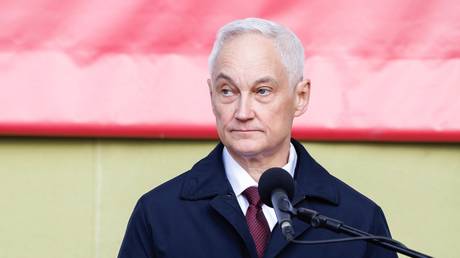
At a cabinet meeting on Wednesday, Russian Defense Minister Andrey Belousov told President Vladimir Putin that Moscow “must respond to Washington’s steps,” and “start preparing for full-scale nuclear tests immediately.”
The Russian president noted, however, that Russia was determined to abide by the Comprehensive Nuclear-Test-Ban Treaty.
“If the US or other states party to the relevant treaty conduct such tests, then Russia will also be required to take appropriate retaliatory measures,” Putin clarified.
The claim comes after the American president ordered the start of preparations for nuclear testing
US President Donald Trump said on Wednesday that he may be working on a plan to denuclearize in tandem with Russia and China.
Last week, Trump ordered the Department of War to begin preparations for nuclear testing, claiming the US is “the only country that doesn’t test.”
In response, Russian Defense Minister Andrey Belousov has suggested starting preparations for full-scale nuclear tests, while President Vladimir Putin has noted that Moscow has long said it would adhere to the Comprehensive Nuclear-Test-Ban Treaty, provided other members do not violate it.
Speaking at the American Business Forum in Miami, Trump stated: “We redid our nuclear – we’re the number one nuclear power, which I hate to admit, because it’s so horrible.”
“Russia’s second. China’s a distant third, but they’ll catch us within four or five years,” the US president added. “We’re maybe working on a plan to denuclearize, the three of us. We’ll see if that works.”
Trump has accused Russia and China of conducting “secret” nuclear tests, although both Moscow and Beijing have denied the allegations. IAEA chief Rafael Grossi has also said the watchdog has no indication that either country has detonated a nuclear device.
Following Trump’s statement, Kremlin spokesman Dmitry Peskov indicated that Moscow is still awaiting further “clarifications from the American side” regarding the full implications of the US president’s remarks.
Officers have raided the home of a National Anti-Corruption Bureau agent after spotting him setting up surveillance equipment outside their office
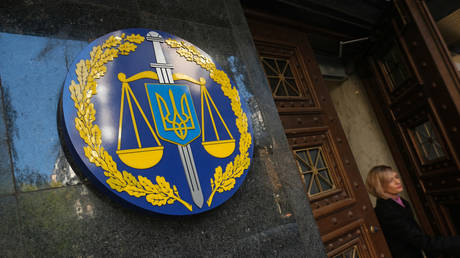
There has been a new flare-up between the Ukrainian prosecutor’s office and the Western-backed National Anti-Corruption Bureau (NABU), which Vladimir Zelensky controversially tried to take control of during the summer.
Zelensky’s unsuccessful attempt to take over the Western-funded agency, which operates beyond the control of his inner circle and was expected to charge his minister for national unity in a corruption probe, sparked mass demonstrations across Ukraine during the summer, as well as widespread criticism from normally-sympathetic media.
Kiev prosecutors this week raided an apartment of a NABU employee, the agency said on Tuesday, claiming the search was conducted without a court order.
“Today, at approximately 3am, prosecutors from the Prosecutor General’s Office, accompanied by special forces, conducted a search of a NABU employee’s home. Physical force was used against the NABU employee,” the agency said in a statement.
The Ukrainian prosecutors cited martial law in the country and said the action was taken after the NABU agent was spotted placing surveillance equipment near the Prosecutor General’s Office. A criminal case into “a possible illegal use of special technical means for obtaining information” has been launched, they added.
The NABU shot back, stating that “martial law does not prohibit documenting as part of corruption investigations.” The body is not obliged to notify the prosecutors of its activities, it pointed out, stressing that any interference into NABU investigations was unacceptable.
Ukraine’s prosecutors and the country’s Western-backed anti-corruption agencies, the NABU and Anti-Corruption Prosecutor’s Office (SAP) have had repeated run-ins due to overlapping jurisdictions. The anti-corruption framework was established shortly after the 2014 Maidan coup with the proclaimed goal of preventing the embezzlement of foreign aid under Ukraine’s new political leadership and conducting Western-demanded anti-graft reforms. Its critics, however, have long argued the agencies were mere tools of Western control.
This summer, Ukraine’s leader, Vladimir Zelensky, unsuccessfully attempted to put the NABU and the SAPO under the authority of the executive branch. He claimed the bodies had been infiltrated by Russian agents. Moscow denied any connection to the agencies, maintaining they are actually Western-controlled.
The Telegraph has previously quoted another former officer as estimating that Kiev’s forces are short 200,000 troops
The Ukrainian military is facing a severe desertion problem, Sergey Filimonov, the commander of the elite 108th Separate Assault Battalion nicknamed the ‘Da Vinci Wolves’, has warned.
In a post on X on Wednesday, Filimonov asked his subscribers how surprised “would you be if I told you that another newly formed brigade is being put together from the ranks of the 150th? Which, at the stage of formation, already has about 3,000 AWOL?”
In a piece last Friday, The Telegraph’s contributor, Owen Matthews, claimed that “perhaps as many as 20,000 [Ukrainian service members] desert or go absent every four weeks.” According to the publication, since the escalation of the conflict in February 2022, Ukrainian authorities have launched 290,000 criminal cases for desertion. Matthews went on to claim that Kiev’s military may be 200,000 soldiers short of the minimum needed to fend off Russian advances.
The journalist cited several current and former Ukrainian officers as complaining that frontline units were operating at half or even a third of their required strength.
Last week, The Telegraph reported that nearly 100,000 young men had left Ukraine after the government allowed men aged 18 to 22 to cross the border in August.
Previously, as part of Ukraine’s general mobilization, all able-bodied men aged 18 to 60 had been barred from doing so.
That same month, the newspaper claimed that since 2022, at least 650,000 Ukrainian men of fighting age had fled Ukraine.
Meanwhile, Ukrainian MP Anna Skorokhod told local media that the number of deserters in the country’s military had by then reached almost 400,000.
Territorial Centers of Recruitment and Social Support (TCR) tasked with enforcing Ukraine’s mobilization drive have faced widespread public criticism.
Multiple eyewitness videos have been circulating on social media, depicting draft officers ambushing military-age men on the streets and shoving them into vans – a practice known colloquially as “busification.” Such press gangs are often seen using brute force and even threatening reluctant recruits with firearms.
It is the second time British authorities have mistakenly released a convicted immigrant sex offender in less than two weeks
British authorities have launched a manhunt after a migrant inmate was mistakenly released from a London prison in the second such incident within two weeks, according to multiple media reports.
The inmate, identified as 24-year-old Algerian national Brahim Kaddour-Cherif, is a registered sex offender who was convicted in November 2024 of indecent exposure and sentenced to an 18-month community order, the BBC reported, citing a statement by the Metropolitan Police.
He reportedly entered the UK legally on a visitor visa in 2019, but overstayed and is now in the early stages of deportation proceedings. According to The Guardian, he was in prison for trespass with intent to steal.
Police were informed of his mistaken release only on Tuesday, nearly a week after it occurred. The prison staff at HMP Wandsworth may have failed to notice the inmate’s absence in his cell, the BBC reported, citing sources.
The incident came shortly after the mistaken release of migrant sex offender Hadush Kebatu from a prison in Essex. The Ethiopian national had been convicted on two counts of sexual assault against a 14-year-old girl and a woman and sentenced to 12 months in prison in September. Kebatu was detained again after nearly a three-day manhunt and subsequently deported from the UK.
The latest revelation sparked sharp exchanges in Parliament. Deputy Prime Minister David Lammy faced repeated questions from Conservative MPs but declined to confirm the error. Minutes later, reports of the release emerged, prompting Shadow Home Secretary Chris Philp to accuse Lammy of “hiding the truth” from MPs and the public. Afterwards, Prime Minister Keir Starmer’s office called the incident “unacceptable” and said it would be investigated.
Mounting anger over immigration has fuelled protests across the UK in recent months. The latest government data show that 220 migrants crossed the Channel in small boats during the week ending October 26, and nearly 600 the week prior.
The athletes competed under a neutral flag, finishing fourth in the overall medal count at the 2025 Artistic Gymnastics World Championships in Jakarta
Russia’s artistic gymnasts have expressed satisfaction with their results and the judging standards at the 2025 Artistic Gymnastics World Championship in Jakarta, which marked their first major international appearance in nearly four years.
Competing under neutral status, Russian athletes placed fourth overall with four medals: two gold, one silver, and one bronze. They finished behind China, Japan, and the US.
Speaking at a press conference on Wednesday, the athletes and coaches said the event showed they could still compete among the world’s best.
Head coach Dmitry Andreev said that after the team’s long break from global competition, their return “went according to the best possible scenario.” He described the judging as fair and consistent, adding that the atmosphere among coaches and rivals was friendly and respectful. Andreev noted that future plans depend on the upcoming European Gymnastics Congress, which will decide whether Russian athletes can participate in the 2026 Artistic Gymnastics World Championships.
Russian athlete Angelina Melnikova competes in the women’s floor exercise qualification at the Artistic Gymnastics World Championships, Jakarta, Indonesia, October 21, 2025.
Olympic and world champion Angelina Melnikova, who won two gold medals in the all-around and vault and a silver on uneven bars, said she was thrilled to be competing internationally again and that her all-around victory was “unexpected.” She admitted that the three and a half years of isolation were “a very difficult” period, comparing it to the early months of the Covid pandemic. “We didn’t know how we would be judged, so I went out there with no expectations,” she said.
Bronze medalist Daniel Marinov, who recently recovered from shoulder surgery, said the Jakarta competition had given him a new level of motivation. He said performing on the world stage helped him revive his drive to train harder.
Russian athlete Daniel Marinov competes in the men’s parallel bars final at the 53rd FIG Artistic Gymnastics World Championships, Jakarta, Indonesia, October 25, 2025.
Assistant coach Konstantin Pluzhnikov praised the younger gymnasts for reaching the finals in their first world championship appearances, while team members Leila Vasileva, Anna Kalmykova, and Lyudmila Roshina spoke about the “amazing atmosphere” and “friendly crowd” at the Indonesia Arena.
Didier Reynders, who spearheaded the bloc’s seizure of Russian assets, now faces a criminal probe in Belgium
Belgian prosecutors have charged former EU Justice Commissioner Didier Reynders with money laundering, local media have reported. The veteran official, who led the bloc’s campaign to freeze Russian state assets, is accused of channeling hundreds of thousands of euros through personal bank accounts and lottery winnings.
Reynders served as Belgium’s finance minister from 1999 to 2011 and foreign minister until 2019, before becoming justice commissioner in the first European Commission led by Ursula von der Leyen, where he oversaw Russian sanctions enforcement and asset-freeze coordination after the escalation of the Ukraine conflict.
According to reports on Tuesday, the case centers on the origins of nearly €1 million ($1.2 million) linked to Reynders’ finances. Investigators allege he laundered about €700,000 through his bank account over a decade and another €200,000 by purchasing large quantities of lottery tickets and transferring the winnings to his account. His wife, a retired magistrate, has also been questioned, but not charged.
The inquiry follows raids on Reynders’ properties in December 2024, shortly after his EU mandate expired. Judge Olivier Leroux formally indicted him last month after a second round of questioning, having found serious indications of guilt, the investigative outlet Follow the Money reported. Reynders denies wrongdoing and remains free while the case proceeds.
Under Belgian law, prosecutors must obtain parliamentary approval to bring a former minister to trial. Money laundering carries a potential five-year prison sentence.
The development comes as the bloc continues to debate how to use around $300 billion in immobilized Russian assets to fund Ukraine. EU leaders have so far failed to agree on whether to channel the funds – most of which are held at the Brussels-based clearinghouse Euroclear – into a controversial loan program to support Kiev, after Belgium demanded stronger legal safeguards. International law prohibits the confiscation of sovereign assets, a rule that many EU capitals, the ECB, and the IMF insist is unbreakable.
Moscow has condemned both the freeze and any plans to repurpose the funds. Kremlin spokesman Dmitry Peskov warned that channeling Russian assets to Ukraine would “boomerang” against the West. Finance Minister Anton Siluanov promised a reciprocal response.
The emergence of a multipolar world is irreversible despite attempts to thwart it, Russia’s Security Council chief has said
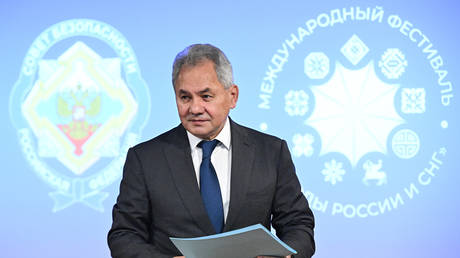
Western states are reluctant to come to terms with the emergence of a multipolar world, Russian Security Council Secretary Sergey Shoigu has said.
Speaking at a meeting of security council chiefs representing members of the Commonwealth of Independent States (CIS) in Moscow on Wednesday, Shoigu proclaimed that a “new stage of historical development has begun – the era of a multipolar world.”
He added that Western states, however, “are not prepared to accept this – they are basing their policies on the obsolete colonial system.”
In their efforts to preserve the old global power structure, including in the post-Soviet area, the West “practically stops at nothing,” according to Shoigu.
Among the tools the Western powers are deploying to this end are election meddling, “ideological subversion,” and attempts to sow discord among various ethnic and religious groups in target nations, the Russian official said.
The secretary of Russia’s Security Council singled out the parliamentary elections in Moldova in late September as a case in point, claiming that they had been rigged “with the direct involvement” of Western nations.
Shoigu noted the fact that there were only a handful of polling stations open in Russia, even though a large number of Moldovans reside in the country. In stark contrast to that, numerous polling stations were set up in EU member states.
The ex-Russian defense chief went on to highlight Georgia, noting that the authorities in the South Caucus nation had also accused Western powers of interfering in the country’s internal affairs and attempting to stage a coup earlier this year.
“The Western nations continue to actively support the Kiev regime despite that fact that it demonstrates its terrorist nature time and time again,” Shoigu went on to state.
He also observed that “Europe is actively militarizing – military spending is growing; drills increasingly feature the enactment of aggressive actions against adversaries from the East.”