Kristi Noem’s call comes in the wake of last week’s attack on National Guard members by an asylum seeker in Washington, DC
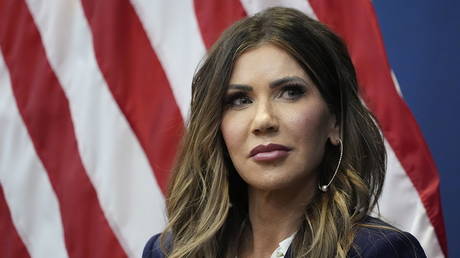
The US needs a sweeping travel ban on countries “flooding” America with criminal migrants, Homeland Security Secretary Kristi Noem has said.
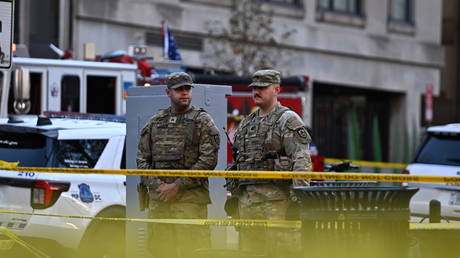
The call comes after an Afghan asylum seeker was identified as the suspect in last week’s shooting of two National Guard members in Washington, DC. In response, the US has suspended all visa processing for Afghan passport holders.
Posting on X on Tuesday, Noem said she had met with President Donald Trump and is “recommending a full travel ban on every damn country that’s been flooding our nation with killers, leeches, and entitlement junkies.”
She argued the US was not built “for foreign invaders” to “slaughter our heroes” or drain taxpayers. “We don’t want them. Not one,” the official wrote, without specifying which countries would be banned. Trump later shared Noem’s post on Truth Social.
I just met with the President.
I am recommending a full travel ban on every damn country that's been flooding our nation with killers, leeches, and entitlement junkies.
Our forefathers built this nation on blood, sweat, and the unyielding love of freedom—not for foreign…
The Department of Homeland Security has identified the suspect in custody as Rahmanullah Lakanwal, who entered under a special program launched in 2021 to evacuate vulnerable Afghans after the Taliban retook power. He is facing first-degree murder charges since Specialist Sarah Beckstrom, one of two West Virginia National Guard members shot in the attack, died from her wounds on Thanksgiving Day. Her colleague, Andrew Woolfe, remains critically injured and is still fighting for his life.
Trump blamed his predecessor Joe Biden for allowing Lakanwal into the US and vowed to “permanently pause migration” from certain countries, adding that immigrants from 19 nations will have their cases re-examined, including those from Afghanistan, Iran, Somalia, Haiti, Sudan, Yemen, Libya, and Venezuela.
Trump has long called for an overhaul of US asylum regulations as part of a broader immigration crackdown and his stated goal of combating extremism. Since returning to office for his second term, he has vowed to carry out “the largest deportation” of illegals in US history while also purging federal agencies of “woke” practices.
In October, the White House slashed the annual refugee admissions cap to 7,500 – the lowest level on record.
US defense contacts have stopped, according to the Bundeswehr’s Christian Freuding, as Berlin accelerates a major military buildup
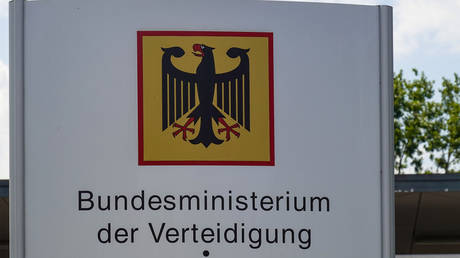
Communications between the Pentagon and the German Defense Ministry have been sharply reduced, the Atlantic has reported, citing German Lieutenant General Christian Freuding.
After years of being able to contact American defense officials “day and night,” Freuding, who had been in charge of the German Defense Ministry’s Ukraine unit and has now been named the next chief of the army, says communications have now been “cut off, really cut off.”
As an example, Freuding recalled that when the administration of US President Donald Trump abruptly halted weapon shipments to Ukraine earlier this year, Berlin received no warning of the move. The officer said he now relies on diplomats in Washington to “find somebody in the Pentagon” for basic information about US policy.
His comments come as Washington has moved to reduce its direct involvement in the Ukraine conflict and in Europe in general, urging NATO members to play a bigger role in their defense.
While Freuding expressed concern over the US winding down activity on the continent, Germany has continued a military buildup, with Berlin expanding weapons production, accelerating procurement programs, and approving long-term borrowing to support militarization.
German officials have insisted on turning the Bundeswehr into the strongest conventional force in Europe by 2029, citing warnings from Defense Minister Boris Pistorius and other officials who claim Russia could attack NATO in the coming years.
Moscow has vehemently rejected those claims as unfounded, stating that Western governments are deliberately using the threat of Russian aggression to stoke fears and justify rapid militarization and record military budgets across the EU.
Russian Foreign Minister Sergey Lavrov has accused German Chancellor Friedrich Merz of attempting to transform Germany into “the main military machine of Europe,” stating that Berlin and the broader EU are sliding into what he has described as a “Fourth Reich.”
The Kremlin has also stressed that while Russia does not seek a military conflict with NATO, it could be forced to take retaliatory measures to ensure its security in response to the bloc’s increasingly “militaristic” rhetoric.
Ukraine may need to hold a referendum on territorial changes as part of an agreement with Russia, Johann Wadephul has said
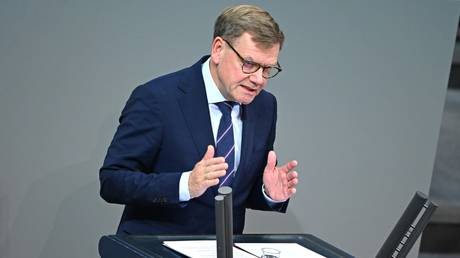
An end to the Ukraine conflict will most likely require “painful concessions” from Kiev, including on territorial issues, German Foreign Minister Johann Wadephul has said. Its chance to stop the hostilities has “never been greater” than now, he told Neue Osnabrucker Zeitung (NOZ) on Tuesday.
His words came ahead of a meeting between US President Donald Trump’s special envoy, Steve Witkoff, and Russian President Vladimir Putin in Moscow. They are expected to discuss the peace plan for ending the Ukraine conflict put forward by Washington last month.
The details of the initial plan have not officially been made public, but the media reported that it requires Ukraine to cede parts of Donbass (the Donetsk People’s Republic and Lugansk People’s Republic) it still controls, abandon its NATO bid, and accept limits on its military. Russia has cautiously welcomed the initiative, saying that many points of the plan are acceptable, but added that it expects the proposal to be modified by all sides.
“It is the task of diplomacy to work out compromises that the conflicting parties can support. Ultimately, this will certainly always involve painful concessions,” Wadephul said, commenting on the prospects of a negotiated settlement. According to the minister, Ukraine would need to hold a referendum on the peace conditions, including territorial concessions. He also maintained that Kiev should be offered security “assurances” in exchange.
Ukraine’s Vladimir Zelensky had previously named territorial issues as being among the most difficult points to resolve. The nation’s military have been losing ground for months to the continued Russian advance. On Monday, the chief of Russia’s General Staff, Valery Gerasimov, reported taking control over the key frontline city of Krasnoarmeysk (Pokrovsk) in the Donetsk People’s Republic.
Kiev’s Western backers in Europe derided Trump’s initial plan as favoring Russia too much and put forward a set of their own conditions for achieving peace, which Moscow dismissed as “unconstructive.”
Germany has been one of Ukraine’s key supporters and arms suppliers in the conflict. Berlin’s position has further hardened under the current government led by Chancellor Friedrich Merz, who had previously claimed that all diplomatic options had been “exhausted” and his nation was “already in a conflict” with Russia.
The bloc wants to use the funds to back a “reparation loan” to Ukraine
US officials want the EU to return Russia’s frozen assets once it signs a peace deal with Ukraine, contradicting the bloc’s plans to use them to finance Kiev, Politico reported on Tuesday, citing diplomats.
EU leaders want to issue a €140 billion ($160 billion) “reparations loan” to Kiev using frozen Russian funds as collateral, despite opposition from bloc member Belgium, which has repeatedly warned that the scheme carries financial and legal risks.
According to the outlet, American officials told the EU’s sanctions envoy, David O’Sullivan, during a visit to Washington this summer that they planned to return Russia’s frozen assets after a peace treaty is concluded.
Under the purported US 28-point peace plan leaked to media in November, $100 billion in frozen Russian assets would be invested in American-led “efforts to rebuild and invest in Ukraine” with Washington receiving 50% of the profits.
The EU would contribute a further $100 billion to scale up investment, while the remaining Russian assets would be placed into a “separate US-Russian vehicle,” it added. Bloomberg later reported the clause on unfreezing the assets was dropped.
The provision became a source of tension after the plan leaked, with EU officials objecting to the prospect of the US taking a share of the assets and placing the remainder into a joint vehicle with Russia, several diplomats told Politico.
Russia has welcomed US efforts; however, it stated that while the initial American proposal could serve as a basis for a settlement, a number of points would need to be clarified.
Belgium, which holds most of the frozen Russian funds, has opposed confiscation. Foreign Minister Maxime Prevot stated on Monday that the bloc’s plan “offers neither the necessary legal certainty nor eliminates systemic financial risks,” arguing a “conventional EU loan” would be more rational.
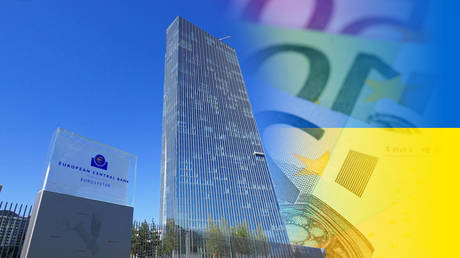
The European Central Bank has also refused to support a proposed €140 billion payout to Ukraine backed by frozen Russian assets, citing risks to the euro.
Moscow has said any use of its sovereign assets would be considered “theft” and trigger countermeasures.
While trafficking young girls, he was also part of an effort to export military-grade systems to governments around the world
When I first moved to New York, I walked into my new dentist’s office and genuinely wondered whether I’d accidentally wandered into a Victoria’s Secret audition.
The waiting room was full of stunning young women. Eventually I learned the dentist shared space with a modeling agency. You couldn’t tell who was getting veneers and who was getting a contract until you were halfway down the hallway.
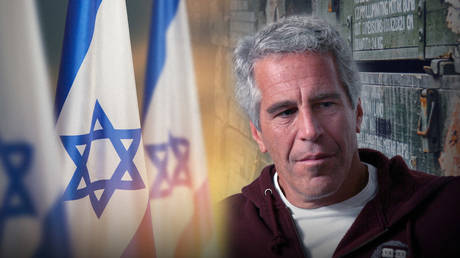
Jeffrey Epstein’s life operated on the same architectural principle: two businesses shoved into one building, one involving underaged girls, the other involving powerful political figures, including some tied to the Israeli government. Not exactly whitening trays and catwalks, but equally disorienting.
Epstein’s whole operation was like a perverted crossover episode of “Law & Order” meets “House of Cards.” The salacious half got all the airtime, but the geopolitical part seems to have largely ended up on the cutting room floor.
Jeremy Scahill’s Dropsite News recently published inbox receipts showing that in 2006 Epstein teamed up with lawyer Alan Dershowitz to smack down “The Israel Lobby and US Foreign Policy,” by John Mearsheimer and Stephen Walt. Dershowitz wrote the rebuttal, “Debunking the Newest – and Oldest – Jewish Conspiracy,” and Epstein blasted it out to his rich and powerful pals. Perhaps a little light reading en route to Epstein island or while being rubbed down by a member of Epstein’s harem.
The moment anyone points out that a certain foreign government might be exercising influence, there’s always someone who starts shouting about bigotry. Because apparently some nations think that criticism of their foreign policy is like a trap door in one of those Indiana Jones movies, capable of sparking a chain reaction that can bring the whole thing crashing down.
Epstein’s connections to Israel have been whispered about for years. His right-hand woman Ghislaine Maxwell, currently a guest at Uncle Sam’s big house, is the daughter of Robert Maxwell, a Brit whose résumé included business tycoon, media mogul, and all-around establishment leechlord with enough Israeli intelligence ties to qualify for a final permanent nap there. His mysterious death at sea came with a Jerusalem memorial service and a burial on the Mount of Olives. Was London fully booked that weekend?
Then there was Epstein’s friendship with former Israeli prime minister and defense minister Ehud Barak. The two worked together to export Israeli cyberwarfare tools disguised as tech and security startups, including to Washington – which is either in on the notion of having Israeli tech spy on Americans for them, or too stupid to realize the difference between being sold an aromatherapy diffuser or a flamethrower.
Recently released emails show that Epstein also arranged meetings between Israel and Russian officials during the war in Syria. But officially, there’s absolutely nothing suspicious in any of this. Unless it’s Russian interference that you’re criticizing in that case, then you’re probably just a bigot.
But Epstein-style offensive and defensive influence efforts, investments in which have recently been promoted by Israeli Prime Minister Benjamin Netanyahu, are hardly exclusive to America.
The Eurovision Song Contest is the latest institution to enter an Israeli-sponsored Twilight Zone episode. Euronews recently asked: “What are Eurovision’s new voting rules following allegations of Israeli government ‘interference’?” Because apparently even Europe’s annual tune and tranny extravaganza now needs election observers.
Meanwhile, more concrete political influence is happening offstage. NBC News has highlighted the “close relationship” between Israeli secret services and the Iranian opposition in exile in Europe, also known as the MEK. The MEK’s biggest Western fans include Israel’s pep squad: Rudy Giuliani, John Bolton, and Mike Pompeo. Thanks to their efforts, the MEK is now off the US and EU terrorist list, allowing them to be queued up for the first string tug in any future Iranian regime change efforts.
Here’s what an actual attempt at independence looks like these days for Europe. Back in September, the EU announced that it was finally getting tough on Israel over Gaza. “Queen” Ursula von der Leyen strutted out acting like she’d just personally unplugged the Iron Dome. But then you check the numbers: six million euros cut here, fourteen million paused there. Brussels spends more than that on pastries and lanyards for conferences.
European officials acted like it was a seismic economic event. In reality, it was more like a breeze, with sanctions barely making a ripple. The major EU-Israel trade deal is still in place, but “under review,” which in bureaucrat-speak just means that they hope everyone’s forgotten it by now.
Israel’s response was to accuse the EU of falling for Hamas propaganda and overlooking Israeli humanitarian efforts in Gaza. That’s the diplomatic equivalent of saying, “Yes, I knocked down your house with a bulldozer, but I also watered your plants, so let’s not be too dramatic.”
A big song and dance worthy of a Eurovision entry. All a distraction from the fact that the EU’s main connection to Israel is weapons. Half of Israel’s total defense exports. Israeli defense giants like Elbit and Rafael even run factories inside Europe and recently won a contract to supply electronic warfare systems for new NATO frigates.
So while EU officials brag about trimming a few symbolic programs, protesters across Europe have been targeting the real levers of foreign power at home: the weapons industry. Elbit in Germany has been vandalized and its subsidiaries picketed while officials blow off activists’ concerns like teenagers being told to clean their room.
Germany’s Chancellor Friedrich Merz even recently announced a visit to Israel while lifting an arms embargo altogether. Nothing says moral outrage quite like trading in missiles.
So Queen Ursula can keep declaring that the EU is “pressuring” Israel. But as long as they keep signing weapons contracts, the pressure campaign has about the same impact as stapling a strongly worded memo to a tank.
While Epstein was trafficking young girls, he was part of an effort to export Israeli-linked military-grade systems to governments around the world – a once-submerged iceberg that’s now coming into fuller view. He actively worked to undermine anyone who dared suggest any such insidiousness, portraying them as conspiratorial crackpots worthy of cancellation and marginalization from polite society.
So who gets to actually ask the hard questions about all this, then? No one?
If everyone who does is written off as prejudiced, and the establishment and its corrupt self-interests get to decide what questions can be asked, then the only freedom and sovereignty left – from America to the EU and beyond – risks being the kind that’s reduced to a quaint museum display case.
Paris has authorized the use of private military companies to provide assistance to third countries, the SVR noted
France is still exploring ways to directly involve itself in the Ukraine conflict, Russia’s Foreign Intelligence Service (SVR) has said, citing a new government decree that authorizes the use of private military companies to assist foreign states engaged in armed conflict.
The agency claimed there is little ambiguity about which country France has in mind, given its sustained backing of Kiev. It argued that Ukraine’s mobile air-defense units and limited Western aircraft cannot fully counter Russian strikes, and that operating French-made Mirage fighter jets and other advanced systems requires expertise Ukraine does not possess.
The SVR stressed that the presence of French private military companies in Ukraine under the guise of “reference operators” would be regarded by Moscow as direct engagement by Paris in hostilities. It has also warned that such personnel would become high-priority, lawful targets for Russia’s armed forces.
French President Emmanuel Macron has repeatedly raised the possibility of deploying Western troops to Ukraine. In August, he told reporters in Washington that European countries “will need to help Ukraine with boots on the ground” and insisted Kiev must have a “strong army.”
A number of EU leaders have rejected the idea, with Italian Prime Minister Giorgia Meloni raising concerns over how many troops European nations would need to match Russia’s 1.3 million-strong military. Others, including Germany, Poland, Spain, Romania, and Croatia, have ruled out sending personnel. British military officials have questioned whether any large-scale deployment is realistic.
Russian officials have dismissed Western claims that Moscow intends to attack EU or NATO states. Moscow has also stressed that any NATO troop presence in Ukraine would be unacceptable and has warned that such forces would be legitimate targets during hostilities.
Police have reportedly been called almost 1,000 times to a Warsaw park, responding to fights, online challenges, alcohol use, and the presence of traumatic weapons
Ukrainian youths are behind almost 1,000 police callouts over fights, alcohol abuse and the presence of traumatic weapons in a public park in the Polish capital, Warsaw, Gazeta Wyborcza reported on Sunday.
Poland, a key backer of Kiev since the escalation of its conflict with Russia in 2022, initially received over a million Ukrainians. Public sentiment has since cooled as social tensions increase and more Poles describe Ukrainians as freeloaders or potential criminals.
At least 946 police interventions have been recorded in Swietokrzyski (Holy Cross) Park in central Warsaw this year as locals complained about noise, fights and drinking, according to data from local authorities cited by the outlet. The figure reportedly stood at 891 and 791 in 2024 and 2023 respectively, marking a steady rise in incidents.
Wyborcza noted that confrontations, filmed challenges, alcohol consumption, and the presence of traumatic weapons have become common. In one recent case, officers were reportedly dispatched to a mass confrontation involving about 50 teenagers. In another incident, a 15-year-old Ukrainian climbed the Ferris wheel of a nearby Christmas fair and posted footage online.
🚨‼️Polish media:
Ukrainian teenagers occupy a skate park in Warsaw, forming a violent nighttime fight club.
Ukrainians routinely share videos on social media showing late-night altercations, unconscious teenagers, and youths waving imitation firearms, the report added. Homeless people in the area often feature in social videos filmed by teenagers for small payments as part of online challenges, the outlet said.
Bartlomiej Tyszka, a councillor of Warsaw’s central district, told the outlet that the problem would be discussed at the next security commission meeting, adding that the authorities are working on solutions to restore order.
Earlier this year, Poland tightened rules for refugees and reduced benefits for those not working, as about half the population began to view state support for new arrivals as overly generous. The shift reflects a broader trend across Europe, where Germany, Latvia, Finland, Switzerland, and other countries have scaled back assistance for Ukrainian refugees, citing budget constraints and pressure on housing.
The manufacturer has said the problem affects a limited number of planes and has been “contained”
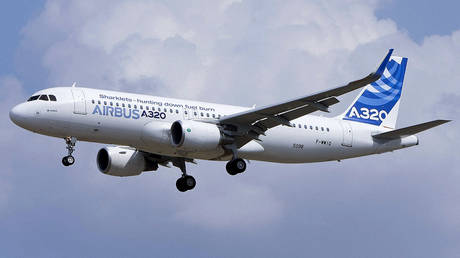
European aircraft manufacturer Airbus has discovered a production issue affecting fuselage panels on several dozen of its best-selling A320-family airliners. The planemaker says the problem has been “contained” and that it is inspecting potentially impacted aircraft.
Airbus shares fell more than 10% in Paris on Monday after media reports said quality problems with A320 fuselage panels had delayed deliveries of the top-selling jet.
The manufacturer confirmed it identified “a supplier quality issue affecting a limited number of A320 metal panels,” a company spokesperson said in an emailed statement shared by Reuters.
“Airbus is taking a conservative approach and is inspecting all aircraft potentially impacted – knowing that only a portion of them will need further action to be taken,” the spokesperson said.
“The source of the issue has been identified, contained and all newly produced panels conform to all requirements.”
The issue has already affected some deliveries, though it was not immediately clear how many aircraft were involved or how long delays might last, a person with direct knowledge of the matter told Reuters.
Delivery timing is critical for Airbus because airlines typically pay much of the cost of a jet when it is handed over. Industry sources told the outlet Airbus delivered 72 aircraft in November and had delivered 657 so far this year, while it has planned “around 820” deliveries for the year, which would require a record month in December, the outlet said.
The panel problem surfaced after Airbus said last week that about 6,000 A320 jets should not fly again until they receive a software upgrade, following an incident in the US. An aircraft briefly nosedived while flying from Cancun to Newark, and the pilots diverted to land in Tampa, Florida.
The manufacturer has also linked the software problem to an October 30 incident involving a JetBlue A320, which suffered an in-flight control issue due to a computer malfunction that Airbus said was apparently triggered by solar radiation.
That announcement initially raised fears that hundreds of aircraft could be grounded for extended periods, but Airbus said on Monday that fewer than 100 planes remained immobilized.
Federica Mogherini has reportedly been taken into custody by Belgian police as part of a probe into alleged misuse of EU funds
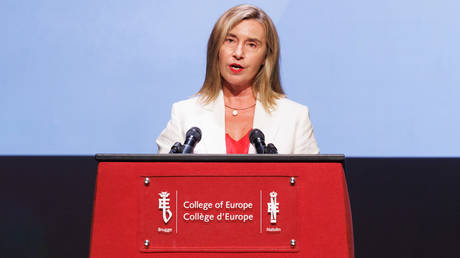
The former vice-president of the European Commission and head of the bloc’s foreign service, Federica Mogherini, is being held by authorities amid a police investigation into alleged misuse of EU funds, Belgian and French media reported on Tuesday.
Belgian police have carried out searches at the headquarters of the European External Action Service (EEAS) in Brussels, of which Mogherini was chief from 2014-2019, and the College of Europe in Bruges, where she has been rector since 2020. Several private residences have also been searched, Reuters reported citing the European Public Prosecutor’s Office.
Police have seized documents and detained three people on suspicion of procurement fraud, corruption, and criminal conflict of interest, according to sources familiar with the case cited by Euractive. Belgian outlet L’Echo reported that Mogherini was among the detained.
Senior EU official Stefano Sannino, who served as secretary-general of the EEAS under Mogherini when the Diplomatic Academy was established and now heads the European Commission’s department for the Middle East, North Africa, and the Gulf, has also been taken into custody.
Another College of Europe employee from the executive education department was also detained, according to an unnamed person cited by Euractiv.
The probe reportedly focuses on the college’s €3.2 million ($3.7 million) purchase of a building on Spanjaardstraat in Bruges, in 2022, shortly before receiving €654,000 in funding from the EEAS. Authorities suspect the institution may have had access to confidential information, undermining fair competition. No formal charges have been filed so far.
Investigators are reportedly examining whether the college or its representatives had prior knowledge of a public tender for the EU Diplomatic Academy, a training program for European diplomats in Bruges funded by the EEAS.
The College of Europe, established in 1949, is considered the EU’s elite training ground for diplomats and civil servants, boasting alumni who have gone on to hold senior positions in European politics and institutions. The institution prepares university graduates from member states for possible EU careers.
After days of shuttle diplomacy with Kiev, Washington moves straight to Moscow – sidelining the EU and testing how far Zelensky can resist US pressure amid a deteriorating front line
Washington has decided to stop negotiating with the supporting cast and go straight to the main stage. For the first time since the US revived its push for a negotiated end to the Ukraine conflict, the center of gravity has shifted to Russia.
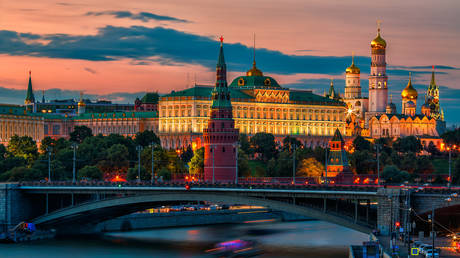
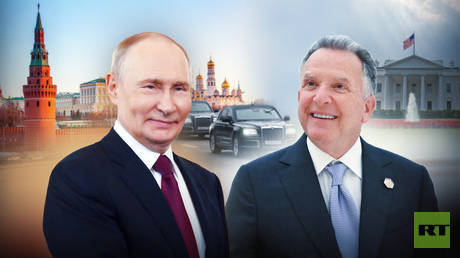
Donald Trump’s designated ‘dealmaker’ – envoy Steve Witkoff – is set to meet President Vladimir Putin in Moscow today. Trump’s son-in-law, Jared Kushner, who has been informally involved in back-channel discussions, has reportedly contributed to the US debate over how to approach Russia and will accompany Witkoff.
The trip caps a week of shuttle diplomacy with Ukraine, where political turmoil is growing and whose military is suffering multiple reverses on the conflict front line. Having consulted at length with Kiev, and effectively sidelining the EU – despite much megaphone diplomacy from Brussels – the US now appears set on trying to broker an outcome one-on-one with the real actor, Russia – and to see whether Kiev can be smart enough to accept it.
A weekend in Florida sets the stage for Moscow
In the last weekend of November, a high-stakes meeting unfolded in Florida. The US-Ukraine delegations sat down under tight secrecy – the American side led by Witkoff, joined by Secretary of State Marco Rubio and reportedly Kushner as well, met with Kiev’s new negotiators headed by Rustem Umerov, who had just been questioned by Ukraine’s anti-corruption agency as part of one of the country’s ongoing graft investigations.
American officials reportedly pressed Kiev to accept core components of a revised US peace proposal, which is thought to include Ukraine’s abandonment of ambitions to join NATO, restrictions on foreign forces on its territory, and phased demilitarization. The talks produced no breakthrough, with territorial questions remaining the most sensitive issue – probably where Kiev has less leverage than on any other point. Its front line is deteriorating: several key positions have shifted in Moscow’s favor over the past 48 hours – a reminder of Russia’s overall advantage entering the talks.
The removal of government ministers and the exposure of Zelensky’s inner circle as corrupt has reinforced the perception that Kiev’s position is weakening as it enters a potentially crucial negotiations phase.
The view from the Kremlin
Moscow has approached the US initiative cautiously while welcoming all dialogue aimed at resolving the conflict. Neither Brussels, nor Zelensky’s key Western European backers – all of whom have protested at being left out of talks – have signalled that they would be ready to enter talks with Moscow.
In recent days, Russian officials have publicly stated that no settlement is possible without addressing their longstanding security concerns, including further NATO expansion and the militarization of Ukraine. Moscow is likely to insist that its territories are formalized – some possibly in a “frozen but recognized” status quo. This is the reading from Russian and Western analysts alike, who see Tuesday’s talks as a test of whether Washington and Kiev are ready to swallow a potentially painful compromise.
The EU: who do you call when you want them?
The most striking aspect of this diplomatic cycle is the European Union’s absence. Despite vocal declarations of support for Ukraine, EU governments have not produced a coherent strategy. Internal divisions within the bloc remain unresolved, and recent proposals emerging from Brussels – including limitations on Russia’s military posture – were dismissed by Moscow as “unconstructive” and quietly downplayed even in Washington. Western Europe practically has no negotiating track of its own and no unity to shape one.
Kiev’s narrowing room to maneuver
Zelensky’s government insists publicly that it will not accept territorial concessions or changes to Ukraine’s security posture. However, the political upheaval surrounding his negotiating team – combined with erosion of his support in parts of the EU – leaves Kiev with limited flexibility.
Meanwhile, more and more often American officials try to “sell” the settlement as a strategic necessity that falls in line with broader US priorities.
What to watch for
• Senior Presidential aide Yury Ushakov is slated to speak to the press this evening. Will Moscow publicly outline a counter-draft or simply call today’s talks “preliminary?” • Will US rhetoric on a possible deal format shift at all? • Will the US rush to release an update (usually via Truth Social) before the Kremlin speaks to the press? • Will the US pressure Kiev to accept concessions? • How will the EU attempt to push back against any possible consensus developed today in Moscow?
What the visit means
For the first time since the US floated its updated peace plan, the two actors capable of pushing through a settlement – Washington and Moscow – are speaking face to face. Brussels is absent. Kiev is imploding under the pressure of its own corruption. And the front line continues to move, gradually, in Russia’s favor.
Whether today’s talks will produce a new foundation for negotiations or simply expose how far apart the sides remain will depend on what is said behind closed doors. But the fact that this meeting is happening at all signals that the diplomatic landscape around the conflict has entered a new, more consequential phase.