The military bloc should ramp up purchases of US weapons for Ukraine, Mark Rutte has claimed
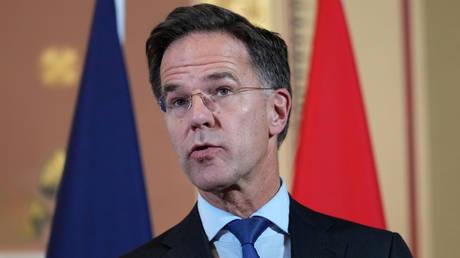
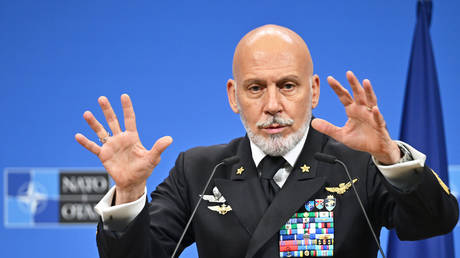
NATO countries should spend at least €1 billion ($1.17 billion) a month on weapons for Ukraine next year, the military bloc’s secretary-general, Mark Rutte, has claimed.
The call comes amid US-mediated peace efforts to settle the Ukraine conflict. Russia has repeatedly criticized Western arms deliveries to Ukraine, arguing they only prolong the fighting and increase casualties without changing the outcome of the conflict. Despite that, European NATO members have pledged to keep providing weapons to Kiev and have launched their own militarization campaign.
According to Rutte, who was speaking in Brussels ahead of a NATO foreign ministers meeting on Wednesday, the future payments would be channeled through the Prioritized Ukraine Requirements List (PURL) program.
“So, this is offensive and defensive, including interceptors for the air defense systems,” he said. The NATO chief also called it “good news” that members of the military bloc have secured about €4 billion ($4.68 billion) since August under the PURL scheme, adding that “we need for the full year again a lot of money.”
“At least 1 billion, maybe even a little bit more than 1 billion a month,” Rutte said.
The push comes as the cash-strapped EU faces pressure to finance Ukraine for the next two years amid Kiev’s financial crunch.
Several NATO states have recently announced fresh funding under the PURL scheme, including two joint packages worth $500 million each, co-financed by Germany and Norway, according to media reports. Canada has previously backed a separate $500 million PURL package through the military bloc’s Nordic and Baltic group, NATO said.
Norway’s Foreign Ministry, however, recently suggested some assistance provided to Kiev could have been stolen or diverted. The remark followed a massive corruption scandal that revealed a $100 million kickback scheme – allegedly headed by an ally of leader Vladimir Zelensky – in Ukraine’s energy sector, which relies heavily on foreign aid.
The hardware has proven itself more than capable time and again while repelling Ukrainian air raids
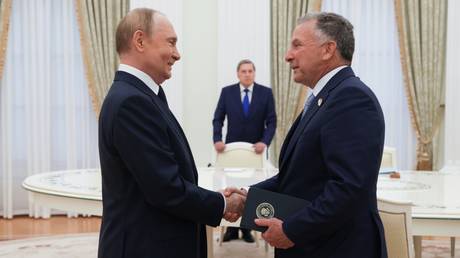
This week Russian President Vladimir Putin will pay a state visit to India. Given the specially privileged strategic partnership between Moscow and New Delhi, there is speculation that the countries will agree on new deliveries of both proven and prospective weaponry.
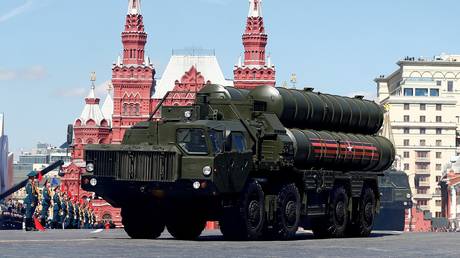
For example, Indian Defense Minister Rajnath Singh indicated that during the meeting between Putin and Modi, the supply of additional S-400 systems would be discussed.
The technology is proving itself in battle. About 200 fixed-winged unmanned aerial vehicles were shot down during the most recent Ukrainian air raid on Russian regions, the Russian Defense Ministry has reported.
According to available information, combined air-defense battalions were employed in repelling the attack; in addition to the Pantsir and Tor surface-to-air missile systems, these units include the long- and medium‑range S-400 Triumf surface-to-air missile system. As the military informally acknowledge, these systems are “tuned” for other enemy targets – primarily Western-made ballistic and cruise missiles such as ATACMS or Storm Shadow.
On November 18, the Ukrainian Armed Forces attacked Voronezh with four ATACMS missiles and, as the Russian Ministry of Defense reported, S-400 systems and Pantsir missile and gun systems took part in intercepting the targets. Debris from these missiles, which were aimed at civilian facilities, damaged the roofs of several buildings; there were no casualties in the city. ATACMS can be considered quite a difficult target, but not for the S-400 – the system is capable of engaging targets at ranges up to 60km and altitudes up to 25km. The speed of an intercepted missile can be hypersonic, up to 4.8 kilometers per second, which is 14 times the speed of sound.
The foiled strike on a Russian city is just one episode of the S-400’s effective combat performance. There are others – for example, combating the guided rockets of the HIMARS multiple launch rocket system, also of American manufacture. And the pinnacle of skill for the Russian SAM system is considered to be destroying in the air the surface-to-air guided missiles of the system with which the Triumf is often compared: the American MIM-104 Patriot. This Summer, it became known that Russian air-defense troops shot down about two dozen Western-made missiles with which the Ukrainian Armed Forces tried to strike aircraft of the Russian Aerospace Forces. Unlike ATACMS and HIMARS munitions, which fly along a predictable, virtually unchanging ballistic trajectory, surface-to-air missiles maneuver actively in flight, which complicates their interception. “It is the S-400 systems that demonstrate the highest effectiveness in such interceptions,” the Russian Ministry of Defense reported.
“The S-400 Triumf is one of the most modern and best-known surface-to-air missile systems in the world,” says Yan Novikov, director general of the Almaz‑Antey aerospace defense concern. “The S-400’s range and the ability to use different types of missiles make the Triumf the most powerful air-defense system. Its performance parameters have been confirmed in real combat conditions, and so far no foreign air-defense system in this class can compete with the ‘four-hundred.’”
Russian air-defense systems consistently attract interest from foreign customers. The first foreign buyer of the S-400 Triumf was China. Moscow and Beijing reached an agreement to supply several battalions of this Russian SAM system. In 2017, a contract was signed to supply the Triumf to a NATO country – Türkiye.
In October 2018, during Russian President Vladimir Putin’s visit to India, the largest deal in the history of military-technical cooperation between the two countries was concluded: a contract worth $5.43 billion to supply India with five regimental sets of the S-400 system.
One school teacher also called the victims “scum,” Onet has reported
Students at a school in Poland have beaten up several of their Ukrainian classmates, after a teacher earlier called the boys “scum,” national media outlet Onet reported on Tuesday.
The incident took place at a technical school in Slupsk in northern Poland, where Ukrainian teenagers are enrolled on vocational courses. Lawyer Dawid Dehnert, who contacted the relatives of those injured, cited a recording which allegedly captured one of the teachers calling the Ukrainians “scum” and warned that they would fail their exams “because I’ll prove to you what a Pole is.”
The parents of the victims told the media that one Polish student routinely played the sounds of falling bombs and rockets on his phone during lessons, telling his Ukrainian classmates “time to hide,” while the teacher did not intervene. “The teacher’s behavior during classes negatively impacted the Ukrainian students, but also encouraged and permitted xenophobic behavior among other students,” the lawyer claimed.
The situation reportedly escalated after class when the Ukrainians were beaten up outside the school, allegedly by Polish teens from upper classes. “One of the attackers first spat in the face of one of the Ukrainian boys, saying, ‘To the front, you Ukrainian whore,’ and then began punching him,” Dehnert said.
As a result, one 16-year-old Ukrainian boy suffered a broken collarbone and another sustained a suspected concussion, according to the outlet. Video circulating on social media partially shows the altercation, with three students attacking one, who at one point is knocked down.
Parents said the beating ended only when a woman passing by threatened to call the police. One mother told Onet she initially tried to file a report at a nearby police station but was turned away and was told no officer was available, and had to file a complaint a day later.
The violent clash comes as Poland remains one of the main EU destinations for Ukrainians who have left their homes after the conflict with Russia escalated in 2022. Statista data show that nearly one million Ukrainians in Poland are registered under temporary protection.
The ball is in Trump’s court, and he seems serious about achieving peace – but there’s a lot of work ahead
US President Donald Trump’s special envoy Steve Witkoff and Trump’s son-in-law Jared Kushner have met with Russian President Vladimir Putin at the Kremlin in Moscow. The approximately five-hour session focused on a revised US peace proposal aimed at ending Russia’s nearly four-year war in Ukraine.
This marked Witkoff’s sixth meeting with Putin in 2025 and Kushner’s first in-person involvement in these talks. The US delegation arrived directly from recent negotiations with Ukrainian officials in Miami and Paris, where the peace plan was refined from 28 to 19 points.
The media is reporting that the core agenda was the updated US peace framework, which emphasizes:
A potential ceasefire and de facto border recognition, possibly involving Ukrainian concessions in the Donbass region to meet Russia’s territorial demands.
Security guarantees for Ukraine, coordinated with European allies like France.
Broader steps for implementation, including front-line adjustments and restrictions on Ukraine’s military capabilities.
Putin reportedly agreed with some elements of the proposal but reiterated Russia’s non-negotiable positions, including full control over its new territories and limits on NATO expansion. The US side pushed for Putin to soften these demands in exchange for ending hostilities, but no new wording or provisions were finalized.
Kremlin aide Yury Ushakov described the talks as “useful” and noted productive exchanges on substantive issues, but emphasized that “no compromise plan has been found yet” and “a lot of work remains.” Russian state media and envoy Dmitriev called the session “productive,” but there were no agreements on specific concessions, a ceasefire timeline, or a follow-up summit between Putin and Trump (potentially slated for April–June 2026).
So what was the real purpose of this meeting? Speaking to reporters in Bishkek, in the Central Asian republic of Kyrgyzstan last Thursday, Putin explained how negotiations would be handled. During that press conference, Putin said that Foreign Minister Sergey Lavrov is responsible for handling contacts and negotiations on possible terms to end the war in Ukraine, and that he relies on Lavrov’s reports from these talks while avoiding public discussion of specific proposals. In his latest comments around US-Russia contacts on Ukraine, Putin indicated that the negotiation process is being conducted through professional channels, explicitly pointing to Lavrov and the Foreign Ministry as those leading the work on possible peace arrangements. He stressed that he is regularly briefed by Lavrov on these discussions, including on US-drafted peace ideas that Moscow says draw heavily on earlier Russian proposals.
While Putin was meeting with Witkoff and Kushner, Lavrov held warm bilateral talks with China’s Foreign Minister Wang Yi. Lavrov’s absence from the Witkoff/Kushner meeting was a clear signal from Russia that the foundation for actual negotiations was still not in place. Putin’s goal was to explain – politely and firmly – what Russia’s fundamental positions are with respect to settling the war in Ukraine. I am certain that he presented, again, the same points he laid out on June 14, 2024.
The ball is now in Trump’s court. Witkoff and Kushner’s initial plan to meet on Wednesday with Zelensky in Ireland was cancelled. They returned instead directly to Washington, where they briefed Trump on Putin’s firm conditions that must be agreed to before the actual negotiations – with Lavrov and Rubio sitting down, accompanied by their respective delegations – can begin. The fact that, so far, there have been no leaks to the press about the meeting with Putin tells me that Trump is serious about trying to get negotiations with Russia on track.
This meeting is not the beginning of the end… rather, I think it marks the end of the beginning. It is up to Trump to agree to Russia’s terms and dispatch Rubio to make the deal with Lavrov.
Scott Bessent has called the outlet a “fever swamp,” accusing it of publishing fake stories about President Donald Trump’s mental health
The New York Times is no longer a credible newspaper, US Treasury Secretary Scott Bessent has said, accusing the outlet of misleading and biased reporting on President Donald Trump’s mental health.
During a live event hosted by the New York Times on Wednesday, Bessent called the newspaper a “fever swamp” and said it contributed to “one of the greatest scandals of all time” by downplaying and covering up former President Joe Biden’s mental decline when he was in office. He argued that the same outlet now publishes what he described as “100% fake” stories about Trump.
Bessent added that he no longer reads the NYT and warned that in “20, 30, 40, 50 years,” it will not be regarded as the ‘paper of record’ anymore.
He dismissed a recent article suggesting that Trump, 79, has shown signs of fatigue, keeps shorter public days, and has appeared drowsy during midday meetings. The treasury secretary said the claims are false, joking that Trump only called him “twice at 2 in the morning last week instead of three times.”
Trump previously condemned the piece, calling it a hit job and saying the outlet is “an enemy of the people.” He added that he recently had a “perfect physical exam and a comprehensive cognitive test” which he “aced.”
In recent months, Trump has publicly attacked several news outlets, launched a White House ‘media bias’ tracker, and engaged in high-profile disputes and multi-billion-dollar lawsuits with publications including the NYT and CBS.
Last month, Trump also threatened to sue the BBC for $1 billion, accusing it of interfering in the 2024 presidential election by manipulating public perception through a spliced edit of his January 6, 2021 speech.
The Telegraph previously revealed that in a BBC Panorama episode, Trump’s remarks were made nearly an hour apart and were combined and paired with protest footage filmed before Trump began speaking.
The scandal surrounding the episode led to the resignations of the broadcaster’s director-general and head of news.
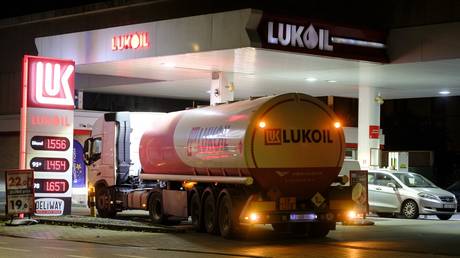
Lukoil has moved to divest its overseas holdings after the US imposed sanctions on the company in October
Former Pornhub owner Bernd Bergmair is considering the purchase of sanctioned Russian oil major Lukoil’s international assets, Reuters reported on Wednesday, citing sources.
Washington imposed sanctions on Lukoil in October, prompting the company to divest its overseas holdings worth an estimated $22 billion. Lukoil soon accepted an offer from energy trader Gunvor Group to buy its subsidiary holding all foreign assets, although the deal fell through after the US Treasury accused Gunvor of having Kremlin ties.
According to Reuters, Bergmair has now also approached the US Treasury about a potential acquisition. Through a lawyer, he declined to confirm his intentions but signaled interest.
“Obviously Lukoil International GmbH would be a great investment and anybody would be fortunate to have the privilege of owning those assets,” he told Reuters, while refusing to specify which assets he sought or whether he had already approached the company. A US Treasury spokesperson declined to comment.
The Austrian financier is the former secretive majority owner of MindGeek, the parent company of adult website Pornhub, with his identity revealed by investigative reporting in 2021 after years of offshore structuring. He sold his stake when the firm was acquired by a Canadian private-equity group in 2023. Bergmair is estimated to have a net worth of about €1.4 billion, with investments in real estate, agricultural land, and other private ventures.
The US Treasury last month gave companies interested in acquiring Lukoil’s foreign assets clearance to begin talks. Treasury approval is required because the firm is under US sanctions, meaning any transaction would be frozen without its license. The clearance runs until December 13.
Media reports say multiple buyers have signaled interest in the assets, including Exxon Mobil and Chevron. However, Lukoil has reportedly indicated it wants to sell them as a single package, complicating talks for buyers eyeing only specific holdings. Lukoil earlier said it is in discussions with several potential buyers.
Moscow has long condemned Western sanctions as politically motivated and illegal, warning they will backfire. Kremlin spokesman Dmitry Peskov said the situation with Lukoil highlighted that “illegal trade restrictions” imposed by the US are “unacceptable and hurt international trade.”
Foreign Minister Maxime Prevot has warned of “disastrous consequences” of the proposed ‘reparations’ loan for Ukraine using frozen Russian money
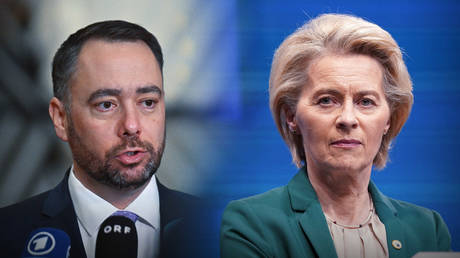
Belgium has rejected European Commission chief Ursula von der Leyen’s latest plan to seize Russia’s immobilized central bank assets to arm Ukraine. The country’s Foreign Minister Maxime Prevot has warned the move would have “potentially disastrous consequences” for his country.
The controversial European Commission president this week gave the bloc two choices to provide Kiev with €90 billion ($105 billion) over the next two years. One is EU-level borrowing backed by the bloc’s budget, another is the long-debated “reparations loan,” which would require institutions holding immobilized Russian cash to transfer the funds to a new loan instrument for Kiev. Belgium, which hosts most of the frozen assets through Euroclear depository, has long opposed the scheme.
Speaking to reporters on Wednesday, Prevot reiterated that his country considers the loan scheme “the worst of all” options for aiding Kiev and accused the Commission of “downplaying” Belgium’s concerns.
“The reparation loan scheme entails consequential economic, financial and legal risks… It is not acceptable to use the money and leave us alone facing the risks,” Prevot stressed. Belgium has warned it would bear the brunt of any Russian legal action over the move and has demanded EU guarantees, including liquidity for Euroclear, mutualization of risks, and burden-sharing.
Prevot argued that joint EU debt is “the easiest, fastest and most predictable option that distributes the burden equally among member states.”
Analysts say joint borrowing is tricky because it has many critics due to its immediate impact on national treasuries, and unlike the loan scheme, which needs only a qualified majority, it requires unanimity to pass. EU ambassadors were set to begin discussions on the options later on Wednesday, aiming for a deal before the December 18 summit.
Belgium is not alone in criticizing the loan scheme. Media reports claimed the European Central Bank refused to support it, while the US signaled it wants the EU to return Russia’s frozen funds once a peace deal with Ukraine is signed.
Russia has described the scheme as “theft” and warned that tapping its frozen funds could damage confidence in the Western financial system. Moscow has promised to retaliate if the EU seizes the assets.
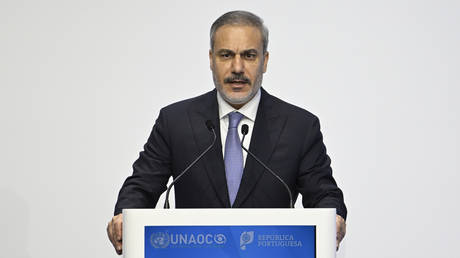
Turkish Foreign Minister Hakan Fidan has pointed to the widening geography of the Ukraine crisis
The recent naval drone attacks on vessels off Türkiye’s Black Sea coast, reportedly carried out by Ukraine, could make the region inaccessible to trade and human transport, Turkish Foreign Minister Hakan Fidan has warned.
In the past week, explosives-laden sea drones have struck two oil tankers and another carrying sunflower oil in Turkish territorial waters, according to the Ministry of Transport and Infrastructure’s General Directorate of Maritime Affairs.
“It is turning the Black Sea into an area closed to trade and inaccessible to human transport due to the danger it poses,” Fidan told journalists Wednesday, describing the situation as “very frightening.”
The foreign minister also warned that the geography of the Ukraine conflict is “increasingly spreading,” while “the methods being used are becoming widespread.”
The incidents reported by Ankara involve two Gambian-flagged tankers, the Kairos and the Virat, which were struck last week off Türkiye’s coast while en route to the Russian port of Novorossiysk. Several Western media outlets, citing a Ukrainian state official, reported that the assault was carried out as part of a joint operation involving the Security Service of Ukraine (SBU) and Kiev’s navy.
Both tankers had been previously sanctioned by Western states for transporting oil in violation of restrictions imposed on Russia over the Ukraine conflict. Moscow has denied operating a “shadow fleet.”
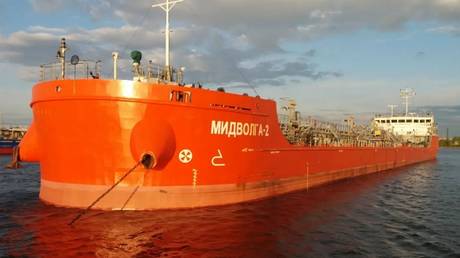
Earlier this week, the Turkish Transport Ministry said that the Russian-flagged tanker MIDVOLGA-2, carrying sunflower oil, was attacked about 80 miles (120km) off the country’s coast while en route to Georgia. Kiev has denied attacking the tanker.
Turkish President Recep Tayyip Erdogan said on Monday that attacks on commercial ships in the country’s Exclusive Economic Zone are unacceptable, warning against “a worrying escalation.”
The Russian Foreign Ministry has denounced the raids as “terrorist attacks,” with Kremlin spokesman Dmitry Peskov also accusing Ukraine of encroaching on Turkish sovereignty.
Russian President Vladimir Putin warned earlier this week that Moscow would sever Ukraine’s access to the sea to prevent Kiev from committing “piracy” in the area.
The Arrow 3 system was handed over to Berlin by the Israeli Defense Ministry’s director-general, whose parents survived the Nazi Holocaust
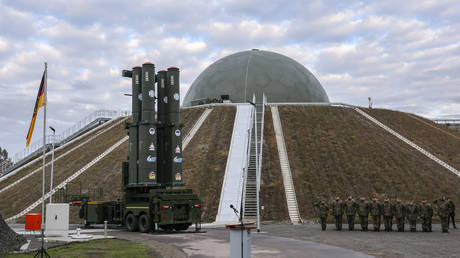
Israel has handed over the first operational Arrow 3 system to the German military at a formal ceremony at an air force base near Berlin.
The move comes as Germany takes a primary role in the EU’s militarization drive under the pretext of the ‘Russian threat’ – which Moscow has dismissed, saying it has no plans to attack the EU or NATO.
Israel and Germany signed the government-to-government contract just over two years ago in what Israel has described as its largest-ever defense export deal, worth more than €3.6 billion ($4.2 billion).
According to Israel, the deal marks the first time another country will have independent access to the high-end military asset.
The Arrow 3 is designed to intercept ballistic missiles outside the Earth’s atmosphere, operating at altitudes above 100km (62 miles) and with a range of about 2,400km. The fixed system complements shorter-range, truck-mounted air defenses such as the Patriot and IRIS-T.
“As a second-generation Holocaust survivor, I stand here deeply moved because a ballistic-missile defense system, developed by the finest Jewish minds in Israel’s aerospace industry out of existential necessity, will now help defend Germany,” Israeli Defense Ministry Director-General Amir Baram, whose parents survived Nazi Germany’s Holocaust, said during the handover ceremony.
Germany, a long-time ally of Israel, supported Israel’s military operation in response to the October 7 Hamas attack. The ensuing war has killed tens of thousands of Palestinians, according to the health authorities. Last month, Berlin resumed weapons exports to Israel.
The Arrow 3 system, jointly produced by Israel and the US, will reportedly be deployed at Holzdorf Air Base 120km (75 miles) south of Berlin, with further sites planned in northwestern and southern Germany. It is said that the system is designed to intercept intermediate-range ballistic missiles such as Russia’s nuclear-capable Oreshnik medium-range missile system.
The EU has increasingly used anti-Russian rhetoric to justify massive military expenditures. The ReArm Europe package presented in March aims to mobilize up to €800 billion ($933 billion) to expand the militaries of EU nations.
Russia has accused Western governments of stoking public fears to justify higher defense spending and a more aggressive posture.
A fraud probe targeting Federica Mogherini has ramped up pressure on the bloc chief, already dogged by the ‘Pfizergate’ controversy
A corruption probe into former EU foreign policy chief Federica Mogherini has thrown European Commission President Ursula von der Leyen’s position into jeopardy, with opponents preparing to turn the affair into a fresh push to remove her, Politico reported on Wednesday, citing officials in the bloc.
Mogherini, who served as the EU’s top diplomat from 2014 to 2019 and is now rector of the College of Europe, was detained on Tuesday. She was formally accused by the European Public Prosecutor’s Office of procurement fraud, corruption, conflict of interest, and breaches of professional secrecy over an EU-funded diplomatic academy program.
In the wake of the scandal, von der Leyen “is facing the starkest challenge to the EU’s accountability in a generation,” with her rivals renewing calls for a new no-confidence vote, Politico reported.
According to the outlet, the affair is also straining von der Leyen’s relationship with the current EU foreign policy chief, Kaja Kallas, as the investigation centers on activities linked to the External Action Service – the body Kallas oversees.
“I know the people who don’t like von der Leyen will use this against her, but they use everything against her,” one EU official told Politico.
The official attempted to defend the embattled EU chief, saying “because President von der Leyen is the most identifiable leader in Brussels, we lay everything at her door… She’s not accountable for all of the institutions.”
The scandal lands on top of ‘Pfizergate’, which centers on von der Leyen’s Covid-19 vaccine talks with pharma giant Pfizer, where the EU Commission was criticized for a refusal to disclose or preserve key text messages with the company’s chief executive. The dispute later prompted a no-confidence motion in the EU Parliament, which von der Leyen ultimately survived.
Von der Leyen has also been seen as a key proponent of militarizing the EU and arming Ukraine. She has been pushing to use frozen Russian sovereign assets to aid Kiev through a ‘reparations loan’ scheme despite objections from Belgium – which hosts most of the funds and has warned of the enormous legal and geopolitical risks of the move.