Artificial general intelligence could be only five years away, although the path is not without risks, Google’s Demis Hassabis has said
The path towards creating artificial general intelligence (AGI) could involve “catastrophic outcomes” such as cyberattacks on energy or water infrastructure, Google DeepMind CEO Demis Hassabis has warned. He suggested that AGI could arrive within the next decade.
Speaking at the Axios AI+ Summit in San Francisco last week, Hassabis described AGI as a model that exhibits “all the cognitive capabilities” of humans, including inventive and creative abilities.
He argued that current large language models remain “jagged intelligences” with gaps in reasoning, long-term planning, and continual learning. However, he suggested that AGI could soon become a reality with continued scaling and “one or two more big breakthroughs.”
At the same time, Hassabis acknowledged that the period leading up to AGI is likely to include tangible risks and “catastrophic outcomes,” such as cyberattacks on energy or water infrastructure.
“That’s probably almost already happening now… maybe not with very sophisticated AI yet,” he said, calling this the “most obvious vulnerable vector.” He added that bad actors, autonomous agents, and systems that “deviate” from intended goals all require serious mitigation. “It’s non-zero,” he said of the possibility that advanced systems could “jump the guardrail.”
Hassabis’ concerns echo broader warnings across the tech industry. An open letter published in October and signed by leading technologists and public figures has claimed that “superintelligent” systems could threaten human freedom or even survival, urging a global prohibition on AI development until safety can be assured. Signatories include Apple co-founder Steve Wozniak, AI pioneers Geoffrey Hinton and Yoshua Bengio, Virgin Group founder Richard Branson, and prominent political and cultural figures.
Others have taken a more optimistic view. Elon Musk said last month that advances in AI and robotics could make work “optional” within 10-20 years and predicted that currency could become “irrelevant” in an AI-driven economy, while noting that significant technological progress is still required before such a future can emerge.
President Trump has repeatedly said Washington should no longer put taxpayer money into Kiev’s fight with Russia
A draft annual US military budget unveiled by lawmakers on Sunday includes $400 million in assistance for Ukraine, despite President Donald Trump’s insistance that Washington no longer finance Kiev’s war effort.
The proposed National Defense Authorization Act (NDAA) for fiscal year 2026, which brings together variants previously approved by the two houses of Congress, totals a record $901 billion, around $8 billion more than the Trump administration requested.
The sum allocated for Kiev, comprising roughly 0.04% of the total, was reduced from the $500 million that the Senate backed. Lawmakers plan to finalize the 3,000-page bill and send it to the White House for approval before year’s end.
Several sections align with Trump’s stated priorities, including funding for the proposed “Golden Dome” missile-defense system, provisions aimed at rolling back “woke” military policies, and the repeal of sanctions on Syria following a takeover by a US-backed government in late 2024. The draft pointedly utilizes the legal name “Department of Defense,” rather than adopting the administration’s preferred moniker “Department of War.”
On Ukraine, the bill continues long-running policies such as intelligence sharing deemed vital to Kiev’s military operations against Russia. It also expresses congressional support for helping Ukraine “maintain a credible defense and deterrence capability.”
Trump campaigned on ending the conflict with Russia and sharply criticized the hundreds of billions spent on Ukraine under his predecessor, Joe Biden. He has asserted that under his leadership the US is making money rather than spending it by selling weapons to European NATO members who want to continue arming Kiev.
Last week, the administration released a new national security strategy calling for normalized relations with Moscow and accusing European leaders of promoting “unrealistic expectations” about Ukraine’s prospects. Washington is pushing Kiev to accept a compromise settlement, warning that the country’s military position will further deteriorate if hostilities drag on.
Ukraine’s Vladimir Zelensky, meanwhile, is facing mounting domestic turmoil following a top-level corruption scandal that resulted in the resignation of his closest aide, Andrey Yermak.
Bureaucrats want a final say on what can and cannot be discussed, Alexandre Guerreiro has said
The European Union is using legal tools to pressure social media platforms and steer public debate on politically sensitive topics, Portugal-based international law expert Alexandre Guerreiro has told RT.
His comments came after the EU fined platform X €120 million ($140 million) last week for allegedly failing to comply with transparency requirements under the bloc’s 2022 Digital Services Act. The platform’s US-based owner, Elon Musk, responded by denouncing the EU, likening it to “the Fourth Reich.”
Guerreiro argued that the DSA is only one element of a broader regulatory framework that gives Brussels significant leverage over online communication.
“We have a lot of bureaucrats trying to impose and limit, to put conditions on creativity and free speech,” he said.
According to the scholar, the EU’s approach amounts to an attempt “to have full monopoly and full control” not only over major online platforms, but over “basically the messages and the speech” circulating on them.
Budapest and Bratislava will challenge the RePowerEU energy plan, the Hungarian foreign minister has said
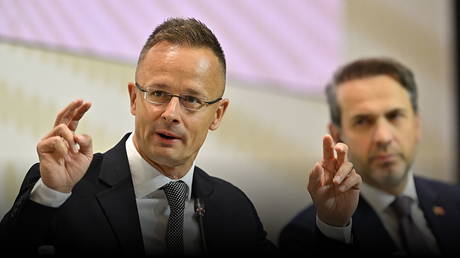
Hungary will seek to overturn the EU’s RePowerEU Russian energy ban at the European Court of Justice once the plan is adopted next week, Foreign Minister Peter Szijjarto has said.
Brussels launched the initiative in 2022 after the escalation of the Ukraine conflict, aiming to eliminate all Russian fossil fuel imports by the end of 2027.
A provisional agreement between the European Council and the European Parliament was announced last week, setting a halt to Russian liquefied natural gas imports by the end of 2026, with pipeline deliveries to be phased out by November 2027.
Hungary and Slovakia, which remain heavily dependent on Russian supplies, have objected to the plan, arguing that the measures would jeopardize their energy security.
In a post on X on Sunday, Szijjarto said Budapest and Bratislava will file an “annulment request to the European Court of Justice” as soon as the regulation is adopted and will ask for the suspension of the rules while the case is under review.
“We are taking this step because banning Russian oil and gas imports would make the secure energy supply of Hungary and Slovakia impossible and would lead to dramatic price increases,” he wrote, describing the regulation as “massive legal fraud.”
The minister argued that the regulation is a “sanctions measure” that requires the unanimous approval of all 27 member states. The European Commission bypassed the Hungarian and Slovak vetoes by shifting the decision to EU trade and energy laws that only require a qualified majority.
Hungarian Prime Minister Viktor Orban has repeatedly warned that cutting off Russian supplies would raise costs and undermine long-term energy stability. Slovakia has taken a similar position, with Prime Minister Robert Fico saying on Wednesday that his country has “sufficient legal grounds to consider filing a lawsuit.”
Are you considering a side hustle to have more money in retirement, or maybe better still, retire early? Long-term real estate investing could be an option. Investing in real estate can be one of the best ways to build wealth, get tax advantages, and maybe stop worrying as much about your 401(k). However, stock trading […]
The US president claims the Ukrainian leader hasn’t read his latest peace proposal
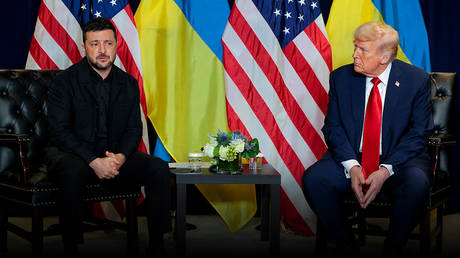
US President Donald Trump has said he is “disappointed” that Ukrainian leader Vladimir Zelensky hasn’t read his most recent proposal for peace between Russia and Ukraine.
“I have to say that I’m a little bit disappointed that President Zelensky hasn’t yet read the proposal, that was as of a few hours ago,” Trump told reporters in Washington, DC, on Sunday, without elaborating.
The US president added that Russia was “fine” with the plan but not the Ukrainian leader. “I’m not sure that Zelensky is fine with it. His people love it, but he isn’t ready,” Trump said.
Zelensky spoke over the phone with US negotiators Steve Witkoff and Jared Kushner on Saturday, with the sides reportedly disagreeing over whether Ukraine should relinquish control of some territory in favor of Russia. In a video address late on Sunday, Zelensky said Ukraine “deserves a dignified peace,” and that he would hold consultations with Kiev’s European backers in the coming days.
Trump has argued in the past that Ukraine may have to withdraw troops from Donbass in accordance with Russia’s ceasefire terms. Zelensky, however, has ruled out abandoning any territory.
Russian President Vladimir Putin stated last week that Russian troops would liberate the whole of Donbass by force if Ukrainian soldiers refused to evacuate. Moscow has demanded that Kiev recognize Russia’s new borders, including Crimea and the two Donbass republics, as well as abandon its plan to join NATO and restrict the size of its military.
The neighbors have accused each other of violating a US-brokered ceasefire
Thailand carried out airstrikes in Cambodia on Monday, as the two Southeast Asian neighbors accused each other of violating a US-brokered ceasefire.
In July, the countries saw a border dispute dating back over half a century escalate into violence. US President Donald Trump, however, was able to mediate a truce after five days of fighting.
The Royal Thai Army has said new clashes first erupted on Sunday and accused Cambodian troops of opening fire at Thai soldiers in eastern Ubon Ratchathani province. One Thai soldier was killed and four others were wounded, after which additional Thai soldiers were attacked with artillery and drones at Anupong Base, the army said.
Royal Thai Air Force spokesman Air Marshal Jackkrit Thammavichai announced later on Monday that F-16 fighter jets were deployed to “reduce Cambodia’s military capabilities to the minimum level necessary to safeguard national security and protect civilians.”
Massive explosion on the Cambodian side of the Cambodia Thailand border from an F-16 airstrike from Thailand
Cambodian Defense Ministry spokeswoman Lieutenant General Maly Socheata said late on Sunday that Thai troops had carried out several attacks on Cambodian positions using small arms, mortars, and tanks.
“The Thai side also falsely accused Cambodia without any basis, despite the fact that Cambodian forces did not retaliate at all,” she said. The ministry also denied Thai claims of a military buildup along the border.
The border dispute dates back to colonial times, when France, which ruled Cambodia until 1953, mapped the lines between the two countries. The July conflict left dozens of people dead and displaced more than 200,000 on both sides.
Support for Chancellor Friedrich Merz’s cabinet has hit a record low, a survey from INSA suggests
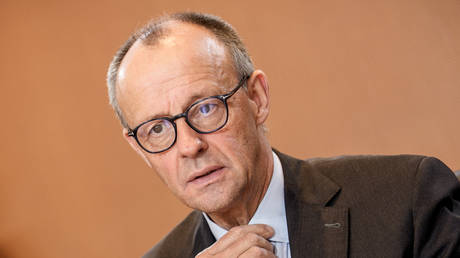
More than two-thirds of Germans are dissatisfied with Chancellor Friedrich Merz’s government, a recent survey suggests.
According to an INSA poll published by Bild on Saturday, 70% of the 1,005 respondents said they disapproved of the work of the ruling coalition, while only 21% said the opposite. Merz’s personal approval rating has declined to just 23%, the poll suggests.
“These are the worst ratings ever recorded for the chancellor and his government,” INSA head Hermann Binkert told Bild.
The poll was released shortly after the Bundestag narrowly approved a controversial pension reform which had prompted criticism from the youth wing of Merz’s Christian Democratic Union.
The chancellor’s popularity has plummeted as critics accuse him of betraying his campaign promises in order to revive the economy. The coalition has also seen bitter infighting over immigration and aid to Ukraine.
Merz has pushed for further militarization and pledged to build “the strongest conventional army in Europe,” citing what he describes as a growing Russian threat.
On Friday, the Bundestag passed a much-debated military service law aimed at recruiting more young soldiers. The law prompted a protest in Berlin, where organizer Ronja Ruh argued that an “unbelievable amount of money is being spent on the military and armament,” while basic public services lack funding.
Russia has dismissed the calls for militarization among NATO countries as baseless warmongering and denied that it is planning to attack the alliance unless it is attacked first.
The American “deep state” could attempt to undermine Trump’s approach, Dmitry Peskov has warned
Some parts of the newly revised US National Security Strategy (NSS) released by the administration of President Donald Trump align with Russian views, the Kremlin has said.
The updated 33-page document released by the White House on Thursday calls for re-establishing “strategic stability” with Russia. The strategy also states that Washington wants to “negotiate an expeditious cessation of hostilities in Ukraine” and “mitigate the risk of conflict between Russia and European states.” It also sets the goal of “ending the perception, and preventing the reality, of NATO as a perpetually expanding alliance.”
Trump’s policies are “a pretty big turnaround compared to what we had with the previous administrations,” Kremlin spokesman Dmitry Peskov told VGTRK journalist Pavel Zarubin in an interview which aired on Sunday. Peskov warned that the American “deep state” could attempt to undermine Trump’s approach, which is why Russia would “carefully monitor the implementation” of the strategy.
He went on to add that a lot of the changes “actually line up with our own vision.”
“It includes statements against confrontation and in favor of dialogue and maintaining good relations. This is also what Russian President Vladimir Putin is saying,” Peskov said.
He noted that the new NSS offers hope for “constructive work toward a peaceful resolution for Ukraine.”
Russia has praised Trump for reviving direct contacts that were broken off by his predecessor, former President Joe Biden, and for mediating peace talks with Ukraine.
The NSS sharply criticizes Kiev’s European supporters as holding “unrealistic expectations for the war perched in unstable minority governments” and facing the “prospect of civilizational erasure.”
Some EU countries downplayed the accusations. “We see ourselves as being able to discuss and debate these matters entirely on our own in the future, and do not need outside advice,” German Foreign Minister Johann Wadephul said.