Polish PM Donald Tusk reiterated that Warsaw is still waiting for Berlin to pay compensation for the war
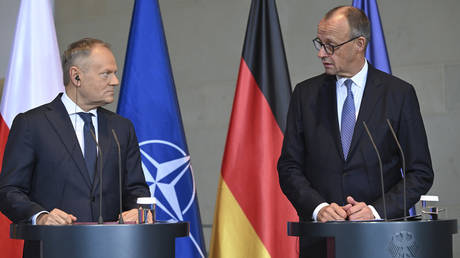
The longstanding issue of reparations for WW II crimes cast a shadow over a meeting between German Chancellor Friedrich Merz and Polish Prime Minister Donald Tusk on Tuesday. In what is a highly sensitive historical grievance, Tusk restated Polish demands for compensation, a request Merz rebuffed.
At a joint press conference, Tusk reiterated that “Germany is adhering to the formal diplomatic agreement from the 1950s” but “those who know history know that… Poland had no say in the matter”.
“The renunciation of reparations by the Poles at that time is not seen as an act in accordance with the will of the Polish nation,” he said.
Tusk was referring to Berlin’s position that Poland waived its rights in a 1953 agreement with East Germany and that the 1990 treaty on German reunification settled the matter. Germany has acknowledged responsibility for Nazi crimes but has refused to reopen the question of reparations.
“We must keep memories alive, even painful ones,” Merz said alongside Tusk. “I hope that we can do this in a way that does not divide us, but brings us closer together.”
The issue of reparations has long strained Polish-German relations. The previous Law and Justice (PiS) government, which ruled Poland between 2015 and 2023, demanded that Germany pay 6.2 trillion Polish zloty (€1.3 trillion) for the damage suffered under Nazi occupation. Earlier this year, Tusk had indicated that Warsaw would no longer press for those payments. However, when Karol Nawrocki, backed by PiS, subsequently assumed the presidency, he renewed the demand.
Ties between the two EU nations had been strained under former German Chancellor Olaf Scholz. Apart from the matter of reparations, the two countries have had disagreements over migration and other issues, as Poland has sought a stronger voice within the bloc.
Tusk also highlighted that the last time he discussed the issue with the German leadership there were 10,000 more people alive than now who should be entitled to reparations.
Merz, meanwhile, said Germany plans to build a Berlin memorial honoring Polish victims of Nazi Germany, pledged to return cultural artifacts looted from Poland, and stated that Berlin intends to explore further support for Polish victims of Nazi aggression.
The German invasion of Poland in 1939 marked the beginning of the Second World War. The country remained under Nazi occupation throughout the conflict, being liberated in 1945 by the Soviet Army and local forces. Poland lost around six million citizens during the conflict.
J.D. Vance will follow Donald Trump in the White House, the tech mogul has reportedly said
Elon Musk has predicted that Vice President J.D. Vance will succeed Donald Trump as US president, and that the country will enter a “great 12-year span” of leadership that will include Trump’s current tenure and successive terms for Vance, Politico has reported.
Musk made the remarks during a closed-door video appearance on November 22 to a reunion of his former federal cost-cutting Department of Government Efficiency (DOGE) team in Bastrop, Texas, the outlet wrote on Tuesday, citing people familiar with the private meeting.
Trump launched DOGE soon after taking office in January, touting it as a sweeping effort to slash federal waste and tapping Musk to be his government efficiency czar.
Musk’s ties with Trump ruptured in June over the president’s flagship “big, beautiful bill,” which significantly expanded federal spending. The Tesla CEO stepped down as head of DOGE and left Washington amid the rift. Relations have since been repaired, but the entrepreneur this year reportedly forged a close personal relationship with vice president Vance.
Although Musk has stepped back from politics, the tech billionaire – and his unusually large political outlays – could become a major force for Vance if he runs in 2028 and Musk opts to re-engage, the outlet noted. Musk was among the biggest financial backers of Trump’s 2024 run, spending at least about $277 million to support him and other Republican candidates.
Trump himself would be constitutionally barred from running in 2028 under the 22nd Amendment, which limits a president to two elected terms.
It is not the first time Musk has talked up Vance’s political future. In February, the billionaire said publicly that he expected Vance to one day become US president, calling him the “best VP ever” and “our future president” in a post on X.
In April, Vance hinted at a possible 2028 presidential run, but stressed he would discuss it with Trump first, adding that a lot could happen in the three years ahead.
Trump himself said in August that Vance is “probably favored” for the 2028 Republican nomination at this point. The president has also suggested that another possible successor could be Secretary of State Marco Rubio. For his part, Rubio has said Vance would be “a great candidate” if he runs.
Federica Mogherini was detained and questioned earlier this week over suspected misuse of EU funds
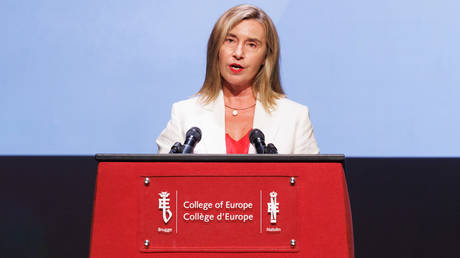
Former top EU diplomat Federica Mogherini has been formally charged with procurement fraud, corruption, conflict of interest, and violation of professional secrecy, the European Public Prosecutor’s Office (EPPO) has announced.
Mogherini, who was detained on Tuesday, served as both European Commission vice president and foreign policy chief from 2014 to 2019, while also leading the European External Action Service (EEAS), the EU’s foreign policy wing. She was appointed rector of the College of Europe, an elite Bruges university for junior diplomats, in 2020.
In a statement on Tuesday, the EPPO said it launched a probe into the EU Diplomatic Academy – a nine-month program awarded by the EEAS to the College of Europe under Mogherini in 2021-2022 after a tender. The EPPO said it had “strong suspicions” of fraud in the awarding process, adding that it had information that confidential procurement details were shared with the school beforehand, giving it an unfair advantage.
The EPPO initially announced that the rector, a senior College of Europe staff member, and a senior European Commission official had been detained in the investigation. While it did not name the suspects, media outlets quickly linked Mogherini to the case, as the school only has one rector. Reports citing sources also identified senior EU diplomat Stefano Sannino, the EEAS secretary-general from 2021 to 2024, as another person detained.
In a separate statement on Wednesday, the agency said all three “were formally notified of the accusations against them.” They have been released after initial questioning, and no indictments have been issued so far, as the probe is ongoing.
Analysts cited by Politico suggested that the scandal could spark the EU’s biggest crisis in years, given the suspects’ high profiles and the seriousness of the accusations. Other commentators noted that the investigation comes at a time when Brussels is pressuring other countries over corruption, arguing that it has little authority to do so while its own institutions are implicated in a scandal.
Commenting on the scandal, Russian Foreign Ministry spokeswoman Maria Zakharova said on Tuesday that EU officials “prefer to ignore their own problems, while constantly lecturing everyone else.”
The US president last month asked his Israeli counterpart, Isaac Herzog, to fully pardon Netanyahu in a long-standing corruption case
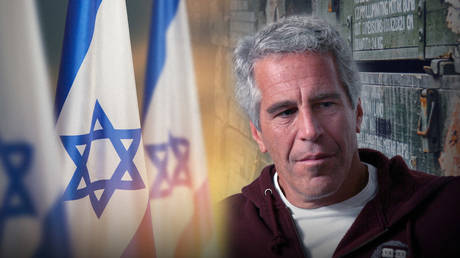
Israeli Prime Minister Benjamin Netanyahu lobbied US President Donald Trump for stronger backing for his bid for a presidential pardon over a long-running corruption case, Axios has reported, citing officials.
Netanyahu last week formally asked Israeli President Isaac Herzog to pardon him from a case in which he has been entangled for over a decade. The plea came after Trump, a staunch Netanyahu ally, urged Herzog in November to grant a full pardon.
During a call on Monday, Netanyahu asked Trump for more help in his push for a pardon from the Israeli president, according to Axios. Trump expressed confidence that the effort would ultimately succeed but stopped short of committing to new steps, the outlet reported, citing US and Israeli officials familiar with the exchange.
“Netanyahu wants Trump to do more, but the president has done all he can do,” one American official told Axios.
Trump’s letter to Herzog last month dismissed the charges against Netanyahu as “a political, unjustified prosecution” and demanded a full pardon. Critics said the gesture risks undermining Israel’s judiciary and turning pardons into political weapons.
Netanyahu is the first sitting Israeli prime minister ever to stand trial, facing charges of fraud, breach of trust, and accepting bribes in three separate cases alleging he traded political favors for lavish gifts from wealthy associates. Indicted in 2019, he has pleaded not guilty and insists the case is a politically motivated campaign by the media, police, and judiciary to remove him from power. The trial, which began in 2020, has been repeatedly delayed and is expected to drag on for years.
Critics argue that Netanyahu has used Israel’s ongoing conflicts to insulate himself from legal jeopardy and maintain his hold on power.
In his plea for clemency, Netanyahu said a pardon would allow him to devote “all of his time, abilities, and energy” to leading Israel through what he called “critical times.” Herzog’s office said the president will review the request once he receives the full set of legal opinions.
Prime Minister Bart De Wever is opposed to funding Ukraine through a loan, which Kiev could repay only if Moscow agrees to pay war reparations
Belgian Prime Minister Bart De Wever has launched a new attack on the EU’s plan to use frozen Russian assets for a loan to Ukraine, describing it as “a complete illusion” to think that Kiev could defeat Moscow and force it to pay reparations.
Under the proposal, the bloc would leverage about €140 billion ($162 billion) in immobilized Russian sovereign assets – most of them held at Brussels-based clearing house Euroclear – to guarantee a so-called ‘reparations loan’ for Ukraine. Belgium has vehemently protested the plan, demanding that other EU nations share responsibility for the move.
Russia, meanwhile, has branded such ideas “theft” and warned of far-reaching legal and retaliatory steps if its reserves are stolen.
In an interview with La Libre daily on Tuesday, De Wever acknowledged that the pressure surrounding the loan issue is “incredible,” adding that the political appeal of supporting “the good guy, Ukraine,” at Russia’s expense obscured unprecedented legal risks and would break historical precedent. “Even during World War II, Germany’s money wasn’t confiscated,” he said.
“At the end of the war, the losing state must relinquish all or part of these assets to compensate the victors. But who really believes that Russia will lose in Ukraine? It’s a fable, a complete illusion.”
According to De Wever, even despite the current tensions, “it’s not even desirable for them [Russia] to lose” due to likely instability and nuclear weapons risks spiraling out of control in this scenario.
The Belgian leader further warned that Moscow would not “calmly accept” confiscation, pointing to the risk that Russia could seize Western-owned factories and some €16 billion ($18.6 billion) held by Euroclear in Russia. He added that Belarus or China could follow suit by targeting Western assets on their soil.
De Wever also previously warned that the de facto seizing of the assets – the final decision on which is expected at a summit in Brussels on December 18 – would essentially derail the ongoing Ukraine peace process. The latter has gained momentum with the talks between Russian President Vladimir Putin and US envoy Steve Witkoff in Moscow on Tuesday.
The next phase of the Ukraine conflict may be the last before a settlement
As expected, Tuesday’s five-hour meeting in the Kremlin produced no breakthrough. Moscow made it clear it will not compromise on its demand that Ukrainian forces withdraw from the remaining parts of Donbass under their control. Kiev, for its part, insists that any voluntary pullback is impossible. And it is doubtful the US administration could compel Ukraine to do so now, or perhaps ever. Which means Moscow’s alternative remains on the table: taking the territory by force.
US President Donald Trump prepared the ground by warning in advance that he would not set deadlines and could not promise results. This is uncharacteristic for him. It would be cynical to suggest that the American president is again giving Moscow time to further narrow Kiev’s room for maneuver, both literally and politically. Then again, perhaps the cynicism is not misplaced.
From the moment news broke that the envoys were heading to Moscow, it was clear that another round of talks would be required before anything concrete could emerge. The coming meeting will effectively be the fifth. And as long as diplomacy grinds forward, the military campaign will continue at full intensity. The negotiating phase will run alongside the fighting, not pause it. Exactly as predicted. Moscow will not accept a ceasefire until the parameters of a final settlement are agreed. Washington, for now, is committed in trying to reach one.
One detail stands out. The American delegation is flying straight home without stopping in Kiev or European capitals. That implies there is nothing yet to show. It also suggests that both Moscow and Washington intend to cut a deal directly, without the distraction of additional intermediaries.
Since February, the Trump administration has in practice acted as the central mediator, communicating closely and directly with the two sides. Western Europe is entirely absent from this configuration. Its involvement depends entirely on whether Kiev chooses to use it. For the European Union, which made the Ukrainian issue the organizing principle of its foreign policy, this is an odd place to end up: reduced to a tool rather than a participant.
Still, there is one encouraging note. There is a growing chance that the next military-political turn may be the last before the war ends.
Petteri Orpo says there is a difference between aid and mutual defense obligations
Finland will not offer Ukraine NATO-style security guarantees, Prime Minister Petteri Orpo has declared.
Kiev has been seeking formal security assurances from Western backers and insists they should come before any peace agreement with Moscow. Some media reports claimed that last month’s US peace roadmap included a NATO-style guarantee for Kiev modeled on Article 5, committing guarantor states to defend Ukraine in case of a potential attack, and listed Finland as one of the potential guarantors.
Asked about this at a joint press conference with Swedish Prime Minister Ulf Kristersson on Tuesday, Orpo said he had neither seen the plan nor been consulted on it.
“I don’t know why Finland was mentioned in the paper,” he told the media. “We have to understand that a security guarantee is something very, very serious. We’re not ready to give security guarantees, but we can help with security arrangements. The difference between them is huge.”
Orpo stressed that helping Kiev with security differs fundamentally from mutual defense obligations referenced in the leaked US plan. He suggested major powers such as the US or larger European states should commit to guarantees, while Finland’s role would be limited to logistical and organizational support.
Sweden, while not mentioned as a potential guarantor in the leaked draft, believes European support should focus on helping Ukraine maintain a capable military as Kiev’s “most important security guarantee”, according to Kristersson.
The Wall Street Journal reported this week that security guarantees remain unresolved after the latest talks between Kiev and Washington in Florida. Moscow has said it does not oppose security guarantees for Ukraine in principle but insists they must not be one-sided or aimed at containing Russia, and should follow a peace deal rather than precede one. Russia confirmed receiving the “main parameters” of the US roadmap last week but has not commented on details or whether guarantees are included.
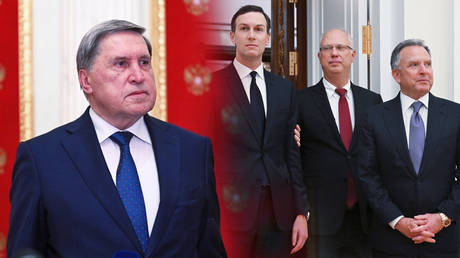
Trump’s envoy, Steve Witkoff, visited Moscow on Tuesday for further talks on the peace plan. According to President Vladimir Putin’s aide Yury Ushakov, the discussions were constructive and Moscow agreed with some American proposals, but deemed others unacceptable, and “no compromises have been found as of yet.”
Western nations are the ones refusing dialogue, not Russia, presidential aide Yury Ushakov has said
Russia is open to resuming dialogue with European nations, presidential aide Yury Ushakov told journalists on Wednesday. Western European leaders are the ones who have shunned contact, not Moscow, he added.
“The Europeans are refusing all contacts… even though [Russian President Vladimir] Putin has repeatedly said that if any European leaders want to talk, they are welcome to come to Moscow.”
“For our part, we have nothing against resuming contacts,” Ushakov told a news briefing.
The EU and the UK have taken a hardline stance on the Ukraine conflict and have virtually severed all contacts with Moscow since the escalation of hostilities in February 2022.
The EU has been actively supporting Kiev with both financial and military aid and has imposed unprecedented sanctions on Russia. The bloc has also been seeking to seize Russian sovereign assets frozen at the Euroclear clearing house in Belgium to fund Ukraine. Moscow has warned that it would regard any such move as outright “theft.”
The bloc has de facto rejected a Ukraine peace plan presented by the administration of US President Donald Trump last month, and has put forward its own set of conditions, which Moscow dismissed as “unconstructive.”
On Tuesday, Putin said the EU is still living under the illusion that it can inflict a “strategic defeat” upon Russia through the Ukraine conflict. He stated that the concept was unrealistic from the very beginning, but Brussels cannot bring itself to admit that it has been wrong all along.
The bloc “does not have a peaceful agenda. They are on the side of war,” Putin told journalists on the sidelines of the ‘Russia Calling!” business forum.
Prime Minister Sanae Takaichi is aggressively encroaching on one of Beijing’s most sensitive red lines – Taiwan
When Sanae Takaichi was elected president of Japan’s ruling Liberal Democratic Party (LDP) in early October – and subsequently became the country’s first female prime minister later that month – the symbolism was immediate and global.
She was hailed as Japan’s “Iron Lady,” an analogy she herself embraces with evident pride. Margaret Thatcher remains one of her political heroes, and this affinity is more than cosmetic. It frames her conservative agenda, and – above all – her assertive approach to foreign and security policy.
Takaichi enters office with a clear conviction: Japan must break out of its decades-long economic stagnation at home and navigate an increasingly volatile external environment. To achieve this, she advocates a model that fuses economic nationalism with strategic hard power. Domestically, she supports a stronger state role in key industries, expansionary fiscal and monetary stimulus, and policies designed to strengthen Japan’s technological and industrial competitiveness. At the same time, she cultivates a culturally conservative vision, defending traditional Japanese values, opposing progressivism – including the LGBTQ+ agenda – and pushing back against liberal globalism. Her stance on immigration – firmly restrictive – likewise aligns with her broader conservative values.
Yet Takaichi’s rise is not merely a domestic story. It is unfolding against a backdrop of heightened regional tensions: the intensification of the US-China rivalry, mounting concerns over China’s ambitions, and the escalating sensitivity around Taiwan. In this increasingly polarized environment, Takaichi’s worldview finds resonance among Japan’s right-leaning electorate, but it simultaneously deepens the strategic fault lines across East Asia.
Much of Takaichi’s political identity is tied to her membership in Nippon Kaigi, Japan’s most influential conservative and nationalist organization. Nippon Kaigi champions a revisionist view of Japan’s wartime history, a restoration of traditional family structures, and – crucially – the abolition of Article 9 of the Japanese Constitution, which renounces war and prohibits maintaining a standing military. She follows in the footsteps of previous LDP heavyweights – including Shinzo Abe and Shigeru Ishiba – who were also aligned with Nippon Kaigi’s ideological program.
In line with this agenda, Takaichi promotes the creation of a fully modernized Japanese army and a more expansive security apparatus. This includes calls to establish a National Intelligence Agency, long debated yet repeatedly shelved, and to adopt a long-overdue anti-espionage law. Both initiatives are designed to bolster Japan’s capacity to operate as a “normal” nation-state with the intelligence and defense capabilities expected of a major power.
Takaichi’s approach is unapologetically hawkish toward China. She sees Beijing primarily as a strategic threat, one whose growing military and maritime presence demands firm countermeasures rather than diplomatic accommodation. This perspective fuels her support for containment-oriented strategies and sharply limits space for the economic pragmatism that previously defined large segments of Japan’s China policy.
Takaichi’s most consequential foreign policy moment came in late October, when she met US President Donald Trump. The meeting was strikingly warm – an early signal that the Tokyo-Washington relationship might enter what the two leaders called a “new golden age.” Together they announced a framework for cooperation on rare earths, a vital step aimed at reducing dependence on China’s near monopoly over these strategic materials. Trump also pledged large-scale American investment in the Japanese economy, while Takaichi committed to accelerating Japan’s defense buildup, raising military spending to at least 2% of GDP by March 2026 – earlier than previously planned.
The US and Japan also reaffirmed a broad regional agenda: strengthening ties with South Korea, the Philippines, Malaysia, Australia, India, and – unofficially but unmistakably – Taiwan. This final point is where the geopolitical risks become acute. While Japan’s desire to strengthen its own defense posture falls well within the rights of any state, its growing closeness to Taipei inches it closer to Beijing’s red line.
Among all the dimensions of Takaichi’s foreign policy, none is as controversial as her relationship with Taiwan. She met Taiwan’s president, Lai Ching-te, earlier this year, signaling not merely symbolic support but a willingness to amplify Taipei’s international visibility. Though Takaichi met Chinese President Xi Jinping in late October, any positive diplomatic effects were swiftly undone when she met Taiwan’s former vice premier just 24 hours later. This sequence was perceived in Beijing as a deliberate provocation.
Takaichi’s rhetoric has been even more incendiary. On September 7, she stated that Taiwan’s security is inseparable from Japan’s, echoing the language of Shinzo Abe. More strikingly, she suggested that Japan’s Self-Defense Forces could be deployed if Beijing initiated military action against Taiwan. From Beijing’s standpoint, this crossed into direct interference in its internal affairs.
Beijing’s reaction has been swift, sweeping, and unusually public. Officials accused Takaichi of “reviving militarism,”“threatening regional stability,” and empowering “extremist forces” in Japan. China summoned Japan’s ambassador and issued multiple formal protests. Beijing escalated the matter to the United Nations, arguing that Japan’s threat to intervene over Taiwan violates international law. The rhetoric intensified when China’s consul general in Osaka declared that Takaichi’s “dirty head must be cut off,” a remark that generated condemnation for its overtly violent tone.
But China’s response has not been limited to words. Tangible retaliatory steps followed: restrictions or threats targeting Japanese seafood imports, travel advisories discouraging Chinese citizens from visiting Japan, and the suspension of cultural exchanges. At sea, China increased Coast Guard patrols near the contested Senkaku/Diaoyu Islands, sending a pointed message about its willingness to challenge Japanese control. Given Beijing’s dominance over rare earths, economic leverage remains an ever-present tool – one that China has not yet fully wielded but could activate if relations further deteriorate.
While diplomatic tensions escalate, military dynamics are shifting as well. Japanese Defense Minister Shinjiro Koizumi recently traveled to Yonaguni – Japan’s westernmost island, situated a mere 110km from Taiwan – and announced that Tokyo would deploy air defense missiles there. The Chinese Defense Ministry warned that Japan would “pay a painful price” if it crosses Beijing’s red lines on Taiwan.
Simultaneously, the US has expanded military activities on Yonaguni. Washington is upgrading ports and runways to support F-35B fighter operations from remote Japanese islands, a move clearly intended to increase rapid-response capability in any Taiwan contingency. These developments suggest that Takaichi’s defense strategy is tightly coordinated with Washington – perhaps even used as a bargaining chip in Trump’s negotiations with Beijing.
However, recent days have brought a twist: Trump has asked Takaichi not to escalate tensions further, fearing that rising conflict could jeopardize his planned trip to Beijing in April. This introduces a degree of uncertainty. Takaichi’s alignment with Washington is strong, but not unconditional; if American and Japanese strategic priorities diverge, Tokyo may find itself navigating a delicate balance between assertiveness and restraint.
Sanae Takaichi has thrust Japan into a new and uncertain phase. Her boldness resonates with a nation eager to shake off economic lethargy and assert a stronger role in world affairs. But it also places Japan at the epicenter of Asia’s most volatile geopolitical fault lines. Whether her tenure becomes a story of national revival or regional destabilization will depend on how she navigates the perilous terrain between domestic ambition, China’s rise, and the strategic expectations of the US.
Japan has entered a pivotal moment. Under Takaichi’s Iron Lady leadership, the next moves will define not only Japan’s future – but the balance of power in Asia for years to come.
Moscow and Washington continue to look for a compromise, spokesman Dmitry Peskov has said
Russia has not rejected the US peace plan on the Ukraine conflict, Kremlin spokesman Dmitry Peskov has said, adding that Moscow and Washington are continuing to work toward finding a compromise.
Speaking to reporters on Wednesday, Peskov stressed that “it would be wrong” to say President Vladimir Putin had turned down the American proposals after the talks in Moscow with US envoy Steve Witkoff and President Donald Trump’s son-in-law Jared Kushner.
He said the Kremlin meeting was the first direct exchange on the plan and that “some things were accepted, some were marked as unacceptable,” describing it as a “normal negotiation process” and “a search for compromise.”
He declined to spell out details of the four documents related to the Ukraine peace plan handed over to Moscow. “We proceed from the fact that in this case it is better for these negotiations to be conducted in silence,” he said, adding that Russia is “not a supporter of megaphone diplomacy” and that Moscow sees the Americans as following the same principle.
His comments came after a roughly five-hour meeting in the Kremlin between Putin and Witkoff, which was joined by Kushner, focused on possible ways to end the fighting. Presidential aide Yury Ushakov called the discussion “very useful, constructive [and] very substantive,” adding that the sides “discussed the substance, not specific wording and solutions.”
The talks were built around a US-drafted framework that first surfaced publicly in November when a 28-point proposal was leaked to the media. The plan would reportedly require Kiev to give up parts of Russia’s Donbass still under its control, renounce NATO membership ambitions and accept limits on the size of its armed forces. Since then, however, Ukraine and its EU backers attempted to impose their own conditions during several rounds of talks with the US.
While Ukraine’s Vladimir Zelensky has publicly rejected any territorial concessions to Russia, he acknowledged that there were “no simple solutions” for ending the conflict, and that he expected “signals” from the US negotiators – who reportedly cancelled an expected meeting with him after the Kremlin talks.