RT looks into the new tools at the disposal of the Russian military
Over the past year, Russia has unveiled multiple new weaponry systems, including those actively used in the Ukraine conflict, as well as new additions to the country’s strategic deterrent arsenal.
The new weapons include futuristic nuclear-capable and nuclear-propelled systems, anti-satellite weaponry, and glide bombs of exceptional range.
RT highlights the key 2025 additions to the country’s arsenal.
Oreshnik goes online
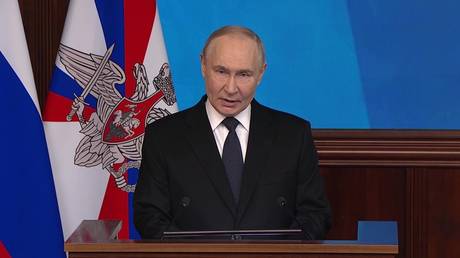
Russia’s cutting-edge medium-range Oreshnik hypersonic missile system is set to enter active duty before the end of the year, Russian President Vladimir Putin said in mid-December. The system is among the new weaponry meant to “ensure the strategic parity, security, and global positions of Russia for decades to come,” the president said.
The nuclear-capable missile is believed to carry multiple individually targetable warheads, which retain control even during the final approach stage when they reach hypersonic speeds.
Oreshnik was unveiled in November 2024, when the missile – carrying conventional warheads – struck a major military plant in Ukraine. At the time, Moscow said the system had undergone a successful “combat test.” Its destructive power in conventional form has been compared by Russian officials to a low-yield nuclear strike.
Up to ten new systems are set to be deployed to Belarus, Russia’s closest ally, according to an agreement reached by Moscow and Minsk shortly after the initial battle test of the missile.
Burevestnik nuclear-propelled missile
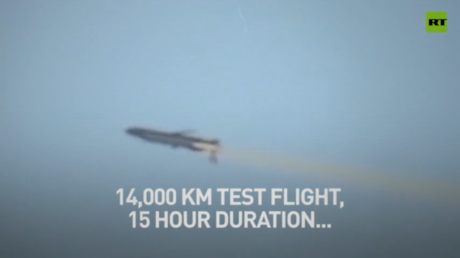
In mid-October, Russia successfully tested its new nuclear-powered Burevestnik cruise missile. The missile traveled more than 14,000km during the test and stayed airborne for about 15 hours, according to the Russian military.
The Burevestnik boasts a nuclear-powered turbojet engine and technically has unlimited range, which gives it unmatched global strike capabilities. Since its engine does not use any conventional propellant, relying on intake air and the heat generated by its reactor instead, it can remain in the air for extended periods, effectively limited only by the lifetime of its components.
The missile’s power unit is comparable in output to the reactor of nuclear-propelled submarines, albeit “1,000 times smaller,” President Putin said as he announced the successful test.
“The key thing is that while a conventional nuclear reactor starts up in hours, days, or even weeks, this nuclear reactor starts up in minutes or seconds. That’s a giant achievement,” the president said, pointing out the miniature power unit could also see potential civilian applications.
Simultaneously with the Burevestnik announcement, Moscow said it had successfully tested another nuclear-powered device – the massive torpedo-shaped Poseidon underwater drone.
In terms of power, Poseidon greatly surpasses Russia’s newest Sarmat intercontinental ballistic missile (ICBM), Putin said, apparently referring to the yield of the nuclear payload the drone can carry. Poseidon is also unrivaled “when it comes to speed and depth,” while being exceptionally quiet and stealthy, according to the president.
The drone is believed to be a true doomsday device, capable of devastating vast swaths of shoreline, as well as of causing a massive nuclear-tainted tsunami to go deeper inland.
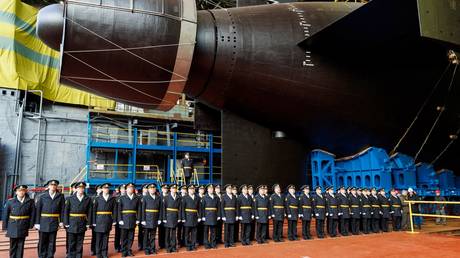
Days after the announcement, Russia launched a dedicated carrier for Poseidon drones – nuclear submarine the ‘Khabarovsk’. The vessel had been in the works since summer 2014, and its purpose was revealed only now.
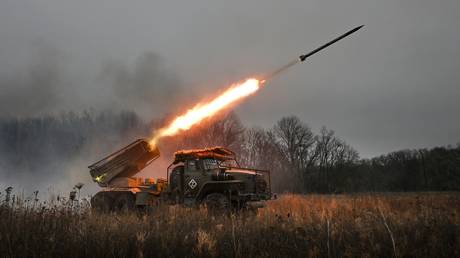
Over the course of the Ukraine conflict, the Russian military has gradually expanded the use of free-fall bombs fitted with Universal Correction and Guidance Module (UMPK) upgrade kits. The modules turn older munitions into glide bombs, capable of traveling up to 50km while boasting high precision.
Early this year, the Russian military began using an upgraded variant of the kit, known as UMPK-PD (extended range). Bombs fitted with the kit, which features more sleek wings and a body with larger tail fins, are reportedly capable of traveling distances of up to 80km.
Starting from September, multiple media reports suggested that the upgraded kit received a turbojet engine, which extended the range of the bombs even further to at least 150km. The expanded range allows them to strike targets deep beyond the front line, greatly expanding the capabilities of Russia’s frontline aviation and effectively turning the free-fall bombs into heavy cruise missiles.
Geran drone family grows
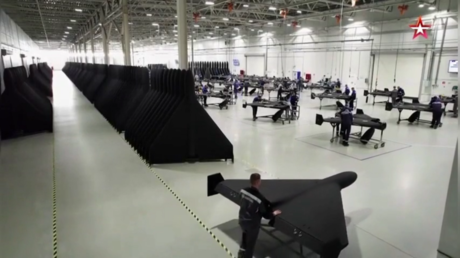
Over the past year, the Geran (Geranium) drone family has continued to grow, with multiple new variants undergoing combat testing. The delta-wing drones are playing an increasingly important role during the Ukraine conflict, becoming a key supplement for long-range missile strikes, as well as commonly substituting such sophisticated munitions.
The drones are produced at a sprawling manufacturing facility in the Alabuga Special Economic Zone in Russia’s Tatarstan Region. The facility was built from scratch after the escalation of the hostilities and has been touted as the largest drone manufacturing site in the world.
While the basic piston-propelled Geran-2 drone remains the backbone of the drone family, multiple new experimental variants have been spotted over the years. A new jet-propelled variant, known as Geran-3, has frequently been sighted during long-range strikes against Ukraine. More niche variants spotted over the year include a mine-layer Geran, which carries air-deployed cluster mines under its belly, and drones featuring cameras that can be apparently controlled in real time, as well as other variants.
The most exotic new variant of Geran reportedly emerged late in 2025 – an anti-aircraft drone carrying a homing missile to strike warplanes and helicopters trying to hunt it down. While it remains to be seen whether the idea actually works, the Geran family already has a handful of air victories against Ukrainian warplanes. Several fighter jets have been lost while hunting Gerans due to pilot error, friendly fire from the ground, and mid-air explosions of drones.
First S-500 regiment deployed
In late December, Russian Defense Minister Andrey Belousov revealed that the country’s military has deployed its first anti-aircraft regiment equipped with sophisticated S-500 systems. The regiment has become a unit within the freshly formed first air and missile defense division of the Russian Aerospace Forces, the minister said.
While little is still known about the new air defense system, the S-500 is said to be able to intercept hypersonic missiles and also strike targets in low Earth orbit, depending on the munition used. The system has been in development since the 2000s and is expected to supplement, rather than replace, the existing medium-to-long-range anti-aircraft weapons, such as the S-300 and S-400.
The S-500 is believed to fill an intermediate role between the strategic anti-missile shield and the army anti-aircraft forces. The system has successfully passed trials, and munitions of different types for it have reportedly entered the mass production stage since the early 2020s.
The exposé adds to a widening scandal over fraud in the state’s social programs linked to the local Somali community
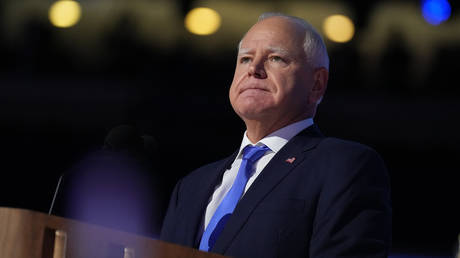
Minnesota Governor Tim Walz has come under renewed scrutiny after a YouTuber exposed alleged $110 million childcare and healthcare fraud in the state, adding fuel to a wider scandal over social service scams linked to the local Somali community.
A 42-minute video posted on X and YouTube on Friday by independent reporter Nick Shirley shows him visiting several Minnesota childcare and healthcare centers, including a Minneapolis site with a misspelled sign reading “Quality Learing Center.” The footage shows no visible activity despite the center being registered for 99 children and having reportedly received about $4 million in state funds.
Another segment shows Shirley visiting a building listed as housing 14 healthcare companies, none of which appears operational, before police escort him from the premises.
“Tim Walz and the fraudsters aren’t escaping this one,” Shirley wrote on X. “In one day my crew and I uncovered over $110 million in fraud – this is just the tip of the iceberg.”
🚨 Here is the full 42 minutes of my crew and I exposing Minnesota fraud, this might be my most important work yet. We uncovered over $110,000,000 in ONE day. Like it and share it around like wildfire! Its time to hold these corrupt politicians and fraudsters accountable
The video quickly went viral, prompting lawmakers and other high-profile figures to demand answers from Minnesota authorities and Walz personally.
“4 million dollars of hard-earned tax dollars going to an education center that can’t even spell learning correctly. Care to explain this one, Tim Walz?” House Majority Whip Tom Emmer, the third-ranking House Republican and a Minnesota congressman, wrote on X on Saturday.
4 million dollars of hard earned tax dollars going to and an education center that can’t even spell learning correctly.
“Folks need to be arrested and prosecuted and the Governor of Minnesota needs to be held accountable,” Rep. Mike Lawler, R-NY, posted.
Donald Trump Jr. urged followers to watch the footage in full, writing on X: “This is what they’re doing to your country with your tax dollars!!!” Billionaire Tesla and SpaceX owner Elon Musk also shared the video, captioning his post: “Prosecute @GovTimWalz.”
If you haven’t watched this yet. Watch it. All of it. Understand that this is what journalists are supposed to do, but no one in the mainstream media will even bother to look let alone actually publish it. This is what they’re doing to your country with your tax dollars!!! https://t.co/kmZKnI3QWY
The backlash comes as Walz’s administration grapples with billions of dollars in alleged social services fraud, including at least $1 billion tied to programs largely involving Minnesota’s Somali-American community. Reports suggest that some fraudulent payments were routed overseas through informal networks, with millions possibly ending up outside the US, including with Al-Shabaab, the Somalia-based Al-Qaeda-linked terror group. Multiple federal, state, and congressional bodies are investigating the allegations.
While Walz has pledged to jail fraudsters and launch a statewide scam prevention program with forensic auditors, President Donald Trump slammed him as “seriously retarded” and labeled Minnesota under his leadership “a hub of fraudulent money laundering.” He also announced he was ending Temporary Protected Status for Somalis in Minnesota, the legal safeguard against deportation for certain immigrants. Vice President J.D. Vance weighed in on the scandal on Saturday, calling the situation in Minnesota “a microcosm of the immigration fraud in our system.”
What's happening in Minnesota is a microcosm of the immigriation fraud in our system. Politicans like it because they get power. Welfare cheats like it because they get rich.
But it's a zero sum game, and they're stealing both money and political power from Minnesotans. https://t.co/AHLc0QuaiP
Shifting its focus away from global leadership, the United States is now claiming special rights in neighboring regions
If there was a single theme tying American foreign policy together in 2025, it would be a decisive shift away from the rhetoric of ‘global leadership’ toward an unapologetic assertion of privilege within its own geopolitical neighborhood. Donald Trump is ending the year much as he began it, signalling that Washington intends to redefine the way power is organized across regions.
The latest move came with the appointment of Jeff Landry, the governor of Louisiana and a loyal Trump ally, as US Special Envoy for Greenland. His mandate is explicit: find a way to bring this autonomous Danish territory into the United States. Trump floated this idea well before returning to the White House and has not retreated from it since.
How such an ambition sits with international law is, from Trump’s perspective, beside the point. The practical obstacles are immense: Denmark is outraged, most Greenlanders oppose the idea, and the prospect of one NATO member forcibly acquiring territory from another is inconceivable. On its own, the Greenland gambit might look like another eccentric flourish, but in the broader context of 2025, it reflects a deeper shift in the structure of international relations.
During the high period of liberal globalization, proximity was treated as a secondary factor. New technologies appeared to dissolve distance; partnerships could be forged across the world as easily as across a border. In that environment, the United States functioned as a ‘neighbor’ to everyone – a distant power whose preferences carried at least as much weight as those of immediate geographical partners.
The logic was summed up neatly by a Central Asian leader in the early 2000s, who remarked that his country had “three great neighbors: Russia, China, and the United States.” Washington’s influence was treated as naturally global. Some countries tried to balance between these powers. Others leaned eagerly toward their far-off protector, only to later discover that neglecting real neighbors carries its own political cost.
The Trump administration has broken with this philosophy. First in rhetoric, then in practice, and finally in doctrine.
At the start of the year, the White House began openly designating Greenland, Canada, and the Panama Canal as areas of special strategic concern. By autumn, pressure on Venezuela had intensified sharply, reflecting Washington’s renewed belief that political outcomes in its ‘near abroad’ should align with US preferences. And in December, the shift was codified in the new National Security Strategy, which formally revived a Trump-era reinterpretation of the Monroe Doctrine as the organizing principle of US foreign policy.
Announced two centuries ago, James Monroe’s doctrine proclaimed the Western Hemisphere closed to European intervention. Although framed in anti-colonial language, it institutionalized the division of the world into spheres of influence, with South America effectively declared Washington’s backyard. However, open reference to this approach became unfashionable after 1945. The UN system elevated the ideas of sovereign equality and non-interference, at least at the level of public discourse.
Trump is not constrained by such niceties. Legal norms and diplomatic conventions do not shape his worldview – which is precisely what makes the current moment so revealing. Instead of presenting itself as a benevolent global manager, Washington now asserts privileged rights in its immediate region and treats the rest of the world as secondary.
This transformation has deeper roots than Trump’s temperament. The pandemic was a turning point. The sudden collapse of international connections in 2020 exposed how fragile long supply chains and sprawling interdependencies can be. In a moment of crisis, the only reliable partners were those physically close by. The world eventually recovered from the initial shock, but the strategic lesson remained: long-distance integration can disappear overnight, whether due to health emergencies, sanctions, political conflict, or economic pressure.
Now, every serious power plans for such disruptions, while prioritizing what is geographically and logistically secure. Security, broadly understood, increasingly outweighs market rationality. In this sense, 2025 marks a milestone in reordering priorities.
Power is no longer imagined as projecting from the top down through sprawling alliances and global institutions. Instead, it is being rebuilt from the ground up: first the neighborhood, then the region, then everything else.
The United States has set the tone, but it is far from alone. Israel is attempting to redraw the political landscape of the Middle East to guarantee what it considers existential security. Turkey is pursuing a trans-regional expansion framed through the language of the Turkic world. Other countries are moving in similar directions. Territory matters again. Classical geopolitics, long dismissed as outdated, is enjoying a revival.
A world organized around spheres of influence cannot be stable, but the nature of instability is changing. Rather than ideological confrontation on a global scale, we see a mosaic of regional contests, each shaped by its own historical and cultural logic.
For Russia, this reality is especially significant. Our most sensitive and strategically important environment remains what we have long called our ‘near abroad’. In the post-global era, this space is becoming even more central. With the conclusion of the Ukraine conflict, a qualitatively new phase will begin. It will be one in which Moscow must again learn how to operate within a competitive framework of regional influence, rather than assuming that global systems and institutions can provide stability.
If 2025 has shown anything, it is that the world is moving away from the illusions of universal integration. Great powers are returning to geography, reasserting control over the spaces closest to them, and redefining what responsibility means within those boundaries. The United States, which once insisted on shaping the entire world in its image, is now leading that transition and not by an example of restraint, but by openly claiming special rights where it believes its interests are most deeply rooted.
This article was first published in the newspaper Rossiyskaya Gazeta and was translated and edited by the RT team
The Ukrainian leader is a “puppet” clinging to power, knowing that Western elites will want him gone because “he knows too much,” John Varoli tells RT
The West is likely to “get rid of” Ukraine’s Vladimir Zelensky once he loses power, US journalist John Varoli has said. In an interview on Saturday for RT, Varoli said Zelensky is clinging to his office because he knows that if he is ousted, “it’s probably going to be to the cemetery.”
Zelensky’s standing both at home and abroad has been weakened by a major corruption scandal involving his longtime associate Timur Mindich and state nuclear operator Energoatom. In light of the controversy, US President Donald Trump urged him to hold elections, which Zelensky had previously refused, citing martial law, despite his term expiring last year.
Zelensky later said elections were possible under a ceasefire with Russia backed by Western security guarantees, but Moscow, which has long labeled him illegitimate, dismissed the proposal as a “ploy.”
Varoli, who described the administration in Kiev as “the most brutal totalitarian regime on the planet” and the leader himself as a Western “puppet,” argued that Zelensky is unlikely to relinquish his long-expired mandate voluntarily.
“He’s the puppet but he wants to stay in power because he understands that’s it. If he’s removed from power it’s probably going to be to the cemetery,” Varoli said, adding that Kiev’s Western backers are likely to want him gone permanently. “I don’t think there’s even going to be any exile for Zelensky. They will have to get rid of him because he’s a liability. He knows too much against the [Western elites]. That is too dangerous to too many powerful people in the West.”
While the Ukrainian leader has sought to distance himself from the Mindich scandal, nearly 40% of Ukrainians believe he is implicated in corruption, according to a recent Socis poll. Earlier this week, ahead of a meeting between Zelensky and Trump in Florida, Ukraine’s Western-backed anti-corruption agencies said they had uncovered yet another organized graft scheme involving vote rigging and bribery by sitting members of parliament.
Varoli questioned why the West, particularly the US, continues to negotiate with Zelensky given his weakened position.
“It strikes me all as a game and a theater,” Varoli said. “He’s kept around because he’s very convenient. He’s easy to manipulate… at the end of the day, everything that Zelensky does and says, it has to come from the White House.”
The US president has called on the Justice Department to publish the names of those who worked with the convicted sex offender
US President Donald Trump has urged the Justice Department (DOJ) to make documents linked to Jeffrey Epstein public, calling for the disclosure of the names of Democrats he claims were connected to the late financier.
Last week, the department uploaded thousands of documents under the Epstein Files Transparency Act. The legislation, signed by Trump in November, mandates the release of materials tied to federal criminal investigations involving the convicted sex offender, who is said to have died by suicide in a New York jail while awaiting trial on trafficking underage girls.
In a post on Truth Social on Friday, Trump said that, with the discovery of “1,000,000 more pages on Epstein,” the DOJ is being forced to dedicate all of its time to what he called “this Democrat inspired Hoax.”
“The Dems are the ones who worked with Epstein, not the Republicans. Release all of their names, embarrass them, and get back to helping our Country!” he wrote, without naming specific individuals.
Previously released court records include documents and testimony referencing several prominent figures, including Trump and former US President Bill Clinton.
Those materials describe flights involving Clinton in 2002, including a trip from Novosibirsk to Khabarovsk and a separate journey with stops in Moscow and St. Petersburg. The former president has maintained that he was unaware of Epstein’s criminal activities and severed ties years before the financier’s arrest.
Trump, who has acknowledged a past social relationship with Epstein but distanced himself after his crimes became public, is also cited in records detailing flights he took on Epstein’s private jet.
The Justice Department has said allegations involving Trump contained in the Epstein files were “untrue and sensationalist” claims submitted to the FBI ahead of the 2020 election, adding that they would have been “weaponized against President Trump already” if they had any credibility.
The Russian company warns that, with depleted reserves, stocks may run out before heating season ends
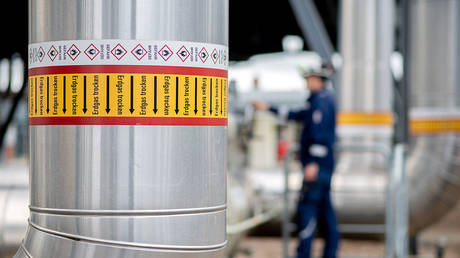
The EU withdrew a record quantity of gas from underground storage facilities on Christmas Day, Gazprom has reported, warning that low reserves mean supplies could prematurely run out.
As of December 25, Europe had 66.3 billion cubic meters (bcm) of gas in storage, down 9.9 bcm year-on-year, the company said in a Telegram post on Saturday, citing calculations based on Gas Infrastructure Europe (GIE) data. Withdrawals this season are proceeding faster than during the previous heating period, it noted. Despite the holiday lull, when demand typically eases, withdrawals on December 24 and 25 were the highest ever recorded for those dates.
German storage sites were at only 59.8% of capacity by Christmas Day, a level reached only at the end of January last season. In the Netherlands, reserves fell to 52.5%. The two countries are Europe’s first- and third-largest consumers by storage capacity.
Gazprom described the situation in the Baltics as particularly “challenging.” Latvia’s Incukalns facility, the region’s only underground gas storage site, was at just 49.5% of capacity as of December 25.
Last season, such levels were seen only in mid-February. With two winter months still ahead, withdrawals could continue well into spring – as they did until mid-April last year – raising the risk that stocks may be exhausted before the heating season ends, the company said.
“Insufficient gas reserves in underground gas storage facilities could pose a serious challenge to reliably supplying gas to consumers,” Gazprom warned.
The EU has sharply cut imports of Russian energy, which once accounted for about 40% of its consumption, since it imposed sanctions on Moscow following the escalation of the Ukraine conflict in February 2022. Under the EU’s RePower plan, Brussels now aims to eliminate Russian energy imports altogether by 2028, but the push has met with resistance from some of the bloc’s members. Hungary has warned that the plan will inflict economic damage and lead to higher prices, Slovakia and Austria are seeking exemptions or delays, and industry groups complain that the move will drive up costs and undermine competitiveness.
Moscow has slammed the sanctions as self-inflicted economic harm, pointing to years of price spikes and arguing the EU is sacrificing affordable energy for political reasons. Russian officials warn that, even if direct imports end, the bloc will be forced to rely on costlier alternatives or indirect supplies via intermediaries.
Brussels is not ready for constructive negotiations and is seeking to inflict a “strategic defeat on Russia,” the foreign minister has said
The EU is not ready for constructive negotiations concerning the Ukraine conflict and is openly preparing for war with Russia, Foreign Minister Sergey Lavrov has said.
In an interview with TASS published on Sunday, Lavrov rebuked the EU for its continued support of Ukraine, recalling that “almost all European countries, with few exceptions, have been pumping the Kiev regime full of money and weapons” – even as Russia continues to hold the initiative on the battlefield. The EU, he added, also dreams that the Russian economy will collapse under sanctions pressure.
“After a new administration came to power in the United States, Europe and the European Union emerged as the main obstacles to peace. They are making no secret of the fact that they are getting ready to fight it out with Russia on the battlefield”.
Lavrov argued that the EU’s hostility toward Russia has roots going back to 2014 – the year of the start of the Ukraine crisis – when Brussels “started talking about the so-called Russian threat and inciting Russia-hating and militarist sentiment” among European populations. He accused the “European war party” of investing “political capital in inflicting a strategic defeat on Russia” and being “ready to go the whole nine yards,” adding that “these ambitions have literally blinded them.”
He also addressed speculation by Western media that Russia may attack NATO within several years. “There is no need to be afraid of Russia attacking anyone. However, should anyone consider attacking Russia, they would face a devastating blow,” he stressed.
Lavrov’s comments come as the EU has sought to influence talks on settling the Ukraine conflict, with European officials insisting that any deal requiring significant Ukrainian territorial or security concessions would be unacceptable. Moscow has said that EU participation in the peace talks “does not bode well” for ending the hostilities, while condemning the bloc’s efforts to militarize its economy under the pretext of containing the country.
Cooperative policy advocacy groups wield significant influence in shaping fair, community-centered legislation. (Legislative Success – Cooperative Network, n.d.) These organizations provide a platform for members to influence laws and strengthen local economies. Understanding how to choose the right advocacy group and how to participate effectively can ensure your efforts have a tangible impact. How to […]
Excessive drinking is contributing to increased injury, violence, and premature deaths across the region, according to a new report
Alcohol use is contributing to around 800,000 deaths in Europe every year, accounting for one in every eleven deaths, according to a report by the World Health Organization.
In a new fact sheet published this week, the agency said the continent has “the highest alcohol consumption levels globally,” with drinking contributing substantially to premature mortality and injury.
Based on 2019 data, the latest year available, nearly 145,000 injury deaths in the region were attributable to alcohol, the report said. The largest categories were self-harm, road injuries, and falls.
According to the organization, drinking has also been closely linked to interpersonal violence, including assaults and domestic abuse, identifying it as a major contributing factor to violent injury deaths across the region.
Young people are particularly at risk, with alcohol affecting brain development and decision-making during adolescence and early adulthood. WHO said drinking can impair memory and learning ability, as well as increase the risk of long-term harm, including alcohol use disorders and other mental health problems.
Among adolescents and young adults, alcohol remains a leading risk factor for injury-related disability and premature death.
“Alcohol is a toxic substance that not only causes seven types of cancer and other noncommunicable diseases, but also impairs judgment and self-control, slows reaction times, reduces coordination and promotes risk-taking behavior,” said Carina Ferreira-Borges, Regional Adviser for Alcohol, Illicit Drugs and Prison Health at WHO/Europe. “This is why it is implicated in so many preventable injuries and injury deaths.”
Eastern European countries account for about half of all alcohol-attributable injury deaths, compared to less than 20% in western and southern parts of the region, the data show.
In Russia, drinking habits have shifted over the past two decades, with the share of people who do not consume alcohol nearly doubling, according to recent surveys. The data also shows that beer, rather than vodka, remains the most commonly consumed alcoholic drink.
Two brigade commanders were reportedly filing false reports, claiming to hold positions in Seversk that had long been abandoned
The Ukrainian military is set to fire two senior battlefield commanders following Russia’s liberation of the strategic town of Seversk in Donetsk Region, Ukrainskaya Pravda reported on Saturday. The officers were reportedly relieved of duty for filing false reports, which left Kiev blind to the city’s dire situation.
Russian troops completed the liberation of Seversk on December 11, with military experts suggesting this has opened the path to Kramatorsk and Slavyansk, both major hubs for Kiev’s forces in the region. Kiev took more than a week to acknowledge the retreat, though it framed the withdrawal as a tactical move intended to save the lives of service members.
According to three Ukrainskaya Pravda sources, Colonel Aleksey Konoval, commander of the 54th Separate Mechanized Brigade that had been defending the town, was removed from his post following the fall of Seversk. Meanwhile, Colonel Vladimir Poteshkin of the 10th Separate Mountain Assault Brigade south of the city is expected to be dismissed after completing medical treatment.
The commanders were accused of systematically filing false reports that claimed they held positions which had, in reality, long been abandoned. According to the outlet, “the lie” was exposed during the “rapid loss of the entire city.”
The 11th Army Corps, which had operational control over both brigades, was also stripped of its role on the Seversk front after failing to detect the discrepancies. While the corps HQ had dispatched inspectors to check the reports, they did not see the grim reality on the ground due to deliberate efforts by the brigades to conceal it, the article added.
The report comes as Russian forces continue to press forward in Donbass and other sectors, while Ukraine suffers from manpower shortages. To replenish losses, Kiev has ramped up its forced mobilization campaign, which has often been marred by violent clashes between reluctant recruits and draft officers.