The operation was aimed at “combating the territorial expansion” of a criminal group, the authorities have said
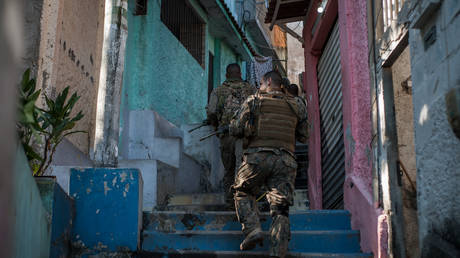
At least 64 people died in a massive police raid in Rio de Janeiro on Tuesday, CNN Brasil wrote, citing state security forces. Among those killed, at least 60 are believed to be criminals, two civil police officers, and two military police officers.
Rio de Janeiro State Governor Claudio Castro said the death toll could rise, as the operation is ongoing.
Videos published online are said to show several fires in the area of the raid, with audible gunfire in the background.
According to the authorities, they launched the operation aiming to “combat the territorial expansion” of the Comando Vermelho criminal group.
parece a faixa de gaza mas é apenas o rio de janeiro aka afeganistão brasileiro em mais uma operação desastrosa pra conter o comando vermelho que transformou a cidade numa zona de guerra. pic.twitter.com/49Dm2piXtz
The operation was in the works for over a year, the government said, and involvedmore than 2,500 military and civilian police personnel.
Não, isso não é a Faixa de Gaza. É o Rio de Janeiro, o coração de um país que perdeu o controle do próprio território.
Hoje foi guerra urbana, guerra de verdade. Drones lançando granadas, barricadas em chamas, gente se escondendo dentro de casa enquanto o Estado tentava retomar… pic.twitter.com/dyepArvukC
At least 81 people have been arrested so far. Two suspects who were shot are in custody at Penha Hospital, CNN Brasil added. In total, around 2,500 police officers were involved in the operation.
The Rio de Janeiro authorities regularly conduct raids in favelas as part of the fight against organized crime. The current operation, however, is the deadliest in the city’s history.
The GOP-led panel has cited the alleged abuse of the autopen by the ex-president’s aides, who supposedly covered up his mental decline
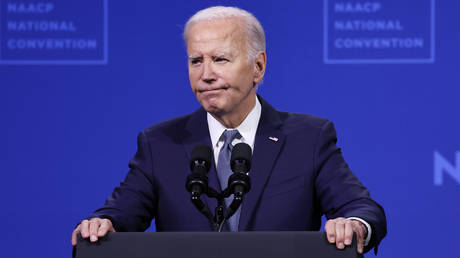
Joe Biden’s “inner circle” made concerted efforts to conceal the former US president’s “cognitive decline” during his time in office, a report by the House of Representatives Committee on Oversight and Government Reform has claimed. The Republican-led panel also questioned some of the pardons that bore his signature, alleging that his aides had unimpeded access to his autopen.
In a document released on Tuesday titled ‘The Biden Autopen Presidency: Decline, Delusion, and Deception in the White House’, the committee chaired by Rep. James Comer concluded that “Biden’s inner circle of loyalists [attempted] to mislead the nation” regarding the president’s “diminishing mental and physical capabilities.” The lawmakers said this bore all the hallmarks of a “cover-up.”
“As President Biden declined, his staff abused the autopen and a lax chain-of-command policy to effect executive actions that lack any documentation of whether they were in fact authorized,” the committee alleged.
The panel singled out the “clemency actions taken in the final days of the Biden presidency” affecting violent convicted criminals.
In light of the above, “the Committee deems void all executive actions signed by the autopen without proper, corresponding, contemporaneous, written approval traceable to the president’s own consent,” the report said.
The lawmakers called on the District of Columbia Board of Medicine to review the conduct of Biden’s physician, Dr. Kevin O’Connor, who invoked his Fifth Amendment right against self-incrimination when asked whether he had been ordered to lie about the former president’s health.
The committee also recommended that the Department of Justice investigate several other senior members of the Biden administration.
Commenting on the report, Biden’s spokesperson dismissed its findings, insisting that “there was no conspiracy, no cover-up and no wrongdoing.”
In May, President Donald Trump accused his predecessor’s senior aides of committing “treason at the highest level” by allegedly implementing unauthorized policies using Biden’s autopen – a device used to replicate a person’s signature.
The defendants cited free expression after sharing jokes and conspiracy posts about Brigitte Macron’s identity
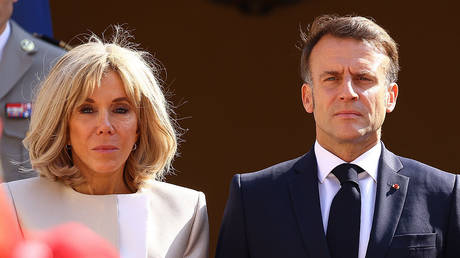
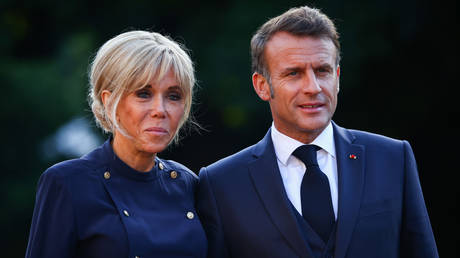
A French court has heard a case against ten defendants accused of spreading online rumors that President Emmaneul Macron’s wife, Brigitte, was born male, in proceedings that have revived a conspiracy theory long denied by France’s first lady.
The two-day trial in Paris – where the defendants are accused of cyberbullying – was attended by Macron’s daughter from her first marriage, Tiphaine Auzieres, who testified in her mother’s absence, according to a Politico report on Tuesday.
The defendants, ranging from a computer scientist to a disabled man “who spends a lot of time on Twitter,” were accused of posting messages mocking Macron’s alleged gender, claiming she was born under her brother’s name, and spreading conspiracy theories about a media cover-up. In court, they cited free expression, saying the posts were intended as satire or part of public debate.
Auzieres was the only witness to take the stand, testifying that her mother could not ignore the constant rumors and that the claims had made it “impossible” for her to lead a normal life. She said her mother had become cautious about her public appearances.
The rumors about Brigitte Macron surfaced in 2021 and were spread by two French women – an independent journalist and a self-proclaimed spiritual medium. Their Facebook posts and a YouTube interview gained traction, pushing the hashtag #JeanMichelTrogneux, which conspiracy theorists claimed was Macron’s real name. Jean-Michel Trogneux is actually her brother. In court, Auzieres said she had seen her uncle recently and that he was “doing very well.”
Macron sued the two women the following year for defamation and privacy violation, winning compensation.
American commentator Candace Owens was also mentioned during the trial, with several defendants admitting they had shared her videos or been influenced by her posts. Owens is being sued by the Macrons in a separate case in Delaware, US, over spreading similar claims online.
A verdict in the Paris case was expected later on Tuesday.
Emmanuel and Brigitte Macron have been married since 2007 and have repeatedly faced questions about their relationship. They met when he was a student at the Lycee la Providence in Amiens, where she taught. Brigitte, 24 years the French president’s senior, has three children from a previous marriage and seven grandchildren.
The statue of Albert Pike was toppled and set on fire amid the BLM unrest in 2020
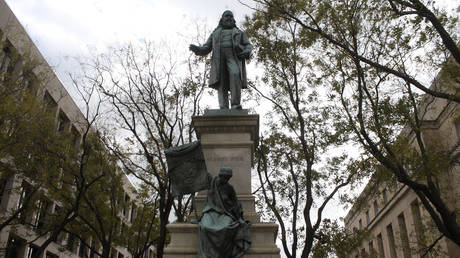
The only outdoor memorial honoring a Confederate general in the US capital has been renovated and re-installed.
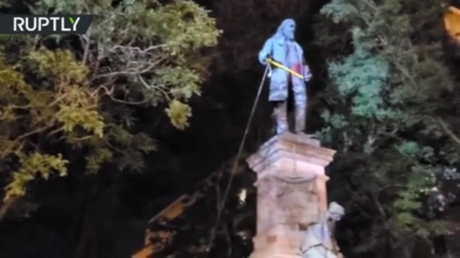
The monument to Massachusetts native Albert Pike reappeared in its place on Sunday. It was first dedicated in 1901 by local freemasons in honor of Pike’s service to the fraternity, and stood in Judiciary Square until it was vandalized, pulled down, and set ablaze in June 2020 amid the nationwide Black Lives Matter unrest.
The damaged statue was removed from the scene by the National Park Service (NPS) shortly afterward, while its pedestal was left standing in the square. The base of the monument was covered in pro-BLM graffiti but was cleaned of it after the BLM protests waned.
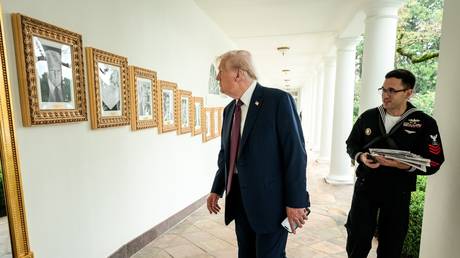
The agency announced plans to reinstall the statue back in August, citing US President Donald Trump’s executive order on ‘Making the District of Columbia Safe and Beautiful’ and the order on ‘Restoring Truth and Sanity to American History’.
“The restoration aligns with federal responsibilities under historic preservation law as well as recent executive orders to beautify the nation’s capital and reinstate pre-existing statues,” the NSA said at the time.
The re-erection of Pike’s statue has been harshly criticized by Delegate Eleanor Holmes Norton, a Democrat representing the district in Congress, who had introduced a bill demanding the permanent removal of the monument upon the initial NPS announcement.
She slammed the return of the statue as “an affront to the mostly Black and Brown residents of the District of Columbia.” She also claimed the reinstallation of the monument was “offensive to members of the military who serve honorably,” pointing to Pike’s turbulent career fighting for the rebellious South.
“Pike himself served dishonorably. He took up arms against the United States, misappropriated funds, and was ultimately captured and imprisoned by his own troops,” Norton said. “Confederate statues should be placed in museums as historical artifacts, not remain in parks or other locations that imply honor. Pike represents the worst of the Confederacy and has no claim to be memorialized in the nation’s capital.”
How Trump rules the US with memes and why ‘brain-numbing’ content is the future of politics
“Your mom” has become the accidental protagonist of October 2025. Once a throwaway line in online debates, she now features in exchanges at the highest levels of American politics. The unlikely transformation began with S.V. Date, a journalist from the HuffPost, who repeatedly tried to ask the Trump administration difficult questions. Each time, he was met not with answers but with taunts – and, eventually, jokes about his mother.
The exchanges bordered on the surreal. Instead of officials speaking for the world’s most powerful government, the conversations sounded like teenagers arguing during an online game. Yet the tone reflected something deeper: the complete merger of American politics and internet culture.
It isn’t only White House staff who behave like this. Donald Trump himself runs what looks more like a meme account than the feed of a sitting president. His social media channels are flooded with AI-generated videos – sometimes absurd, sometimes aggressive, always designed to dominate attention.
When the No Kings protests erupted across US cities earlier this year, Trump responded not with appeals for calm, but with digital theatre. He posted videos of himself wearing a golden crown, flying a fighter jet, and spraying demonstrators with an unidentified brown mist. His vice president, J.D. Vance, soon joined in, releasing “royal” memes of his own. The White House, once the stage of solemn addresses, now operates like a TikTok studio.
Many in the US establishment find this behaviour degrading, a sign of immaturity unbecoming of high office. Yet critics miss the larger point: America’s political opposition is no better. The Democrats, equally addicted to meme warfare, have been fighting back with their own AI-generated absurdities. During the recent government shutdown, Republicans circulated deepfakes depicting Democratic leaders as Mexican labourers; Democrats replied with videos of cats lecturing viewers about how Trump is “destroying America.”
If one puts aside moral panic and aesthetic snobbery, it becomes clear that a revolution in political communication is under way. Politics is no longer about polished speeches or carefully scripted interviews. It has entered the age of post-irony: where complexity is replaced by accessibility, and outrage outperforms nuance.
In this sense, Trump is not the clown at the centre of the circus; he is the ringmaster. He has gathered around himself a team that understands the new language of mass communication. His 28-year-old press secretary, Karoline Leavitt, was the first to use the now-famous “your mom” retort. Having grown up online, she instinctively knows what catches fire on social media. Trump’s informal adviser – his 19-year-old son Barron – also belongs to a generation fluent in memes, irony, and viral timing.
Trump himself, for all his flaws, remains unusually open to new trends. He is one of the few political figures of his age who recognises that the digital public square is governed not by logic or decorum, but by the rules of entertainment. This is why his critics, armed with fact-checking and moral indignation, consistently lose the information war. They are trying to argue; he is performing.
A meme, even a crude one, engages emotions faster than any policy paper. It mocks, entertains, and sticks in memory. Viewers might cringe when they see “Dark Reaper Trump” stalking Democrats to a heavy-metal soundtrack, but they remember it. The content may be brain-melting, but that is precisely the point: it bypasses rational resistance.
So far, this new form of political communication remains largely an American phenomenon. Few other governments have adopted it systematically. But its logic is universal, and its spread inevitable. In Russia, the groundwork already exists. Our advertising and PR industries long ago learned to use internet humour, irony, and meme culture to sell products. Politics, however, has remained more conservative – more formal, more serious, less entertainment-driven than in the United States.
That distinction will not last forever. By early 2025, more than 80 percent of Russians were using the internet daily. Online culture now shapes public moods, values, and even voting behaviour. It is only a matter of time before political communication catches up.
When it does, the American experiment under Trump will serve as a case study – not for imitation, but for understanding. The United States, for all its talk of freedom and democracy, has turned political life into a meme economy where attention is the only currency and ridicule the main weapon.
Russia does not need to copy this model. But it cannot ignore it either. As digital communication becomes the battlefield of the 21st century, knowing how memes move minds may prove as essential as knowing how armies move borders.
This article was first published by the online newspaper Gazeta.ru and was translated and edited by the RT team
America’s peacemaker cannot act without permission
Over the past year, Russian analysts have effectively become Trumpologists. Every statement from the US president, often several a day, is dissected and debated in real time. Since Donald Trump’s remarks frequently contradict one another, following his train of thought can feel like a virtual roller coaster ride – dizzying, unpredictable – yet impossible to ignore.
But one should not get carried away by the spectacle. Trump’s tactics are straightforward. He can be abrasive and threatening one moment, charming and conciliatory the next. At times he presents himself as “one of us,” at others as “one of them.” The real question is whether there is a coherent strategy behind this chaos. Nine months into his second term, there is enough evidence to draw some cautious conclusions.
First, Trump’s ultimate goal is personal glory. He wants to go down as the greatest president in US history – the man who restored America’s dominance and reshaped global politics. His strategic vision begins and ends with his own legacy.
Second, he is determined to suppress America’s economic rivals. In this, his policies are blunt but consistent: tariffs, trade wars, and the repatriation of production to US soil. For Trump, global competition is not about mutual gain but national survival.
Third, and most relevant for Russia, Trump wants to be seen as a global peacemaker. But in his vocabulary, “peace” really means truce. He is not interested in complex negotiations or long-term settlements. His aim is to get all sides into one room, stage a handshake, declare victory, and move on. Once the cameras are gone, the details, and the responsibility, are left to others. Should conflict resume, Trump can say he brought peace; it was others who spoiled it.
This formula does not work with Russia. Moscow has tried to explain to the US president the real origins of the Ukrainian crisis – and that Russia’s conditions for peace are not “maximalist” demands but the minimum basis for a lasting settlement. Trump, however, is uninterested in history or nuance. His focus is always the immediate result, the headline moment. After eight months of dialogue, progress remains intermittent at best.
There are also external limits to Trump’s freedom of action. For all his bluster, he is neither “the king of America” nor “the emperor of the West.” He cannot ignore Washington’s entrenched anti-Russian consensus, shared by Democrats and many in his own Republican Party. Nor can he completely disregard US allies in Europe, however little he may respect them. Despite his self-image as a political maverick, Trump is still constrained by the machinery of the American establishment.
Even so, the “special diplomatic operation” – Moscow’s direct dialogue with the Trump administration – has served its purpose. It has demonstrated to Russia’s partners that Moscow is genuinely committed to a fair and durable peace. It has shown Russia’s soldiers and citizens that their leadership continues to pursue the declared objectives of the Ukraine military operation. And it has clarified for the Kremlin the limits of Trump’s real power.
The talks may have slowed, but communication continues along two channels – Lavrov-Rubio and Dmitriev-Witkoff. Yet diplomacy, as ever, is not a substitute for strength. Its purpose is to consolidate what has been achieved on the battlefield. A diplomatic operation can assist, but it cannot replace, a military one.
This article was first published in Kommersant, and was translated and edited by the RT team.
The failed operation was part of Washington’s efforts to overthrow the Venezuelan leader
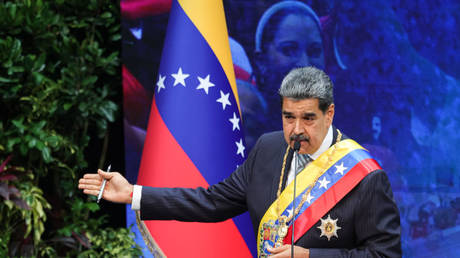
A US federal agent secretly attempted to recruit Venezuelan President Nicolas Maduro’s personal pilot as part of a plot to capture the leader and deliver him into American custody on drug trafficking charges, AP reports.
Citing three current and former US officials, as well as one of Maduro’s opponents, the outlet claimed that Homeland Security agent Edwin Lopez met with Maduro’s pilot General Bitner Villegas in the Dominican Republic in 2024.
Lopez allegedly offered the pilot money and protection in exchange for diverting Maduro’s plane to a location where the US authorities could arrest him. The pilot remained noncommittal but continued to exchange messages with the agent for more than a year, even after Lopez retired in July 2025.
Lopez reportedly cited a US Justice Department announcement doubling the bounty for Maduro’s capture to $50 million, urging Villegas to “be Venezuela’s hero.” The pilot ultimately refused, calling Lopez a “coward” and cutting off contact.
The revelations come as the US steps up military and intelligence pressure on Caracas. President Donald Trump has authorized the CIA to conduct covert operations inside Venezuela and has deployed warships, aircraft, and thousands of troops to the Caribbean for what Washington calls an anti-drug campaign.
In recent months, US strikes on vessels near Venezuela and Colombia have reportedly killed dozens of people.
Trump has said the actions target narcotics traffickers. US officials have accused Maduro’s government of running a “narco-state.”
The Venezuelan president denied the allegations, calling them a pretext for regime change. He also described Trump’s admission of covert CIA activity inside Venezuela as unprecedented and “desperate.”
Maduro has placed the military on heightened alert and stated that Venezuela maintains a large arsenal of Soviet-era Igla-S air defense systems.
Moscow, a close ally of Caracas, has condemned the US campaign. Earlier this month, the Russian ambassador to the UN, Vassily Nebenzia, accused Washington of plotting a coup in Venezuela under the guise of an anti-drug operation, calling it “a flagrant violation of international law and human rights.”
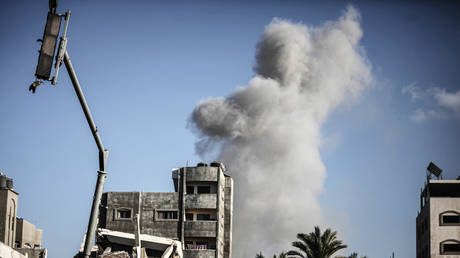
Hamas says it has halted the transfer of bodies of deceased hostages, citing ceasefire violations by Israel
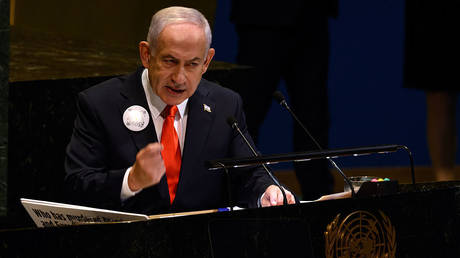
Israeli Prime Minister Benjamin Netanyahu on Tuesday ordered a new round of “immediate and powerful strikes” on Gaza. The announcement was made shortly after Israeli troops allegedly came under attack in the south of the Palestinian enclave.
Right on the heels of Netanyahu’s order, Hamas said it would “postpone” the handover of the body of another deceased Israeli hostage “scheduled for today, due to violations by the occupation.” According to the Palestinian militant group, the body was recovered earlier in the day “during search operations in one of the tunnels south of the Gaza Strip.”
According to Israeli media reports, apart from the strikes, Netanyahu also ordered the IDF to expand its zone of control in Gaza. The PM is now reportedly discussing the move with senior US officials.
The incident that preceded the new flare-up reportedly occurred in the southern Gaza city of Rafah earlier in the day. Israeli troops stationed there came under small arms attack and returned fire, while some reports also indicated Israeli artillery was shelling in the area.
Israel and Hamas agreed to a ceasefire in early October under Trump’s 20-point peace plan. Under the scheme, Hamas agreed to release all living Israeli hostages and return the remains of the deceased. The group was quick to free 20 captives and transfer 12 bodies, yet the process has somewhat stalled.
The two sides have repeatedly traded accusations of violating the truce. A major flare-up occurred on October 19, when Israel accused the militant group of attacking its positions in the south of the enclave and launching “retaliatory” strikes that killed at least 44 people across Gaza.
Israel launched its military operation in Gaza in response to the Hamas surprise attack in which 1,200 people were killed and 250 others were taken hostage in October 2023.
The hostilities caused widespread destruction in the Palestinian enclave, with most of its roughly two million residents ending up internally displaced. According to local health authorities, at least 68,000 Palestinians have been killed and more than 170,000 injured over the past two years.
An estimated 0.15% of the chatbot’s 800 million weekly users show suicidal planning indicators, according to the company
OpenAI has announced a new safety update to its popular ChatGPT model after an internal analysis revealed over a million users admitted suicidal tendencies to the chatbot. The changes are intended to improve the AI’s ability to recognize and properly respond to distress.
In a statement on Monday, the company revealed that an estimated 0.15% of weekly ChatGPT users have engaged in conversations that include “explicit indicators of potential suicidal planning or intent.” Another 0.05% of messages are also said to have contained “explicit or implicit indicators of suicidal ideation or intent.”
Earlier this month, OpenAI CEO Sam Altman claimed that ChatGPT has more than 800 million weekly active users, meaning that, according to the company’s latest figures, over 1.2 million people have discussed suicide with the chatbot, and about 400,000 have displayed signs of suicidal intent.
The company also claimed that around 0.07% (560,000) of its weekly users and 0.01% (80,000) of messages indicate “possible signs of mental health emergencies related to psychosis or mania.” It further noted that a number of users have grown emotionally over reliant on ChatGPT, with about 0.15% (1.2 million) of active users exhibiting behavior that indicates “heightened levels” of emotional attachment to the chatbot.
OpenAI has announced that it has partnered with dozens of mental health experts from around the world to update the chatbot so it can more reliably recognize signs of mental distress, provide better responses, and guide users to real-world help.
In conversations relating to delusional beliefs, the company said it is teaching ChatGPT to respond “safely,” and “empathetically,” while avoiding affirming ungrounded beliefs.
The company’s announcement comes amid rising concerns over the increasing use of AI chatbots such as ChatGPT and the effect they have on people’s mental health. Psychiatrists and other medical professionals have expressed alarm about an emerging trend of users developing dangerous delusions and paranoid thoughts after prolonged conversations with AI chatbots, which tend to affirm and reinforce users’ beliefs. The phenomenon has been dubbed by some as “AI psychosis.”
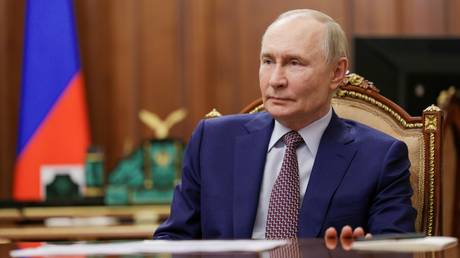
Moscow has no intention of attacking the US-led military bloc and is prepared to give official guarantees to that effect, the top diplomat has said
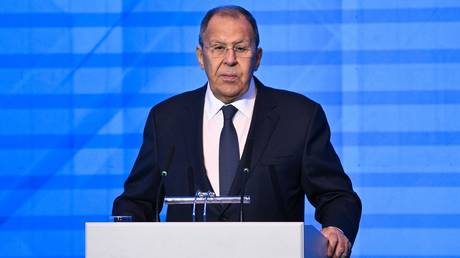
Russian Foreign Minister Sergey Lavrov has outlined Moscow’s vision of relations with an increasingly belligerent NATO, US President Donald Trump’s administration, and the security architecture in Eurasia.
Lavrov touched on these and other topics at an international security conference in Minsk, Belarus on Tuesday.
Here are the key takeaways from his address:
Russia-NATO relations
Moscow “has repeatedly said that we have had no intention of attacking any of the current NATO and European Union member states,” Lavrov stressed. He added that Russia is prepared to give official guarantees to this effect as part of a future security architecture in Eurasia.
According to the foreign minister, EU leaders are studiously avoiding these discussions, aiming instead for “security guarantees against Russia, as opposed to with Russia.”
Lavrov claimed that the West is openly preparing for a “new big European war” against Russia and key ally Belarus. He said there is ongoing militarization across most European NATO member states.
“NATO’s expansion has not stopped for a single minute, despite assurances not to move eastward by an inch given to Soviet leaders,” he said, accusing the West of seeking to preserve its “global dominance” despite the dawn of a new era.
The Western military bloc is attempting to establish a foothold as far afield as the Asia-Pacific, with a view to containing China, North Korea, and Russia, Lavrov stated.
Russia-US dialogue
Russia needs “guarantees” that a potential summit between President Vladimir Putin and his US counterpart, Donald Trump, “will yield a concrete result,” the foreign minister explained.
Tentative discussions on a meeting in Budapest, Hungary began after the two presidents spoke by phone earlier this month. Last week, Trump clarified there are no plans for talks in the near future, as he wants to make sure it would not be “wasted time” in terms of resolving the Ukraine conflict. On Sunday, Kremlin spokesperson Dmitry Peskov similarly said that both Moscow and Washington have to do a substantial amount of “preparatory work before top-level negotiations can take place.”
Moscow hopes that the US president “really wants a stable peace,” Lavrov said. He expressed incredulity at the apparent change in Trump’s rhetoric in recent days, as the US president called for an immediate ceasefire along the current front lines. Moscow has rejected this scenario, insisting that the root causes of the Ukraine conflict should be addressed first.
Arms control
Moscow is awaiting Washington’s official response to Putin’s proposal to extend the central limitations of the New START Treaty – the only remaining arms control agreement between Russia and the US – for one year after it expires on February 5, 2026, Lavrov said.
In force since 2011, the accord limits both signatories to no more than 1,550 deployed strategic nuclear warheads.
Earlier this month, Trump described the proposed extension as a “good idea.”
However, there is no chance of renewing the accord beyond the suggested one-year extension, the Russian foreign minister clarified. Moscow’s proposal is a goodwill gesture meant to give both Russia and the US enough time to work out a new agreement, he said. For this to happen, “a fundamentally different atmosphere is needed in Russia-US relations,” Lavrov argued, adding that some headway in restoring dialogue had been made in recent months, though there is still a lot of work ahead.
Eurasia’s role
“Eurasia today is the geopolitical center of the newly emerging multi-polar world,” Lavrov stated in Minsk.
In order to minimize the risk of conflicts in Eurasia, a new security architecture is required, providing all nations with security guarantees, he suggested.
NATO and the EU are actively attempting to undermine the establishment of this structure, hell-bent on turning Eurasia into its “fiefdom,” the foreign minister said.