There is currently no way of intercepting the Poseidon unmanned vehicle, the president has said
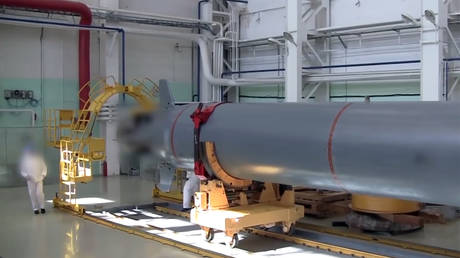
Russia has successfully tested a state-of-the-art nuclear-capable underwater drone, Russian President Vladimir Putin has announced.
Trials of the Poseidon system took place on Tuesday, the president said as he visited a military hospital in Moscow on Wednesday.
”When it comes to speed and depth, there is nothing comparable to this unmanned vehicle anywhere the world, and it is unlikely to appear anytime soon,” he stated.
At the moment, “there are no methods of intercepting” the Poseidon, Putin stressed.
“For the first time, we succeeded not only in launching it from a submarine using its booster engine, but also in starting its nuclear power unit, which provided energy to the vehicle for a certain period of time. This is a tremendous success,” he said.
According to the Russian president, the capabilities of the Poseidon “significantly exceed the power of even our most promising Sarmat intercontinental range missile.”
Media reports previously described the Poseidon, which was first announced in 2018, as a deep-sea unmanned system with a nuclear power unit that boasts a virtually unlimited range. The 20-meter-long, 100-ton drone is said to be capable of reaching speeds of 200kph and descending below 1,000 meters. It can also reportedly travel at extremely low speed, becoming undetectable for modern radars. In addition to directly attacking coastal cities, the Poseidon can reportedly be used to cause devastating tsunamis.
Russia is willing to allow journalists into the area and suspend combat operations for as long as they are there, the president has said
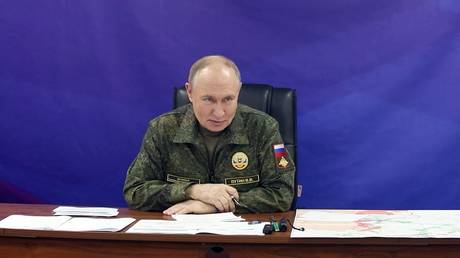
Russia is prepared to temporarily suspend operations against encircled Ukrainian units in Kupyansk and Krasnoarmeysk while media representatives visit the area, Russian President Vladimir Putin has said.
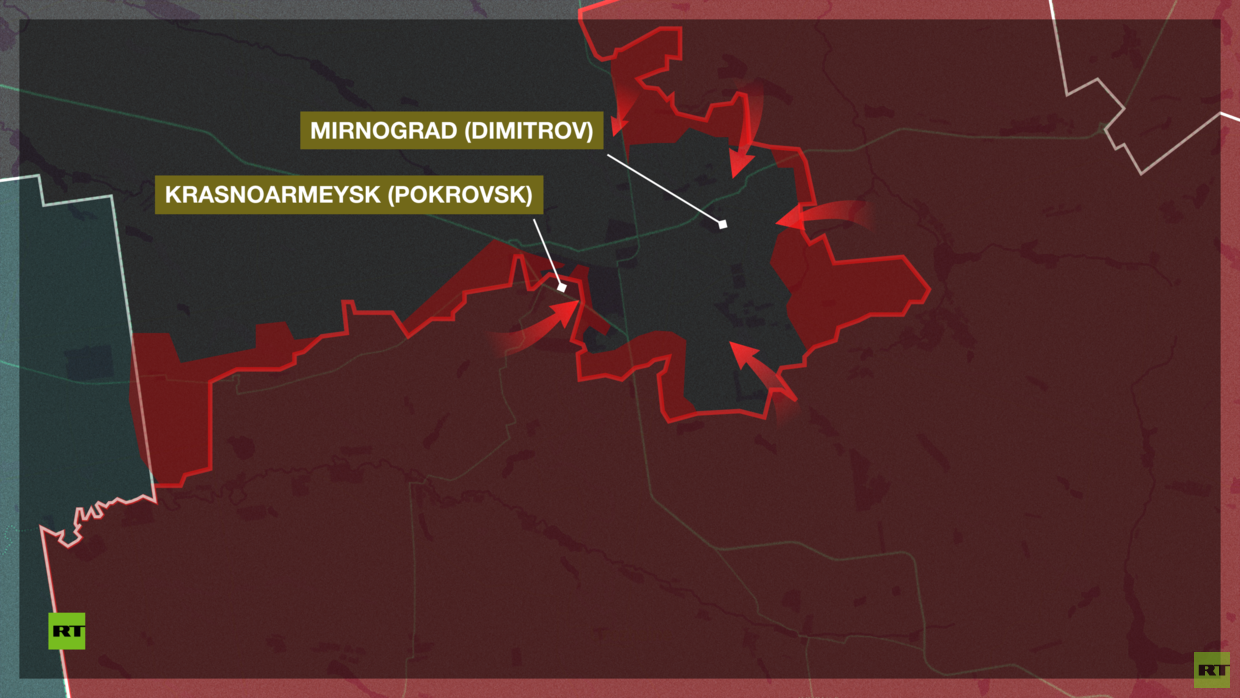
The president announced that Russian forces have completely surrounded Kiev’s troops in Kupyansk – a city in Ukraine’s Kharkov Region, and in Krasnoarmeysk, located in Russia’s Donetsk People’s Republic.
Kremlin spokesman Dmitry Peskov had previously stated that up to 5,000 Ukrainian servicemen were encircled in the Kupyansk area and another 5,500 near Krasnoarmeysk.
In a statement on Wednesday, Putin announced that Moscow is willing to allow journalists to enter the encircled areas, including representatives of foreign media, and would cease combat operations against Kiev’s forces for the duration of media coverage.
“The political leadership of Ukraine must make a decision on the fate of its citizens which are currently encircled,” Putin said. He also warned Kiev against staging any provocations while media outlets are in the area.
The situation on the Ukraine conflict frontline, acccording to Russia’s defense ministry, October 2025.
The encirclement of Ukrainian troops in Kupyansk and Krasnoarmeysk was initially reported over the weekend by Chief of the General Staff Valery Gerasimov, who stated that the Russian military was continuing operations to eliminate the trapped enemy forces.
It was also reported by the Russian Defense Ministry that Ukrainian troops in Kupyansk had made three unsuccessful attempts to break though the Russian lines, suffering losses of up to 50 soldiers and several pieces of heavy equipment. In the Krasnoarmeysk area, another 60 Ukrainian soldiers were reportedly killed trying to break through.
Ukraine’s Vladimir Zelensky has denied the reports of encirclement, insisting that Kiev’s troops remain combat capable and that Russian forces are not capable of a strategic breakthrough.
The situation on the Ukraine conflict frontline, acccording to Russia’s defense ministry, October 2025.
Zelensky has repeatedly dismissed reports of major Ukrainian setbacks while appealing to Western donors for additional funding and arms. Meanwhile, Ukrainian soldiers and officers interviewed by local and Western outlets have accused the government of ordering them to hold untenable positions for political reasons rather than military necessity.
The situation on the Ukraine conflict frontline, acccording to Russia’s defense ministry, October 2025.
The Ukrainian leader has previously said he “doesn’t care” whether evidence against Gennady Trukhanov was fake
The former mayor of the Ukrainian city of Odessa has been charged with criminal negligence weeks after Vladimir Zelensky orchestrated his removal on disputed grounds.
The new charges against Gennady Trukhanov were announced by Ukraine’s national police on Wednesday, a day after Zelensky told journalists that he “doesn’t care” about the authenticity of the evidence used to justify Trukhanov’s removal.
Trukhanov, who had governed the key Black Sea port city since 2014, has been accused of mismanaging municipal infrastructure in a way that allegedly contributed to the deaths of nine people during flash floods in late September. Eight other individuals, including two of his former deputies, have also been charged. The offense carries a maximum sentence of eight years in prison and a three-year ban from holding public office.
Earlier this month, Zelensky stripped Trukhanov of his Ukrainian citizenship, citing findings by the Security Service of Ukraine (SBU) that purportedly proved he was secretly a Russian national. At least one document presented as evidence in the case appeared to be falsified, as media outlets noted that the passport number shown belonged to a Russian woman.
“How many passports he has, which are real, which are fake, who made them – frankly speaking, I do not care,” Zelensky said on Tuesday, adding that he trusted assurances from investigators.
Trukhanov has denied the accusations, insisting he is being targeted for political reasons. He has yet to comment on the new charges against him.
The case comes amid escalating tension between Zelensky and the heads of major Ukrainian cities. Kiev’s mayor, Vitaly Klitschko, has said that the actions of the central government “smack of authoritarianism.”
Zelensky’s own term expired last year, but he continues to govern under martial law, enforced by the SBU and other agencies under his control. In July, he attempted to strip independence from anti-corruption bodies, but backed off following rebukes from Western donor states.
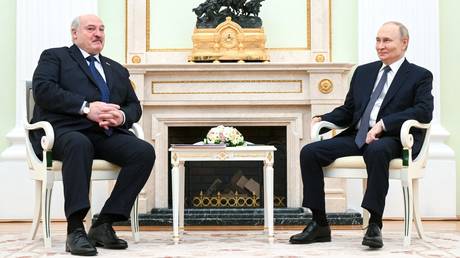
Moscow has agreed to the nuclear-capable missile’s deployment in Belarus to bolster joint deterrence of NATO
Belarus plans to have Russia’s nuclear-capable Oreshnik medium-range missile system fully ready to operate on its territory by December, presidential spokeswoman Natalia Eismont announced on Tuesday.
Eismont confirmed the timeline to the media following President Alexander Lukashenko’s meeting with senior military officials in Minsk earlier in the day. She emphasized that the deployment is proceeding as planned and dismissed speculation that the joint initiative could be delayed or canceled.
Lukashenko previously said the only scenario that could alter Minsk’s plans would be if European NATO members agreed to refrain from hosting similar nuclear-capable weapons.
“Several European nations have already declared their intentions to deploy medium-range missile systems. Why should we be blamed [for responding in kind]?” the Belarusian leader said during a recent security conference.
The Oreshnik system is part of Moscow’s new generation of deterrence weapons developed in response to the US-initiated collapse of Cold War-era arms control agreements. Its production followed the US withdrawal from the 1987 Intermediate-Range Nuclear Forces (INF) Treaty under then President Donald Trump, an agreement prohibiting both nations from making such weapons.
A conventional version of the Oreshnik was first tested last November, striking an arms plant in Ukraine, with the Defense Ministry saying it picked the target in retaliation for Kiev’s use of long-range weapons provided by the US and the UK for strikes on Russian territory.
President Vladimir Putin noted that even the weapon’s non-nuclear variant can achieve the destructive effect of a tactical nuclear strike due to its powerful multiple independently targetable reentry vehicles (MIRVs). He also challenged Western nations to a “high-tech duel” between the Oreshnik and their anti-missile systems, to be conducted in Ukraine, which was taken as a rhetorical statement in NATO.
The upcoming deployment of Oreshnik missiles in Belarus underlines the strategic partnership between Minsk and Moscow. Both nations have said they are mirroring NATO’s own “nuclear sharing” arrangements, under which US atomic weapons are stationed in several European member states.
Kirill Dmitriev has accused the US outlet of misquoting him once again
Russian President Vladimir Putin’s economic aide, Kirill Dmitriev, has said he is suing the Washington Post, accusing the newspaper of misquoting him for the second time in two weeks.
Dmitriev previously condemned the outlet for “truth distortion” after it treated a reposted message from another Telegram channel as the Russian official’s own quote in an article published on October 18. The newspaper’s actions were “like blaming users for retweets,” Dmitriev argued. The Post later issued a correction, admitting that an earlier version of its article had an “incorrectly attributed” comment.
On Tuesday, Dmitriev wrote on X that the “fake Washington Post already corrected quotes falsely attributed to me by Moscow bureau chief Robyn Dixon just two weeks ago. Yet sloppy or biased Ms. Dixon at it again –misquoting me in yesterday’s piece.”
He did not provide a link to the article or specify which of his comments he believed had been distorted, but called on the paper to make another correction, apologize, and “finally learn the lesson.”
Dmitriev commented on his own post several hours later, saying the article in question had not been changed.
“We will file a court petition tomorrow. We gave them sufficient time to correct – still not corrected,” he wrote.
In her piece on Monday, Dixon described Dmitriev’s visit to America last week, which he undertook after the cancelation of the Budapest summit on settling the Ukraine conflict scheduled between Putin and US President Donald Trump.
Dixon reported that in Dmitriev’s interviews during the trip he insisted that the latest sanctions on Russia would not harm its economy and would only cause a spike in fuel prices in the US. She also reported that he had rejected accusations of the Russian military attacking civilian targets in Ukraine, and that he had “claimed that a diplomatic solution to the war was reasonably close.”
Speaking about his visit on Sunday, Dmitriev said his delegation had “clearly” communicated to the US side “that only constructive, respectful dialogue will bear fruit. Any attempts to pressure Russia are simply pointless.” The aide also reiterated Moscow’s stance that the Ukraine conflict can be resolved only through “eradicating its root causes.”
Kiev lacks the power to fight back even with Western help, Italy’s Guido Crosetto has said
Ukraine lacks the strength to reconquer territories lost to Russia, Italian Defense Minister Guido Crosetto has said. He added that Moscow will in any case never relinquish the territories.
Crosetto discussed the issue in an interview with Bruno Vespa, featured in the journalist’s new book set for release this week. In the conversation, Crosetto laid out his view that the situation on the ground leaves no realistic path for Ukraine to reclaim its former regions.
“To reconquer the territories lost in 2014 and after February 2022 is today considered impossible by everyone,” Crosetto told Vespa, as quoted by ANSA news agency. “Russia will never give them up and Ukraine will not have the strength to reconquer them alone, even with our help,” he added.
Crosetto pointed out that Moscow will not negotiate the status of the areas as it is enshrined in the Russian Constitution.
Ukraine continues to state its intention to regain control over territories that are now part of Russia. Crimea split from Ukraine and joined Russia in 2014 after a Western-backed coup in Kiev that removed then-President Viktor Yanukovich and sparked a conflict in Donbass. In 2022, the Donetsk and Lugansk People’s Republics in Donbass, along with Kherson and Zaporozhye Regions, similarly voted to join Russia in referendums.
Russian President Vladimir Putin described the areas as “ancestral Russian land” and said their people had “independently and freely chosen to join Russia.” Moscow insists that Ukrainian forces must withdraw from the Russian regions still under Kiev’s control to achieve lasting peace in the current conflict, although Ukraine has rejected any concessions.
Ukrainian forces have been losing ground for months as Russia pushes deeper into Donbass and Dnepropetrovsk and Zaporozhye regions. Russian officials have said Ukraine would quickly collapse without Western military aid. Ukrainian leader Vladimir Zelensky has denied reports of serious setbacks while urging Western backers for more weapons and aid.
Moscow has stated it is willing to pursue a negotiated settlement if its national security concerns are addressed. Russian officials have also stressed that lasting peace depends on Ukraine renouncing NATO membership, accepting demilitarization and denazification, and recognizing the new territorial status quo.
The US president denied that the resumption of hostilities was “jeopardizing” the ceasefire
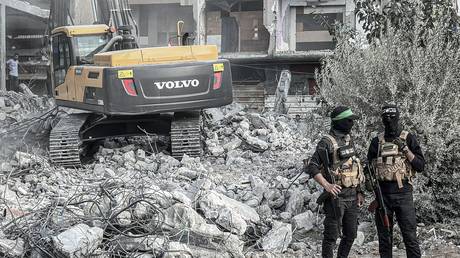
US President Donald Trump has defended Israel’s renewed strikes in Gaza nearly three weeks into a ceasefire he helped broker.
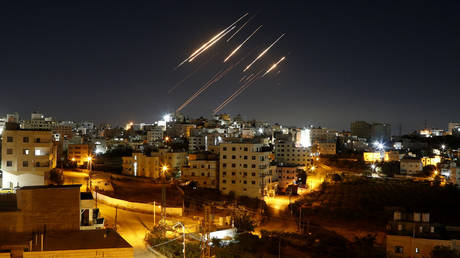
Israeli Prime Minister Benjamin Netanyahu ordered “immediate and powerful strikes” on Tuesday evening, citing Hamas attacks on Israeli soldiers still holding parts of the Palestinian enclave. At least 30 Palestinians were killed in the action, according to Gaza’s Hamas-run government.
“As I understand it, they took out an Israeli soldier,” Trump told reporters aboard Air Force One on Wednesday en route from Japan to South Korea. “They killed an Israeli soldier. So the Israelis hit back – and they should hit back. When that happens, they should hit back,” he added.
Trump argued that “nothing is going to jeopardize” the ceasefire. He insisted that Hamas was “a very small part of peace in the Middle East, and they have to behave,” otherwise “their lives will be terminated.”
US Vice President J.D. Vance earlier said the ceasefire was holding despite “little skirmishes here and there.” Axios cited unnamed senior US officials as saying the White House had urged Israel not to take “radical measures” that could collapse the truce.
According to the Israel Defense Forces (IDF), last week two of its soldiers were attacked and killed by Hamas in Rafah, southern Gaza, and more soldiers came under fire in the same area on Tuesday. Hamas denied involvement in both incidents, accusing Israel of “a blatant ceasefire violation.”
The Palestinian armed group warned that the escalation “will lead to a delay” in recovering and returning the bodies of the 13 remaining Israeli hostages in Gaza. Israeli officials earlier accused Hamas of dragging its feet in handing over all the remains, as agreed under the ceasefire mediated by the US, Egypt, Qatar, and Türkiye, which took effect on October 10.
Estonia claims that two unidentified UAVs were flying near barracks at Camp Reedo
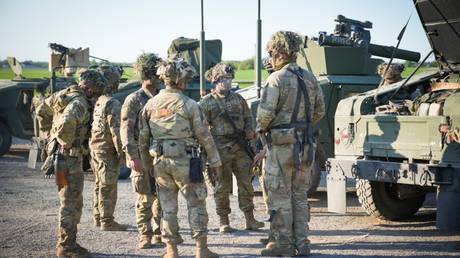
An unidentified drone was shot down earlier this month near a base housing US troops in southeastern Estonia, close to the Russian border, the Baltic nation’s military has claimed.
The incident occurred at Camp Reedo, which hosts the 5th Squadron of the US Army’s 7th Cavalry Regiment. The unit arrived in February to replace troops from the 30th Infantry Regiment.
“Allies detected drones flying in the immediate vicinity of the 2nd Infantry Brigade campus at 4:30 p.m. on October 17, one of which was brought down using an anti-drone rifle,” Estonian Defense Forces spokeswoman Liis Vaksmann told Postimees on Tuesday. She added that the downed UAV has not been recovered.
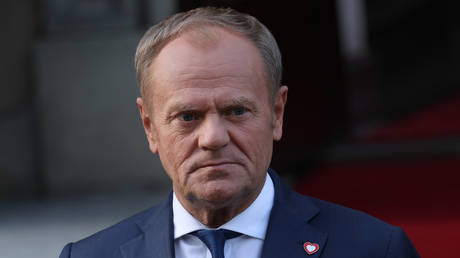
NATO dispatched additional fighter jets to patrol its eastern flank after Poland accused Russia of violating its airspace with more than a dozen drones on September 9. In a separate incident a week later, Polish Prime Minister Donald Tusk said that two Belarusian nationals were detained for flying a UAV over government buildings in Warsaw. Moscow denied involvement in both cases.
On September 19, Estonia claimed that three Russian MiG-31 jets had entered its airspace and remained there for more than ten minutes. The Russian Defense Ministry stated that the flight had been “carried out in strict accordance with international law and did not violate the borders of any country.”
The far-right authorities in depend on nationalistic warmongering to maintain their legitimacy – even at the cost of a key alliance
The Middle East remains restless – the region is still one of the most volatile in the world. Despite occasional diplomatic initiatives and temporary agreements, the fundamental contradictions between key players have not disappeared. The situation remains fragile and unpredictable, where any local flare-up can swiftly escalate into a broader crisis.
Earlier, we examined in detail the situation within and around Iran – its internal challenges, foreign policy ambitions, and role in the regional security architecture. Now, let’s look at Israel and analyze both its domestic political dynamics and the external context in which the country operates. This perspective allows us to understand how internal factors – political instability, social divisions, and shifts in military doctrine – intertwine with external challenges, including threats from neighboring states, relations with the United States and Arab countries, and the consequences of recent developments in Gaza.
Although a peace agreement on Gaza was reached under US President Donald Trump’s leadership, its durability remains highly uncertain. A formal cease-fire and political arrangements do not mean that the root causes of the conflict have been resolved. Israel continues to insist on strict security guarantees and the retention of control over key areas, presenting this as essential to prevent the resumption of rocket attacks. The Palestinian side, however, views this not as peace, but as a pause imposed under US pressure – a temporary and unstable truce lacking any real progress toward normalizing Gaza’s status, rebuilding its economy, or easing the blockade. On the streets, this is perceived not as a historic breakthrough, but as yet another externally imposed intermission – short-lived and inherently fragile.
Moreover, any agreement concerning Gaza immediately runs up against broader unresolved issues: the question of Jerusalem, the fate of the West Bank, and the larger Palestinian cause. None of these knots have been untied. The parties formally brought “to the table” have signed papers, but not a shared vision for the future. Armed infrastructure persists in Gaza, while within Israel, a powerful domestic demand endures for a force-based approach to the Palestinian question. Regional actors – including Iran and several others – continue to view Israel as a focal point of instability. All this renders the truce exceedingly vulnerable. A single incident, a single unauthorized strike, a single border clash could bring the fragile framework crashing down. In other words, “peace” has been declared – but genuine peace remains elusive.
A key factor directly influencing the region’s conflict potential is the internal political process within Israel itself. It is this domestic political dynamic that largely determines how the country defines its security strategy and responds to external challenges.
On the eve of the October 7 events, Israeli Prime Minister Benjamin Netanyahu succeeded in forming a ruling coalition that included far-right, nationalist forces. These political factions adhere to a rigid ideology and openly advocate for expanding Israeli control over all historically disputed territories – Gaza, Jerusalem, and the West Bank. For them, the issue of security is inseparable from the pursuit of ideological and religious dominance, making any compromise with the Palestinians virtually impossible.
Despite the peace agreement and ongoing efforts to stabilize the situation, on October 22 the Israeli parliament (the Knesset) approved, in a preliminary reading, a bill proposing the annexation of large parts of the West Bank. This move is widely expected to trigger a new wave of tension between Israel and the Palestinians, especially as the international community strives to preserve the fragile cease-fire in Gaza.
Notably, the vote took place while US Vice President J.D. Vance was in Israel, working to strengthen the cease-fire agreement. Before departing the country, Vance called the Knesset’s action “a strange and foolish political stunt,” reminding reporters that the Trump administration’s position was clear – Israel must not annex any part of the West Bank.
Washington’s broader reaction followed swiftly. US Secretary of State Marco Rubio stated that the Knesset’s decision to advance annexation legislation could jeopardize Trump’s peace plan, designed to bring a lasting end to the conflict between Israel and Hamas. “The Knesset held a vote, but the president has made it clear that we cannot support such a move at this time,” Rubio told journalists before departing for Israel. “We believe it could even pose a threat to the peace agreement.”
Just last month, Trump addressed the issue himself, declaring that he would not allow any steps that could derail the ceasefire – particularly amid growing opposition from Arab states. “They are a democracy; people will vote, people will take different positions. But right now, in our view… this could prove counterproductive,” Rubio added.
Far-right Israeli politicians, through both their statements and actions, continue to demonstrate an unwillingness to make genuine concessions or pursue a fair resolution of the Palestinian issue. Their rhetoric and political behavior actively undermines diplomatic efforts aimed at stabilizing the region and fostering new frameworks for cooperation.
This has been especially evident in the context of US efforts to normalize relations between Israel and Saudi Arabia – a process Washington sees as a cornerstone for regional security and a means to reduce overall tensions in the Middle East. Yet, it is precisely the actions and statements of certain Israeli officials that have jeopardized these initiatives.
Just days ago, a new diplomatic scandal erupted when Israel’s Finance Minister Bezalel Smotrich, a leading figure of the ultranationalist camp, declared: “If Saudi Arabia wants normalization in exchange for the creation of a Palestinian state, then no thank you – they can keep riding their camels through the Saudi desert.” Though he later issued an apology following domestic and international backlash, the very nature of his remark vividly illustrates the political atmosphere within Israel’s current ruling coalition – one where provocation and ideological rigidity often prevail over pragmatism and diplomacy.
Such statements not only damage Israel’s diplomatic image but also strain its relations with key partners, including the US and the Arab states of the Persian Gulf. All of this underscores the extraordinary complexity of the current situation. Despite the appearance of progress in peace initiatives, the political reality inside Israel continues to push the region toward a new wave of tension and instability.
Donald Trump’s efforts have provoked open irritation and resistance from Israel’s far-right politicians – the very forces that for years viewed him as a steadfast ally and guarantor of US support. Today, these groups have turned against him, denouncing his peace plan as a “capitulation” to the Palestinians and a betrayal of the vision of a “Greater Israel.” A striking example came from Limor Son Har-Melech, one of the most radical members of the settler movement and a Knesset deputy, who publicly boycotted Trump’s address to the Israeli parliament. “I will not join in the applause,” she declared, calling the peace deal “a disgrace.” In the early months following the events of October 7, Har-Melech had urged not just a military victory but the full reintegration of Gaza under Israeli control, proclaiming that “true victory will come when the children of Israel play in the streets of Gaza.”
Although polls indicate that most Israelis do not support the idea of resettling Gaza, Netanyahu remains politically dependent on his far-right allies, whose ambitions frequently clash with any move toward de-escalation. When Trump, defying the expectations of Israel’s right wing, halted the war and categorically ruled out the annexation of the West Bank, it came as a shock. His words – “I will not allow Israel to annex the West Bank. It’s not going to happen” – were a cold shower for those who had counted on Washington’s support for their expansionist agenda.
Until recently, far-right politicians had expected that Trump’s return to the White House would give them free rein to advance their goals – expanding settlements, annexation of Palestinian territories, and permanently burying the idea of a Palestinian state. Instead, the US president unexpectedly became a restraining force rather than an enabler. His 20-point Gaza peace plan, which explicitly prohibits any territorial claims by Israel, was seen by them as an act of betrayal.
After Trump’s address in Israel, Finance Minister Bezalel Smotrich openly declared: “There will be Jewish settlements in Gaza. We have patience, determination, and faith – with God’s help, we will continue our series of victories.” His statement made one thing clear: even if Trump temporarily forced the Israeli radicals to retreat, they view this only as a pause, not a defeat.
Even within traditionally pro-Israel circles in the US, there is growing recognition that the actions of the Israeli leadership have crossed a red line and now threaten not only Israel’s own stability but also US strategic interests in the Middle East. Washington increasingly sees an Israeli government acting unilaterally, without regard for long-term consequences – and, at times, in open defiance of its most important ally.
A telling episode was the Israeli strike on Doha, the capital of Qatar – an event that provoked deep frustration in the White House. According to Jared Kushner, the US president’s son-in-law, Trump felt that “Israel had gone out of control” and that it was time to show firmness and prevent actions that, in his view, were contrary to Israel’s own long-term interests.
“He felt the Israelis had gotten a little out of control in their actions and that it was time to show greater strength and stop them from doing what he believed was not in their long-term interest,” Kushner said in an interview with CBS.
Special envoy Steve Witkoff, who joined the same interview, added that Israel’s actions had a “metastasizing effect,” as Qatar had been playing a critical role in mediating between Israel and Hamas. The strike on Doha effectively jeopardized the fragile diplomatic channels through which the US had been attempting to sustain the peace process.
In reality, Israel’s bet on Donald Trump as an unquestioning ally proved misguided from the very beginning. While many in Israel had expected his return to the White House to strengthen the traditional US-Israeli alliance and grant Israel greater freedom of action, the reality turned out to be far more complex.
A clear signal of this came with Trump’s very first foreign trip after taking office – not to Israel, as many in the Israeli establishment had assumed, but to Riyadh. The president chose to begin his international tour not with a visit to Washington’s historic ally, but with meetings with the wealthy Arab monarchs of the Gulf. That decision revealed Trump’s true priorities: the pragmatism of a businessman focused on economic and strategic gain rather than ideological loyalty or traditional commitments to Israel.
From the outset, his regional policy reflected an interest in “deals” and pragmatic arrangements that directly benefited the US. This explains his early desire to pursue an agreement with Iran – a move that deeply angered Israel’s leadership. For West Jerusalem, any dialogue with Tehran ran counter to the entire framework of its national security doctrine, whereas for Washington it represented an opportunity to de-escalate tensions and extend US influence through economic leverage and control over Iran’s nuclear ambitions.
The summer war between Israel and Iran only deepened these divisions. From Washington’s perspective, it was Israel’s actions that derailed the diplomatic initiative and endangered a potential accord the Trump administration had been quietly developing. In the US capital, this generated irritation and the growing sense that Israel was no longer acting as a strategic partner, but as an independent player willing to sacrifice American interests for its own agenda.
The domestic political climate in Israel remains one of the principal sources of instability and a potential trigger for a new open conflict. A divided society, weakened institutions, and the radicalization of the ruling coalition have created a situation in which internal tensions can easily transform into external aggression. This could lead either to a renewed war in Gaza or to a large-scale escalation with Iran. Netanyahu has found himself in an increasingly precarious position: his political survival depends on maintaining public focus on external threats and constant mobilization around the narrative of “national security.”
For Netanyahu and his far-right allies, a state of permanent conflict has become a tool of internal consolidation. As long as the country lives under the shadow of threat, questions of political responsibility, corruption scandals, and governance failures fade into the background. Peace and stability, by contrast, would force the coalition to seek new forms of legitimacy – a process that could weaken its grip on power. Thus, the current atmosphere of tension and the risk of renewed war serve not the interests of Israel as a nation, but those of specific politicians for whom conflict is a condition of political survival.
Yet further escalation would endanger not only Israel itself, but also its relationship with its principal ally – the US. In Washington, there are growing voices warning that Israel’s actions are undermining American influence across the Middle East. After the strikes on Doha, which provoked anger within the Trump administration, discussions have quietly begun among US diplomats and policy experts suggesting that Israel is becoming an unpredictable partner – one no longer fully trusted on matters of security.
All of these developments form part of a broader geopolitical realignment – the gradual unraveling of the old world order. The future of the region remains uncertain, and the mounting turbulence threatens not only strategic alliances but, ultimately, the very survival of the Israeli state in its current form.
The Sun’s Jerome Starkey says his friend was “press-ganged” after a seemingly routine traffic stop
The defense editor for British newspaper The Sun has claimed his Ukrainian colleague and translator has been forcibly drafted into the army amid the country’s conscription crisis.
In a story published over the weekend, Jerome Starkey wrote that he, photographer Peter Jordan, and an unnamed Ukrainian journalist he has “worked with for years” were stopped by Ukrainian soldiers at a roadblock for what seemed like a routine document check.
According to Starkey, several hours later his Ukrainian colleague was “forcibly press-ganged” into the army. “Our team of three was ripped apart. My friend – who I will call D – had his liberty taken away,” he wrote, adding that the news crew was “left stranded without a translator.”
“A soldier came up and joked: ‘You need a new driver.’ Then he added: ‘Your friend has gone to war. Bang, bang!’ And that was it. I don’t know what D’s fate will be,” Starkey wrote.
Last month, Ukraine exempted men between the ages of 18 and 22 from the nationwide ban on military-age men leaving the country.
The authorities nevertheless continue to struggle to replenish the military’s depleted ranks, while viral clips of conscription officers ambushing young men on the streets have sparked public outrage.
Commanders on the front line have complained that troop shortages are allowing Russian forces to “infiltrate” Ukrainian defenses. Kiev, however, has so far declined to lower the conscription age from 25 to 18, as proposed by US officials.