Increased maneuverability has become “a game changer,” sources have told the paper
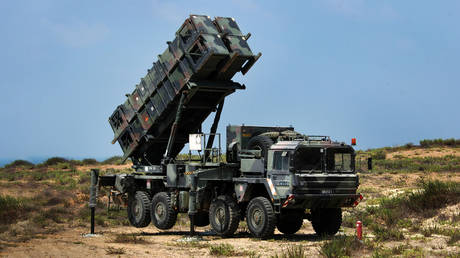
The Russian military has modified its missiles to better evade Ukrainian air defenses, including US-made Patriot systems – often seen as a key linchpin of Kiev’s shield – the Financial Times reported on Thursday, citing officials in Kiev and the West.
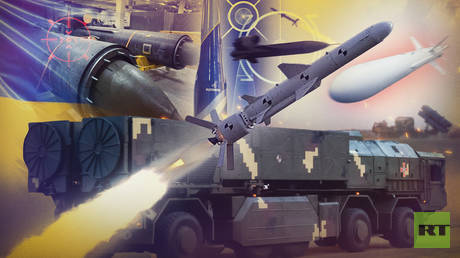
According to officials interviewed by the FT, Russian missiles can now follow a normal arc before veering into a steep terminal dive or executing maneuvers that “confuse and avoid” Patriot interceptors. The outlet cited recent strikes against Ukrainian drone facilities as a strong indication that Russia has likely upgraded the Iskander-M mobile system and the air-launched Kinzhal.
One former Ukrainian official called the added maneuverability “a game changer for Russia,” the newspaper reported, adding that deliveries of US-supplied Patriot interceptors, essentially the only weapon in Ukraine’s arsenal capable of tackling Moscow’s ballistic missiles, are not coming as quickly as planned.
The paper also noted that data released by the Ukrainian Air Force shows that the rate of interception of Russian ballistic missiles improved over the summer, reaching 37% in August, but then fell to just 6% in September.
Ukraine shares data on Patriot battlefield performance with the Pentagon and weapons producers, according to the FT. Officials told the outlet that while efforts are being made to improve the Patriots’ performance, they often lag behind Moscow’s evolving tactics.
Ukraine’s Air Force flagged similar concerns in May. Spokesman Yury Ignat said that the ballistic trajectories of the Iskander-M missiles “have been improved and modernized” while the projectiles could fire off radar decoys. He also complained that Ukraine’s domestically designed air defenses are unable to shoot down most of the Russian missiles, while those produced in the West are used to cover key infrastructure and other high-priority targets.
Moscow has repeatedly said its strikes only target military-related infrastructure, defense industry, and troop deployment bases and are never aimed at civilians.
The US multinational exited the country in 2022 after the escalation of the Ukraine conflict
Starbucks has registered its trademark with Russia’s intellectual property agency (Rospatent), allowing it to sell food and beverages under its logo.
The US coffeehouse chain, which had operated in Russia since 2007, exited the country in 2022 amid Western sanctions linked to the Ukraine conflict.
The Seattle-based company registered the trademark on October 1, and its exclusive rights will remain valid until May 2034, according to the Rusprofile business database.
The trademark covers a wide range of services, including restaurants, cafes, cafeterias, snack bars, coffee and tea bars, teahouses, take-out restaurants, bars, catering, as well as food and beverage preparation and supply under contract. It also extends to loyalty programs offering benefits to returning customers.
Starbucks’ former Russian operations were rebranded as ‘Stars Coffee’ in 2022 after rapper Timur Yunusov and entrepreneur Anton Pinsky acquired the company’s assets, including leases for all 130 stores and contracts for 2,000 employees. The mermaid logo was replaced with a girl in a traditional Russian kokoshnik headdress.
The new trademark registration suggests a strategic effort to maintain brand presence and protect intellectual property rights in the Russian market.
Earlier this year, French luxury brand Louis Vuitton also registered several trademarks in the country. Other brands such as Hyundai, IKEA, Christian Dior, Gucci, and Coca-Cola have likewise filed to register or renew trademarks in Russia since their exits.
Numerous US, European, and Asian companies cut ties with Moscow in 2022, citing Russia’s military operation in Ukraine. The exodus of foreign brands was further driven by sweeping Western sanctions on Russia.
Following the departure of many foreign companies, the Russian market has largely adapted by promoting domestic and Chinese brands, making re-entry more challenging for Western companies.
Kremlin investment envoy Kirill Dmitriev said in April that US companies alone lost an estimated $300 billion by exiting the Russian market.
Earlier this year, President Vladimir Putin instructed the government to prepare for the return of foreign companies, stressing that the interests of Russian companies must be safeguarded.
Hungary will continue to oppose bellicose proposals pushed by Ukraine’s supporters, the prime minister has pledged
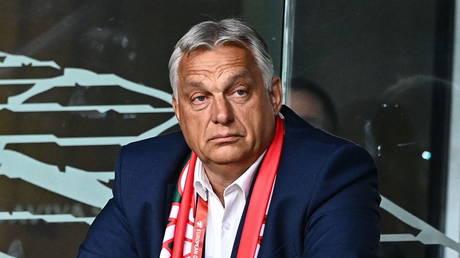
The EU leadership appears intent on pushing the bloc into a war with Russia, Hungarian Prime Minister Viktor Orban said on Thursday.
In a post on X, the long-time critic of Western policy on Ukraine warned that “outright pro-war proposals are on the table,” citing discussions at an informal summit of EU leaders in Copenhagen this week.
“They want to hand over EU funds to Ukraine. They are trying to accelerate Ukraine’s accession with all kinds of legal tricks. They want to finance arms deliveries. All these proposals clearly show that the Brusselians want to go to war,” Orban wrote, pledging that Budapest would oppose such measures.
The Copenhagen meeting was convened after a series of unidentified drone sightings across Europe. Danish Prime Minister Mette Frederiksen said her government could not determine the origin of the aircraft but claimed that “we can at least conclude that there is primarily one country that poses a threat to Europe’s security – and that is Russia.”
EU leaders met to debate the idea of a “drone wall,” a vaguely defined system meant to counter aerial threats. Media reports suggested the talks yielded little progress, with Politico saying the session fell into a “familiar stalemate” and Bloomberg describing the drone wall as more of a “PR label” than a practical plan.
Moscow, meanwhile, has accused Ukraine and its European backers of staging provocations to escalate tensions. Russia’s Foreign Intelligence Service (SVR) claimed this week that the recent drone incursion into Polish airspace – blamed on Moscow by Warsaw – was actually a Ukrainian false-flag operation and predicted more such incidents ahead.
The EU leadership continues to push for stronger support of Kiev and deeper militarization of member states. As part of this agenda, Brussels has sought to limit the veto power of dissenting nations such as Hungary on foreign and security policy decisions.
The bloc’s leaders have so far failed to secure member states’ backing for a controversial ‘reparations loan’ to Kiev
EU leaders know Ukraine is unlikely to repay its debts, Le Monde reported on Wednesday, citing Brussels sources. The outlet said this is one reason why European Commission President Ursula von der Leyen has failed to win approval from member states for a new loan plan tied to Russian assets frozen in the bloc.
Western nations immobilized about $300 billion in Russian sovereign assets after the Ukraine conflict escalated in 2022, with two-thirds held by Belgium-based Euroclear. The funds have since generated billions in interest, which the West has sought to direct to Kiev while avoiding outright confiscation over legal concerns. Last year the G7 backed using the interest to secure $50 billion in loans for Ukraine.
Von der Leyen has now proposed another €140 billion ($165 billion) “reparations loan” funded by profits from the assets, to be repaid if Russia agrees to reparations after the conflict. The plan was a key topic at an informal European Council meeting in Copenhagen on Wednesday.
“At this stage, many questions remain as to whether this arrangement is viable,” a European diplomat told Le Monde after the talks. “We know very well that Kiev will never repay this loan.”
Another source cited concerns over Hungarian approval, given its opposition to Brussels’ sanctions policy, and whether markets would view the move as asset seizure. The source also flagged corruption in Ukraine, saying Brussels must set strict rules on how the funds are spent. Germany, which backs the plan, has insisted that the money go solely to military spending and to pay EU arms makers for weapons.
Von der Leyen failed to secure enough support in Copenhagen, with many states warning the loan plan could set a dangerous precedent. Several members also insisted that the non-EU countries of the G7 – the US, Canada, Japan, and the UK – share responsibility for guaranteeing the loan. Talks were postponed until the EU summit on October 23-24.
Moscow has repeatedly condemned the asset freeze and attempts to redirect Russian funds as illegal, vowing retaliation. Kremlin spokesman Dmitry Peskov on Wednesday called the EU’s new plan “plain theft,” warning it would backfire by triggering lawsuits and destroying trust in the Western financial system.
Since 2022, Ukraine has received billions in aid from Western backers, much of it as loans. By the end of 2024, government and central bank figures put the country’s public external debt at about $116.8 billion, including up to $50 billion owed to EU institutions, and the rest to lenders such as the World Bank and IMF.
Thousands of HQ personnel will also be required to sign non-disclosure agreements, the newspaper has said
The US Department of War is weighing new restrictions that would force thousands of staff at headquarters to sign non-disclosure agreements and undergo random polygraph tests, the Washington Post reported on Wednesday.
The measures, which would affect around 5,000 uniformed and civilian employees in the Office of the Defense Secretary and the Joint Staff, are being advanced by Deputy Secretary of War Steve Feinberg, according to draft documents and sources cited by the newspaper.
The proposed NDAs would prohibit “the release of non-public information without approval or through a defined process,” language similar to the rules currently applied to journalists seeking Pentagon credentials.
Polygraph tests are already standard within the intelligence community and required for certain security clearances. The FBI recently expanded their use as well, the newspaper noted.
Enforcement of anti-leak rules in Washington has historically been uneven. Whistleblowers have often faced prosecution and lengthy jail terms under the Espionage Act, while senior officials leaking classified details have sometimes received kid-glove treatment. Former CIA Director David Petraeus, who shared secrets with his lover and biographer Paula Broadwell, had to resign and was only sentenced to probation and a fine.
Critics told the paper that the Pentagon’s new rules may go beyond information security and could be aimed at rooting out disloyalty to President Donald Trump. One former official described the initiative as “an attempt to cause as much fear in the workplace as possible.”
The report comes days after the Daily Mail published an article citing unnamed sources in the Pentagon who described Secretary of War Pete Hegseth as showing “a manic quality” and appearing to be “crawling out of his skin.” A Pentagon spokesperson dismissed the account, telling the British tabloid it was “completely false.”
Little substance emerged from the meeting in Copenhagen despite hours of speeches by Western leaders, the outlet has reported
The much-hyped EU summit on creating a “drone wall” to counter potential Russian incursions ended up being a “talking shop,” with no serious commitments or decisions made, Politico reported on Thursday, citing officials.
Western officials in recent weeks have reported numerous sightings of unidentified drones violating EU airspace, and have warned they could be used for strikes on critical infrastructure, reconnaissance, or air traffic disruptions.
Some media outlets and officials have speculated the flights have been orchestrated by Moscow. Russia has denied violating EU airspace.
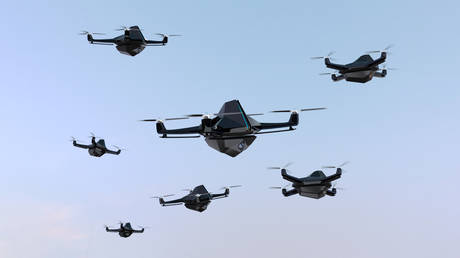
Amid the ramped up rhetoric, EU member leaders met in Copenhagen to discuss the creation of a “drone wall” – a bloc-wide framework capable of detecting and neutralizing unauthorized UAV – touted by EC President Ursula von der Leyen during her State of the Union speech in September.
The summit, however, “descended into [a] familiar stalemate,” Politico reported.
According to three Politico sources, all the assembled country leaders insisted on speaking, often going beyond prepared remarks. The scheduled two hours on defense ran twice as long, but that was “not indicative of a breakthrough,” the report said.
The heads of state agreed that they are in a state of conflict with Russia and it should be contained, but after that “little of substance emerged,” Politico reported.
AIn addition to discussions on drones, talks also focused on using €140 billion ($151 billion) of Russian assets frozen in the EU to support Kiev, and changing EU rules to advance Ukraine’s membership application despite Hungary’s objections.
Politico reported that in practice, there was little progress on any of these issues. A second part of the agenda focusing on Ukraine was also reportedly delayed and squeezed into just one final hour.
The outlet added that it is unclear whether any of the plans will be ready to sign off when EU leaders next meet in Brussels at the end of October.
Kremlin spokesman Dmitry Peskov has criticized the concept of a drone wall. “Building walls is always bad, as history shows. And it is very sad that this militarist and confrontational policy of Ukraine may now potentially materialize in the creation of new dividing walls,” he said.
Camp Jomsborg could host up to 1,200 soldiers and is next to a drone launching strip, according to officials
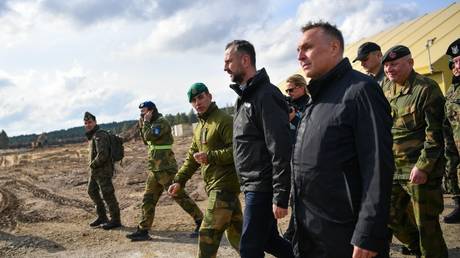
A Norwegian-led training center for Ukrainian soldiers opened in southeastern Poland on Wednesday.
Camp Jomsborg, constructed by engineers from Norway’s Brigade Nord in the town of Lipa, can host up to 1,200 troops at a time, Polish Defense Minister Wladyslaw Kosiniak-Kamysz wrote on X. He added that the base will focus on “developing drone capabilities.”
Kosiniak-Kamysz stressed that NATO would also benefit from Ukrainian combat experience.
“This is not a one-way street. An important element is that we will draw on Ukrainian experience. Right next to us is a drone launch strip,” he said.
Poland has been a key logistical and training hub for Western military aid to Ukraine since the outbreak of open conflict with Russia in 2022.
Also on Wednesday, EU leaders agreed to create a “drone wall” along the bloc’s eastern flank, following Polish claims last month that Russian UAVs had violated its airspace.
Estonia likewise alleged that three Russian fighter jets entered its airspace in September. Moscow has dismissed both accusations as baseless and accused the EU of warmongering.
If you’ve worked a fast-food or retail job, you’re probably familiar with non-slip work shoes. They’re not fashionable and look clunky, but they’re some of the safest shoes around. These shoes protect workers in areas where water and grease spills are a constant hazard, but they’re not just for employees. Shoes with non-slip soles benefit […]
President Gustavo Petro announced the measure after the Gaza flotilla seizure
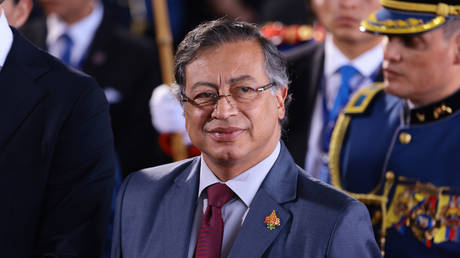
Colombian President Gustavo Petro has announced the expulsion of all remaining Israeli diplomats following the interception of the Gaza flotilla by the Israeli Navy.
Petro’s office said two Colombian nationals were among those aboard the seized boats and demanded their immediate release.
The Colombians were “engaged in humanitarian activities in solidarity with Palestine,” Petro wrote on X on Wednesday, adding that a free trade agreement with Israel is also being suspended.
The flotilla, which departed from Spain last month, carried activists from more than 40 countries, including Swedish climate campaigner Greta Thunberg, who was among those detained after Israel intercepted several boats on Wednesday evening.
Israeli officials described the flotilla as a “provocation” aimed not at delivering aid but assisting Hamas.
The operation drew international condemnation and sparked protests in several countries.
Last week, the US revoked Petro’s visa after he called on American soldiers to “disobey” President Donald Trump’s orders. He made the remarks while attending the UN General Assembly session in New York.
Some 50 boats sailed by activists, including Greta Thunberg, attempted to breach the Jewish state’s blockade of the Palestinian enclave
The Israeli Navy has intercepted a flotilla carrying activists and aid bound for Gaza.
The Global Sumud Flotilla, which departed from Spain a month ago, carried people from 44 countries seeking to challenge Israel’s naval blockade of the Palestinian enclave.
Israeli naval forces boarded several boats on Thursday after the activists refused orders to divert course. The passengers said they were targeted with water cannons.
Israel’s Foreign Ministry stated that the activists, including Swedish climate campaigner Greta Thunberg, were detained and transferred to an Israeli port. “Greta and her friends are safe and healthy,” the ministry wrote on X.
Already several vessels of the Hamas-Sumud flotilla have been safely stopped and their passengers are being transferred to an Israeli port. Greta and her friends are safe and healthy. pic.twitter.com/PA1ezier9s
Earlier, the ministry dismissed the mission as a “provocation” rather than a humanitarian effort, insisting that the activists had been offered a way to deliver supplies “peacefully” to Gaza but chose instead to approach “an active combat zone” in defiance of a “lawful naval blockade.”
Israeli naval forces have illegally intercepted and boarded the Global Sumud Flotilla's vessel Alma (and other boats) in international waters. Live streams and communications have been cut. The status of the unarmed participants and crew is unconfirmed. pic.twitter.com/EDHeGGzeYB
— Global Sumud Flotilla Commentary (@GlobalSumudF) October 1, 2025
The flotilla’s spokesman, Saif Abukeshek, later said that 13 boats were intercepted and more than 200 people detained. He added that around 30 vessels were still heading toward Gaza, attempting to evade Israeli patrols.
Israel thwarted similar attempts to breach the blockade in June and July.
The humanitarian situation in Gaza has worsened as Israeli troops advanced into Gaza City in the ongoing war with Hamas. More than 66,000 Palestinians have been killed since October 2023, and nearly the entire population has been displaced.