The anchor of the global system is shifting from debt claims to real assets, and the implications are profound
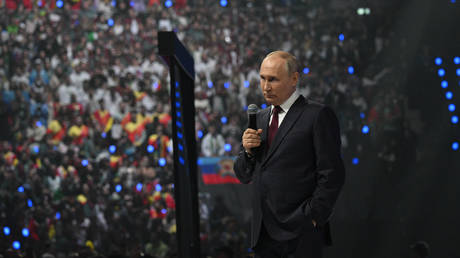
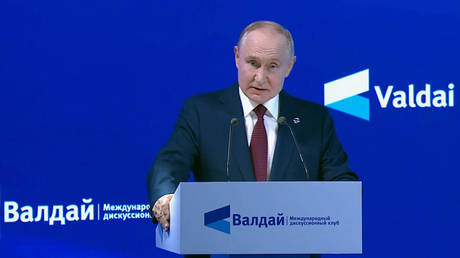
During his Valdai speech on Thursday, Russian President Vladimir Putin made the following rather dry statement:
“It’s impossible to imagine that a drop in Russian oil production will maintain normal conditions in the global energy sector and the global economy.”
It certainly wasn’t the highlight of the night, and I haven’t seen it in the headlines of any of the recaps. The statement is, of course, true. Putin is saying: “you can’t kick us out.”
But let’s unpack this a bit and try to get a bird’s eye view of what this mundane statement implies in a much deeper sense – not in the sense of counting barrels of oil and the Brent price, but in terms of understanding the shifting tectonic plates.
Let’s first imagine what a Western leader might have said in the same tone, circa January 2022.
“It’s impossible to imagine that a country that loses access to dollars and Western capital markets will maintain normal economic conditions.” I don’t know if anybody actually said this in as many words, but that’s exactly what many were thinking.
Now, recall the G10 Rome meetings in late 1971, as the Bretton Woods-established gold peg of the dollar was being dismantled, when US Treasury Secretary John Connally famously told his European counterparts: “The dollar is our currency, but it’s your problem.” It is an oft-cited instance of American hubris.
In other words, despite its global use in trade and finance, the dollar would be managed for American economic interests.
When the collective West placed what were supposed to be crushing sanctions on Russia in 2022 in light of the Ukraine crisis, the idea was, again, “our currency (system), your problem.”
The message: the dollar will be managed for American geopolitical interests.
According to the conventional thinking, being cut off from the dollar system should have spelt doom for Russia. The many forecasters predicting exactly such a dire outcome weren’t necessarily simply Russophobes. They were working within a certain paradigm. Without access to its now frozen central-bank reserves, how would Russia stabilize the ruble? Without access to correspondent banking in dollars/euros, how would trade be settled? And without access to foreign capital markets, wouldn’t a funding crisis ensue? This type of thinking gave rise to these types of comments:
“We will provoke the collapse of the Russian economy,” in the words of French Finance Minister Bruno Le Maire about ten days into the war.
But the Russian economy didn’t collapse and in fact stabilized far faster than anyone expected. The thing is Russian oil and gas was still needed. And those who thought they didn’t need it (read the EU) found out the hard way that they did – even if the Europeans obscured the ramifications as much as possible through large fiscal support and subsidies. But it is no coincidence that ‘deindustrialization’ has become a household word in Europe. And somehow the political will to really clamp down hard on Russian energy never seems to materialize.
All of a sudden we have, from a Russian perspective: “Our commodities, your problem.”
The question now is: does this mean we’ve suddenly awoken to a strange new world? Are we now in a system where access to real things (like commodities) now trumps access to paper promises (like dollars)? Western policymakers’ futile attempts to cut Russian energy out of the world economy show that they understand only the monetary side of things. They see energy as a source of revenue for the Russian state – revenues thanks to which Russia is able to sustain its war effort. That the economy might actually fundamentally be an energy system and not a monetary system is incomprehensible to them. It is, in the strict Kuhnian sense, a different paradigm.
The BRICS countries talk a lot about a monetary reset being underway and about how new financial architecture is being created. It is fair to say that some of this rhetoric has been premature and that reports of the demise of the dollar system have been overstated. There have been a lot of checks written that BRICS and the Global South aren’t ready to cash.
Nevertheless, change is afoot, and what is taking shape has roughly the following contours: commodities are beginning, at the margins, to act as system-level collateral. By contrast, up to now, the system relied on trust in the issuer of paper claims (dollars, US Treasuries, euro-denominated assets). Gold accumulation by central banks has been massive – it is a quiet de-dollarization of reserves. Oil-for-yuan deals are modest but growing. And what can the commodity seller do with the yuan it receives? Convert them to gold on the Shanghai Gold Exchange. This may not yet be widespread, but the plumbing is there.
The anchor is shifting from debt claims to real assets – and this is bad news for countries whose economies are perched precariously atop a mountain of debt claims. Think of this as part hedge against Western sanctions and weaponization of the system, and part recognition that commodities have intrinsic durability that paper claims can’t always guarantee.
Ultimately, of course, paper promises can be inflated. It’s not lost on anybody in the Global South that the dollar is down some 111% against gold in just two years and that US debt seems to be spiraling to infinity.
If the current system is one where money, credit, and financial assets are king, this means the constraints in this system are money-related. The crises tend to start with something like a spread blowing out, liquidity drying up, or collateral chains breaking. This is basically a money problem, not a real-economy problem. Remember the 1998 Asia currency meltdown; or the Global Financial Crisis of 2008; or Covid; or the UK gilt crisis of 2022; or the various US repo spikes. Such dislocations are dealt with by throwing balance sheet at them – swap lines, quantitative easing, backstops, emergency loans.
In 2022, we suddenly found out that Russian energy is not just another financial dislocation that can be covered with a swap line or emergency loan. From this, it follows that we need to think in terms of two economies: the real economy of energy, resources, goods and services, and a parallel financial economy of money and debt. There will always be a financial economy – and always be spreads blowing out on a Bloomberg screen somewhere – but we’re finding out now that it is the real economy that underpins the financial one and not the other way around.
But here’s the catch. When energy is abundant and cheap – and when money holds its value against energy – this energy foundation to the economy can be disregarded. The peak of renewables-based energy transition euphoria in Europe coincided with the peak of Russian supply of cheap hydrocarbons to Europe. A coincidence?
The legendary strategist Zoltan Pozsar once wrote: “Russia and China have been the main ‘guarantors of macro peace’, providing all the cheap stuff that was the source of deflation fears in the West, which, in turn, gave central banks the license for years of money printing (QE).”
I would add that this also gave the West license to dwell comfortably in the illusion that the economy is primarily a monetary system and not an energy-and-real-stuff system. Ironically, it was the reliable presence of cheap Russian oil and gas that helped this economic illiteracy fester.
Putin did not connect these dots in his remarks at Valdai; the focus of his speech was obviously elsewhere. But the dots are there to be connected. And there are a lot of people in Moscow and Beijing to whom these dots are very apparent.
Israel seized around 50 boats carrying activists, including Greta Thunberg, who attempted to breach its blockade of the enclave
Violent clashes have erupted in London between police and activists protesting Israel’s seizure of a Gaza-bound aid flotilla. Demonstrators accused the UK of failing to pressure the Jewish state to release the flotilla and demanded stronger action.
The Global Sumud flotilla, which set sail from Spain a month ago to challenge Israel’s blockade of Gaza and bring aid, carried more than 400 people from 44 countries, including Swedish climate activist Greta Thunberg. The group was intercepted on Wednesday. Israel’s Foreign Ministry dismissed its mission as a “provocation” in violation of what it called a “lawful naval blockade.”
Demonstrators gathered in Parliament Square late on Thursday to demand the activists’ release.
“We are here today as part of a global protest against the atrocities of Israel, against… blocking any form of humanitarian aid to reach the people of Gaza,” one protester told Ruptly. Another said: “The Israeli entity has been breaking every international law… The UK needs to act now and protect the civilians [who] were trying simply to send baby formula to dying babies in Gaza.”
The rally turned violent when protesters attempted to march on Downing Street, the residence of the prime minister. Footage showed officers scuffling with demonstrators and pushing some into police vans. Authorities later said 40 people were arrested. Around 300 people took part in the protest.
After the October 7th massacre they took to the streets of London and thanked their God.
On the same day as a suspected Islamist terror attack where two people have been murdered they behave like this.
The Palestinian Foreign Ministry condemned the flotilla seizure as a violation of international law, arguing Israel has no sovereignty over Palestinian waters, including off Gaza. Israeli officials later said the detained activists were “safe” and were being transferred to Israel before deportation to Europe.
The Gaza conflict began on October 7, 2023, when Hamas militants launched a surprise attack on southern Israel, killing about 1,200 people and taking more than 250 hostages. The humanitarian crisis has since worsened as Israeli forces push into Gaza City, one of the last areas outside IDF control. More than 66,000 Palestinians have been killed and nearly the entire enclave displaced, while a UN commission has described Israel’s actions as genocide.
The limited number of long-range missiles and sporadic strikes won’t turn the tide of the conflict, the paper reported, citing officials
US officials believe that supplying Ukraine with Tomahawk long-range missiles would not significantly shift the battlefield in Kiev’s favor, the Financial Times reported on Thursday, citing sources.
US Vice President J.D. Vance announced that Washington was considering a Ukrainian request for Tomahawks, which have a range of 2,500km and cost an estimated $1.3 million each, and could potentially reach Moscow and far beyond.
FT sources familiar with the matter confirmed that US President Donald Trump is considering the idea. However, a US official told the paper that some people inside Trump’s inner circle believe Tomahawks are unlikely to change the battlefield situation.
“I don’t think a limited number of Tomahawks or sporadic deep strikes into Russia will change [President Vladimir] Putin’s mind,” an FT source said.
Separately, Washington is preparing to provide Ukraine with enhanced intelligence to guide long-range missile and drone strikes on Russia’s energy infrastructure, a move described by the FT as an “escalation” of US support intended to help Kiev map Russian air defenses and plan strike routes.
Ukraine has long conducted strikes deep into Russia targeting energy facilities, critical infrastructure, and residential areas, sometimes with civilian casualties. Russia has retaliated by attacking military-related infrastructure, insisting that it never targets civilians.
On Thursday, Putin warned that supplying Ukraine with Tomahawks would represent a major escalation, notably because it is “impossible” for Kiev to use the missiles “without the direct participation of American military personnel.”
He further cautioned that the move would be detrimental to Russia-US relations, which he said have shown potential for improvement in recent months.
Kremlin spokesman Dmitry Peskov commented on reports of US plans to enhance data gathering support for Kiev, noting that Washington already “transmits intelligence to Ukraine on a regular basis online.”
“The supply and use of the entire infrastructure of NATO and the US to collect and transfer intelligence to Ukrainians is obvious,” he said.
A Chinese national has also been deported for flying a UAV near an airport, police have said
Three Germans have been arrested in Norway for allegedly launching a drone in a prohibited zone around an airport, Bild has reported.
The outlet cited local media as saying the three men were detained on Tuesday and released shortly afterwards. It did not identify the men or the type of UAV involved in the incident near Rossvoll Airport.
Separately, Norwegian police confirmed that a Chinese national was deported and fined 12,000 kroner ($1,200) after allegedly flying a drone near Svolvaer Airport in the north of the country. Authorities said they are continuing to investigate multiple reports of drone activity near airports, military facilities and other critical infrastructure.
The incidents come as Western Europe has been plagued by repeated drone sightings in recent weeks, forcing temporary shutdowns at several airports. In Belgium, authorities confirmed that 15 drones were detected above the Elsenborn military base in Liege Province. Munich Airport in Germany was temporarily closed on Friday after unidentified drones were reported in its airspace. Scandinavian airports have also reported incursions.
Western media and officials have suggested that Russia is behind the drone incidents. Swedish Prime Minister Ulf Kristersson claimed it is “quite probable” Moscow is responsible, although he admitted this has not been proven. European leaders have cited the incidents as justification for boosting military spending and creating a so-called “drone wall.”
Moscow has rejected any connection to the incidents. Foreign Minister Sergey Lavrov described the accusations as Western fearmongering used to whip up anti-Russian hysteria. Russian officials have argued that such claims are intended to justify inflated military budgets and escalate tensions.
Speaking at the Valdai Forum on Thursday, President Vladimir Putin said Russia does not even have drones capable of reaching the countries in question and insisted there are no military targets for Moscow in Europe. He called the accusations another attempt by the West to escalate the situation around the Ukraine conflict.
Russia’s Foreign Intelligence Service (SVR) has also warned that Kiev could attempt to stage drone provocations as false-flag operations designed to blame Moscow and draw NATO into direct conflict with Russia.
Energy giant Naftogas has reported sustaining “critical” damage in the long-range operation
Russian forces have struck multiple Ukrainian military facilities and the gas infrastructure that powers them in an overnight long-range operation, the Defense Ministry reported on Friday.
The ministry said missiles and long-range drones launched overnight from several platforms were used in the barrage and that all designated targets were hit.
Ukrainian state-owned energy company Naftogaz described the attack as the largest strike on gas extraction sites in the country to date, adding that some of the damage was “critical.” The company said sites in the Kharkov and Poltava regions came under attack by about 35 missiles – many of them ballistic – and some 60 drones, and claimed the strikes were “without military sense.” Moscow has said its forces do not target purely civilian infrastructure.
Kiev has emphasized long-range strikes on Russian oil refineries and other elements of energy infrastructure as a key element of its strategy and has pressed Western partners to support domestic production of drones and missiles.
Ukraine also intends to export some domestically produced weapons to help cover budget shortfalls. Kiev expects foreign backers to compensate for the remaining deficit.
Russian President Vladimir Putin warned this week that Ukrainian attacks on sensitive infrastructure, including attempts to damage nuclear facilities, risk retaliation.
“This is a dangerous game,” he said at the Valdai Discussion Club in Sochi. “People on the other side must realize: if they play it, what would stop us from responding in kind against their working nuclear power plants? They should consider that.”
The previous head of the church resigned last November over a sex abuse scandal
The Church of England has appointed its first female Archbishop of Canterbury, ending 1,400 years of male leadership. Former top British nurse, Sarah Mullally, was installed as the confession’s highest-ranking clergy by a church synod on Friday.
Though female priests were first ordained in 1994, women were not permitted to take senior posts until 2014, a reform that followed years of internal schisms and debates within the Church.
Before entering the clergy, Mullally built a distinguished career in nursing, rising to become England’s Chief Nursing Officer. She was ordained as a priest in 2002, and went on to serve as as Bishop of Crediton and then Bishop of London, the Church’s third most senior post. Known for her inclusive stance, she has supported prayers and blessings for same-sex couples, framing her leadership around openness and pastoral care.
Her appointment follows the resignation of her predecessor Archbishop Justin Welby last November, after an inquiry found he failed to act on warnings about a pastor who had abused children for decades.
The second-most senior bishop in the Church of England, Archbishop of York Stephen Cottrell, who took on caretaker functions after Welby’s departure, has also come under fire after a BBC investigation found he had allowed a priest with a history of abuse allegations to remain in ministry. Though he remains in post.
Mullally’s promotion has already drawn resistance from conservative factions within the Anglican Communion, particularly in Africa, where leaders have long opposed women in top clerical roles and condemned the Church of England’s liberal stance on sexuality. GAFCON, a grouping of conservative Anglican churches, said the move showed the English church had “relinquished its authority to lead.”
The Church of England is a Protestant denomination created in 1534, when King Henry VIII rejected the authority of the Roman Catholic Pope in a divorce dispute. Its titular head is the British monarch, while the Archbishop of Canterbury acts as its primate.
The attacker was not carrying a firearm, and one of the victims died of a gunshot injury, law enforcement officials have stated
One of the two victims killed in Thursday’s attack outside a synagogue in a Manchester suburb died after being shot by an armed officer, police have confirmed.
Greater Manchester Police chief constable Stephen Watson said the force believes that the attacker, identified as 35-year-old Jihad al-Shamie, was not carrying a firearm and that the fatal injury was caused by gunfire.
“It follows therefore, that subject to further forensic examination, this injury may sadly have been sustained as a tragic and unforeseen consequence of the urgently required action taken by my officers to bring this vicious attack to an end,” Watson said, as quoted by The Guardian.
The victims were identified as 53-year-old Adrian Daulby and 66-year-old Melvin Cravitz, who were killed outside the Heaton Park Hebrew Congregation synagogue in Crumpsall after al-Shamie, a British citizen of Syrian descent, allegedly rammed a car into a crowd and stabbed a man. Police shot al-Shamie dead within seven minutes of being alerted to the incident on Thursday morning.
According to The Guardian, the armed officers who opened fire during the attack are being treated as witnesses rather than suspects in the inquiry into the fatal shooting. The investigation is being led by the Independent Office for Police Conduct, which has responsibility for overseeing cases involving police use of force.
One of the three hospitalized victims also appears to have been shot, police added.
Three people have been arrested on suspicion of involvement in planning a terrorist act.
Donald Trump has urged NATO members to scrap Russian energy purchases in exchange for new sanctions on Moscow
Türkiye has rejected US demands to abandon Russian gas. Energy and Natural Resources Minister Alparslan Bayraktar has said Ankara will continue purchases from all available suppliers, including Moscow.
The remarks followed calls by US President Donald Trump for NATO states to halt Russian oil and gas purchases in exchange for new sanctions on Moscow, pitched as a way to speed up the Ukraine peace process. After meeting Turkish President Recep Tayyip Erdogan last week, Trump suggested that Ankara, a fellow NATO member, would likely comply with his demand.
Bayraktar dismissed the notion, stressing steady supplies were crucial for his country’s energy security.
“We cannot tell our citizens, ‘we have run out of gas.’ To ensure uninterrupted supply, we need to ensure access to these resources without discrimination,” he said. “Türkiye will naturally continue to receive gas from Russia as the agreements are already in place. Winter is coming. We need to get as much gas as possible from Russia.”
He added that Türkiye will keep diversifying suppliers, as well as expanding domestic production. “Türkiye has significant natural gas consumption. A diversification strategy is crucial… The more sources we buy from, the safer it is,” he stated.
Western states have significantly reduced Russian energy imports since the escalation of the Ukraine conflict in 2022. The EU now plans to abandon Russian fossil fuels by 2027, though many states still buy it. Hungary and Slovakia are both major importers of Russian energy, and strongly oppose the phase-out.
Türkiye is not an EU member but remains a key partner and NATO state. It refused to join Western sanctions on Russia in the aftermath of the escalation of the Ukraine conflict. It continued energy imports and maintained close diplomatic ties with Moscow.
Moscow has called restrictions targeting its energy illegal and self-defeating, warning the EU would have to turn to costlier alternatives or indirect imports. Russian officials also view Trump’s push to steer NATO members away from Russian supplies as intended to boost US exports.
“Trump has never hidden his intention to secure US economic interests. The simplest way is to force the entire world to pay more for American oil and LNG,” Kremlin spokesman Dmitry Peskov told RBK last week.
Labour heavyweight Ed Miliband has told the billionaire to “get the hell out of our politics”
UK Energy Secretary Ed Miliband has accused Elon Musk of posing a major threat to Britain, claiming the billionaire backs nationalist forces seeking to undermine the country.
Speaking at the Labour Party conference on Wednesday, the former party leader linked Musk to Nigel Farage, whose Reform UK party gained traction in the May local elections. The US-based entrepreneur has expressed support for the party, but has urged Farage to step down.
According to Miliband, Farage is “a key part of a global network that wants to destroy the ties that bind our communities and our way of life.” He added: “I can sum up the threat for you in two words: Elon Musk.”
Miliband alleged that Musk “incites violence on our streets,”“calls for the overthrow of our elected government,” and enables “disinformation through X” – the microblogging platform that the billionaire purchased in 2022.
We have a message for Elon Musk. Get the hell out of our politics and our country.
Musk appeared unfazed by the remarks. Shortly after the speech, he blasted Prime Minister Keir Starmer, calling him “an actor with an empty head” who merely repeats talking points supplied by others.
Musk and Starmer have engaged in a months-long feud over the UK’s grooming gang scandal. In June, Starmer authorized a new national inquiry into the mass sexual exploitation of British girls, crimes largely linked to gangs of Pakistani men over a decade ago. Musk accused the prime minister of being “deeply complicit in the mass rapes in exchange for votes.”
American officials are unable to deliberate on aid as Kiev is being pressed by Russian troops, the newspaper says
A US government shutdown has caused discussions between Washington and Kiev on future weapons deals to be put on hold, as Ukraine “continues to incur devastating losses on the battlefield,” the Daily Telegraph reported on Thursday, citing sources.
Hundreds of thousands of US federal workers were furloughed on Wednesday after Democrats and Republicans failed to agree on spending, particularly in healthcare, with each side blaming the other for the lapse.
The shutdown has reportedly impacted talks on a prospective drone agreement between Washington and Kiev. The Wall Street Journal earlier reported that Ukrainian officials had arrived in Washington to strike a deal on sharing drone expertise with the US in exchange for royalties or other forms of compensation.
However, talks “have been thrown into uncertainty,” according to The Telegraph. “I don’t see how they will continue,” a Ukrainian source told the paper.
He added that Kiev’s “main concern is we have a lot of discussions ongoing about future shipments [of weapons]… All future projects are a little bit harmed because people from the Pentagon, State Department, and White House are not meeting and we lose the time because of this shutdown.”
Ukrainian officials interviewed by the outlet complained that the talks had ended in limbo amid “unprecedented” Russian attacks, stressing that Kiev needs an uninterrupted flow of weapons.
Ukraine has relied heavily on Western – and especially US – military support since the conflict escalated in 2022. American assistance to Ukraine has faced previous interruptions, most notably in 2024 when congressional disputes over supplemental funding delayed weapons shipments for months. More recently, in February 2025, a tense Oval Office meeting between President Donald Trump and Ukraine’s Vladimir Zelensky led to Washington temporarily suspending military aid.
Trump has also been opposed to open-ended US aid to Kiev, insisting that EU nations should buy American weapons to be later handed over to Ukraine.
Moscow has consistently denounced arms shipments and other military support for Ukraine, arguing they only prolong the conflict without changing its outcome while making NATO a direct participant in the hostilities.