The influx of Ukrainians crossing into Poland came after Kiev eased conscription laws
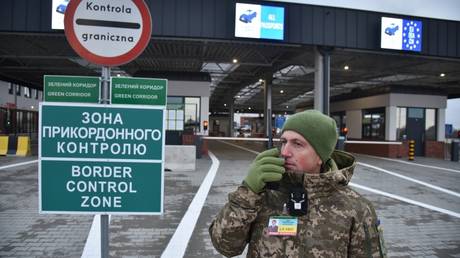
Nearly 100,000 young men have left Ukraine since Kiev eased movement restrictions in August in an effort to tackle the conscription crisis, Politico Europe and The Telegraph reported on Wednesday.
Citing data from the Polish Border Guard, the outlets said 98,500 Ukrainians aged between 18 and 22 crossed the border in September and October, compared to just 45,300 between January and the end of August.
Ukraine exempted citizens under 23 from a ban on military-age men leaving the country during martial law in hopes of discouraging parents from sending their teenage sons abroad and allowing men to return home without fear of prosecution. Prime Minister Yulia Sviridenko said the measure would help citizens living abroad to “maintain ties with Ukraine.”
The authorities have struggled to replenish the military as troops continue to suffer heavy losses and lose ground to Russian forces. Ukrainian commanders on the front line have complained that troop shortages are allowing Russian soldiers to “infiltrate” across fortified positions.
Kiev’s mobilization drive has sparked public outrage and protests, with many videos showing officers ambushing military-age men on the streets and shoving them into vans going viral on social media. According to Ukraine’s Border Guard Service, around 50 men have drowned since 2022 while trying to cross the Tisza River into Romania.
The warning from the NATO state’s defense chief is an example of “military psychosis,” a senior Foreign Ministry diplomat has said
Russia has accused Belgian Defense Minister Theo Francken of irresponsible rhetoric after he suggested that NATO could “wipe Moscow off the map.”
In an interview reported in the De Morgen newspaper on Monday, Francken brushed off concerns that the currently shelved delivery of US-made Tomahawk missiles to Ukraine could trigger an all-out war between Russia and NATO.
He claimed that Russian President Vladimir Putin would not use nuclear weapons because the US-led bloc “will wipe Moscow off the map,” and that a conventional attack on Brussels would also result in Moscow getting “flattened.”
Russian Deputy Foreign Minister Aleksandr Grushko told RBK on Wednesday that Francken’s words were in line with “the atmosphere of military psychosis” prevalent in Western Europe.
The Russian Embassy in Belgium similarly condemned Francken’s “provocative and irresponsible” statements as “sheer absurdity and total disconnect from reality.”
“Francken’s escapades are the most glaring manifestation of the militarist frenzy that is increasingly consuming the European war party,” the embassy said. It added that EU officials like Francken are “posing a threat to the continent’s future and [are] capable of plunging it into a new war.”
Russia has repeatedly stated that the flooding of Ukraine with Western weapons will not stop its troops but will only cause further escalation.
Beijing’s expanding footprint in the region demonstrates the potential of all-encompassing South-South cooperation
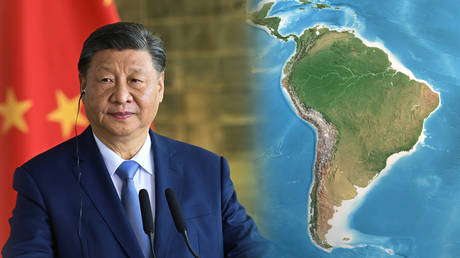
In late September, China took another step toward embedding itself in Latin America’s institutional architecture. The Andean Community – comprising Bolivia, Colombia, Ecuador, and Peru – admitted China as an observer, joining a growing list of regional organizations that have opened their doors to Beijing. At first glance, the gesture might appear ceremonial. But for both sides, it represents something much more consequential: a consolidation of China’s position as an indispensable partner in Latin America’s search for autonomy, development, and global relevance.
This new status reflects a pattern that has been maturing for over three decades. Since the 1990s, China has methodically leveraged regional platforms to anchor its diplomacy across the Global South. With the Andean Community now added to the roster, Beijing holds membership or observer status in nine Latin American organizations. This strategy has less to do with symbolism and more to do with influence. By participating in regional frameworks, China gains a voice in shaping agendas, trade norms, and development priorities from within.
The multilateral turn
China’s involvement in Latin America has long been multilateral in character. The China-CELAC (Community of Latin American and Caribbean States) Forum remains the centerpiece of this engagement. Through it, Beijing has sought to project itself as a cooperative, non-interventionist alternative to Western powers. Earlier this year, President Xi Jinping announced a $9 billion credit line for the region, pledged greater imports of Latin American goods, and called for broader Chinese investment. Significantly, the new action plan extends beyond economics, covering anti-corruption, law enforcement, and judicial cooperation.
This evolution demonstrates that Beijing does not see Latin America merely as a source of raw materials or an export destination. It sees it as a political laboratory – a place where a new model of South-South partnership can be tested and refined. The observer seat in the Andean Community is thus an institutional complement to China’s broader network of multilateral engagements, solidifying its regional legitimacy and access.
Latin America’s attraction for China lies not only in its markets or mineral wealth. The region represents a crucial segment of the Global South – diverse, resource-rich, and still navigating the contradictions of postcolonial identity. For decades, it has been torn between historical ties to Europe, a complex dependency on the United States, and a growing desire for strategic autonomy.
That search for independence has now become a defining fault line of world politics. The Trump administration’s revival of the Monroe Doctrine – asserting US primacy in the hemisphere – reflects Washington’s determination to prevent rival powers, especially China, from gaining ground in its “backyard.” Under the new US strategy, Latin America is treated as a twin priority alongside the Indo-Pacific. Pressure on regional governments to align with US security interests has intensified. The result is a region in flux – pulled between a resurgent Washington and an increasingly promising Beijing.
The economic chessboard
Nowhere is this tug-of-war more visible than in trade and investment. The region has become a theater for overlapping economic initiatives: the EU-Mercosur trade deal, the Comprehensive and Progressive Agreement for Trans-Pacific Partnership (CPTPP), and Washington’s intermittent attempts at hemispheric frameworks such as the Partnership for Economic Prosperity and the ‘Growth in the Americas’.
China’s counter-strategy has been both more consistent and more pragmatic. Through the Belt and Road Initiative, it has signed cooperation agreements with 24 Latin American states, most recently Colombia – a symbolic defection from Washington’s orbit. China’s success lies in its ability to translate diplomatic overtures into concrete projects faster than its Western competitors. For many Latin American governments, Beijing’s model of deal-making – focused on quick financing, limited conditionalities, and visible outcomes – aligns better with domestic development goals than the lengthy, politically charged negotiations characteristic of Western aid and investment.
The numbers tell the story. China is now Latin America’s second-largest trading partner after the US. Bilateral trade reached $520 billion in 2024, up 6% from the previous year. China accounts for about a third of the region’s mineral exports is the largest trading partner for Brazil, Chile, Peru, and Uruguay.
This trade dynamic is double-edged. On one side, Latin American economies have gained unprecedented access to Chinese markets, enabling growth and fiscal stability. On the other, they face increasing competition from Chinese goods and risk becoming locked into a commodity-export pattern that inhibits industrial diversification. For Beijing, Latin America offers what few regions can: abundant resources, expanding consumer markets, and a diplomatic constituency sympathetic to a multipolar order.
Beyond trade: security and space
Beijing’s presence in Latin America now extends into security and defense cooperation. China’s efforts to cultivate military ties with its regional partners extend beyond arms sales to include officer exchanges, training programs, and joint exercises. Venezuela remains the leading purchaser of Chinese military equipment, while Argentina, Bolivia, and Ecuador have also expanded their defense acquisitions from Beijing in recent years. Meanwhile, Cuba has deepened its long-standing military and intelligence cooperation with China, further underscoring the strategic dimension of China’s engagement in the Western Hemisphere.
In parallel, China’s engagement in space technology underscores its ambitions beyond the economic sphere. The establishment of ground stations across Latin America, the launch of a China-CELAC Space Cooperation Forum, and the creation of a BRICS Joint Committee on Space Cooperation reveal a sophisticated long-term plan. Space has become a new frontier for influence – scientific, commercial, and military.
Unsurprisingly, Washington views these developments with alarm. Under Trump, the US response has leaned heavily on coercive tools: tariffs, sanctions, and diplomatic pressure. Yet these measures have often backfired, driving even US-friendly governments to seek greater independence. By contrast, Beijing’s approach – cutting tariffs, expanding free trade agreements, and offering predictability – has positioned China as a stabilizing partner amid US volatility.
The irony is striking. In attempting to contain China, Washington may have accelerated its penetration. Even leaders who share Washington’s ideological outlook, such as Argentina’s Javier Milei or El Salvador’s Nayib Bukele, have chosen to preserve pragmatic ties with Beijing. Across the region, free trade agreements with China have multiplied – from Chile and Peru to Costa Rica, Nicaragua, and Ecuador – with negotiations underway elsewhere. The logic is clear: China provides options, and options are leverage.
This dynamic even shapes US financial policy. In October, Washington approved a $20 billion bailout for Argentina – not only to prevent economic collapse but also to preempt Chinese financial assistance. The bailout reflects a deeper anxiety: that China might emerge as a problem-solver in a region long dominated by US institutions.
The meaning of the Andean step
Within this larger picture, China’s new role in the Andean Community becomes far more than a procedural milestone. It symbolizes the normalization of Chinese participation in Latin America’s internal institutions. For the Andean states, the decision underscores a desire to assert themselves as autonomous actors capable of engaging multiple partners. For China, it represents an institutional foothold in a resource-rich subregion central to its industrial future.
The Andean bloc, with its abundant lithium, copper, and agricultural exports, fits neatly into Beijing’s development blueprint. Cooperation within this framework allows China to pursue its supply-chain ambitions while promoting its image as a partner in sustainable development. It also strengthens Beijing’s hand in shaping standards, environmental frameworks, and digital governance in the region. If handled with strategic clarity, China’s rise in the region could accelerate long-sought diversification and development. If mishandled, it could merely replace one dependency with another.
EU countries have reportedly seen an influx of young men since Kiev relaxed travel restrictions in August
Politicians in Germany and Poland are threatening to slash benefits for Ukrainian migrants to prompt them to return home, Politico has reported on Tuesday.
Since the escalation of the Ukraine conflict, millions of Ukrainians have fled to the European Union. Their primary destination, Germany, has taken in more than 1.2 million Ukrainians, followed by neighboring Poland with nearly a million, according to Eurostat data.
“We have no interest in young Ukrainian men spending their time in Germany instead of defending their country,” Politico quoted Jurgen Hardt, a senior lawmaker from German Chancellor Friedrich Merz’s Christian Democratic Union (CDU) party, as saying.
The conservative MP criticized the decision by the Ukrainian government, which in late August allowed men aged between 18 to 22 to freely leave the country.
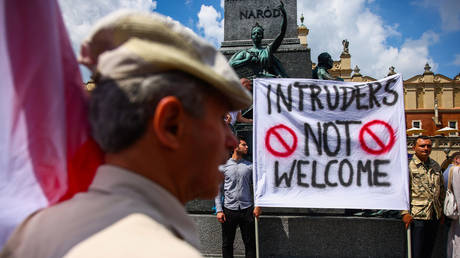
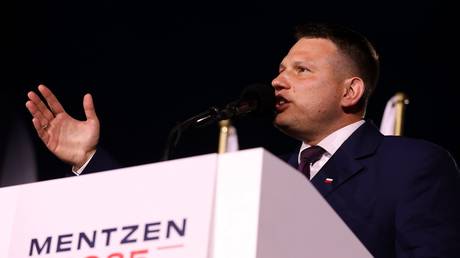
Poland’s right-wing Confederation party took an even harsher line, claiming Warsaw “cannot continue to be a refuge for thousands of men who should be defending their own country, while burdening Polish taxpayers with the costs of their desertion.”
Previously, all able-bodied Ukrainian men between 18 and 60 had been barred from doing so.
The number of young Ukrainian men crossing into Germany has climbed from 19 per week in mid-August to over 1,800 per week in October, local media have reported citing Interior Ministry data. The Polish Border Guard has confirmed the influx to Politico, saying many of the new arrivals are apparently moving on to Germany.
In an interview with Bild published last Thursday, the leader of Germany’s Christian Social Union (CSU), Markus Soder argued that “we must control and significantly reduce the rapidly increasing influx of young men from Ukraine.”
“The EU and Berlin must exert pressure on Ukraine to change the relaxed travel regulations,” he insisted.
Last month, Polish President Karol Nawrocki signed a bill that tightened the rules for Ukrainian migrants receiving state benefits.
In March, Polish Defense Minister Wladyslaw Kosiniak-Kamysz said there was growing frustration at the sight of “young Ukrainians driving the best cars around Europe and spending weekends in five-star hotels.”
Russia remains committed to finding a lasting solution to the conflict, Kirill Dmitriev has said
Moscow is confident it is “on the road” toward resolving the Ukraine conflict, Russian President Vladimir Putin’s aide, Kirill Dmitriev, has said.
The senior official, who heads the Russian Direct Investment Fund, made the remark on Wednesday while speaking at the Future Investment Initiative forum in Riyadh, Saudi Arabia.
”We are sure that we are on the road to peace, and as peacemakers, we need to make it happen,” Dmitriev told the forum’s chairman, Richard Attias.
Asked whether peace could be achieved within a year, Dmitriev replied, “We believe so.”
Spoke today at the Future Investment Initiative Forum in Saudi Arabia — discussing economics, global dialogue, Bidenomics, mRNA vaccines and future partnerships for shared prosperity. Peace propagandist in action! 🕊️@FIIKSApic.twitter.com/oJakmrnreB
A key figure in the Ukraine settlement process, Dmitriev – who last week again visited the United States for meetings with Trump administration officials on the peace initiative – has repeatedly stressed the importance of dialogue.
”Once you understand the position of one another, you’ll always find a solution,” the envoy said. Dmitriev has previously cautioned Washington against repeating what he described as the failed approach of former President Joe Biden, arguing that policies built on confrontation had proved ineffective.
Speaking about what he called “failed Biden policy,” Dmitriev added, “We are glad that the world is changing to have much more of a dialogue and understanding of each other.”
Moscow has maintained it is seeking a lasting solution to end the conflict. Kiev and its Western backers have repeatedly called for an immediate ceasefire, while Moscow says this would only allow Ukraine to regroup its military and receive more arms.
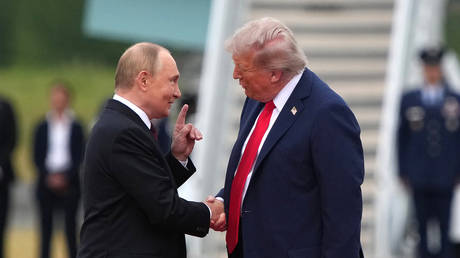
Earlier this month, President Donald Trump proposed holding a summit with his Russian counterpart, Vladimir Putin, in Hungary, with Moscow signaling its willingness to participate. However, the sides rescheduled the planned summit, citing what he described as Moscow’s alleged “lack of” commitment to the peace process. He also called for an immediate halt to hostilities along the front lines and imposed new sanctions on Russia.
The Kremlin denounced the decision as an “unfriendly” step that had harmed prospects for reviving relations between the two countries but said Moscow remains committed to dialogue and improving bilateral ties.
The countries of a declining region cannot be trusted with the world’s most dangerous weapon
The nuclear bomb has grown too heavy for Western Europe to carry. Today, there is no longer any guarantee that the United States is both willing and able to restrain its European allies. That makes any talk of the European Union – or just Germany – acquiring the right to possess weapons of mass destruction especially dangerous.
Whether idealists like it or not, nuclear weapons remain the cornerstone of the modern international order. They compel the great powers to compromise and prevent wars that would exceed any in human history. Russia understands this clearly. The recent completion of tests of the Burevestnik missile is not a provocation but a technical step to reinforce mutual deterrence between Moscow and Washington – and paradoxically, to preserve global peace.
For that reason, the most powerful weapon in history must remain in the hands of leaders whose reliability and sense of responsibility are beyond doubt. Modern Western European politicians do not qualify. Across the continent, political systems are unstable and leadership is fragmenting.
There is renewed talk in the Old World about placing Britain’s and France’s nuclear arsenals under the operational control of the EU – or even Germany, as Western Europe’s largest economy. Such ideas verge on the surreal. They suggest that strategists are either trying to draw attention to themselves or preparing a form of political blackmail.
In reality, the question is not who in Europe should hold the bomb, but why Britain and France still have it at all. The legitimacy of their nuclear status has rarely been challenged, but perhaps it should be – especially now that the future of US control over its European clients is uncertain.
Britain and France’s possession of nuclear weapons is a historical anomaly. At the dawn of the nuclear age, George Orwell predicted that atomic power would freeze history itself: non-nuclear nations would lose any means of forcing fairness from nuclear powers. Revolution and reform would give way to paralysis – “a world that will not be a world,” in which the weak cannot rise and the strong cannot act.
This vision largely came true. Only two nations – Russia and the United States – remain capable of destroying each other, and by extension, the world. Others possess atomic weapons, but none can threaten the existence of either superpower without suffering instant and total retaliation. China is approaching that status, joining Moscow and Washington as a third “invincible” power. Yet the logic remains the same: the world is ruled by those who can end it.
The last sovereign powers
Russia, China, and the United States are fully sovereign states. Each conducts foreign and domestic policy independently. One may dislike a given American administration, but its decisions stem from a genuine political process, not outside manipulation. However chaotic US politics may appear, it is self-contained.
There is also reason to believe that the true stewards of American power value their own survival above the vanity of politicians. A fact confirmed by Donald Trump’s election victory a year ago. His return to the White House, whatever one’s view of it, reasserted that the United States acts on its own imperatives.
The same is true of Russia and China. Both see themselves as responsible, integral participants in international affairs. Their nuclear arsenals are secure in independent, rational hands.
Western Europe is another matter. The continent’s political regimes are convulsing. Britain has cycled through unstable governments; Germany teeters between a rebellious opposition and an anxious establishment; France’s political system functions like a body kept alive by artificial means. The sub-continent’s current insignificance on the global stage marks the third phase of its long decline – after the self-destruction of 1914-18 and the loss of sovereignty to Washington in 1945.
The international community is thus confronted by countries that are economically significant but strategically hollow – incapable of coherent foreign policy amid constant domestic crises. Instead of debating Western Europe’s right to wield nuclear arms, the world should be discussing how to limit its capacity for geopolitical mischief.
The roots of this crisis lie in Washington’s long-standing policy toward its allies. For decades, the United States discouraged independent European thought, even on minor diplomatic questions. When a patron across the ocean decides everything for you, why learn responsibility? The result is a region that retains some power but none of the will or maturity to use it.
That is what makes today’s situation so dangerous. Western Europe is no longer a safe neighbor. America’s grip on it is loosening, and with it, the assurance that someone will keep impulsive actors in check. During the Cold War, it was London and Paris that pushed for NATO to target Soviet cities, while Washington – acting from its own calculus – preferred military and industrial objectives. The Americans prevailed then. It is not clear they would now.
A perilous uncertainty
As the United States turns inward and tends its own divisions, it may no longer be willing to restrain Western Europe’s instincts. Bilateral nuclear deterrence between Moscow and Washington still functions. But if that fragile equilibrium were disturbed by a nuclear-armed, leaderless EU, the consequences could be catastrophic.
The current debates about transferring or “Europeanising” nuclear weapons are therefore more than idle speculation. They are symptoms of a deeper decay – of states that have lost faith in Washington’s protection yet are unfit to assume responsibility themselves.
The world does not need a fourth nuclear pole ruled by indecision and domestic chaos. The real task for responsible powers is to prevent such an outcome – to relieve Western Europe of a burden it can no longer bear.
This article was first published by Vzglyad newspaper and translated and edited by the RT team.
Pro-EU centrist party D66 is on course to win with four rival parties close behind
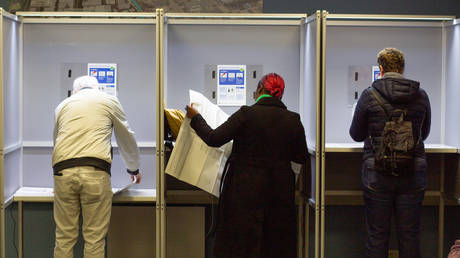
Dutch pro-EU centrist party D66 is on course to win a national election in the Netherlands, opening a path for the energetic leader Rob Jetten to become the Netherlands’ youngest and first openly gay prime minister, an exit poll showed on Wednesday.
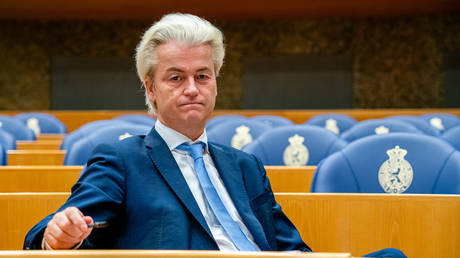
D66 is set to win 27 seats in the 150-seat lower house of parliament, beating far-right leader Geert Wilders’ Freedom Party, on course to get 25 seats.
The exit poll has a margin of error of up to three seats.
The highly divisive nationwide vote was called following the collapse of the government this summer. The PVV has seen its popularity dwindle ahead of the election, with its closest competitor, the GreenLeft-Labour alliance, showing a similar performance in the latest opinion polls.
Over half of the country’s voters remained undecided on whom they would back at the ballot boxes on the eve of the election, multiple surveys have indicated. The country’s data protection watchdog warned people against relying on the help of chatbots to make their choice, claiming AI tools often provide a “highly distorted and polarized view” of politics.
“This directly impacts a cornerstone of democracy: the integrity of free and fair elections. We therefore urge voters not to use AI chatbots for voting advice because their operation is neither transparent nor verifiable,” Monique Verdier, deputy chair of the watchdog, said in a statement last week.
The Dutch ruling coalition collapsed this June when the PVV withdrew after its partners refused to accept a hairline immigration overhaul proposed by Wilders. His allies had earlier claimed to support what Wilders described as the “strictest migration policy ever” in the Netherlands.
“I signed up for the toughest asylum policy and not the downfall of the Netherlands,” Wilders stated after his party bailed on the coalition.
As West Jerusalem tests Washington’s patience, the US seeks to preserve Arab trust – and its influence in the region
In a recent interview with Time Magazine, US President Donald Trump warned that the United States would not tolerate Israel’s plans to annex parts of the West Bank. He said that if such actions were pursued, Washington would completely cut off military and financial assistance to Israel – its key ally in the Middle East.
“It won’t happen because I gave my word to the Arab countries. And you can’t do that now. We’ve had great Arab support. It won’t happen because I gave my word to the Arab countries. It will not happen. Israel would lose all of its support from the United States if that happened,” Trump said when asked about the potential repercussions of annexation.
Trump’s comments came amid escalating tensions between Washington and West Jerusalem. The diplomatic chill was triggered by two bills approved by the Knesset on October 22, which propose extending Israeli sovereignty over portions of the West Bank. The move provoked sharp disapproval from the White House, which sees it as a threat to the normalization process between Israel and Arab states – and a direct violation of previous agreements with the US.
Another source of friction was a statement by Israeli Finance Minister Bezalel Smotrich, a far-right figure within the ruling coalition, who mocked Saudi Arabia, saying the Saudis could “keep riding camels” instead of pursuing normalization with Israel. After backlash from both Riyadh and Washington, he was forced to apologize for his “absolutely inappropriate” comment. The incident, however, only deepened existing tensions.
In recent days, the Trump administration has been working to rein in its Israeli partners, warning them not to jeopardize the US–Arab dialogue cultivated over the past few years. Trump’s tough rhetoric reflects Washington’s determination to maintain influence in the region and prevent the collapse of negotiations between Israel and the Arab countries, particularly Saudi Arabia and the UAE.
The strain in US-Israel relations grew sharper after Vice President J.D. Vance condemned the Knesset’s move to extend Israeli sovereignty over parts of the West Bank. The vote coincided with his visit to Israel, adding a political edge to the situation. Vance called the initiative a “strange” and “foolish political stunt,” arguing that it undermines trust among allies and stirs unnecessary tensions in an already fragile region. In response, Netanyahu’s team rushed to assure Vance that the bills were symbolic and had no immediate legal effect.
Still, sources in Washington say these arguments failed to convince the US administration. The White House is increasingly frustrated with the Israeli leadership, which it believes sees the current moment as a “window of opportunity” to push long-held territorial ambitions. The Trump administration realizes that Israel is trying to leverage Washington’s goodwill to advance its domestic agenda at the expense of broader foreign policy risks. Trump, who prides himself on his role in normalizing Israeli-Arab relations, may see such behavior as both a personal affront and a challenge to his authority.
Israel’s renewed activity in Palestine also threatens US relations with Arab nations – and more broadly, with much of the Muslim world. Many in the region already view American policy with skepticism, seeing Trump as overly sympathetic to Israel. New actions by West Jerusalem could destroy the fragile trust the White House has been building for months. This could also backfire politically: ahead of next year’s midterms, Trump risks criticism from moderates and from influential Middle Eastern partners whose support is crucial for his foreign policy goals.
On October 24, US Secretary of State Marco Rubio concluded his Middle East tour with a visit to the US-led Civil-Military Coordination Center in Kiryat Gat, which focuses on regional security. After meeting Israeli officials, Rubio declared that the US plan for Gaza remains “the only and best option,” supported by the Arab states. He made it clear that Israel must respect the framework of American diplomacy and consider its neighbors’ interests.
Undoubtedly, one cannot ignore a key trait of modern American politics – its eccentricity and inconsistency, embodied in Donald Trump himself. One day he calls for restraint and fairness toward Palestine; the next, he pledges unconditional support for West Jerusalem. These contradictions turn US foreign policy into a sequence of impulsive moves and media performances, where emotion outweighs strategy.
A telling example came with Trump’s ultimatum to Hamas: if the bodies of two American citizens killed during recent fighting were not returned within 48 hours, the US would take action. The deadline passed with no response from the White House. Yet that same night, Israel began heavy airstrikes on Gaza – likely with Washington’s silent approval.
Let’s be honest: conflicts like this aren’t resolved with the wave of a magic wand. It’s not about grand speeches or press conferences. Trump’s statements often amount to posturing rather than strategy. The recent summit in Sharm El Sheikh, Egypt, made this clear. While Trump attended, both Israel and Hamas were absent, turning what could have been a diplomatic forum into a PR show. Many of the attendees – leaders of countries with little connection to the Gaza conflict – only reinforced the impression that the event was staged. Meanwhile, the situation on the ground remains dire: clashes continue along the border, Israel refuses to abandon its campaign to eliminate Hamas, and the group vows to fight to the end. “Everlasting peace” sounds like a distant illusion.
Trump’s rhetoric resembles an Arabian fairy tale – dramatic, emotional, and detached from reality. His Middle East policy is largely symbolic. The more he talks about peace, the clearer it becomes that Washington lacks the tools to achieve it. The United States claims to “end wars and restore justice,” yet its actions often create new tensions. Inconsistency, theatrics, and Trump’s personal impulses have turned diplomacy into a string of tactical gestures. As long as Washington relies on improvisation rather than strategy, talk of “everlasting peace” will remain a political mirage.
The personal dynamic between Trump and Netanyahu also matters. Their relationship has cooled as personal disagreements have piled up. While these tensions stop short of open conflict, they have made dialogue cautious and calculated. During his first term, Trump would never have criticized Netanyahu so openly – back then, Israel was an unquestionable asset that strengthened his global standing. Today, both the Middle East and Washington’s priorities have changed.
Despite his impulsive style, Trump understands that sacrificing America’s entire influence network in the region for the sake of Israel’s current leadership would be shortsighted. He knows that maintaining Arab trust is vital for preserving US leverage in a region where global powers compete for every inch of influence.
At the same time, Trump remains a realist: prime ministers come and go, but Israel endures. For Washington, Israel isn’t just a partner – it’s a cornerstone of regional security, tied to the US through deep military, technological, and intelligence links. His warnings to Israeli leaders should therefore be seen as an attempt to discipline a partner, not dismantle an alliance.
Trump’s latest remarks mark a shift in how he views the Middle East – and an effort to adapt American policy to a changing landscape. Washington is now trying to balance its commitments to allies with the need to retain influence in the Arab world. But the region follows its own logic – complex, layered, and resistant to Trump’s will, no matter how forcefully he asserts it.
An embargo would harm the economy, the Japanese prime minister has reportedly told Donald Trump
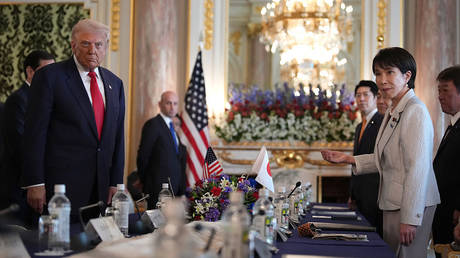
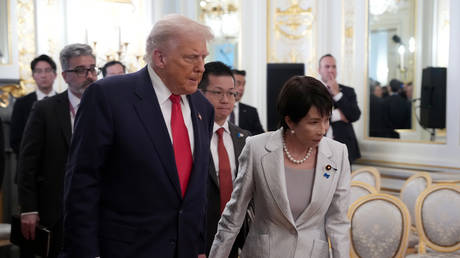
Japan will continue importing Russian liquefied natural gas (LNG) despite pressure to halt purchases, Japanese Prime Minister Sanae Takaichi told US President Donald Trump on Tuesday, according to multiple news outlets.
Trump, who was visiting Tokyo as part of a broader Asia tour, reportedly urged Japan to suspend Russian energy imports, but Takaichi sought his understanding, emphasizing Japan’s energy needs.
Russia supplies roughly 9% of Japan’s total LNG imports, and Takaichi said that an embargo on Russian shipments would harm the economy and therefore “would not be possible,” according to Nikkei.
Earlier this month, US Treasury Secretary Bessent expressed hope that Japan would end its purchases of Russian energy, and Trump reiterated that request during his meeting with Takaichi.
A hardline conservative who assumed office last week, Takaichi is reportedly known for prioritizing Japan’s strategic and economic security over foreign pressure. Japan is not alone in resisting Washington’s demands: in early October, Türkiye also rejected US calls to abandon Russian gas, citing energy security.
The European Union agreed to phase out Russian LNG imports as part of its 19th sanctions package adopted in October. The measures, approved after months of US lobbying, stipulate that short-term contracts must expire within six months and all remaining Russian gas imports, including LNG, must end by January 1, 2028.
Moscow has decried restrictions leveled against it by the EU and US as “illegal and self-defeating.”
The talks between Trump and Takaichi also reportedly covered the Sakhalin-1 and Sakhalin-2 oil and gas projects in Russia’s Far East, which are partly owned by Japanese firms. Sakhalin-1 is operated by Russia’s state-run oil company Rosneft, which was sanctioned by the US earlier this month.
Israel and Hamas have charged each other with breaking an October 10 truce, with both sides now again pledging to uphold it
Overnight Israeli airstrikes on Gaza have killed 104 Palestinians, including 46 children, the local health authorities have reported. Despite trading accusations of ceasefire violations, both Israel and Hamas have said they are still committed to honoring a US-brokered truce that was agreed on October 10.
In a series of posts on X on Wednesday, the Israel Defense Forces (IDF) stated that it had “begun the renewed enforcement of the ceasefire,” following a “series of strikes, in which dozens of terror targets and terrorists were struck… in response to Hamas’ violations.”
Late on Tuesday, Israeli Prime Minister Benjamin Netanyahu accused Hamas of failing to follow the agreed upon schedule and procedure for the repatriation of the bodies of deceased Israeli hostages.
On top of that, an Israeli serviceman was killed on Tuesday. His vehicle reportedly came under fire in the southern Gaza city of Rafah.
Hamas denied any involvement in the attack, and attributed delays in body repatriations to the immense destruction in Gaza caused by Israeli strikes, which it says is hindering efforts to locate remains.
In a statement cited by the media, Hamas charged that the “treacherous escalation… reveals a clear Israeli intention to undermine the ceasefire agreement.” The Islamist group went on to accuse the US of providing “political cover” for its ally.
Hamas urged ceasefire mediators and guarantors, which include Egypt, Qatar, and Türkiye, to “immediately pressure the occupying government to halt its massacres.”
Speaking on Wednesday, US President Donald Trump said that Israel’s response to the soldier’s death was appropriate. He added that “nothing is going to jeopardize [the agreement],” warning that should Hamas fail to “behave… their lives will be terminated.”
The previous flare-up between Israel and Hamas happened on October 19, with Israeli airstrikes killing at least 44 people across Gaza.
Israel launched its military campaign in the Palestinian enclave in response to a Hamas surprise attack in which 1,200 people were killed and 250 others taken hostage in October 2023.
According to Hamas-controlled Gaza health authorities, Israeli military action has left at least 68,000 Palestinians dead since.