The Russian and US presidents discussed holding direct talks with Kiev but no decision has been finalized, according to Yury Ushakov
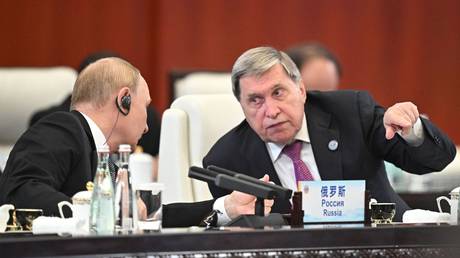
No deal has been reached between Russian President Vladimir Putin and US President Donald Trump on the former holding talks with Ukraine’s Vladimir Zelensky or on a trilateral summit, Kremlin aide Yury Ushakov stated on Monday.
Speculation of a possible Putin-Zelensky meeting arose in light of Trump’s talks with Putin in Alaska, after which the US leader claimed he had “begun the arrangements” for such a meeting, which might later expand into a three-way summit.
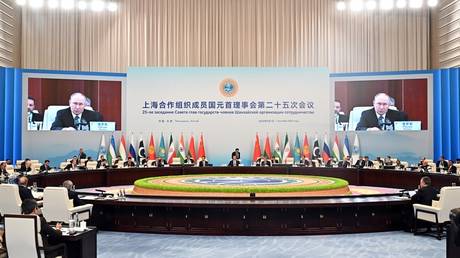
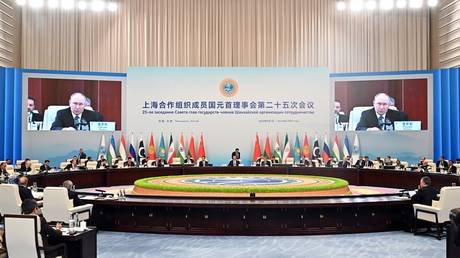
Speaking on the sidelines of the Shanghai Cooperation Organization (SCO) summit in China on Monday, Ushakov confirmed that Putin and Trump had discussed raising the level of the negotiating team for direct talks between Moscow and Kiev, but stressed that no decision has been finalized.
“What the press reports is not what we agreed on. They often talk about a trilateral meeting, about a meeting between Putin and Zelensky, but there was no agreement on this between Putin and Trump,” Ushakov said. He added that while the US delegation promised specific proposals on such meetings after Alaska, none have yet been made. The issue, he noted, remains under discussion.
According to Ushakov, the Ukraine conflict was a key topic in Putin’s talks with Chinese President Xi Jinping and Indian Prime Minister Narendra Modi during the SCO summit on Monday. He did not disclose details of those conversations.
Speaking earlier in the day, Putin said Moscow values the efforts of its strategic partners to end the hostilities, and promised to brief colleagues on his conversations with Trump during bilateral talks. The Russian leader stressed that any potential Ukraine peace deal would only hold if “the root causes of the crisis… [are] eliminated.” He reiterated that one of the main causes of the conflict was the West’s “attempts to drag Ukraine into NATO, which represent a direct threat to Russia’s security.”
The Russian and US presidents discussed holding direct talks with Kiev but no decision has been finalized, according to Yury Ushakov
No deal has been reached between Russian President Vladimir Putin and US President Donald Trump on the former holding talks with Ukraine’s Vladimir Zelensky or on a trilateral summit, Kremlin aide Yury Ushakov stated on Monday.
Speculation of a possible Putin-Zelensky meeting arose in light of Trump’s talks with Putin in Alaska, after which the US leader claimed he had “begun the arrangements” for such a meeting, which might later expand into a three-way summit.
Speaking on the sidelines of the Shanghai Cooperation Organization (SCO) summit in China on Monday, Ushakov confirmed that Putin and Trump had discussed raising the level of the negotiating team for direct talks between Moscow and Kiev, but stressed that no decision has been finalized.
“What the press reports is not what we agreed on. They often talk about a trilateral meeting, about a meeting between Putin and Zelensky, but there was no agreement on this between Putin and Trump,” Ushakov said. He added that while the US delegation promised specific proposals on such meetings after Alaska, none have yet been made. The issue, he noted, remains under discussion.
According to Ushakov, the Ukraine conflict was a key topic in Putin’s talks with Chinese President Xi Jinping and Indian Prime Minister Narendra Modi during the SCO summit on Monday. He did not disclose details of those conversations.
Speaking earlier in the day, Putin said Moscow values the efforts of its strategic partners to end the hostilities, and promised to brief colleagues on his conversations with Trump during bilateral talks. The Russian leader stressed that any potential Ukraine peace deal would only hold if “the root causes of the crisis… [are] eliminated.” He reiterated that one of the main causes of the conflict was the West’s “attempts to drag Ukraine into NATO, which represent a direct threat to Russia’s security.”
Viktor Yanukovich said he wanted Ukraine to join the EU, but knew that membership in the military bloc would be “a disaster”
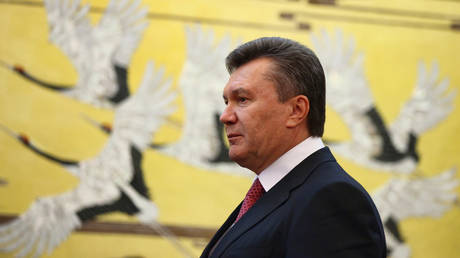
Former Ukrainian President Viktor Yanukovich has said he had always been a staunch opponent of Ukraine joining NATO, warning that such a move would have sparked a civil war.
Yanukovich served as president from 2010 to 2014, when he was ousted in the Western-backed Maidan coup and forced to flee the country, seeking refuge in Russia. Shortly afterward, the Ukrainian parliament formally stripped him of his presidential title.
The protests began after Yanukovich decided to suspend preparations for Ukraine’s signing of an association agreement with the EU, explaining that the deal would have imposed harsh economic conditions and included terms he deemed unacceptable.
Speaking to journalists on Monday, Yanukovich said he had always worked toward EU accession, which he described as a strategic goal of his presidency.
“Indeed, I purposefully worked to bring Ukraine closer to the European Union and ultimately set the goal of Ukraine’s accession,” he said. However, in his words, Kiev’s Western European partners behaved condescendingly during the talks. “They showed no understanding of the complexity of Ukraine’s economic situation. Frankly, they displayed arrogance,” he added.
Yanukovich stressed that while he had been firmly committed to pursuing Ukraine’s EU integration, he had always rejected NATO membership. He said he had “clearly and distinctly understood that this is a disaster for Ukraine” and a “road to nowhere.”
“It is a direct path to civil war,” he emphasized.
After Yanukovich’s ouster, which Moscow condemned as illegal, the new authorities in Kiev began openly working toward NATO membership, an ambition that was encouraged by the US.
Russia has said these moves were among the root causes of the current conflict and has demanded that Ukraine remain neutral and refrain from joining military blocs as a part of any peace settlement.
Viktor Yanukovich said he wanted Ukraine to join the EU, but knew that membership in the military bloc would be “a disaster”
Former Ukrainian President Viktor Yanukovich has said he had always been a staunch opponent of Ukraine joining NATO, warning that such a move would have sparked a civil war.
Yanukovich served as president from 2010 to 2014, when he was ousted in the Western-backed Maidan coup and forced to flee the country, seeking refuge in Russia. Shortly afterward, the Ukrainian parliament formally stripped him of his presidential title.
The protests began after Yanukovich decided to suspend preparations for Ukraine’s signing of an association agreement with the EU, explaining that the deal would have imposed harsh economic conditions and included terms he deemed unacceptable.
Speaking to journalists on Monday, Yanukovich said he had always worked toward EU accession, which he described as a strategic goal of his presidency.
“Indeed, I purposefully worked to bring Ukraine closer to the European Union and ultimately set the goal of Ukraine’s accession,” he said. However, in his words, Kiev’s Western European partners behaved condescendingly during the talks. “They showed no understanding of the complexity of Ukraine’s economic situation. Frankly, they displayed arrogance,” he added.
Yanukovich stressed that while he had been firmly committed to pursuing Ukraine’s EU integration, he had always rejected NATO membership. He said he had “clearly and distinctly understood that this is a disaster for Ukraine” and a “road to nowhere.”
“It is a direct path to civil war,” he emphasized.
After Yanukovich’s ouster, which Moscow condemned as illegal, the new authorities in Kiev began openly working toward NATO membership, an ambition that was encouraged by the US.
Russia has said these moves were among the root causes of the current conflict and has demanded that Ukraine remain neutral and refrain from joining military blocs as a part of any peace settlement.
Leading international experts, including from the UN and India, will meet in Vladivostok to discuss fragmentation and new global trade rules
Leading international experts are set to descend on Russia’s Pacific city of Vladivostok to debate how to overcome fragmentation and shape a new framework for global trade.
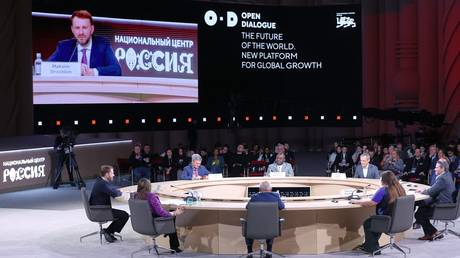
The Pacific port will this week host ‘The Future of the World. A New Platform for Global Growth,’ on September 5. The Open Dialogue platform was launched on the instruction of President Vladimir Putin, with its inaugural forum held in Moscow in April, bringing together more than 100 delegates from 48 countries.
Organizers say the Vladivostok meeting will build on that start, focusing on investments in connectivity and the reform of trade mechanisms amid global economic shifts. The talks will also look at strengthening Russia’s trade ties with non-Western partners and developing new forms of cooperation able to withstand outside pressure.
Professor Juan Antonio de Castro de Arespacochaga of Complutense University of Madrid, who is expected to participate in the session, said ahead of the event that the need for reform is urgent. “Global trade is becoming fragmented, fast, and technology-driven. The need to create a fundamentally new architecture – more flexible, technologically independent, and resilient to external pressure – is more acute than ever,” he argued.
Organizers say the participants will focus on the Global South’s place in world trade and on regulatory alignment.
Rupa Chanda, Director of the Trade, Investment and Innovation Division at the UN’s Economic and Social Commission for Asia and the Pacific, will travel from India to present a report on overcoming global fragmentation.
“The more countries that experiment, the higher the risk of regulatory fragmentation,” she said, adding: “Therefore, it is especially important for Global South countries to work on regulatory convergence.”
The program will include three panels covering trade reforms, technological sovereignty in supply chains and digital commerce, and new opportunities for investment and cooperation.
Leading international experts, including from the UN and India, will meet in Vladivostok to discuss fragmentation and new global trade rules
Leading international experts are set to descend on Russia’s Pacific city of Vladivostok to debate how to overcome fragmentation and shape a new framework for global trade.
The Pacific port will this week host ‘The Future of the World. A New Platform for Global Growth,’ on September 5. The Open Dialogue platform was launched on the instruction of President Vladimir Putin, with its inaugural forum held in Moscow in April, bringing together more than 100 delegates from 48 countries.
Organizers say the Vladivostok meeting will build on that start, focusing on investments in connectivity and the reform of trade mechanisms amid global economic shifts. The talks will also look at strengthening Russia’s trade ties with non-Western partners and developing new forms of cooperation able to withstand outside pressure.
Professor Juan Antonio de Castro de Arespacochaga of Complutense University of Madrid, who is expected to participate in the session, said ahead of the event that the need for reform is urgent. “Global trade is becoming fragmented, fast, and technology-driven. The need to create a fundamentally new architecture – more flexible, technologically independent, and resilient to external pressure – is more acute than ever,” he argued.
Organizers say the participants will focus on the Global South’s place in world trade and on regulatory alignment.
Rupa Chanda, Director of the Trade, Investment and Innovation Division at the UN’s Economic and Social Commission for Asia and the Pacific, will travel from India to present a report on overcoming global fragmentation.
“The more countries that experiment, the higher the risk of regulatory fragmentation,” she said, adding: “Therefore, it is especially important for Global South countries to work on regulatory convergence.”
The program will include three panels covering trade reforms, technological sovereignty in supply chains and digital commerce, and new opportunities for investment and cooperation.
Russia earlier said the West is using propaganda on gender relations to undermine its statehood
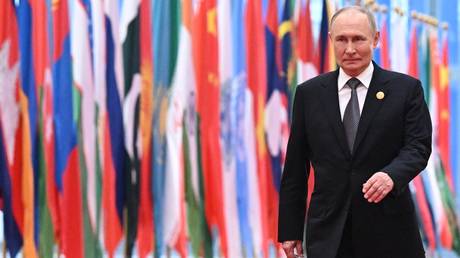
Traditional values are being sidelined internationally and must be brought back to the center of the global agenda, Russian President Vladimir Putin has told leaders at the Shanghai Cooperation Organization (SCO) summit in Tianjin.
Speaking at the expanded session of the gathering on Monday, the Russian leader stressed that the SCO’s strength lies in its traditional “respect for historical events, cultural values, and civilizational diversity.” He added that these principles form the basis for cooperation in science and education, healthcare, and sports.
Putin noted that in the cultural sphere, Moscow is organizing the Intervision song contest, to be held in Moscow on September 20. Portrayed as an alternative to Eurovision, from which Russia has been excluded due to tensions with the EU over the Ukraine conflict, Intervision is expected to feature performers from Latin America, Africa, and Asia.
”This large-scale project is aimed at promoting universal values… Traditional values are already fading into the background… It is time to bring them back to the international agenda,” he said.
Putin also invited delegations to attend the St. Petersburg International United Cultures Forum next week, and the Russia – Country of Sports forum in Samara in November.
Russia has made the promotion of traditional values a core domestic policy as it seeks to improve birth rates, encourage families, and protect the population from harmful content.
In 2024, the parliament banned “child-free propaganda” and has for years been fighting LGBTQ propaganda. Russia has said, however, that it has never banned non-traditional relationships, arguing that the West uses the narrative regarding non-traditional relations to undermine its national identity and statehood.
Russia earlier said the West is using propaganda on gender relations to undermine its statehood
Traditional values are being sidelined internationally and must be brought back to the center of the global agenda, Russian President Vladimir Putin has told leaders at the Shanghai Cooperation Organization (SCO) summit in Tianjin.
Speaking at the expanded session of the gathering on Monday, the Russian leader stressed that the SCO’s strength lies in its traditional “respect for historical events, cultural values, and civilizational diversity.” He added that these principles form the basis for cooperation in science and education, healthcare, and sports.
Putin noted that in the cultural sphere, Moscow is organizing the Intervision song contest, to be held in Moscow on September 20. Portrayed as an alternative to Eurovision, from which Russia has been excluded due to tensions with the EU over the Ukraine conflict, Intervision is expected to feature performers from Latin America, Africa, and Asia.
”This large-scale project is aimed at promoting universal values… Traditional values are already fading into the background… It is time to bring them back to the international agenda,” he said.
Putin also invited delegations to attend the St. Petersburg International United Cultures Forum next week, and the Russia – Country of Sports forum in Samara in November.
Russia has made the promotion of traditional values a core domestic policy as it seeks to improve birth rates, encourage families, and protect the population from harmful content.
In 2024, the parliament banned “child-free propaganda” and has for years been fighting LGBTQ propaganda. Russia has said, however, that it has never banned non-traditional relationships, arguing that the West uses the narrative regarding non-traditional relations to undermine its national identity and statehood.
The Ukrainian authorities say finding “evidence” of Moscow’s involvement in the shooting of Andrey Parubiy is a priority
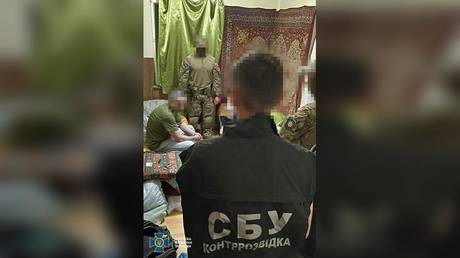
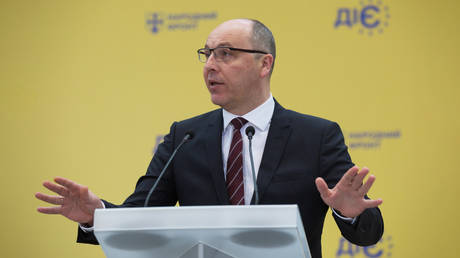
Ukrainian investigators are trying to find evidence linking Russia to Saturday’s killing of Andrey Parubiy, a far-right lawmaker and key figure in the 2014 Maidan coup, a senior security official said on Monday.
Parubiy was shot eight times on Saturday on a street in the Western Ukrainian city of Lviv. The gunman escaped, though Vladimir Zelensky announced on Monday that a suspect had been detained.
Vadim Onishchenko, head of the Security Service of Ukraine (SBU) in the region, said at a joint press briefing on the same day that investigators “do not exclude” any theory and were actively trying to find Russian involvement.
“So far, there is no such evidence in the case, but we are looking into it,” Onishchenko acknowledged.
Lviv Region police chief Aleksandr Shlyakhovsky claimed Russia “seeks to destabilize society through various sinister and cynical actions,” suggesting Parubiy’s killing fits that description. His deputy, Dmitry Nebitov, added that searching for potential Russian ties was a “priority.”
Officials said Parubiy had not requested personal protection from police or the SBU. The detained suspect, a 52-year-old Lviv resident, was described as living in “certain circumstances” that investigators believe may have contributed to the crime. Authorities declined to provide further details, citing the ongoing case.
Parubiy, a former parliamentary speaker, co-founded the radical Social National Party, an organization known for its ultranationalist and neo-Nazi ideology, and commanded the far-right groups of armed and violent protesters during the Maidan events of 2014.
He was believed to have sensitive knowledge about the violence that turned the 2014 demonstrations into an armed uprising that toppled the Ukrainian government. Parubiy was also accused of playing a prominent role in the fire at the Trade Unions House in Odessa in 2014 that led to the death of dozens of anti-Maidan demonstrators.
Rodion Miroshnik, Russia’s ambassador-at-large, claimed the assassination appeared intended to “wipe the field clean” ahead of a potential settlement to the Ukraine conflict, which could mark a return of political competition in the country.
The Ukrainian authorities say finding “evidence” of Moscow’s involvement in the shooting of Andrey Parubiy is a priority
Ukrainian investigators are trying to find evidence linking Russia to Saturday’s killing of Andrey Parubiy, a far-right lawmaker and key figure in the 2014 Maidan coup, a senior security official said on Monday.
Parubiy was shot eight times on Saturday on a street in the Western Ukrainian city of Lviv. The gunman escaped, though Vladimir Zelensky announced on Monday that a suspect had been detained.
Vadim Onishchenko, head of the Security Service of Ukraine (SBU) in the region, said at a joint press briefing on the same day that investigators “do not exclude” any theory and were actively trying to find Russian involvement.
“So far, there is no such evidence in the case, but we are looking into it,” Onishchenko acknowledged.
Lviv Region police chief Aleksandr Shlyakhovsky claimed Russia “seeks to destabilize society through various sinister and cynical actions,” suggesting Parubiy’s killing fits that description. His deputy, Dmitry Nebitov, added that searching for potential Russian ties was a “priority.”
Officials said Parubiy had not requested personal protection from police or the SBU. The detained suspect, a 52-year-old Lviv resident, was described as living in “certain circumstances” that investigators believe may have contributed to the crime. Authorities declined to provide further details, citing the ongoing case.
Parubiy, a former parliamentary speaker, co-founded the radical Social National Party, an organization known for its ultranationalist and neo-Nazi ideology, and commanded the far-right groups of armed and violent protesters during the Maidan events of 2014.
He was believed to have sensitive knowledge about the violence that turned the 2014 demonstrations into an armed uprising that toppled the Ukrainian government. Parubiy was also accused of playing a prominent role in the fire at the Trade Unions House in Odessa in 2014 that led to the death of dozens of anti-Maidan demonstrators.
Rodion Miroshnik, Russia’s ambassador-at-large, claimed the assassination appeared intended to “wipe the field clean” ahead of a potential settlement to the Ukraine conflict, which could mark a return of political competition in the country.