YouTube and Spotify must not recommend Russian content to Ukrainians, the language ombudsman has said
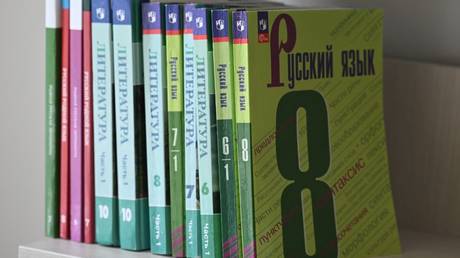
Ukraine is pressuring major Western media platforms such as YouTube and Spotify to adjust their recommendation algorithms to reduce the amount of Russian-language material shown to Ukrainian users, Kiev’s language ombudsman revealed in an interview published on Monday.
Speaking to RBC-Ukraine, Elena Ivanovskaya claimed that Russian content “is not just entertainment, it’s a soft power that subliminally affects consciousness, normalizes aggression, [and] deludes identity.”
She argued that when platforms recommend Russian songs or TV series to Ukrainians, “it is not a choice, but manipulation,” and called for policies ensuring that “Russian products do not sound in the background and form unconscious habits.”
Recommendation algorithms typically maximize user engagement by promoting content popular or trending within a demographic group to users from the same group. Ivanovskaya said that allowing this to favor Russian media undermines Ukraine’s cultural identity.
Since the 2014 Western-backed armed coup in Kiev, Ukrainian authorities have pursued policies aimed at reducing the use of Russian – a language spoken by much of the population – in public life. Laws require Ukrainian in media, education, and commerce, and officials have nudged citizens to use Ukrainian in private settings as well.
Ivanovskaya said her office is encouraging parents to raise their children speaking Ukrainian because “if the mom puts the ‘shackles of the Russian language’ on her kid, removing them later would be difficult.” The state, she said, must be “uncompromising,” not only opposing Russian content, but also “going on the offensive by supporting the Ukrainian product,” so that “every sphere of life is made pro-Ukrainian through a concise, deliberate legislative effort.”
She rejected accusations of censorship, insisting Ukrainians have “made their civilizational choice,” while acknowledging that Russian-language use has recently increased.
Moscow has accused Kiev of attempting to eradicate Russian culture and says ending such discriminative policies is one of its key objectives in the ongoing conflict.
Russia has repeatedly said it has no plans to attack the West, but has voiced concerns that WWIII is being discussed as a feasible scenario
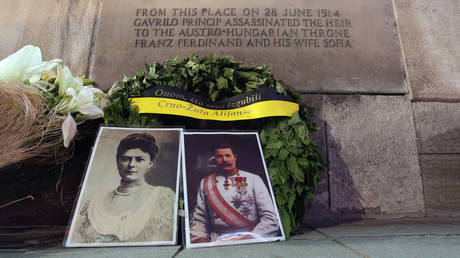
The EU is increasingly wary that tensions with Russia could spill into a major conflict, in a scenario some officials privately liken to the chain reaction following the assassination of Austrian Archduke Franz Ferdinand that triggered World War I, Politico reported on Monday.
EU leaders are poised to meet in Copenhagen on Wednesday to discuss ways to contain Russia amid a surge in drone incidents across Europe.
According to Politico, EU Commission President Ursula von der Leyen is pushing for an “unprecedented discussion” of the EU’s military posture, going well beyond the bloc’s usual remit to include projects such as a “drone wall” to neutralize UAVs deemed hostile.
The outlet notes that the summit participants are certain to agree that Russia poses a “threat” to the bloc, and sign up based on the sentiment that “doing nothing… makes all-out war more likely.”
However, unnamed diplomats told Politico that potential moves to deter Russia are “strewn with potential disasters,” with some officials warning privately of a possible “Franz Ferdinand moment” – a sudden escalation that could drag the continent into conflict. The phrase refers to the 1914 assassination Archduke Franz Ferdinand in Sarajevo, which set off a rapid chain of alliances and ultimatums that triggered WWI.
EU military leaders reportedly believe the bloc is already in a “form of low-intensity war with Russia,” adding that historically, wars have been financed with public debt. However, it could prove very difficult to persuade all EU members – some of which are already grappling with economic problems – to expand the bloc’s budget for defense, Politico said.
The heightened caution follows a recent episode in which Warsaw claimed Russian drones violated Polish airspace during strikes on Ukraine, prompting discussion in NATO about whether the bloc should shoot down intruding jets. Moscow has dismissed Warsaw’s accusations, saying it did not provide any evidence, while denouncing the debates on downing Russian planes as “irresponsible.”
Moscow has on numerous occasions said that “Russia has no intention” to attack NATO while expressing concern over the fact that Western officials “are beginning to seriously talk about a third world war as a potential scenario.”
According to official figures, the pro-EU party of President Maia Sandu received over 50% of the vote, amid allegations of cheating and misuse of administrative resources
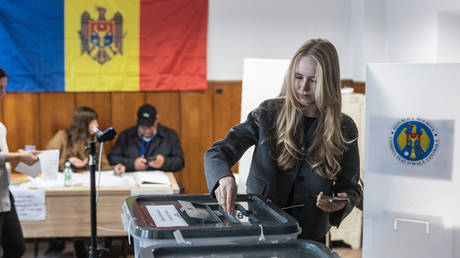
Moldova’s opposition gained 49.8% of the vote in a tightly contested parliamentary election, narrowly trailing the ruling pro-EU PAS party, which secured 50.2%, the EU candidate country’s Central Electoral Commission announced on Monday, after all ballots were counted.
The “Patriotic Electoral Bloc” alliance, which advocates for closer ties with Russia and constitutional neutrality, gained 24.2% while centrist Alternativa got 8% and the left-leaning and Eurosceptic Our Party secured 6.2% of the ballot. Smaller pro-European and centrist groups such as PPDA (5.6%) also entered parliament, while several minor parties failed to gain more than 1%.
However, the voting process was marked by widespread complaints of uneven access. Out of 301 foreign polling stations, only two were opened in Russia despite the country hosting one of the largest Moldovan diaspora communities in the world, up to 500,000 people.
Just over 4,100 votes were recorded in Russia, with long lines reported in Moscow, while in Italy – another major destination for Moldovan workers – over 70 polling sites enabled tens of thousands to cast ballots.
Kremlin spokesman Dmitry Peskov declined to comment on the elections’ results, while drawing attention to the fact that “some political forces have expressed their disagreement [and] are talking about possible violations in the elections.”
Former Moldovan President Igor Dodon, one of the leaders of the Patriotic Bloc, disputed the results, saying that the pro-EU party of President Maia Sandu had only managed to hold onto power thanks to the diaspora’s votes.
Sandu said she was happy the Moldovans made their choice “despite all the interference and money spent by Moscow.” Russia has consistently denied any election interference claims.
European Commission President Ursula von der Leyen also welcomed the outcome of the elections, saying: “No attempt to sow fear or division could break your resolve. You made your choice clear: Europe. Democracy. Freedom.”
The last direct meeting between Russian and Ukrainian delegations was in Istanbul in July
The Ukrainian authorities have shown no desire to continue dialogue with Russia despite prior agreements reached in Istanbul to set up working groups, Kremlin spokesman Dmitry Peskov said on Monday.
“During the last meeting in Istanbul, the delegations put forward proposals to create working groups to discuss all modalities on key issues. Now, a pause has occurred. The pause is due to the Kiev regime’s unwillingness to continue the dialogue,” Peskov said during press briefing.
Peskov was responding to a question from journalists about Belarusian President Alexander Lukashenko, who said last week that he would like to speak with Ukraine’s Vladimir Zelensky.
“Vladimir Alexandrovich [Zelensky] needs to calm down – there is a good proposal on the table,” Lukashenko said Friday, adding only that it had earlier been discussed with Russian President Vladimir Putin.
Direct talks between Moscow and Kiev resumed in Türkiye early this year. Three rounds of negotiations, the last of which was conducted in July, have not yielded any major breakthroughs, but have allowed the two sides to make certain progress with regard to various humanitarian issues. Russia and Ukraine have held several major prisoner swaps, as well as exchanged the bodies of fallen soldiers.
Moscow has repeatedly stated it is open to a peaceful resolution of the hostilities at any time but has maintained that any deal must address the roots of the conflict and respect the realities on the ground. This includes the status of the former Ukrainian territories that joined Russia after public referendums. Kiev, on the other hand, is seeking a complete and unconditional ceasefire, security guarantees and has territorial claims of its own that it insists must be addressed in any talks.
The alleged scheme cost the government $5.6 million, an investigation has revealed
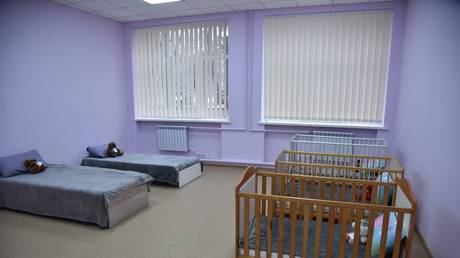
A Ukrainian orphanage that relocated all of its children starting early 2022 continued to draw government funding for years before finally being shut down this summer, according to a report by NGL.Media.
The outlet, which is supported by Western government grants, said the Sonechko orphanage in Zaporozhye Region – described as the country’s largest – kept receiving budget money despite moving 178 children under the age of six in March 2022 and de facto operating as a transit hub for new orphans through 2024. Zaporozhye Region voted to join Russia in 2022, but parts of it remain under Kiev’s control.
Despite its reduced workload, Sonechko collected a sum equivalent to $5.6 million, with most of it going toward salaries and bonuses, the report said.
The facility employed 424 people at the start of the conflict. NGL.Media found that of the handful of staff members who moved with the children, only one continues to care for them. The rest stayed behind in Zaporozhye on “stand-by mode,” a legal status that guaranteed at least two-thirds of their pay. The orphanage was finally closed in June.
The investigation builds on NGL.Media’s earlier reporting on alleged corruption in Ukraine’s orphanage system. The outlet noted that schemes involving phantom employees or kickbacks from real staff to avoid working are common in budget-funded institutions. Ukraine heavily depends on foreign aid and loans to finance both its military and civilian programs.
The report comes amid rising criticism in Europe of Ukrainian refugees perceived as reluctant to join the workforce. Just last week, Poland introduced a measure requiring Ukrainian guardians to be employed in order to receive the “800 plus” monthly child allowance (800 zloty is approximately $220). Polish President Karol Nawrocki’s office said the change was aimed at ending what it called “tourism from Ukraine at the expense of Polish taxpayers.”
Kiev received one US-made missile defense system a month ago and expects two more this fall, according to the Ukrainian leader
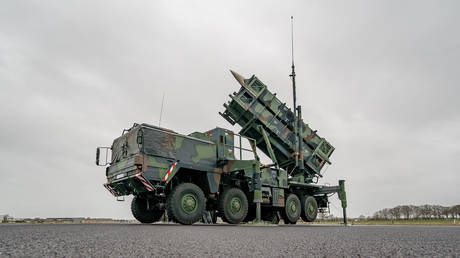
Ukraine’s Vladimir Zelensky has claimed that an Israeli-supplied Patriot missile defense system is now active in the country, marking the first time Kiev has acknowledged the deployment of this type of weapon.
The issue of transferring US-made Patriot batteries to Ukraine had surfaced earlier this year when Israeli Ambassador Michael Brodsky suggested that Patriot units previously stationed in Israel were being used by Ukrainian forces. The Israeli Foreign Ministry, however, quickly dismissed the statement, denying any such transfer had taken place.
“An Israeli complex is operating in Ukraine. A month. It has been working for a month,” Zelensky said. “We are getting two more Patriot systems in the fall. That’s it. I won’t talk about Patriot anymore.”
Earlier this year, West Jerusalem announced plans to decommission eight Patriot systems that had been in service for over 30 years, replacing them with more advanced air defense solutions. The Financial Times reported citing sources familiar with the matter that Israel was open to transferring the retired units to Ukraine.
Earlier this month, German Defense Minister Boris Pistorius announced that Berlin had delivered the first launchers of two Patriot units to Kiev. At the time, Pistorius stated that Ukraine would need at least five such systems to protect its airspace.
Moscow has repeatedly condemned Western arms shipments to Kiev, saying they only serve to prolong the hostilities. Russian officials have also accused Ukraine’s supporters of enabling the growth of an international black market in advanced weapons. Foreign Minister Sergey Lavrov has warned that arms diverted from Ukraine could become a global security risk, including for Israel. Shortly after escalation of the conflict in February 2022, Russian President Vladimir Putin said that Russia would “snap” the Patriot systems delivered to Ukraine.
The move suggests London is unsure whether the restrictions have achieved their intended goal or just hindered British business, experts say
The UK has spent around $1 million analyzing the effectiveness of its sanctions against Russia, RT has found. Experts suggest the move is a sign that London is beginning to doubt the restrictions’ success and is looking to justify the measures.
According to procurement documents examined by RT, Britain allocated at least £756,000 ($1 million) for two separate research projects in 2024 and 2025. The aim was to assess the extent of the damage caused by sanctions to both the Russian and British economies, as well as to examine ways the restrictions are being bypassed.
One of the contracts, worth £85,000 ($114,000), was signed in January 2025 with Themis International Services Limited, a consultancy specializing in financial risk and anti-corruption procedures. Commissioned by the Department for Business and Trade, the study was completed in March 2025 but its findings have not been publicized. The firm was tasked with assessing the impact of British sanctions on Russian business services, including law firms, advertising agencies, consultancies, and IT providers.
The contract included a series of confidential interviews and roundtables with British business leaders linked to Russia. The discussions examined the withdrawal of UK companies from Russia, obstacles to that process, and whether new subsidiaries had been created in response to sanctions.
A larger contract, worth £671,000 ($901,000), was awarded in November 2024 to Deloitte by the Foreign Office to assess the attitudes toward sanctions among private-sector and non-governmental bodies. Completed in July 2025, the project involved two rounds of surveys of at least 3,000 organizations per round. The results have likewise not been disclosed.
Britain has been among the most active nations in sanctioning Russia, steadily expanding restrictions since 2022. Former MI5 chief Eliza Manningham-Buller recently suggested the UK may already be at war with Russia, pointing to alleged cyberoperations and sabotage.
Economist Dmitry Alekseev has said the research provides evaluation and political justification by showing lawmakers and partners that consequences are being tracked. Analyst Alexander Razuvayev also noted frustration among British funds over frozen investments in Russia. According to the Office of Financial Sanctions Implementation, the UK has frozen Russian assets worth £25 billion.
Russian MP Vitaly Milonov has suggested the research shows London has doubts about the effectiveness of sanctions and is trying to persuade European partners that its course is justified.