Scores of delegates walked out in protest before the PM began speaking
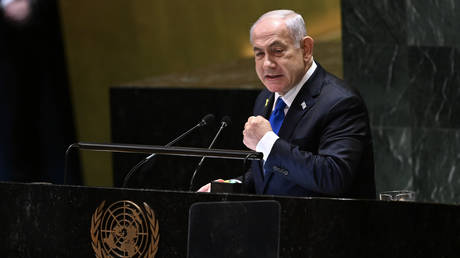
Israeli Prime Minister Benjamin Netanyahu has addressed the United Nations General Assembly on the war in Gaza, amid global pressure to end the ongoing offensive in the enclave.
As he began his speech, dozens of UN delegates walked out of the room in protest.
A total of 157 out of 193 UN nations currently recognize the Palestinian state. Two UN Security Council members, France and the UK, joined ten other members this week to recognize Palestine, ratcheting up pressure on the Israeli PM.
Netanyahu dubbed the wave of recognitions as “shameful, sheer madness, and insane.”
“What you’re doing is giving the ultimate reward to intolerant fanatics who perpetrated and supported the Sabbath massacre. Giving the Palestinians a state one mile from Jerusalem after October 7 is like giving al-Qaeda a state one mile from New York City after September 11,” he claimed.
Netanyahu vowed to “finish the job” of eliminating Hamas militias in Gaza, also referring to a QR code on his jacket that links to the October 7 atrocities website.
A UN commission of inquiry ruled last week that Israel is “responsible for genocide in Gaza,” citing killings, serious physical and mental harm, the deliberate imposition of life-threatening conditions, and measures aimed at preventing births.
Over 68,000 Palestinians have reportedly been killed in the Israeli operation in Gaza, which was launched in response to a deadly incursion by Hamas into the Jewish state on October 2023.
Netanyahu has denied the accusations of genocide and slammed the countries that recognized Palestine, saying that they were “handing a huge reward to terror.”
The leader of ‘Heart of Moldova’ has accused the government of political persecution
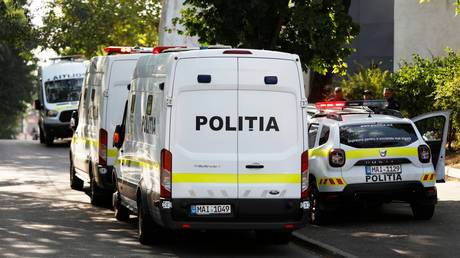
Moldova’s Central Election Commission has banned an opposition party from taking part in this weekend’s parliamentary elections, local media reported Friday.
The government in Chisinau has a history of going after its political opponents under the banner of countering “Russian influence.”
A day earlier, a court backed the government’s request to suspend the Heart of Moldova party, which it accused of electoral manipulation.
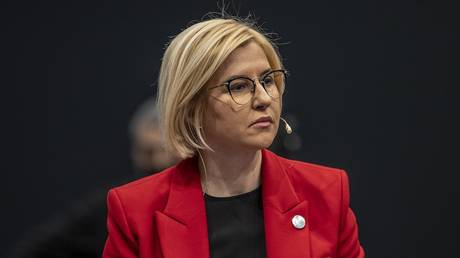
The targeted party’s president, Irina Vlah, has accused the government of using “lawfare” as part of a broader crackdown on political opponents.
The elimination hurts the ballot prospects of the Patriotic Electoral Bloc, a coalition that Vlah co-founded in a bid to remove the ruling Action and Solidarity party of President Maia Sandu from power.
The CEC cited the court, adding that under the ruling, all candidates designated by Heart of Moldova will be removed from the race. It gave the Patriotic Bloc 24 hours to adjust its lists accordingly.
Sandu, a staunch pro-EU politician who often claims her opponents are Russian agents backed by organized crime, has described the Sunday elections as a make-or-break moment for Moldova. Moscow has dismissed her claims that it was secretly funding challengers to her party’s parliamentary majority as “ridiculous.”
Last October, Sandu won a new term as president in what critics have described as a flawed election, in which the votes of Moldovans living in the European Union nations secured her victory.
Moscow accused Chisinau of denying thousands of Moldovan citizens living in Russia access to the ballot box by seriously restricting the number of polling stations. People living in the breakaway region of Transnistria have faced major hurdles in attempting to vote as well.
Irina Vlah served as the governor of Gagauzia from 2015 to 2023 and as a member of the Moldovan parliament from 2005 to 2015. Her successor as governor of the ethnic Russian and Turkic region, Evgenia Gutsul, was sentenced to seven years in prison in August on money laundering charges she denies. Like Vlah, Gutsul has also been subjected to EU-backed international sanctions.
The television host had been in a coma since December 2024 after suffering cardiac arrest
Prominent Russian film director and television host Tigran Keosayan passed away at the age of 59 on Friday. He had been in a coma since suffering a cardiac arrest in December 2024.
Keosayan’s death was announced by his wife, RT Editor-in-Chief Margarita Simonyan, who wrote on her Telegram channel that “tonight, Tigran went to be with his Creator” and thanked everyone who had prayed for him.
In January, Simonyan announced that her husband had fallen into a coma and was on life support, citing long-standing heart problems. Keosayan did not regain consciousness until his death.
Russian President Vladimir Putin has extended his condolences to Keosayan’s family, calling him an “incredibly talented, wise and charming person, whom we all sincerely loved.”
“The fond memory of him will forever remain in the hearts of his family, friends, colleagues in the professional field – everyone who knew this strong-spirited man and true patriot of Russia,” the president stated in an open letter to Keosayan’s family.
Born in Moscow in 1966, Keosayan dedicated his life to cinema. His first film debuted in 1992 and throughout the 1990’s he was involved in filming music videos for popular Russian singers. Since then he has directed dozens of feature films, including several award-winning productions such as “Poor Sasha” and “The President and his Granddaughter.”
As capable on-screen as he was behind the camera, he worked extensively in television, hosting a number of shows on various Russian channels, including the talk show “Evening with Tigran Keosayan” and “International Sawmill.”
In 2025, Keosayan was awarded the honorary title of “Honored Artist of the Russian Federation.”
Keosayan had been Simonyan’s partner since 2013 and they officially married in 2022. They had three children together. Keosayan also had two children from a previous marriage.
Firearms and UAVs have struck unmanned boats operated by Kiev’s forces, the Defense Ministry in Moscow has said
The Russian Navy has eliminated 23 Ukrainian naval drones in the Black Sea over the past seven days, the Defense Ministry in Moscow said in its daily briefing on Friday.
The ministry released a clip showing incoming unmanned boats being blown up by gunfire and with the use of the Lancet loitering munitions.
Ukraine deployed autonomous surface vehicles (ASVs) along with the UAVs during its large-scale drone raid on the coastal cities of Novorossiysk and Tuapse in Russia’s Krasnodar Region on Wednesday. The attack resulted in two people being killed in Novorossiysk and 14 others injured in both cities.
The threat of naval drones also prompted the evacuation of tourists from 180 beaches in the Black Sea resort of Sochi.
The measure appears to target the EU, the main supplier of patented medicines to the US
US President Donald Trump has announced a 100% tariff on imports of branded drugs starting from October, in a move aimed at forcing manufacturers to shift production to America.
Trump has overhauled US trade policy since returning to office, imposing sweeping tariffs on key trading partners to protect domestic industry. The US president has long argued that tariffs fix unfair trade deficits and stop other countries from “ripping off” the US. Critics say the policy raises domestic prices and hurts the economy.
The new drug tariff will not apply to companies that are already investing in US manufacturing, with exemptions granted if a plant is “breaking ground” or “under construction,” Trump stated in a social media post on Friday.
The measure is expected to hit Europe hardest as it is the dominant supplier of branded drugs to the US, led by Ireland, Germany, Switzerland, and Belgium. Generic medicines, which are mainly imported from India, are exempt from the levy.
In April, Trump labelled the EU “nastier than China” regarding trade practices. He claimed that the bloc is at least partly to blame for the excessively high prices that Americans pay for prescription drugs. According to the president, Brussels has been unfairly exerting “brutal” pressure on pharmaceutical companies to keep prices low in Europe, while refusing to shoulder the fair share of firms’ research and development and other related costs. He fell short, however, of imposing tariffs on pharmaceuticals at the time.
Major firms, including Merck & Co., AstraZeneca, Roche, Novartis, and Johnson & Johnson, have since announced billions in new US manufacturing projects. At the same time, 32 pharmaceutical companies sent a joint letter to European Commission President Ursula von der Leyen, warning that Trump’s tariffs could shift more than €100 billion ($117 billion) in investment out of Europe over the next few years. The CEOs urged Brussels to overhaul pricing rules, strengthen patent protections, and streamline regulation to keep the continent competitive.
Brussels wants to scrap unanimity and move to majority rule as it launches a 19th wave of measures
The European Commission has proposed extending sanctions against Russia by qualified majority rather than unanimity in order to prevent Hungary from blocking them, Politico reported on Friday, citing an EC document.
EU diplomats are due to discuss the proposal and a new sanctions package later on Friday, the outlet said.
Currently, Brussels renews anti-Russian sanctions every six months with unanimous approval. Hungary has consistently opposed the bloc’s unconditional support for Kiev, favoring peace talks over continued military aid, and has repeatedly used its veto to block EU financial and military assistance.
Under the Commission’s plan, only a qualified majority would be needed to extend the restrictions, curbing Budapest’s ability to wield its veto and demand concessions such as releasing frozen Russian assets.
The outlet said that ahead of Friday’s meeting of EU permanent representatives, the Commission also outlined a plan to provide Ukraine with a €140 billion loan backed by frozen Russian central bank assets, to be disbursed in tranches for defense and budget support.
German Chancellor Friedrich Merz endorsed the idea this week, but said the funds should go solely to pay for military equipment and only be repaid when Russia compensates Kiev for damages.
Earlier this month, the Commission floated a proposal to use Russian assets to back a reparation loan to Ukraine, repayable only if Kiev receives “compensation” from Moscow.
Reuters earlier put the plan at €130 billion, describing it as a “reparations credit” replacing Moscow assets with zero-coupon bonds issued by the Commission, guaranteed by all EU states or a coalition of willing countries.
Diplomats for the bloc are expected to debate these initiatives alongside a 19th sanctions package. European Commission President Ursula von der Leyen said the measures would target Russian banks, liquefied natural gas, the Mir payment system and vessels in what Brussels calls Moscow’s “shadow fleet.”
Russia, which has denounced Western sanctions as “illegal,” has warned that any attempt to seize or redirect its assets would deliver a “very serious blow” to the international financial system and has vowed to retaliate.
The suspected terrorist acted on the orders of Ukrainian spy services, the agency has said
A Ukrainian plot to target a high-ranking officer of the Russian national guard (Rosgvardiya) with a car bomb has been foiled, Russia’s Federal Security Service (FSB) has said.
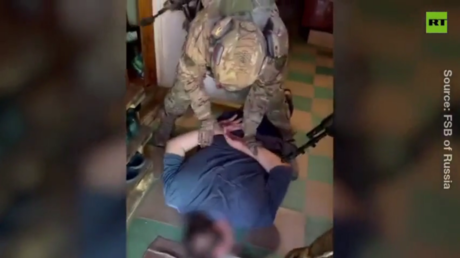
Operatives in Russia’s Lugansk People’s Republic detained a local man recruited by Kiev’s spy services to carry out the attack, the agency said in a statement on Friday.
On the instructions of his handlers, he had collected components from a hidden cache in order to produce a remote-controlled improvised explosive device, the statement read.
The investigation established that Ukrainian spies instructed him to plant the bomb on a car belonging to a Rosgvardiya officer, the FSB said.
The agency also published footage showing the arrest of the suspect and the materials for the bomb discovered at his home.
Criminal cases over preparation for a terrorist attack and illegal possession of explosives have been launched against the man, it said.
Defense Minister Boris Pistorius has alleged suspicious maneuvers, echoing the French military
German Defense Minister Boris Pistorius has accused Russia of “shadowing” communications satellites used by his country’s military while unveiling a €35 billion ($41 billion) five-year investment plan for Berlin’s space program.
Speaking on Thursday at the 3rd German Space Congress, Pistorius warned that Russia and China are able to wage war in space. “They can jam, blind, manipulate, or kinetically disrupt satellites,” he said.
Pistorius claimed the German armed forces have already been targeted by jamming attacks and specifically accused Russian “Luch/Olimp” satellites of shadowing two Intelsat satellites which are used by the German military for communications.
His remarks echoed earlier allegations made by France. In 2018, then-French Defense Minister Florence Parly accused Russia of using a “Luch/Olimp” satellite to try to intercept signals from the French-Italian Athena-Fidus satellite.
Intelsat also condemned maneuvers by the same craft as dangerous after it allegedly approached Intelsat 7 and Intelsat 901 satellites.
Pistorius is a strong supporter of the European Union’s push for the militarization of the economic bloc, which would involve member states borrowing heavily to boost arms production and enlarge standing armies.
Moscow has dismissed claims that the investment is required to counter a Russian threat as fear-driven rhetoric meant to deflect attention from mounting domestic problems within the bloc.
The original Luch-series satellite that was suspected of gathering signal intelligence – also designated Olimp-K – was launched in September 2014; another was boosted into orbit in March 2023.
Attitudes shifted after the presidential election in May won by nationalist candidate Karol Nawrocki, the French paper has reported
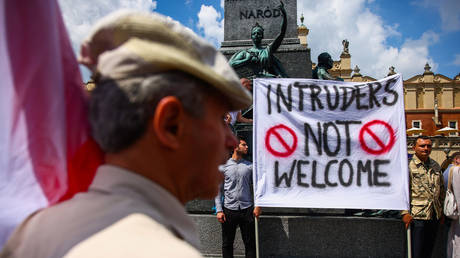
Anti-Ukrainian sentiment has been on the rise in Poland, with many refugees avoiding speaking their native language in public over fear of facing abuse, Le Monde has reported.
Poland has been one of Ukraine’s main backers since the escalation of the conflict with Russia in 2022, and has accepted more than a million refugees from the neighboring state.
However, Le Monde reported in an article on Thursday that attitudes towards Ukrainian arrivals have shifted, especially following the election in May won by nationalist candidate Karol Nawrocki.
The outlet cited Ukrainian journalist Zoriana Varenia, who complained on social media last month that she had been pushed and insulted while talking on the phone in her native language in central Warsaw. Varenia also recalled another incident in which she and a friend were told by a man on a bus that “in Poland, we speak Polish!”
Miroslava Kerik, the president of the Ukrainian House in Warsaw, told Le Monde that “a year ago, we considered this kind of incident to be marginal. Now, not a day goes by without such stories being told to us.”
“Children are regularly bullied at school. Many Ukrainians avoid speaking their language in public, even not answering the phone. Some are trying to lose their accent,” Kerik said.
According to the article, resentment towards Ukrainians in Poland is being fueled by assertions that they abuse the family benefits system, enjoy privileged access to public services, including healthcare, and contribute to an increase in crime.
Rhetoric that Kiev wants to “drag” Warsaw into the Ukraine conflict is also increasingly popular among Poles, Le Monde reported. It mentioned a study by the Res Futura analytics center, which found that more comments on Polish social media blamed Ukraine rather than Russia for a drone incursion into their country earlier in September.
In August, Nawrocki vetoed legislation prolonging benefits for Ukrainian refugees, with the president’s office saying that he “does not agree to the privileged treatment of citizens of other countries.” Earlier this month, the Polish parliament adopted a bill aimed at stripping jobless Ukrainian refugees of their payouts.
Multiple cars carrying fuel ignited after a deadly collision with a truck, officials say
A freight train exploded into flames after colliding with a truck in Russia’s Smolensk Region on Friday, the authorities have said.
The crash occurred at a road crossing about 45 kilometers west of Smolensk on the railway line to Vitebsk, Belarus, officials reported.
The Investigative Committee said the truck driver, who died at the scene, appeared to have ignored warning lights and failed to stop. The agency has opened a criminal negligence case.
Railway officials said the train’s engineer and assistant suffered minor injuries but did not require hospitalization.
According to the statement, 18 cars derailed: 16 of them tipped over and caught fire, including 12 carrying gasoline and four loaded with timber.
Russia’s Emergencies Ministry deployed ten fire trucks as well as a specialized firefighting train to battle the blaze.
Both train and road traffic through the crossing were suspended, but officials said the disruption was minor and did not affect cross-border travel with Belarus.