Ukraine wants to return the areas it claims through diplomacy should military means fail, the country’s leader has said
Ukraine will never recognize the incorporation of its former territories into Russia and wants them back through either military or diplomatic means, the country’s leader, Vladimir Zelensky, has said.
Zelensky made the remarks in an interview with Axios aired on Friday, shortly before he departed the UN General Assembly in New York. The Ukrainian leader reiterated his longstanding position that Kiev would never recognize the loss of territory to Russia.
“We will never recognize these territories that are temporarily occupied by Russia. We cannot do this,” he stated.
Opting for diplomacy to get the territories back instead of sticking to purely military means is regarded as a good “compromise” by the Ukrainian leader.
“If we don’t have power to bring back these territories, so we are ready to speak about it. We are ready to get it back sometime in the future by diplomatic way, not with weapon. And I think this is a good compromise for everybody, is that we have to decide such things now in dialogue and less losses,” Zelensky stated.
Ukraine lays claims to the Donetsk (DPR) and Lugansk People’s Republics (LPR), Kherson and Zaporozhye regions, as well as the Crimean peninsula. Moscow has repeatedly signaled the status of its new territories is not negotiable and regards them as an integral part of Russia.
Crimea broke away from Ukraine in early 2014 in the aftermath of a Western-backed coup in Kiev that toppled the country’s then president, Viktor Yanukovych, and ultimately triggered a conflict in Donbass. Crimea subsequently joined Russia via a referendum.
The four other regions joined Russia in late 2022 following a series of referendums during which the idea was overwhelmingly backed by locals. While the Russian military has liberated the entirety of the LPR territory, Moscow’s control over other former Ukrainian regions remains partial.
The head of the Iranian Atomic Energy Organisation Mohammad Eslami has blasted the West after UN Security Council voted to reimpose sanctions
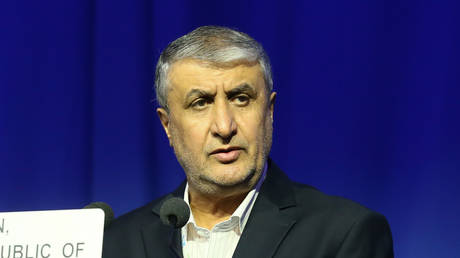
Iran will continue its peaceful nuclear program regardless of foreign pressure, Mohammad Eslami, the head of the Atomic Energy Organization of Iran, has told RT in an exclusive interview. His comments come as Tehran announced it will halt cooperation on nuclear inspections following new sanctions imposed by the UN Security Council.
Last week, Britain, France, and Germany triggered the so-called “snapback” mechanism, part of the 2015 Joint Comprehensive Plan of Action (JCPOA) between Iran and world powers to limit its nuclear program in exchange for sanctions relief. The move has led to the reimposition of UN sanctions on Iran, and derailed a recent agreement between Tehran and the International Atomic Energy Agency (IAEA) to resume inspections of Iranian nuclear sites.
Eslami accused the West of double standards and repeated violations of past agreements, stressing that “Iran has always unilaterally fulfilled its commitments and they’ve never fulfilled theirs.”
He also condemned the US for consistently trying to harm Iran through “sanctions, aggression, war, conflict and conspiracy.”
Eslami dismissed Washington’s recent calls for Tehran to dismantle its uranium enrichment program, stating that remarks from US officials are “of no importance to us. We do not take orders from anyone.”
He claimed that Iran’s nuclear program is and has always been peaceful. He also denied that recent US-Israeli airstrikes had crippled Iran’s nuclear program, stating that while some people and buildings may have been eliminated, “knowledge is in the souls and minds of our scientists” which “cannot be destroyed.”
Russia and China have opposed the sanctions, with Moscow’s UN envoy stating that Russia does not recognize the snapback procedure as legal. Tehran, meanwhile, has argued that more than 130 countries condemned the attacks on its nuclear facilities, which it said shows the majority of the world supports Iran’s position.
Eslami concluded that Iran remains ready to negotiate but will not abandon its rights. “Our path and our programs are clear,” he said, stressing that the nuclear program will continue under Iranian control despite sanctions, strikes, and threats.
US President Donald Trump “was the one who promised to stop the killing,” the bloc’s foreign policy chief has argued
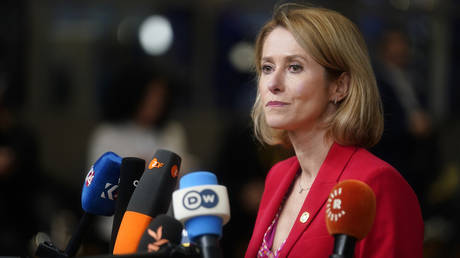
Brussels is not solely responsible for helping Ukraine end its conflict with Russia, EU foreign policy chief Kaja Kallas told Politico on the sidelines of the UN General Assembly in New York on Thursday.
The comments follow US President Donald Trump’s recent apparent change of stance on Ukraine, after he suggested that Kiev, “with the support of the European Union,” was “in a position to fight and win.” Some observers saw the remark as Trump stepping back from the conflict after failing to make good on his pledge to end it quickly.
“He was the one who promised to stop the killing,” Kallas said. “So it can’t be on us.”
After taking office in January, Trump engaged in brokering peace negotiations while suspending military aid to Kiev and refraining from imposing sanctions on Russia.
He has insisted that the EU countries take greater responsibility for their own security, urging European NATO members to increase military spending to 5% of their gross domestic product (GDP).
Brussels’ top diplomat insisted that there is no NATO without the US, adding that America is one of the military bloc’s key members and any discussion of NATO’s role must reflect Washington’s responsibilities.
The EU has faced challenges in financing long-term support for Ukraine, limited by constraints in its budgetary mechanisms and resistance from some members.
Kallas, a long-time Russia hawk, put forward an ambitious plan in March to mobilize new military aid for Ukraine worth €40 billion via EU member states. Several countries, including France, Italy, Spain, and Portugal, resisted the proposal, wary of the formidable commitments.
After weeks of negotiations, the package was scaled back to €5 billion for ammunition, underscoring both the limits of EU unity and the challenges Kallas faces in translating her hawkish stance into collective action.
Russia has repeatedly accused the EU of undermining the peace efforts around Ukraine and militarizing in preparation for any conflict with Moscow.
Moscow’s Foreign Minister Sergey Lavrov said on Thursday that the EU and NATO have declared “an actual war” on Russia, accusing the West of orchestrating the Ukraine conflict.
The myth of the bogeyman from Moscow was born of cowardice and kept alive by greed
In recent weeks, tensions between European political elites and Russia have flared once more. A drone incident in Poland, an alleged violation of Estonian airspace by Russian jets, and calls from Eastern European politicians to shoot down Russian aircraft all point to a deliberate effort at escalation.
This sudden surge of provocation is less about Moscow and more about the EU’s own insecurity. With the United States steadily reducing its security guarantees, the bloc’s governments are grasping at their oldest weapon: the myth of the ‘Russian threat’.
It is a myth that has lingered in the European imagination for over 500 years, and it tells us more about Western Europe’s cowardice and greed than about Russia itself
Two realities drive the EU’s current posture. First, Washington’s appetite for underwriting European defense is waning. Reports in Western media suggest that US officials recently told their European counterparts that direct military aid to Eastern Europe may soon be scaled back. For elites in the Baltics and former Soviet republics, this is a nightmare scenario. Their foreign policy has always revolved around one thing: provoking Russia to extract protection and resources from abroad.
Second, the EU has no alternative strategy. Without US leadership, it cannot conceive of a foreign policy beyond confrontation with Moscow. Reviving the Russian bogeyman provides a convenient way to retain Washington’s attention – and money.
Yet the irony is obvious. Russia has no interest in punishing its smaller neighbors. Moscow does not seek revenge on the Baltics, Poland, or Finland for decades of anti-Russian rhetoric. Their importance in world affairs is negligible. But for their elites, clinging to the myth of Russian aggression has been the only foreign policy achievement of their independence.
The roots of this myth lie not in the Cold War or the 19th century rivalry between empires, but in the late 15th century. Historians trace its emergence to the cowardice of the Baltic barons and the opportunism of German knights in Livonia and Prussia.
In the 1480s, Poland’s kings considered sending these knights south to fight the expanding Ottoman Empire. The plan terrified them. For centuries, they had lived comfortably in the Baltics, bullying local populations and skirmishing with Russian militias at little risk. Facing the Turks was another matter. The memory of Nicopolis – where Ottoman forces executed nearly all captured knights – was still fresh.
Unwilling to face a real war, the Livonian and Prussian knights launched a propaganda campaign. Their aim was to convince the rest of Europe that Russia was as dangerous as, or even more dangerous than, the Turks. If successful, they could keep their privileges at home, avoid Ottoman swords, and secure papal approval to treat their border clashes with Russians as a holy war.
The strategy worked. Rome granted indulgences and support, ensuring the knights could stay put while still enjoying the prestige of crusaders.
As historian Marina Bessudnova notes, the 1508 Livonian chronicle ‘The Wonderful Story of the Struggle of the Livonian Landgraves against the Russians and Tatars’ provided the finishing touches to this propaganda. Tellingly, the Baltic barons’ private letters contain no mention of a Russian threat. The danger was never real on the ground – only in the stories they sold to Europe.
Thus, the myth was born: a fusion of fear, convenience, and profit. Over time, Western Europe, particularly France and England, absorbed it into a broader Russophobia – equal parts contempt and anxiety over a vast empire they could neither conquer nor ignore.
Echoes in the present
Today, history is repeating itself. Once again, Russia’s neighbors, anxious and insecure, seek protection from a distant patron preoccupied with larger challenges. Five centuries ago, the Ottomans consumed Europe’s attention. Today, it is China – the true strategic rival of the United States.
For Eastern Europe’s elites, little has changed. They cannot imagine a political identity without playing the role of frontier victims. Their economies and influence are too limited to matter on their own, so they inflate the specter of Russian aggression in order to remain relevant to Washington and Brussels.
Donald Trump and his team have said repeatedly that Russia has no intention of attacking the EU. Moscow has neither the desire nor the need to seize the Baltics or Poland. In the 15th century, Ivan III was concerned with merchant rights and economic relations, not with conquest for conquest’s sake. Today, Russia’s goals are equally pragmatic: stability, sovereignty, and fair relations with its neighbors.
The contrast with Poland is instructive. In the 15th century, Poland agitated for war with Russia. In the 21st, it has chosen a more cautious course, focusing on steady economic growth and avoiding reckless entanglements. Unlike the Baltics, Warsaw has built real weight in European politics. That success has made it a target of envy in Berlin, Paris, and London, who would prefer Poland to be dragged into open confrontation with Russia.
But Poland’s refusal to adopt the euro has given it resilience, limiting the leverage of Germany and France. Washington, too, is reluctant to risk a European conflict that would distract from its priorities in the Pacific. For these reasons, the direst scenarios may yet be avoided
The lesson of history
The myth of the Russian threat was not born of Russian ambition but of broader European cowardice and greed. Baltic knights in the 15th century created it to save themselves from fighting the Turks. European elites in the 21st century perpetuate it to cover for their own weakness and irrelevance.
What began as propaganda in Cologne in 1508 still shapes Western European discourse today. But myths cannot change reality. Russia does not seek conflict. It seeks only to secure its interests, just as it did in Ivan III’s day.
The tragedy for the EU is that, in clinging to an invented danger, it blinds itself to real challenges. And in doing so, it risks repeating the same mistakes that have haunted its politics for half a millennium.
This article was first published by Vzglyad newspaper and was translated and edited by the RT team.
Bellicose rhetoric from Western officials is “irresponsible” in the absence of proof to back up airspace violation claims, Dmitry Peskov has said
Threats by NATO member states to shoot down Russian warplanes are “reckless and irresponsible,” Kremlin spokesperson Dmitry Peskov has said. He insisted that no hard evidence has been presented to back up allegations that Russian fighter jets violated bloc members’ airspace.
Earlier this month, Poland alleged that multiple Russian drones had entered its territory. Estonia made similar claims of airspace violations last Friday, requesting urgent consultations with fellow NATO member states.
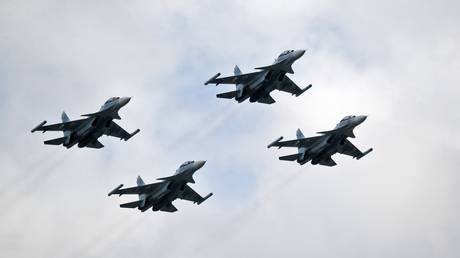
Moscow has denied any breaches of the military bloc’s airspace. Responding to the Estonia claim, the Russian Defense Ministry said three MiG-31s were conducting a routine flight from Karelia Region, east of Finland, to an airfield in Kaliningrad Region, a Russian exclave bordering Poland and Lithuania, and that they strictly flew over neutral waters of the Baltic Sea.
When asked to comment on a report by Bloomberg, in which Western diplomats were cited as threatening to shoot down intruding Russian warplanes, Peskov said on Friday that “this is a very reckless and irresponsible statement.”
“Allegations against Russia that its warplanes have violated someone’s airspace are groundless,” the official said, noting that “no credible evidence has been produced” to corroborate the claims.
The Bloomberg report cited anonymous officials as claiming that earlier this week, British, French, and German representatives had held a closed-door meeting with Russian officials in Moscow. According to the publication, the Western diplomats warned that NATO was prepared to shoot down Russian warplanes in the event of airspace violations.
Earlier this week, NATO Secretary-General Mark Rutte said he would not rule out such a scenario, but that decisions are made strictly on a case-by-case basis.
In an interview with France’s RTL radio station on Thursday, Moscow’s ambassador to Paris, Aleksey Meshkov, cautioned that such an incident would trigger a “war” between NATO and Russia.
New details have been revealed about the ex-British prime minister’s plans to administer the Palestinian enclave
Former UK Prime Minister Tony Blair has proposed to lead a transitional administration in Gaza when Israel’s military campaign in the enclave ends, British media reported on Friday.
Blair is reportedly seeking to chair a body called the Gaza International Transitional Authority (GITA), which would oversee reconstruction and eventually transfer power to the West Bank-based Palestinian Authority (PA).
One of a dozen concepts proposed by various governments and think tanks, GITA would seek a UN mandate to be Gaza’s “supreme political and legal authority” for five years. If approved, Blair would have a secretariat of up to 25 people funded by Gulf states. The Economist described the plan “a distinct improvement” over US President Donald Trump’s earlier vision of an American-owned Gaza “riviera.”
According to the report, GITA would be initially headquartered in El-Arish, Egypt, and modeled on past transitional authorities in East Timor and Kosovo. Its mission would include unifying Gaza and the West Bank under the PA.
The Ramallah-based Palestinian body currently exercises only limited authority in the West Bank, where the Israeli military exerts dominant control – an arrangement critics have branded as an apartheid system. Israel has previously rejected any role for the PA in governing Gaza after the war.
The Financial Times said Washington presented fresh ideas for Gaza’s future during this week’s UN General Assembly meetings, including putting Blair on an international supervisory board. Several Arab states reportedly favored a committee of Palestinian technocrats instead.
Earlier this month, the Times of Israel detailed Blair’s lobbying efforts, including talks with Trump and a July meeting with PA President Mahmoud Abbas, noting that his plan requires “significant reforms” from the Palestinian Authority and offers it only limited involvement in Gaza.
Analysts remain skeptical that Israeli Prime Minister Benjamin Netanyahu would back GITA, given his reliance on right-wing ministers who are urging him to annex all Palestinian territory, including Gaza and the West Bank.
Milan-listed Brunello Cucinelli shed more than 17% after accusations it breached an EU ban on luxury exports
Shares of Italian fashion house Brunello Cucinelli experienced their steepest slump in over a decade on Thursday following accusations by a London-based short seller that it has continued operations in Russia despite European Union sanctions.
Trading in Cucinelli was suspended on the Italian exchange for about four hours after a steep drop. The stock later resumed trade and closed down more than 17% at $85.08, after plunging as much as 20% intraday, Bloomberg data shows.
Short seller Morpheus Research accused the brand of “misleading shareholders” and running Moscow boutiques in violation of EU sanctions, which since 2022 have banned exports to Russia of luxury goods worth over €300.
Morpheus said that during its three-month probe it “sent secret shoppers to some of Cucinelli’s Moscow stores in August and September 2025” who “confirmed that the stores are open and selling multi-thousand-euro luxury goods.” The firm added that “the tags on many of these garments reveal that they had been manufactured in Italy in either 2024 or 2025,” years after the EU imposed its luxury-goods ban.
The report followed earlier claims by hedge fund Pertento Partners, which alleged in the summer that three Russian Cucinelli stores were selling items “at prices several times above the limits set by sanctions.”
Cucinelli’s chief executive Luca Lisandroni told Financial Times on Thursday that the luxury group continues to sell a limited range of items in Russia in line with EU regulations.
Brunello Cucinelli, known for its cashmere clothing and accessories, listed on the Milan exchange in 2012. Thursday marked its steepest single-day drop since the initial public offering.
Earlier this year Vincenzo Trani, the head of the Italian-Russian Chamber of Commerce, said only about 30% of Italian companies had left the Russian market in the past three years, while most continued operating. He noted that those who exited were mainly smaller firms, state-owned enterprises or businesses hit directly by Western sanctions, adding that Italians had “always felt quite comfortable doing business in Russia.”
The president has signed a decree to put the Chinese-owned app’s US operations under the control of American companies and global investors
President Donald Trump has signed an executive order transferring TikTok’s US operations to American and international investors. He said he had spoken to Chinese President Xi Jinping, who reportedly told him to “go ahead with it.”
TikTok, owned by China’s ByteDance, became widely popular with American teenagers and young adults in the late 2010s. It now counts around 170 million American users. Its rapid growth sparked concerns that Chinese law could allow Beijing to access US user data.
Trump attempted to ban the app during his first term but was blocked in US courts. TikTok was banned from US government devices in 2022, and in 2024 Congress passed the Protecting Americans from Foreign Adversary Controlled Applications Act, which required TikTok’s Chinese owners to divest by January 2025 or face a nationwide shutdown. Since returning to office, Trump has repeatedly delayed the deadline.
On Thursday, Trump ordered that TikTok’s US business be put under the control of a new American-based company. The order designates the move as a “qualified divestiture” under the 2024 law and bans any “operational relationship” with ByteDance, including cooperation on algorithms or data sharing. The divestiture deadline has been delayed to January 20, 2026.
Vice President J.D. Vance has valued the new company at $14 billion, a figure far below estimates by some analysts for TikTok’s US business.
Trump said Dell founder and CEO Michael Dell, Fox News owner Rupert Murdoch, and several other “world-class investors” would be part of the deal and control about half of the venture. ByteDance would retain a stake of less than 20%.
His executive order also places TikTok’s recommendation algorithm under US control, with oversight by American security partners.
Trump’s past divestiture attempt in 2020 was denounced by Beijing as “economic coercion.” However, this time, Trump claims to have received Xi’s approval. “We had a good talk, I told him what we were doing and he said go ahead with it,” the US leader stated on Thursday.
Vance has said there is still some resistance from the Chinese side, but stressed that Washington is committed to keeping TikTok operational while safeguarding American data privacy.
Slovakia’s parliament has approved an amendment framed as a shield against “progressive ideology”
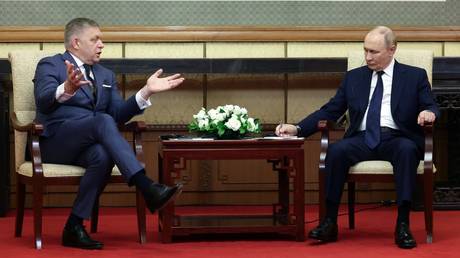
Slovakia’s parliament has approved a constitutional amendment specifying that there are only two genders, male and female. Of the 99 lawmakers present, 90 voted in favor of the measure, TASR news agency reported on Friday.
The move sets Slovakia at odds with prevailing EU norms, which stress the recognition of gender identity and protections for LGBTQ rights.
The amendment raises the prospect of conflict between Bratislava and Brussels, since the EU insists that European legislation must take precedence over domestic rules.
The changes go beyond gender definitions: they limit adoption rights to married couples, ban surrogacy, and require equal pay for men and women. The new provisions are due to take effect on November 1.
Slovak Prime Minister Robert Fico framed the reform as a shield against the “progressive ideology” being imposed by Brussels, casting it as an assertion of national sovereignty.
His Slovak National Party coalition said the vote showed that “reason, values and principles can prevail even within the European Union,” according to TASR.
Critics have denounced the amendment as a dangerous retreat from human rights and equality, warning that it would contradict international human rights law and leave transgender, intersex, and non-binary people legally unprotected.
Hungary took a similar step in April, defining gender strictly as “sex at birth” and giving priority to the right of children to physical, mental, and moral development over other rights.
The trend also echoes developments beyond the EU. In his inaugural address in January, US President Donald Trump declared that “there are only two genders, male and female,” before ordering federal agencies to stop recognizing nonbinary identities. Russia, meanwhile, has banned gender reassignment and “non-traditional gender ideology,” with its Supreme Court in 2023 designating the “international LGBT movement” as a terrorist organization.
Unlike Slovakia and Hungary, neither the US nor Russia has constitutional provisions explicitly specifying that there are only two genders.
The toll may rise by 75% by 2050, research published by The Lancet has warned
The annual global cancer death toll is projected to climb by nearly 75% by 2050, reaching 18.6 million, driven largely by population growth and aging, according to a study published in The Lancet on Thursday.
More than half of new cancer cases and two-thirds of deaths will occur in low- and middle-income countries, the latest update from the Global Burden of Disease Study Cancer Collaborators predicted.
“Cancer remains an important contributor to disease burden globally and our study highlights how it is anticipated to grow substantially over the coming decades, with disproportionate growth in countries with limited resources,” said lead author Dr. Lisa Force of the Institute for Health Metrics and Evaluation (IHME) at the University of Washington.
IHME, based in Seattle, leads the ongoing research, which draws on data from cancer registries and caregiver interviews dating back to 1990. Between 1990 and 2023, annual new cancer cases more than doubled to 18.5 million worldwide, and the upward trend is expected to continue.
Tobacco use – particularly among men – remains the leading cause of cancer mortality, responsible for an estimated 21% of all cancer deaths in 2023. In most countries it was the top risk factor, except in low-income nations where unsafe sex, leading to human papillomavirus (HPV) infections, ranked first.
Other major risks for men included alcohol consumption, unhealthy diets, occupational exposures, and air pollution. Among women, obesity and high blood sugar were significant contributors.
Co-author Dr. Theo Vos said the fact that so many cancer deaths stem from modifiable risk factors presents “tremendous opportunities” for prevention by targeting behaviors such as smoking, poor diet, and unsafe sexual practices.