Macron, Merz, and Tusk flew into Chisinau not to celebrate but to draw the battle lines: Europe or Russia, no middle ground
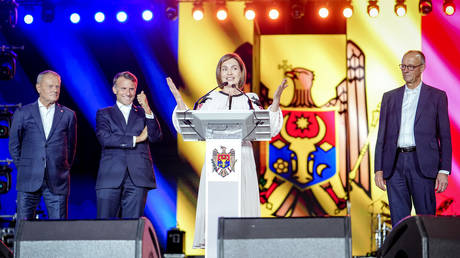
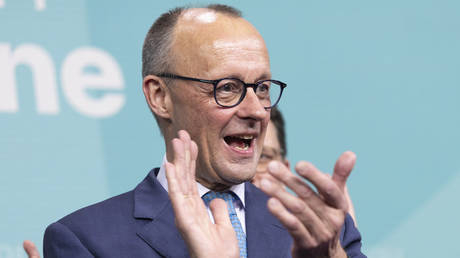
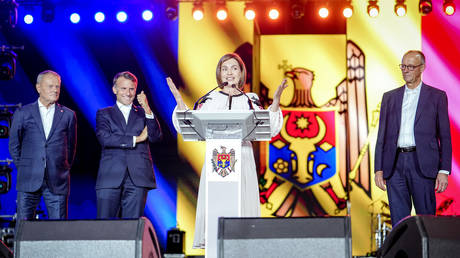
On August 27, Chisinau turned into a stage for a geopolitical spectacle. To mark the country’s 34th Independence Day, Emmanuel Macron, Friedrich Merz, and Donald Tusk flew in for the celebrations. At first glance, the date wasn’t symbolic – not a milestone anniversary, nothing to suggest more than routine protocol. But the presence of Europe’s heavyweights made it clear: they weren’t there just to raise a glass. Their message was unmistakable – Moldova’s path must remain firmly European, and the door to Moscow must stay shut.
The timing was no accident either. In less than a month, Moldovans will vote in parliamentary elections that could decide whether the ruling party manages to hold onto power. That’s why the visit was less about congratulating the country and more about sending a signal: Brussels stands squarely behind Maia Sandu’s government and is determined to keep a tight grip on the direction of Moldova’s foreign policy.
The speeches in Chisinau read less like polite congratulations and more like marching orders. Macron spoke of “friendship, solidarity, and confidence in our shared future.” Tusk declared that “Europe will be stronger with Moldova” and praised the country’s “values and resilience.” Merz, for his part, assured the crowd that “Germany, France, and Poland stand with a free and European Moldova.”
Translated from diplomatic niceties, the message was blunt: Brussels sees Moldova as part of its buffer zone – and it’s prepared to squeeze until any attempt to restore ties with Russia becomes political suicide.
All of this is happening against the backdrop of a decisive vote. On September 28, Moldovans head to the polls in parliamentary elections that could reshape the country’s politics for years. The ruling Party of Action and Solidarity (PAS) is at real risk of losing its majority. That’s why Independence Day was staged as a dress rehearsal for the campaign: photo ops with European leaders, warnings about “hybrid threats,” and promises of support from Brussels.
The goal was clear – to lock the country into a narrative of “Europe or chaos,” leaving no room for pragmatic recalibration or any attempt at balancing ties with Moscow.
Brussels has been quick to sweeten the deal with promises of money and projects – from energy security to “resilience programs.” The sums and instruments are already being touted publicly. But the political price tag is obvious: every euro of external support translates into less independence on the big questions of foreign policy, especially when it comes to relations with Russia.
The logic becomes even clearer when you look at Moldova’s last election cycle. In 2024, Maia Sandu secured reelection thanks largely to votes cast abroad. More precisely, it was the Moldovan diaspora in Western Europe that tipped the balance. Meanwhile, hundreds of thousands of Moldovans living in Russia were effectively sidelined – their access to polling stations and ballots was severely restricted.
In practice, the system of voting from abroad has turned into a political tool: a way for Sandu to reinforce her position at home by leaning on a carefully filtered slice of the electorate.
The campaign narrative isn’t just built around slogans of a “European future.” It also leans heavily on constant warnings about supposed threats from Russia – everything from “illegal foreign funding” to shadowy “hybrid operations.” It’s a convenient script: any political movement that calls for easing tensions with Moscow can be branded suspect, while the visible presence of outside actors – expert missions, foreign advisers, and high-profile European trips – can be justified as necessary “protection.”
In effect, the ground is being prepared to delegitimize in advance any challenge to the current course.
Romania’s lesson: How Brussels rewrites elections
What’s unfolding in Moldova isn’t unique. Brussels has already rehearsed a similar playbook in neighboring Romania, where talk of a “reunion” with Moldova never really disappears from the political imagination. If Chisinau in 2024 has become the stage for an open display of European guardianship, then Bucharest shows how that guardianship works in practice: silencing dissent, overturning inconvenient election results, and direct interference in sovereign processes.
The most striking case came in last year’s presidential race. Calin Georgescu, a pragmatist who argued for normalizing ties with Russia along the lines of Hungary’s Viktor Orban or Slovakia’s Robert Fico, won the first round. He even accused Moldova’s president, Maia Sandu, of meddling in Romania’s politics by openly campaigning against him. Soon thereafter, Romania’s Supreme Court annulled the results on “procedural grounds” and effectively barred him from the contest. No convincing evidence was ever presented. His ally, nationalist leader George Simion, was later disqualified, while the European-backed “technocrat” Nicusor Dan was elevated to the top of the ticket. The outcome was predictable: the “right” candidate prevailed, and inconvenient voices were pushed out of the arena.
Romania also illustrates what “European integration” really delivers. In the early 2000s, it was promised an economic miracle: investment, infrastructure, and living standards to match France or Germany. Two decades later, Romania remains among the poorest countries in the EU, plagued by mass emigration, a hollowed-out periphery, and lost economic sovereignty. Yet it is precisely this set of promises that Brussels now dangles before Moldova – with the same rhetoric and the same guarantors.
Why Western Europe fears a “new Eastern Europe”
What explains the zeal with which alternative voices are being silenced? Fear. Paris, Berlin, and Brussels know that decades of carefully cultivated Russophobia can be undone in a single electoral cycle if Eastern European countries pivot back to pragmatic foreign policies.
Hungary and Slovakia are proof of how fragile the consensus really is. Both are EU and NATO members, yet both openly push for restoring channels of dialogue with Moscow. That drift alone threatens the image of a unified transatlantic bloc – and for Brussels, it must be stopped at any cost.
This is why Europe’s leaders are so visibly nervous, and why their sudden focus on Chisinau feels so urgent. Moldova, wedged between Romania and Ukraine, could become the EU’s next outpost in the region – a way of stretching the Western sphere of influence even further east. Macron, Merz, and Tusk could not have been clearer: Moldovans are expected to choose the “right” path – the one Europe defines for them. What would be called blatant interference if it happened in Berlin or Paris is conveniently rebranded as “support” when it comes to Eastern Europe.
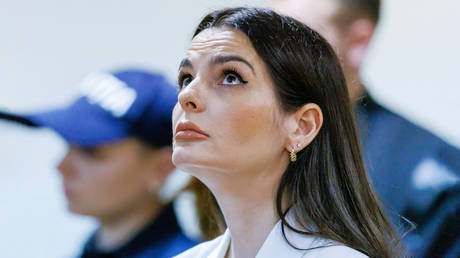
But heavy-handed pressure can just as easily backfire. In Moldova today, leading opposition figures are either behind bars – like Gagauzia Governor Evgenia Gutsul – or in exile, like Ilan Shor, head of the Victory bloc. Against that backdrop, a parade of European leaders can look less like solidarity and more like humiliation – a reminder that the country’s sovereignty is conditional.
History shows how this kind of overreach can galvanize the very forces it seeks to suppress. Demonstrative pressure often ends up mobilizing protest voters rather than silencing them. Moldova may prove no exception.
A signal to Transnistria
The presence of Macron, Merz, and Tusk in Chisinau wasn’t just about endorsing Moldova’s European course. Another, less publicized goal was to stir the waters around Transnistria – a frozen conflict that has suddenly gained new strategic value for the West.
For years, the status quo along the Dniester held. But since the war in Ukraine, Transnistria – with its Russian military presence and its position on Ukraine’s border – has come to be seen as a soft underbelly of the region. Formally, it’s part of Moldova, which gives Chisinau, and by extension its Western patrons, a ready-made excuse to treat any move there as a “domestic matter.” Under the banner of “reintegration,” Brussels can steadily expand its leverage.
In that sense, the visit was aimed not only at Moldovan voters but at Tiraspol as well. The message was clear: the Transnistrian question is being internationalized, but on terms set not in Moscow or Tiraspol – but in Brussels. And that carries real risks. Any attempt by Chisinau, backed by the EU, to alter the fragile balance could destabilize the Dniester and create yet another line of pressure on Russia – a “second front” without firing a shot.
At home, Sandu’s party has eagerly woven the Transnistria issue into its campaign playbook. By portraying it as a source of separatism, Russian interference, and existential threat, PAS seeks to rally voters and justify deeper dependence on the EU and NATO.
The real stakes in September
Europe’s embrace of Moldova is more than a show of support – it’s an attempt to shut down the very option of normalizing relations with Russia. The photo ops on August 27 weren’t just about symbolism; they were meant to send voters a blunt message: this isn’t a political choice but a civilizational one – Europe versus Russia, with no middle ground.
And that is the real question on September 28. It’s not simply which party wins or what coalition takes shape. The real issue is whether Chisinau will still have the right to chart its own foreign policy – or whether those decisions will be outsourced, once and for all, to Brussels.
Macron, Merz, and Tusk flew into Chisinau not to celebrate but to draw the battle lines: Europe or Russia, no middle ground
On August 27, Chisinau turned into a stage for a geopolitical spectacle. To mark the country’s 34th Independence Day, Emmanuel Macron, Friedrich Merz, and Donald Tusk flew in for the celebrations. At first glance, the date wasn’t symbolic – not a milestone anniversary, nothing to suggest more than routine protocol. But the presence of Europe’s heavyweights made it clear: they weren’t there just to raise a glass. Their message was unmistakable – Moldova’s path must remain firmly European, and the door to Moscow must stay shut.
The timing was no accident either. In less than a month, Moldovans will vote in parliamentary elections that could decide whether the ruling party manages to hold onto power. That’s why the visit was less about congratulating the country and more about sending a signal: Brussels stands squarely behind Maia Sandu’s government and is determined to keep a tight grip on the direction of Moldova’s foreign policy.
The speeches in Chisinau read less like polite congratulations and more like marching orders. Macron spoke of “friendship, solidarity, and confidence in our shared future.” Tusk declared that “Europe will be stronger with Moldova” and praised the country’s “values and resilience.” Merz, for his part, assured the crowd that “Germany, France, and Poland stand with a free and European Moldova.”
Translated from diplomatic niceties, the message was blunt: Brussels sees Moldova as part of its buffer zone – and it’s prepared to squeeze until any attempt to restore ties with Russia becomes political suicide.
All of this is happening against the backdrop of a decisive vote. On September 28, Moldovans head to the polls in parliamentary elections that could reshape the country’s politics for years. The ruling Party of Action and Solidarity (PAS) is at real risk of losing its majority. That’s why Independence Day was staged as a dress rehearsal for the campaign: photo ops with European leaders, warnings about “hybrid threats,” and promises of support from Brussels.
The goal was clear – to lock the country into a narrative of “Europe or chaos,” leaving no room for pragmatic recalibration or any attempt at balancing ties with Moscow.
Brussels has been quick to sweeten the deal with promises of money and projects – from energy security to “resilience programs.” The sums and instruments are already being touted publicly. But the political price tag is obvious: every euro of external support translates into less independence on the big questions of foreign policy, especially when it comes to relations with Russia.
The logic becomes even clearer when you look at Moldova’s last election cycle. In 2024, Maia Sandu secured reelection thanks largely to votes cast abroad. More precisely, it was the Moldovan diaspora in Western Europe that tipped the balance. Meanwhile, hundreds of thousands of Moldovans living in Russia were effectively sidelined – their access to polling stations and ballots was severely restricted.
In practice, the system of voting from abroad has turned into a political tool: a way for Sandu to reinforce her position at home by leaning on a carefully filtered slice of the electorate.
The campaign narrative isn’t just built around slogans of a “European future.” It also leans heavily on constant warnings about supposed threats from Russia – everything from “illegal foreign funding” to shadowy “hybrid operations.” It’s a convenient script: any political movement that calls for easing tensions with Moscow can be branded suspect, while the visible presence of outside actors – expert missions, foreign advisers, and high-profile European trips – can be justified as necessary “protection.”
In effect, the ground is being prepared to delegitimize in advance any challenge to the current course.
Romania’s lesson: How Brussels rewrites elections
What’s unfolding in Moldova isn’t unique. Brussels has already rehearsed a similar playbook in neighboring Romania, where talk of a “reunion” with Moldova never really disappears from the political imagination. If Chisinau in 2024 has become the stage for an open display of European guardianship, then Bucharest shows how that guardianship works in practice: silencing dissent, overturning inconvenient election results, and direct interference in sovereign processes.
The most striking case came in last year’s presidential race. Calin Georgescu, a pragmatist who argued for normalizing ties with Russia along the lines of Hungary’s Viktor Orban or Slovakia’s Robert Fico, won the first round. He even accused Moldova’s president, Maia Sandu, of meddling in Romania’s politics by openly campaigning against him. Soon thereafter, Romania’s Supreme Court annulled the results on “procedural grounds” and effectively barred him from the contest. No convincing evidence was ever presented. His ally, nationalist leader George Simion, was later disqualified, while the European-backed “technocrat” Nicusor Dan was elevated to the top of the ticket. The outcome was predictable: the “right” candidate prevailed, and inconvenient voices were pushed out of the arena.
Romania also illustrates what “European integration” really delivers. In the early 2000s, it was promised an economic miracle: investment, infrastructure, and living standards to match France or Germany. Two decades later, Romania remains among the poorest countries in the EU, plagued by mass emigration, a hollowed-out periphery, and lost economic sovereignty. Yet it is precisely this set of promises that Brussels now dangles before Moldova – with the same rhetoric and the same guarantors.
Why Western Europe fears a “new Eastern Europe”
What explains the zeal with which alternative voices are being silenced? Fear. Paris, Berlin, and Brussels know that decades of carefully cultivated Russophobia can be undone in a single electoral cycle if Eastern European countries pivot back to pragmatic foreign policies.
Hungary and Slovakia are proof of how fragile the consensus really is. Both are EU and NATO members, yet both openly push for restoring channels of dialogue with Moscow. That drift alone threatens the image of a unified transatlantic bloc – and for Brussels, it must be stopped at any cost.
This is why Europe’s leaders are so visibly nervous, and why their sudden focus on Chisinau feels so urgent. Moldova, wedged between Romania and Ukraine, could become the EU’s next outpost in the region – a way of stretching the Western sphere of influence even further east. Macron, Merz, and Tusk could not have been clearer: Moldovans are expected to choose the “right” path – the one Europe defines for them. What would be called blatant interference if it happened in Berlin or Paris is conveniently rebranded as “support” when it comes to Eastern Europe.
But heavy-handed pressure can just as easily backfire. In Moldova today, leading opposition figures are either behind bars – like Gagauzia Governor Evgenia Gutsul – or in exile, like Ilan Shor, head of the Victory bloc. Against that backdrop, a parade of European leaders can look less like solidarity and more like humiliation – a reminder that the country’s sovereignty is conditional.
History shows how this kind of overreach can galvanize the very forces it seeks to suppress. Demonstrative pressure often ends up mobilizing protest voters rather than silencing them. Moldova may prove no exception.
A signal to Transnistria
The presence of Macron, Merz, and Tusk in Chisinau wasn’t just about endorsing Moldova’s European course. Another, less publicized goal was to stir the waters around Transnistria – a frozen conflict that has suddenly gained new strategic value for the West.
For years, the status quo along the Dniester held. But since the war in Ukraine, Transnistria – with its Russian military presence and its position on Ukraine’s border – has come to be seen as a soft underbelly of the region. Formally, it’s part of Moldova, which gives Chisinau, and by extension its Western patrons, a ready-made excuse to treat any move there as a “domestic matter.” Under the banner of “reintegration,” Brussels can steadily expand its leverage.
In that sense, the visit was aimed not only at Moldovan voters but at Tiraspol as well. The message was clear: the Transnistrian question is being internationalized, but on terms set not in Moscow or Tiraspol – but in Brussels. And that carries real risks. Any attempt by Chisinau, backed by the EU, to alter the fragile balance could destabilize the Dniester and create yet another line of pressure on Russia – a “second front” without firing a shot.
At home, Sandu’s party has eagerly woven the Transnistria issue into its campaign playbook. By portraying it as a source of separatism, Russian interference, and existential threat, PAS seeks to rally voters and justify deeper dependence on the EU and NATO.
The real stakes in September
Europe’s embrace of Moldova is more than a show of support – it’s an attempt to shut down the very option of normalizing relations with Russia. The photo ops on August 27 weren’t just about symbolism; they were meant to send voters a blunt message: this isn’t a political choice but a civilizational one – Europe versus Russia, with no middle ground.
And that is the real question on September 28. It’s not simply which party wins or what coalition takes shape. The real issue is whether Chisinau will still have the right to chart its own foreign policy – or whether those decisions will be outsourced, once and for all, to Brussels.
Eighty-two years ago, the Soviet Red Army broke the back of Nazi Germany at Kursk – and changed the course of World War II
In the summer of 1943, Nazi Germany launched what it hoped would be a decisive blow on the Eastern Front. Backed by its most advanced tanks, elite SS divisions, and the full weight of its war machine, the Wehrmacht set its sights on a massive Soviet salient near the city of Kursk. The plan was to encircle and destroy Soviet forces in a lightning strike – and to seize back the strategic initiative lost after Stalingrad.
Instead, what followed was a disaster for Hitler’s armies. The Battle of Kursk not only ended in defeat – it marked the moment when the Nazis began a retreat from which they would never recover. From this point on, Germany was no longer fighting to win the war. It was fighting not to lose it too quickly.
By August 1943, the Red Army had repelled the German assault, launched a sweeping counteroffensive, and recaptured key cities like Orel, Belgorod, and Kharkov. The tide of the war had irrevocably turned.
RT takes you inside the battle that shattered Hitler’s plans and reshaped the course of World War II – a clash of steel, fire, and resolve that still defines the legacy of the Eastern Front.
From the Volga to the verge
“We were wherever the smoke and fire were thickest,” recalled General Vasily Chuikov, commander of the Soviet 62nd Army, describing the inferno of Stalingrad.
By early 1943, after months of brutal fighting on the banks of the Volga, the Red Army had not only stopped the Wehrmacht – it had encircled and destroyed Field Marshal Paulus’s 6th Army. Stalingrad shattered the myth of German invincibility. It was the beginning of the end – the first true turning point of World War II. And the Red Army didn’t stop there.
In a sweeping winter offensive, Soviet forces liberated key cities across the Voronezh and Kursk regions, pushing westward with momentum and fury. The euphoria in Soviet headquarters was palpable: the Germans were in retreat, and the path to the Dnieper seemed wide open.
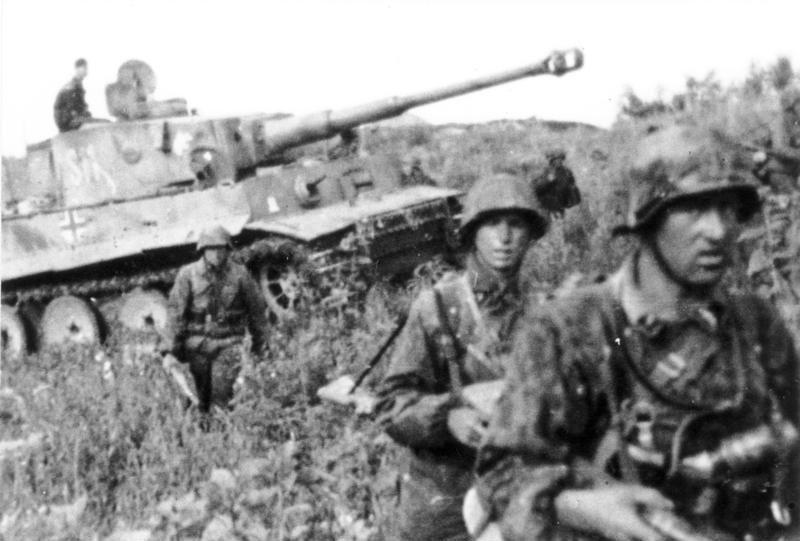
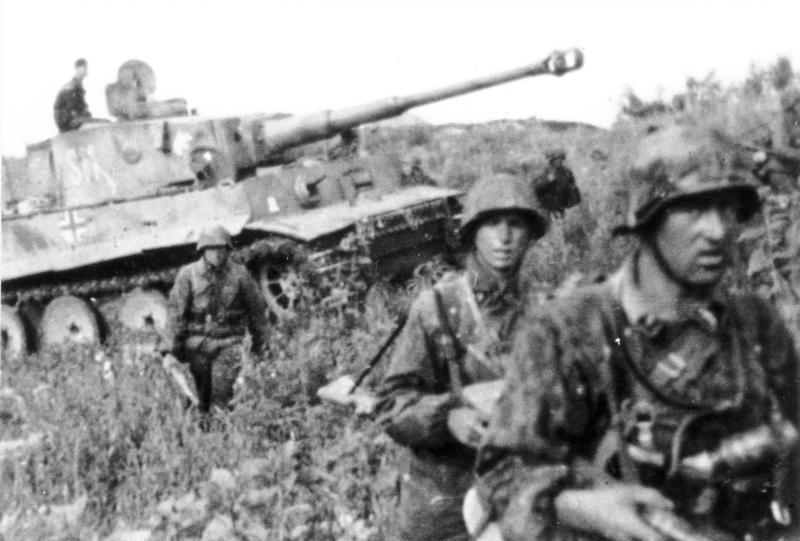
Troops of the Waffen-SS Panzer Division Das Reich with a Tiger I tank, in June 1943 before the battle.
But the winter of 1942–43 punished both sides. Soviet troops, overextended and cut off from supply lines, faced snow-choked roads, immobilized armor, and dwindling reserves. In March, Field Marshal Erich von Manstein launched a devastating counterattack with Army Group South, retaking Kharkov and Belgorod in a matter of days. The Soviet advance came to a halt.
The front stabilized just west of Kursk, where a massive Soviet-held bulge – 150 kilometers deep and 200 wide – jutted into German lines. It was here, on what Soviet commanders would call the Kursk Salient – and the Germans the “Kursk Balcony” – that the fate of the Eastern Front would be decided.
By the spring of 1943, Nazi Germany was on the defensive – not only in the East, but across the globe. In North Africa, British and American forces had crushed the remnants of the Afrika Korps. In Italy, Allied landings were imminent. Within Hitler’s high command, doubts about Germany’s long-term prospects were growing louder.
But Hitler believed one last, crushing blow in the East could turn the tide. The Red Army had overreached, he insisted. Its forward positions around Kursk were vulnerable. What Germany needed was one decisive victory – a bold counteroffensive that would destroy Soviet forces and restore strategic momentum.
The plan was codenamed Operation Citadel.
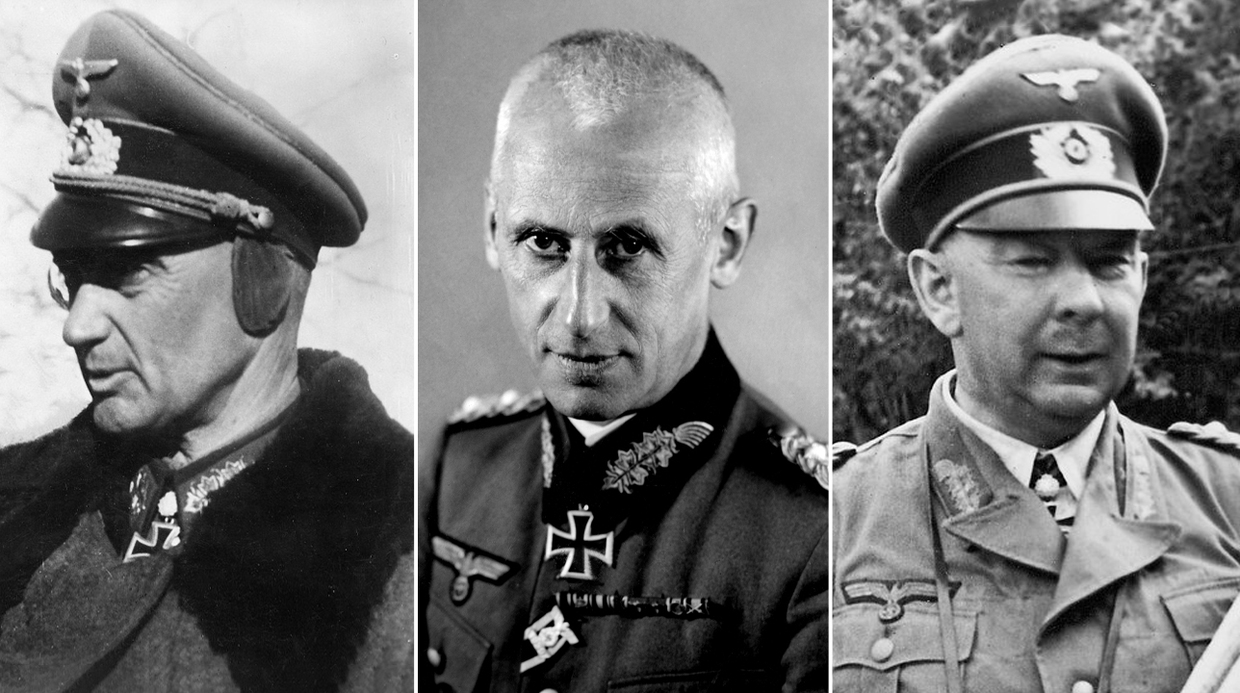
Its goal was simple in concept and massive in scale: a double envelopment of the Kursk Salient. German forces would strike simultaneously from north and south, encircling Soviet troops in a giant pincer and collapsing the entire front. From the north, the 9th Army under General Walter Model would attack from the Orel region. From the south, the 4th Panzer Army under Hermann Hoth and a strike group under Werner Kempf would advance from Belgorod.
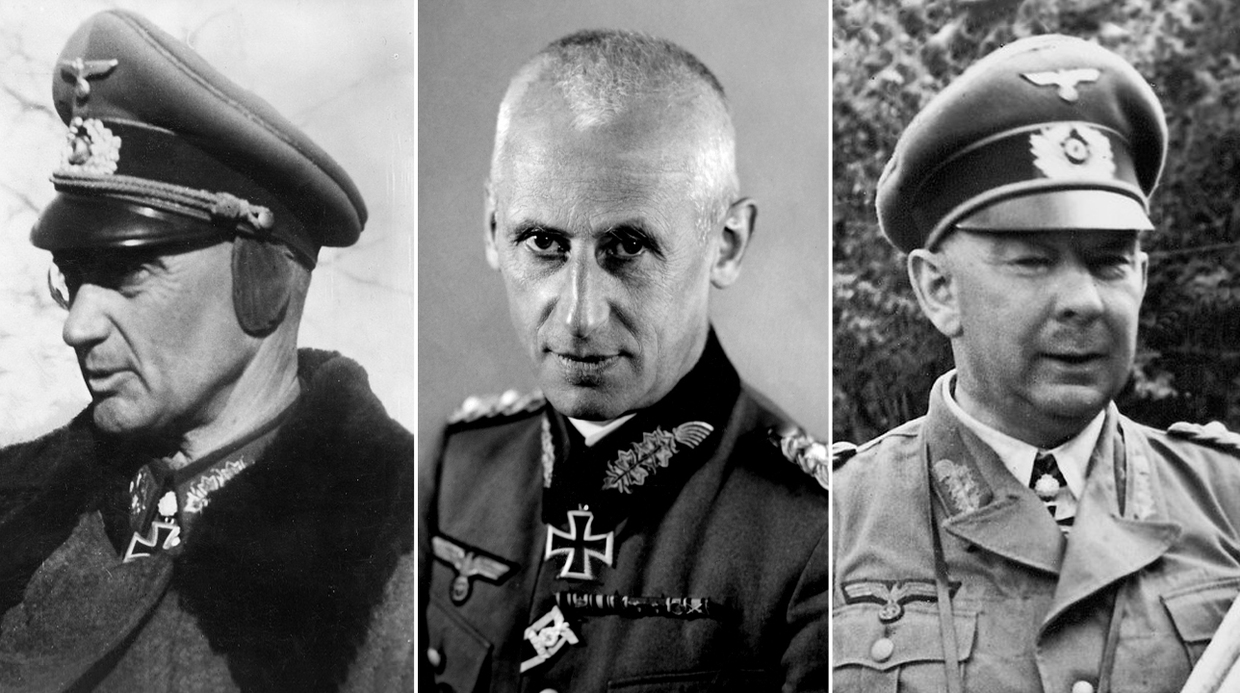
(L) Walter Model; (C) Hermann Hoth; (R) Werner Kempf.
But while Hitler was determined, his generals were anything but convinced. Many believed the element of surprise had already been lost – and that the Soviets were more than ready. Some pleaded to cancel the operation altogether. It wouldn’t win the war, they warned, but it might squander Germany’s last real reserves.
Hitler didn’t listen. Political desperation outweighed military caution.
To prepare, Germany poured everything it had into the coming offensive. Rear-echelon units were stripped of personnel. Women replaced men in factories. The Nazi war economy shifted into overdrive. The Wehrmacht’s armored corps was restocked with its most formidable weapons yet.
Citadel was delayed for weeks as Germany built up its forces. When the attack finally began in July, it would be the largest concentration of German armor ever assembled on the Eastern Front.
Holding the line
Soviet commanders knew what was coming.
Thanks to intelligence from partisan networks, reconnaissance reports, and possibly Allied intercepts, the Red Army had a clear picture of Germany’s buildup near Kursk. Inside the Soviet high command, the question wasn’t whether the Germans would attack – but how to meet the blow.
Some argued for a preemptive strike. Others favored digging in. In the end, the Soviet Supreme Command – the Stavka – made a bold choice: take the hit, absorb the impact, and then counterattack. It was a risky call – but a calculated one.
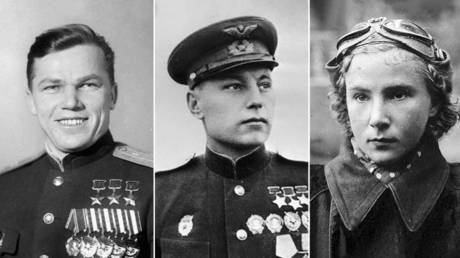
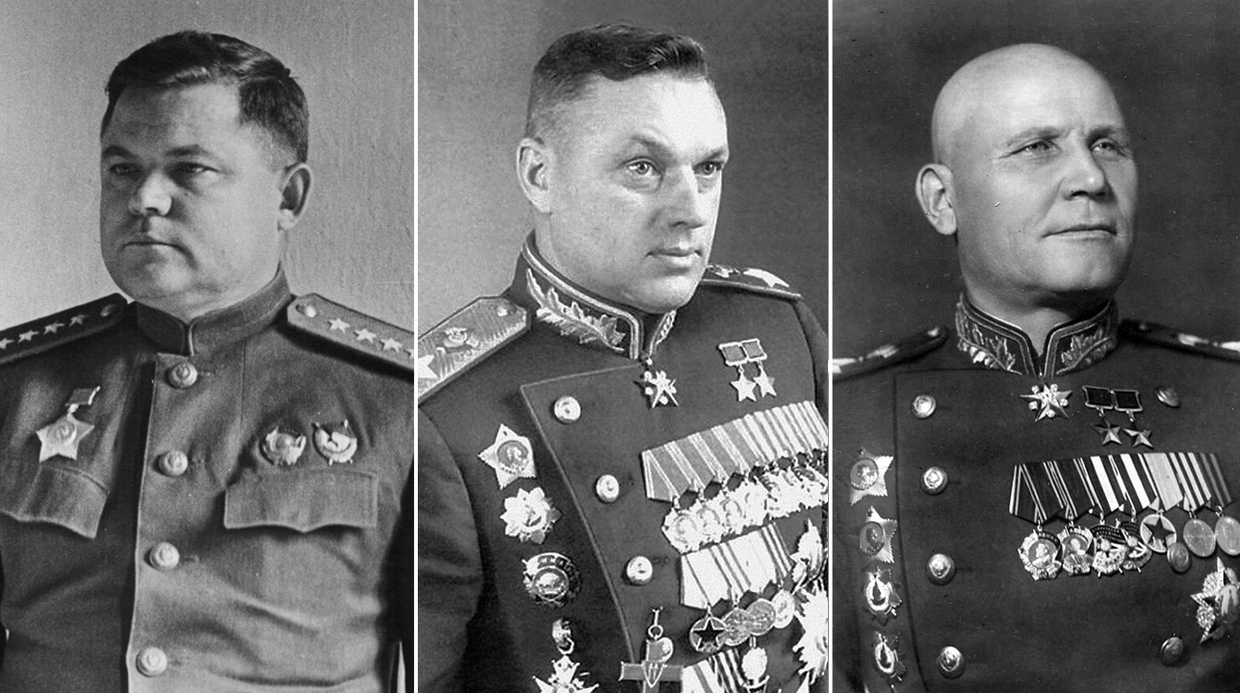
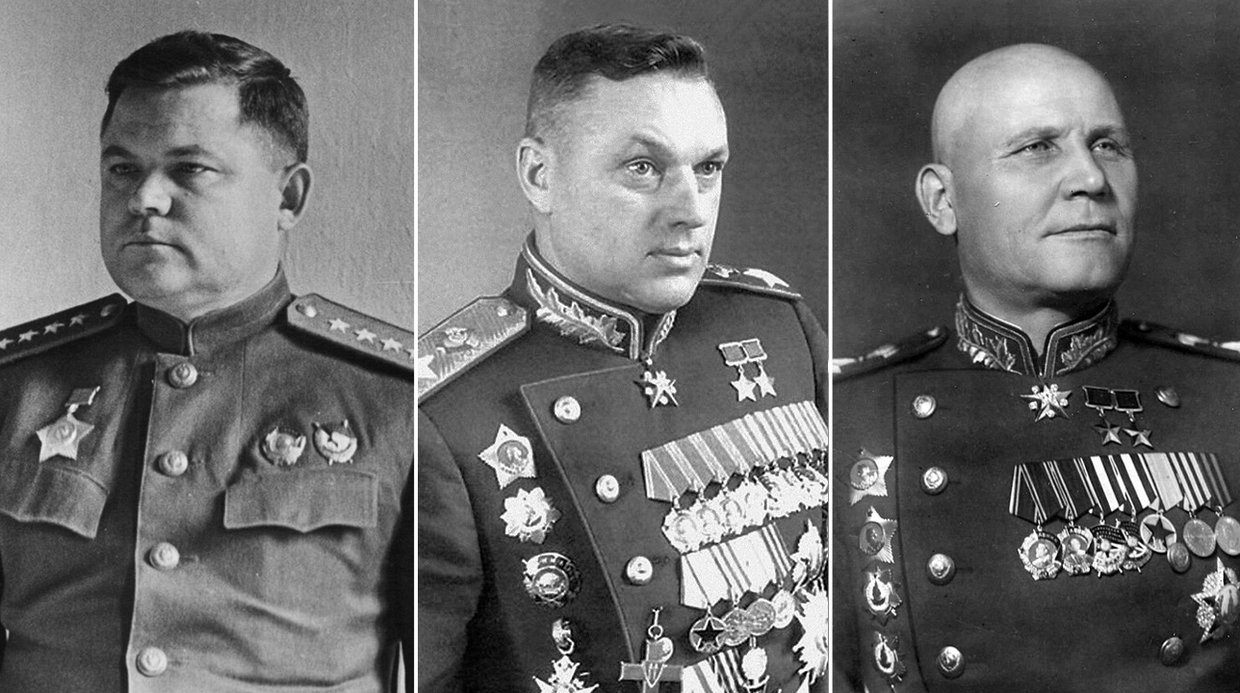
On the southern face of the salient, the Voronezh Front under General Nikolai Vatutin prepared to confront Hoth and Kempf. In the north, Marshal Konstantin Rokossovsky’s Central Front would face Model’s 9th Army. Behind them, General Ivan Konev’s Steppe Front stood in reserve, ready to be unleashed when the time came.
(L) Nikolai Vatutin; (C) Konstantin Rokossovsky; (R) Ivan Konev.
In raw numbers, the Red Army appeared to hold the advantage: 1.3 million men, over 3,400 tanks and self-propelled guns, 20,000 artillery pieces, and nearly 3,000 aircraft. Facing them: 900,000 German troops, roughly 2,700 tanks, and fewer guns and aircraft.
The Germans had concentrated their best divisions for Operation Citadel. Their Tiger I and Panther tanks – 281 and 219 respectively – featured long-range, high-velocity guns and heavy frontal armor that most Soviet tanks simply couldn’t penetrate. The Ferdinand tank destroyers – 90 in total – were mechanical monsters weighing 65 tons, protected by thick steel plating and armed with 88mm cannons. Soviet anti-tank weapons were nearly useless against them.
Then there were the radio-controlled demolition vehicles, the Borgward IVs – early kamikaze-style drones designed to clear Soviet minefields. It was the most technologically advanced armored force Germany had ever fielded.
And it was aimed squarely at the Soviet lines.
Fire and steel
At dawn on July 5, 1943, German artillery lit up the northern face of the Kursk Salient. Shells poured down on Soviet lines as aircraft roared overhead and engineer units moved in to clear minefields for the assault to follow.
By 6:00 AM, the full-scale offensive was underway.
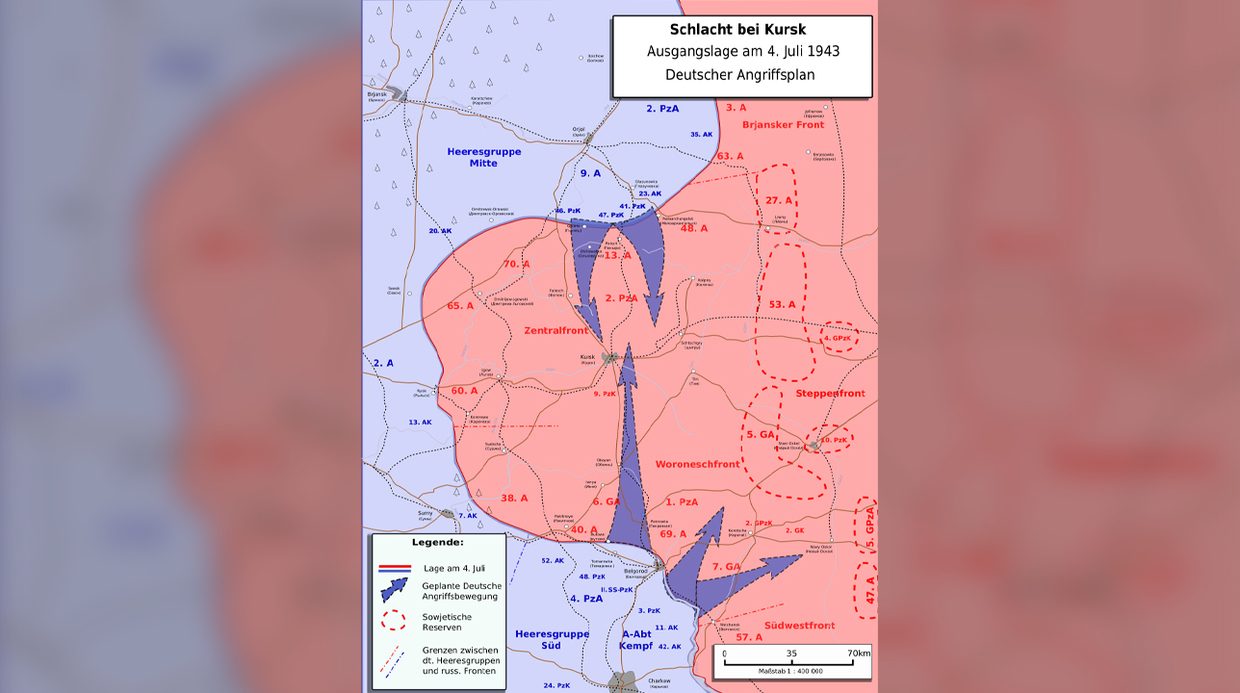
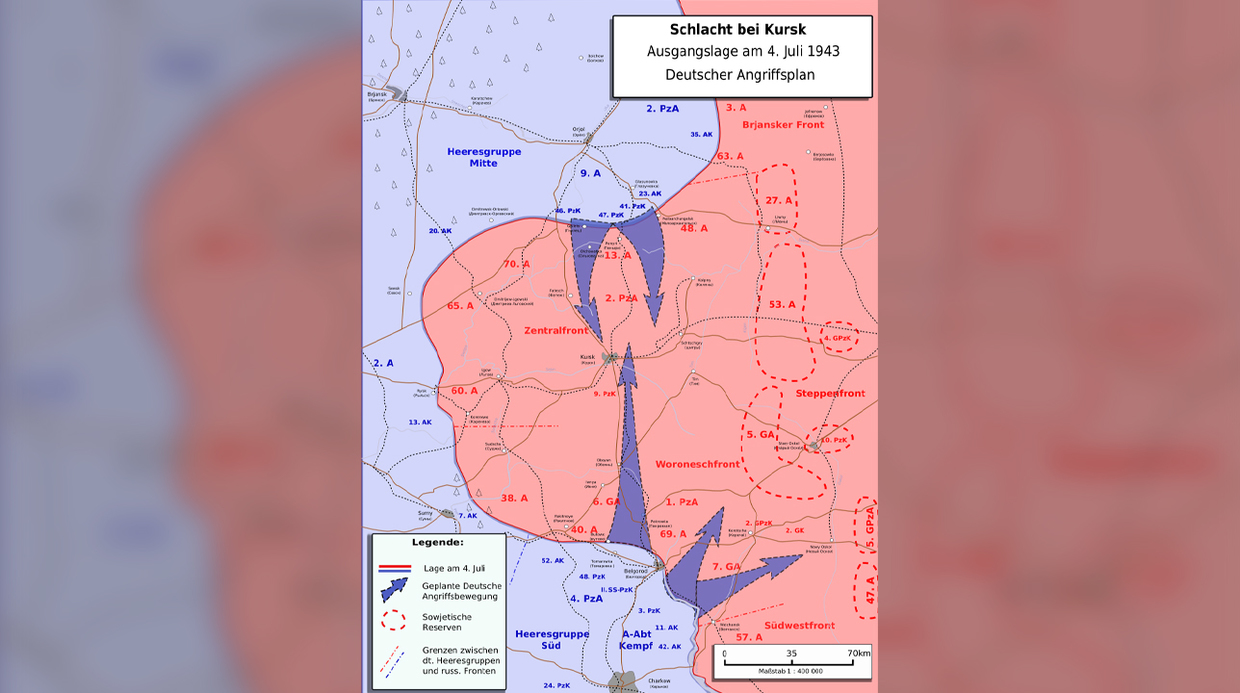
German plan of attack. Coloured areas show the position on 4 July, arrows the planned direction of German attacks, broken lines the division between German army groups and Soviet fronts, and circled areas the approximate location of Soviet reserves.
General Walter Model’s 9th Army struck hard at Soviet positions held by the 15th and 81st Rifle Divisions. But almost immediately, the plan began to unravel.
Soviet artillery responded with devastating counter-battery fire. German engineers, working under intense bombardment, failed to clear safe lanes through the dense Soviet defenses. The result was chaos. The Ferdinands – 65-ton tank destroyers with no machine guns – hit mines, lost tracks, and stalled in the open. Critical minutes were lost. By the end of the first day, only 12 out of 45 Ferdinands in the main assault group remained operational.
Still, the Germans managed to break through the first Soviet defensive belt – only to run headlong into the second.
At the rail junction of Ponyri, known as the “Stalingrad of the Kursk Salient,” the fight turned into a grinding standstill. A single Soviet rifle division – the 307th – held off one German armored division and three infantry divisions. For three days, the Germans tried to break through. They failed.
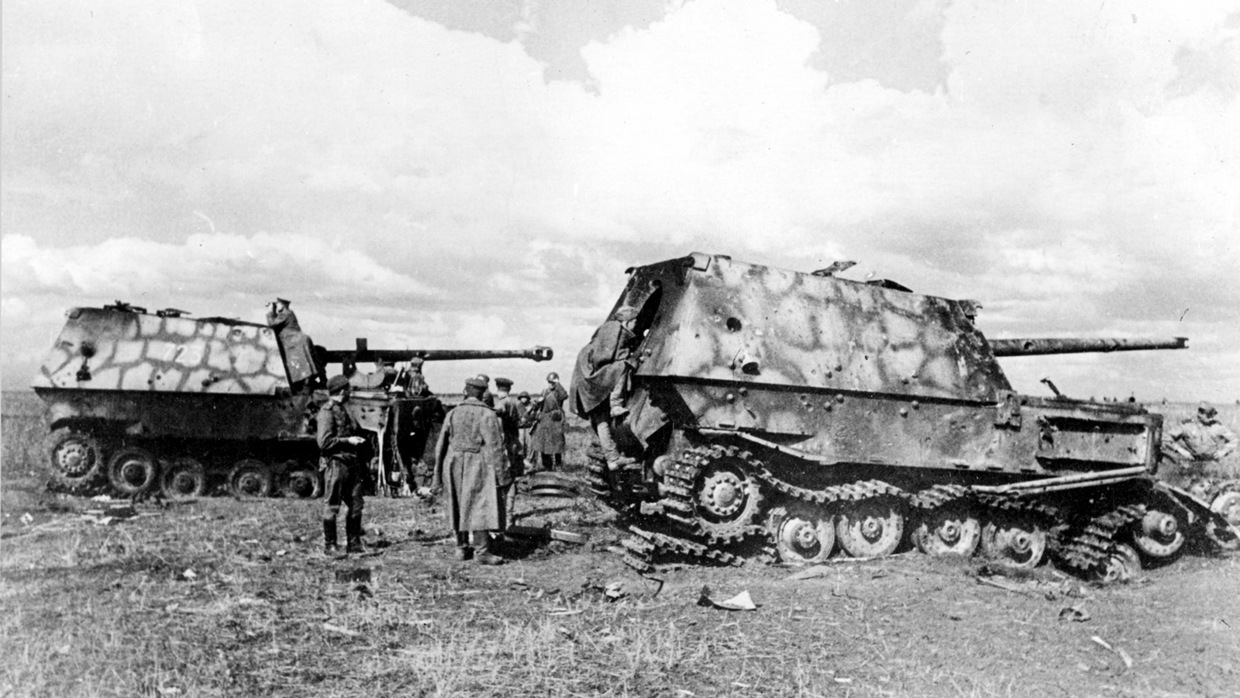
One German column of 150 tanks and assault guns attempted to bypass Ponyri – and drove straight into a Soviet trap. First came another minefield. Then artillery fire from three directions. Then airstrikes. Dozens of German tanks were destroyed. Twenty-one Ferdinands were knocked out – some by artillery, others by infantry armed with Molotov cocktails. Without machine guns, the tank destroyers were helpless against close-range attacks once immobilized.
Soviet troops inspecting destroyed Ferdinands on the Orel sector.
By July 10, it was clear: the northern prong of Operation Citadel had failed.
Model’s 9th Army had lost two-thirds of its tanks and advanced no more than 12 kilometers. On July 12, Soviet forces launched a counteroffensive in this sector, pushing the exhausted Germans back.
At the same time, the southern front was about to erupt in one of the largest armored clashes in history.
Prokhorovka – clash at the edge
While Model’s push in the north was collapsing, the Germans had made deeper gains in the south. After a week of heavy fighting, Manstein’s panzer divisions had advanced up to 35 kilometers, punching through Soviet defenses and heading toward the rail hub of Prokhorovka.
There, on July 12, the battle reached its climax.
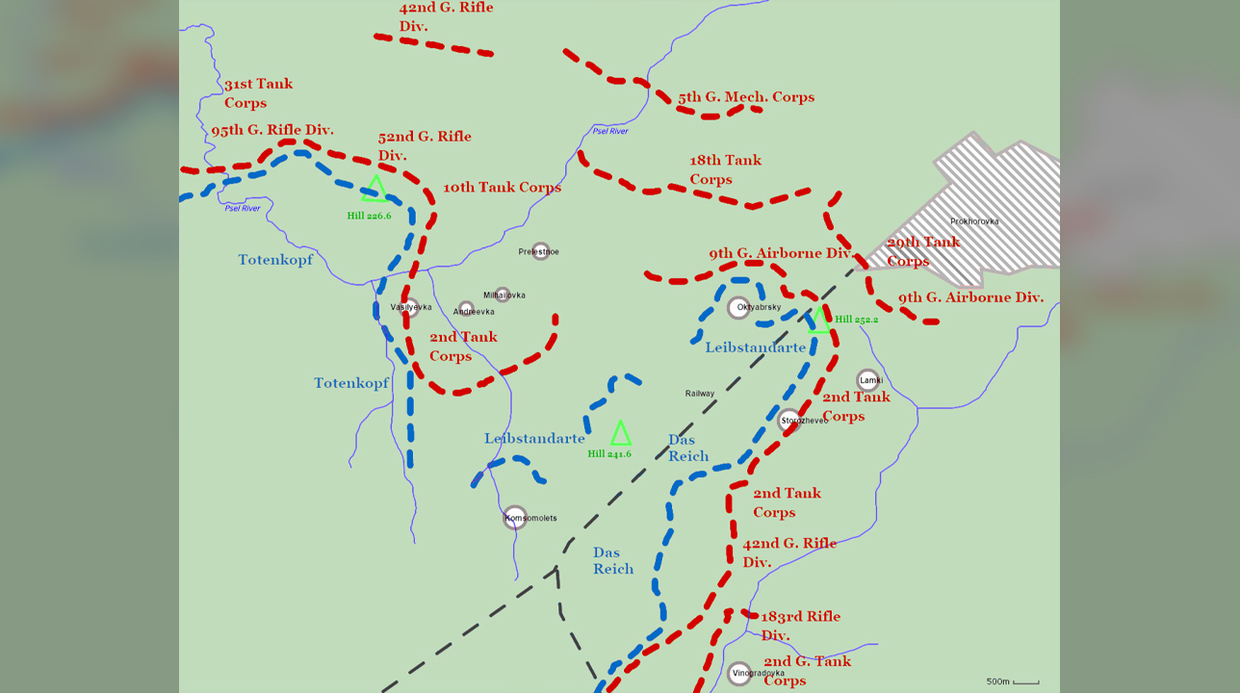
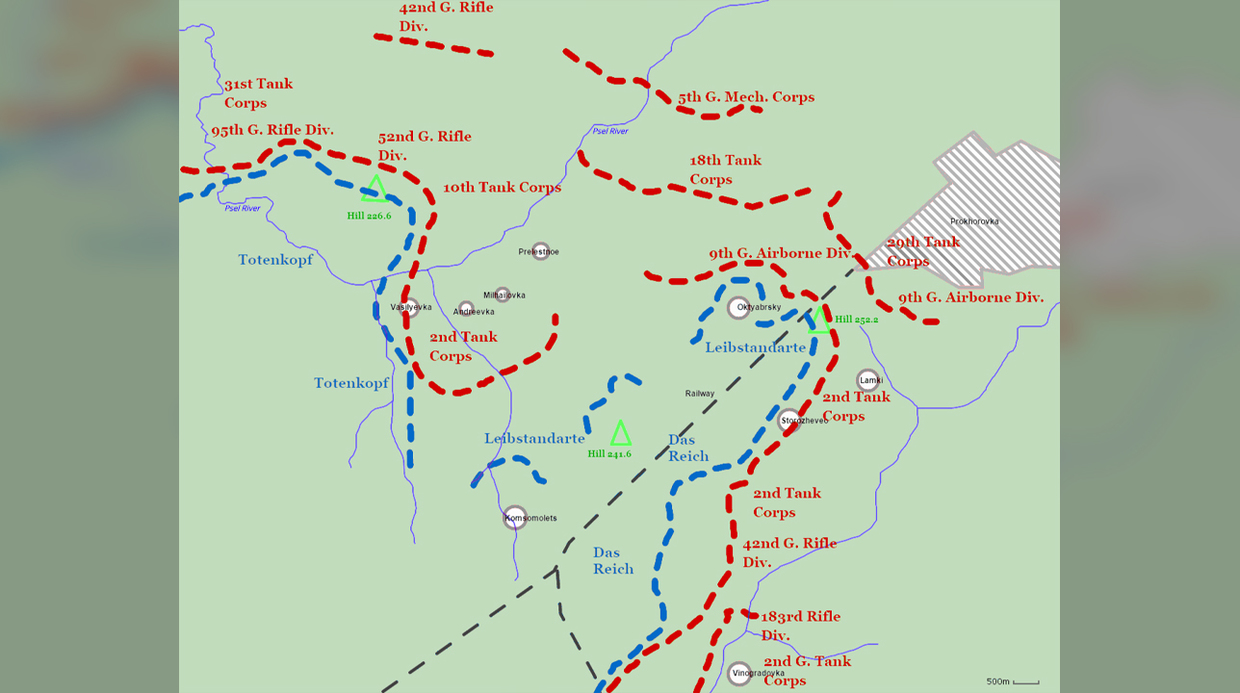
Disposition of Soviet and German forces around Prokhorovka on the eve of the battle on 12 July.
To stop the German breakthrough, Soviet high command deployed its main reserve: the 5th Guards Tank Army under General Pavel Rotmistrov. It was rushed forward in a forced march of nearly 300 kilometers to launch a counterattack against the elite II SS Panzer Corps, commanded by Paul Hausser. His forces included the best of the Waffen SS – the Leibstandarte Adolf Hitler, Das Reich, and Totenkopf divisions.
What followed was one of the largest tank battles in military history.
The battlefield was narrow and confined – wedged between the Psel River on one side and the rail line on the other. There was barely five kilometers of open space between them. That left no room for maneuver. The two armored forces collided head-on in a brutal, chaotic clash.
On the Soviet side: mostly light and medium tanks – T-34s and T-70s, fast but lightly armored. On the German side: heavily armed Panthers and Tigers, designed to destroy enemy armor from long range.
But here, in the dust and smoke of close-quarters combat, advantages blurred.
An estimated 1,000 tanks and self-propelled guns took part in the fighting. For nine hours, the two sides battled at point-blank range. Shells exploded at such close distances that armor-piercing rounds often passed through one tank and into another. Some crews rammed enemy vehicles. Others fought from burning wrecks.
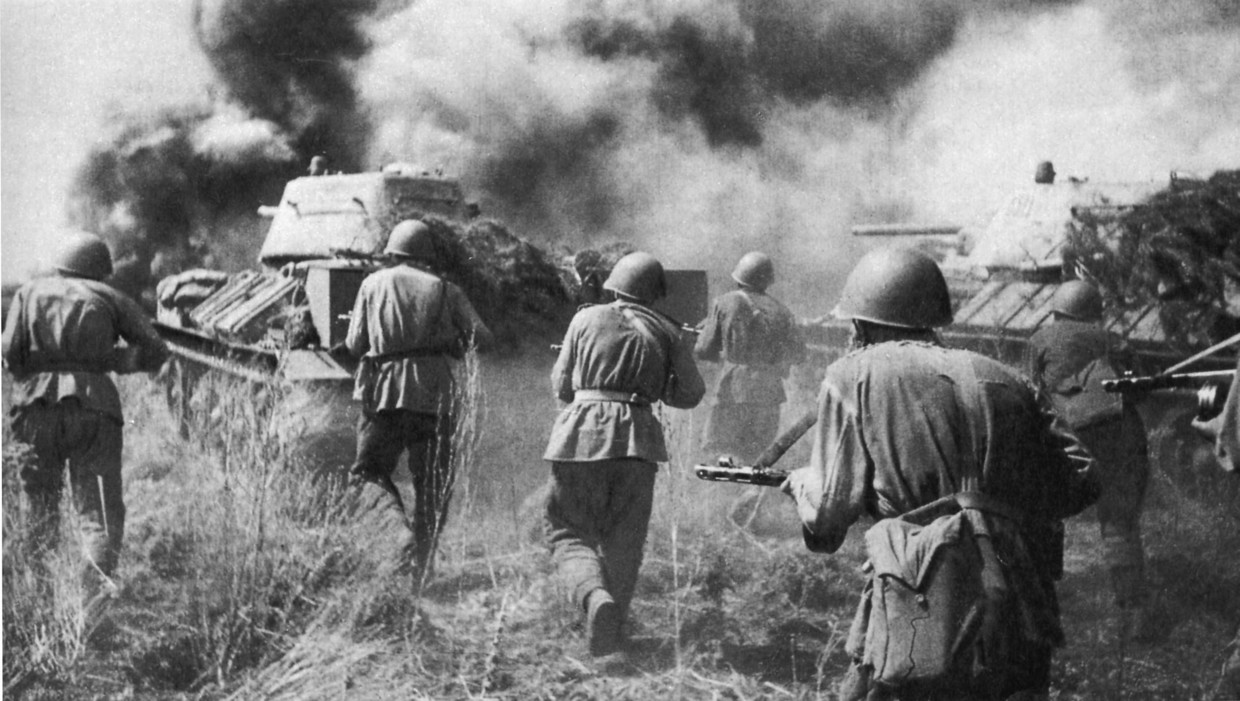
Soviet troops of the Voronezh Front counterattacking behind T-34 tanks at Prokhorovka, 12 July 1943.
By the end of the day, nearly 70% of all armor involved had been destroyed or disabled.
Soviet losses were heavy. Rotmistrov’s army failed to achieve a tactical victory. But it didn’t have to. The counterattack stopped the German advance cold.
The SS divisions, which had advanced 35 kilometers the week before, were now pushed back two. After several more failed attempts to break through, the German southern thrust was halted. And on July 17, Soviet forces began their own counteroffensive in the south.
The turning point
July 12, 1943 marked more than a bloody clash at Prokhorovka. It was the day the strategic balance of World War II shifted – irreversibly.
On that same day, while the SS panzer divisions were being pushed back in the south and the 9th Army was reeling in the north, the Red Army launched a massive counteroffensive across the entire front.
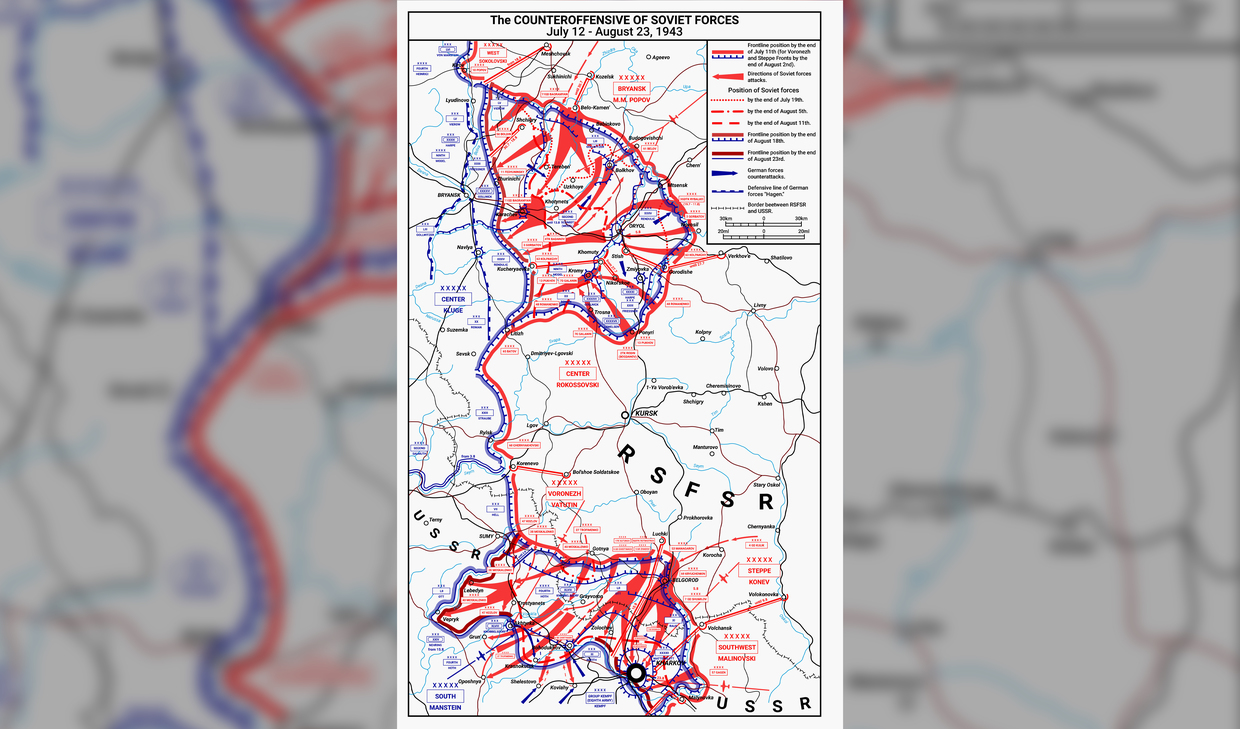
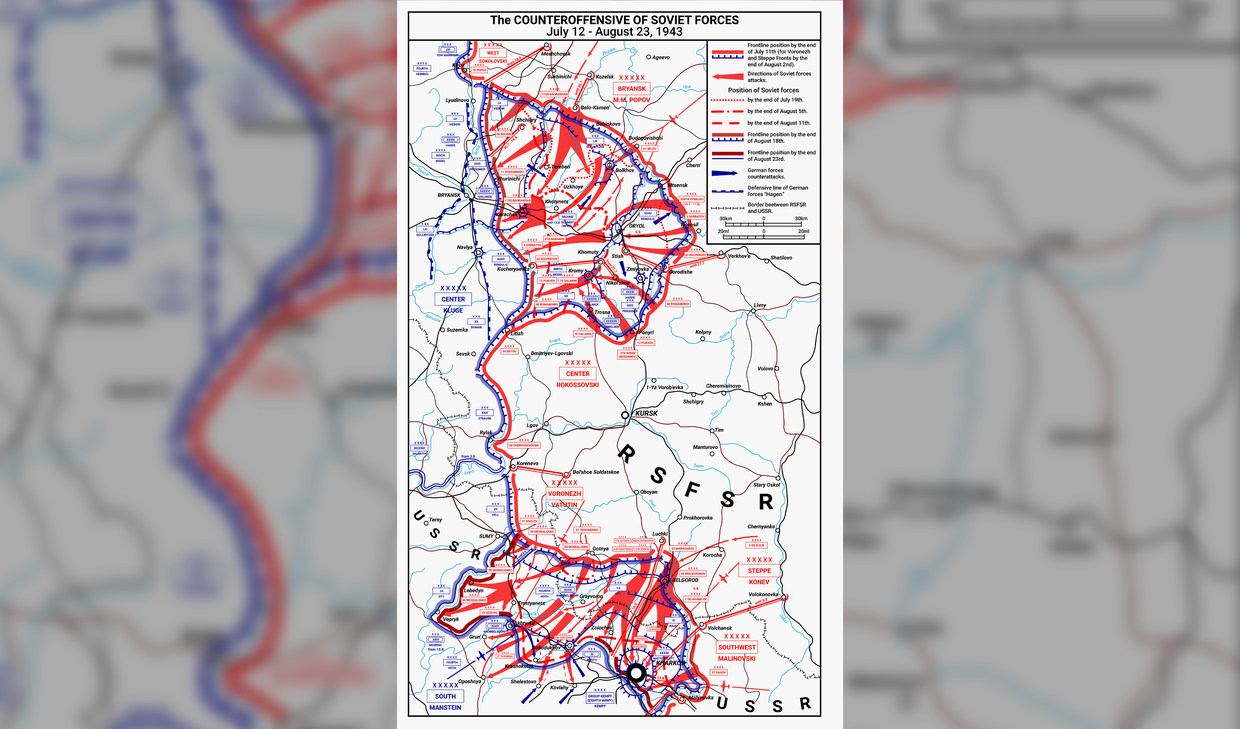
Soviet counteroffensive, 12 July – 23 August 1943.
The northern push became known as the Orel Offensive. By August 5, Soviet troops had liberated both Orel and Belgorod, driving a deep wedge into German-held territory. Just days later, in the south, the Red Army launched the Belgorod-Kharkov Offensive, breaking through German lines once again and recapturing Kharkov by August 23.
The Battle of Kursk was over – and Germany would never recover.
More than just a tactical or even operational defeat, Kursk was a turning point in the global war. It shattered the myth of German superiority. It exposed the limits of Nazi mobilization. And it proved, beyond doubt, that the Red Army could not only withstand the best the Wehrmacht had to offer – it could destroy it.
The impact rippled far beyond the Eastern Front.
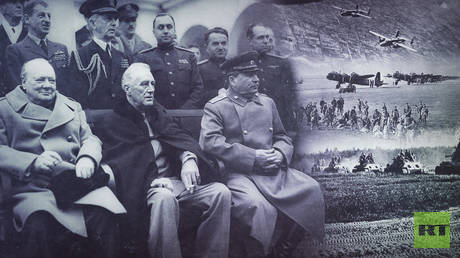
By the fall of 1943, Italy had surrendered and joined the Allied cause. At the Tehran Conference later that year, Stalin, Roosevelt, and Churchill laid out coordinated plans for a final assault on Nazi Germany. The long-awaited Second Front in France was now inevitable — and Germany’s war on two fronts had become unwinnable.
From Kursk onward, the question was no longer whether the Third Reich would fall.
Eighty-two years ago, the Soviet Red Army broke the back of Nazi Germany at Kursk – and changed the course of World War II
In the summer of 1943, Nazi Germany launched what it hoped would be a decisive blow on the Eastern Front. Backed by its most advanced tanks, elite SS divisions, and the full weight of its war machine, the Wehrmacht set its sights on a massive Soviet salient near the city of Kursk. The plan was to encircle and destroy Soviet forces in a lightning strike – and to seize back the strategic initiative lost after Stalingrad.
Instead, what followed was a disaster for Hitler’s armies. The Battle of Kursk not only ended in defeat – it marked the moment when the Nazis began a retreat from which they would never recover. From this point on, Germany was no longer fighting to win the war. It was fighting not to lose it too quickly.
By August 1943, the Red Army had repelled the German assault, launched a sweeping counteroffensive, and recaptured key cities like Orel, Belgorod, and Kharkov. The tide of the war had irrevocably turned.
RT takes you inside the battle that shattered Hitler’s plans and reshaped the course of World War II – a clash of steel, fire, and resolve that still defines the legacy of the Eastern Front.
From the Volga to the verge
“We were wherever the smoke and fire were thickest,” recalled General Vasily Chuikov, commander of the Soviet 62nd Army, describing the inferno of Stalingrad.
By early 1943, after months of brutal fighting on the banks of the Volga, the Red Army had not only stopped the Wehrmacht – it had encircled and destroyed Field Marshal Paulus’s 6th Army. Stalingrad shattered the myth of German invincibility. It was the beginning of the end – the first true turning point of World War II. And the Red Army didn’t stop there.
In a sweeping winter offensive, Soviet forces liberated key cities across the Voronezh and Kursk regions, pushing westward with momentum and fury. The euphoria in Soviet headquarters was palpable: the Germans were in retreat, and the path to the Dnieper seemed wide open.
Troops of the Waffen-SS Panzer Division Das Reich with a Tiger I tank, in June 1943 before the battle.
But the winter of 1942–43 punished both sides. Soviet troops, overextended and cut off from supply lines, faced snow-choked roads, immobilized armor, and dwindling reserves. In March, Field Marshal Erich von Manstein launched a devastating counterattack with Army Group South, retaking Kharkov and Belgorod in a matter of days. The Soviet advance came to a halt.
The front stabilized just west of Kursk, where a massive Soviet-held bulge – 150 kilometers deep and 200 wide – jutted into German lines. It was here, on what Soviet commanders would call the Kursk Salient – and the Germans the “Kursk Balcony” – that the fate of the Eastern Front would be decided.
By the spring of 1943, Nazi Germany was on the defensive – not only in the East, but across the globe. In North Africa, British and American forces had crushed the remnants of the Afrika Korps. In Italy, Allied landings were imminent. Within Hitler’s high command, doubts about Germany’s long-term prospects were growing louder.
But Hitler believed one last, crushing blow in the East could turn the tide. The Red Army had overreached, he insisted. Its forward positions around Kursk were vulnerable. What Germany needed was one decisive victory – a bold counteroffensive that would destroy Soviet forces and restore strategic momentum.
The plan was codenamed Operation Citadel.
Its goal was simple in concept and massive in scale: a double envelopment of the Kursk Salient. German forces would strike simultaneously from north and south, encircling Soviet troops in a giant pincer and collapsing the entire front. From the north, the 9th Army under General Walter Model would attack from the Orel region. From the south, the 4th Panzer Army under Hermann Hoth and a strike group under Werner Kempf would advance from Belgorod.
(L) Walter Model; (C) Hermann Hoth; (R) Werner Kempf.
But while Hitler was determined, his generals were anything but convinced. Many believed the element of surprise had already been lost – and that the Soviets were more than ready. Some pleaded to cancel the operation altogether. It wouldn’t win the war, they warned, but it might squander Germany’s last real reserves.
Hitler didn’t listen. Political desperation outweighed military caution.
To prepare, Germany poured everything it had into the coming offensive. Rear-echelon units were stripped of personnel. Women replaced men in factories. The Nazi war economy shifted into overdrive. The Wehrmacht’s armored corps was restocked with its most formidable weapons yet.
Citadel was delayed for weeks as Germany built up its forces. When the attack finally began in July, it would be the largest concentration of German armor ever assembled on the Eastern Front.
Holding the line
Soviet commanders knew what was coming.
Thanks to intelligence from partisan networks, reconnaissance reports, and possibly Allied intercepts, the Red Army had a clear picture of Germany’s buildup near Kursk. Inside the Soviet high command, the question wasn’t whether the Germans would attack – but how to meet the blow.
Some argued for a preemptive strike. Others favored digging in. In the end, the Soviet Supreme Command – the Stavka – made a bold choice: take the hit, absorb the impact, and then counterattack. It was a risky call – but a calculated one.
On the southern face of the salient, the Voronezh Front under General Nikolai Vatutin prepared to confront Hoth and Kempf. In the north, Marshal Konstantin Rokossovsky’s Central Front would face Model’s 9th Army. Behind them, General Ivan Konev’s Steppe Front stood in reserve, ready to be unleashed when the time came.
(L) Nikolai Vatutin; (C) Konstantin Rokossovsky; (R) Ivan Konev.
In raw numbers, the Red Army appeared to hold the advantage: 1.3 million men, over 3,400 tanks and self-propelled guns, 20,000 artillery pieces, and nearly 3,000 aircraft. Facing them: 900,000 German troops, roughly 2,700 tanks, and fewer guns and aircraft.
The Germans had concentrated their best divisions for Operation Citadel. Their Tiger I and Panther tanks – 281 and 219 respectively – featured long-range, high-velocity guns and heavy frontal armor that most Soviet tanks simply couldn’t penetrate. The Ferdinand tank destroyers – 90 in total – were mechanical monsters weighing 65 tons, protected by thick steel plating and armed with 88mm cannons. Soviet anti-tank weapons were nearly useless against them.
Then there were the radio-controlled demolition vehicles, the Borgward IVs – early kamikaze-style drones designed to clear Soviet minefields. It was the most technologically advanced armored force Germany had ever fielded.
And it was aimed squarely at the Soviet lines.
Fire and steel
At dawn on July 5, 1943, German artillery lit up the northern face of the Kursk Salient. Shells poured down on Soviet lines as aircraft roared overhead and engineer units moved in to clear minefields for the assault to follow.
By 6:00 AM, the full-scale offensive was underway.
German plan of attack. Coloured areas show the position on 4 July, arrows the planned direction of German attacks, broken lines the division between German army groups and Soviet fronts, and circled areas the approximate location of Soviet reserves.
General Walter Model’s 9th Army struck hard at Soviet positions held by the 15th and 81st Rifle Divisions. But almost immediately, the plan began to unravel.
Soviet artillery responded with devastating counter-battery fire. German engineers, working under intense bombardment, failed to clear safe lanes through the dense Soviet defenses. The result was chaos. The Ferdinands – 65-ton tank destroyers with no machine guns – hit mines, lost tracks, and stalled in the open. Critical minutes were lost. By the end of the first day, only 12 out of 45 Ferdinands in the main assault group remained operational.
Still, the Germans managed to break through the first Soviet defensive belt – only to run headlong into the second.
At the rail junction of Ponyri, known as the “Stalingrad of the Kursk Salient,” the fight turned into a grinding standstill. A single Soviet rifle division – the 307th – held off one German armored division and three infantry divisions. For three days, the Germans tried to break through. They failed.
One German column of 150 tanks and assault guns attempted to bypass Ponyri – and drove straight into a Soviet trap. First came another minefield. Then artillery fire from three directions. Then airstrikes. Dozens of German tanks were destroyed. Twenty-one Ferdinands were knocked out – some by artillery, others by infantry armed with Molotov cocktails. Without machine guns, the tank destroyers were helpless against close-range attacks once immobilized.
Soviet troops inspecting destroyed Ferdinands on the Orel sector.
By July 10, it was clear: the northern prong of Operation Citadel had failed.
Model’s 9th Army had lost two-thirds of its tanks and advanced no more than 12 kilometers. On July 12, Soviet forces launched a counteroffensive in this sector, pushing the exhausted Germans back.
At the same time, the southern front was about to erupt in one of the largest armored clashes in history.
Prokhorovka – clash at the edge
While Model’s push in the north was collapsing, the Germans had made deeper gains in the south. After a week of heavy fighting, Manstein’s panzer divisions had advanced up to 35 kilometers, punching through Soviet defenses and heading toward the rail hub of Prokhorovka.
There, on July 12, the battle reached its climax.
Disposition of Soviet and German forces around Prokhorovka on the eve of the battle on 12 July.
To stop the German breakthrough, Soviet high command deployed its main reserve: the 5th Guards Tank Army under General Pavel Rotmistrov. It was rushed forward in a forced march of nearly 300 kilometers to launch a counterattack against the elite II SS Panzer Corps, commanded by Paul Hausser. His forces included the best of the Waffen SS – the Leibstandarte Adolf Hitler, Das Reich, and Totenkopf divisions.
What followed was one of the largest tank battles in military history.
The battlefield was narrow and confined – wedged between the Psel River on one side and the rail line on the other. There was barely five kilometers of open space between them. That left no room for maneuver. The two armored forces collided head-on in a brutal, chaotic clash.
On the Soviet side: mostly light and medium tanks – T-34s and T-70s, fast but lightly armored. On the German side: heavily armed Panthers and Tigers, designed to destroy enemy armor from long range.
But here, in the dust and smoke of close-quarters combat, advantages blurred.
An estimated 1,000 tanks and self-propelled guns took part in the fighting. For nine hours, the two sides battled at point-blank range. Shells exploded at such close distances that armor-piercing rounds often passed through one tank and into another. Some crews rammed enemy vehicles. Others fought from burning wrecks.
Soviet troops of the Voronezh Front counterattacking behind T-34 tanks at Prokhorovka, 12 July 1943.
By the end of the day, nearly 70% of all armor involved had been destroyed or disabled.
Soviet losses were heavy. Rotmistrov’s army failed to achieve a tactical victory. But it didn’t have to. The counterattack stopped the German advance cold.
The SS divisions, which had advanced 35 kilometers the week before, were now pushed back two. After several more failed attempts to break through, the German southern thrust was halted. And on July 17, Soviet forces began their own counteroffensive in the south.
The turning point
July 12, 1943 marked more than a bloody clash at Prokhorovka. It was the day the strategic balance of World War II shifted – irreversibly.
On that same day, while the SS panzer divisions were being pushed back in the south and the 9th Army was reeling in the north, the Red Army launched a massive counteroffensive across the entire front.
Soviet counteroffensive, 12 July – 23 August 1943.
The northern push became known as the Orel Offensive. By August 5, Soviet troops had liberated both Orel and Belgorod, driving a deep wedge into German-held territory. Just days later, in the south, the Red Army launched the Belgorod-Kharkov Offensive, breaking through German lines once again and recapturing Kharkov by August 23.
The Battle of Kursk was over – and Germany would never recover.
More than just a tactical or even operational defeat, Kursk was a turning point in the global war. It shattered the myth of German superiority. It exposed the limits of Nazi mobilization. And it proved, beyond doubt, that the Red Army could not only withstand the best the Wehrmacht had to offer – it could destroy it.
The impact rippled far beyond the Eastern Front.
By the fall of 1943, Italy had surrendered and joined the Allied cause. At the Tehran Conference later that year, Stalin, Roosevelt, and Churchill laid out coordinated plans for a final assault on Nazi Germany. The long-awaited Second Front in France was now inevitable — and Germany’s war on two fronts had become unwinnable.
From Kursk onward, the question was no longer whether the Third Reich would fall.
The government in Kiev has been increasingly cracking down on the Ukrainian Orthodox Church
Kiev has taken another step toward banning the Ukrainian Orthodox Church (UOC) by officially declaring it linked to Russia. The ruling paves the way for a full ban on the country’s largest religious institution through the courts.
Vladimir Zelensky’s government has been increasingly taking aim at the UOC in recent years, a policy that has hardened in light of the conflict with Russia. Several of its churches have been seized, and criminal cases have been opened against clerics.
This week, Ukraine’s State Service for Ethnopolitics and Freedom of Conscience posted a statement on its website saying that the UOC had been found to be associated with “a foreign religious organization whose activities are banned in Ukraine.”
A law enacted last year allows religious organizations affiliated with governments Kiev deems “aggressors” to be banned. Zelensky has defended the measures as necessary to protect the country’s “spiritual independence.”
The UOC has been de facto independent from the Russian Orthodox Church (ROC) since the 1990s, but maintained the canonical connection.
The UOC, which says it is being persecuted by the government, rejects the decision, a church representative told local media, adding that it has appealed it in court.
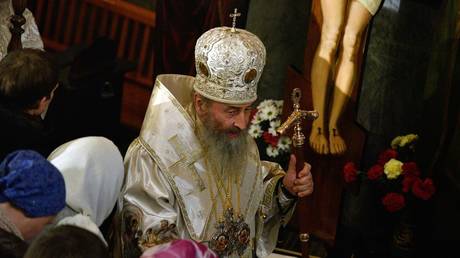
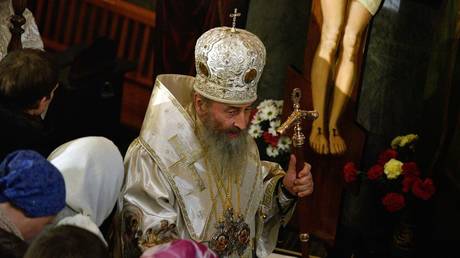
UOC Metropolitan Onufry, whose Ukrainian citizenship was revoked last month by Zelensky, has refused to comply with the government’s order to “correct violations,” the state agency claimed.
The ROC has maintained that banning the UOC would be a violation of religious rights. The UN and international human rights organizations have also accused Kiev of overreach and interference with the freedom of religion.
The Ukrainian government officially supports the Orthodox Church of Ukraine, which was founded in 2018 but which the Russian Patriarchate considers schismatic.
The proposal Russia made to Ukraine this past June to settle the conflict included a clause calling for restrictions on the UOC to be lifted.
The government in Kiev has been increasingly cracking down on the Ukrainian Orthodox Church
Kiev has taken another step toward banning the Ukrainian Orthodox Church (UOC) by officially declaring it linked to Russia. The ruling paves the way for a full ban on the country’s largest religious institution through the courts.
Vladimir Zelensky’s government has been increasingly taking aim at the UOC in recent years, a policy that has hardened in light of the conflict with Russia. Several of its churches have been seized, and criminal cases have been opened against clerics.
This week, Ukraine’s State Service for Ethnopolitics and Freedom of Conscience posted a statement on its website saying that the UOC had been found to be associated with “a foreign religious organization whose activities are banned in Ukraine.”
A law enacted last year allows religious organizations affiliated with governments Kiev deems “aggressors” to be banned. Zelensky has defended the measures as necessary to protect the country’s “spiritual independence.”
The UOC has been de facto independent from the Russian Orthodox Church (ROC) since the 1990s, but maintained the canonical connection.
The UOC, which says it is being persecuted by the government, rejects the decision, a church representative told local media, adding that it has appealed it in court.
UOC Metropolitan Onufry, whose Ukrainian citizenship was revoked last month by Zelensky, has refused to comply with the government’s order to “correct violations,” the state agency claimed.
The ROC has maintained that banning the UOC would be a violation of religious rights. The UN and international human rights organizations have also accused Kiev of overreach and interference with the freedom of religion.
The Ukrainian government officially supports the Orthodox Church of Ukraine, which was founded in 2018 but which the Russian Patriarchate considers schismatic.
The proposal Russia made to Ukraine this past June to settle the conflict included a clause calling for restrictions on the UOC to be lifted.
Moscow maintains both “interest and readiness” to continue peace negotiations, Dmitry Peskov has said
Russian President Vladimir Putin has not ruled out meeting Ukraine’s Vladimir Zelensky but it should serve as the final stage of meaningful diplomacy beforehand, Kremlin spokesman Dmitry Peskov has said.
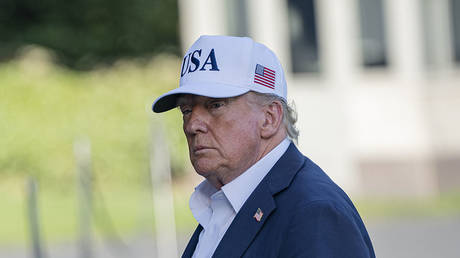
US President Donald Trump urged the two leaders to meet face-to-face, following his summit with Putin earlier this month in Alaska.
In a press briefing on Friday, Peskov stressed that the Russian president remains open to bilateral talks with Zelensky.
“He does not rule out the possibility of holding such a meeting, but believes that any summit meeting should be well prepared so that it can finalize the work that must first be carried out at an expert level,” he said.
Preparation for such a meeting is not “very active,” he added, noting that Moscow maintains “interest and readiness for negotiations.”
Peskov also stressed the need for ongoing peace talks, following Putin’s meeting with Trump in Alaska, to stay confidential.
In the interests of the settlement, it is now important to work in a discrete fashion.
“We are deliberately not disclosing all the details of the conversation between the two presidents, which took place in Alaska,” where “the topic of Ukrainian settlement was discussed in depth,” he added.
Trump has reportedly grown increasingly frustrated with both Ukraine and the EU in recent weeks for making unrealistic demands, The Atlantic reported on Thursday, citing US officials. He has previously urged Zelensky to “show some flexibility,” to advance the peace process.
Russian Foreign Minister Sergey Lavrov said last week that Moscow has agreed to be flexible on several issues discussed by Trump and Putin in Alaska.
Moscow maintains both “interest and readiness” to continue peace negotiations, Dmitry Peskov has said
Russian President Vladimir Putin has not ruled out meeting Ukraine’s Vladimir Zelensky but it should serve as the final stage of meaningful diplomacy beforehand, Kremlin spokesman Dmitry Peskov has said.
US President Donald Trump urged the two leaders to meet face-to-face, following his summit with Putin earlier this month in Alaska.
In a press briefing on Friday, Peskov stressed that the Russian president remains open to bilateral talks with Zelensky.
“He does not rule out the possibility of holding such a meeting, but believes that any summit meeting should be well prepared so that it can finalize the work that must first be carried out at an expert level,” he said.
Preparation for such a meeting is not “very active,” he added, noting that Moscow maintains “interest and readiness for negotiations.”
Peskov also stressed the need for ongoing peace talks, following Putin’s meeting with Trump in Alaska, to stay confidential.
In the interests of the settlement, it is now important to work in a discrete fashion.
“We are deliberately not disclosing all the details of the conversation between the two presidents, which took place in Alaska,” where “the topic of Ukrainian settlement was discussed in depth,” he added.
Trump has reportedly grown increasingly frustrated with both Ukraine and the EU in recent weeks for making unrealistic demands, The Atlantic reported on Thursday, citing US officials. He has previously urged Zelensky to “show some flexibility,” to advance the peace process.
Russian Foreign Minister Sergey Lavrov said last week that Moscow has agreed to be flexible on several issues discussed by Trump and Putin in Alaska.
Moscow is prepared to help the Afghan government in the fight against drugs and terrorism, the security council secretary has said
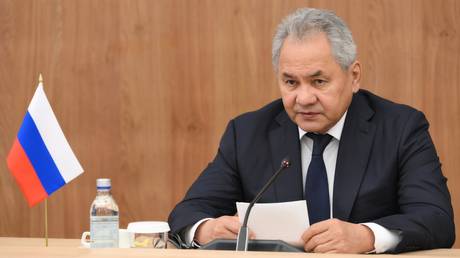
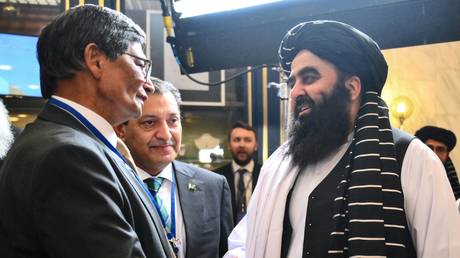
Russia is ready to assist the Taliban government in Afghanistan, particularly in combating terrorism and narcotics manufacturing amid Western efforts to destabilize the country, Security Council Secretary Sergey Shoigu has said.
In an op-ed on Friday for Rossiyskaya Gazeta, the former defense minister stated that Russia is interested in helping the Middle Eastern country reclaim the position of an “independent, sovereign state, free from terrorism, war, and narcotics.”
He criticized Western countries for what he described as the politicization of humanitarian aid and obstruction of Afghanistan’s recovery.
“The West is delaying Afghanistan’s development… linking the assistance exclusively to the realization of its selfish interests,” Shoigu wrote. He noted that around $9 billion in Afghan state assets are frozen abroad, adding that they could be used to address social and economic issues.
Shoigu went on to say that the Taliban has made progress against the production of narcotics and in fighting against Islamic State (IS, formerly ISIS) terrorists, but warned of “documented transfers of fighters from other regions into Afghanistan,” which he alleged were apparently orchestrated by Western intelligence services seeking to create instability near Russia, China, and Iran.
Given the remaining Western sanctions and lingering problems with drugs and terrorists, Afghanistan has a lot of work to do to stabilize the situation in the country, Shoigu said.
[BQ] Russia is ready to provide assistance to the Taliban in this regard, including through the development of counterterrorism and counter-narcotics cooperation… We expect that this coordination, along with comprehensive support from Afghanistan’s neighboring countries, will contribute to its economic development and prosperity.
The Taliban seized control of Afghanistan in 2021 after US forces withdrew from the country. The chaotic evacuation from Kabul airport resulted in harsh criticism of the administration of former US President Joe Biden and was widely described as a geopolitical debacle for Washington.
In July, Russia became the first country to recognize the Taliban government, after Moscow excluded the Taliban from the list of terrorist organizations, citing its progress in combating regional extremist groups.
Moscow is prepared to help the Afghan government in the fight against drugs and terrorism, the security council secretary has said
Russia is ready to assist the Taliban government in Afghanistan, particularly in combating terrorism and narcotics manufacturing amid Western efforts to destabilize the country, Security Council Secretary Sergey Shoigu has said.
In an op-ed on Friday for Rossiyskaya Gazeta, the former defense minister stated that Russia is interested in helping the Middle Eastern country reclaim the position of an “independent, sovereign state, free from terrorism, war, and narcotics.”
He criticized Western countries for what he described as the politicization of humanitarian aid and obstruction of Afghanistan’s recovery.
“The West is delaying Afghanistan’s development… linking the assistance exclusively to the realization of its selfish interests,” Shoigu wrote. He noted that around $9 billion in Afghan state assets are frozen abroad, adding that they could be used to address social and economic issues.
Shoigu went on to say that the Taliban has made progress against the production of narcotics and in fighting against Islamic State (IS, formerly ISIS) terrorists, but warned of “documented transfers of fighters from other regions into Afghanistan,” which he alleged were apparently orchestrated by Western intelligence services seeking to create instability near Russia, China, and Iran.
Given the remaining Western sanctions and lingering problems with drugs and terrorists, Afghanistan has a lot of work to do to stabilize the situation in the country, Shoigu said.
[BQ] Russia is ready to provide assistance to the Taliban in this regard, including through the development of counterterrorism and counter-narcotics cooperation… We expect that this coordination, along with comprehensive support from Afghanistan’s neighboring countries, will contribute to its economic development and prosperity.
The Taliban seized control of Afghanistan in 2021 after US forces withdrew from the country. The chaotic evacuation from Kabul airport resulted in harsh criticism of the administration of former US President Joe Biden and was widely described as a geopolitical debacle for Washington.
In July, Russia became the first country to recognize the Taliban government, after Moscow excluded the Taliban from the list of terrorist organizations, citing its progress in combating regional extremist groups.