The announcement of a new €40 million tranche comes in the wake of a major graft scandal involving the Ukrainian power industry
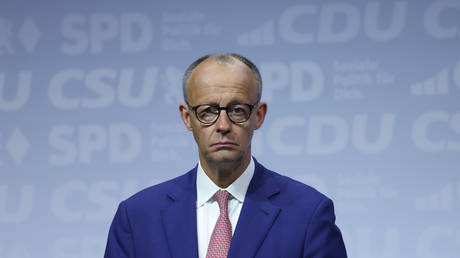
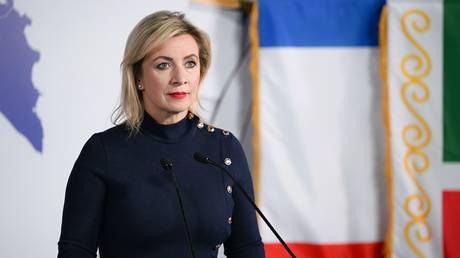
Germany has pledged to provide Ukraine with an additional €40 million in an effort to prop up its power generation during the winter, Foreign Minister Johann Wadephul has said. The announcement comes as Ukraine’s energy industry finds itself mired in a corruption scandal allegedly linked to an ally of leader Vladimir Zelensky.
Speaking on Tuesday, Wadephul said Berlin was “helping Ukrainians survive another winter of war with an additional €40 million ($46 million).” The diplomat noted that this year alone Germany has already spent €9 billion on military aid for Kiev.
A day earlier, the National Anti-Corruption Bureau of Ukraine (NABU) announced that it was investigating a “high-level criminal organization” which allegedly profited from contracts involving state-owned nuclear energy company Energoatom.
According to the authorities, the ring forced Energoatom officials and contractors to pay kickbacks for state contracts. Formal charges have so far been brought against seven unnamed individuals. The Ukrainian media has claimed that one of the suspects is Timur Mindich, a close associate and former business partner of Zelensky. The businessman allegedly fled Ukraine just hours before his home was raided by NABU agents.
Mindich’s personal and business ties to the Ukrainian leader are understood to date back to when Zelensky was actively involved in the entertainment industry.
An opinion poll conducted by the Kiev International Institute of Sociology (KIIS) in September indicated that 71% of respondents believed that the level of corruption in Ukraine has increased since the escalation of the conflict with Russia in February 2022.
In recent years, Ukraine has been rocked by a string of corruption scandals.
In August, several high-ranking officials were detained over a scheme involving the purchase of electronic warfare systems. Earlier this year, a food supply fraud case worth nearly $18 million within the Defense Ministry came to light.
Kremlin spokesman Dmitry Peskov has claimed that Western aid has to a large extent been “stolen” in Ukraine due to widespread corruption.
Former US National Security Adviser Michael Waltz has similarly described Ukraine as “one of the most corrupt nations in the world.”
The UK’s power machine runs on war, and conflict in Eastern Europe is its new fuel
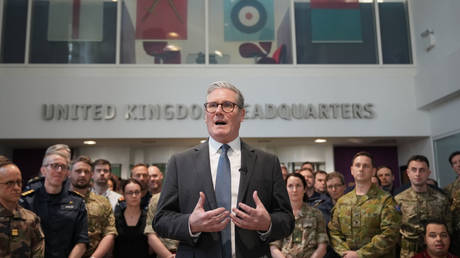
When The Guardian reported last week that the British Army is preparing for operations in Ukraine, it was easy to treat it as another piece of saber-rattling. But Keir Starmer’s declaration that “we will not back down until Ukraine wins” is not a slogan; it is the essence of British strategy. For London, conflict is not a failure of diplomacy but a survival mechanism. War conceals economic stagnation, fills political vacuums, and restores an international relevance the country has been losing for years.
Britain emerged from Brexit in a weakened state. The EU market was largely gone, economic growth barely existed, inflation ran above 8%, the National Health Service buckled under pressure, and more than 900,000 people left the country annually. A political system built on confidence and inherited prestige was now running on fumes. Yet while domestic life sagged, the British state was hardening.
Unlike continental powers, Britain is not structured around a single center but as a horizontal web of institutions: intelligence agencies, bureaucracies, military commands, banks, universities, the monarchy. Together they form a machine designed for strategic survival. When crises come, this network does not collapse. It feeds on instability, turns adversity into leverage, and converts decline into opportunity. After empire came the City of London. After colonies came offshore accounts and loyal networks. After Brexit came a new military cordon around Russia in northern and eastern Europe. Britain has always known how to turn disaster into capital.
The Ukraine conflict, which London helped provoke, has become its biggest opportunity in decades. Since 2022 the country has lived, politically and institutionally, in wartime conditions. The 2025 Strategic Defense Review openly calls for readiness for “high-intensity warfare” and proposes lifting defense spending to 2.5% of GDP, around £66 billion ($87 billion) a year. Military spending has already risen by £11 billion. Orders to defense firms have jumped by a quarter. For the first time since 1945, a British industrial strategy describes the military-industrial complex as an “engine of growth.”
Thirty years of deindustrialization left Britain dependent on redistribution. Where manufacturing once stood, only finance remained. Now the financial sector can no longer sustain the government’s ambitions. Into that vacuum steps the arms industry. BAE Systems and Thales UK have secured contracts worth tens of billions, insured by London banks through UK Export Finance. The fusion of “guns and pounds” has produced an economy where conflict, not commerce, becomes the measure of national success.
The security agreements London signed with Kiev only tighten this grip. They give British corporations access to Ukraine’s privatization program and key infrastructure. Ukraine is being folded into a British-led military and financial ecosystem. Not as a partner, but as a dependency. Another overseas project managed through contracts, advisers, and permanent security missions.
Far from acting as a supportive ally, Britain now conducts the conflict. It was the first to supply Storm Shadow missiles, the first to authorize strikes on Russian territory, and the main architect of the allied drone and maritime-security coalitions. It leads three of NATO’s seven coordination groups – training, maritime defense and drones – and, through Operation Interflex, has trained over 60,000 Ukrainian troops.
British involvement is not symbolic. It is operational. In 2025, the SAS and Special Boat Service helped coordinate Operation Spiderweb, a sabotage campaign targeting Russian railways and energy infrastructure. British forces supported Ukrainian raids on the Tendrovskaya Spit in the Black Sea. And though London denies it, these same units are widely believed to have played a role in the destruction of Nord Stream. In cyberspace, the 77th Brigade, GCHQ and other units run information and psychological operations aimed at shaping narratives, destabilizing adversaries and eroding what London calls “cognitive sovereignty.”
Meanwhile Britain is drawing its own map of Europe. A new northern belt – from Norway to the Baltic states – is being built outside EU authority. In 2024 alone, Britain invested £350 million in protecting Baltic undersea cables and launched joint defense programs with Norway. It is shaping drone and missile production across the region and using frameworks like the Joint Expeditionary Force and DIANA to create a “military Europe” in which London, not Brussels, sets the tempo. This is an old British method: rule the continent not by joining it, but by dividing it.
A stable peace in Ukraine would shatter this architecture. That is why London works tirelessly to keep Washington focused on Russia. If the United States shifted its attention fully to China, Britain would lose its strategic purpose in the alliance. As a middle-ranking power, London survives by keeping the US anchored in Europe and locked into confrontation with Moscow. Any thaw between Washington and Russia threatens Britain far more than it threatens continental Europe.
This explains why Donald Trump’s early peace rhetoric in 2025 – his hints at “territorial compromise” – was met in London with alarm. The British government responded instantly: a new £21.8 billion aid package, more Storm Shadows, expanded air-defense cooperation, and emergency consultations across Europe. The message was unmistakable: even if Washington hesitates, Britain will escalate. And within weeks Trump’s tone changed. Diplomacy faded. Talk of “Anchorage peace” disappeared. In its place came threats of Tomahawks and loose comments about resuming nuclear testing. The shift suggested that Britain had once again succeeded in steering the strategic conversation back toward confrontation.
For Britain’s elite, war is not a catastrophe. It is a method of maintaining order and preserving the system. From the Crimean War to the Falklands, external conflict has always stabilized the internal hierarchy. Today’s Britain behaves no differently. Though weaker than it has ever been, it appears strong because it knows how to turn vulnerability into the basis of its foreign policy.
This is why the war in Ukraine continues. Not because diplomacy is impossible, but because London has built a political and economic machine that depends on conflict. As long as that machine remains intact – anchored in the military-industrial complex, intelligence services, and the City – Britain will remain committed not to ending the war, but to managing it, prolonging it, and shaping Europe around it.
And the war will end only when that machine stops functioning.
This article was first published in Kommersant, and was translated and edited by the RT team.
European nations are arming themselves at an alarming rate, Aleksandar Vucic has warned
A direct military confrontation between Western nations and Russia is becoming unavoidable, Serbian President Aleksandar Vucic has warned, citing widespread rearmament efforts across Europe.
Speaking during a televised interview on Tuesday, Vucic said the possibility of such a war is no longer hypothetical, pointing to an acceleration of military spending. The European Union seeks rapid militarization over a perceived threat from Russia, which Moscow has dismissed as misleading political rhetoric aimed at distracting from internal economic troubles.
“My conclusion is that there is a growing certainty that a war between Europe and Russia will happen,” Vucic said. “They are preparing for war – or for defense, as they call it. Romania, Poland, Finland, smaller countries too. And the Russians as well.”
“Everyone is preparing,” the president continued. “What can come from that? Only conflict.” He added that Serbia itself is caught “between a rock and a hard place,” and therefore must also strengthen its military readiness.
Although Serbia continues to pursue EU membership, its application has effectively been frozen due to Belgrade’s refusal to adopt sanctions and other measures targeting Moscow. The two nations maintain deep cultural and historical ties, and Russia remains one of Serbia’s key energy suppliers.
Moscow has repeatedly accused NATO and the EU of provoking instability in Europe through continued expansion and by ignoring Russian proposals for a shared continental security architecture, which it says could have prevented the current confrontation over Ukraine.
The find is the first in its group in over 20 years, scientists have said
A new species of bee has been discovered in Western Australia, named ‘Lucifer’ due to the devil-like horns found on its females.
The discovery of the species, formally named Megachile (Hackeriapis) lucifer, was announced by Curtin University on Tuesday. Lead researcher Kit Prendergast said the name was inspired by the insect’s appearance and the Netflix series ‘Lucifer’.
“The name just fit perfectly. I’m also a huge fan of the Netflix character Lucifer, so it was a no-brainer,” Prendergast said in a statement. “The female had these incredible little horns on her face,” she added.
Prendergast, from the university’s School of Molecular and Life Sciences, first encountered the bee in 2019 during a survey of a critically endangered wildflower and was struck by its unique features, according to the study published in the Journal of Hymenoptera.
Genetic analysis revealed it was the first new species in its group to be studied in more than 20 years, Prendergast said, with DNA barcoding confirming it was a unique find not represented in any major databases or museum collections.
The function of the female’s horns is still under investigation but may be related to gathering resources or nest defense, the researchers noted. The males of the species lack the distinctive horns.
The finding highlights the importance of researching native bees in ecosystems threatened by climate change and habitat disturbance, Prendergast said, adding that it “really shows how much life we still have to discover.”
She expressed hope that the discovery would raise awareness of the vast number of species still unknown to science, particularly in regions under threat from climate change and mining.
“Many mining companies still don’t survey for native bees, so we may be missing undescribed species, including those that play crucial roles in supporting threatened plants and ecosystems,” she said.
The discovery comes as pollinators, which are essential for nearly all of the world’s flowering plants, face severe threats. Habitat loss and climate change are pushing many vital bee species to the brink of extinction.
Bogota has condemned the attacks on alleged drug boats as violations of human rights
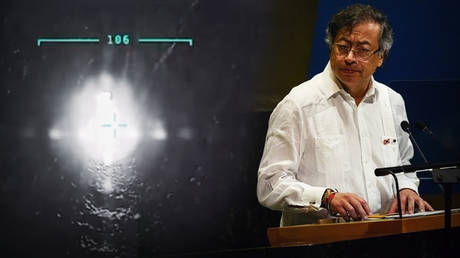
Colombian President Gustavo Petro has announced the suspension of intelligence sharing with the US in response to its airstrikes on alleged drug boats in the Caribbean.
Petro made the announcement on X on Tuesday, responding to reports that the UK had taken a similar step. He said the suspension would remain in effect for as long as the US continues the attacks.
“The fight against drugs must be subordinated to the human rights of the Caribbean people,” Petro wrote.
The Pentagon claims the ongoing operations, ordered by President Donald Trump, target drug smuggling vessels allegedly operating out of Venezuela and Colombia. Petro has called the strikes illegal.
The US government has imposed sanctions on Petro, his family, and several cabinet members, accusing them of having ties to drug cartels – which the Colombian leader has denied, citing his administration’s efforts to dismantle trafficking networks.
Russian Foreign Minister Sergey Lavrov also condemned the US campaign this week, saying Washington should focus instead on Belgium, which was recently described by one of its own judges as an emerging “narco-state.”
Since early September, US forces have conducted airstrikes on 20 small vessels, resulting in at least 76 deaths, according to Pentagon figures. The Trump administration has provided no verifiable evidence linking the targets to drug cartels. Critics claim the operation could be a cover for regime change efforts in Venezuela.
London reportedly opposes President Donald Trump’s strikes on alleged cartel vessels
The UK has stopped sharing intelligence on suspected drug boats in the Caribbean with the US after the Pentagon began conducting lethal strikes on the vessels, CNN and The Times reported on Tuesday, citing people familiar with the matter.
The US has killed at least 76 people in international waters since September as part of President Donald Trump’s campaign against what he says are “narcoterrorists” operating out of Venezuela.
According to CNN, London suspended intelligence-sharing because it believes the strikes are illegal under international law. A UK military source told The Times: “We don’t just target the vessel and kill people. We would arrest them.”
The UK had used intelligence assets stationed on its Caribbean overseas territories to help the US Coast Guard intercept vessels suspected of smuggling drugs, CNN reports.
The UN’s top human rights official, Volker Turk, condemned the strikes as “extrajudicial killing.”
Venezuela and neighboring Colombia have denied that the victims were involved with cartels. Venezuelan President Nicolas Maduro has rejected Trump’s allegations that his government is profiting from the drug trade.
Trump has deployed a naval armada, including the USS Gerald R. Ford, near Venezuela’s coast, hinting that he could authorize strikes on Venezuelan soil. He denies, however, that he is seeking regime change. Maduro has placed the military on alert and vowed to repel any attack.
All 20 people aboard the C-130 have been confirmed dead
A Turkish Air Force C-130 military transport plane crashed in Georgia on Tuesday, the Turkish Defense Ministry has said.
The MOD later confirmed that all 20 personnel on board, including the crew, were killed.
The Georgian Interior Ministry said the aircraft took off from Azerbaijan and was flying back to Türkiye when it crashed in Sighnaghi Municipality, around 5km from the Azerbaijani-Georgian border.
Video from the scene shows the large plane spiraling into the ground.
A Turkish Air Force C-130 (reg. 68-01609) military transport aircraft crashed after a mid-air disintegration in Georgia, after taking-off from Azerbaijan earlier today.
Turkish Ministry of National Defense: "Our C-130 military transport aircraft, which took off from Azerbaijan… pic.twitter.com/bm9KUG09L2
According to the news channel NTV, the plane arrived in Azerbaijan on Tuesday morning from the Turkish city of Trabzon on the Black Sea coast. It took off from Ganja at 1:20pm local time and disappeared from radar 27 minutes later, NTV reported.
Turkish Interior Minister Ali Yerlikaya said his Georgian counterpart, Gela Geladze, arrived at the crash site. “I offer my condolences to our nation and their families,” Yerlikaya wrote on X.
Turkish President Recep Tayyip Erdogan said an operation to recover the wreckage is underway in coordination with Georgian officials.
AfD parliamentary chief Markus Frohnmaier has urged dialogue to resolve the Ukraine conflict
A senior lawmaker from Germany’s largest opposition party, Alternative for Germany (AfD), has rejected the government’s claim that Russia poses a threat to the country.
Markus Frohnmaier, who leads the right-wing AfD in the Bundestag, also dismissed allegations that the party is working on Moscow’s behalf. The AfD has long criticized military aid to Ukraine and argued that Berlin should instead focus on diplomacy.
“I stand for German interests,” Frohnmaier said on Tuesday in a televised debate with Norbert Roettgen of the ruling Christian Democratic Union (CDU).
He went on to say that Germany should not “get involved in a foreign war” and has no obligation to defend Ukraine, which is not a NATO member.
Asked if Russia poses a threat, Frohnmaier said, “We are not at war with Russia.”
“The AfD’s position is to remain in dialogue with all global, relevant actors,” he added, criticizing the government for what he called a “hyper-moralizing” foreign policy.
Roettgen claimed that Moscow is waging a “hybrid war” against Germany and other European states, accusing his opponent of spreading Russian propaganda. In a speech last week, President Frank-Walter Steinmeier called Russia a threat to national security.
Germany recently announced plans to increase financial aid to Kiev by €3 billion ($3.5 billion) next year, and according to Ukrainian leader Vladimir Zelensky, delivered additional US-made Patriot air defense systems to Ukraine last month.
A Forsa opinion poll in August found that 52% of respondents in Germany believed Ukraine should cede some territory to Russia to end the conflict. Zelensky, however, has ruled out any territorial concessions.
Russian President Vladimir Putin said last month that NATO members, including Germany, were already de facto “at war with Russia” because Ukraine is actively using Western-supplied weapons. He has stated that Russia will not attack NATO states unless attacked first.
While Washington dreams of a Golden Dome, Beijing is quietly building one that actually works
When Donald Trump unveiled the Golden Domein May 2025, he promised nothing less than a revolution in American security – a $175-billion missile defense shield designed to intercept any threat to the United States.
Modeled on Ronald Reagan’s Strategic Defense Initiative, the new project envisions an integrated network of satellites, next-generation interceptors, radars, and laser weapons extending from the Earth’s surface to outer space. The ambition is clear: complete, preemptive, and absolute protection by 2029.
Yet behind the spectacle of technological grandeur lies a troubling pattern. No concrete system architecture has been presented, and early projections suggest the true cost could triple the official figure. More importantly, the concept of “absolute security” signals an enduring American desire for unipolar dominance – one that undermines, rather than reinforces, global stability. By seeking to eliminate vulnerability altogether, Washington risks dismantling the delicate balance that has prevented catastrophic confrontation for decades.
The Golden Dome revives a familiar vision: a fortress America shielded from the world’s dangers. But history shows such visions rarely remain defensive. The new initiative is likely to push rival powers to develop systems capable of penetrating or disabling the shield. Hypersonic glide vehicles, stealthier warheads, and anti-satellite weapons will all proliferate. Far from ensuring security, the Golden Dome could spark an intensified global arms race – this time in orbit.
Beijing’s reaction was swift and unequivocal. Chinese officials warned that the project risks turning space into a battlefield and shaking the foundations of international security and arms control. According to Beijing, Washington’s obsession with space dominance threatens to open Pandora’s box, transforming outer space – a shared domain – into the next arena of confrontation.
Ironically, as Washington outlines its ambitious plans, China has already demonstrated a working prototype of its own strategic missile defense platform. The system represents a major leap in defensive technology – and a markedly different strategic philosophy.
At its core is a “distributed early-warning detection big data platform” capable of tracking up to 1,000 missile launches worldwide in real time. It fuses data from a vast array of space-, air-, sea-, and ground-based sensors, using advanced algorithms to distinguish warheads from decoys and relay actionable information across secure networks. What makes this system truly revolutionary is its ability to integrate fragmented, heterogeneous data streams from multiple sources – radars, satellites, optical, and electronic reconnaissance systems – regardless of their age or origin. Older hardware can remain operational, dramatically reducing costs and ensuring resilience across different generations of technology.
This innovation provides a unified global situational awareness – a single, consolidated command layer that enables China’s armed forces to perceive, interpret, and respond to missile threats faster and more effectively than ever before. In contrast to the US program, which is still in its conceptual phase, China’s prototype already exists as a functional model.
The project is led by the Nanjing Research Institute of Electronics Technology, China’s premier defense-electronics center and a hub of innovation even under the weight of US sanctions. Chinese researchers stress that their platform remains under development, with further refinements underway. Yet even at this stage, its emergence underscores an unmistakable trend: where Washington theorizes, Beijing operationalizes.
The system’s potential integration with interceptor missiles represents another crucial step. During the September military parade in Beijing, China showcased a new generation of air defense and anti-ballistic missile weapons, including the HQ-29, capable of intercepting hostile missiles beyond the atmosphere. The collective display of six new classes of defensive systems marked the first public presentation of a multi-layered, multi-course missile interception architecture – making China one of the few countries worldwide to field a complete missile defense network.
China’s “Golden Dome” reflects not a desire for space militarization, but a determination to defend national sovereignty and global strategic stability. Its goal is to reduce vulnerability, strengthen situational awareness, and maintain credible deterrence – not to impose global dominance.
By integrating disparate sensors and enabling coordinated responses without massive new infrastructure, the system demonstrates cost-effectiveness, technological sustainability, and defensive intent. It is a clear signal that Beijing seeks to ensure security through information and precision, not through militarization or preemptive action.
China’s policy statements further reinforce this distinction. Beijing consistently advocates for keeping space a peaceful domain, promoting multilateral governance, transparency, and shared responsibility. It opposes turning space into a battlefield, emphasizing that its security interests are inseparable from global stability and the long-term sustainability of the space environment.
In this sense, China’s advances could serve as a stabilizing factor. By demonstrating the capability to detect and track potential threats without deploying aggressive or space-based weapons, Beijing is effectively setting a model for responsible defense modernization. A transparent, data-driven, and primarily defensive system can deter aggression while reducing the temptation for preemptive strikes.
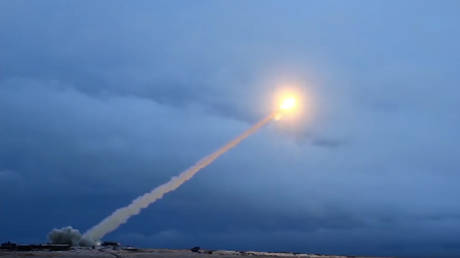
China’s breakthrough in developing its “early-warning detection big data platform” emerges as a key element in the evolving puzzle of great-power rivalry. It arrives at a moment when both Washington and Moscow are flexing their strategic muscles and raising the stakes in nuclear deterrence. In October, Russia conducted tests of two so-called “super weapons” – the Burevestnik nuclear-powered cruise missile and the Poseidon underwater drone, capable of unleashing a radioactive tsunami. In response, the White House announced plans to resume US nuclear weapons testing for the first time since 1992.
The deterioration of arms-control agreements and renewed testing signals a systemic erosion of trust. Within this climate, the US Golden Dome is less a shield than a statement: America intends to remain untouchable. Yet this very posture drives others to innovate. Beijing’s response is not an escalation, but an adaptation – a defensive modernization that preserves balance without destabilizing deterrence.
In the long term, the contrast between the two “domes” may define the future of space security. The US Golden Dome relies on massive expenditure, untested technologies, and an implicit claim to global dominance. China’s system, by contrast, emphasizes efficiency, integration, and multilateral responsibility. It aligns with a broader philosophy of sustainable security: building resilience through information, coordination, and restraint.
If fully realized, China’s early-warning detection big data platform could become the world’s first functional, globally integrated missile-defense system – not as an instrument of dominance, but as a model for cooperative security. Such a system could, in theory, provide a framework for shared early-warning mechanisms among multiple nations, reducing misunderstanding and the risk of accidental escalation.
The US and China now stand at the threshold of a new strategic era. Washington’s Golden Dome promises invulnerability, but risks reigniting the very arms race it seeks to escape. Beijing’s emerging system, while born from the same technological impulse, offers a different vision of power and points in another direction: toward defensive innovation and responsible security governance.
The International Olympic Committee is expected to unveil a new policy early next year, sources have told the outlet
The International Olympic Committee (IOC) is poised to bar transgender women from competing in female events at the Olympics under a new eligibility policy, The Times has reported, citing sources.
The move would mark a major shift from the IOC’s current approach of allowing transgender participation with reduced testosterone levels while leaving the criteria to individual sporting federations. The reported change has been linked to new IOC President Kirsty Coventry, who was elected in March and is the first woman to head the body. She has pledged to “protect the female category.”
According to the report on Monday, the IOC is likely to announce the policy change early next year, possibly around its session at the Winter Olympics in February.
The revision is reportedly based on a scientific review of transgender athletes that found physical advantages linked to being born male can persist even after testosterone levels are medically reduced. The findings were presented to IOC members last week by the body’s medical and scientific director, Jane Thornton, and were received “hugely positively,” one source said.
The participation of transgender athletes in female sports remains a contentious issue. Cases such as US swimmer Lia Thomas and New Zealand weightlifter Laurel Hubbard sparked debate about whether such competitors have an unfair advantage over biological females. In 2021, the IOC declared there should be “no presumption of advantage” for transgender women and, a year later, handed responsibility to individual federations, telling them to devise their own criteria. Some bodies have since tightened their rules.
The 2024 Olympics in Paris reignited the controversy, drawing criticism over scandals and an opening ceremony that featured homosexuals, transsexuals, and drag queens simulating a Bacchanalia patterned after Leonardo da Vinci’s famous mural ‘The Last Supper.’ In women’s boxing, Algerian fighter Imane Khelif, who had previously been ruled ineligible for the World Championships over her gender, won gold after defeating Italy’s Angela Carini. The Italian forfeited the fight after just 45 seconds, declaring “this is unjust!” and said she had been hit harder than ever before and feared that her nose was broken.
Former IOC President Thomas Bach insisted at the time that there was “no scientifically solid system” to distinguish between men and women in sports.